Monday, June 29, 2020

Aran Tea Thai "Assam," compared to an Assam version


Assam Teehaus version left, Aran Thai "Assam" right


both used nice multi-layer packaging, and graphic stickers (not that such branding helps the tea)


I'm comparison tasting a Thai version of Assam along with an Assam version; that seemed a good way to establish a baseline.  I really liked the Thai sheng version from Aran (reviewed here); it just seemed a bit like green tea to me, in between type categories in style.  This struck me as quite close to an orthodox Assam, when trying it a week before doing a review, with this comparison filling in just how similar.  The outcome:  quite similar.

The Assam Teehaus product was a version that Maddhurjya Gogoi sent me last year.  His teas are pretty far up the scale for as good as orthodox Assam gets.  I think maybe versions from Oiirabot and Lautimi, sold by Tea Leaf Theory, might have matched my preferences just a little better, but that may have just related to being that much closer to Chinese tea versions in style, not to actually being better.  Dian Hong, Yunnan black tea, is a personal favorite, and tea really close to that in character might seem better to me, versus that actually relating to some objective improvement in quality.


meeting Maddhurjya (second from right) along with Sasha and Kittichai two years ago


I reviewed those Assam Teehaus versions here.   Comparing the label that version he had described as a "blended Assam orthodox."  From that review it sounded like I liked the other version slightly better, that a citrus aspect worked better for me than a more pronounced aromatic spice aspect.

For anyone into reviewing other range further this review from last year covered that Oiirabot version I mentioned,  and the Tea Leaf Theory Latumoni producer version.  Really good Assam is out there, there just can't be that many producers' versions on the level of all these.


Review:


Assam Teehaus version left, Aran Thai version right (in all photos)


I'll describe the Assam version--the one from Assam, India--first, since I'm using it as a baseline.


Maddhurjya's Assam (Assam Teehaus):  I didn't let this brew for long so it's a bit light.  The flavor is nice, complex and balanced, earthy with good sweetness.  Distilling that to a list will go better next round.  Some fruit and a hint of spice indicate it will show even better complexity as it evolves.


Aran Thai Assam version:  hard to evaluate in comparison for both being so light this early but this holds its own.  It's clean and full flavored, with some decent feel kicking in already, even though it's not fully wetted yet.  It's not so far off the other in character; more on that as a listing next infusion.


I tried to back off the proportion just a little from what I usually use to brew teas Gongfu style but in the end this was essentially that; the amount that would all but fill a gaiwan once the leaves saturated.  Too much tea to drink in one go too, especially since I just had some fruit with breakfast (fresh mango and banana with yogurt, a personal favorite), and drinking loads of Assam along with that doesn't work well.  Pastry stands up to lots of tea input better, or breakfast cereal.


Second infusion:
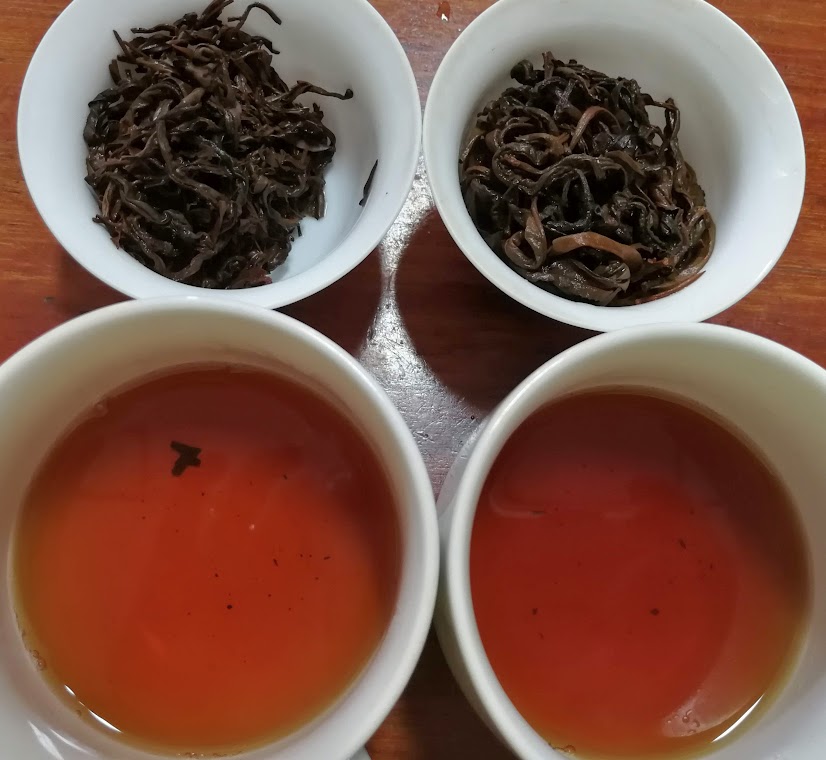


Assam Teehaus:  that is nice.  Warm sweetness kicks in, with lots of flavor complexity.  There is malt but it's relatively subdued compared to the level in a lot of Assam versions, that main-aspect, dry-feel related form.  Beyond the malt some molasses sweetness adds a dimension, and warm tones like aromatic wood or even mild spice contribute.

It would be possible to interpret some flavor as dried fruit, towards dried tamarind, but it's not pronounced, so it would be just as natural to leave that off a list.  I don't see it as floral but that also wouldn't be an unreasonable interpretation, along the line of rose petal.


Aran tea Thai version:  this experience overlaps a good bit with the other tea, more than I expected.  That malt is so subdued in this, and slightly different in form, that it stands out as a difference, but it is still common space, to a limited extent.  Complexity is on a similar level but the flavor range is different.  This leans more towards aromatic wood, or even cured leather.  That could easily be musty, but in this version expression it's quite clean.  It also hints towards a good bit of other range, the floral, towards warm and sweet dried fruit.  A little more dark wood tone seems to show through in this.

In tasting each back and forth the first (Assam Teehaus version) tastes more like dried cherry than it had without that direct comparison, a deep, rich flavor, more into fruit range than the other extends.  The feel for both is nice, and the way there is some pleasant depth of structure to them, but they're just soft and full, not astringent at all.  Even aftertaste range adds just a little depth to both, just not so much compared to how that often goes for oolongs and sheng.


Third infusion:


Assam Teehaus:  a warm aspect seems to bump up a bit, towards spice, but it's a little non-distinct.  The rest is similar, maybe just shifted a bit in aspect range.

This is pretty good tea, quite far up the scale of how Assams go.  Tea blog reviews tend to be about making minor distinctions, and that's what's going on here.  There's a good chance that I like this tea better than I did in the original review for brewing it Gongfu style instead.  For a lot of black teas it kind of doesn't matter, but for better quality versions being able to adjust outcome a little round to round, and experiencing the minor transitions, really can be more positive.


Aran tea:  similar; this is picking up a bit of depth too.  Given that I'm infusing both without using a timer that could also be it, a shift in brewing time.  Or maybe that's just how it would go for a tea like these being infused for around 1 1/2 minutes previously, where they would tend to be in a cycle.

Tasting one after the other the first (Maddhurjya's) is slightly sweeter and brighter, and the second (Thai version) a little heavier on dark wood tone, but again they are a lot closer than I remembered from the first try.  I tend to not frame interpretation as a clear "how good" judgement since that's just subjective, tied to preference, versus trying to communicate details of the experience, but both are good.


Fourth infusion:


I'll let these go longer to check on that effect, and probably let this drop after.  These will brew a couple of additional rounds, for sure, maybe even another three or four, but the point here is comparison, not adding every last detail.


Assam Teehaus:  more of the same, if anything slightly better, smooth, sweet, rich, and complex.  This tea really is better than I remember it last year.  Maybe it improved with age, or maybe brewing it this way worked out better than trying it prepared Western style in the first review.  Or other subjective differences always come into play, how I feel on any given day.

This house is a little chaotic this morning, making it hard to generate long aspect lists.  It would seem odd if that translated to liking the teas better, a slightly higher degree of background noise, but I guess you never know.


those noise-makers with cousins on a recent trip (mine are in the center)


Aran Thai black tea:  side by side differences stand out but tasted a week apart these could seem relatively identical.  The Assam version is slightly sweeter, a little towards dried cherry fruit versus dark wood tone, but they overlap more than they are different.

Both are good.  For the Assam I'd expect that; Maddhurjya has been working at making better and better Assam versions for a few years.  It's odd that a Thai producer could get so close to that in outcome.  Again I think there may still be just a little room for improvement related to the absolute best Assam versions I've tried, but these are definitely very pleasant.


I think the posing is about looking fabulous


Conclusions:


Really good tea!  The Aran Thai version, I mean; the Assam Teehaus I liked slightly better but both were quite good.  In terms of value this tea is more than worth the modest pricing that I paid for it.

It works on so many levels; this style of tea is forgiving related to how you prepare it, with relatively little astringency to brew around.  Brewed very light the intense flavor still comes across, and relatively strong still works, although some sort of medium is best.  I suppose you could even add milk to this, although it seems better to adjust your preference to appreciate how it doesn't need it, and wouldn't be improved by that.  Brewed at really high infusion strength it would probably be great with vanilla ice cream, at the risk of disrespecting the tea.

This mentioned that I like this style best prepared Gongfu style, but really using a Western approach is fine.  For lacking much astringency it would also work made "grandpa style," brewed in a tea bottle, and drank without separating the leaves back out, adding more water for a second or third round.  That's a great way to bring tea for car travel; carrying a half-liter thermos along even gets you that next round without running across hot water somewhere.

I just tried that with the Aran green tea version yesterday (at time of editing this post), and it worked well, it was just a little bitter.


on a road trip way back when


Saturday, June 27, 2020

2003 Dayi / Taetea 7542 sheng (Sheng Olympiad sample)


that white part doesn't seem ideal; it was less apparent just looking at it but noticeable 


I'm trying a second sample from the 2020 Sheng Olympiad sheng tasting set from Liquid Proust.  The first version I tried, a 2005 Xiaguan "wild" sheng, was really interesting and pleasant.  This is a classic tea version that I won't say much more about; I've reviewed versions of it before, and those posts would go through what the tea version is about.  It's used as a benchmark of sorts, as a consistent version others can be compared against.

Andrew Richardson's description (the tea enthusiast / vendor who runs this shop and set offering):


~15g of 2003 7542 from Dayi: I'll let you all go research about the 7542 blend and Dayi, but I'll say one thing about this... I'm incredibly thankful to even have the opportunity to offer this to everyone let alone do it at a price that you couldn't even tell was added to the whole set. Oh, and I need to mention these are Hong Kong stored.


Sounds good.  It goes without saying that "Hong Kong stored" tends to be used as just one thing, as if every tea stored in Hong Kong is going to experience a similar environment, when in practice that would really vary.  Micro-climate in different places varies, humidity and temperature, and issues like airflow change things, along with those other two main parameters.  There's no reason a storage environment couldn't even control the humidity level, adjust that, but Hong Kong is said to offer pretty good natural conditions for sheng storage.


eating really delicious noodles in Hong Kong last April


it felt cold to me, being from Bangkok, but this rainy day speaks to how it can be humid


paying respect to a Guan Yin statue


Review:  


First infusion:  plenty of wet slate / damp basement / cement block aspect range; I would imagine that's almost entirely storage related, and will fade, at least some.  This could pass for Liu Bao.  It's hard to get a read on what is going on beyond that.  It seems fine, not ruined by the relative mustiness, clean beyond that one dominant tone.  This will surely still be clearing out next round but I'll move onto trying it then.


Second infusion:  I went a little long on infusion time to get that initial transition moving, around 15 seconds, even though right between 5 and 10 would probably be enough.  It still tastes like Liu Bao but like a much cleaner, more aged, later-infusion round version of one.  The next round will really show where this is going better, but I'll describe this one too.  Old furniture flavor picks up; the wet slate / cement block range is giving way to that.  Sweetness bumps a little, a faint hint of molasses, maybe closer to Chinese date (jujube). 

Feel is decent; it's clean with a bit of fullness.  The lower quality older sheng I've tried tends to narrow down to a limited flavor range and lose feel fullness altogether.  Aftertaste length / duration is fine, but it will probably carry over a more pleasant range within a couple of rounds.


Third infusion:   this infused for a bit under 10 seconds, plenty of time for this proportion (backed off how I normally brew sheng, so just in a more conventional range for most of everyone else).  There is still some wet slate to this, but now it's balanced more evenly with the aged furniture, more complex for including the other less pronounced dried fruit range.  A deeper flavor edge resembles a bit of char, actual charcoal flavor. 

I get the sense that some part of all this could relate to what people tend to call camphor, but I don't.  Actual camphor is closer to what Vicks Vapo-rub smells like; this isn't that.  All of these other flavors do have an odd combined effect, and the feel is hard to describe.  I suppose it could be interpreted a bit towards aromatic, in the sense that furniture polish is that way, which would be related but different oil compounds.

This overlaps a little with the three aged CNNP cakes that I have (or whatever those really are; CNNP versions are said to be inconsistent in origin at best, and buying some of them from local Chinatown sources throws that consistency off even more).  It comes across as cleaner for having had a lot of that experience; those really can emphasize the damp basement range in different ways. 

Humid and hot Bangkok storage can be too much; it seems critical to allow the teas to have some limited air exposure, and if you just throw the in a sealed space for a decade they come out really musty.  Some of that can clear up after half a year of more air exposure but to some extent it's also a permanent change.


Fourth infusion:  the lower infusion levels people tend to describe using make sense related to how intense this tea is; it's brewing a bit strong at 7 to 8 seconds infusion time.  Cutting proportion back just a little would help with dialing lighter infusion strengths in.  At least there are no negative aspects to "brew around;" this would work at different infusion strengths.

It's nice, just at a slightly different balance of the same aspects.  It cleans up further, and the aged furniture and dried fruit range picks up a little.  It will probably just keep that up for another ten rounds or so, changing more at the end related to how extending infusion times to keep intensity up changes effect.  It's nice; standard enough range aged sheng, as it should be.  That balance of Chinese date / jujube flavor is nice, hinting just a little towards real black licorice.

I suppose the effect could be relatively different depending on the storage input, swapping out some of this depth and aspects that needed to clear off for a bit less fermentation-developed range if it had been stored dryer.  Given how musty older teas stored here in Bangkok could be, and how Malaysian storage examples have worked out, to me this tastes like a more moderate range natural storage version.  But then what do I know.


Fifth infusion:  even cleaner; this starts into more of an aromatic bark spice range, frankincense or something such.  I brewed this round slightly faster, maybe 6 seconds instead of 8, and to me that's plenty for this proportion.  Brewed this light it's also easier to pick up the now-faint trace of mustiness, since separating flavor range works better at a lighter infusion strength level, but it all works well.  I'll let the next round go just over 10 seconds to see how that shifts things.  The feel depth will increase a good bit, and experienced flavor range should shift.

Aftertaste experience is still nice, it's just moderate related to how that tends to go for other tea character range.  Feel fullness and creaminess is also fine but moderate in comparison with some other aged sheng range.  Since I appreciate flavor as much as the other aspects, and pleasant balance of all character range most, it's fine for me.


Sixth infusion:  brewed even slightly longer--ok, twice as long, but still a moderate timing--the touch of char comes out a lot more.  That effect tends to stand out even more after a dozen infusions or so.  It's pleasant how the aged furniture range comes across so strong in this.  Aftertaste experience does increase, of course, and feel fullness, which gains a trace of structure, along with the prior non-distinct fullness.  Complexity is pleasant, the way all the flavors and other aspects I keep mentioning combine.  There is room for improvement across a lot of the range but it's good.


Seventh infusion:  I'll let this go after this round, off to do the first yoga class I'll be back to after a 3 or 4 month break for the pandemic.  I don't love the experience of doing yoga but at my age it helps to stay a bit flexible.  There's more of a physical-health story to be told about a knee problem I've been dealing with, about how I took most of that time off running, and am only 5 runs or so back into it, but I'll close this with some more thoughts about this tea instead.

It's fine; not different than last round.  I drink teas a lot like this whenever I feel like that having experience, but CNNP versions instead.  The Tulin tuochas I have that are a couple years younger are not that far behind this fermentation level, well along related to that process, but the character is quite different.  I guess it's about what I expected.


Conclusions:


I drank a few more infusions and it only seemed to be fading.  Some aged cardboard seemed to pick up as extending infusion times changed the flavor profile (where more often that's a touch of char that increases instead).  I liked the tea, it was an interesting experience, it just wasn't all that different or better than the aged versions I have on hand, which never seemed all that exceptional to me, but are pleasant.

I suspect that storage wasn't an ideal input for this tea version.  The touch of white in the photo, and evident from appearance, didn't make me too nervous, but then I wouldn't want to drink a cake worth of tea I was concerned about, versus not worrying as much about a sample.  The taste seemed to indicate that fermentation went a bit far, or was in a less than ideal form. 

All that can be a real balancing act, and what is ideal definitely could vary by preference.  If someone wanted to try a tea that's essentially completely finished fermenting, as this seemed to be, then either trying a 30 year old version or trying a tea that was stored on the more humid side would lead to that.  It's not as if that's a linear sort of scale; more or less humid conditions, and to some extent also temperature and air contact as inputs, would lead to different outcomes.


On a different subject, that of personal context related to trying aged sheng versions, I've ran into a roadblock in terms of trying better teas related to budget limitations.  Using a sampling strategy offsets that, but then instead of having moderate priced and quality cakes around to keep drinking as they age you've got 20 gram samples, which will be gone soon enough.  It really helps having a good bit of budget depth for exploring above average aged sheng.  Sample sets like this are nice; you might not love some of the versions for your own reasons, or some could really stand out related to what else is out there, or not match up well, but still you get to try different things.

For standard factory teas like this I could buy relatively inexpensive tongs of new versions and then wait a dozen years or so; that strategy is a gap in my current approach.  Having "only" 10 or so kilos of tea around already has my wife convinced that I own more tea than I'll ever drink, even though it's not that much.  Much better sourcing and networking is another alternative; two different online friends have mentioned buying through Taiwanese sources that sell for much lower pricing than standard Western outlets like Yunnan Sourcing.  That would involve some learning curve, and failures, probably ideally supported by basing it off what one of those friends are already doing.

For now I'm ok with drinking a good bit of younger sheng, and buying only slightly aged versions from outlets like the Chawang Shop, cutting the waiting time from a dozen years to more like half that.  Sample sets and running across versions in different ways fills in depth of experience.  I should be part of a local tea enthusiast network; that would help.  More will follow soon enough about a step towards that.


from the day after the last photo; he gave up his pandemic look


Thursday, June 25, 2020

Aran Tea Thailand produced sheng (pu'er-like tea)


An online contact mentioned producing Thai versions of Assam black tea and sheng (pu'er-like tea) in the International Tea Talk group that I admin for.

That's most of it for background.  They have a Facebook page, which would show some pictures and add a few product details, and would work for contact.


one of those Thai tea producers (credit their FB page)


I usually mention when vendors provide samples for review so I guess that I might add that I bought these teas, 100 grams of each, for a reasonable price, the standard range here in Thailand.  I'm not opposed to buying some tea, I just don't have budget to try a little of everything, so it's nice when some vendors help out with that.  The review will be the same; I'll say what I really think.

I've already tried the Assam (variety Assamica based black tea made in an Assam style, which kind of goes without saying) but starting with the sheng still makes sense, since I've been more on that page for a couple of years.  I've tried enough Assam in the past year to place the other tea against the best range of versions (I think), but maybe I'll do a comparison review post anyway, since it's interesting trying similar teas side by side.

It's strange skipping past the requisite claims about this being from ancient trees, wild grown, pesticide-free, and so on.  It probably is all that, although photos from their Facebook page show seems to show plants of different ages growing under different conditions.  It's as well to just judge the character anyway.  From the dry tea scent, which is rich, sweet, and complex, this will be pretty good.  The color is a bit dark; it will be interesting to see what that ties to in terms of wetted leaf appearance and brewed tea aspects.


Review:


First infusion:  this leans a little towards green tea character, a slight vegetal edge, and other parts it would be hard to completely describe, part of the feel.  That's not to say that "they've got sheng wrong," character can vary a lot for those, and it's impossible to identify related aging potential based on the first sip.  It tastes like an exceptionally good green tea, well balanced, very fresh, not astringent, with good sweetness, and complex.

The vegetal range is towards fresh green beans.  I think a lot of people would prefer this to even a very good sheng, if they just weren't on that sheng page.  Someone looking for sheng who doesn't like green tea wouldn't care for it.


Second infusion:  still mostly very fresh green beans.  A hint of bitterness is more into sheng range, but it splits the difference, between the two, to be honest closer to green tea in style.

It's the fresh and sweet version of green beans, prior to any cooking, nothing like frozen or canned types.  Ordinarily if I reviewed a sheng that tasted like vegetable the description would be more negative, but I do kind of like this tea.  I say over and over that green tea is my least favorite main type, and that's true, but I have tried some versions that work as exceptions.  One Thai version from Tea Side, a steamed green tea, was a good example of that.  I usually buy Longjing once a spring (a main Chinese type, a pan-fried flat leaf produced version), I just haven't got around to that yet this year.


that Tea Side sheng and green tea comparison (sheng left)


those dry teas (sheng left, green tea right)


Third infusion:  not transitioning so much.  It may not, since green teas tend to less.

It's obvious enough but sheng and green tea are two of the most closely related types.  Green tea is heated to stop enzymes from reacting to oxidize the tea, and sheng is just heated slightly less, leaving those compounds more active to enable aging transition.  Or so the general story goes, and also the actual reality.

This has pleasant character and good complexity.  It's bright and clean, and complex, with plenty of sweetness.  I'm not sure how it would age given the aspect range it's in, but it's fine as it is now, so maybe as well to not even check on that.

They sell cakes as well, compressed versions, and that complicates things a little.  This probably would still be quite pleasant in a year or two but I'm not sure it would improve.  It's conceivable that it could work for long-term aging, it just lacks the aspects I see as markers for what does commonly improve through that sort of transition (sheng fermentation).  Some degree of bitterness is a good sign, and a characteristic type of astringency, a structure to the tea. This has a touch of bitterness and a little dryness, rounding out a generally smooth and slightly full feel, but it's not in that other range.

To be clear on placing it this would be one of the two best Thai green teas I've ever tried, along with that Tea Side version.


Fourth infusion:  the feel and flavor are both gaining a little depth; if anything it's improving.  The aspect range is still quite similar though.  Floral range is a good interpretation of a lot of the sweet character; I've not mentioned that yet, and it's transitioning to play more of a role, to stand out most.  The "green bean" stood out more for being atypical, but floral range is stronger, a more dominant aspect.  The way that a bit of astringency and vegetal range pairs with a warm, sweet floral tone it reminds me of dandelions.

In the past I would sometimes use longer or shorter infusions to try a tea in a different way, to highlight some of the aspect range both can emphasize.  I'll try a longer infusion to check on that next round, increased from around 15 seconds up to 30 instead.


Fifth infusion:  that feel edge does ramp up a good bit; brewed for twice as long as this (for closer to a minute, at a high infusion proportion) this would be a bit harsh.  It's still pleasant like this; the feel still works well.  That feel is just as close to green tea as to sheng, or maybe slightly closer.

The sweetness, freshness, and pronounced cleanness make this tea work well.  Green tea can span a lot of range that doesn't work quite as well:  odd astringency, harshness, "straight grass," kale and other cooked vegetable range.  Again, this seems in between green tea and sheng range to me, just closer to green.

I'll leave off there; it's not transitioning much, so filling in how the next half-dozen infusions go won't add much.  It should be less positive towards the end, picking up other flavor range that doesn't work as well, or dropping out some of the positive intensity.


Conclusions


It's hard to place what it means when a sheng seems more like green tea.  I actually liked the tea; there's that.  I wouldn't expect it to age well, but then who knows, maybe after three years it would be even better, and after 15 just amazing.  Seems doubtful, but maybe.

On positive character alone this is quite pleasant.  It would be very difficult to buy a better Thai green tea than this; I've only ever tried that one version on this level.  Value is good; it's quite good tea for what I paid for it, or really just quite pleasant in general, and also an exceptional value.  Things seem to shift a little in relation to buying a cake of this (they also sell it compressed), since more or less drinking straight through that would seem advisable, versus waiting to see how it changes.

All of this is just one person's take; someone else might well try this and see it all very differently.  Others could enjoy it less if they don't care for this aspect range, and the judgment about type designation and aging potential might also vary.