Showing posts with label Teehaus. Show all posts

Sunday, August 6, 2023

Specialty whole-leaf Assam from Maddhurjya


Maddhurjya Gogoi, a tea producing friend in Assam, recently sent me some tea to try and review.  It's been awhile since I've tried Assam on this level, or any Assam, really.  I've been through a few cycles of checking out teas from there, so the range is familiar, but I've been mostly on sheng pu'er for a number of years now.  I've already tried this tea, before tasting it to write review notes, so I know how it works out; it's pretty good, as I would've expected.

I met Maddhurjya on a visit here once before; he's such a nice guy.  Their tea production theme and philosophy is a familiar one, moving to create much better quality, organically produced teas from plants that were producing more ordinary versions earlier on.  They've been at it awhile, allowing time for experimenting with different processing techniques, changing processing equipment use (much earlier on), or even changing plant type inputs.  We didn't discuss all that again; this will just be about the tea.


Maddhurjya is second from right, beside Kittichai, the Jip Eu shop owner


The packaging mentions a number of branding and company names; it's described as Lu Ma Whole Leaf Assam Orthodox, Hand Crafted Black Tea, from MG TE, produced by Chah Bari, operated by Gogoi and Sons, under Assam Teehaus.  The last one is familiar.  They're in Dabohibil Village (Assam, of course).


In the past their tea versions have held their own against any other highest quality Assam I've tried.  Next one might wonder about placing that in relation to Darjeeling, or Chinese teas, or from elsewhere.  Assam is interesting and novel for including a variation of maltiness that comes across much differently in whole-leaf, higher quality versions than in relatively ground leaf tea forms.  The astringency drops out almost completely, reduced to a fullness of mouthfeel effect, so that flavor input stands alone more, combined with better sweetness and other range.  Flavors tend to include dried fruit along with a mineral undertone base.

I've still not covered if the quality level or general appeal can match that of good black tea elsewhere.  Style and aspect variations stand out more than quality level, which varies within any kinds of categories.  To me it's fair to either associate or separate whole-leaf tea production from other quality inputs, depending on what you mean, how you want to use that umbrella term (quality).  Broken leaf tea tends to not be as good as whole leaf versions, although there would be plenty of exceptions to that on both ends, just amazing broken or cut up leaf tea (like most tea from Japan, for example), or plenty of whole leaf versions that just aren't that good. 

Beyond that, comparing like for like, more whole leaf versions from Assam versus Darjeeling, China, Taiwan, Thailand, or wherever else, quality can vary, but in general aspects shift by local plant type, growing conditions, and processing inputs, more than some from a location tends to be better or worse (as represented by the best versions, of course).  Darjeeling doesn't express the same flavor range, or as much intensity (at least in one sense), but refined and very pronounced fruit flavors with good sweetness can stand out more.  Nepal teas can be fantastic in a different way, maybe a little closer to Darjeeling in character, but also just their own thing.

This tea description will help place all that.  I'll brew it Gongfu style, which is a normal approach for me for higher quality, whole leaf black teas.  Water is not far off boiling, and proportion higher than most people would use, probably 7 grams for a 100 ml gaiwan, brewing in less water than that, since that measurement tends to relate to the volume to the top, not how much you use.


Review:


First infusion:  malt hits you first; the usual.  Of course it's a soft and mild version of malt, not the type with a bit of edge, that seems to somehow pair with the astringency.  The depth of this tea is nice, the way layers of aspects combine to provide a really complex experience.  Warm mineral tones seem to support it as a base, but there is range one might interpret as either aromatic tropical wood or spice.  Mind you this tea is just getting started; it's not even fully wetted yet.

Fruit isn't as pronounced, at least yet, but one part tastes a little like dried tamarind.  Even though this first round is brewed a little light the feel is already rich and full, and aftertaste lingers on.  It's hard to describe why that matters in tea experience; how it supports a more complete experience.  The tea drinking experience can seem more limited without those extra dimensions, as a quick flash of a few positive flavors, versus an experience of more depth, when they're present (fuller feel and aftertaste).

I just reviewed two Chinese oolong versions, presented as being two different quality levels by the vendor, or at least that was implied in a cost difference.  A Tie Guan Yin version didn't include any more aftertaste experience than this, even though usually that's more noteworthy in that range of oolongs than in good Indian black teas, and then the other, a Dan Cong, compared more favorably.  


some color difference is from inconsistent camera settings, which I'm not editing to correct


Second infusion:  depth picks up, which wasn't exactly a limitation that first round.  What I'm describing as warm mineral tones, working as a base, combined with dark tropical wood or spice range, similarly more a context background than forward element, really needs even more unpacking, but I'm not sure if I can add a list of extra descriptions or concepts to help with that.  It's interesting how really good Darjeeling can seem to dazzle you with a complex range of pronounced, higher end fruit and floral tones, with pleasant deeper range supporting and balancing that, along with great sweetness, and then this is the opposite; the depth itself stands out.  The higher end might be drifting some to a warm dried citrus peel aspect, with dried tamarind fruit still present, but not overly pronounced.  Then that deeper range is more complex and intense.


I hadn't really thought of all this in those terms before but this may relate to what I love so much about Dian Hong, Yunnan black tea, that it covers both ranges equally.  Some versions can have a nice forward aspect, with less base, and it's more common for others to include a lot of warmer, deeper structure, mineral tones, mild and deep fruit elements, earthy range, etc., missing balance in what I'm describing spatially as a high end.  But often it just balances.  The different flavor range of roasted yam, roasted sweet potato, cacao, and mild spice is well suited for expression as pronounced aspects and deeper tones.


Back to this version, it's not unbalanced, because sweetness and lighter flavors are also present.  But one more cacao element, a touch of raisin, or a little extra other fruit or spice would balance it to expressing forward notes just as much as depth.  Often the more forward aspects can fade while depth picks up over rounds; it will be interesting to see how this changes in relation to that, if the deeper tones really dominate more later, or if the opposite somehow occurs.


third infusion:  the more forward flavor aspects transitioning round to round offsets some of the pattern I'm describing here, the depth standing out more.  There is still a faint edge of warm dried citrus in this, and more that relates to something like dried tamarind (more to place that range; it might differ slightly from that), but more of an autumn leaf tone is picking up, a sweetness and richness across an unusual vegetal range, that's really in between fruit and vegetal ranges.


Permit me a tangent about fallen leaves; the scent of tropical tree and plant leaves is much different than the range of those I experienced living in places like Pennsylvania and Colorado.  PA had deep and rich, very complex, tree vegetation range, so the fragrance of walking in the woods in the fall, or even spring and summer, was very layered and complex.  It's drier and less heavily forested in the high mountains in Colorado, so more spice-like, subtle, lighter fallen leaf scents would stand out.  Since you adjust to the scent range you happen to be in, just as your eyes can relate equally well to a broad range of light levels, to some extent all this would become transparent, just the intensity range you're within just then.  

The tropics are something else.  Vegetation has a sweeter, more floral oriented scent range.  It gives up the depth of a heavier, richer PA forest tone, and doesn't settle on the same lighter, almost spice-like range of CO forests, but in one sense fragrance is much more pronounced.  Sweeping the leaves in the driveway almost makes you want to brew that and try it out.  Some of that is from a range of types of flowers thriving at different times, or aromatic components of trees covering more range.  Back in Hawaii that tied to seed pods seemingly related to tamarind or other fruits, but here in Bangkok the gardens at the house grow dozens of kinds of plants, papaya, banana, lime, and mango, flowering vines, palms, basil, and so on.  

The depth of this tea ties to all that; in a sense it might be a mix of layers of tones that comes across as a base due to the diversity, since it's not that 3 or 4 of those stands out to seem more forward.


fourth infusion:  I brewed this a little lighter, not varying infusion time to see how results vary, but it did work out like that.  Brewed light the lighter flavors stand out more, and the warmer depth is less pronounced.  I think this is more in line with how a lot of people brew most Chinese teas, to try to be clear.  Intensity is still fine, but it would be easy for someone acclimated to mild black tea to like theirs brewed stronger.  

Getting back to a flavor-list approach a round later might help keep this reading length in check, and describe transition patterns better.  I'll get back to a 20-some second infusion time next round, brewing it on the stronger side again, since that works better as an experiential optimum for me.


fifth infusion:  fruit range seemed to shift the most.  What had been dried tamarind with some dried citrus peel might have transitioned a little towards plum.  Of course heavier flavors picked up too, from increasing brewed strength, back to warm mineral tone standing out.  

I'm not mentioning malt so much, for starting out by saying that's the main flavor aspect, right?  It's there too, but it settles into more of a mid-range background context; all the rest stands out in relation to malt.  Malt in CTC Assam seems to link to very dry flavor and astringent feel range, to astringency experience, and that's not present in that form here, since this has good feel structure but not that kind of edge.  Here it's a little more like malted milk ball range, or the malt that gets added to a milkshake (not often enough; I miss that from my childhood), or in Ovaltine.  That blends in better than the stronger and harsher variation; it's easier to almost miss it as one part that integrates with the rest.


sixth infusion:  probably a good place to leave off; this is long enough, and it won't be as interesting a story how this fades over the next half dozen rounds.  For brewing it strong it won't make it far past a dozen infusions.  The more forward, higher end range is definitely not dropping out; there is plenty of fruit left in this, and other more vague but complex aromatic range.  


Conclusions:


This is a really solid, high quality tea.  In terms of a general quality level I don't think this is giving up much to other black teas anywhere.  Flavor range and other character is different, varying naturally along with a range of inputs, but it's "as good" as any other black tea I've tried.  

That's a real accomplishment; it can drop into the background as a natural outcome, that of course any tea can be really good.  But so many inputs had to be controlled to go just right for that to happen.  The tea plants themselves, growing conditions, processing choices, processing equipment used, storage conditions; it all had to go really well.  Weather had to contribute positively; it's not as if all the conditions were something producers can control.  Maddhurjya and his family did a great job.

There is always going to be one more version out there that's distinctive in some other way, or finer and finer quality level steps to climb.  I'm not trying to say that this is the best possible orthodox Assam that could reach the market.  It's pretty far up the scale; interesting, distinctive, balanced, and refined, lacking any noticeable flaws.  

Sometimes I'll mention that pricing relates to the assumed quality level, that teas can be presented as one thing or another, like a Tie Guan Yin oolong version being sold as upper medium range, or a Dan Cong oolong selling as a similar thing, implied as better since the standard type quality range doesn't match directly, the scale of typical offerings.  I don't keep up with how higher quality Assam maps out, or how many alternatives would be anything like this, or some even better (there always is more range).  I suspect that awareness and demand for teas anything like this in both Indian and international markets is still limited, with the same being true in very different senses for Darjeeling, better Nepal versions, good Chinese black tea, and so on.  For whatever reason sheng pu'er awareness and demand "blew up," just in a very limited sense, and oolongs have always been a favorite category of many.  

Someday maybe specialty tea will have its moment, or maybe it will always be a niche interest.  Either way in the meantime this is a good example of what most people are missing out on.  That's too bad but not so bad, given how good Darjeeling and Chinese black teas, and the rest, all are in their own ways.


the last time I saw these guys, just a few days ago, with more separation to follow


Monday, June 29, 2020

Aran Tea Thai "Assam," compared to an Assam version


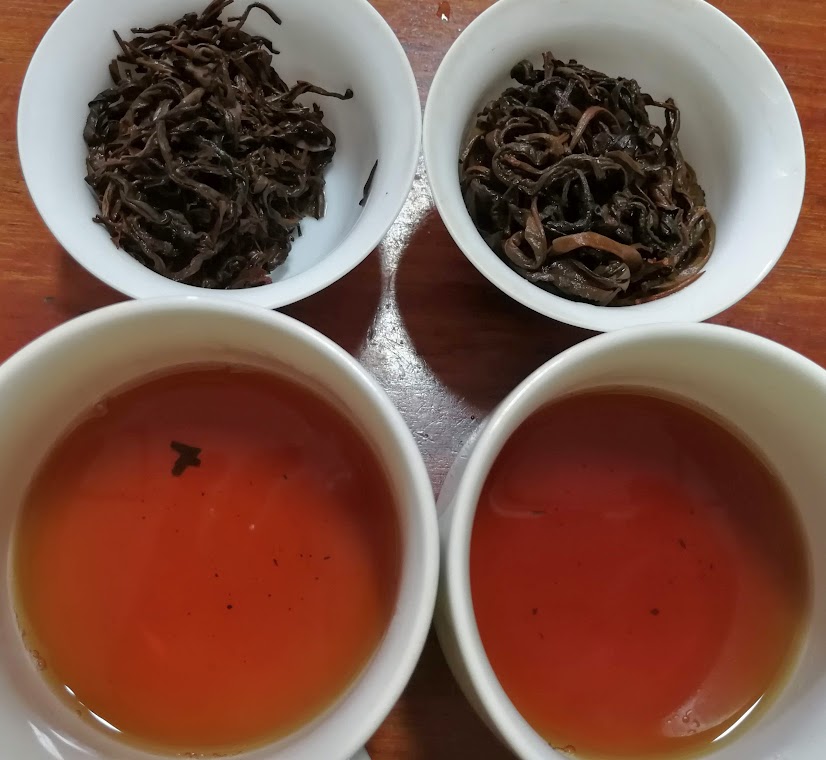
Assam Teehaus version left, Aran Thai "Assam" right


both used nice multi-layer packaging, and graphic stickers (not that such branding helps the tea)


I'm comparison tasting a Thai version of Assam along with an Assam version; that seemed a good way to establish a baseline.  I really liked the Thai sheng version from Aran (reviewed here); it just seemed a bit like green tea to me, in between type categories in style.  This struck me as quite close to an orthodox Assam, when trying it a week before doing a review, with this comparison filling in just how similar.  The outcome:  quite similar.

The Assam Teehaus product was a version that Maddhurjya Gogoi sent me last year.  His teas are pretty far up the scale for as good as orthodox Assam gets.  I think maybe versions from Oiirabot and Lautimi, sold by Tea Leaf Theory, might have matched my preferences just a little better, but that may have just related to being that much closer to Chinese tea versions in style, not to actually being better.  Dian Hong, Yunnan black tea, is a personal favorite, and tea really close to that in character might seem better to me, versus that actually relating to some objective improvement in quality.


meeting Maddhurjya (second from right) along with Sasha and Kittichai two years ago


I reviewed those Assam Teehaus versions here.   Comparing the label that version he had described as a "blended Assam orthodox."  From that review it sounded like I liked the other version slightly better, that a citrus aspect worked better for me than a more pronounced aromatic spice aspect.

For anyone into reviewing other range further this review from last year covered that Oiirabot version I mentioned,  and the Tea Leaf Theory Latumoni producer version.  Really good Assam is out there, there just can't be that many producers' versions on the level of all these.


Review:


Assam Teehaus version left, Aran Thai version right (in all photos)


I'll describe the Assam version--the one from Assam, India--first, since I'm using it as a baseline.


Maddhurjya's Assam (Assam Teehaus):  I didn't let this brew for long so it's a bit light.  The flavor is nice, complex and balanced, earthy with good sweetness.  Distilling that to a list will go better next round.  Some fruit and a hint of spice indicate it will show even better complexity as it evolves.


Aran Thai Assam version:  hard to evaluate in comparison for both being so light this early but this holds its own.  It's clean and full flavored, with some decent feel kicking in already, even though it's not fully wetted yet.  It's not so far off the other in character; more on that as a listing next infusion.


I tried to back off the proportion just a little from what I usually use to brew teas Gongfu style but in the end this was essentially that; the amount that would all but fill a gaiwan once the leaves saturated.  Too much tea to drink in one go too, especially since I just had some fruit with breakfast (fresh mango and banana with yogurt, a personal favorite), and drinking loads of Assam along with that doesn't work well.  Pastry stands up to lots of tea input better, or breakfast cereal.


Second infusion:


Assam Teehaus:  that is nice.  Warm sweetness kicks in, with lots of flavor complexity.  There is malt but it's relatively subdued compared to the level in a lot of Assam versions, that main-aspect, dry-feel related form.  Beyond the malt some molasses sweetness adds a dimension, and warm tones like aromatic wood or even mild spice contribute.

It would be possible to interpret some flavor as dried fruit, towards dried tamarind, but it's not pronounced, so it would be just as natural to leave that off a list.  I don't see it as floral but that also wouldn't be an unreasonable interpretation, along the line of rose petal.


Aran tea Thai version:  this experience overlaps a good bit with the other tea, more than I expected.  That malt is so subdued in this, and slightly different in form, that it stands out as a difference, but it is still common space, to a limited extent.  Complexity is on a similar level but the flavor range is different.  This leans more towards aromatic wood, or even cured leather.  That could easily be musty, but in this version expression it's quite clean.  It also hints towards a good bit of other range, the floral, towards warm and sweet dried fruit.  A little more dark wood tone seems to show through in this.

In tasting each back and forth the first (Assam Teehaus version) tastes more like dried cherry than it had without that direct comparison, a deep, rich flavor, more into fruit range than the other extends.  The feel for both is nice, and the way there is some pleasant depth of structure to them, but they're just soft and full, not astringent at all.  Even aftertaste range adds just a little depth to both, just not so much compared to how that often goes for oolongs and sheng.


Third infusion:


Assam Teehaus:  a warm aspect seems to bump up a bit, towards spice, but it's a little non-distinct.  The rest is similar, maybe just shifted a bit in aspect range.

This is pretty good tea, quite far up the scale of how Assams go.  Tea blog reviews tend to be about making minor distinctions, and that's what's going on here.  There's a good chance that I like this tea better than I did in the original review for brewing it Gongfu style instead.  For a lot of black teas it kind of doesn't matter, but for better quality versions being able to adjust outcome a little round to round, and experiencing the minor transitions, really can be more positive.


Aran tea:  similar; this is picking up a bit of depth too.  Given that I'm infusing both without using a timer that could also be it, a shift in brewing time.  Or maybe that's just how it would go for a tea like these being infused for around 1 1/2 minutes previously, where they would tend to be in a cycle.

Tasting one after the other the first (Maddhurjya's) is slightly sweeter and brighter, and the second (Thai version) a little heavier on dark wood tone, but again they are a lot closer than I remembered from the first try.  I tend to not frame interpretation as a clear "how good" judgement since that's just subjective, tied to preference, versus trying to communicate details of the experience, but both are good.


Fourth infusion:


I'll let these go longer to check on that effect, and probably let this drop after.  These will brew a couple of additional rounds, for sure, maybe even another three or four, but the point here is comparison, not adding every last detail.


Assam Teehaus:  more of the same, if anything slightly better, smooth, sweet, rich, and complex.  This tea really is better than I remember it last year.  Maybe it improved with age, or maybe brewing it this way worked out better than trying it prepared Western style in the first review.  Or other subjective differences always come into play, how I feel on any given day.

This house is a little chaotic this morning, making it hard to generate long aspect lists.  It would seem odd if that translated to liking the teas better, a slightly higher degree of background noise, but I guess you never know.


those noise-makers with cousins on a recent trip (mine are in the center)


Aran Thai black tea:  side by side differences stand out but tasted a week apart these could seem relatively identical.  The Assam version is slightly sweeter, a little towards dried cherry fruit versus dark wood tone, but they overlap more than they are different.

Both are good.  For the Assam I'd expect that; Maddhurjya has been working at making better and better Assam versions for a few years.  It's odd that a Thai producer could get so close to that in outcome.  Again I think there may still be just a little room for improvement related to the absolute best Assam versions I've tried, but these are definitely very pleasant.


I think the posing is about looking fabulous


Conclusions:


Really good tea!  The Aran Thai version, I mean; the Assam Teehaus I liked slightly better but both were quite good.  In terms of value this tea is more than worth the modest pricing that I paid for it.

It works on so many levels; this style of tea is forgiving related to how you prepare it, with relatively little astringency to brew around.  Brewed very light the intense flavor still comes across, and relatively strong still works, although some sort of medium is best.  I suppose you could even add milk to this, although it seems better to adjust your preference to appreciate how it doesn't need it, and wouldn't be improved by that.  Brewed at really high infusion strength it would probably be great with vanilla ice cream, at the risk of disrespecting the tea.

This mentioned that I like this style best prepared Gongfu style, but really using a Western approach is fine.  For lacking much astringency it would also work made "grandpa style," brewed in a tea bottle, and drank without separating the leaves back out, adding more water for a second or third round.  That's a great way to bring tea for car travel; carrying a half-liter thermos along even gets you that next round without running across hot water somewhere.

I just tried that with the Aran green tea version yesterday (at time of editing this post), and it worked well, it was just a little bitter.


on a road trip way back when


Sunday, November 17, 2019

Assam Teehaus orthodox Assam versions


orthodox Assam (left) and blended orthodox Assam


more sharing tea than samples in this case


I'm reviewing two more of the Assam versions passed on by Maddhurjya Gogoi, related to his cousin Chittaranjan recently visiting here to drop them off, and the earlier review of two others.  There's more on what they are doing, and photos of tea growing and production on his related Facebook page, and a vendor profile in this review post from last year.  The short version is that they're focusing on changing over to organic production methods, and using a local co-op style processing model.

I don't have more to share as an intro; these are presented as orthodox Assam and blended orthodox Assam.  Teas are ordinarily grown and processed by relatively small origin local lots and harvest seasons, and that must be what's going on here, just without those specifics.  They could as easily be presented along with invoice numbers or brand names, as the Enigma version was, but that doesn't change how they come across when brewed anyway.  Maddhurjya is probably selling more of this tea in a small wholesale vendor capacity than as an end-point seller, which would naturally relate to doing less with an online sales outlet site and branding themes.

Review:


blended orthodox right


Orthodox:  pretty good orthodox Assam.  Malt stands out, of course, but as is typical for better orthodox Assam it's moderate in intensity, balanced by other flavor aspect range.  A pronounced dark mineral tone grounds the flavors.  Sweetness, balance, and complexity are fine.  I'll do more with splitting out an aspects list next round.


Blended orthodox:  this is similar, it just has a different flavor aspect to it, some sort of spice or herb range.  It's hard to tell if it's identical to the other wild version I had already tried, which struck me as closest to fennel seed.  It might be that, or it may not be.  This version seems a little drier than the first.  The mineral effect is similar but the feel aspect is different.  Dryness is moderate for both, the way the feel structure extends to include that.


Second infusion:


Orthodox:  it's quite nice; the level of malt, feel structure, clean flavors, and overall balance.  It could be a little sweeter and a little more complex.  The flavor intensity coming across as malt and a warm mineral undertone is pleasant but more range would be more positive. 

At some point these descriptions and interpretations end up splitting hairs, pitting quite good versions of teas against the best versions that I've ever experienced.  This tea would be a revelation for a lot of black tea drinkers, breaking into new ground for striking the overall balance it does.  It's much better than any blend, Assam, or Ceylon that ever finds it's way into a mass produced commercial tin or grocery store shelf.  I'd probably like their Enigma version better, at a guess; I should try those two together sometime.

Blended orthodox:  again a different flavor aspect in this stands out, something else along the line of herb spice, which may be towards green wood, or really could be something closer to the fennel seed notable in the other tea.  It's not strong enough to be easy to identify.  It makes it seem like this might be slightly less oxidized but that flavor shift could come about in other ways (using a different tea plant type input, for example). 

The body seems lighter than the first in this round, as if part of the structure and dryness is common and another part is missing, so softer.  It's odd that I'd interpret that feel difference in two completely different ways across subsequent infusions.  This round I brewed a bit lighter, and that would shift how both come across, but it shouldn't relate to any secondary aspect inversion like that.  That could be tied to review error, or maybe just related to one brewing slightly faster than the other.  Bud content shifts feel quite a bit, along with changing flavor; that may be a difference between these.

Third infusion:


I'll try slightly longer to get a feel for how these come across at an infusion strength that might be more conventional for most people.


Orthodox Assam:  flavor complexity is really nice for this; the description so far hasn't done that justice.  Beyond the malt a citrus-like aspect seems to be picking up.  It's on the sweet and warm side, so may be in between tangerine and red grapefruit.  Warm mineral range still stands out.  Feel has softened just a little, with that moderate dryness easing up, settling into an even better balance.  Now it's more just full.  An aftertaste effect rounds out the experience, a trailing on of the malt and citrus.

Blended orthodox:  wood picks up; that herb spice like aspect seems more solidly within slightly cured hardwood range now.  A reasonable amount of sweetness offsets that, although a bit more sweetness and flavor complexity would really shift how this comes across.  There is a warmer spice aspect that seems to be picking up, not the "greener" or more herb range fennel seed as prior, towards an aromatic wood tone, or related bark spice.  It's not really cinnamon, or towards frankincense / myrrh, somewhere in the middle. 


Fourth infusion:


Orthodox Assam:  not so different than last round; citrus might have bumped up just a touch.  This is much nicer than in the first two rounds, with that touch of dryness shifting to rich fullness, and with sweetness and flavor complexity evolving.  Even a warmer touch of spice tone adds a bit of extra range.  This is on par with the better versions of Assam I've tried, probably with final judgment about it relating as much to personal preference for aspects and style as to quality level.

Blended orthodox:  also not different.  I don't care for the pronounced wood-tone as much as the added sweetness and fruit in the other version, but to some extent that's probably about preference too.  Feel still gives up just a little, with decent fullness and richness, just slightly less so in comparison with the other version.


Of course the teas were far from finished there, four rounds in using Gongfu style brewing, maybe about halfway through a typical cycle.  A couple of rounds later it seemed like I probably should have been adding cocoa to the flavor description list, but that doesn't change the overall account by much. 

Usually transitions vary less in the second half, so only covering the first four infusions gets the general idea across.  A tea brewing a large number of positive infusions is one sign of quality, and these did keep going, but it's a fine point trying to judge count and late steep changes as that kind of indicator. 

Conclusions:


I'm thinking that trying two of the best Chinese black teas I've yet to experience yesterday is coloring this interpretation (a Fujian Lapsang Souchong and Jin Jun Mei).  These teas are good, just not on that level.  There's no shame in that; almost no Chinese black teas are on that level either.  Those expressed incredible complexity and balance, novel fruit and honey flavors, and a really refined nature.  They were the product of generations of selection of plant types, growing and harvesting inputs, and processing skills, and also relatively ideal growing conditions for those plant types.  These two Assam versions probably stand head and shoulders above almost all the Assam tea versions produced a decade ago, helping set a new benchmark, holding their own ground against the progress other better local producers are making.

To some extent that's comparing apples and oranges anyway, since Assam tea styles are just different.  It's also true that I'm most attached to Chinese style teas, even though I can appreciate and enjoy Indian tea versions, black teas from Assam, Darjeeling, and other areas, and what other South East Asian countries produce.  One might wonder to what extent I'm mixing up "objectively better" and personal style preference, and I may not be able to draw that line myself.  These Assam versions would be perfect with food, a great breakfast tea, and are good enough that thorough experimenting with optimizing brewing results would still make sense.

I think it will help trying these alongside other Assam versions, to really place them.  I'm not going to review these samples every weekend for three weeks in a row but at some point it would be interesting doing a direct comparison, or maybe with a Darjeeling sample I have yet to get to. 

I'll try to get back to that, but there are some other really interesting teas around to try as well.  I picked up a really novel Thai version of a sheng ("pu'er-like tea") about a month ago, and I've had some aged sheng and shu to get to, and a Yunnan Dian Hong Chinese black tea version.  That might be interesting to use for comparison too.

I was talking in the last post about how people seem to fear tea supply running out too much, keeping sources a secret so that what they like is there to buy when they get back to it.  One part of that was the idea that other tea growing regions are developing better and better processing methods and tea quality output.  These teas represent part of what I was talking about.  These versions are really pleasant now, and given where they stand in relation to the last I tried from Maddhurjya--which were already quite nice--they'll probably just keep getting better.  Anyone who hasn't tried Assam in awhile probably isn't familiar with what the better orthodox version range is like now.