Showing posts with label cooking. Show all posts

Tuesday, May 9, 2017

Masala chai pumpkin pie, really cooking with tea


I made a masala chai rice pudding not so long ago, but didn't actually add tea, only the related spice blend.  That worked out really well, just drawing on the spicing mix, but I couldn't help but wonder how it would've turned out with tea as a flavor element.  I'd written here about how to make pumpkin pie from scratch, awhile back, so it was just a matter of putting it all together in another desert, with tea as an ingredient this time.


To back up a little, we ran across a wholesale vegetable vendor in Phisanulok on a trip in Thailand, and bought what must be at least 20 pounds of Thai pumpkin, a half dozen of them.  That cost around $2, kind of crazy.  Vegetables cost less here but buying them out in the country at good rates for those areas is something else.  I could make a lot of pies.


The American pumpkin pie spicing, used for pies and coffee drinks, is pretty close to masala chai spicing anyway.  Per my understanding that would include cinnamon, ginger, clove, and nutmeg, with masala chai swapping out nutmeg for cardamom, and potentially adding star anise and black pepper, which I'll skip.  A touch of salt also works well in masala chai, which of course would've been part of the pie anyway.  So it's onto details, how I went about it.


How would one add tea to a pie?  There are a few options, which start from the assumption I didn't plan to actually mix the tea in as an ingredient (eating a good bit of tea alone would probably be hard on your stomach, but mixed with food would probably be fine).  The most obvious fix would be to add it to milk, to simmer that with tea added prior to using it to make the custard base (pumpkin pie is just pumpkin, sugar, milk (or cream or condensed milk), eggs, and spicing).  A less obvious solution would be to add black tea to the water used when roasting the pumpkin, which I did decide to try.


I added a lot of black tea; nearly a third of a cup of it, split between a CTC  Assam I had around and a Thai black tea I just bought.  I'm not sure how much difference it makes but I like the idea of splitting the tea input between an astringent, malty, rough-edged CTC tea and a smoother, milder, fruit or woody-tone tea.  I might've added some of a Taiwanese black to this instead if I'd not ran across that Thai tea, but it's a waste to use tea that's really good, and the version I've not tried yet that I have a good bit of is probably well over that threshold.  That orthodox tea takes up a lot of space for a limited amount of tea but the CTC version doesn't, and partly as a result the input of the latter really could be a bit much.


roasting pumpkin in tea--different


I added some spicing to the tea and water mix used to roast the pumpkin, some clove, thin sliced ginger, cardamom, and cinnamon.  It wasn't intended as the final spicing blend but it made sense to start the spice infusion process too since roasting would take about an hour.  There are different ways one could give the pie the ginger kick, with using fresh ground ginger or even juiced ginger standing out.  I have dried ginger powder in a spice rack but I'll go with all fresh ginger since we keep it around and cook with it anyway.  The effect of fresh ground ginger versus dried is quite a bit different though; there's definitely more risk of the pie turning out too spicy, so one would have to be careful about the amount used.

While setting up the roasting mix it occurred to me that I'd have a version of masala chai as leftover pumpkin broth after the roasting step.  That would be different than typical masala chai because it would have a strong pumpkin flavor.  How strong, you might wonder.  Since I've roasted pumpkin before I'd already have experienced that:  quite intense.  It works well to make a pumpkin soup base, or it's nice just to drink, if one is into such things (I am; I usually just drink it).

I'll review that masala chai version first, then get back to the details about the pie.  I might mention first about tasting the darkened, roasted pumpkin, that tea and spice blend input seemed a little strong.  That's normal; masala chai tastes awful without the sugar and milk because the flavors balance just isn't designed for drinking it that way.  Unless you're dealing with a light version that is intended to be drank alone, but it would have to be very light though, still back in the range of flavored teas.  A more typical masala chai mix is strong, and needs those counters to balance the intensity.  That's not a bad thing; the recipe design accounts for that as an input, focusing on the final effect.


Review of the by-product, masala chai with pumpkin stock


I saved the infused spiced tea and liquid blend, a by-product of the roasting step, refrigerated overnight.  The initial water I measured as 3 1/2 cups, and between evaporation and the pumpkin absorbing a lot there was about two large cups of tea worth left.  One part I heated, simmering it on the stove, and drank a second cup cold, to try it both ways.  Upon first taste it was a bit too vegetal, in part related to Thai pumpkin being a little closer to a squash than the jack-o-lantern style version (what Westerners call squash; they're all part of the same vegetable group, they're squash).  A bit more sugar and a few drops of vanilla helped offset that, along with just switching expectations.

The tea wasn't designed to be a final version, so the flavor profile had eased up quite a bit on spicing as I typically prepare masala chai.  Ginger in particular was quite subdued.  But it worked.  The pumpkin gave it an interesting complexity, not bad at all once I expected it to be there.  Beyond that it was just a mild masala chai blend.  I would expect some people to hate it and others to prefer it to versions without pumpkin depending on personal preference.  It definitely added some complexity, although it didn't taste mostly like pumpkin with all the tea and spicing in it.


masala chai stock photo, from an earlier post about that

It was interesting experiencing it cold and hot, as two versions.  The cold presentation helped the pumpkin input largely drop out, so I suppose preference for one of those two styles would depend on that factor.  I liked both; they were just different.  Pumpkin really was just another layer in the flavor, it just stood out a lot when initially tasting it because it's an atypical layer.  The balance of the spices was fine, I'd just prefer even more clove and ginger.


I was wondering if tea balance would work, since around a third of a cup of tea is a lot, surely enough to make at least a half dozen cups of tea, probably more like a dozen, now absorbed into a lot of pumpkin and remaining in three cups of liquid tea.  It was strong but fine.  At a guess that pumpkin absorbed a good bit more than half the tea flavor (and caffeine? who knows).  It seems kind of obvious but I didn't want to under-shoot related to tea flavor addition, to be concluding that the experiment would be interesting to re-try with more tea so that the tea taste was actually present.  It's bold to add so much tea to a recipe but I think that was in the right range.


There's one more choice to be made related to that since I have a third small cup of the strong tea left, half a cup really, which I could add back into the pie or leave out.  Either way would have worked, but in the end I did mix it in.  Water is not a typical ingredient in a pumpkin pie but I have some cooking cream at home, so it's easy to offset the addition by going with the cream instead of milk or half and half, as I usually do.  As I recall the old traditional version my Mom made when I was a child used condensed milk, but I stopped considering that type of ingredient more than 20 years ago, early in my cooking self-training.

To me cooking is about tasting, about projecting ahead where a flavor balance is going to go, then making adjustments.  Another part is about texture.  Using interim tasting as input really doesn't work so well in making a masala chai, if you don't add the milk as you cook it (which is the typical way to prepare it, to cook the milk with the tea), because milk and sugar change the flavor so much it's hard to factor that in.

Towards the end of making this pie it really turned into a struggle.  It's easy to run into trouble with crust temperature, since the butter or margarine needs to be at just the right degree of softness to form correctly, and that became a glitch.  It's hot here (I live in Bangkok, and it's the hot season now), even hotter in a kitchen while cooking, and once it started to soften too much I put it in the refrigerator, then the rest took too long and I overcooled it.

I had been using ground cloves in the past but tried grinding whole cloves this time instead, and our food processor isn't as suited to that as a spice grinder would be.  I grated fresh ginger for this pie, but it was difficult dialing in that spicing level along with the clove.  A glitch or two is easy to work through but when a few aspects don't click the venture can turn into a slog.  I was trying to rush this cooking process by the time it was over, already working it into a busy day, and that's just not really how experimental cooking works.  We'll see if that affects results or not.


The final results

the pie; crazy, but it's square


Sometimes these experimental food ventures work out well, as that masala chai spice rice pudding did, and often not nearly that well, or sometimes better on a second try.  On first taste this didn't click in the same way.  The clove and ginger were both a little strong, and I didn't get the salt level right to balance flavors.  That's just about not paying attention, since you can't easily tell how spicing will integrate but salt level is an easier call, even if it's quite subtle in this type of dish.


It wasn't immediately obvious if the tea played much of a flavor role or not, due to the spicing.  It all came across as a little too strong, not falling into balance, and I think the tea might have just helped push it further in that direction.  Backing off the more intense spices might have helped it play a nice supporting role, but I erred in the other direction instead.


It made me think through the differences in masala chai (the drink), and cooking rice pudding and pumpkin pie.  Masala chai needs to be intense, that's part of the whole point, and the sugar and milk provide compensation for some relatively high spice levels.  In retrospect I went quite light on the ginger and clove in that rice pudding, even backing off the cinnamon, allowing the cardamom to play a larger role, but I switched all that around in this case.  All of those rely on striking the right balance, which is especially important in pumpkin pie.  Layering pumpkin with intense spices requires the right touch or the pumpkin itself can nearly drop out as a flavor base that ties it all together.

With a rice pudding the neutral rice flavor automatically falls way into the background; there can be no substantial "rice" flavor, although it is in there.  With that dish you can potentially lose the "custard" flavor, the creamy fullness egg cooked into milk provides, which is already not going to stand out in a desert based on pumpkin instead.

Anyway, tasted on it's own it turned out ok, just a little intense, without striking that exceptional balance.  There wasn't much "pumpkin" aspect coming across.  That general spiciness also offset noticing the input of the tea, which probably just ramped up flavor intensity, complexity, and busy-ness, which it really didn't need.  I can't help but wonder if using so much CTC tea wasn't also a problem, if that edgy, biting, malt tone didn't combine with the edge of ginger and clove to dial up the flavor volume a little too loud.  Could it work better than plain pumpkin pie, if adjusted correctly?  Maybe.  One more factor comes into play.


The whip cream input, sort of


the kind of people that eat whip cream from the can

The adjustment period is not over once you finish the dish, although at first it may seem so.  I made the pie to go with whipped cream (you sort of design it for a certain level of that for balance).  We had a can of instant whipped cream in the refrigerator, with only a little already used to go with jello, so adding extra whipped cream would be an easy counter to the spiciness.  It's not just a fix because the spicing level was designed to include that, in the same way you would make two completely different masala chai versions if you planned to add milk and sugar or not.


Unbeknownst to me my two kitchen assistants ate part of it and expended all the propellant--nitrous oxide--by ineffectively eating it directly from the can.  This was in spite of clear instructions related to how making that mistake would be possible.  I told them to not eat it from the can, at all, and if they did to just tip it up while doing so, holding the can nozzle side down.  So much for me being consistent.  It was that kind of cooking venture anyway, a bit up and down.


I tried the pie with vanilla ice cream the second time, not ideal but it would serve the same purpose.  It was much better; quite good even.  It was amazing how it shifted the intensity down to enable the spicing to become reasonable, although still just a little heavy on clove.  I might've been able to detect tea as an input but it seemed to layer in to just add complexity and earthiness to the pie.  It's hard to say if that actually improved it.  Pumpkin taste definitely did get crowded out.


If I tried it with rice pudding again instead, and used better tea, and all but omitted clove and ginger, used them sparingly as mild support, that may work even better.  But I'm not sure I could really tell what role black tea played even if I got the balance right, or it might not taste like black tea at all especially if I did get it right.  That's an odd thought, isn't it, that the only way to balance the flavor properly might be to not taste it at all.

The reason that better tea in general is so effective in beverage form is that it's standing alone, or at least my tea almost always is.  Only blended versions aren't.  Most teas can be intense but only in a subtle way; the intensity and complexity comes from a tea drinker becoming accustomed to that range, to calibrating their sense of taste.

Masala chai really is an anomaly, and it's quite odd that bergamot in Earl Grey works as well as it does, or jasmine in a nice black tea.  Jasmine green tea or osmanthus oolongs are typically great examples of why those other two are exceptions.  Both can be fine until you become accustomed to plain teas, and then the lack of subtlety becomes hard to take.  Or maybe that's just my experience.  Jasmine green tea was a gateway tea for me but I have no idea when I last tried one.

It might be better to just make the pie without tea and have a nice tea on the side.  That seems an odd place to leave it, so I'll consider what someone else tried related to this.  Google had more to say about the masala chai rice pudding I made, which I'd not looked up when making that.


Thai fruit; no connection


Versus from a recipe


I'm not recommending that you do this, to completely hand your cooking experiment over to some internet reference source, but it wouldn't hurt to check one before starting out (like this article and recipe; Google's first pick for the terms I entered).  Of course I didn't; I read all this after making this pie.  This citation about author preference shows where it's going to go:


I prefer a pumpkin pie that is subtle in its spice and sugar; with a creamy and tender filling, against a crust that has both flake and crunch.  

I usually serve pumpkin pie with some whipped cream that's folded through with just enough maple syrup to take off its edge, but If in the mood for true gilding, I’ll serve it with a Black Tea Caramel... heady with Darjeeling and cardamom, it completes the whole masala chai thing the pie has started. 


I must admit I'm a bit flexible about the crust texture part but that is how ideal spicing usually goes for pumpkin pie.  Spicing supports the effect but stays in the background.  Related to texture, it's funny how I do like to cook, and experiment with flavors, but in a sense I really do have a "crocodile's tongue," as my wife says (a Thai expression).  I could spend a whole day making something I feel like eating, prepared just in the way I imagine it, or I could just eat grilled cheese sandwiches for a week.  And when I make pies frequently the crust does turn out flaky but it doesn't matter so much to me if it doesn't.


Here is her recipe related to spices (although adding that sauce mentioned changes things; that sweetness and spicing essentially becomes part of the equation):


1 teaspoon ground cinnamon
3/4 teaspoon ground ginger
1/4 teaspoon ground cardamom
1/8 teaspoon ground clove
1/8 teaspoon fresh ground black pepper


That would be subtle.  I don't measure ingredients when I cook but I went stronger on spicing, with the actual black tea input adding a substantial layer beyond that.

Let's consider the caramel sauce spicing too (omitting reference to cream and butter):


1 tablespoon loose leaf black tea, Darjeeling is best
4 green cardamom pods, cracked
2 cups (400 g) granulated sugar
1/2 cup (120 ml) water
2 tablespoons pure maple syrup
1 tablespoon whisky
Seeds scraped from a vanilla bean
1/4 to 1/2 teaspoon flaky sea salt such as Maldon


So way, way less tea than I put in this pie, nearly by a factor of ten.  I can't imagine how this caramel could be "heady with Darjeeling" from adding enough tea to make a couple of cups worth.  Darjeeling is a good call, probably a second flush or autumn harvest version, maybe second flush instead to not waste the other.  Or a Lipton tea bag might work almost as well for mixing in a tablespoon of tea with all the rest.  Using a single vanilla bean might seem sparse but I've went on before about how much flavor those can impart, even adding a creamy texture based on adding only a limited amount.


I suppose it's appropriate that my first experience with really cooking with tea wasn't a resounding success.  It sort of worked, and maybe I'll get back to it.

Tuesday, April 4, 2017

Masala chai spice themed rice pudding


You might think this topic makes no sense, that it's not even close to being a tea, unless I made it with tea as an ingredient, but I didn't.  That might've worked.  It's not so different than anything including cinnamon and ginger being marketed as "pumpkin spice" related back in the US, but that typically happens in the fall.

I could accept that critique.  This post isn't at all about tea, even though it appears in a tea-themed blog.  It is vaguely related, and I feel like communicating how a masala chai themed rice pudding worked out after making one, and writing about cooking instead, so here it is.


from really making masala chai, in this post

What would the difference be if it were pumpkin pie spice related?  The two sets of spices overlap so much and can vary enough that per my understanding there isn't much difference (which you can check in this first venture into food writing, a post about making a pumpkin pie from scratch).


I made this rice pudding with cinnamon, cardamom, clove, and vanilla.  Ginger would've been ok,  standard for both spice theme sets, but it seemed like clove covered some related flavor-role space, only better for this dish.  Cardamom stood in place of the nutmeg used in pumpkin pies.


Masala chai can include black pepper too, and often enough star anise, but often enough not too.  I only like star anise in savory soups or else it seems like too much for me, with too strong an aftertaste.  That limits it in my cooking to the role it plays in Chinese five spice blends and Vietnamese Pho.


With that context out of the way I'll move on to discussing making this rice pudding version, after some background.


before cooking, the mix


The background, cooking history and philosophy


My Mom made rice pudding, a favorite desert as a child.  That version would've probably used only cinnamon and nutmeg for spicing, besides vanilla.  She slow-cooked it in a crock pot.  It was made based on a standard recipe, using the same ingredients in the same proportion every time, the way normal people prepare foods.

I stopped using recipes in my early 20s, and cooked enough to overcome the missteps that resulted from that.  I guess the idea was to explore cooking by feel, to learn from mistakes, and to experience balancing the inputs more directly, by tasting and adjusting.  It usually worked out, and when it didn't the next version after almost always did.  I cooked everything I could think of:  meats prepared a broad range of ways, traditional American foods, barbecue, soups, or region-specific foods like Cajun, Mexican, and Italian, expanding into doing a lot of baking.  That ranged into ventures as aggressive as making croissants and danishes from scratch, one place I ran into my limitations.  Cakes, pies, tarts, puddings and custards are easy; finely layered forms of pastry not so much.

Rice pudding is easy, you just need to avoid screwing up the proportions.  That's what would happen if someone tried to make it for the first time without any reference to a recipe.  Lets take a look at one, although it's not my Mom's, which I've lost track of.


Old-fashioned Rice Pudding


This recipe was referenced as a Quora answer as the 1975 Betty Crocker version (so it's quite classic):


2/3 cup uncooked regular rice

1 1/3 cups water
2 eggs or 4 egg yolks
1/2 cup sugar
1/4 teaspoon salt
1/2 teaspoon vanilla or 1 tablespoon grated orange peel
2 cups milk
1/2 cup raisins
Nutmeg


Stir together rice and water in saucepan. Heat to boiling, stirring once or twice. Reduce heat; cover and simmer 14 minutes without removing cover or stirring. All water should be absorbed.


Heat oven to 325°. Beat eggs in ungreased 1 1/2-quart casserole. Stir in sugar, salt, vanilla, milk, hot rice and the raisins. Sprinkle with nutmeg. Bake, stirring occasionally, until knife inserted halfway between edge and center comes out clean, 50 to 60 minutes.


All that really would work.  They don't mention cinnamon at all; kind of strange.  Vanilla seems more appropriate than orange peel, to me, but I guess it could be a matter of taste.  Lets move on to what I just made instead.


A masala chai spice version


I used about 3 cups of cooked rice, and probably around 2 1/2 cups of milk (a lot--too little and the pudding turns out too dense, since even cooked rice will soak up liquid, and the dish is basically a custard).  I added 5 relatively small eggs, a size that just wouldn't come up back in the US, where almost every egg seems to be large.  I'd guess that would be similar to three of those.


palm sugar (credit)

I didn't measure the sugar, and used palm sugar instead, which comes in disks (strange, right?).  I've botched some dishes getting a feel for how those equate to granulated sugar.  I tasted the mixture for sweetness--with raw eggs in it, just madness--and added a bit of granulated sugar at the end to adjust it.  Salt is a critical ingredient, getting the right amount, so little that you barely taste it but enough that is still balances the rest, just as for masala chai.  I added about half a teaspoon.


I can't estimate how much cinnamon, cardamom (ground black pod type), and ground clove I added; some, a good bit, adjusting by tasting after.  Nutmeg really would also work well, and someone else might like ground or even fresh ginger in it, but I'd rather have clove and cardamom fill that range.  Beyond that I added a bit of vanilla (imitation liquid version, maybe two tablespoons), and skipped the raisins, since my Mom didn't add those.  Mashed banana might be nice to add fruit tone but it doesn't match this theme.

I baked it at around 350 for over an hour, starting even hotter initially to speed up heating.  We use Celcius here (in Thailand), so really 200, but then we have a large size version of a toaster oven and temperatures work out differently in those.  Thais tend to not bake; ovens aren't standard.  Slow cooking in a crock pot works really well, we just don't have one.


cooked version; browning the top is optional, but would dress it up


The verdict


It was awesome.  It might seem like splitting spicing input between cinnamon and nutmeg would make roughly the same desert but going heavy on cardamom and adding a good bit of clove for higher end gave it a spice effect you could almost feel more than taste.  I don't mean in the same way spicy Thai food hits your sense of taste like a hammer, or more like a comet-strike if that goes badly, or how Indian food changes your metabolism and the spicing sweats back out of you.  I mean it was tasty in a way that's hard to completely get your sense of taste around; the effect was deeply catchy.

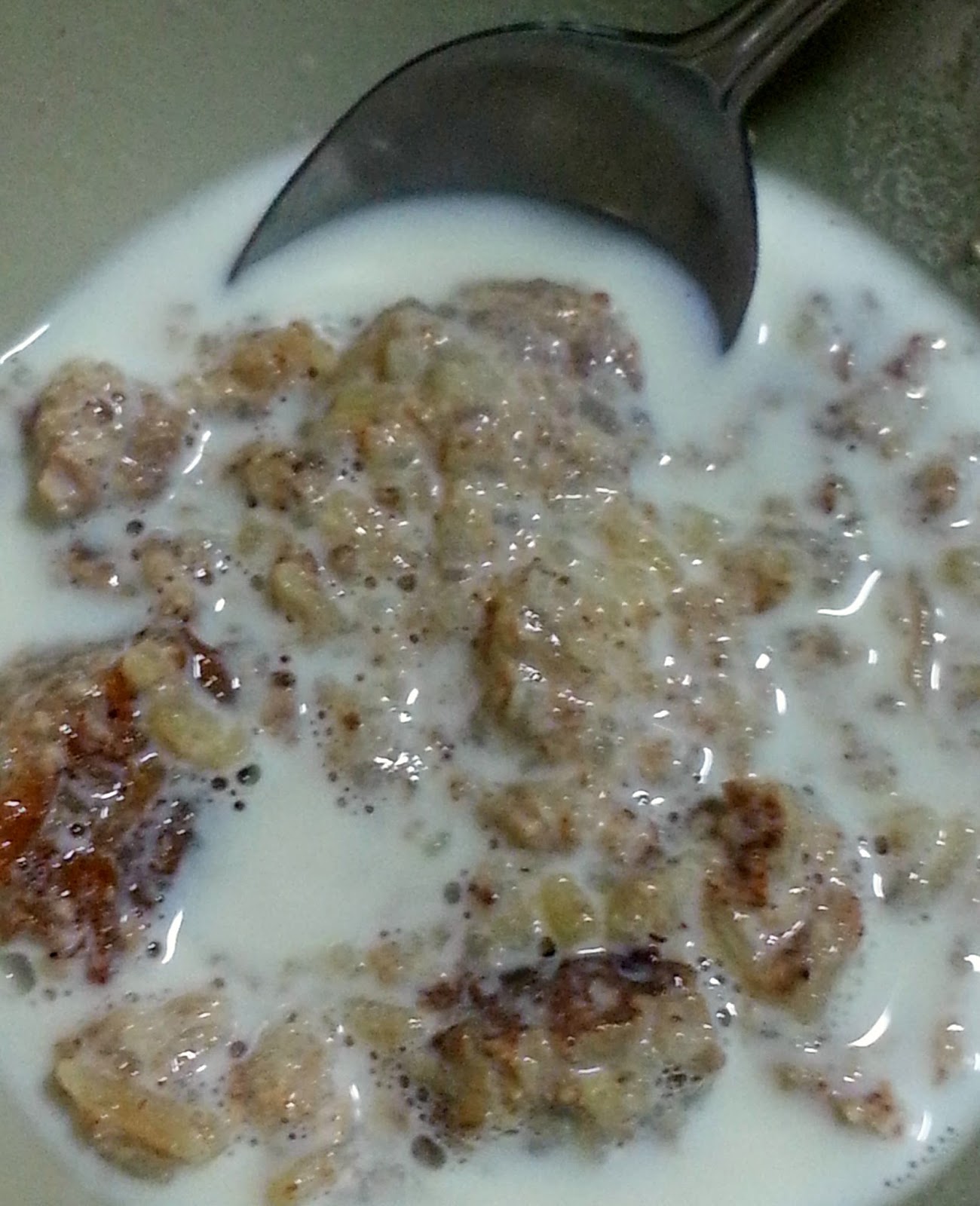
served warm with milk

It would seem natural to add some black tea, wouldn't it?  I'd probably even strongly brew two types of black tea and add both, to give it more complexity.  But I'm not really a "cooking with tea" type of person.  I drink a truly insane amount of tea, maybe only equivalent to a half dozen large cups a day, or 20 small ones, or a mix of sizes, but the number of types really adds up.  I like matcha soft serve ice cream and pretty much leave it at that.  Tea could combine well with lots of foods but I'd sort of rather that in my own diet it didn't.


If I'd made this dish for other people I'd have tried that, for the sake of novelty as much as flavor balance, and eventually I may.  If adding black tea it would make sense to go ahead and put the ginger back in too, but draw the line at black pepper, to keep it sensible.

Monday, January 11, 2016

baking a pumpkin pie from scratch (not about tea)

This is a clear violation of tea-blog scope, writing about something that has nothing whatsoever to do with tea.  I wanted to write a bit about cooking in a food group I'd been spamming with tea blog links when the two subjects seemed to overlap, and then thought why not break form and write it here.  If I don't post links to it anywhere then it will be a little like it never happened anyway.

So all this is about a very normal thing for me, making a pumpkin pie from scratch.  It's really not worth mentioning how to do it, in a sense, because it's so easy a child could do it, and everyone should already know how, it's just normal food preparation, but I'll run through it anyway.


Japanese pumpkin is orange; brown- green Thai version

To begin, we bought a pumpkin travelling in Isaan, North-East Thailand, on a trip to Khon Kaen.  They kept selling interesting an inexpensive fresh vegetables so we came back with a lot of corn, that pumpkin, a watermelon, and a lot of one type of yam.


The pumpkin is a Japanese pumpkin, different than the type one sees in America or the Thai pumpkin, which looks more like a strange version of a squash, with a green, odd-textured exterior.  Thai pumpkin tastes more like a squash too, with the Japanese style in the middle, not so different than the one you see America, but not the same (on the left in this picture).


Isaan!  Looks like the country anywhere, but a little tropical


I'll keep it simple, just how I made it, resisting the urge to ramble on and on about tangents.

Roast the pumpkin:


Of course, right.  One would cut up the pumpkin into manageable large sections, take out the pulp and the seeds, and keep the skin on, then put the pumkin in a covered pan with water in it for something like 45 minutes to an hour, around 350 or so (but I'm on Celcius here, so 175 C = 350 F).  Really I used around 200, close to 400 F, but it will take the pan and water and pumpkin awhile to reach temp, so it may work well to go with 400 for 20 minutes then back that off to 350 for another half an hour.


roasted pumpkin (slightly less orange)


It's really not a recipe if someone keeps saying "about, roughly," right?  A real recipe can talk you through it, but for me it's best to just wing it a bit, and then fix the glitches next pie.  Betty Crocker can give you more input on measured ingredients, though, and Google must have more on roasting pumpkin.


You know when the pumpkin is ready when it's soft.  If it has a little more texture than you think it should that won't matter, because the pie still needs to cook, but if there's a raw layer near the skin you won't be able to make it work out.  Once the pumpkin is roasted you'll still need to take it out, let it cool a little, then scoop the pumpkin flesh from the skin.  I'm using the skin to eat separately; yesterday I roasted some with butter, and some of that with a yellow curry powder added, broiled at high heat for about 15 minutes in a toaster oven.  For God's sake don't throw it out; think of the nutritional value, must be lots.


another way to roast it

This is a good time to mention I made the whole thing in a large toaster oven.  Thais don't generally have ovens, and we don't (I live in Bangkok).  At a different time in my life I practice baking in a normal small version; you can, but the extra space helps.  It absolutely won't work without a temperature setting, though, so if yours just toasts it's too much of a stretch.  The oven we have isn't like a normal toaster oven, it's a larger version for baking, with two different rack levels and an option to use an extra fan to help distribute the heat differently for some types of cooking.


Ordinarily you wouldn't cover a pie, I mean with foil, and it will throw off the top texture if you do in this case, but I'd at least consider it for a toaster oven because it's just not set up for baking like that.  One really should cover the pumpkin for the roasting step.


Toast the seeds


Maybe optional, but come on, do it.  As a child we made them with just salt added, but this time I added a good bit of oil as well.  It works a lot better with the American version of a pumpkin, with smaller seeds and a thinner seed shell, but the ones I just made are tasty.  I'm not going to be as much help as I should be about temperature and time, and mine went a little extra brown this time, so about three minutes less than I cooked mine would be better.  Just keep an eye on them!  Again maybe 350 would work, maybe only 12 to 15 minutes, but it's easy to check, just eat one.  They should start to tan a little but not get brown.


a little less dark would be as well

Prepping them takes some doing; it takes some meticulous work separating them from the mushy pulp, but that roasting step gives you an hour to mess with.  I'd give them a really good wash too; all that pumpkin mush could throw off the final crispy-skin texture a little.


Salt level is critical, not too much, not too little, but just don't go crazy with it and you'll be fine.  Someone else might think about spicing, doing a curry here too, but for me I like the plain taste.


Make the crust


Easy!  Melt butter to a soft but not liquid state, cut in enough flour so that it gets a bit clumpy, then add water chilled with ice to get it back to a dough consistency.  Ok, so maybe that's not so easy.  My mom used a pastry cutter, hard to describe, it looked like a handle with a half-dozen thick wires making a part that worked like a giant fork.  You can mix it with a fork, or a wooden spoon; I used a metal tablespoon this time.  It only needs a touch of salt, or not if you are using salted butter, but I add a little of whatever spice I feel like, usually cinnamon and something else.  I didn't feel like grinding the sticks and was out of the powder so I did the unthinkable and made this pie without any.  As I recall I put a little nutmeg and ground cardamom in the crust this time.  Vanilla would be nice but if using liquid one would want to be careful about texture.

They advise careful rolling and folding the crust, then some edge fluting, which is a nice approach, but I mashed handfuls of the dough into the pan to give an even depth coating.  Function over form!  Some purist would say I've lost some of the lightness of texture by hand-warming and over-working the dough, and that's right, it's not as flaky as it would have been, but I honestly don't care.  I don't want a light-structured pie crust any more than I want a machine-processed pie-filling consistency; I want it to seem like a person made it, not a machine.


Make the pie filling


Tricky stuff!  Mash the cooked pumpkin, mix in spicing, sugar, spices, eggs, and milk.  Here you might want to check on that link I mentioned for Betty Crocker's version to back me up.  I used four eggs this time, when I'd initially planned to go with three, but the pie was kind of big (non-standard; more on that later), and I decided to use palm sugar disks, and needed to dissolve those in water to work with them, and the mix was a bit thin looking.

They say to use evaporated milk, in that version.  I guess; why not.  Or whole milk really would work, or cream, or half and half.  It's your pie; go with your own instincts, just plan to make another at some point in the future that will turn out even better once you see what works.  Evaporated milk has a nice flavor balance and texture, the right elements for ingredient purposes, but half-and-half would be about the same, and nice that it's a bit less processed.

This is where things gets strange:  I don't measure, anything, ever (ok, maybe for chocolate chip cookies, those things are touchy).  Even stranger:  I would taste the mix to see if it's right, even though it tastes way different when cooked versus raw, and that risks sudden death with raw eggs in it (or maybe not, really).  So for sugar you've got me how much to add, or even what type.  That Betty Crocker version requires a half-cup of white sugar, but really why wouldn't one go with half white and half brown instead.  I used all palm sugar, which is a long story related to how that differs, so hard for me to really say.  So I'll say something that's partly right and perhaps a little wrong; it's closer to a less processed cane sugar.

Spicing:  let's check back in with that "original" recipe, what "pumkin pie spice" really is:

1 teaspoon ground cinnamon
1/2 teaspoon salt
1/2 teaspoon ground ginger
1/8 teaspoon ground cloves


Not bad, for a start.  It's essentially a fruit based custard, so as well to add just a little vanilla as well.  I would also throw in a dash of nutmeg, and ramp up the ginger and clove level a little.  I added cardamom to the version I just made, and as I mentioned I didn't use any cinnamon, but that is crazy.


Next someone might think of how to push this further; fresh vanilla pod would add a lot of flavor, and if someone had easy access to a juicer using a bit of fresh ginger juice instead of a powder would work out better, just good to be careful or the pie would turn out spicy, maybe not in a good way at some level.  Someone that's been making a lot of masala chai might think "why not black pepper?" but that wouldn't cross my mind.  I usually skip it for that tea too, but to each their own.


Bake it


Betty Crocker says to use 425 for 15 minutes and go down to 350 for another 45.  I kept this one in for about an hour close to 400, because it really did take a long time.  For this step I would give the standard recipe a close read to see what they say about checking temperature, and consider the bit they mention about covering a fluted edge with foil to keep it from over-browning.  It that happened the pie would still be worth eating, it's all just about little details at some point.


About the picture of a pie here, someone might notice it's square (OMG!).  Round is more ideal, but it fits in the toaster oven space that way (really a larger baking oven version of a toaster oven, but not so different).


And the top isn't right; not dark and carmelized, because I made it covered.  That can actually affect taste just a little, but not much, so probably as well to leave it uncovered right at the end, but only right at the end if burning it when cooking in a smaller space than a normal oven is a concern.  The crust did stick a bit, too, due to that lapse in method I'd mentioned.  This is not so difficult to work around by not pressing it in the pan, and using a light flour dusting on the outside of the rolled dough.  Or not; that part doesn't affect the taste, just presentation.


For all the rough-edges in approach, I'll go ahead an offer my opinion of how it turned out compared to the standard version, using canned ingredients.  I think much better, which is kind of amazing given that I didn't use cinnamon.  Part of that was luck, since I'm out of practice (I've made this two or three times in the last 8 or 9 years).  Getting the spice balance right without measuring is a stretch; same for level of sweetness.  Even if it wasn't so great this is my pie, my own creation, and I enjoy cooking a lot more for my own input being part of the process.


If I were in the US I'd say I could just buy a store-bought pie if I wanted the completely standard version, but here I really can't.  There are pumpkin pies out there, somewhere, in specialty grocery stores or very expensive niche bakeries, but walking into a normal grocery store to get a normal version isn't an option.  I'm confident that this is one of the best pumpkin pies in existence in this city of 10 or 12 million people right now.


Now I just need more people to appreciate it.  My kids will eat a little but they're much happier to eat little handfuls of the whipped cream instead, all the more so since I cut that corner and bought the can of automatically whipped cream that they would love to make a meal of.