Showing posts with label self. Show all posts

Saturday, February 26, 2022

The Buddhist nonexistence of self in relation to multiple personality experience (DID)


I wrote a summary about looking into Dissociative Identity Disorder awhile back, the experience of multiple personalities.  This won't go into what that is; that summary covered it.  The intention was to return to the idea of the Buddhist rejection of the existence of a real self (covered here) in relation to the experience of multiple personalities.

I was just talking to an online contact about this, and it helps frame ideas I've been "kicking around" for a few months to do that, so I'll use parts of how I expressed that here (many thanks to them).

To be clear the assertion that there is no real, permanent internal self is essentially meaningless without a context.  Of course our bodies are real, and our social selves aren't unreal, and we function as a legal entity, in an employee role, within the context of a marriage bond, etc.  We are real, in most main senses, as an abstract or internal entity.  Hopefully this will expand on what that could mean, and will get back to how this applies to DID. 

It's a bit overly simple but if the experience of one internal persona is not real, as I think it's not, at least in a limited sense, then the experience of multiple personas could hardly be more or less real.  Even the social convention part could be flexible; as of now there is no significant allowance in standard norms for people to manifest more than one internal self, but that could change.  It's probably a bit unsatisfying how this doesn't really develop these two sets of ideas much further, that any internal self is just an assumption or convention, and that the external social norm itself might be open to change.  I do fill in some background, and offer limited opinion about how this works out.


Back to what the "rejection of a real self" theme is about


It's very difficult to think through what it could possibly mean to say that no internal self is real, the one idea from Buddhism (which again is provisional and functional, not a statement of metaphysical truth or modeling). As I see it that only makes sense or has a meaning tied to a unique introspection and transformation project. 

Buddhism is promoting this as a thought model for a particular reason.  One might ask "which Buddhist teaching, in which core text?," and for that you need to turn to a Buddhism website and page around through basics.  In case your Google is broken this turns up on page one of a search, or this kind of starting point lists other online reference pages, with a bit of interpretation from a monastic source to follow.  

I'm talking about my own perspective as an outcome of long study here, what worked for me in internal review.  I have two degrees in religion and philosophy based mainly around study of Buddhism but I'm not going back through any of that, or start this out with citing sutras, or other interpretations (beyond doing a little with that to serve as starting points).  Buddhism taken as philosophy, as a model for reality, generally doesn't map well to what I take Buddhism to be, but I'll mostly set that aside too.
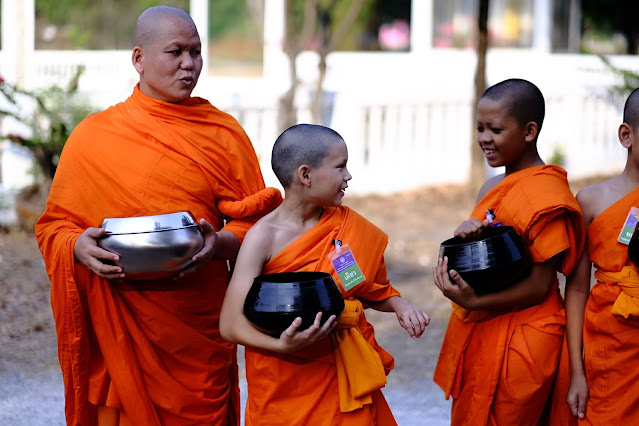

a favorite picture of my son as a novice monk


Taking up this idea as a conditional supposition works to help examine and to some extent deconstruct the existing assumed version of a self.  In practice our form of internal self-definition is really a collection of assumptions, beliefs, preferences, definition through personal history, inherent personal characteristics, outcomes related to memory, and so on.  Social roles build on all of that, or are an integrated part of it, both a basis and an outcome.

Why do this internal review, one might wonder.  An introspection process like this can help resolve some fairly conventional "ego," reality construct, and expectations issues.  We really only can act in the present (kind of a given, when you think about it), but our reality can become overly shaped by regrets related to the past or anxiety related to the future.  Lots of self-image themes can be problematic.  Here I'm describing a blurring between definition of self and experienced form of reality, the other parts that shape it, which tie to self-definition more than is immediately obvious.  

Back more directly to self image, a range of concerns could become negative in ways that it could be helpful to "unpack," and then move on to resolving.   These could relate to self-image, in relation to persona or physical appearance, social status and roles, ownership of material goods, social connections, and so on.  It should seem a little indirect to start from "self is not real" to move on towards better understanding and then resolving these things, but in my experience it can work, with that functionality the main point.


"Real" in this context refers to the form a particular person has taken up, so it wouldn't be just one thing.  For example, self-image could be a huge part of personal definition for someone, related to their physical image and social image, positioning within a subculture and such, or at an economic level.  Or that could largely drop out for someone else, and they could define themselves in completely different ways, for example through a set of interests.  I think even if someone is isolated on a remote island alone the social image conditioning aspect would never really completely drop out though; that you would define yourself in terms of being separated from social contact, like in that Tom Hanks movie.

As I see it we rely more on psychological models than others, so in a conventional worldview a real and continuous (somewhat permanent) internal self is not taken to be a mental mirrored aspect of a soul, typically. It would be accepted that self and brain function overlap, but the primary model people would tend to use would be psychological, about a subconscious and conscious divide, about inherent forms being exhibited based on innate tendencies, learned patterns of being and response, and so on.  We would probably tend to gravitate towards self-definition through defined forms and models, eg. introvert and extrovert, through class level, or the more modern and potentially problematic alpha and beta concepts.

The real meaning or purpose of this negative construct comes in when you consider what "not real" is about.  Those layers of being aren't tangible, like the physical body, but they're not exactly imaginary either.  All of those social constructs are "real" things, within the limitation that social constructs ground a lot of all of our lives, as assumptions and sets of ideas or conventions.


Of course we go just a little further, and we naturally assume that we experience a real internal self, that the internal persona we experience must map to something continuous and well-grounded, be it a soul, or an output our brain produces.  It could be that a self is a conditioned social response that represents a manifestation of our sub-conscious, invoking a divide which really just breaks apart two things we don't experience so directly. It works to question that assumption; what if that self is just assumed continuity, not rigidly grounded at all, or as fixed as it seems?  What if what "we" really are is a set of assumptions and response patterns, which are reinforced by social roles and language forms, but nothing more real than that?  What if we could reset that, or split it into parts, beyond just having aspects of our self being context related (work-self, family role self, etc.)?  I'll get back to that last point.


Limited input about rejection of self from a short reference source


Maybe that's enough framing, or maybe it's not.  Just in case let's back up and consider a popular writing explanation of what Buddhism is doing with this supposed rejection of self (or not doing), in this reference article (written by a monk, for what that's worth), “There is no self.”


When Vacchagotta the wanderer asked him point-blank whether or not there is a self, the Buddha remained silent, which means that the question has no helpful answer. As he later explained to Ananda, to respond either yes or no to this question would be to side with opposite extremes of wrong view (Samyutta Nikaya 44.10).


Right, so the idea that there is no continuous, permanent self according to Buddhism isn't a model for reality, a description of the way that things really are or aren't, that can be mapped out easily.  It's something else.  This following interpretation isn't a core teaching, it's that writer's explanation:


Because clinging lies at the heart of suffering, and because there’s clinging in each sense of self, he advised using the perception of not-self as a strategy to dismantle that clinging. Whenever you see yourself identifying with anything stressful and inconstant, you remind yourself that it’s not-self: not worth clinging to, not worth calling your self (SN 22.59). This helps you let go of it. When you do this thoroughly enough, it can lead to awakening. 


I don't really see this as wrong but to me it's also not the most direct and helpful description of the doctrine of anatta, or not self.  He adds more detail to that, about a final middle ground:


Some ways of selfing, the Buddha and his disciples found, are useful along the path, as when you develop a sense of self that’s heedful and responsible, confident that you can manage the practice (Anguttara Nikaya4.159). While you’re on the path, you apply the perception of not-self to anything that would pull you astray. Only at the end do you apply that perception to the path itself.


This mostly works, it's just back to the part about "apply the perception of not-self" seeming a bit awkward.  It seems a fairly direct reference to what gets abbreviated as "dropping" in Zen, setting aside forms of attachment.  In that context it relates to meditation and mindfulness, but that works as a description of Zen in general, and it really doesn't apply much less to other forms of Buddhism.  The output of last sentence then gets described as "dropping dropped," which is a cool structure of ideas.

If you are trying to stop obsessing over desire related to sexual attraction, for example, you would need to examine what is going into that and how to disrupt that focus, but I'm not sure that "applying the perception of not-self" would be an effective strategy.  If that meant cutting off the personal association with those ideas somehow--the tricky part--then sure, that's it.  Or related to reacting in anger, to sorting out why triggers cause that reaction, how to disrupt the internal association and response sequence, and so on.  

To a limited extent you would need to understand those cycles of self-definition, assumed context, patterns of input, and your own expectations and responses.  You couldn't just wave a general and broad "not self" concept at these themes and resolve them.  I'm sure this relates to the cited content being simplified to make sense in summary form, not related to practices that simple being supported (just stop doing it).  In the end the final step would be simple, just not doing that thing, not following forms or ideas mentally, but you couldn't just say "I'm not going to get angry anymore" and be done with it.

That author raises another good point:


The belief that there is no self can actually get in the way of awakening. As the Buddha noted, the contemplation of not-self can lead to an experience of nothingness (MN 106).


This could be a reference to different things, but Buddhism is definitely not about nihilism, the acceptance that nothing is real, there is no inherent meaning in anything, with adopted meaning of questionable value.  Retaining a lot of the experience of meaning of life is fairly important, but adjusting assumptions going into that and experience of response forms can be helpful.

I'm reminded here of continually seeing a lot of meditations on death stated in Buddhist discussion groups.  Those can be helpful for placing life experience; that's the point.  You can't really take up a positive modeling (an explanation) or value association for death itself, because it's just the cessation of life.  If you think about death quite a bit you can experience the transitory nature of life experience in a different form, or consider more deeply what you value, or which assumptions you hold that you tend to not examine (eg. the importance of social status versus enjoyment of direct experience, and so on).


Back to DID / multiple personality experience


If it turns out that a lot of what people are doing with the standard construct of a self is carrying through assumptions, biases, external forms and roles, and so on then it may not make much difference if that is being applied to one or more internal hypothesized selves, or personas.  Application to one continuous and relatively consistent internal form would seem more conventional, but it's not as if that's necessarily grounded in a basis in reality matching that form.  It could just be a convention.  How would it be different if we somehow regarded our work persona, family role, and friends oriented persona as relatively completely different individuals?  Hard to say.

It's best to not lose sight of the context, that people experiencing DID didn't choose it, with this condition brought on by fragmentation of self through childhood trauma.  I have ran across what seems to be a parallel form that is completely optional though, the experience of a "tulpa," a made-up internal persona friend, more or less.  A Reddit subforum for that interest describes them as "Intelligent companions imagined into existence."

People with DID may not see this "tulpa" theme as so closely related, or positive.  But then one problem the psychological treatment community seems to have with DID is that there is a voluntary or intentional aspect to that disorder, that suggestion, often framed as typically offered by a therapist, changes the experience by reinforcing it, in a more diverse and developed form.  

I'll set most of all that aside here, and not go far with examining the tulpa theme, just working with DID as best defined as a basic, limited form, involuntary experience, which can develop over time but is not intentional.  I will leave off by saying that people discuss tulpas in such groups (as the one cited) as distinct individuals with different points of view, with variations in internal perspective not taking on voluntary forms at all.  One recent post there discussed the difference in allowing a secondary persona to drive a car, instead of the main one, discussing how that persona needed more practice, drove differently, and so on.  Strange stuff, hard to place, but moving on directly to negative judgement may not be appropriate.

The broad conclusion seems a bit hasty, doesn't it, saying that if one internal persona is really not real then experiencing a half dozen isn't so different?  It doesn't necessarily match with the theme that Buddhism sets up review of self as potentially not real for a purpose, to discover which related forms can or should be changed.  Or maybe it does?

The reasons for this reasoning step seeming awkward and potentially in error seem clear enough:  we've left behind conventional experience as a context, and have crossed into considerations of mental health issues, or at best into voluntary alternate forms of experience of reality that are relatively completely unfamiliar.  A trained therapist might reliably consider if an experience of multiple selves is healthy or else negative, or how best to respond through treatment and intentionally adopted perspective.  

In online groups where people discuss DID it's a common assertion that therapists vary a lot in how they see the condition in general, and treatment approaches, or any one person's status, and I guess that variation could be problematic.  Obviously I'm not discussing this subject here as any form of proposed self-treatment, not really even for people with singular self-identities.  Just considering different sets of ideas seems safe enough, but putting these into some form of internal practice would be something else.


Considering broader mental health and perspective issues


I could be wrong, but even beyond the tulpa subject it seems like there are running themes that relate to how human experience is changing, and DID ties together with ways that people could be in the future but were not like in the past, nearly as much, or in the same ways.  Almost no one would have imagined that people being "gender fluid" might have become a standard option a decade ago.  We're not exactly there yet, but uptake is headed that way.  20 years ago there weren't many exceptions to binary gender self-image, never mind acceptance of those varying over short spans of time.  In retrospect it's odd that someone identifying as "gender neutral" took as long to come up with as it did, or at least to become a standard form.

Mental health perspective also changes.  Probably just understanding what schizophrenia is, or parts of it, would help explain parts of how conventional experience works.  I asked my kids if they ever experienced external voices or separate personalities and one said that he did, that some internal voices seem external sometimes. I'm not overly concerned about that, but I think there's something more common to it that connects with complex typical experience range.  

Consider this stat from the Hearing Voices Network reference site:


Statistics vary, but it’s generally accepted that between 3 and 10% of the population hear voices that other people don’t...

Some people hear voices talking when no-one is around. These could be like the voices of people they know, or complete strangers. They might hear many voices, or just one. Voices can shout, whisper, be clear or muffled. They can speak in sentences or say single words...

Some people see things that others don’t. These visions can be very clear and realistic, but they can also include fuzzy shapes, shadows and beams of light. Some people see the voices that they hear, others see insects or spiders. For some, the visions are very complex (like entering into another world)...

Whilst many people associate voice-hearing with diagnoses of schizophrenia and psychosis, research suggests that the majority of people who hear voices have no mental health issue at all.


This probably seems to be headed in a direction I'm not going to follow here, saying that there is a continuum of part of 3 to 10% of the population who hallucinate, with many of those people still experiencing good mental health.  My point is that we previously assumed that reality had almost always taken a very consistent, conventional, narrow range of forms, and that may not be what a lot of people had been experiencing all along, related to gender, sensory perception, image of self, and many other issues.  If half of everyone is "terribly mental ill" that doesn't necessarily change the nature of their condition, that proportion, but I suspect that something else entirely is coming to light, that it's not that, but just normal variation instead.

Use of "normal" is potentially problematic in that construct.  It has long since been normal for Thai culture to accept a third standard gender, M to F transgender, or however that's supposed to be expressed now.  40 years ago that wouldn't be seen as normal in the US, and now it would depend on perspective, normal to many and not normal to some others.

This is an interesting reference on a vaguely related but completely different experience, Eleanor Longden presenting a Ted Talk on "The Voices In My Head," about schizophrenia instead of DID.  I'm not trying to say that the conditions are similar; they're surely not.  But it is interesting hearing a clear account from someone about experiencing range beyond a singular internal voice and persona, including perspective on that condition, and approach used to maintain maximum functionality, to work with it.


Would Buddhism "work" for people with varying mental health or self-image contexts?


Obviously I don't really know; the point here would be to talk through perspective on it a little instead.  It's interesting to consider how someone with 5 or 10 internal experienced personas might only enlist one of them into Buddhist practices, or maybe several.  I've talked about it a little with an online contact, a practicing Buddhist who experiences DID, but understandably context for message discussion doesn't seem completely consistent.  The practice might become more challenging, related to perspective inconsistency.  If I can draw on more feedback from online contacts I might add more from them in other writing later.

It's in an interesting world we live in, that we might become curious about a form of experience like DID and then reach out and discuss it with people who experience it online.  I've done that, talk to a few people about it.

Really talking to anyone about Buddhism is problematic, regardless of their perspective.  If someone shared 80% of your understanding of the form, purpose, and helpful practices related to Buddhism then discussion with them about the remaining 20% could be interesting, and helpful, if enough use of related concepts matched up.  In any other cases it would be problematic to discuss ideas without assuming some exposure base for context, or without getting tripped up by varying use of concepts and terms within different sub-groups or traditions.  

Of course any discussion would need to actively avoid self-framing as some sort of accomplished authority, perhaps even if someone was serving in a monastic role.  A monk like Thich Nhat Hanh could let that drop; people would get that his interpretation and communication about core teachings isn't a misplaced guru role claim.  There are few examples of such well respected, authoritative teachers like him, and in a sense the world is a poorer place in relation to his recent passing, but that is how this transitory existence goes. 

The idea of Sangha, or Buddhist community, helps resolve this, by leading practitioners to embrace shared experience, and by placing the role of monks as members within an appropriate context there, in relation to an established set of teachings, and consistent use of concepts.  In a Buddhist country more or less the whole country is the community, but then acceptance as a conventional religion also enters in, putting focus on ritual aspects, societal forms, ethics, etc.  In "the West" active participation in application of core teachings is more of a focus, beyond it serving as a grounding context for normal life.

To be clear, and to address one key point I've left out, it's hard for me to relate to how challenging it would be to navigate reality with significant mental health issues.  I also can't fully relate to how any other person would interpret or utilize any Buddhist teachings, even though I've definitely discussed that with people. At the risk of repetition this is intended as discussion, not some form of practical guidance, and certainly not as definitive interpretation of core Buddhist concepts.

Approaching these ideas in these ways has seemed helpful to me, and to have positively impacted my own worldview.  It was a process that took time, that isn't finished after three decades of taking it up.  It's hard to even see it as relating to having made progress, as much as how I've just used these concepts might imply.  If anything I may have clarified a few prior mistaken assumptions, and shifted perspective a little, and that's about it.  Application of Buddhism probably made it easier to consider the perspective of others, and to lighten up in seeing the world only in relation to my own self-interests and biases.  

Maybe less is more related to self-image, and people experiencing DID, or tulpas, voluntary related extra selves, would do well to deconstruct those experiences a bit, and to thin them, to scale back the experience of ego.  It seems more functional, less demanding, and simpler to experience a more limited version of a singular self, if possible.  I can't be sure though; since I've only ever experienced one self that's a guess.  It may be no less functional to experience the world through the perspective of multiple selves, or at least it could be interesting, the extra diversity.  

Maybe re-framing that is in order.  It seems better to me, to have worked well through past effort and trial, to focus less on internal definition, on conventional ego, likes and preferences, self definition and self-image, immediate inclination related to fulfillment of the next desire, focusing on the past and future, and so on.  It seems an improvement to also function in accordance with the perspective and interests of others, or to look at contexts from multiple contextual frameworks, without only focusing on one of my own that ties to what I want out of a situation or set of circumstances.  But I'm not comfortable extending that to a more objective framing, to say that such an approach is better in general, or that others should attempt this.  

Creating and sustaining fictional internal selves may be positive for others.  This seems to relate to the tupla case, while for people experiencing DID it's not necessarily about that, per my understanding, since they experience multiple personas in relation to response to early life and ongoing stress.  In the DID case it's about working with an existing form of reality, not adopting one, so the experience isn't really "fictional" in the same sense.  I don't have a clear feel for to what degree the experience can be adjusted, or that forms are optional.  

It is interesting considering how some accounts relate to complex "Sims" simulation program style physical spaces and social structures, and other accounts are nothing at all like that, but it's hard to place that meaning anything in particular.  Accounts of experiences vary so much in discussion and study references that it's not really even possible to identify if there is a most standard form of DID experience, but there seems not to be.  It can couple with a broad range of other mental health conditions.  If people really are experiencing quite different things in relation to DID experience it would seem reasonable that coping or self-development approaches should also vary.

It almost goes without saying but people take Buddhism to be a broad range of things, related to a lot of different practices and core ideas, across a broad range of living traditions, and other forms.  I'm not advocating one as most central here, as much as must have seemed implied, just discussing my own interest, past understanding, and approach.  It never did overlap that much with DID experience in this discussion, but it seems there could be more connection to patterns in changes in how people self-identify than I'm clear on just yet.


Friday, November 5, 2021

The Buddhist rejection of a real self


I tried writing out a comparison of the Buddhist rejection of a single self with how that would apply to a case of multiple personalities, related to Dissociative Identity Disorder.  It really split into two different posts, because it required so much background about what Buddhist teachings are doing in rejecting a permanent, real self.  So I'll post it as two parts, with that DID related part following later.


Discussing Buddhism in relation to inner experience of reality can be difficult.  I'll keep the Buddhism resume limited here, but it is relevant, since I have experienced four significant contact points with the subject.  I studied Buddhism on my own for about decade, starting in my early 20's, initiated by a life change starting me on looking into the nature of experienced reality, what it's all about.  Later on that led to going back to school to study Buddhism as religion and philosophy in two academic programs, getting a BA and MA, but stopping short of the phD step that would've enabled pursuing that as a career.  

Then I also ordained as a Thai Buddhist monk at one point, for a limited time, for a bit over two months.  I have since lived in a Buddhist society in Thailand for over a decade, as part of a Thai Buddhist family, engaging in the routine religious practices they do.  To be clear to me Buddhism, at its core, is really a form of practical psychology, designed to serve a function of adjusting perspective and internal life experience, so the ceremonies and religion forms are kind of beside the point.


with a cat I now see as my oldest daughter, Nong On, at the end of 2007


Keoni ordained at that same temple, here with Kalani offering alms (food for the day)


It's not simple to summarize the core Buddhist teaching that rejects the existence of a real self, and different people could easily take that in completely different ways, even with significant valid exposure.  All of this is my own opinion and interpretation, which I'm not going to support by citing early core teachings or later religious school references.  It maps fairly directly to ideas from the Thai Theravada Buddhism forest monk tradition, but I wasn't really a part of that while I was ordained.  I was a "city monk" instead.  I did do a week long meditation retreat outside of Bangkok at one point, but it wasn't with that sub-group.


Buddhist rejection of a permanent, real self


Taken one way this main teaching relates to rejecting the existence of a soul, so it's all about rebirth versus a heavenly afterlife.  I really have no idea what happens after we die, and speculating about that isn't of interest to me.  I am agnostic about it, only really focused on what goes on in this life.  In religious scope this is really most of what it's typically taken to mean, that someone will return as a different person, and they should be selfless while "here," because we are all inter-connected.  That kind of works, to encourage ethical behavior, but I think it's not the main point.  Ethics / morality does support the rest, it is one part of the Eightfold Path. 

Taken another way it's a philosophical position, relating to the discussion of realism versus nominalism or idealism that occurs in that realm.  I've studied some academic philosophy metaphysics (not the same as use of the term to mean spirituality related, in fortune telling practices or crystal shops), but this is also not of interest to me.  It's really too long a story to explain how that works out, how academic philosophy never really completely connects to someone's form of experienced reality (most typically), and it's not actually supposed to.  That probably sounds more judgmental and like more of a slight than it's really intended.  Most of my professors tended to just take that as a clear starting point, that we working on "problems," not sorting out the nature of reality for practical purposes.  If we were doing that instead we would've been working towards wisdom, not knowledge, or at least that's how they sometimes put it.

Let's skip ahead to what I take the rejection of a real self to mean, versus crossing off the list of everything it might possibly mean.  I take it to be a practical point, something that ties to actionable practice.  It doesn't mean that a lot of internal reality is invalid in some sense, but only that upon examination a good bit of patterns in processing reality can be adjusted; they aren't as fixed as they seem.  This rejection is not part of a negative model, it's about a starting point for introspection.


Put in summary terms, experienced reality itself is a construct.  

It's something that we create through interpretation.  We experience everything as real, as objectively the same for everyone, from inner and outer reality, but even external objects are interpreted through the lens of our own experience.  Of course those external objects do tend to be fixed; if I see an apple you would see and experience the same apple in the same ways, beyond potential food taste preference difference.

Our inner self isn't completely different.  That seems like a fixed, objectively real thing, even though of course it's not tangible in the same way a book or whatever else would be.  If two people pick up the same book they have the same physical experience (essentially; philosophers love splitting hairs about everything, but it's the same).  The meaning of the book could be different, a feeling towards it, it's going to degrade a little over time, but it's still about the same.  We tend to see our internal interpretation of external events in a similar way, that something positive like a vacation experience or sports event, or negative, like a dropped ice cream cone, or mass killing we would all interpret in generally similar ways.  Of course those aren't objects, in any sense, they are events instead.


That self, and the related perspective and worldview, is really a set of habits, assumptions, and internal processes, the experience of continuity of experience itself, tied to personal history.  

All that occurs on a subconscious level, mostly.  It can be changed; it's not even difficult to do so.  Having a very bad experience changes the experience of an internal self very quickly.  Moving from one city to another or changing jobs also does, or having children, and so on.  Changing ideas enough would change the experience of self, for example, joining a cult, or even the military, or going back to college.  Taking up a religion is a different thing; it would be easy to not put that into deep enough practice to really make significant difference, to just trade out some ritual forms and personal connections.

Why would the Buddha tell us that self isn't real?  It's completely practical and functional, as I take it.  Per my understanding everything taught in Buddhism is, or else it's not a genuine part of it.  That serves as one idea and basis for re-examining the form of reality, and what is contributed internally.  Taken alone it would change nothing, but with significant introspection related to one's personal form of experienced reality even taken alone it might.  Other ideas support it, and other process, practices of mindfulness (developed awareness of momentary reality) and meditation (a tool for developing a capacity to understand your own experience, for dropping out some noise, or for seeing what the noise is, and other ordinary base forms).

It all tends to get oversimplified in common portrayals of Buddhism.  One form of that is suggesting that mental clutter is the issue, that we can sidestep that, and drop internal chatter, judgements, worries, and self-obsession simply by setting it all aside.  There's a lot to that.  Another form interprets impermanence as a central key, really a different idea scope, but it all tends to link.  The dropped ice cream cone works as an example; just after that occurs how one relates to it can be a personal choice.  It could linger as a negative bias to inner reality or let go of.  Hopefully someone wouldn't experience a bad day over something that trivial but experience does tend to cascade a bit, with us slipping into one type of context and not necessarily slipping right back out of it.  It's not experienced self in the same form as self-image, but perspective framework and internal self are parts of a whole.

One might confuse hearing that the self is not real with the idea that the experienced internal self is a bad thing.  There is no need to make that connection.  Continuity of personal experience is a pre-requisite for living as a person; that depends on some scope one could interpret as an inner self.  "Selfishness" is something else, and it's as well to not get too caught up in English word forms saying things that they really don't speak to.  Ego and self are two separate things, in different models, varying depending on what the related framework of ideas is set up to do.  It's easy to adopt parts of a Freudian internal model without necessarily thinking all that through (ego, id, superego), probably mapping parts to other terms, just assuming that it's all meaningful and real enough, or put another way is functionally descriptive.  That works, with some limitations; it works better if you are aware of what you are assuming in the first place, and what role that then plays in interpreting or framing reality.

Everyone is self-interested; they kind of have to be.  If you find your own self or your own life experience uninteresting or unpleasant things probably aren't working out well for you, and it's an impractical assumption.  Self-development would almost certainly work on developing positive life skills, not furthering some illusory image or agenda.  Materialism or focus on a broad range of negative sensory experience, like drug use, is kind of something to be avoided, but those are not exactly the point here either.  What is the point then?

Let's use self-image as an example (again without getting too caught up in that term including something that Buddhism seems to be rejecting).  It's not a negative thing, taken alone, to see yourself or present yourself a certain way.  As a social being it's necessary.  But it could be very beneficial for someone to consciously understand how and why they are putting energy into this pursuit, of adjusting external image, and tying expectations and planned future direction to all sorts of related patterns.  For that to go unexamined for someone's whole life would kind of be a shame, as Socrates kept saying.  

For someone succeeding at meeting a social norm (here used to describe a complex image, not one individual pattern), or even excelling at that, it may be the case that too much energy is going into that, with life unbalanced due to focus on appearance, clothing, ownership of items that frame an image, even something apparently healthy like focus on physical fitness.  Social status tied to wealth and career success, or image, is as significant as any of that, or potentially more so.  It would be easy to experience a severe crisis in your 40s when you realize that the pursuit you have been so successful at has robbed you of capacity to pursue other directions, and aging is going to take away a lot of what you have accomplished.  At least material success can span a duration of time, but expectations can make that kind of accomplishment a continually moving target.  

A different kind of negative side could be just as bad, related to gaps in expectations coming up.  Someone could focus a lot of their energy or attention on dislike of appearance or self-image aspects, which might not even relate to positive change themes, and life might just seem continually not so good.  No need to cite examples; people can get stuck in all sorts of loops related to identifying most with what they see as personal gaps in their own life experience.

It might seem like I'm just saying that one should be self-aware, and lead a balanced life.  That's definitely part of it.  Maybe moving further and examining changes that are possible beyond that could help frame the general point.  These really relate to the kinds of changes that happen once you start to unpack how you build up your own image of your self and your life, and what tends to change once you start making adjustments.  The process of that unfolding is complicated, and it would work out in different ways for different people.  Explaining the outcome rather than the process itself, the actual tools, might seem a little counterintuitive, out of a normal rational order, but it still makes sense.  Everyone's approach and what they turn up through forms of introspection would be different, just as the resulting changes would also be different.


Changes to experience of self

I'll use things I have experienced as an example.  It's not a claim to "success at practicing Buddhism," because that's not how it works.  It's not a contest, and there aren't really clear and specific goals.  Things get removed in practicing Buddhism, forms of error, or approaches, practices, or perspective that are flawed, not added.  There is no final positive model for reality or experienced form that one is striving for.  Removing most error would be pleasant, but that can't be interpreted as a positive goal, to win at being most enlightened, or even conventionally self-less.  That kind of goal--a concept or model of enlightenment itself, for example--would be rejected along the way as part of the practice, as just one more form of excess internal perspective baggage to be discarded.

It can be hard to relate this to internal perspective and form, to turn up specific examples.  I experienced something in a strange range once while meditating, that led to a change in experienced form of inner reality.  No need to add experiential details; those don't make much sense.  My internal voice essentially dropped out.  Later it resumed in a much quieter, less pronounced form, but it took time to, weeks or months.  Really it would be more conventional for anxiety and internal doubt and noise to gradually diminish over time, and this is a good example of removing error or forms that don't work.  Radically and suddenly re-working perspective of an internal self isn't how that normally goes, and probably in general it wouldn't be advisable.

Dropping out materialism would be an example of relatively lower-hanging fruit, and a more typical process.  Aiming for severe psychological change would seem strange, and is probably counterproductive.  

As consumers who are the subject of continual advertising we are more or less programmed to feel like we lack something, all the time.  We really should have those new clothes, a new watch, or phone, or car, etc.  Then when you acquire those things, or even just experiences, travel and such, there is a limited degree of satisfaction, but the process continues, and it's next something else.  In a lot of cases owing that new thing would bring up extra perceived lack, instead of fulfillment, since things that go along with that material item would then be desirable.  Owning one really nice watch could easily bridge into collecting nice watches, and so on.  Based partly on being poor at one earlier stage of life I got out of the habit of collecting or buying material things, and never really got back into it.  It really did help examining the role that material things were playing in my life to make peace with breaking that cycle.

Back to mental space--not that owning physical things isn't mostly about that--the experiences of anger, regret related to the past, anxiety in relation to the future, can all be interpreted and to some extent resolved by better understanding the nature of experienced reality.  One part is that we only really directly contact the present moment.  Our minds are not typically firmly grounded in present experience, and it's not so easy to even notice that, never mind adjust for it.

One might think all this is sort of related to "self" but it's really something else, just about the form of experienced reality.  Self is at the core of that.  Self-image grounds all of it.  Every personal connection we experience, every plan, and reaction, or goal, all tie back to who we see ourselves to be.  Even that relationship to a nice watch is more about self-image than anything else; how we present our external image to others, how we see it ourselves, what status issues tie to material ownership, and so on. 


That self isn't exactly an illusion, it's just not real, in the same sense that a book is actually real.  

Again it's a set of habits, assumptions, aspirations, internal connections, external associations, life practices, and so on.  All of those can be understood and adjusted.  You can't change your past or who your parents were but you can most definitely change your interpretation of your past, and how it relates to your present and expected future.  And your relationship with your parents, to some extent even after they are dead.  That's the kind of thing that isn't obvious; it would require sorting through your own sub-conscious framework for reality to really see what it means.

There is a conventional error or misunderstanding that Buddhism is about wiping out self, cleaning the slate, dropping all of it.  In a very limited sense this can relate to a range of some forms of Buddhist practice, but that is definitely not what Buddhism is.  Zen is about self-discovery through setting aside some of the internal noise and connections, but it's not valid practice unless it relates to reworking that experience to some form that's different but still related.  That kind of transition would be impossible without sorting out the prior definition of self and experience of reality; there is absolutely no chance of just dropping it all.  Anyone making that kind of claim shouldn't be taken too seriously.  Embracing quiet moments and more direct experience are something else; of course that can be useful, and pleasant.

Of course someone could easily protest that I've just made a related but conflicting claim, one based on personal authority, of how one should interpret Buddhism properly.  But I really haven't, as I see it.  The teachings of the Buddha tell us to examine our own life experience and internal reality, and that's what I'm advocating.  There is limited guidance for approach (not so limited for range; there's a lot of "Buddhism," maybe too much).  A lot of teachings relate to what will perhaps relate to specific forms of perception or worldview framing error, but it's not mostly about that.  

There is no positive description of a final end state (enlightenment, moving clear of problematic attachments), and not even much for what kinds of errors to try to remove, as much as one might expect.  Introspection turns up what is problematic within everyone's own case.  It's easy to use broad strokes as examples, for example drug and alcohol use act as hindrances, or too much focus on materialism, external image, or social status can be negative.  Those things aren't necessarily inherently bad though, taken in appropriate ways, except maybe for the drug and alcohol use.  Why that's an exception is complicated.

In my own case I consumed a lot of alcohol and drugs in the past.  It can seem pleasant, and can help to bring people together in social activities.  There's not always a steep price to be paid in terms of side effects or direct consequences.  But it does pull focus towards the experience of altering reality, and over time that naturally becomes more and more negative.  Even maintaining a low level turns out to come at a cost.  In my 40s I would most often drink one large beer a week, as a Friday evening ritual, an aid to unwinding from a work-week.  To some extent on Monday through Thursday I was experiencing not drinking alcohol in a negative sense, minor enough that I barely noticed it, but it did set up a faint underlying sense of lack.  It's nothing to worry about; the point here is that it still comes at a cost, so that limited drug or alcohol experience comes at a low cost.


Dropping self, or at least part of what relates


Is this possible, experiencing reality with no sense of self?  I want to keep this moving, originally towards getting back to tie-in with DID, about if it should be possible to adjust experience of multiple selves instead of just a single one, but this only finally starts to connect after considering "dropping self."  My own answer:  not really.  We continue to experience being grounded in a body, and we continue to experience continuity of a social self, that is, others expect us to be the same person we were yesterday, when they have social ties to us.  We take up roles, like that of an employee, or parent, or son or daughter.  That last roles we were granted before birth; we don't tend to pick it.  We could reject the role; that would work, or change the form of it.

An odd aside related to that:  my father and grandfather had a falling out, and in the end each decided to put aside their connection with the other.  In the end that rejection and that gap probably came to define them as much or more than the original relationship had, even though it didn't tie to an active interpersonal relationship.  They could never step aside from the rest of the family's self-definition as including that role, or completely resolve their own internal experience of a gap.  Of course they weren't so open with me about it that I knew of their internal experience, but one gets a sense.

One might wonder, am I also carrying around an internal experience of being separated from attachment to material things, a negative form or lack experienced as a restriction or special condition?  Maybe.  I tend to not see it that way; I just don't buy much.  For monks it's most definitely that; their lives are defined by a set of over 100 rules and restrictions that are set up to simplify their lives, but it turns into an ideological and functional code of conduct, a positively defined form of a negative, not a simple removal at all.  

It might be helpful to consider what other forms of removal we tend to carry around as negatives, not so much to link to Buddhist practices or definition of self, but just to see how these things do shape our reality.  Divorced people can come to define themselves through that prior connection that no longer exists, as widows can.  Being retired really should be about enjoying the lack of work demand, but it might also be experienced as a gap in definition of self.  It was interesting hearing about two work contacts' experiences in the past with losing weight, two people who were not overweight, who both confessed to me that they once were.  They seemed to carry this image of changed self with them, and even years later had trouble completely identifying beyond experiencing that lack (of a negative condition, to be clear, as they saw it).  Recovered alcoholics can be like that, can't they, prone to self-definition as what they see themselves to not be.

It's definitely possible to "thin out" experience of a self by dropping the parts we see as negative, I guess to some extent without retaining the lack.  Just doing that requires a high degree of introspection and "work."  Plenty of parts are always going to remain in place.  Personal preference across a broad range isn't really problematic.  There would be no need or benefit in eliminating all food preferences, for example.  If someone loves to live on McDonald's food that's an exception; there may be huge benefit in letting that completely drop.  The way to get there would be to take up an enjoyment of healthy food.  Or seemingly less balanced people giving up normal food entirely is an option, that Soylent meal replacement theme, but that also works as an example of why extremes don't work.  

For sure long term avoidance of food in place of drinking some complicated meal replacement shakes is a very bad idea.  That would be like embracing some body hack where you only sleep for 4 or 5 hours a day; it won't end well.  We really need to work within the constraints of having a physical body and being a social creature, not to drop related parts of that out.  This is common sense that we don't need Buddhist wisdom to recognize and accept.

Radical changes in forms of experience are possible.  Practicing moderation in terms of even considering those is probably advisable.  Original Buddhism absolutely doesn't advocate for people to give up their life and go sit in a cave, and re-emerge in a completely different form, although that context can come up in later stories, and that sort of was the Buddha's own approach.  A bit of Zen practice might be fine, or for the right person at the right time that social-isolation cave theme could be just the thing.  But in general that's just not Buddhism.  Don't take my word for it; read the core teachings, translations of the original received words of the Buddha himself.  Translation errors tend to skew meaning, with even the most basic core concepts not typically presented consistently or well (like that of attachment, self, or suffering), but one can read past that, while putting the ideas into practice within the context of their own life.

At the start it's as well to just think of Buddhism as introspection.  The more you notice what is going on in your inner reality the more problems and potential positive changes will become evident.


Conclusion


This kind of just ends, without really developing any one theme too far, doesn't it?  I've not started into methodology, about how it really works, so touching only a little on a starting point and end point seem all the thinner.  Maybe some of that will come through in writing further about DID, if it also applies as directly to multiple selves, but that won't be written as a "how-to" for Buddhism either.  I've never done a lot with that theme, even though I've had plenty of exposure to Buddhist practice, in addition to the background.  It seems like the kind of thing other subject experts might address better.

Then again the way that works in practice people would tend to pass on one person's worth of experience most often based on exposure within one narrow school.  That's fine, that's completely relevant, but it still seems to trade out depth of exposure to breadth.  It's back to a generalist versus specialist theme that comes up a lot in tea experience; it's hard to have it both ways.  From a distance greater specialization and in-depth exposure to narrow range should provide a lot more insight, since one could "get further," but in practice it's not that simple.  Related to both Buddhism and tea it would probably be nice to be able to split the difference, do the impossible, and cover both, to specialize in a narrow range and also have exposure to a broad range of ideas and experiences.

I'll take these ideas a little further in more practical application in that next writing, just not necessarily towards Buddhism in practice guidance.  Maybe eventually I will get around to saying more about that.