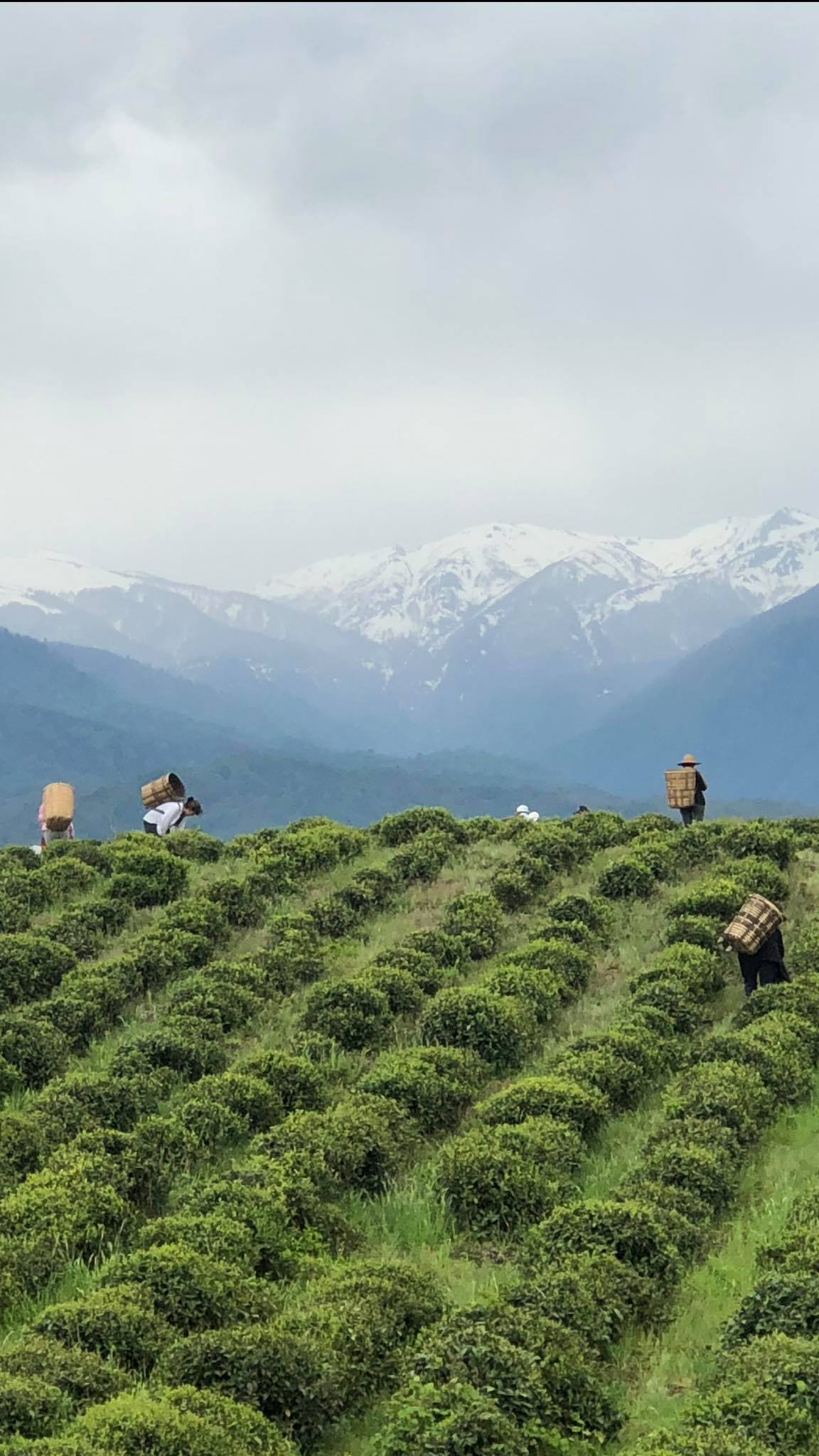
Showing posts with label Greengold. Show all posts

Saturday, May 18, 2024

Greengold Georgian Mze Etseri (yellow) and Qvevri Etseri gaba processed black tea


Mze yellow tea left, Qvevri gaba black right


I picked this first sample to review randomly, Qvevri Etseri, not knowing that it was gaba processed.  I tend to not like those.  A sourness often comes across that makes the experience less pleasant than if it wasn't there.  

I tried a second tea afterwards, their Mze Etseri (including the plantation name, per one description), to help keep moving through a broad set of samples they sent for review (many thanks for that!).  It seems to tell more of a broader story about how personal preference mixes with more objective quality themes in evaluating teas.  

Quality level is pretty good for their teas.  I don't tend to mention flaws, as much as describing tea aspects and character that one might like or not like.  Limitations in intensity or sweetness don't come up so much, but someone might see balance or refinement as issues, given the styles tend to be novel.

I can cite descriptions from a catalog that I've downloaded from their website in the past, which isn't available through the main links there to it now.  They might be updating descriptions or types range in that.  These had been listed in that reference through their main web page:


The grape flavor reference reminds me of how purple leaf Assamica tea versions tend to include sourness and fruit along the line of grape.  Probably I would've "noticed it" if I'd read that description before the tasting, inclined towards that interpretation by that.  

I don't think anyone's interpretation is a clear, objective, final description of tea aspects, but if you taste the teas a few times, and stay open to varying interpretations, the description outcome would be closer to that.  It's not practical for tea blog review; trying them once and writing and editing notes takes hours, and it's too many hours doing two rounds and then merging notes.


I interpreted that flavor as floral and then fruity in later rounds, not exactly as citrus, but that could work, as a less intense version of that.  I did mention honey and nuts; their description is fine.  Marzipan is an interesting description, and one that's not familiar to me; here is Google's description of that (surely an AI compiled version):


What is Marzipan? Marzipan, also known as almond candy dough, is a smooth and pliable confectionary paste made from almonds that can be used as a cake icing or molded into candies. It features a clay-like consistency that makes it easy to handle.


Review, Qvevri Etseri gaba processed black tea


#1:  that touch of sourness is definitely there, but it's balanced by other pleasant flavors, and not so pronounced.  There's no chance this would be a favorite version as a result but it might be fine.  Other people don't mind that aspect as much as I do; personal preference works that way.  

Other warm tones are a bit malty; that part is nice.  Mineral depth is pronounced, seeming to extent to a touch of salt.  There's never salt in tea, I don't think, but it's interesting when some mineral range can resemble it.  Some of the rest might lean a little towards cacao, but I'll do a more complete flavor list over the next round or the one after, when it all seems clearer.


#2:  that transitioned a good bit, mostly in a positive sense, but one part is mixed in pleasantness.  A wine-like character entered in; that's nice.  A kind of funky vegetal flavor range also picked up, along the line of endive or mustard greens.  Or maybe neither of those is right; I tend not to eat that kind of vegetable.  It's like dandelion leaf, if that helps, which probably doesn't since that's not something people eat.  Spice-like tones also pick up a little, but they're not easy to make out beyond the warm tones, touch of sourness, warm mineral, hint of cacao, and odd vegetal input.


#3:  it falls into slightly better balance, but this is still really strange.  It's hard to imagine someone drinking this and experiencing one of their most favorite flavor profiles, but then preferences do vary.  

People tend to drink gaba processed teas for a relaxing effect, and I won't notice that.  I'm not sensitive to drug-like effects from tea, and I'm feeling a bit hazy from experiencing an unrealistically long day yesterday.  I ran 12k (8 miles), walked 5k doing errands, watched Kalani play for two hours, then did more errands, busy from 8 in the morning until 9 at night.  I'm feeling it.  I'm quite calm but tired.


#4:  this is brewed a little stronger.  I don't think that will help with separating and defining flavors, it's just to try it made differently.  A sun-dried tomato savory aspect picks up.  This would be quite pleasant without that one sour note.  With it I wouldn't drink this just for flavor experience.  At this point that savory edge stands out most, along with a wine-like background flavor, and then warm tones below that, some mineral, that sourness, and more vague warm flavor not so different than cacao, but really not distinct.  It seems that one vegetal aspect evolved and split into a wine-like flavor and the savory sun-dried tomato part.  

I'll probably drink one more round and then set this aside; it would be nice to try another version to get through more of their teas.  Apparently they make a lot, and I'll be leaving Honolulu to go back to Bangkok in two weeks, for the summer, so it would be nice to finish more of this cycle of tastings.


#5:  maybe this balances the best that it has so far; all the flavors are evolving to integrate better.  It may be for the best to brew this Western style to get it all to mix from the first infusion.  It comes across more like a standard black tea, with those odd flavor inclusions mixing and reduced in intensity.

In a sense this isn't a fair trial because I don't like gaba teas.  Maybe a reader who does can read through all this and place how they would like it if that sourness wasn't interpreted as a negative inclusion.


Mze Etseri, yellow tea:


#1:  this is nice.  It's unusual, and interesting, but not as challenging as I found the gaba version to be.  It reminds me of trying yellow teas in the past, but I may have only ever tried three versions of those, or at least that's all that come to mind.  There's an unusual flavor aspect in them, as I remember, which is also included in this, a fermented light edge, not dis-similar to how one type of cardboard smells, like a shoe box.  But it's better than that sounds; it mixes with other flavor range in a nice way.

Brighter honey and floral tones stand out, along with dry mineral and that cardboard edge, which might be closer to balsa wood.  I suppose there is a faint hint of sourness in this as well, but it's hard to notice, and depends on judgment whether it is even that, where you couldn't miss it in the gaba version.  A flavor that I'm describing here as floral stands out; it's distinctive, and I think truly in that range, but it could be interpreted differently.  Warm sweetness makes it all integrate well, along the line of the taste of beeswax (or smell of it; beeswax is an odd thing to try and taste or eat).


#2:  it's even better.  A creaminess really picks up, in the feel, which can at times remind you of the taste of cream as well, as occurs in this.  The flavors I described last round integrate a lot better, and they were already pleasant then.  Those include rich floral tone, honey sweetness, warm mineral, towards beeswax, and then a touch of butter or cream.  Feel is a bit thicker, and aftertaste lingers in a pleasant form, even though I brewed that last round fast.  

At their best these Greengold teas can really catch lightning in a bottle, extending into really novel and pleasant range, balancing well, coming across as very refined.  Then other versions aren't quite as polished, or include flavor range I don't like as much; they vary.  Which versions are which, very novel and positive or else a bit of a miss, might vary with preference.  In some cases trying a version more than once can shift interpretation, since novelty can be very positive or else a little hard to relate to.  That might not apply as much to this version, but if someone had never tried anything similar to a yellow tea it might apply quite directly to this.


#3:  another shift; a touch of fruit seems to come out.  It's non-distinct enough that it's hard to place though; maybe along the line of yellow watermelon, a little sweeter and different than the red version.  There's a freshness and brightness to this, which is odd, since that contrasts with the warm tone and hint of extra fermentation effect, a deepening of the flavors.  But it integrates; it comes across as all one experience, even as one flavor, even though it's actually complex.  

Maybe instead of describing the fermented range as like cardboard or balsa wood it's more like how a library smells; a mix of paper and binding materials scents, complex from relating to thousands of books, but also kind of distinct.  To me it's pleasant when combined with the fresh floral and light fruit range, but then someone else might not like it; I think that part relates to personal preference (again) instead of objective judgement.


#4:  an interesting spice tone picks up, quite similar to lemongrass, just maybe not exactly that.  A long infusion might draw out something else entirely; I had planned to stop taking notes here but maybe I'll try one more round.  A richness to the feel and flavor of this might also relate to nuts, to something like Brazil or macadamia nut (probably the second).


#5:  that was a really long infusion; I got distracted and forgot the tea.  It's still ok brewed extra strong, just with a stronger underlying base, which has shifted to light green wood tones brewed so strong.  There is no astringency edge to come up but the related feel is stronger, a little towards structured or drier.

This isn't all that close to green tea character, not vegetal, without the same feel edge.  It's hard to compare it to any other tea type; it seems most like yellow tea.  The closest might be a mild green tea like Taiping Hokui, or a fresh and sweet oolong like Bao Zhong / Pouchong.  


Conclusions:


Of course I liked the yellow tea version a lot more.  Maybe it is even better (objectively), beyond just matching what I like most.  Then again I never could relate to what people see in gaba tea versions, which supposedly has to do with feel effect, and it must also relate to preference or openness to that flavor range, the distinctive sourness.

To me the second yellow tea version was really distinctive, interesting, well-balanced, and positive.  Parts of that apply to the first too, the gaba version, but it's hard for me to move completely past that one flavor note.


where I run, beside Diamondhead, with extra clouds since it has been rainy lately


the kids!  it was mix and match outfit day at her school.


Tuesday, April 30, 2024

Greengold Georgian Tovli Esteri white tea


On to reviewing a Greengold Georgian white tea, their Tovli Etseri version.  It's part of a set of samples the owner, Nika, sent for review (many thanks!).  Many have been novel, pleasant, and high in quality, with some not suiting my personal preference as well as others, how that always goes.

It's this, from information in a catalog available through their website:


There are no prices on their website, since they are a producer, only selling teas at a wholesale level, not through a checkout style sales page.  Anyone really interested in the teas, who isn't a tea vendor, could still check in with them about buying them; it couldn't hurt to ask.

It's not as easy to pigeonhole Georgian tea styles as it might be in other places, with exceptions different from the norm anywhere.  Versions and styles seem to vary.

One thing I didn't do in this review is compare these to other interesting white teas that I've tried recently.  It can be hard to keep track of really fine details, and it works better to compare secondary aspects like intensity, refinement, feel, and novelty more directly, not across months of time.  I think in terms of pleasantness and those factors some others have been comparable, maybe more on par with a Chinese version than a Thai example, but that could be wrong. 


Mao Feng material Chinese white tea and Wang Put Tan Thai shou mei, reviewed here


Review:


#1:  a bit light, to be expected for this proportion being lower than normal, and quick, with the leaves needing time to saturate.  What does show through is pleasant, honey sweetness, bright melon, light floral tone, and sweet straw-like warmth.  This is what you'd hope it would taste like.  

Thickness of feel comes across already, even brewed quite light.  Not at rolled oolong intensity, but you can pick it up.


#2:  warmth and depth increases a lot.  In a limited sense intensity does, but this is still subtle, there's just a lot going on.  It's hard to break the flavor list down, given how integrated and subtle the flavors are, but in a limited sense there's a lot going on.  

Melon still stands out more than the rest to me.  Warm tones include something like the straw-like sweetness before, picking up, now towards a light wood tone, like fresh sassafras root.  It's a sappy and sweet scent that lots of lighter woods give off, when you peel a thin leather-like bark from a younger tree.  Interpretation as light and warm floral could make sense but to me it's not exactly that.


#3:  I let this soak more like 30 seconds to try it brewed a little stronger.  The earlier thick feel shifts to feel creamy now.  There's a sweetness, richness, and brightness to this that reminds me of the taste of cream.  The fruit range evolves just a little, a hint towards citrus.  It's a stretch to say that this tastes like Creamsicle, the Popsicle flavor, but it does bring that to mind.  Aftertaste range picks up a bit brewed slightly stronger, lingering more.  

This is quite pleasant.  To be clear I'm probably using positive terms to interpret flavors related to liking it.  That straw-like aspect might taste like balsa wood instead, or someone could take issue with flavors seeming subtle, the intensity.  That's just white tea for you though; if moderate intensity seems negative it's probably better to stick with other types.  Some oolongs can cover similar range and be more intense.


#4:  warmth very gradually keeps picking up.  This shifts towards a dry fallen leaf flavor range, just brighter, sweeter, and more fruity than US fall tends to cause.  It reminds me of sweeping the driveway in Bangkok, where tropical plants dropped lots of fine leaves and flowers, many from fruit trees.  The next infusion shifts slightly again, but keeping this short works since that's already the basic story.


Conclusion:


Really nice!  I tend to not care much for the most subtle range of white teas, when intensity is so limited that they don't taste like much, but this was nothing like that.  The sweetness, creaminess, melon fruit, hint of citrus, straw-like warm tones, and evolving leaf flavor range and touch of citrus were all very pleasant.  

The tea was subtle enough that pushing it a bit to bump intensity might still make sense, but I wasn't really doing that, and there was still plenty to experience.  For sure this would give just as good results using Western brewing, and it may also work out experimenting with cold brewing.

Monday, April 22, 2024

Greengold Daisi black / red tea


I'm trying another Georgian tea sent for review by Greengold, following review of a white / green version, an oolong and roasted green version, and two black teas.  All of these have been interesting and pleasant, and none really completely match styles from other places, standing alone as novel type versions.  Quality was good for all of them.

It works as an intro to clarify that often vendors sell relatively fully oxidized teas as either black or red tea.  Red tea, the more literal original Chinese designation, is often used for styles that are less oxidized and sun-dried, matching some Chinese processing range.  Black tea is almost always used for Indian / Sri Lankan style black teas, which tend to be more fully oxidized, and may or may not be presented as very broken leaf.  Those conventions can be a little loose; either term could work for any related teas.

From an online product listing on their website:


It was really nice, and the review descriptions I wrote match that fairly closely, as follows.


Review:


#1:  brewed a bit light, still opening up, but already malty.  It includes warm and sweet tones similar to malty Chinese black teas, not a bit drier and stronger as is typical for Assam.  It leans a little towards cacao but flavor might be centered more on fruit, along the lines of dried fruit.  It's complex, but unpacking that to a list might be difficult.


#2:  brewed a little too strong; funny how that cycle happens so often, overcompensating for a last round.  A few layers of flavors dial way up in this.  Mineral base picks up, including an inky aspect.  Savory sun-dried tomato range joins in.  Some warm tones remind me of an effect from roasted teas, no longer close to cacao but more into coffee range.  That mineral is so pronounced that it seems to include salt.  Sweentness is fine; it helps the rest balance.

It will be interesting trying this brewed more optimally, if I ever get to that, to see how these flavors balance when it's brewed better.


#3:  better!  Mineral still does include a touch of salt, seemingly, which matches with the savory note, and kind of works, offset by the rest.  Complexity is really good in this; there is a lot going on.  None of it really seems like a flaw, just interesting character instead.  There is no sourness or tartness (maybe a trace, balancing with the rest), no musty flavor; it's clean, rich, and bright.  

I can't place this as similar to any Chinese tea, or from anywhere else.  I guess that's fine, that it's novel and distinctive.

Fruit range is interesting, and a bit hard to place, towards a fruity version of floral experience.  It might taste a little like the Thai roselle tisane, rich and sweet, a little towards rose petals, but not exactly the same.  The warmer fruit range might be along the lines of dried tamarind.  It's hard to separate those inputs out and define them, with all the rest going on.

It's a little early but I might try to place how much I like this.  It's good, pleasant and interesting.  I keep having the experience of it being more complicated relating to a completely novel tea experience, at this stage in my tea journey.  It's almost as if repeating variations of earlier experiences would be easier to relate to, versus having new ones.  People seeking out repetition of an earlier experience might not be as interested in this tea.  Then of course it's also pleasant for offering something new.  I had neighbors new to better tea experience try one of the Greengold teas I had reviewed earlier and they absolutely loved it, one of their favorites in a set of interesting versions.

I've been drinking a Thai version of shai hong, Yunnan sun-dried, slightly lower oxidation level black tea, that this is closest to.  It's as different as similar, with that a little more tart, and flavor set not exactly matching, but the range is closest to that.


#4:  warm and sweet tones pick up, and the savory range stands out more than the mineral aspects now.  I like it slightly more like this, and it was already pretty good before.  It balances in a more conventional way.  I would guess that this would brew quite well using a more conventional Western approach (conventional across the count of all tea drinkers; probably more tea enthusiasts would tend to Gong Fu brew this kind of tea).

You experience this across your tongue and the rest of your mouth in an unusual way.  It's intense, and the experience coats your mouth, as flavor and feel, with that pronounced mineral range and sweetness lingering on.  Feel isn't dry or rough, but it has full body.  For the aftertaste some warm mineral, fruit tones, and a lighter cacao / coffee sort of input carries over.  That last part has shifted back closer to cacao brewed lighter, or maybe that's just part of the transition cycle.

Oxidation level seems low in this; that probably contributes to it having an unusual character.  Tones would warm further and flavor range would be more familiar oxidized more to a conventional level.  As it stands the result is quite novel.


#5:  Fading a bit, but still quite pleasant.  This will stretch for a few more rounds if I add more infusion time, and it seems those will still be pleasant, but it's on the way out.  I'm not noticing a completely new transition, more a mix of what occurred before.  Some of what I listed out seems to fade as a root spice tone picks up.  That savory edge and unusual mineral, right at the edge of salt, is still there, and most of the rest, just faded now.


Conclusions:


Pleasant, complex, and novel.  Note there were no mentions of any kinds of flaws, typical for their teas.  

This did seem to be processed to back off full oxidation level slightly, evident in the color of the lighter brewed rounds, and in the flavor listing.  Of course I'm not mentioning vegetal tones here or anything like that; I mean that maybe it's not completely oxidized, but not in a more medium oolong-level range.  It's good.

It always helps to place how good a tea is in comparison to value, relating quality and pleasantness in comparison with cost, since that range matters.  A pretty good tea selling for 15 cents a gram can be a much better value than a better version selling for 30.  Greengold is a producer, selling their teas wholesale through other outlets, so their website that I mentioned isn't listing per 50 or 100 gram prices, or any prices at all.  

This tea holds its own with quality level for most of what is sold through Western outlets related to teas from other countries, all the way up curator sites where only the absolute best quality teas are sold for quite a bit, well over that 30 cents per gram range, then this might stand out less.  If this somehow absolutely matched someone's style preference then never mind how much or how little it costs, it would be fantastic.  I really liked it.

Wednesday, April 17, 2024

Greengold white-green tea


I'm trying another Greengold Georgian tea, one labeled as "Greengold white-green" tea this time.  The hybrid style theme sounded interesting, with more detail about it in their related website page:


მწვანე ოქრო /mts’vane okro/, in English meaning “Green Gold”, this is how Georgian ancestors were calling tea. Green Gold product has specific altitude in manufacturing process: tea leaves are plucked in specific area of our plantation and specific time (weather, degree level, moisture level, period of the day), which generates special aroma and taste of this tea.


The liquor has a soft, smooth and medium-thick texture. The moistened leaves have a distinct grapefruit juice odour. The infusion gives frank aromas of herbs, fruits and flowers. Its finish is slightly dry and ticklish. Sweet and refreshing. It gives you the body sensation of an instant heat.


Interpretations of flavor aspects are never completely consistent, between vendor descriptions and reviews, and how different people would identify flavors, but all that is pretty much it.

There would be one objectively more correct interpretation, wouldn't there?  In my opinion not really, but I can relate to the opposing conclusion and opinion, that there is.  Flavor aspects are complex in teas, as the compounds produced in the process leaves would also be.  For sure there is a one to one mapping of some final compounds and flavors to those compounds found in other food items, but in general I would expect a mix to occur, not two or three distinct compounds determining main flavors, or even a half dozen.

As we infuse teas across a number of rounds it's very conventional for people to interpret flavor profiles as shifting quite a bit, as the main effective compounds producing flavors varies.  For sure it was all present initially in the dried leaves, with the same compounds present in all infusions, but those are being extracted at different rates, in different proportions, and it seems likely that we tend to interpret sets of distinct flavor inputs in complex ways.


Review:


#1:  this could definitely pass for green tea; it's fresh, vegetal, sweet, and a bit floral.  I like it, even though green tea isn't a most favorite style range.  When green tea balances well that sometimes-annoying grass and vegetable flavor range can really work, as it does in this.  Longjing works around that by tasting more like nuts or toasted rice.  I can appreciate the umami intensive Japanese green tea styles but they're really not a favorite, so this more standard range I'd like better.  

Or maybe it is a little like white tea, and I've just not sorted that part out, including some less vegetal, sometimes warmer range.  Sweetness and brightness is really pleasant in this.


#2:  there is a distinctive flavor range in this that I'm having trouble making out, something that seems to reoccur in these Georgian teas.  It's along the line of a spice note, or maybe that's not it.  A touch of mint seems closer.  I had eaten a couple of those Girl Scout cookie Thin Mints not so long ago and thought it was just that carrying over in the first round, but I think this does taste minty.  It might be that paired with a savory note, so it's like a touch of mint and a bit of sun-dried tomato combined.  It's quite catchy. 

That sun-dried tomato range trails over into a unique mineral range too, which tastes almost like salt.  By that I mean that somewhat distinct flavors seem to relate to each other (perhaps already clear enough).  The range I'm describing as floral doesn't come across as distinct or pronounced then, because there is a lot of other flavor going on.  


#3:  the balance of these flavors is shifting but the set is the same.  I might be missing a spice related aspect description, in there along with the vegetal range.  It's not simple identifying that vegetal range; it's not far off fresh green bean but that's not it, closer to sugar snap pea or fresh soybean.  If I had to pick one it's sugar snap pea.  Feel is decent in this, not thin, but aftertaste really stands out, trailing on as a strong flavor experience after you swallow.  Length, that's sometimes called.


#4:  the brightness and sweetness fades a little, with depth and warmth picking up.  I'll give this a longer soak and see what I make of that and close taking notes.  

It's possible that this is a tea and tisane blend; one leaf doesn't look all that similar to Camellia Sinensis.  That might explain why the flavor is so distinctive.  Even though there is plenty of complexity, lots of different flavor range, it all integrates, so that it doesn't seem like some sort of blend to me.  Of course it could just be varying "real tea" plants that match together, or an extra herb that somehow does, along with those.


it's clear enough which leaf doesn't match the others


#5:  more of the same, including more transition in the same direction.  That vegetal range is quite different now, more onto a spice range, still including a bit of mint, and considerable sundried tomato savory tone.  I might like it better like this, less like a conventional green tea now.  The brightness and freshness being more intense did work well, with this still kind of bright and fresh.  


#6:  I let it brew a really long time, forgetting it, and flash-brewed the next round to mix them together.  Vegetal range increased again, into some sort of plant-stem type range, which doesn't mean much in relation to what a more conventional brewing outcome would've been.  It was still nice.


Conclusion:


An interesting and pleasant tea.  Maybe how much I like teas often doesn't come across in reviews, since I focus on identifying aspects and comparing to standard styles more, with the second not as relevant in this.  I never did get far with placing this as somewhere in between white and green tea.  

I liked it.  It was fresh, intense, pleasant, well-balanced, and novel.  I could probably even drink quite a bit of this, as a routine tea selection when I felt like having something approachable, light, and fresh, stepping back from the edge in relation to the normal sheng pu'er intensity.  It matches what I remembered of their teas, that the quality level and pleasant character hold their own with really good teas from anywhere else.  There isn't a single mention of an aspect flaw in this review for a reason.


Of course green and white teas are not completely unrelated categories, but it's odd considering a type to be in between them, instead of one or the other.  White tea is for the most part just dried, not processed in any other way, beyond some potential degree of wilting, allowing fresh leaves to rest.  Green tea is kill-greened, processed by a main heating step, to suspend activity of enzymes that convert compounds into black tea, the process referred to as oxidation.  

Use of pan-frying, steaming, or oven roasting seems to make a difference, probably best optimized by pairing ideal processing with material suited for that particular step.  Oven heating seems to relate most to large-scale production, but I could be clearer on to what extent final outcome results are inferior to using the other processing / heating forms.


I could say more, and there is an interesting reference on oxidation / enzymatic browning here, but in general I tend to focus on what teas are like, not speculating about processing or other inputs.


There was an exception in this review; one leaf seemed to not be Camellia Sinensis, and I wondered if this wasn't a tea and tisane blend.  Probably not really intentionally, not created or presented as such, but it does seem like an extra leaf made it in there.  Interesting, right?  That never happens.  This is one potential explanation in their main website page information:


Our tea plants are surrounded by paulownia tomentosa trees.  The trees create the ultimately supportive environment for plantation’s growth.


That's not described as material used in blending, but the look does match that extra leaf (from their site):


On to many more questions, right?  Is that leaf even edible?  What should it taste like, and is it ever used to make a tisane?  Would it be healthy?

This reference is comforting:


Paulownia tomentosa is commonly known as Princess Tree, Empress Tree, Royal Empress Tree, Royal Paulownia, Fox glove tree, Kiri (in Japan), PaoTong (China), and Odong-Namoo (Korea). 

Paulownia plants are well respected in Japan, China and most of East Asia for its tradition, uses and quality of wood. According to traditional literature flowers and leaves are cooked and consumed occasionally for the treatment of fever and pain, and skin ailments [40]... The major polyphenol found in Princess Tree wood is Paulownin which belongs to a class of chemistry called lignan.


Other sources that come up in a Google search describe use of leaves of this type of tree as animal food input, and say that consuming the leaves isn't a health risk for pets, although for some related plant versions you shouldn't eat the flowers.  Brewing a stray leaf should be fine.  

The related Wikipedia page doesn't mention consumption at all, but brings up that it might be seen as an invasive species in some places, probably partly related to it being fast growing, and potentially capable of replacing other tree species.  A photo there makes it even clearer that it probably was a leaf from that tree type:


By Plantman - Own work, CC BY-SA 4.0, https://commons.wikimedia.org/w/index.php?curid=129895550


Maybe it's a theme that they could look into, using those leaves as tisanes.  For sure that would involve lots more review related to EU import, but a related tea and tisane blend might be pleasant and novel.

Monday, April 1, 2024

Greengold Georgian Kesane oolong and Phoenix roasted green tea


Nika of Greengold sent another set of Georgian teas to review, which I started covering comparing two black tea versions, and now I'm on to oolong and a well-roasted green tea.  Many thanks to him for these!

In that black tea review the versions didn't seem as conventional as I expected.  One was similar to one Chinese black tea in style, and the other was unusual.  I suppose trying the earlier set 2 or 3 years ago I'm not remembering how conventional or unconventional those were.  These may be a bit unusual.  I'll use the web page descriptions as an intro again:


KESANE, which is name of one of the most mysterious flower, which in Georgia grows only in Guria region. Our tea plants are surrounded by forrest which is full of this flower. According to the legend this flower is called "Forget-me-not". Our Oolong tea is made with such mystery recipe and after you taste, you will not forget it.

It is a golden tea that displays the aroma of woody, honeyed, fruity, roasted with a hint of vegetal notes. The taste is refined and full-bodied, sweetish. The taste is juicy and smooth, buttery, sweetish, with fruity sourness, spicy nuances and refreshing finish. The liquor is transparent, with a shade of a meadow honey.


PHOENIX tea is a roasted green tea, with a very strong aroma and taste, which makes it an unique product. It is made from morning-plucked fresh leaves and is being roasted on a very high temperature, that’s why is named after Phoenix.

Strong fire is the key to deliver specific strong aroma during the tea manufacturing process.

AROMA: HONEY, WOOD, FRUIT, VEGETABLE

Tea has strong aroma and flavours with some notes of cocoa, honey that gives it points of acidity and notes of aged wood. It has a sharp and delicately texture. The degree of taste balance and the predominant malt taste. It is true that in the mouth, the balance between medium acidity and medium amount of tannins make this tea honeyed, round and easy to drink that highlights the sweet flavour.


Review:


Kesane:  warm, rich, a bit nutty; I expected something else from the moderate darkness of color tones, for it to be even lighter.  There is touch of caramel flavor as well.  Feel is thick and rich too, which is atypical for a light initial round, especially if the flavor is still light.


Phoenix:  that's different.  There is a smoky input that stands out first, then an unusual type of flavor and astringency that pair together, maybe like tree bark.  This tastes like heavy pine smoke.  When you expect that it can be quite pleasant, especially when paired with suitable tea aspects, as with Lapsang Souchong.  When you are expecting a mild floral or vegetal tea, anywhere near typical green tea range, it hits a bit hard.  Mineral undertones are so strong that it tastes a bit like petroleum.

It's odd how the infusion strength differs in these.  The first isn't as light as initial rounds sometimes are but it seems like it will strengthen more in the next round, that it hasn't quite opened up, and this is really intense, even a bit much.  I'll need to use flash infusions for this tea from here on out.


Kesane #2:  it's odd how depth, feel, and richness come across as stronger in this than typical forward flavors.  The flavor is fine in it, along the line of root spice coupled with mild nut, brazil nut, macadamia or such.  A faint touch of caramel and light vegetal edge add complexity, so light that it's hard to define, but not intensity.  Sweetness is moderate but that input works with the rest.  It's odd that this doesn't remind me of any other tea version, strange that no other teas that come to mind have been like this.


Phoenix:  it balances much better for being brewed quite light, infused quickly.  Smoke input really stands out but it's not nearly as strong, and the unusual vegetal (bark) and mineral (petroleum) range have eased up.  Sweetness and feel kind of catch up; this makes a lot more sense now.  One obvious question is if people who love Lapsang Souchong would also love this, given that it's not even a black tea base paired with that smoke input.  I think that most would.

This may or may not even be a smoked tea.  It's pretty smoky though, and that input had to come from somewhere.  It's hard to identify other flavor range to round out a list.  It tastes a bit like pine, not only pine bark but also the needles.  There probably is more to notice that's being overwhelmed by the more dominant range at this point.


Kesane #3:  not transitioning too much.  A bit of autumn fallen leaves tone enters in, but that's pretty close to what I had already been describing.  I like this tea; to me this unusual character works.  It balances well, and is pleasant.  It's not far off typical shou mei white tea range, comparing more to that than to most oolongs.  It's odd trying one very light and subtle tea along with an intense one; it might work out that I like this more for the other being a bit dialed up.  

I'm a sheng pu'er drinker, and was just discussing how unusually high intensity might be part of the appeal of that for me, but it took awhile to really like that flavor set, and what's going on with the Phoenix version is new to me.


Phoenix:  not transitioning much either.  Intensity is moderated by using a really short infusion time but this tea is strong.  

It might come across better paired with food; some of that intensity might make more sense while alternating it with a breakfast or snack food, something rich and intense in flavor.  This might pair well with gingerbread or red velvet cake, something that isn't subtle.  Or this might even be fantastic with a conventional American breakfast, with fried eggs, bacon (especially smoked bacon, setting up a parallel between the two), fried potatoes and so on, all with a glass of orange juice.  

This might even be a rare tea alternative that a coffee drinker seeking a match in intensity might love.  It's not the same as a French roast coffee but it overlaps in a few different ways.  That intensity builds up as you sip it a few times, almost changing in effect, and becoming too much.  I could add milk to this and see what happens, even though that's blasphemy in the tea world.

I actually did that; in one sense this tasting just went off the rails.  With just a touch of sugar this would really pull together, since that softened the intensity issue, but the smoky and pine tones are still a little edgy, even with that one part sorted out.  It would fall close to a London Fog, Earl Grey with milk.  

It might sound like I'm saying that this tea is so harsh that it needs plenty of adjustment, and this commentary can be taken that way, but as I see it I'm really discussing an unusual potential of the tea.  If you put milk in the other version it would disappear.  This can balance in a novel and pleasant way, as more intense Lapsang Souchong can.  Or just drinking it with food would seem to accomplish some of the same effect, resolving high intensity, but in a completely different way.


Kesane, #4:  I brewed this a little stronger and feel includes more of an edge now, not much compared to average tea feel range, but some.  Interpreted in other ways people could see this tea as creamy, or could interpret the nut / root spice / autumn leaf range as subtle floral tones instead.


Phoenix:  this balances better than ever; it softens and gains better balance.  The flavor list still holds up, it's just not similar to earlier in overall effect with the balance of those inputs shifted around.  The challenging part eases up; it wouldn't make as much sense to add milk to this, as brewed this round.


These teas are far from finished, brewed Gongfu style, the notes just stop here.  I tried them for a few more rounds and they didn't transition that much more.


Conclusion:


Interesting, pleasant teas.  That roast level in the Phoenix was a bit aggressive but if you were expecting that, or even seeking it out, it could be quite pleasant.  If you expected a light oolong or moderate roast Wuyi Yancha it would seem burnt to a crisp.  It worked out as Lapsang Souchong works out; you have to like that range to get them, and then it's pleasant.

Oddly I feel like I could relate to these better if they matched standard Chinese or other-origin tea character.  Then that's about needing clear and defined expectations to appreciate tea character, which seems strange to me.  Did I lose experiential flexibility along the way?


The Kesane oolong works well for a mild and unique oolong range.  Maybe it reminds me a little of a gentle white tea, with the full feel and macadamia nut range flavors very approachable.  I would guess that if you try brewing it in different ways and adjust to the character more complexity would stand out, that you could get more flavor range out of it.  Probably trying it alongside a much more intense tea didn't really do it justice.

For the Phoenix tea you just have to be ok with a high roast level.  From there varying brewing approach could adjust intensity, and could shift experienced aspects some, but it's going to be smoky and intense.

Well-roasted green tea is unusual, isn't it?  Then it's back to whether a type being novel is ok or not.  It is if you think it is, if you like the aspects and character.  Aging it a year or two would probably tone down that smoky intensity some, and from there pairing with food or even adding milk would also work, as discussed in the review.  Just dropping infusion proportion would help, the amount of tea used in relation to water.  Or drinking a smoky, intense tea could be nice, if someone's preferences align with that.


Wednesday, March 27, 2024

Greengold Georgian black teas comparison, Taiguli and Kolkhida


I'm back to reviewing, trying out two Greengold Georgian black teas, Taiguli and Kolkhida versions.  Those names don't mean anything to me, so I'll cite their website descriptions following:


TAIGULI, in English meaning “Bouquet”, is made from freshly harvested finest tea leaves. Full of tips and plucked by the hands of the local villagers. Made according to the traditional Georgian Black Tea technology, with some corrections of the modern one, that gives an unique taste.

An ideal fine tea to drink until mid-afternoon. The light amber color indicates that it is a black tea. It is a clean tea since it does not present any glaze or deposits. Bright and alive tea. The aromatic intensity is moderate.

The liquor has a predominant malt aroma. The wood is sharp and you could almost tell it is unique. The taste of the tea is sweet at first but is slightly bitter and light-bodied when swallowed.


KOLKHIDA  TEA is made on Black seaside historical region “Kolkheti Lowland”, where high mountain fresh air meets the sea breeze. This special place has it’s unique climate which has an effect on the leaves. Unique KOLKHIDA taste, which you can find only in Georgia, comes from the Kolkhida tea leaves, which is massively used in this tea.

A fine tea, clean and bright, apparently dense, that can accompany you throughout the day. The liqueur displays malty, spicy and cooked lemon aromas. Sweet tea with a smooth body. The malt flavour remains for a long time. You can also appreciate a camphor flavour that gives a burning sensation.


I might also mention that the last set of teas I tried from them, also sent by Nika of Greengold for review, was fantastic, much better than I could have expected they would be.  I suppose that set a high level of expectations for these, and although they were pretty good it was a lot to live up to.

We had talked to Nika in a meetup back in 2021, which includes more of his story, about renewing production at an older tea plantation in Georgia.  That's covered in very limited detail here, in a post with more about two of the earlier black teas.


Nika, and tea plants


I've just moved back to Honolulu, here for 3 months to rejoin the kids, who are finishing up their second school year over that time, who I've been separated from for almost all of the past 7 months.  It's great, being in Hawaii.  I should write a post about what it's like here, since adding a couple of pictures and a couple of sentences wouldn't do it justice.  

Probably being at the tail end of jet lag and busy with kids' spring break activities didn't help with this review.  It was rushed, as they tend to be, but I had less initial focus to work with.  Brewed tea color is all over the place, surely related to shifting infusion timing.  Part of that relates to zeroing in on an optimum, and checking results at different infusion intensities, and it's also partly about that lack of focus.  It's not quiet where I live now.


Review:


Taiguli:  a little light; I used the standard approach of getting a first impression from a light round before a true review test.  This is interesting; moderate oxidation level input maybe?  Flavors are warm and pleasant, along the line of soft and warm malt.  It has some oolong character for lacking much astringency edge, and being soft and full.


Kolkhida:  this tastes like a familiar flavor set from teas sold as Golden Monkey in China.  Those teas always have a Chinese name too, and a typical origin area background, but that's the kind of thing I explored more in my first years trying and writing about teas, that particular type range.  Later I stayed more focused on Dian Hong, with Fujian, Chaozhou area, and Taiwanese blacks mixed in.  A different but related malt range stands out.  This extends more into rye bread scope as well.  A stronger infusion will help with adding more flavor and character breakdown.

To clarify I don't think this is a complete match for that style; I'm adding these comparisons as a reference point.  The teas definitely weren't made to copy any Chinese versions; they're presented as local products that represent modern, updated interpretations of traditional local tea styles.


Taiguli, #2:  I might have went a little strong, compensating for the slow start, brewing these for about 20 seconds.  This definitely has some edge now.  The flavor set is interesting and unusual.  It includes herb notes, along the line of fennel seed.  Sweetness is pleasant.  There are fruit tones that are hard to break down to a list; maybe along the line of dried elderberry.  The feel has an unusual dryness to it.  In the end the effect is interesting but not overly well balanced.  Drinking this brewed a little lighter will probably help it balance.  

Going back and drinking this after the other tea there is a vegetal range aspect that stands out, which is hard to describe.  It tastes a bit like when you bite into a grape seed, extended on to leaf character, so maybe like tasting a grape plant leaf or stem.


Kolkhida:  interesting!  For favoring Dian Hong most, Yunnan black tea, it's still pleasant, but not the optimum range and balance, per my preferences.  It has nice depth, and it seems to balance better, for the different layers or inputs to support each other better.  

One part is that malt tone, no longer as dominant as a singular main flavor, which again extends to bread range, or even fennel seed.  Another aspect is a savory but sweet quality, along the line of sun-dried tomato.  Mineral range is pronounced, with one part of that range coming across almost like salt; that's unusual.  I just drank a Thai version of pressed shai hong yesterday that this overlaps a good bit with, with a touch of tartness, as occurs in that tea as well.  To me it hangs together well enough.  It might evolve in character and balance even better during a third lighter infusion.


Taiguli, #3:  I'm not reaching the optimum infusion strength balance here; this is too light again.  It works like this but it's no good for ideal experience and review.  Vegetal tone eases up and warmth stands out more; it's nice.  It's not my favorite black tea range for the set of aspects but it's fine.


Kolkhida:  a wine-like character picks up, entering in where sundried tomato and some berry left off earlier.  This also isn't my absolute favorite black tea range, but it's closer.  I like these teas but it's odd not absolutely loving them.  All of the Greengold teas were so good the last round that I couldn't critique them much in terms of style, quality, or aspects range, and for these two how much someone likes either would depend on preference.  It's as if these are more experimental versions, working with different styles to make different forms of tea.  It seems like the first, the Taiguli version, is backed off in terms of oxidation level.


Taiguli, #4:  the best this has been; that's a good sign, that it evolves positively, even though it's also about just getting an infusion strength balance right.  Warm and sweet tones stand out the most so far, with pleasant spice-like undertone.  There's a little tartness and vegetal range too.  The next infusion, #5, is even better, but these notes leave off here.


Kolkhida:  this balances better than ever too.  A higher level of sweetness is pleasant, and the mix of aspects balances better.  That sun-dried tomato savory tone really complements the rest.

One thing I'm not commenting on here is a range of weaknesses or flaws that aren't present.  If teas are truly badly made then more sourness would occur (although I suppose either of these could be interpreted as slightly sour, I just don't see it that way), or flavors could be murky, less clear.  Sweetness could be lacking, throwing off balance, or vegetal tones could be even stronger, although there is some of that in both these, just more in the Taiguli version.


Conclusion:


Good teas, interesting and pleasant, even though these aren't a direct match to my favorite black tea aspect and character preference.  I've been spoiled for drinking some amazing teas over the years, and tend to focus in on range I really love, the warm and sweet, balanced, cacao, roasted sweet potato and yam, Chinese date towards dark cherry fruit in Dian Hong and related style versions.  Vegetal range and tartness doesn't come up much, in what I tend to drink.  Neither version of these was tart but one included some vegetal range.

I don't see any of the aspects in these as any sort of flaw, just normal style variations.  The quality level was quite good.  The form of malt in these varied from Chinese tea versions and Assam, for example, closer to one Chinese tea version in one case but still a little different.  I think I might have really loved their oolongs better earlier on, and for being surprised at how good all the teas were I might have built up an unreasonable expectation from memory, expecting all of them to match the best of any teas made anywhere.  These were good, pleasant and distinctive, but they don't change everything for me related to tea experience.

It's an interesting start, and there are many more samples to get to, again shared by Nika of Greengold.  I expect that character of most others will be as good or better, and that many will match my main aspect preferences even better.


on a ridgeline hike, again


Hanauma Bay, a wonderful nature preserve and snorkeling area


sunset at the beach; in Waikiki, near our small apartment


Saturday, May 21, 2022

A tea tour and conference event in Georgia (the country)


first posted in TChing here.

An online contact / friend, Alexander Zhiryakov, mentioned an upcoming tea conference event in Georgia, which reminded me that I've not ever mentioned trying tea from that country in a TChing post. What I have tried was nice. Some versions from a number of years back, from Moychay, were kind of mid-range for being novel or pleasant, but still ok, and unique in style.  More recent versions from Nika of Greengold were very unique, and better than still-being-developed styles should be, really exceptional. A couple of reviews are here and here.


Nika!


That was because Greengold was working with a reclaimed old Soviet plantation, so the growing plants part was already covered, they had been thriving there under natural growing conditions for awhile. That just left processing, which went surprisingly well, related to them doing some networking and drawing on other resources and experience to replace processing development guesswork with experienced input.  All that will be part of this tour and conference event, since they will visit Greengold.


That friend mentioning the event, Alexander Zhiryakov, was the main founder of Laos Tea.  I met him in a Moscow tea tasting some years back related to that role and theme.  He's not the sole organizer of the event, but he is involved with that process.


Alexander is on the right


the version including Dasha


This doesn't really directly relate to Alexander working on different initiatives to set up tea testing based quality standards, overlapping with a broader evaluation theme. A group of friends and I talked with him and another Russian friend in that informal online meetup series last year, described in very limited detail here.


It seemed like an interesting event for combining a few main themes, the first of which is local tea background, drilled down to reviewing growing plants and processing demonstrations, including limited hands-on experience of tea making, and of course trying teas.  Then a second part related to tea judging tea versions, then auctioning some category winning versions and favorites. Then there was a related social outing afterwards, local gathering and hiking outing theme. It sounded great.


More specific details about that event (with meals and tea tastings along with event steps not mentioned in this summary):


Dates: 15 - 17 July 2022 

Place: Ozurgeti, Georgia (capital of Guria provice, the main tea region).

Travel related:  The nearest international airport is Batumi, 48km away from Ozugreti, with the Tbilisi and Kutaisi airports as alternatives.   


Day 1:  visit mountain tea garden (Greengold), learn about tea plucking and processing, how green and black tea are produced.

Day 2:  Travel to Anaseuly Tea Institute and Experimental factory, learn about Soviet tea science in 1950’s, and modern leaf compound analysis, with later sessions about tea tasting process and experimental processing techniques.

Day 3:  Tea fest opening in the Park of Culture, Ozurgeti, competition, awards, and beginning of tea auction portion.


Afterparty (separate):  in Bakhmaro, mountainous resort south-east of Ozurgeti, at 2000 m elevation, tea tastings and hikes.  


More information and related contact details will be posted in a Tea4b.com website notice, by the time this TChing article is posted.


two Greengold oolongs, really nice teas


It seems like in other tea areas local competition between producers tends to prevent these kinds of events being arranged.  Tea competitions or conferences are common enough, just not this scope, which overlaps some with guided tea tours, the parts about visiting producers and hands-on sessions related to making teas.  It would work in places like Wuyishan, or Assam or Darjeeling, but tea tourism is already established enough in many areas.  People already visit for vacations or to connect with producers, either related to a tour guided theme or else on their own.


Covid must have made it difficult to develop any new event ventures of most kinds over the last couple of years, unless those related to an online context.  It's nice to hear about a novel travel related theme, with great timing for shifting focus off other Russian news.  Potential disruption related to a "special military operation" being conducted by that neighboring country must bring up concerns about travel disruption, but from what I've seen of other recent tourism videos in Georgia there are great travel options there, and the country isn't experiencing any problems related to those events.