Showing posts with label Mengsong. Show all posts

Sunday, November 23, 2025

Tea Mania Yibang and Mengsong sheng pu'er, from 2013 and 14


I'm reviewing two partly aged sheng pu'er versions from a Tea Mania set of samples I received awhile back.  Many thanks to Peter, the owner, for sharing them for review!  All their teas are exceptional, for the most part, so that drops out one potential concern, about whether I'll like them or not.  

Farmerleaf is like that, to add a reference point for people who aren't familiar with them.  Styles vary some; Farmerleaf is oriented more towards what that particular harvest year turns up in a local area, mostly in Jing Mai, but also beyond there, and Tea Mania uses limited input from a very reliable set of producers, from different areas.

In recent Reddit tea sub (group) posts two themes came up that relate to these, which I'll only touch on a little here.  One is semi-aged tea, particularly relating to dry storage, and the other relates to brewing dragonballs.  I didn't know where these were stored, when writing the notes, but the site listing usually includes that.  It wasn't in a place as humid and warm as Bangkok or Malaysia, and probably somewhere in Yunnan, where conditions vary a good bit.  

My input was that it can make a lot of sense to drink medium aged teas (in the roughly 10 year old range) when they are aged in dry conditions, changing very slowly.  Note that people use the terms aged or semi-aged in different ways.  For some aged sheng is 20 years old, period, so 15 years is semi-aged.  Others would shift around those times.  It really depends more on fermentation level, which ties to storage conditions input.

The same teas would push through a fermentation transition cycle fast where I am now, in Bangkok, losing the initial freshness and brightness over the first 3 to 4 years.  That's great for teas that need to change a lot, like Xiaguan tuocha versions, since they're much further through the process at 15 years, and pretty much completely ready at 20.  But for high quality sheng, versions that are approachable to begin with, it's not so ideal, unless you do actually drink the tea within that first 3 to 4 years.  Or you can wait for another dozen for more complete change-over, with 15 years old being the low end threshold for mostly age transitioned, even in wetter (more humid) storage.  This review covers more on that related to these two examples.  

But let's start with the vendor listings:


Yibang Gushu Spring 2013 (120 CHF, $148, for a 200 gram cake)


For this Pu-erh cake, teamasters Panda and Yang Ming used tea leaves from up to 300 years old tea trees (Gushu) and processed them into 200g cakes. We were especially looking forward to this Pu-erh because we personelly like tea fromYibang. The tea trees in Yibang are very special. The tea leaves of  the Yibang tea trees are noticable smaller in size and some of them turn under certain conditions purple.

Sichuan tea storage

Teamaster Panda was so kind and has left us some bing of this great tea. Since this tea was stored in Sichuan, the home of Panda, the riped very well. Sichuan is not as humid as Xishuangbanna but also not as dry as Kunming. In fact, it’s just the level we prefer.

Harvest: Spring 2013

Pressed: 2013

Taste: Fruity, a lot Cha Qi and a sweet aftertaste

Terroir: Yibang, Xishuangbanna prefecture, Yunnan province, China


Mengsong Dragon Balls ($62 for 80 grams, 10 8-gram balls)


My friend and mentor, Tea Master Panda, has once again dug up a rarity. Year after year Tea Master Panda has inspired us anew with fresh and well-known Pu-erh teas from the old tea mountains. But the lovers of stored teas were a little bit forgotten. For them we now have a well stored Mengsong Gushu from spring harvest 2014. Dragon Balls, Long Zhu in Chinese language, of 8g were made from the tea leaves in Yang Ming’s tea factory to offer the tea in small quantities or as a sample. The tea was stored in Xishuangbanna under natural conditions until 2020 and is already very ripe.

Harvest: Spring 2014

Pressed: 2014

Aroma: Mellow aroma, strong Cha Qi and fruity taste

Terroir: Mengsong, Xishuangbanna prefecture, Yunnan province, China


This same material is sold as 2014 gushu Mengsong cake, here, listing for $222 for a 357 gram cake.


Review:


Yibang:  that's very nice.  There's a really distinctive spice tone in this, in between sassafras and driftwood, or including those, and maybe some other range.  It could seem a little fruity, but it's mostly that.  Tones are warm, but this hasn't transitioned that much for being a dozen year old version.  It must have stayed in a cooler and dryer place.  Yunnan?  I'll check the description at the end.  Feel is nice, but it's too early for describing that just yet.

Later editing note:  Peter (Tea Mania) is describing this storage as in between humid and dry, but my own baseline relates to where I live in Bangkok.  Teas change fast here.  I don't think that's ideal for all types for all aging levels, but it is perfect for moving things along, if that's the intention.


Mengsong:  one of the challenges is going to be getting this to open up.  There never will be a parallel to the infusion cycles.  One positive about brewing dragonballs, which is mostly negative, as I see it, is that since the inner part starts to infuse over the first 4 rounds or so there is fresh, bright character being extracted across a lot of rounds, instead of it all transitioning over the first 3 to 5.  But beyond that it's a hassle getting it to infuse, and you don't get as clear an impression of the tea character at different stages for that mixing together of parts of the infusion cycle.

It's too light for description just yet, but this tea is really good.  There's a pretty good chance that I've tried it before; it seems familiar.  It's bright, floral, sweet, and light, but even for all that you get a sense of great intensity and complexity setting in, and maybe even refinement.  This tea version is probably worth the trouble of messing with dragonballs.  But in talking to Peter in the past, the Tea Mania owner, they pressed dragonballs to use as sample references for teas, not to sell as those, so someone buying this version--if it's still available--might relate to the cake form.

Later edit:  they sell both forms; that's convenient.


Yibang #2:  that interesting spice range picked up.  It includes medicinal herb spice as well, a general range that may or may not seem descriptive.  I get a sense that there may be a spice related flavor I'm missing referencing, that something out there does match this.  Or it's probably so complex that only a most distinctive range could match, and there would be more.  This includes sassafras, and also something like ginseng, and some medicinal spice or even incense spice (sandalwood, maybe).  Someone really dialed into this range would absolutely love it, and others might not like it.

Feel has a bit of body and dryness.  I suppose that seems to connect with what I'd expect from bark spice flavor, and again the specifics within this range are pretty open to different interpretations.  It wouldn't be unusual for someone to see that as connecting with warm mineral, or for others to miss that in a description list.  Brewing it on the fast side, slightly faster than I have been, is probably optimum.  Flavors are plenty intense, and as is typical for many warmer and mineral or mild earth oriented teas a lighter brewed intensity works better.

This certainly isn't "going dead" in terms of being in an in-between aging / fermentation transition phase, the awkward teen years theme people mention. 


Mengsong:  starting to infuse.  Warmer tones pick up in this already.  It's still fairly light and bright, especially for this age.  Where it lands in the balance is fine.  Bitterness has mostly evolved out of the flavor profile, as for the other, but I would have surely loved this at half this age, at higher intensity, with more bitterness, some extra astringency, and lighter flavor tones.  It seems like it's going to be quite positive just now, so I don't mean that as criticism.  

Flavors and feel don't always make sense at different ages and transition levels, but these both seem to.  Maybe because it's not a bit further along, because the transition process was slower due to cooler and dryer storage?  I'll add more on that in an intro at the editing phase.

A more flavor-list oriented description will probably make more sense next round.


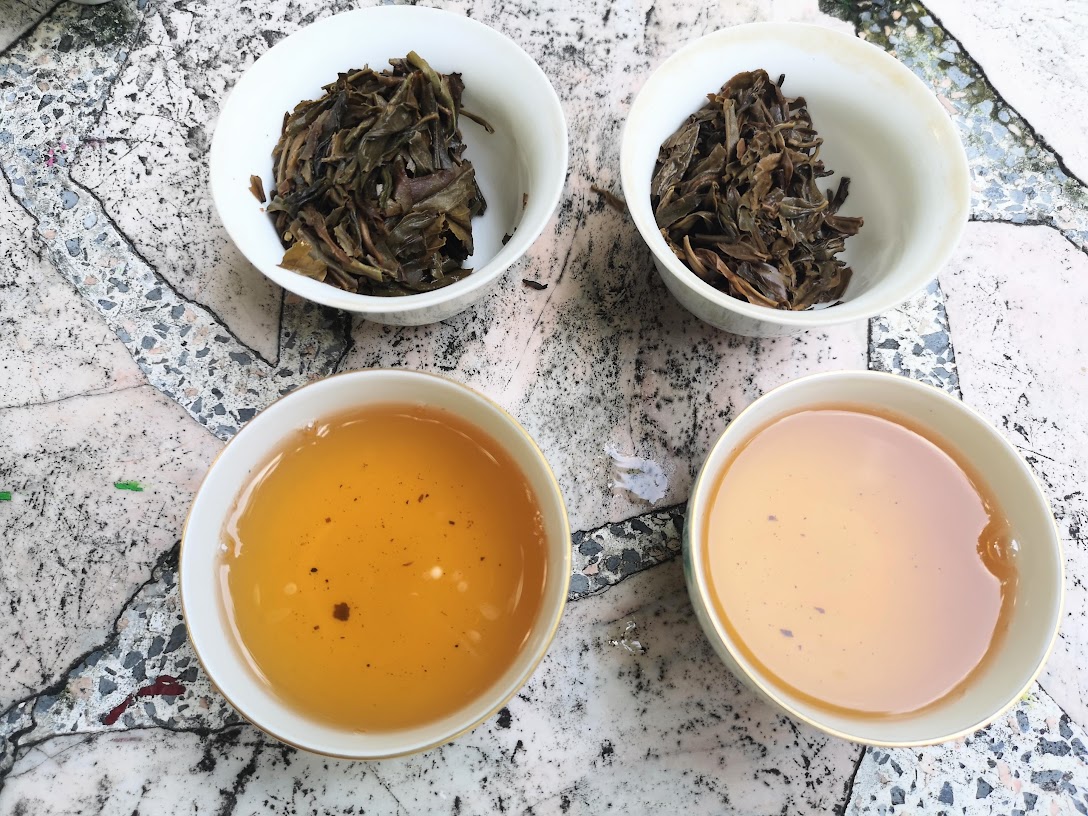
the fermentation level color difference is obvious, but the Mengsong does darken over rounds


Yibang #3:  brewed light this is really nice; intensity is still high, and complexity comes across even better.  I broke form and didn't brew 8 grams of this, maybe more like 5 or 6, and it was a good call, to help moderate intensity.  It's odd that so much intensity comes up this far into aging transition.  It's not bitter or astringent, it's just that the flavor is intense, and you get plenty from it brewed light.

It's still in that broad spice range, all warmer tones, just not heavy in character.  Again it's sassafras, some medicinal spice (maybe back spice oriented?), with some incense spice, along the line of sandalwood, to the extent I can remember that scent.  It would be funny if this tastes a lot like patchouli smells and I just don't remember that.  

There is also a light mint note in it, that integrates with the warmer spice so much that it's hard to identify.  Thais love to smell very strong scented mixes of spices, ya dom, to clear their nose or brighten their mood, and this isn't so close to that typical mix but it might overlap a little.  That mint might be evolving into camphor range, where it had been brighter before.  Camphor probably should be on the short list of main flavor aspects.


Mengsong:  this is finally unfurled enough that I'm breaking it apart, ripping it with my fingers, so it will brew much differently next round, and the one after it will be expressing a more developed character.  At this stage it's still quite light, but also very pleasant.  It's sweet, floral-oriented, and creamy.  

I'm starting to get blasted on these teas and this one isn't even really infusing completely yet.  I may need to eat something and walk around a little after the next round.  

Ordinarily it doesn't make sense to drink two together like this, not so much because you can't identify the effects of just one, although some people value that, but because you can't make it through a 7 or 8 round infusion cycle and still drink the 14 to 16 cups of tea.  I'm not throwing this tea away to rush the process; it's too good to do that.


Yibang #4:  the proportion of the long list of flavors I keep mentioning keeps shifting.  Now camphor stands out all the more, and incense spice has replaced a lot of the rest.  It's the best this has been, and it was pretty good in earlier rounds.  Feel is smoother, richer, and not dry at all.  Depth picks up, and aftertaste intensity expands.  All of that is from using a pretty fast infusion time too, 10 seconds or so.  

This is on a path of evolving and improving so much that it may be as good or better for a couple more infusions, then I'd expect complexity to taper off a little in later rounds.  Infusion 7 isn't exactly a late round, but I mean this has been evolving to be better and better, more complex and with more depth, and usually that doesn't keep up for the whole cycle.


Mengsong:  it's a completely different tea, now that it has started brewing most of the leaves.  Flavor range is similar, but intensity is completely different, and the balance seems different, even though the character is really the same.  Mild spice tones pick up in this.  Nothing like the intensity and complexity of the other version, the Yibang, and this still connects back to warm floral range, and a lighter mineral tone base.  Sweetness is really nice in this.  It's not missing in the other, but it stands out more in this.  

Layers of complex flavors mix together.  One part seems like floral or spice, as I've mentioned, then others could seem vegetal, in a sense that's hard to identify.  It connects through a warm wood tone range, which is back to sandalwood, or even a touch of cedar.  It integrates and balances well.  For anyone who doesn't drink young sheng it may seem to include bitterness, but for a sheng drinker the inclusion is so moderate that it's easy to miss the role a very limited input of that plays.  Sweetness and other flavor range are much more intense.

These kind of show how I think that slower, dryer aging works for some brighter character teas.  In Bangkok the heat and humidity would have overpowered and shifted the brighter range in these at half this age, at 5 or 6 years instead of 11 or 12.  That's fine for making Xiaguan more approachable, or Dayi numbered series cakes, because those need a lot of transition, but these would have great to drink at half this age / transition level.  And they're still exceptional now, just in a different form, and sense.  

Next one might wonder if you couldn't just drink a wet and hot stored version of these at 3 years old to get the same effect, and although it's a personal judgment kind of the call I think not.  Moving so much faster, based on fast bacteria and fungus input, the effect isn't the same.  Bright tones drop out quickly, within 3 or 4 years, and the warmer range that enters in is slightly different.  I'm not saying that wet stored tea has to become musty, although it can be, but flavor range tends to be heavier.


Yibang #5:  I let these brew longer because someone delivered a package just as I poured that round.  It's a different perspective on the tea, I just wouldn't have tried it without that prompt, for how these were in the last round.

Intensity is a bit much.  It's not ruined, but the character is much different.  A sappy sort of resin flavor and feel emerges.  Camphor is still pronounced, and a different balance of all that spice tone I kept going on about.  It's good like this, and nothing really shows up as a flaw.  Some people might not like this flavor set or character, but to me that's not related to a quality limitation.  It's a positive sign that it drinks well overbrewed (a little; I didn't leave it for too long).  Effect is still clean, and that dry edge to the feel isn't unapproachable, it's just more resinous.


Mengsong:  this approaches the other tea's character more than it had last round.  It also picks up a woody, aromatic spice resinous character.  A hint of cedar is pronounced, and beyond that it's more incense spice range.  These might be good as truly aged teas, in however long one judges that to take, maybe another decade at this somewhat slow transition pace.  They're not fading in intensity, and the evolved character for both is still positive.  Some versions seem a lot more woody, but that often relates to a lower quality level and less positive character earlier on.  

At a guess I would have liked this tea better at half this age, better even than as fully aged, in another 8 to 10 years.  That's more about me liking younger range sheng than how this is changing, or probably will change.  I get it that many people like refined, complex, deeper flavors of aged sheng, that it's a very natural preference, especially as a developed one.  If I would have been drinking more aged sheng than young versions over the last half dozen years maybe I'd be on that page.  I do drink some, regularly, but I love the freshness, brightness, sweetness, and intensity of younger sheng, even though bitterness and more astringency go along with that.  Not the kerosene oriented flavor and harsh feel of cheaper factory teas; I mean related to versions that are good within the first few years, or even as brand new tea.


Yibang #6:  brewed lighter again the balance changes.  It is taking on a slightly more woody flavor; this is kind of fading.  This could have easily been where it was at infusion #8, if that last round had been for a normal timing.  This is still really nice, complex, with a decent feel, and good balance, but it's on the decline.  I did brew a few rounds later on and they were still positive, not noticing any unusual flavor transitions, or fast decline.


Mengsong:  this could be where part of this tea only being on it's 3rd infusion helps.  It retains some of that early-round brightness and freshness.  I suppose some of the late-round extra bitterness is already entering in too, since it was infusing for longer earlier on just to get it decompressed, so it's a mixed effect.  

This is still really positive.  A little more wood tone enters in, but not to the extent the other is moving in that direction.  The brightness includes a touch of citrus; that's something I probably missed in the last two rounds.  A little of that creaminess and floral range reminds me of the high mountain character of Taiwanese oolongs; that's pleasant, along with the rest.

Related to my own preference I do like the Mengsong better.  Again I might've liked it more 3 or 4 years ago, but it makes sense at this level, and shows promise for how it will be as an aged version, much later on.


Conclusions:


That's already most of what I thought of these.  It's hard to express in terms of aspects just how good these teas are.  They're good; quality level stands out.  It's odd saying that along with commenting that I tend to like younger versions, so for me they'd probably have been better a few years ago.  It's not at all a conflict, as I see it.

Value can be hard to assess, because the range of what is out there like these is limited, in comparison with younger / newer tea range.  Same for quality level; plenty of tea this good is available, but not as much as more ordinary versions are.  You'd have to know where to look to find it.

The Yibang version sells for $148 for a 200 gram cake, equivalent to $264 for a 357 gram version, and the Mengsong for $222 for a 357 gram cake of the same material.  That's a bit.  Only people with somewhat open tea budgets would consider these, but for sheng enthusiasts who value higher quality aged versions, who have that budget, $300-400 cakes are not such an unusual theme.  Or $1000 and up; there's no limit.  It's beyond the range I'm familiar enough with to critique, really.  But it's probably fair, maybe even a good value.

As I mentioned in the notes I've not leaned into exploring better aged sheng versions, and kind of couldn't, given that this higher pricing extends all the more to sample range, where none of it would be under $1 a gram.  In that sense buying 80 grams of the Mengsong for $62 is a good value.  People already feel however they do about the dragonball form, who are already in the process of exploring above average quality sheng pu'er.  It seems like a dozen years ago the conventional reaction was that it's a great way to try a little of these types of teas, and then within 8 or 9 years ago a loose pu'er community consensus was that they don't brew very well, so they stopped turning up as frequently.  Of course they're still around, even as newly pressed versions, but not like a decade ago.


cats coming down with the flu has been a running theme lately


her too


Sunday, July 27, 2025

2011 Bulang and 2012 Mengsong Malaysia stored sheng pu'ers


I'm reviewing two older sheng pu'er versions, again from the Legend of Tea vendor in Malaysia (sent by them for review; many thanks!).  This should be interesting for balancing out a set of different aged versions from them and from Tea Mania, a Swiss vendor I've also been reviewing teas from.  

I'll cover their listing description, then the review, which I essentially always write before reading any description.


2011 Xiao Ba Wang Raw Puerh Tea  (Bu Lang origin, $77.70 for 200 grams, equivalent to $139 for a 357 gram cake)


The raw material selected by XiaoBaWang in 2009 is from BuLang Mountain, which is one of the six ancient tea mountains in China, and it is also one of the most famous Puer tea production areas. BuLang Mountain is located in South Asia, with a tropical monsoon climate, full of sunshine, abundant rainfall. These natural conditions contribute BuLang Mountain Tea as a legend in Puer tea.

Tea liquor tastes high sweetness, after 9 years of storage in the pure dry warehouse, it becomes thick and smooth, not astringent, not dry, and docile.


A little to unpack there:  that may well be tea that's two years older than the pressing date (which isn't so unusual), with the 9 years time-frame just relating to when the page listing was updated (in 2020, it would seem).  The "dry warehouse" part relates to natural storage, per discussion with the vendor; conditions weren't maintained at a consistently high humidity level.


2012 Xiao Ba Wang Raw Puerh Tea  ($72.96 for 200 grams, equivalent to $130 for standard 357 cake)


XiaoBaWang 2012 chose to use spring tea leaves from MengSong Mountain, MengHai County. MengSong is one of the oldest ancient tea plant in MengHai, the history of MengSong Mountain minority tea planting is as long as that of NanNuo Mountain minority tea planting.

The tea leaves are tightly knotted, bitterness melts in the mouth, leaving a lingering aroma. The palate is rich and thick, with a sweet aroma of honey fruit.


That seems clear enough.


Review:


2011 Bulang:  it's pretty subtle at this point, warm tones and not much more.  It will open up a bit and strengthen, it's just a matter of how much.  I actually used a rinse this time too.  I'll push it the next round and add more description.


2012 Meng Song:  also subtle, also warm in tone, but a bit different.  Both of these express a slight mustiness, like old book or stored boxes smell, which I don't see as necessarily too negative.  That kind of thing can transition away within a round or two, as harsher astringency sometimes does in younger sheng.


2011 Bulang #2:  perhaps brewed a bit too long, from the color, but that will move things along.  This is definitely well-aged sheng, towards the end of that process.  Breaking that down to a flavor list is never so easy.  People end up mentioning descriptions like camphor, medicinal herb, ju-jube (Chinese date), and old books, which are all reasonable and valid enough, but those can lend themselves to seeming a bit vague.  Medicinal herb could be a lot of things, and "old books" is sort of an underlying context or impression.  

This tastes a little like old books, or old furniture.  I suppose there's a sort of old tropical hardwood flavor going along with that.  Feel is interesting, with some fullness, and then also dryness.  I can't really place fruit or spice, and that list doesn't seem long enough yet, to describe what I'm experiencing.


2012 Meng Song:  there's a good bit more root spice to this, or something along that line.  It could be a bark spice.  Old books might also work.  It comes across as more intense; the other is still a bit subtle at this point.  Again feel has some structure and also some dryness.  Ju-jube might actually fit for this one; kind of funny it works out like that.


2011 Bulang #3:  it's funny how much intensity and complexity comes across in this, with it still hard to describe as tasting like much.  It has a lot of depth.  Warm mineral tones stand out, and that aged books sort of theme, more pronounced than it usually is, more of a main flavor component, versus a supporting aspect.  I've tried varying versions of aged teas that seem to just fade, and a warm depth remains, but not much else, and this isn't like that.  It doesn't work to say this is subtle, but in one sense that's true.  A faint woodiness is also present, like the deep washed-out scent of driftwood.  It's probably better than it sounds, related to how much I like it.


2012 Meng Song:  this is more intense, more conventional.  Old books flavor is also present in this, or maybe it's old furniture.  Again the rest is a bit like a spice-tone, maybe a root, possibly bark.  Interpretation as dried fruit could work, again with Chinese date working as well as any other.

Both are fairly clean at this point; that initial mustiness did drop out.  Mouthfeel is unusual for both, or maybe not that unusual related to how well-aged sheng go.  It's full in a different sense, even a little dry, with strong mineral tones seeming to match with that experience, with both carrying over.  It's interesting that mouthfeel can carry over, as is common with aftertaste.  These are definitely truly aged sheng versions, pretty far along for this being only 13 years old.

I used the broken parts of the sample for this Meng Song version; that probably affected the feel, bringing out even more dryness, which may soften over a couple of more rounds.


2011 Bulang #4:  it improves, but it's still subtle.  A warm sweetness picks up.  For people on this page this experience could be lovely, but for many others they just wouldn't get it.  I'm in the middle.  

It's complex enough that someone with the right background or imagination could list out a very long flavor and feel aspect list, and then for most it wouldn't come across as expressing much that's distinct at all.  Aged sheng can be like this.  

On the positive side this may well be a humid-stored sheng version that's now 16 years old, not 14, and for some trying a relatively fully aged version might be really novel.  It might mellow and deepen a little but it's pretty much there.


2012 Meng Song:  perhaps easier to relate to for stronger flavors emerging, and more distinct individual flavor range, rather than mostly depth and mineral, with aged books or furniture range.  It might taste a little greener at this stage (in the infusion count, related to transitions over this brewing cycle).  It's warm, and well-aged, with almost all the vegetal range switched over to warmer flavors (aged wood, spice, etc.), but the process isn't absolutely complete, it can still probably change more.  13 years is a long time in warm and humid storage conditions, but it's still not the same as 20 to 25.

Both of these express so much warm mineral depth.  It's one thing to say that, but hard to convey what that is like.


2011 Bulang #5:  it shifts a bit into spice range, maybe a subtle root spice, along the line of ginseng, or maybe some medicinal herb type I'm not familiar with.  It's funny how it lacks more up-front or forward flavors but the depth adds up to an experience of complexity, and even intensity.  It's also clean, and heavy on mineral base tones.  It's interesting.


2012 Meng Song:  this shifts, but it's within the same dried fruit / bark spice range.  It's really coming into its own at this stage, the best it has been.  Dryness fades, and fullness and richness pick up.  Trying them one after the other I do like this better, especially at this point, but the other has been improving as well, smoothing out and picking up more depth and complexity.


2011 Bulang #6:  a reference to something like a macadamia nut might help place what I've been trying to express, a nut type that is rich and complex, heavy with creamy flavor, but that doesn't taste like much, at least that's easy to pin down.  It tastes like a macadamia nut; that's it.  Some of that richness and fullness is present in this.  It might be closer to a Brazil nut, I think.  There's a warm mineral edge that's common across different kinds of tea, that's also hard to place.  Like driftwood?  Or subtle spice?  The aged books reference doesn't work as well since the flavor is so clean at this stage, but it might still cover a part of it.


2012 Meng Song:  that mix of flavors I've been describing doesn't seem like an ideal description, but it's probably as close as I'm going to get.  It shifts just a little each round, but the same set just comes across differently, shifting the balance of each input.  Warm mineral undertone is still a main part of the experience of both, and feel is unique for both.

Skipping reviewing late rounds isn't because there wouldn't be more to tell.  This covers most of the story, and it's too much for me to get through.


Conclusions:


It probably didn't help that I do those tastings on weekend mornings, and rush to get to errands.  Today it's a doctor's visit; yesterday it was something else.  For teas like these it's better to take your time, to drink them over an hour or more, letting the experience settle in.

They seemed good.  That would relate to preference, as for any tea type or version, and aged sheng is an unusual range.  It can be complex but subtle.  Maybe only the older Bulang version really seemed subtle, and even for that version that description isn't the best fit.

This reminds me of trying an aged sheng version (from Thailand) with a local contact, who was well-known in tea discussion circles back then, on Tea Chat.  He commented that it seemed about right, in the right range, and was pleasant, but it didn't work as well to describe what that range was, or why it was positive.  That might've been 8 or 9 years ago, and that tea was probably around this age then, or maybe slightly newer.  I'm not really capturing why these work out well here either.  Maybe if I'd added camphor as a description that would clarify everything.

Aged Xiaguan and other factory teas are completely different.  They wouldn't typically be this approachable at "only" 13 and 14 years old (or 16; the other may have been pressed from material that wasn't new), even stored in a humid and warm place.  Intensity would be dialed way up, probably with some aspects seeming like rough edges.

So just how good are these, and do they seem to represent a good version of "boutique" style-range teas?  I suppose that second distinction might be a bit broad to evaluate.  Styles and forms would vary too much.  To me they seem quite pleasant, like good examples of these kinds of styles, and it reduces down more to whether or not someone likes this type range of tea, transitioned through this form of storage input.  Maybe I do like the trade-off of rough edges and heavier barnyard flavors for older Xiaguan better, but that wouldn't work as well this young, no matter the storage conditions.  For this age these styles seem pretty suitable; they work well fermentation transitioned this much.

To make all that more specific I suppose it depends on whether someone likes the complex, layered, but somewhat subtle character of the Bulang, or the spice-range intensive distinctive flavor of the Mengsong version.  Again to me they're fine, they're good.  I suppose I liked where that younger Bulang was better (from 2021), how somewhat transitioned but still young floral range stood out.

Of course I can't extend all of this to any guesses about what these were like when brand new, or 4 years into aging.  It would be nice if I could, or if anyone else could.  With enough exposure some transition patterns would have to stand out, but it may not work well to guess what flavors had dropped out.

It's even difficult to specify how these relate to my own preference.  They're good, and I would like drinking each if I owned them, but nothing really stands out as something I couldn't do without.  It's nice how the Bulang expresses so much complexity and depth, even if forward flavor notes are limited.  The extra flavor intensity of the Mengsong version is nice, but that kind of root spice range isn't really a personal favorite.

Related to value it's an unusual opportunity to buy cakes of this quality and aged character for this general pricing range ($130-some, or both were really $70-some for 200 gram versions).  That's fairly standard range pricing for young sheng, at this point.  These are obviously a boutique style tea material and style.  That's not a great thing, if a tea ends up fading away, or aging results aren't positive, but these are good quality.  Maybe earlier on a quality marker could've identified the Tea Mania versions I just reviewed as slightly better, a little more complexity or depth, but at this stage, since they lack much for flaws, it's more about match to preference, instead of quality level being a limitation.  

I was hoping that more of a connection with the Tea Mania 2017 and 2018 versions would turn up (from Bulang and Hekai), but those are at the opposite side of the aging range, and I can't guess about what will lead to what to that extent.


visiting One Bangkok, a new mall


it's a good place to catch a movie.  if you've been considering seeing Fantastic Four you should go; it was great.


Wednesday, July 9, 2025

Legend of Tea 2024 Mengsong sheng pu'er


I'm reviewing a third tea from the Malaysian vendor I've covered not long ago, Legend of Tea.  These teas were sent for review (many thanks to them).

This theme is one I've been looking forward to, checking out a sheng pu'er version they sent.  I'm trying out reviewing it completely blind, only knowing that it's sheng, with all of the label in Chinese.  It's pretty good, but I'll let the review itself cover that.  Value is really good; I'll add more on that after I cite the vendor's description, following:


2024 Xiao Ba Wang Raw Puerh Tea

As a timeless classic from Legend of Tea, "Xiao Ba Wang" has upheld its reputation for 19 years by consistently selecting high-quality, cost-effective materials with good craftmanship to deliver premium tea at an affordable price for all to enjoy.

This year's Xiao Ba Wang is sourced from ecological tea trees in the high mountains of Mengsong Da Man Lü, this sheng Pu-erh boasts a fresh, sweet aroma complemented by the distinctive alpine forest fragrance. Its naturally refreshing profile is soft, sweet, and intricately layered, offering a gentle yet rich tea-drinking experience. Each sip reveals a long-lasting sweetness with a refreshing, full-bodied aroma that lingers delightfully.


This is listed at $25 for 200 grams, so it's moderately priced, on the low side for Western oriented in-house teas (under $50 for a standard 357 gram cake; you don't see that in the main Western outlets, unless it's for "factory tea," nothing of this general type).  

It's quite good for that price, the quality level (I try the teas before adding website content).  I'll say more about that in the review, and cite more about the listed vendor background here:


What is High Mountain Ecological Tea?

High mountain ecological tea is cultivated in pristine, pollution-free environments far from industrial influence. Grown at elevated altitudes in eco-friendly tea gardens, these tea trees thrive in an ideal natural setting, surrounded by year-round clouds and mist. The significant temperature difference between day and night enriches the tea leaves, producing a clear, sweet broth with a distinctive mountain flavor and lingering sweetness.

At first sip, the tea is sweet and soft, with a full-bodied aroma that unfolds in layers, delighting the senses and enriching the palate. The sweetness and smoothness spread gradually, leaving a deep, long-lasting impression in the throat. Xiao Ba Wang beautifully combines the freshness of nature with the warmth and precision of handmade craftsmanship, offering a unique balance of strength and softness that is truly unforgettable.


I take everything every vendor says with a grain of salt, but it would be nice if all of that were true.  The tea is good; you would expect positive results like that from this sort of source context.


Review:


#1:  a little light; that's how first infusions tend to go, when you don't stretch the timing to offset that, or use a rinse to speed that along.  So far it's nice.  Sweetness is still moderate; how that balances might be a main input to my own preference.  It's clean in presentation, no mustiness, off flavors, harsh astringency edge, and so on.  There is already some mineral tone coming out.  I'll save the flavor breakdown for the next round, but it seems nice, as if a few things will stand out, including some floral tone.


#2:  depth and complexity pick up.  Bitterness starts, but that's still moderate.  Mineral undertone is pronounced, of course in a light mineral range, nothing like in Wuyi Yancha or other roasted oolongs.  Flavor seems to include floral tones, and a creamy sort of feel is adjoined by a touch of creamy flavor.  Sounds like oolong range, doesn't it?  But the feel structure of this is sheng, and the included bitterness, even if it's not challenging.  

Warmer tones are hard to identify.  They could be interpreted as a savory edge, along the line of sundried tomato.  Or it could be interpreted as an herbal tone, even towards a green-wood edge, but to me more of a savory aspect that includes herbal range.  It's not exactly like pine, but not so far off that.

So what would this be, judging by just this?  Hard to say.  I don't have a catalog of distinct flavor profiles for broad and narrower Yunnan origins mapped out in my experiential memory.  It's not as smooth, floral, sweet, and "round" as Yiwu tends to be, but being approachable with some floral range it's not completely dis-similar.  The pine note reminds me of Jing Mai, but it's not clearly pine, to that same extent.  It's not edgy, intense, or challenging enough to be from standard larger areas like Menghai or Bulang (with intensity and complexity more the Menghai theme, and distinctive bitterness that could be paired with pleasant sweetness from Bulang).  So I don't know what it is, and probably won't.


#3:  bitterness ramps up a good bit; this is closer to where it's going to be, and may even lose some of the bitterness and challenging edge over a round or two.  But it's not really heavily astringent, or all that bitter, as more bitter versions tend to be.  That's significant, but it balances with the rest.  At this point it's the main part of the experience, so I mean balanced in the sense of still standing out most.

Sweetness isn't bad; it works.  I've become accustomed to fruity, approachable, complex South East Asian sheng versions, and this isn't that.  Aftertaste extends well beyond drinking the tea, and feel structure adds to complexity.  Flavor range isn't as distinctive as it might be.  Mineral tones stand out a lot, and some floral range, and an herbal / vegetal edge, more herbal than vegetal.  It's not unlike how ginseng root comes across; a bit vague, but also complex, with plenty going on.


#4:  more of the same; it isn't changing quickly.  Aftertaste and bitterness may both dial up slightly.  Intensity is definitely good, and again the balance and overall effect is nice, the lack of flaws.  Flavor range doesn't extend to anything so interesting, but it comes across as good tea, pleasant and intense.  

I think I'm feeling the effects already.  It just worked out that breakfast was light on carbohydrates (starch in particular), which seem to delay stomach processing of tea compounds, and protect from negative feel issues.  For me that's a good thing; I don't need to be getting stoned off tea.  But this seems to have significant effect, for people on that page.  

This may be a good quality version from an area known for being challenging, with this pronounced bitterness and feel structure only this approachable because it's whole-leaf material, and perhaps not low elevation / high fertilizer input grown.  People claim that older plant material has a greater depth to it, more mineral range, with extra aging potential, and that more wild origin material tends to pick up interesting flavor range from the environment, and to often be more approachable, while still complex, which could vary.  I suppose there's probably some truth to all that, it just doesn't help identify this tea.


#5:  still not evolving so much.  The earlier set of descriptions was already broad enough, and only the balance of the range mentioned keeps shifting.  Floral tone really isn't so pronounced, compared to the rest.  There might be some moderate fruit range evolving, along the line of grapefruit, probably a relatively sweet version of that.  Herbal / medicinal range stands out, but not as much as bitterness and the mineral base.  I'll look up what this is, out of curiosity, and leave off the notes here.  


I checked; it's from Mengsong, presented as high mountain, natural growth origin teas, maybe not forest tea, but from a diverse environment (as I interpret it; I've pasted most of the description there).  I've reviewed teas from Mengsong but again I don't memorize a matrix of origin-related character types well.  It is interesting how the flavor range I struggled with describing, saying it was a bit like pine, or maybe ginseng, possibly herbal or vegetal in some way, they describe as "distinctive mountain flavor."  That works.


Conclusions:


Just wonderful, for a tea presented as a moderately priced version (low, really, using Western outlet standards).  It's a throw-back to when Yunnan Sourcing was still trying to keep their Impressions series as a moderately priced offering.  Maybe they do release a modest quality version still, but last I checked most branded as such had moved on to higher quality, more distinctive specialization, and a higher price range, the typical $70 to 80 a cake that now represents the low end of in-house pricing.

Some of my reluctance to be open to that $80 to $140 current range is that I just don't have the budget to be buying and drinking that.  That's enough of an issue.  Then I also remember when the standard range for pretty much all cakes was $30 to 50, with some outlets pushing "white label" more exclusive pressings up closer to $1 a gram.  I tried some marketed as such, and never bought any.  To me buying a $100 tiny 100 gram cake is ridiculous.


Tea quality got better, over the last decade.  A middle of the range $100, 357 cake is now probably better than most of the range available a decade ago, or closer to that exclusive pressing version than factory teas, or the then-rarer in-house versions.  At the same time vendors working off a standard mark-up benefitted greatly from selling $120 cakes instead of $40 versions, so they embraced, or even led, the customer demand for better and better versions.  

"Gushu" was all selling for $1 a gram 5 years ago, when pricing was still going up.  Some surely was from older plant sources, but who knows, really.  Or from more natural growth gardens, as this is presented.  You could see from the pressed cake that chopped material had given way to more whole leaves, which is now more the standard form, outside of "factory tea" versions.


It's hard to place this version within the broad range.  One critique one might apply is that it was clearly high quality material, but not necessarily as distinctive as it could be.  With a bit more sweetness and floral range, or more distinctive bitterness, or other flavor range, feel, or whatever it might include, it would stand out more.  It's good though, reasonably balanced, clean, somewhat complex, and pleasant.  For this price it's probably better than it should be, and better value than you could find in the half dozen or so standard Western outlets.

It led me to looking at whatever else they sell, and a lot of the rest of their range is even more value oriented.  They tend to sell what looks like blended material pressings identified by year, by the Chinese zodiac sign that year.  To me this looks a lot like the Yunnan Sourcing standard themes.  Here's an example:


Year of Snake Raw Puerh, 357 grams, $14.82


Year of Roaster Raw Puer, 357 grams, $19.998, from 2016  (rooster; I kept the typo)


Those two cakes could change how someone is exploring sheng, or could just be extra daily drinkers to check out for someone years into the type preference.  Or they could be bad?  Low cost, low-medium quality sheng can still be positive, just not in the same ways that spending over $100 on a cake tends to work out.  You often give up aging potential.  But then you really need to try a tea aged to be completely sure how that's going to go, even after you are familiar with typical aging transition patterns.

That last one is a 2016 cake stored in Malaysia; it's hard to summarize what that might mean, if someone doesn't already know.  It's known for being a place to age tea quickly, the opposite of dry and cool Kunming storage.  9 years in Malaysia could represent a similar fermentation level to 15 in Kunming.  For a $20 standard sized cake!  That's unheard of in Western outlets, maybe beyond gambling on very mixed results through a vendor like King Tea Mall, a reseller who passes on whatever happens to turn up.

They do sell what is presented as more standard, higher quality, desirable origin specific teas.  Here is an example:


2009 NanNuo Ancient Tree Tea, $86.58 for a 357 gram cake


I've had fantastic experiences with the few Nan Nuo versions I've tried, and no average or below average results.  Here's their write-up for that tea:


NanNuo Ancient Tree Tea is a slightly domineering tea. The tea liquor entrance has a significant bitterness, which quickly dissipates and turns sweet, bitter with sweetness (just like Musang King). Since ancient times, NanNuo Mountain was a very famous ancient tea mountain. Meanwhile, there is also a key source of raw material for high-quality puer tea. There are abundant resources of ancient trees, which has made today's NanNuo Mountain a quality assurance reputation.


It's probably not that bitter at this point, 16 years later, stored in Malaysia (presumably).  But you don't have to trust their judgment, or sourcing aptitude, since they sell samples of lots of their sheng range (I didn't check if it covers this one; it doesn't, so for those more distinctive and costly cakes you would have to trust them).

For people open to gambling on an $87 cake that's an interesting option, 16 years old and from a desirable origin area.  Ordering other versions first could work, and what samples are available, to get a sense of their range.  

All of this isn't really intended as a sales pitch.  It's completely familiar background for people well into sheng exploration, or maybe not clearly thought through for people just getting started, or not yet started.  It's how you tend to evaluate new sources, and to decide what else to buy.  If a cake is in the $20 range sampling makes a lot less sense; you just try that kind of thing, and see how it goes.  Maybe not by buying a vendor's whole selection range, in case it doesn't work out; you'd mix buying a few types.  Having tea around that you don't like can be awkward.

But then if you aren't familiar with aging transition patterns that shifts things.  Some tea character / aspect starting points have plenty of potential, and some don't.  There's nothing like trying the same tea a couple times a year for 6 or 8 years to see how it is changing.  It can be awkward doing that if it seems great after 8 or 9 years, and then you run out of it, and can't buy more.  I sometimes buy a second cake of what seems most promising, then at least I'll have some after the exploration phase, even though a single cake isn't that much.

I'm not sure how this cake would age, what it would be like in 10 or 15 years.  Even more intensity might be a good sign, to build in potential for change.  They sell versions from this line going back to 2010, but those are from different identified origin areas, so not at all identical teas.  Versions from 2010 and 2011 are from Nan Nuo and Bulang, and sell for $81 and $78, which really could be a life-changing sourcing option if those are very good material teas.  

Now I wish that I could spend a few hundred dollars exploring those.  But I live in Honolulu part time on a Bangkok salary budget, and spend more on airfare than makes any sense at all, so I'll make due with what I can afford to try.  It could be interesting seeing what their lower end range is like.  One last tangent note:  they mention "dry storage" in one product description, for that 2011 tea:


The raw material selected by XiaoBaWang in 2009 is from BuLang Mountain, which is one of the six ancient tea mountains in China... Tea liquor tastes high sweetness, after 9 years of storage in the pure dry warehouse, it becomes thick and smooth, not astringent, not dry, and docile.


Dry for Malaysia is probably hot and humid for Kunming; it could all be relative.


Monday, November 11, 2024

Tea Mania Mengsong (2014) and Bulang (2021)


Another sort of contrasting type theme post, related to these being different ages.  Sometimes it can be interesting comparing a shift in character over storage time so directly, or in other cases it just doesn't make sense together.  We'll see.  Both versions are presented as gushu (older plant material).  Per usual I'll add the vendor description after making notes. 


Mengsong Dragon Balls (50 CHF or $57 for 80 grams, 71 cents a gram)


...But the lovers of stored teas were a little bit forgotten. For them we now have a well stored Mengsong Gushu from spring harvest 2014. Dragon Balls, Long Zhu in Chinese language, of 8g were made from the tea leaves in Yang Ming’s tea factory to offer the tea in small quantities or as a sample. The tea was stored in Xishuangbanna under natural conditions until 2020 and is already very ripe.

Aroma: Mellow aroma, strong Cha Qi and fruity taste

Terroir: Mengsong, Xishuangbanna prefecture, Yunnan province, China

There's no need to take the "already very ripe" part too specifically; it's a general claim that the tea has transitioned quite a bit.  Of course this isn't remotely similar to shou pu'er; it doesn't mean that.


Bulang Gushu 2021 Balanced  (99.76 CHF, $114 USD, for a 200 gram cake, 57 cents a gram)

I'm not completely sure this is the "balanced" version and not the "bitter" one, but I'd guess that it is.  The description:


...Reminiscent of the legendary 2015 Bulang Gushu, which we still fondly remember and has long been sold out, this tea promises a similar allure.

Echoing the legacy of both the 2015 Bulang and the esteemed 5-Village Blend, this Bulang Gushu shares a unique connection – it is sourced from the tea fields of a former school friend of Yang Ming. This personal touch adds to the tea’s story, making it not just a beverage but a testament to long-standing relationships and shared history. Enjoy the depth of flavor and rich heritage encapsulated in each cup of this exceptional Bulang Gushu.

Taste: Strong, intense and deep

Terroir: Bulang Mountain, Xishuangbanna prefecture, Yunnan province, China


Not much description there, but I included some of that marketing framing in anyway.  If the tea lives up to it then colorful backstories are fine.


The Mengsong version is dragon balls, pressed spheres, and the Bulang is a coin or disc, so they'll also brew a bit differently.  In both cases it will take 3 or 4 rounds to get them to brew consistently, but it won't throw off the character so much during those early rounds, it will just be less consistent.  For tasting purposes that might make more difference than for ordinary drinking; you tend to focus in on relatively minor effects when tasting, versus just accepting a general impression.

I'm getting to the end of this Tea Mania sample set (and the Tea Tracks set as well; the two I'd been reviewing back in September).  Both have been really interesting, pleasant, and consistent.  To me Tea Tracks follows more of a selective and limited curator vendor theme, and Tea Mania sells based on direct sourcing of exceptional character and value sheng, and other types.  Both would be good sources, but Tea Mania stands out for including so much range, and a few that are really exceptional in quality and value.  Most I've tried are good, so the best exceptions are really something.


Review:


Mengsong (2014):  the effect the age transition has had on this is interesting; 10 years is awhile.  Warm tones include warm mineral and plenty of spice range.  It's a little towards aromatic wood, cedar and such, but to me this is complex all within the range of warm spices, like incense spices, or even more aromatic woods like sandalwood.  

The character is interesting and pleasant, and it makes sense.  This hasn't entered into a range where it's just quiet, or awkward for being in between fresher tones and that deeper range.  


Bulang (2021):  that has a nice depth and a cool, interesting character as well.  These will be better than I expected.  It's not completely different than the other in terms of general range, with mineral and some spice standing out, but greener, slightly woodier tones are also present.  This has an unusual degree of depth to it.  It's odd saying that about sheng, which often expresses complexity, intensity, and depth, but this is on another level.  

One interesting aspect is hard to pin down, maybe more along the lines of root spice, sassafras or root beer.  Maybe that includes plenty of ginseng range, and I'm just not clear on that flavor; I haven't been messing around with ginseng for many years.  It's not as bitter as I would've expected.  There is some bitterness, but it's moderate.  It seems like it might've already transitioned some, because this expresses so much flavor range and depth, but it has only been 3 years for this tea, not so long.  It must have started out more "approachable" than it might have.

I did a long rinse first, which I discarded, and then went long on the Bulang, and quite long on the Mengsong, and these are opening up already.  Both might need a round or two more to fully open but this won't take as long as I expected; knowing what to expect seemed to make some difference.  You also tend to brew longer earlier on, to get that early process sorted out, so it's slightly off optimum for that other reason, that you need to make adjustment in some sense for it, either using a long infusion or accepting a few rounds will be less uniform, partly unfurled and partly not.


Mengsong #2:  that's so catchy!  I last reviewed a Mengsong version a week ago, so in one sense part of this range might seem familiar, but this seems a bit further along for transition (aging and fermentation), and interesting for it.  Looking back that was a 2019 Mengsong version (from Tea Tracks); not at all young.

I don't always relate well to partly aged teas, versions in between a half dozen and ten years old.  They can be promising, or pleasant, but often the experience is about potential, not what you experience at that time.  This is good, both interesting and pleasant.  There are layers to what's going on.  One part is warm mineral, another a warm spice aspect, and a menthol sort of edge balances the rest in an interesting way.  Camphor, I guess that I should be saying.  The feel is even ok.  It has a bit of dryness to it, which I suppose will sort back out and transition to something else over 5 or so more years, but it's not unpleasant as it is now.  It all kind of works.


Bulang:  this is unusually interesting too.  Intensity picks up; there is a lot to this.  Often that could mean bitterness or astringency is high in the balance, for a 3 year old sheng, but it's not disproportionate in this.  I'm interpreting this as including camphor too.  It's odd, because I don't run across aspects that seem exactly like that effect to me very often.  I might say "camphor" once a year in this blog, almost never by sheng drinker tea blog standards.

The other seems more pleasant to me, a better match to my own preference.  That's not a completely fair judgment, because the warmer tones, greater complexity, and depth of the other seems to derive from positive aging transitions.  It is what it is though; maybe this will be just as good or better in 7 more years, or maybe it won't be.  

This includes a perfume-like floral range edge, which is nice.  A touch of green wood feel counters that, not perfectly balancing against it, but more just offsetting it.  It's as novel as it sounds; they both are.  Very often for reviewing partly aged sheng it's about judging how positive aspects are, and how it matches within a range of conventional character types, and for the second these are both kind of unique.  In cases like these a close match to preference could make them seem amazing, or a larger gap from that standard of judgment could make one seem interesting but not as easy to value.

This has been a lot of tea already, two rounds in.  I'll already take a break to eat just a little, and drink some water, and might have to keep these review notes short, limited to less rounds than is typical.  Pushing intensity to get early opening-up transition out of the way is a part of that; it would've been easy to drink 3 or 4 quite light rounds if these were cake material that came unpacked well.


Mengsong #3:  the color difference is striking now, this version being so much darker.  This tea is really nice at this stage, as I've expressed.  I would expect it to only get better, to smooth out and deepen in character, and to not change that much more over the next 5 years.  That touch of dry feel will probably smooth out, changing to greater richness.  

I'm not doing "warm spice tones" justice in describing this, or explaining how it strikes a balance between remaining floral range and deeper mineral flavors.  The descriptions always only go so far.  Without as pronounced a mineral range the rest wouldn't tie together as it does.  Dominant spice range and camphor are a nice primary flavors set.  I suppose someone could still find that feel edge a bit objectionable, too dry, or structured in a way they don't like, but it seems nice enough to me.  


Bulang:  every round it seems that pronounced, sappy, root spice (ginseng / sassafras), camphor, green wood edge range can't develop to be more intense, and then every round it does.  It has a sort of pine edge to it at this stage.  To me that balance works a good bit better than a heavier green wood inclusion did last round, which is still present, but more secondary now.  I'll brew both these on the relatively light side next rounds, a fast infusion, and see how that changes things.  Infusion strength was relatively standard last time, not brewed too long, but out to about 20 seconds, so it could be lighter.


Mengsong #4:  it's even more pleasant brewed lighter, still really on the intense side, brewed for about 10 seconds.  Sappy, rich feel balances well at this infusion strength.  Flavor complexity isn't so different than what I've been describing, just shifted to balance a little better.  

A touch of pine may be picking up in this too.  It's interesting how closely these seem to parallel each other, relatively different, but with some repeating notes.  Some of that could be from the power of suggestion, me looking for what I've already been experiencing, but some flavor themes seem to link between these, even though just as much flavor and other character is quite different.


Bulang:  brewing this fast has broken the cycle of that one set of flavors emerging stronger and stronger, but it fits into a more pleasant balance this round, it integrates better.  Even the green edge it had seems to be softening, as an experience of depth picks up.  

I must admit I hadn't been completely sold on the gushu theme Peter and Tea Mania had long since been promoting.  Good tea is good tea, and a few minor character aspects seem to kind of link to that, like a little more mineral range, but it also can seem relatively overstated.  It can seem like people over-value a limited type of depth, and that it doesn't actually make the experience that much more pleasant.  These are a little different though.  

It seems like tea being well-produced, grown under favorable conditions, and also well-processed both mix as related inputs.  Producers realize that old-plant material is valued, that it commands good product sales pricing, so they take care to get growing conditions, harvesting, and processing dialed in.  Then beyond that there really could be significant positive effect from that one cause, plant age, but it would be harder to spot for it all tending to mix.


Mengsong #5:  this may be a good place to leave off; even with eating some sunflower seeds and nuts and drinking water this is a lot of tea to ingest in one go.  If an interesting later transition occurs I can mention it, since I'll drink the tea later, but to me it's enough of the story told covering most of the cycle (half the rounds, at most, but most of the changes).

Again balance is quite nice, and of course complexity, intensity, and depth.  It hasn't changed much from the last round.  It seems like this might be a better tea than I tend to run across, in terms of final character after aging that next 5 or so years.  Or maybe that's more a comment about a match to preference, that I like this style and aspect set.  Even for drinking it right now it's quite positive, unusually so for a tea at the 10 year aging mark.


Bulang:  this is good too; it's not as if it's flawed, or doesn't make sense, in a bad place to experience right now.  It doesn't match my preference as well.  That really unusual and complex flavor set is really something.  Both of these are quite rich and full in feel.  I've not been going on about aftertaste experience but neither is thin or limited in the least, so the full range of experience is expressed, including that.  


Conclusions:


I would guess that I always would love the Mengsong version more, as it ages across different levels of transition.  Both are interesting though, and there's no reason why it necessarily seems better.  That's just a match to preference based assessment, as I see it.  It would be interesting to try it in another 7 years to check on that, to see how it changed.

Value is hard to place for these.  They seemed quite good to me, and "gushu" material versions can tend to cost even more than this.  Of course I liked the older and more expensive Mengsong version more; it would work out like that.  I didn't go on and on about it in the notes but it seemed to include a bit more structure and complexity, and flavor tones had evolved a bit more over the extra 7 years.  I could probably never bring myself to buy 80 grams of tea for $57 but for people more on that page, into that range, it could seem like a good deal.  That also means that I've tried many samples presented as selling for more than this but I don't own equivalent cakes.

I really also liked the Mengsong version I covered in the last review, from Tea Tracks, another gushu version, from 2019, selling for $124 for a 200 gram cake (or presented as such; it's always hard to say).  That divide in age makes any sort of direct comparison problematic.  Trying them side by side I would guess about comparing quality level, character, and starting points, or mid-way points, but saying that both were very pleasant is enough.

If someone is into higher end, somewhat aged sheng pu'er versions this cost issue would have to be something they live with, or they could drink a different kind of tea, factory versions.  I just saw a comment by a well-known vendor about how preferences have shifted, and a decade ago factory tea is most of what there was, and these gushu / boutique producer / narrow origin material versions are kind of a new thing.  It is what it is.  Someone could see this framing as a bit exaggerated, and think that quality and positive experience doesn't justify spending around $1 a gram (with these significantly below that level, maybe a good deal for that, or maybe that's still pretty normal).  

One runs across the idea that boutique sheng doesn't always age-transition well.  I could type some more paragraphs on that but it's hard to get the bottom of related generalities, and I'd need another decade of exploring sheng to have a more informed opinion.  Not everything I've tried that is sort of similar in category background has been as positive as these.  Some styles are positive and interesting for a few years and then die off more than they continue to improve.  

One red flag seems to be when a tea is too approachable when quite young, when bitterness, astringency, and intensity are moderate earlier on.  Of course I'd be guessing to project backwards in relation to these, about their origin.  I'm not saying that they'd need to have been unpleasant or relatively undrinkable for the first year or two, instead that sweet, floral or fruity, and mild feel versions might not age well.

These two versions were really pleasant to experience just now, the main thing.


Saturday, November 2, 2024

Tea Tracks Mengsong Xiang (2019) and Ya Nua Gushu (2018)


Back to reviewing!  I quit while I visited family in the East Coast of the US, in Pennsylvania, and now I'm back in Bangkok.

I don't want to say too much about these, two sheng pu'er versions from Tea Tracks, sent by a friend to try.  I'm not that familiar with the narrow local areas, although Meng Song kind of rings a bell, and I don't know much about them for backstory.  The website mentions these details:


Meng Song Xiang 2019 - 勐宋  (114 Euro / $124 per 200 gram cake)


Meng Song Xiang is a village in southern Menghai. This tea is made of ancient tree material (gu shu, 古树). It has a full body and a pleasant bitterness, which lingers in the mouth as a fruity sweetness for a long time. Here is a review of the tea (in German): puerh.blog Meng Song review

Taste:  Soft yet bold taste. Upfront bitterness that turns into a sweet sensation.

Trees:  Old trees (gu shu 古树) growing in a natural environment

Origin:  Meng Song, Menghai, Yunnan, China


Ya Nuo 亚诺 2018 (You Le Shan)  (120 Euro / $130 per 200 gram cake)


Ya Nuo is a village on You Le Shan (mountain), one of the old six famous tea mountains in Xishuangbanna. This tea is made of ancient tree material (gu shu, 古树). The tea starts out very softly in the first brews with hardly any bitterness, but develops a nice sensation in the aftertaste. 

This is one of the teas that can clear your head on a cloudy day.

Taste:  Soft and subtle taste that develops a cooling sweet aftertaste.

Trees:  Old trees (gu shu 古树) growing in a natural environment

Origin:  Ya Nuo (village), You Le Shan, Xishuangbanna, Yunnan, China

Harvest:  early Spring 2018


The teas seemed pretty solid when trying them, but it's hard for me to evaluate value in relation to pricing beyond a limited range.  I could tell they seemed pretty good but not really how good.  I suppose then it's on considering how much I like them, setting that aside.  I don't buy pu'er that costs over 50 cents a gram, so of course I would run out of benchmark range. 

These are almost sold out on the website; there won't be much marketing function in describing these, since they'll be gone any day now.  The reviews might be partly about that but also just to communicate about trying teas, and to see what I make of them in notes.


Review:


Mengsong:  pleasant; definitely some bitterness stands out.  This flavor profile is somewhat familiar but I'm not going to do justice to describing it.  Beyond bitterness there is some sweetness, and from there identifying even aspect ranges is difficult.  Floral?  There is definitely a pleasant mineral layer, a little on the dry side, but pleasant in flavor and feel (to the extent that the two ranges map together).  There's good structure to the feel.

So far this just sounds like describing sheng pu'er in general.  It is pretty standard sheng, in one sense, just a better than average version, and only type-typical related to a subset, to Mengsong area versions.  5 years of aging has softened this, probably, although there is still plenty of bitterness and feel structure.  The tones have surely warmed some.  Maybe I'll readjust to reviewing more as rounds go by.


Ya Nua:  to me this expresses a distinctive root spice aspect.  Think along the lines of sassafras, but it's probably not so close to that.  It's not so far off the standard incense spice range, and if I had better scent memory of the main few incense spice versions I could reference one it's closest to.  That has the character overlapping just a little with aromatic wood tones.  Bitterness and mineral are dialed back just a little in comparison with the other, but it's still reasonably intense.  It might slightly less complex.  Better luck with deriving two flavor lists next round.


Mengsong 2:  I brewed these on the fast side for using a relatively high proportion, and for both being on the intense side.  It was still a bit much; I can switch to 5 second rounds to adjust further.  It's not that I forgot that I usually tend to overdo it with proportion, I just didn't offset it.

There's a catchy, familiar range in this I wish that I could describe better.  It's a way in which feel structure, bitterness, floral tone, and mineral all combine, in a very integrated form.  It comes across as a familiar set of aspects, that naturally pair together.  Maybe this is what people would seek out in standard Mengsong experience, a good version of it, but of course I can't claim that.  I don't retain a matrix of memorized local area types, and I might never, regardless of how long I kept trying different things.  

Would people seek out a 5 year old version, and how is the storage input for this if they were inclined to?  Those are harder to answer.  This aspect set is dialed in though; the proportion of everything is as it should be, and there are no flaws, no out of place aspects.  You're signed on for bitterness in drinking it, but to me that's moderate, even if it's higher than I would've expected for a partly age-transitioned tea.  Maybe this wasn't stored in a very humid place.  To me that's fine, aging and changing a tea over more slowly, unless there is a reason to get it moving quickly, for example to get a factory tea that will need 20-25 years to be good to cover that ground in 15.  I suppose at a minimum saying more about the floral range in this would be helpful, but not much comes to mind for labeling it.


Ya Nua:  this picked up a little depth and smoothed out some in character; it's better.  It's slightly more subtle now, but it still has a lot going on.  Bitterness hasn't faded but it's moderate compared to the other.  There is plenty of mineral range and other deeper flavor complexity, it's just not as forward and dominant as in the other version.  Spice tones still make up a main part of the experience.  Feel has decent structure, even a touch of dryness, all of which prevents it from coming across as thin.  At 6 years old (probably 6 1/2) this will head into that range where it shifts over from being new to old right around now, and maybe flavors seeming a little less forward now is a part of that.

As with the other it comes across as quite clean and well balanced to me, lacking flaws or limitations.  I suppose flavor complexity either settling out, for now, or being limited earlier on could be a limitation, but I see that as more character neutral, just how it is.  Something being out of balance would be more what I'm referring to, or a negative aspect.

At two rounds in I'm already feeling this.  I'm finally back in Bangkok, which is why I'm reviewing again, back in this familiar hot and humid environment, and even though it's 9 AM it's warmer than Pennsylvania had been during a cooler mid-afternoon.  It's too bad that more people back there don't appreciate the great tea drinking weather.


Mengsong 3:  this is shifting, in a pleasant way.  A bit more spice tone picks up, not completely unlike the range found in the other, just not the same either.  


Ya Nua:  less transition, but the tones may be warming slightly.  This seems like a good round to let it transition and get back to describing it more next time.


Mengsong 4:  it's interesting how bright and fresh this is, for being a 5 year old tea.  I could try to guess about how this has softened in character over that time, how it would've been more intense and challenging within the first year or two.  In part that would relate to describing what could be taken as positive about somewhat drier range storage.  Or maybe just a medium humidity and heat input range version; it's easy to pick up a biased judgment of norm here in Bangkok, where both are dialed up to maximum.

It's also interesting to consider where this will go from here, what relatively full aging might look like for it, when, and in what character range.  It needs at least another decade, or maybe more for full transition.  It's in a decent place for drinking as somewhat transitioned tea now, I suppose not so far out of entering into the teen years phase, when it might not make as much sense.  I certainly can't project ahead and list out likely flavor range to develop, but the intensity and balance at this stage seem like a good sign, that it's holding up well so far.


Ya Nua:  this is less complex and intense, but it has an interesting character, and plenty of intensity related to providing a pleasant experience now.  It's not muted.  The earlier spice range is still dominant, and a bit of vegetal range might've picked up as well, along the lines of tree leaf, not exactly like wood, but kind of related.  Maybe it only shifted in form, and it had seemed more like aromatic wood earlier, now vegetal in a different sense.  In most forms that would seem like a flaw, a subject I've already referenced, but with plenty of spice tones and mineral range it integrates well in this.

For someone preferring intensity of experience the other might be better.  One might question if this doesn't express a different kind of depth, related to the gushu theme, a standard idea that forward flavors might not be as intense but a base of depth could stand out more.  I don't know.  Both are fairly balanced; both have plenty going on across a significant range.  Underlying mineral range is a strength for both.

A different kind of acid test comes to mind, based on having visited "home" recently, drinking mostly a half dozen versions of tea for a month:  which would I keep returning to, if I had plenty of both?  I really love approachable, interesting, sweeter range, even fruity sheng, more than these two styles.  Sometimes I do crave a more intense experience, and it's not hard to appreciate good quality in tea versions.  Probably I like the Mengsong more.  It's more standard and less novel, in a sense, and would fill more of a craving for intensity and complexity, when that comes up.  I tend to go in cycles, and I'll even drink harsher teas sometimes, a bit here and there for weeks, like not quite ready Xiaguan tuos (which seem to never be fully ready, maybe until 25 or 30 years along, even aged in Bangkok).


Mengsong 5:  better than ever; the character really integrates.  In terms of description it's still about the same, but the balance has shifted to work even better.


Ya Nua:  this is still interesting for being on the subtle side, as sheng goes, related to flavor, which is perhaps a bit odd since it's on the intense side as oolong or black teas go, never mind white tea.  Then it has a lot of depth, including some bitterness, and great mineral range, so the intensity is there, just not in terms of forward flavors, as in the other.

It's breezy out just now; that's not usually the case in Bangkok.  At 9:30 it's sort of cool (30 C / 86 F and 71 % RH), or at least what I'll need to adapt to as cool for here.  At its maximum the PA "Indian summer" was in the mid-80s, but much, much drier.  Running there was fantastic.  It was easy to pick a time to go out when it was only 60 or so (16 C), so "cold" that your body heat would never accumulate.


Mengsong 6:  I'm maxed out for tea, and these aren't changing that much anyway, so this will do for notes.  Again it's interesting and pleasant how the earlier floral tones have transitioned more into a spice range.  The brightness, intensity, and complexity are all quite positive in this.  This seems like the kind of tea everyone should own a cake of, I just don't.  This version should cost a bit, for as good as this seems.  I suppose it's possible that the most recent peak in sheng pu'er costs happened just after this was made, so it might be more reasonable than I expect [not really, unless more current pricing is really high].


Ya Nua:  quite nice; good depth, good balance, interesting character.  I love the other one more, so that offsets that positive judgment some.  I think that has to do with relation to preference as much or more as quality, or it being more interesting.  I suppose local area demand shifts pricing as much as any of those other factors, so cost could relate to what other people seem to value, or at least what the market takes up and promotes.


Conclusions:


Both pretty good teas.  I kept going back and forth over how good while trying them.  They seem better in quality than they are a close match to my own natural preferences; I like them, but they're probably better than a match to my preference indicates.

Since other people sometimes value more aged character ranges that I don't love it can be hard to project ahead to what others might like later on, as they transition more.  Often I'd fill in more guesses about that, but it wouldn't be based on much, and would be unreliable, so I may as well skip that part.

I had a fairly typical experience with trying a tea in this general age range just today, the day after making these notes, so I'll mention that.  I re-tried a Nan Nuo version that I really liked, that I had drank most of the cake of back when it was new, made in a really bright, fresh, sweet, approachable when young style, from 2017.  It was still ok, but not nearly as positive as it had been 6 years ago.  It wasn't simply fading away as much as I'd expected, but it had been a good call to mostly drink straight through that over a year's time back then, setting a little aside to see how it might change later.

These are different, and especially the Mengsong seems to be retaining some intensity and complexity.  The Ya Nua version had interesting character too, it was just more subtle already.  It's interesting how sheng versions need to be made in a very specific style, related to aspects included, and I guess to how versions are processed, or else the flavor tones warm but they seem to oxidize instead of fermenting.  Or so it seems to me, but then what do I know.


back to my favorite tasting spot


cleaning up after a month of unmanaged growth in the garden


October must have been a bit rainy