Showing posts with label OB. Show all posts

Thursday, November 22, 2018

Hatvala Vietnamese Oriental Beauty

a local holiday theme; more to follow at the end on that


It'll be nice getting back to this familiar tea type, to do a review of a tea that's very pleasant, complex and subtle, but not challenging on those other levels (combined or blind tastings and such).

Geoff of Hatvala sent a few Vietnamese sheng to try, along with this version I'm reviewing (which is also from Vietnam).  I've tried previous years of their OB before, which were great, so it'll be interesting to try this one.  If it's the same version another friend talked about it's different this year, more subtle, complex and pleasant, but not as intense and forward related to the fruit and spice notes.

There is back-story to ramble on about related to the potential range of this tea type, how much versions vary, but I've been through all that.  Protests about Taiwan sharing the term "Oriental Beauty" do come up, but regardless of where someone stands on those naming convention issues the teas don't change.  Tea experience itself is more interesting to me than naming conflicts, history, and related rituals (even teaware, and that scope is completely functional).  Other functional issues like cultivar background or processing seem more interesting to me, since they're direct causes of how the teas turn out, but they can be hard to gain a clear picture of.

At best the debates over names and categories can be territorial disputes that are a bit irrelevant, people marking out their own space as special through holding onto their own words (beyond actual "counterfeiting" issues).  At worst it seems to just be trolling, about getting conversation stirred up versus actually making any point.  Language can be like that though; there is plenty of room for people to take use of labels differently than I do.  I suppose that relates to me not wearing that many labels myself.  I'm an American, and self-identify as a tea enthusiast, and beyond that different categories often get a bit hazy.

Review


On first sip it's clear the tea is great.  I can see how this comes across much differently than I remember the last version.  Some OB is bright and sweet, heavy on muscatel or other citrus.  Other versions can show more spice, earthy but in a sweet way, with lots of cinnamon and the rest showing up.  Both ranges tend to be more intense than subtle.  This is different.

Cinnamon does stand out; that is common with a familiar range.  Beyond that the main aspect seems to be a subtle melon range.  I don't like melon, any versions but watermelon, so it's odd that it tends to work for me in the more rare cases where it makes it across in teas (and I identify it; more rare yet).  Bai Mu Dan can include melon as a flavor aspect, for example, and that tends to seem pleasant to me.  Mineral plays a larger role than it often does for OB.  It's still soft, easy to drink, and very approachable, so it's not mineral as pairs with astringency and malt in a black tea; far from that.  It does include some corroded iron bar range though, which is common in teas that are typically a lot edgier.

The taste is still clean.  Really how well this particular tea works out, working from that aspects range, depends on that factor.  It will evolve and flavors will shift but it wouldn't take much tree-fungus or fermenting peat aspect to totally throw off other really pleasant effect.  I don't think this will go that way though.

That first infusion I went a bit over 15 seconds to get things started fast, to avoid saying "it's too light to be sure but..."  All that just depends on preference; that makes for a nice start to experiencing a tea too.

I was just thrown out of my tasting space by the family making too much noise, putting a new steam iron together nearby.  It's a nice change, to taste tea outside instead.  It would be nice if I were a full kilometer away from that home appliance project since some people have quieter fights than my wife talking through interesting things going well.  Luckily my wife has Keoni in there for common sense and mechanical aptitude; it'll still be loud but at least it will work out with him helping.


Keo made me this breakfast, French toast


somehow we had made it to a Tefal warehouse outlet sale


The way these aspects balance together have me not missing the more intense, brighter, and sweeter character of the earlier versions of this tea as much.  It seems closer to a soft, sweet, rich Chinese black tea in character, where fruitier OB might share a little space with second-flush Darjeeling (just not the tannin edge; even for soft versions of those Darjeelings there's a lot more structure to them than in the softer Taiwanese--or typically Taiwanese--more-oxidized oolongs).  The tea didn't transition that much in this first round; it still comes across as cinnamon, subtle but pronounced melon, probably a touch of citrus (just not a lot, maybe along the line of dried blood-orange peel), and mineral, in the range of corroded iron with rocks, I suppose.

That last mineral part has so much depth and complexity it comes across as a natural well spilling out of the side of a Pennsylvania hill does.  That's how my parent's house gets water, by the way.  It's filtered by miles of hills that it falls on as rain, and picks up the taste of the rocks it runs through.  One particular mineral is stronger in their source, but I forget which (which has little to do with this tea, it's just a tangent).  It may be that range that could make this tea very appealing to someone, or it might not if that doesn't click for them, and the brighter orange and other spice range is missed.  Either way it's not hard to relate to, to "get," unlike some subtle teas or intense teas that take more processing.


The idea of alternative interpretations of flavor aspects has been coming up, a little.  Not in online discussions so much, but as something that keeps occurring to me.  Someone could see this as floral in nature.  It's not a stretch at all to shift interpretation from melon, subdued citrus, and cinnamon, over mineral, over to including or being based on a rich, sweet, complex floral tone instead, maybe in orchid range.  Or I suppose it would be more natural to just add it to a list.

That cinnamon tone with mineral leans towards what people tend to identify as toasted pastry.  It's not like croissant, in this case, but more like a good version of danish, or even matching sticky-bun.  As to the fruit I'm interpreting as melon a different part of the range reminds me a little of dried longan, which has a sweet, rich flavor that's hard to describe.  Given all that the melon could be interpreted as an anomaly, a part that doesn't match the rest, but to me the tea including that range lends the experience complexity.


The tea isn't thin, and it doesn't leave your mouth as soon as you drink it; it's just not so noteworthy in those regards that I've ended up going on about that range.  If someone really valued full feel this might seem a little thin but it's not thin at all.  The aftertaste isn't localized or intense as it is for sheng, or even bright-stone mineral in Taiwanese high mountain oolongs, but that interesting mineral range stays with you, sweetened and deepened with the cinnamon doing the same.


However many infusions in it's not transitioning much.  Some teas do and some don't; at least it had nice complexity and balance going for it all along, and it seems to be holding up well across the first 4 infusions or so.  I've got things to do though, so I'll grab a couple more fast infusions and then get back to this later, leaving off taking notes for now.


That friend who had tried this mentioned he liked last year's version a lot better at first, since it's more typical of OB range:  brighter, a bit sweeter, more intense, heavier on fruit aspects like citrus.  He also said that after drinking this a few times he appreciates it more, as different instead of inferior.  I'd tend to agree.  I did like the version and set of aspects better from the version I tried before but this is interesting, well-balanced, and quite pleasant, just different.


As with any of the Hatvala teas this version is a good value for what it is.  Their rolled oolong versions sell for less but that's how the types work out in Taiwan too; this type is a lot more rare (good versions of it are), and in higher demand.  Versions from Taiwan vary so much it doesn't work well to say if it's typical of that general range or not.  To me it seems so, and it seems above average related to what I've tried of those, but again with a high degree of variability any one person's personal judgment about that means less.

Sharing Thai culture theme images


On a completely different subject I recently attended a traditional Thai version of a wedding, and on the same day the US celebrated Thanksgiving Thailand observed Loy Krathong.  It's probably closer to Easter in underlying theme than Thanksgiving; the idea is to float small "boats" (kratongs) made of bread or leaves and flowers to carry off your sins.  Originally it tied more to appreciation towards nature, per my limited and likely flawed understanding (so getting back towards being thankful), but it seems to relate more to personal observations now.

At any rate I'll share some pictures of both.


that "boat" is a krathong (which I helped make!)


it makes for a colorful setting


beautiful and environment-friendly but still a mess to clean up later


traditional Thai wedding look (the bride is my wife's cousin)


family photo; with a cousin and my wife's uncle


I've lost track of what this step symbolizes, pouring water


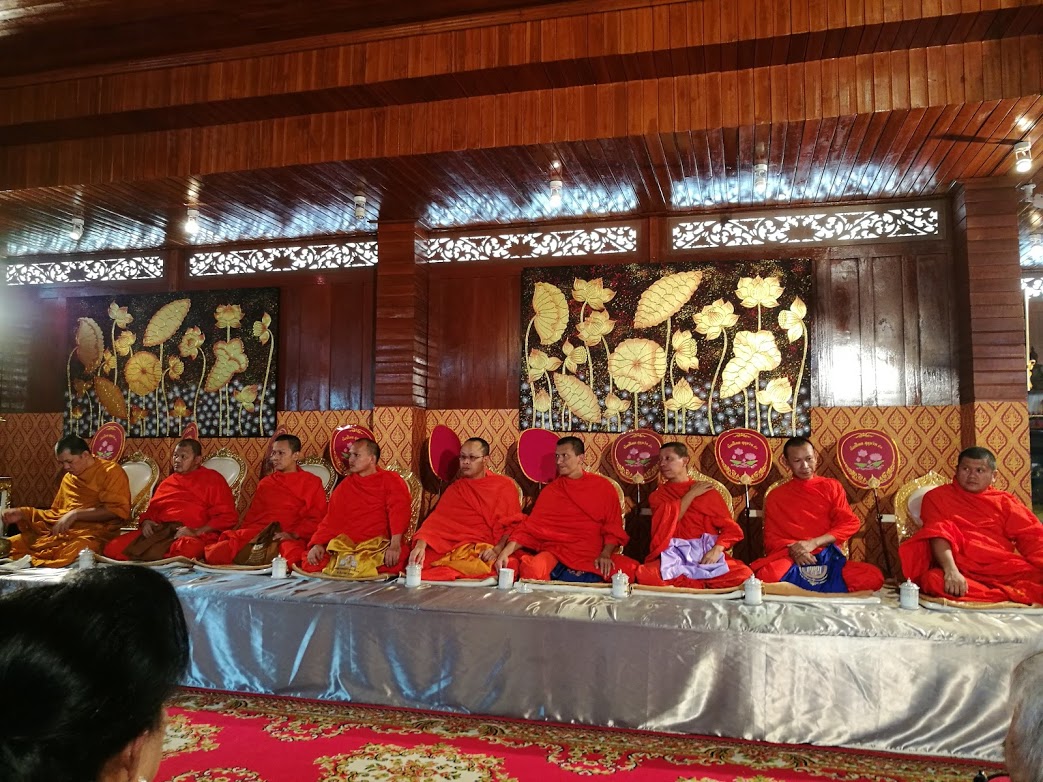
the Thai Buddhism equivalent of a priest or minister


Monday, June 26, 2017

Hatvala Vietnamese Oriental Beauty


a type-typical look; sometimes with a bit more color


This tea is a version of Oriental Beauty from Hatvala, a great supplier of original and local teas from different parts of Vietnam (and they run a cafe in HCMC / Saigon).  I reviewed a great version of a jasmine black tea from them not so long ago, with more of their selection related to local tea styles than these two examples indicate.

For whatever reasons the tea industry in Vietnam seems a bit more diverse than in Thailand, and in addition to covering more range of types the teas are better.  It usually doesn't work to make blanket statements like that, on the subject of tea or any other scope, but Thai teas somehow seem limited to being generally decent or else not quite that good.  Vietnamese teas don't tend to be as good as the best Chinese or Taiwanese versions, per what I've tried of both, but definitely a step closer, and sometimes on the unique side for being prepared in different styles.

One strange twist related to that:  it would be possible to try lots of Vietnamese teas, even when visiting there, and get the impression that they almost always drink one style of green tea.  Fish hook tea, that's sometimes called, from this area, and they also make Taiwanese style light oolongs.  I visited Hanoi a few years back and found others (that black tea in that review was great), it just takes some looking around.  This tea is from Son La, an area shown of the following map reference.


Vietnam tea areas map from Hatvala (pdf version available online)


I won't say much about what Oriental Beauty is here (also referred to as Dong Fang Mei Ren or Bai Hao), or even link to posts where I do, given how well-known a type it is.  The short version:  it's a more oxidized oolong style that tends to taste like fruit and spice, maybe along the lines of citrus, muscatel, or cinnamon.  This review describes this tea in relation to typical aspects, although of course they vary.  There's another part about the tea leaves being bitten by bugs, and that improving the flavor, covered elsewhere in this blog or in lots of other places.


the last OB version I bought from Taiwan, from the Lin Hua Tai shop in Taipei


The subject of tea knock-offs came up recently in a news article about teas from Vietnam being sold as an award-winning local version in Taiwan.  Apparently they have different types and levels of awards there, so it doesn't mean that Vietnamese teas are now equivalent to those from Taiwan, but there must be some degree of equivalence to collect any local award.  It's interesting that they can test for tea origin now; the article doesn't go into how.  I recently tried an oolong from Yunnan that could pass for a high mountain Taiwanese oolong too; it had that brightness, intensity, cleanness, underlying mineral structure, and distinctive flavor profile--the whole set.  This tea is definitely copying the style of a tea type from Taiwan but it's not a counterfeit tea in the same sense as in that article since it is sold as being from Vietnam.


I've only tried versions of OB from Thailand and Yunnan (interesting, but not as close a match), but I've seen others mentioned from India and Japan, and styles crossing over, a tea version of fusion, is more accepted now.  I tried a Japanese-style green tea version of Vietnamese tea on a visit to the HCMC area before I started this blog, maybe five or six years ago, and that was ok.  It's hard to really place on a quality scale based on memory that far back, and my experience with Japanese teas is still too limited now to be a great judge of those, all the less so back then.  It only occurred to me later that some or most of that tea might be making it's way back to Japan as Japan-originated tea.


Review


The leaves look like an Oriental Beauty, maybe a little less colorful than some do, but with the same general twisted and multi-colored look.  The dry tea scent has a strong ripe peach aspect.  I don't mean an ordinary peach smell, the way a typical peach comes across, instead the rich, warm, complex flavor of a perfectly ripe, juicy, dark-fleshed peach.  It's almost separate from tasting like peaches often do, a different thing, a higher level of the experience.  Kind of a tangent but my Mom sent me a box of ripe pears once and it was a similar experience, much richer, sweeter, juicier, and more complex, almost as if I'd never had real pears before then (maybe that was these; some frightfully expensive pears).  There had been a pear tree at my great-grandfather's house. but that was a different type, I think.  Anyway.


The first infusion was more or less a long rinse, how I usually do that, but plenty of that bright, fresh peach aspect came across.  It reminded me a lot of a Mi Lan Xiang Dan Cong, how some of those taste exactly like peach instead of honey orchid, how that translates.  I'd have placed it as that type of oolong in a blind tasting for that reason.  There was more going on, also citrus, and a hint of spice, with plenty of sweetness, but that infusion was just about getting my senses around the experience of that peach.  I say teas are "bright" often enough, which probably seems to mean something, and this definitely was.

The flavors rounded out a bit more on the first longer, real infusion.  Peach is still dominant, but citrus picks up, not so far from muscatel (grape-like, towards citrus, as I place those flavors), maybe a little brighter than that range usually goes.  There is a bit of spice as underlying context but this OB version is heavy on fruit.  It's an interesting contrast with trying those compressed white teas the day before, doing a four-tea tasting, just getting immersed in those warm, subtle, earthy tones, with fruit a subtle highlight in some.  This tea is definitely fruit-forward, and much sweeter, more intense.

It's a complex enough experience, with body and richness filling it out, and lots of flavors complexity, but still very approachable and easy to take.  It would probably be possible to move from describing three primary flavors up to 7 or 8, as some tea reviews tend to. That isn't one of my own strengths, parsing aspects out to that next level of analysis.  The tea has some complexity but it's easy to take as a simple, positive experience.  There's nothing challenging or problematic about it, and no sense of straining to pick up what's going on.

The warmth picks up a little more on the next infusion.  The peach drops down into an integrated range, with spice tones filling that in, and the citrus loses some brightness and intensity too.  The spice is pretty close to cinnamon; it wouldn't be much for rounding error to just say that's what it is, but I get a sense there's either more in related range going on or that's not exactly it.  The intensity is hard to describe.  I'm not brewing this heavy at all, really on the light side instead, but plenty of aspect range comes across as it is.  It has an almost perfume or liquor-like floral element, not really a richness, not exactly aroma, just an intensity that's not typical.  For OB's that type of effect is not unheard of though, normal for those.  This is well within the normal OB range, really, just better than it really should be for not coming from Taiwan.  The flavor aspects are nice, the sweetness and cleanness is pronounced, and the overall effect is really positive.  So they did good.

It's so good that I'm tempted to go the other way in looking at the tea:  what's wrong with it, what weaknesses?  No tea is perfect; they all only express so much range, and in fairness to Taiwanese OB's there should be some mention of that.  For most teas you don't even have to ask, to seek out what the limits are, or what could be different, you tend to shift brewing or focus to appreciate the positives instead.  I'll say more about limits related to this tea on the next round.


Hatvala tea sourcing video; some remote parts of Vietnam


Next infusion:  even more spice.  Now this is showing cinnamon with fruit instead of the other way around.  Peach is still there, and some background citrus, deepened a little in level, but the overall range is completely shifted.  As far as how it could potentially improve, maybe the feel could be a little thicker.  To me it works perfectly as it is, since the feel is light and a little thin, as oolongs can go, but with a hint of dryness from the astringency level (a bit high in the oolong range, how OB's tend to work, essentially part of the defined type).  Or maybe someone could see it as not complex enough, as having great flavors, but somehow wanting more range out of it, more depth to that astringency element, or a bit more aftertaste.  The sweetness and positive flavors linger, but not for the long, long time as some teas do.  Maybe being simple and approachable but complex in the range of flavor wouldn't suit everyone.  It definitely works for me though.


A Thai Oriental Beauty--that I've described a few times--was one of the best versions of OB I've tried from outside Taiwan and this is a good bit better.  That Yunnan OB wasn't close enough to the type to compare; it was sort of an interpretation, more a fusion style, at a guess not even based on similar plant types.  I've just finished the last of a nice OB from Taiwan, from that holiday season trip, and this compares well enough to that, just a bit different.  Flavor-wise it's better, more fruit and a little sweeter; related to other aspect range maybe giving up just a little.  All in all a great version of the tea type, better than it really should be.


I was just describing about how not everyone would like those compressed white teas, that they seemed to not be challenging, but how the general range and subtlety might be an acquired taste, or not to everyone's liking.  It's hard to imagine someone not liking this tea.  I guess people could be firmly on another page, drinking some other teas in a limited range, or off towards appreciating such high-level, sophisticated attributes that this could seem too simple.  Maybe it could seem too sweet or fruity.  But in general it seems like this tea would suit almost anyone, no matter what their favorite tea style is.