 |
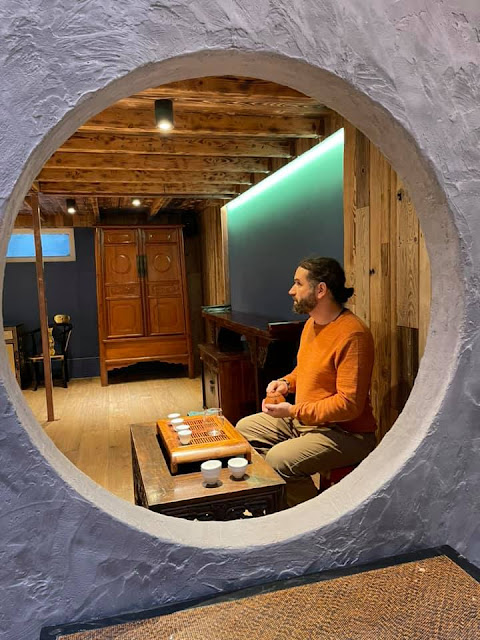
Sergey Shevelev in the Moychay Amsterdam shop |
I had mentioned talking about tea vendor perspectives in a meetup session summary post, about appreciation for or bias against Moychay by Russian tea enthusiasts. I'll go into more on that here, reviewing how I see cases of vendor support or negative impressions. I think it might have more to do with embracing shared group perspective and association than what one might take to be more intuitive inputs, about range of selection, best quality offerings, or about value issues.
Alex said that the further along tea awareness exposure among Russians you go, relating to people with more developed preference and awareness, they tend to have a more negative opinion of Moychay. But why? It could be because they are better informed to judge, but that's not what Alex added as his main take. He thought it's because as a vendor grows, gains a lot of exposure, and seems more "corporate" opinions naturally become more divided on them, including significant negativity. To interpret that a little, it could be that tea "beginners" appreciate supporting introductory content, and haven't yet sorted into preference related groups.
We can see that in cases like Yunnan Sourcing and Mei Leaf, although maybe there's not a direct parallel to the layers of controversy surrounding Mei Leaf. Or maybe we can set aside problems with plant age claims, exaggerated descriptions, and that one glitch related to branding through a Native American cartoon image, and perspective issues might start to match back up across vendors again.

I've noticed myself being more critical of Don Mei's content than may be justifiable (explained at length related to causes and limitations in this post). In some cases his Youtube content contains minor gaps or errors, but even when a number of statements aren't wrong, but aren't clearly objectively right either, and that's all presented as background to sell a specific tea version, it seems a bit dodgy to me. It could be like that with Sergey (the Moychay owner), that people are overly sensitive of tone in presentation, suspecting that a lot of the range is as much indirect marketing as it is genuine background content.
Back to Don, I'll cite an example to place what I mean. In one post about a Rou Gui he mentioned how the link between that type and cinnamon flavor--what Rou Gui translates as--is often overstated, that it doesn't necessarily taste like that. Some do taste like cinnamon, or cassia, and some don't. But if he had said exactly that it would be providing good background information content that could support selling the version he was discussing (which didn't taste like cinnamon), but as I interpreted his statement he implied Rou Gui just doesn't really taste like cinnamon, which is wrong. Then probably if he had been selling a version that happened to include that flavor the opposite would have been emphasized. Maybe I'm wrong about that; I tried to look up that video to re-watch it to evaluate that again, but I'm pretty sure that video has been deleted. He did upload another on judging Rou Gui and Wuyi Yancha (Wuyishan area "rock oolong"), but it's not the one I'm mentioning.
In that second video on judging Wuyi Yancha quality most of his ideas seem fine, it's just not how I would put similar interpretations. He doesn't really get into mouthfeel and aftertaste as considerations, which to me leaves a lot out in terms of describing what people experience and value. Complex flavor is part of it too, and I tend to frame descriptions a little differently than he would, but I can't say that he's wrong about what he said in that.

There is an intensity and hard to describe character to good Wuyi Yancha that isn't exactly about flavor, feel, or aftertaste, but spans those. I see it as a liqueur like or perfume like fragrant and aromatic quality, which comes across and balances differently in different versions. His take is more about a long flavor list occurring, including subtle flavors, which is ok. Different people can focus on different things, flavors really can be complex, and they do tend to transition over rounds, further complicating things. People new to tea do tend to focus on flavor as the main experience, which never completely drops out later, but it's often seen as only part of what one is experiencing.
It's interesting how Yunnan Sourcing avoids this particular range of objection by Scott (the owner) not really using Youtube content as marketing, and erring on the side of limiting written product description of teas, just saying a little to give a bit of sense of what they are. There's a good chance that half of his Yunnan Sourcing Fans Facebook group--which kind of is a sales tool, but a different subject, since Scott isn't really active there--aren't familiar with his Youtube content, because they just don't emphasize it.
Different people do pass on thoughts on teas there in that group, so that's not different and could support sales, and marketing could still be the main point of the Youtube product description videos. Part of this point relates to Yunnan Sourcing having 6000 subscribers on their Youtube channel, compared to 3900 members in that Facebook group; just promoting videos there would surely add to that viewership and follower count, but they don't do that.
 |
Scott Wilson (of YS) making light of image issues, through a "caption this" contest, as I see this |
Mei Leaf has almost 90,000 Youtube followers, and Sergey Shevelev of Moychay has 105,000. Mind you I see nothing wrong with vendors producing tea background content to serve as both marketing and information for customers, and others. It promotes the industry and general awareness, in addition to one vendor's products. Everyone else selling or promoting tea should be grateful that both are successful at it.
The point here is that in developing a lot of content, and being successful in gaining a following, even without self-promoting as a tea expert a vendor would automatically seem to take up the mantle of being an authority, one step towards being a "tea master." To me it seems to help a little if there is less marketing angle and they are de-emphasizing their own reference content, as Yunnan Sourcing seems to. William of Farmerleaf strikes a really great balance; nothing in their Youtube background information material seems geared towards sales, more just on background, but of course it could still support sales in that form. He has 6000 subscribers too, as YS does; you can make of that what you will.
I can't really offer any opinion about most of Moychay's video content, related to that factor of balancing general information and promotion, because I've only seen a half dozen of their videos, mostly geared towards a Western audience, the translated versions. It seems sales emphasis neutral, but there could be indirect marketing concerns with the more viewed Russian videos, for all I know, with that content open for critique. It's sort of a slippery slope. One might say that Wuyi Yancha is good, and then that this particular version is, and then that you should buy this through our shop. It takes a deft touch to offer informative background but to not take the last step, so that it doesn't feel like watching an ad.
Alex's point that people are just going to be divided makes sense.
Next one might consider whether or not there are broad quality or value issues that could trigger negative reactions from some Russian tea enthusiasts. I'm not sure. Moychay's product quality and value don't seem so different than Yunnan Sourcing's, to me; pretty good in general, covering a lot more range than is normal for standard vendors. Some is exceptional, above average tea selling at a great value, or representing really novel offerings, with other examples just kind of normal related to all that. Eventually a below average quality or value product might turn up from any source.
For teas that are completely unique it can be hard to identify value, for brand new types, hybrid style versions, or rare aged teas. For example, this yellow tea from Khosta, Krasnodar region, 2021 sells for $20 for 100 grams. Sounds kind of low to me, but who knows, it might also depend on how well it turned out. I doubt that there is a second yellow tea from that Russian area being produced to set a market value, not that I would know if there was. I tried a yellow tea from Mississippi last year, from Jason McDonald's farm, which listed for $14 per ounce (50 cents a gram instead of 20), but production overhead in the US would probably be much, much higher, and the tea could be better, or the target audience could vary.
The main opinion expressed about Mei Leaf is that their tea is good, which is the main thing, but that value isn't very good, that you could get the same quality level of products elsewhere for less. Then some Mei Leaf fans reject that last part, seeing the teas as unique and positive enough for above average level pricing to be fair. A sub-theme about people liking or disliking Don Mei almost eclipses whether or not his teas are good, or a good value, as discussed in this Facebook group thread.
Where am I going with all this? How vendors present themselves and end up being perceived is an interesting theme to me, especially related to forms and causes. My final take may be way off, that people are really looking for a way to self-identify and connect with others in a lot of cases, even though they may or may not see it that way, framing their own outlook as a normal shopping perspective.
Group identification related to tea vending
For one particular reason I think Mei Leaf probably doesn't get fair treatment, in retrospect, maybe even from what I've communicated, even though I think their tea is probably generally overpriced too. I think Don "rubbing people the wrong way" as a video persona factors in a lot. I don't think Scott Wilson of Yunnan Sourcing gets too beat up online, but it seems like any successful vendors can easily become targets for criticism, justified or not. Maybe justifiably so? A bit of pushback here and there might keep them honest. Reddit comment discussion sometimes tends to go a couple steps beyond that. Scott did get involved with a messy discussion issue there once, but then that's Reddit for you, not much better than Twitter for sometimes being harsh.
That's only half the story though. People love Don Mei more than seems justified too, clear from that Facebook group post I mentioned:
*In Mei Leaf's most recent video*
Commenter: "Why does the Facebook Gong Fu Cha goup hate you so much?"
Don: "🤷♂️ Maybe I would dislike myself if I was on the outside"
Lololol I don't buy Mei Leaf teas because of shipping costs, but I love Don so much.
I guess that he loves Don because of his sense of humor? I'm not sure that comment was offered as humorous. The comments there talk about appreciation for his teas, his online content, and for him being an interesting and charismatic person, the part that people are divided over.
I think group inclusion is the extra component that's not as evident. Why would almost 4000 people join a Facebook group to talk about tea from one vendor (Yunnan Sourcing Fans)? To be fair Q & A discussion does go better there than in most places, but cutting off discussion at one vendor's selections seems limiting. Why are there lots of vendor specific Discord servers now, with varying degrees of engagement? I only belong to Farmerleaf's and Liquid Proust's, because I was just checking those out more than participating, since I wouldn't have anything to add for not being a regular customer for either.

Moychay's tea clubs theme is something else, but it connects. That adds in drinking tea in a setting that goes a long step beyond a cafe for being decorative and establishing a vibe, and it supports a more ceremonial take on tea experience. All the same it is also shifting individual tea experience to social experience.
 |
this is more a tasting area than a club, but Moychay's club theme is an interesting subject |
The online group case is more interesting to me though, because then it's reduced to being abstract, having more to do with self-definition and text message discussion contact than real life. Or the "main" Discord group, Communitea, is big on voice / audio based meetups; I guess that's more in the middle.
In a podcast comment discussion someone once mentioned being "on team Xiaguan," not just saying that they like Xiaguan, but emphasizing how that put them in a group. To me that's odd, even though that form of expression comes up more and more now. Podcast creators tend to lean into this social dynamic, making their audience feel like part of a group, by establishing specialized use of slang, or even a nickname for group members (as "teaheads" is used). Theo Von and Chris Delia are good examples of comedians using this form. Oddly on one Reddit subforum Joe Rogan podcast followers connect and unify related to seeing Joe Rogan as an idiot, reveling in dumb things he says, or making fun of him for using steroids, for being short, or for his anti-vaxer position. It still works, I guess, it just seems backwards, unifying as fans connected by partial dislike.
Vendors could make use of this, the positive part, right? That's essentially what the Discord groups represent. It's not negative really; to the extent someone wants to feel like they are a part of something for liking Don Mei's teas, or those from Yunnan Sourcing, Moychay, Farmerleaf, and so on, that's fine, and it really is also about sharing information.
Next more experienced and older tea enthusiasts might look down on all that, and see it as silly how younger and newer participants cling to odd forms of association. But it happens in more subtle ways across a broad spectrum, even when people don't feel a need to formalize the link. If someone loves Essence of Tea, Teas We Like, Tea Encounter, or Hou De you won't tend to hear about it, but there's no reason why someone couldn't value "being in the know" in a similar form, just with less post comments for interaction. Without even taking up the external role as an elite, experienced, "higher" form of tea enthusiast the more subtle social role as isolated participant may still be regarded as meaningful. Not joining a group or talking about it could be seen as just following a different code: those who talk don't know, and those who know don't talk.
Let me pass on a thought that ties to this, that might clarify it. To an extent I get the impression that some more introverted expats--foreigners living abroad, somehow implied as higher in status level than "immigrants"--like the social role because it defines them as different, and as being a certain way, without any need for setting that up or interacting. Just being white is a stereotype, where in the US you need to pair that with class / economic status to make a start, and then it still doesn't go far, and you also have to add political affiliation. Here in Thailand, where I live, foreigners are respected but also disliked a little, seen as quirky and odd but likely to be intelligent, and interpreted as probably having questionable morals, related to paying for romantic relationships. It's not quite that simple, but basically you are a type, just for being white. Let's set aside how that would go for other races; that's not the point.
The point is that stereotyping, and to some extent group inclusion, is almost freely granted, and some people seem to value that. In tea groups you just need to adopt shared perspective, which isn't quite as easy, but which may not be very difficult.
Tied to Mei Leaf support expressing or just feeling that "I love Don" is more than enough; you're in, even without buying the tea, as that guy explicitly stated in that post. As a Yunnan Sourcing fan you just need to have placed one order, and to have liked one tea version, and to express intention to keep going. If you want to feel at home among 10+ year experience tea snobs on Tea Forum--no offense intended; those people are nice--it's not quite so simple, but parroting what others say goes a long way. In the Gong Fu Cha Facebook group you just need to buy a gaiwan, and to be looking into yixing, or post any photo of drinking tea outside. R/tea on Reddit isn't a unified social group, but posting a picture of a half dozen boxes of grocery store tea-bag tea in a cabinet will draw at least 100 upvotes.
Why are we like this, group oriented to a strange degree? With me included, surely. An online contact put it well in a Quora answer about how social interaction is evolving:
There's a broad emphasis on smaller and more detailed clustering, which in turn relies on people having a firmer sense of self and on them defining themselves in certain ways. We assign ourselves to many categories which are smaller and more specific than perhaps they've been in the recent past.
Right! A half dozen years ago people might group together in relation to tea interest, but that has pushed down to which teas people like now, or how they brew and experience them, and on further to which vendor sources of those teas they prefer. Embracing or rejecting someone with a high profile online as an information source, or sub-culture leader, is just an extension of that.
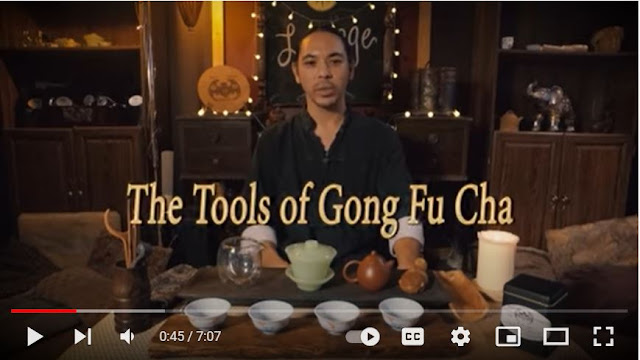 |
there's nothing wrong with combining being charismatic and informative, as So Han does |
People can even now unify, to an extent, in relation to shared dislikes, not just personal associations and likes. So this seems to be the last component of the negative mixed feelings related to many tea vendors; it's attractive to dislike a lot of things, and even to identify through that. It automatically places you above that subject or person, for looking down on them. If you dislike Dave Chappelle for making transgender jokes that identifies you as more sensitive to minority perspective than him. If you can criticize the people who make that criticism, for being "woke," then you are implied to have a broader view of how social commentary works than they do. Even not liking a movie can place you socially.
Never taking up these kinds of connections and oppositions would be a very reasonable and functional option. But then there wouldn't be that much to talk about on social media, so that perspective would tend to not be expressed, or wouldn't seem interesting if it was. There's normally a strong inclination to like or dislike things, to agree or disagree with ideas, so remaining neutral isn't so simple. It's natural to react, and to place yourself in relation to that kind of perspective.


