Showing posts with label fragrance. Show all posts

Friday, January 31, 2025

Ginger flower and honey orchid fragrance Dan Cong


honey orchid left, in all photos


This reviews two more Dan Cong from an ITea World sample set, sent by them for review. The last two were exceptional (orchid and magnolia fragrance versions).

One is the most commonly sold Dan Cong type, Mi Lan Xiang, or honey orchid fragrance (or aroma).  The other version, ginger flower fragrance, I've probably never tried. Their site description of that set follows:


iTeaworld 2024 Christmas Gift Sampler: Fenghuang Dancong Oolong Tea  ($109.90 for 100 grams)


Fenghuang Dancong Oolong Tea:  Huang Zhi Fragrance, Orchid Fragrance, Honey Orchid Fragrance, Magnolia Fragrance, Ginger Flower Fragrance, Osmanthus Aroma, Cinnamon Fragrance, Almond Fragrance, Night-scented Stock, Jasmine Fragrance


I might add a note on their brewing advice, before touching on the subject of value.  They recommend using Gongfu brewing, of course, starting at 6 to 8 seconds, and moving to 10 to 15 seconds, for up to 10 infusions.  That's fine, but I would brew these quite a bit longer, and only get about 6 to 8 rounds out of them.  If I was using a proportion of 8 or 9 grams I'd probably roughly match their parameters, but to me 8 seconds isn't long enough at 5 grams to 100 ml.  That's about preference, not really an optimum.  I'm a sheng pu'er drinker; I can't be brewing teas really light like that, but it is one common form of preference.  It might even work slightly better to isolate flavor aspects, even though that's counter-intuitive.

Is just over a dollar a gram justified for these?  I tend to state over and over that I just won't buy tea at a dollar a gram.  I probably wouldn't buy these.  But for what they are, the quality of the four versions I've now tried, that's about right.  At least they offer sales that could cut that back a little, 20% off if you spend over $100, so it seems this would drop automatically, at least now.  If these really cost 80-some that's a pretty good value.

It feels odd saying that.  Who spends over 80 cents a gram on tea?  People who don't care what the cost is, or who get hooked on types and quality levels of teas that they just can't get for less.  It's better not to do that.  This is where I usually say that other range of similar tea, for this type, isn't as good, in a sense, but it's interesting and pleasant enough that it doesn't matter, it's fine.  With Dan Cong you kind of take a hit.

I will say this:  I just bought decent Dan Cong for a gift at $20 per 100 grams.  It won't be this good, and this range of different DC versions doesn't turn up.  I bought that in a Bangkok Chinatown, and you can't match value or that version offering on the internet, oddly.  I didn't try that exact version I bought, to be clear, but I've bought Dan Cong from that shop three times, I think it was, so you can kind of get a sense of what they sell from that kind of history.  Upper medium quality Dan Cong can be really nice, if you can find it.  Online sources wouldn't sell that for less than $40, but it's still 40 cents a gram instead of 80+.  Other Chinatown shops here would probably sell lower quality Dan Cong for more; it was an exception, even for here.

These might all be that little bit better, or at least the first 4 were.  Maybe the honey orchid, Mi Lan Xiang, wasn't quite on the level of the others, but they were all pretty far up there for quality.  So I guess if you really feel that you need to experience what pretty good Dan Cong is like this is reasonable (given the other versions are like the first four, and I expect that there could be some quality variation).


Review:


Honey orchid:  that's nice.  I didn't use an extended first round for these to bump infusion strength to a normal level, so I'll be trying them light for a first infusion.  Character is good; these aspects are nice.  Tone is a little warm; it seems that oxidation level is balanced really nicely, probably supported with very moderate roast input, that is hard to fully place.  It all integrates.  Flavor is floral, of course, hinting a bit towards ripe peach.  The warmth comes across as a touch of cinnamon, at least so far.  Astringency hasn't emerged yet, but being on the light side that would be moderate.  It's a great start.

One might wonder if this seems really familiar, for this being the name for Mi Lan Xiang, the most common form of Dan Cong.  I guess so.  Those still vary a good bit, and this is a novel and positive version of one.


Ginger flower fragrance:  I guess that tastes a lot like ginger flower?  There is a light spice edge to it; it's really interesting.  The general tone is sweet, like jasmine, not even all that far from jasmine.  Again the moderate warmth works really well for this.  Floral tones are plenty bright and intense, and then it's grounded by warmer floral range, and what could seem like a bit of spice.  

This is so fragrant that it's perfume-like.  No tea this good is artificial, I don't think; I mean that volatile compounds give it a positive effect, what I often call liqueur-like, when the flavor context is slightly different.  It'll be interesting trying both slightly stronger.


Honey orchid #2:  I brewed these for about 15 seconds, or just over, not a long infusion time, but plenty for this proportion, for "only" using 5 grams.  Flavor is great.  Intensity picks up a good bit, but it stays in a similar flavor range.  A richness picks up, a thicker feel.  Astringency also does, but it's not sharp or edgy, only tied to that fuller feel.  Flavor definitely includes a lot of warm floral tone and some peach, and again I read the warmer part as being like cinnamon, just not exactly that.  

Ordinarily I'd be brewing 8 or so grams of this, drawing out even more intensity, even for using slightly cut back infusion times.  As long as you keep infusion timing out around 20 seconds that intensity would still be there.  There is no sharp edge to worry about; may as well push this tea a little.  Refinement and balance are great.  There could be a little more depth, and a little more pop, with aftertaste carrying over a little more, so I'm not saying that this is an ideal version, but it's pretty good.  It's definitely in the right range.


Ginger flower:  that ginger edge really comes out; it actually tastes more like ginger this round.  Maybe I was expecting that to be less of a literal description, or maybe ginger flowers also smell like ginger toot.  The sweetness is again like jasmine, with more warmth.  Where the other includes warm tone that's towards cinnamon this is really aromatic incense spice range instead, a set that I don't have clear enough memory of to distinguish between (frankincense, sandalwood, etc.).  

Feel seems a little thicker, and aftertaste does carry over just a little more.  It seems natural to push these just a little harder next round, infusing them for just over 20 seconds, to see what comes of that.  There's nothing negative to work around, so it will be down to trading off maxing out intensity for having them brew less rounds.


Honey orchid #3:  it's funny how someone unfamiliar with this tea type range could be absolutely blown away by this tea version, the strong floral tone, touch of fruit, sweetness, richness, depth, overall intensity, the way it all balances, and so on, and then the other version amps a lot of that up just a little.  Good Dan Cong is really something. 

"Good" is so relative; above average quality versions just tend to be like this, but from how people describe even versions they take to be positive many aren't.  That characteristic astringency edge people describe needing to brew around is a quality issue.  I suspect that low elevation, monoculture grown versions are pushed too hard with chemical fertilizers, leading to that, but of course that's just a guess.

Aftertaste does seem to pick up a little, for adding just a little more infusion strength.  Feel is generally good, it just seems less noteworthy with the other being a little richer.  Maybe the flavor being relatively familiar does cost it a bit in terms of novelty, but it's not as if I'm drinking Mi Lan Xiang versions all the time.  It's been awhile.


Ginger flower:  that's as far as this should be pushed for infusion strength, or maybe this is tipped a little over a natural optimum.  You know when something is enough when it's too much.  The ginger type flavor is still novel and positive, and other floral range is nice, but that jasmine sort of floral note is a little too strong in this.  

Could that flavor have been bumped by contact with actual jasmine flowers?  Sure, it's possible.  I'd guess that's not an input, but the effect would be like this.  It wouldn't draw out that much ginger flavor though.  And the supporting incense spice range warmth is really interesting and pleasant.  This is just how good Dan Cong goes; it's a little surprising that tea can be like that.  If added flavoring could be this clean, balanced, and positive I'd probably drink flavored teas.  Good Wuyi Yancha can be a bit surprising too, but not as much across this floral and fruit range, typically.  That liqueur-like effect can be really strong in some types of those though.


Honey orchid #4:  the feel isn't necessarily thicker or richer, but somehow it picked up a syrupy effect; the texture changed.  That's nice.  Intensity and complexity are good, and depth, but somewhere in that set is the closest thing to a limitation this tea has.  It could hit harder.  I suppose it could be slightly more intense and complex, and could express a little more depth.  It feels like splitting hairs saying that.  Someone could buy a dozen Mi Lan Xiang versions and not get one this good.  But there's a magic that happens when it's all dialed way up, and this quite good, but maybe just short of magical.

This is part of why I feel like chasing quality level optimums is a bad thing, to be clear.  If you need every new and different next experience to be better than all the last you set yourself up for disappointment instead of enjoyment.  This is already so good.  I'm just trying to place it, for people who are really on that page, into Dan Cong.  It would make for a bad goal trying to top this tea, and an expensive one, probably requiring some hit and miss, but it would be possible.


Ginger flower:  at just the right infusion strength this gets pretty close to magical.  The way all those flavors I keep describing come together, with the rich feel, warmth, depth, aftertaste trailing on--it works.  I suppose that ginger and floral mix, not so far off jasmine range, may not appeal to everyone, or that incense spice undertone people might see as less positive than I do.  To me it all really integrates.  I don't think it was a happy accident that made this tea turn out this good; I suspect that whoever made it really knew what they were doing.

That reminds me, in the last meetup at my favorite Bangkok Chinatown shop the owner, Kittichai, was describing how oolong is harder to make than sheng pu'er (in his opinion).  He said that to make sheng the material plays a lot of the role, and if you get the simpler standard steps right it will turn out as well as the material allows.  But oolong is different; there are more steps, more inputs, and more judgment required.  That matches my understanding too, even though I have zero experience with processing tea myself.  The timing for every step needs to be carefully determined, not according to a recipe, but in relation to the material and the conditions, related to how compounds are changing just then.  It's the same for withering, bruising, and oxidation, on to fixing, then later roasting; variable after variable requires tea maker input.

It seems funny saying that since over and over I've said that South East Asian sheng is typically just a little off Yunnan versions, probably related to processing differences.  Some of that could be intentional; people seem to draw out withering or add a limited oxidation step to offset the final bitterness and astringency, the harshness.  In Yunnan if the material is a bit aggressive after processing it just is; you age it some to offset that, not change the processing inputs.  What do I know anyway; I'm just a tea drinker.
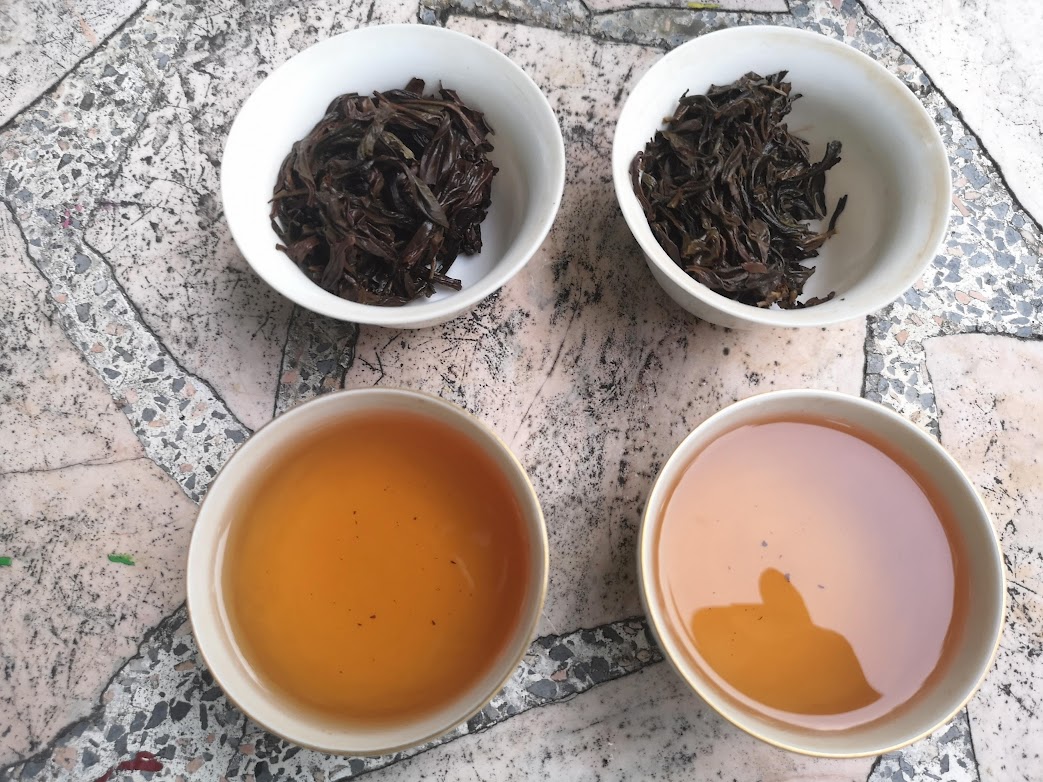


Fifth infusion:  in order to not repeat those same aspect lists I'll just combine thoughts in one note for this round, and end this note-taking.

The honey orchid version has levelled off related to changes, not necessarily fading, but maybe giving up a little intensity.  It's quite pleasant like this, and not changed, but a next round would need to be infused longer to get this far.

That ginger tone is always surprising in the other version, when you first taste it each round.  And it being supported by so much floral and spice range is really something.  I suppose the feel could be a little thicker, but there's so much novel and well-balanced range that it's really splitting hairs to point out where it's weakest.


Conclusions:


These are much better than the earlier tasting sets from ITea World.  If you go back and read the wild origin material posts I did those teas are positive, mostly, but they're not complex, intense, balanced, and refined like this, none of them.  Then again this is Dan Cong (and they also cost more); that would be like trying sheng pu'er and saying that other type range just doesn't match it for intensity.  Of course not.  Just across that one dimension these aren't as full-throttle intense as the ordinary range sheng pu'er versions I often have with breakfast.  But across almost every other dimension the aspects really stand out.  

I suppose that only applies if someone loves floral-oriented teas with some fruit and spice range to add depth.  If someone loves green tea or hei cha, and not that range, these may not work as well for them.  To me the appeal seems relatively universal in form, but in practice personal preference isn't exactly like that.  People like whatever they like.


Thursday, March 1, 2018

Oolong pu'er, about sheng aging potential


Related to reviewing different sheng versions lately considering which sheng pu'er will age well and which won't keeps coming up.


A comment about a Moychay Nan Nuo sheng relates directly to that (here on Reddit, by Jay, if he's familiar, who sells tea here):

It'll be interesting to watch it age over several years but my gut instinct is that it will fade rather quickly in BKK. The fruity flavors often indicate oolong style pu that will fade out with age.


I had framed a similar idea in that original review more as a question.


I love the fruit in it, and that overall "bright" effect.  Often when I'm drinking sheng made within the past year I'm saying this might be better in a year or two, a little less edgy, but in this case I'm not so sure.  If that brightness were to decline, as it would to some extent, the balance might be just as positive, or more so, or the tea could've been best drank when very young like this.


Of course the deeper issue is what aspect range indicates a tea will age well, and to what extent that varies by preference, or is it not possible to tell by trying a tea.  All of that is essentially what this post is about.  I frame that as a question in the response to that comment by Jay about "oolong pu'er":


I've ran across this description, and take it to mean sheng pu'er that resembles oolong in aspect character, smooth, not astringent or bitter, sweet, sometimes with fruit aspects.

The odd twist is that often mentions of that term pair it with descriptions of processing variation (or error, depending on interpretation) with the tea heated more in the kill-green (shaqing) step causing conversion of compounds essential to sheng pu'er fermentation (or whatever someone wants to call that, since there's more back-story about that term too). But only at that simple one-step variation description it should become more like a green tea, shouldn't it? 

Some other descriptions, which usually don't mention "oolong-style" as a comment, say sheng that's heated too much more or less is green tea. But green tea usually tastes nothing at all like oolong, with more initial oxidation being a main difference in the two, beyond difference in resulting aspects. That additional oxidation wouldn't be present in sheng that got a bit hot during processing. 


Jay mentioned that Tea Chat discussion link for further reference, along with a concise overview "some of the stuff that is aromatic and flavorful and easy to drink today can die in a matter of three years."


I'll look into that Tea Chat discussion here, citing parts of it.  It never really resolves, but it's interesting to consider individual points made.  I want to touch on another tangent first, about people using the terms fragrant and aromatic in different ways.  I'm sure it means something very clear and consistent to the people using it, probably even well agreed upon in limited groups or circles, but I wouldn't be surprised to find that the meaning varies among people.


exploring sheng aging by trying six years of consecutive samples (here and here)


more to follow about turning another page in trying interesting versions


More on aroma, fragrance, and other aspect descriptions


It's common enough knowledge that basic taste / flavor is really divided into two parts, what our tongues pick up (salty, sweet, umami, etc.) and aromatic compounds, identified in sensors in the lower rear of the nasal passages instead, related to our sense of smell.  I've mentioned this "basics" video summary by Barb Stuckey before, author of "Taste What You're Missing."

It would be simple if aroma is intended as only the information carried by aromatic compounds that are identified by sensation related to smell.  In this tea vendor blog post that's essentially how it's being used.

The problem is that I've ran across other range of uses before, and it doesn't seem to be quite that simple in these citations.  Jay mentioned in that comment "some of the stuff that is aromatic and flavorful," apparently contrasting the two (which I had just cited).  It doesn't work well for flavor to mean what's tasted by the tongue in that, although it could still work.  Typical language use of the concept of flavor includes both types of sensory input, but then the concepts of taste and flavor tend to blur together in common use.  In lots of citations related to tea use of all of the terms seems to vary, but to generally incline towards one specific concept range, assumed as shared and understood.

A research article (Tea Aroma Formation) summarizes aromatic compounds present in tea, reflecting that simple version:

The current review summarizes tea aroma compounds and their formation in green, black, and oolong tea. The flavor of tea can be divided into two categories: taste (non-volatile compounds) and aroma (volatile compounds). All of these aroma molecules are generated from carotenoids, lipids, glycosides, etc. precursors, and also from Maillard reaction. In the current review, we focus on the formation mechanism of main aromas during the tea manufacturing process.


So why not just leave it at that?  "Taste" can be reduced to what the tongue is picking up, "aroma" to the rest, to aromatic compound input.  Or on the looser side taste or flavor could mean both, and someone could be more specific about how they're using the terms if it's really necessary.  The reason I'm not comfortable leaving it at that (that first option) relates to running across the terms being used in different ways.  Generally loose ordinary language use of broad terms is something else, but I mean in discussions about tea.

Of course most of the flavor of all teas is carried mostly by aromatic compounds.  Sweetness is picked up through sensation by the tongue (mostly, as far as I know and can determine), even though it's not typically sugars causing that in tea, but also other compounds that come across similarly.  The same is true for the feel of teas, astringency, and bitterness and sourness, obviously, but beyond that most is "aromatic," or from the contribution of volatile compounds.

Onto the complication:  often the pronounced floral or fruit range in a tea like a Mi Lan Xiang Dan Cong is referred to as flavorful, while the more subtle, different range in a Ya Shi (duck shit) Dan Cong is referred to as aromatic instead.  Of course some people will disagree completely with that; my central point is that people are using the terms in different ways.  Is that convention--if correctly identified--only because someone is using the terms in the wrong way, or that they aren't clear on how limited tongue-based taste perception is?  Maybe.  But it seems to represent a different convention that breaks "flavor" apart differently than just between tongue and nasal passages instead.

I've been through some degree of training in wine tasting but referring back to that doesn't help (which could instead relate to limitations in my own training and memory).  And even if there had been a clear convention and terms break-down there it still might not carry over.

Ordinarily I'd speculate, and say that a certain range seems to have represented what people are meaning by "aroma" in some cases, with the rest pushed off to "flavor" or whatever else.  I have expressed thoughts on this before but I can't really get much clearer to pinning this down.  I tend to use "aromatic" myself in a specific and limited sense that's probably not universal, or who knows, maybe almost entirely incorrectly.

Just because someone is from within the Chinese tea tradition (like my online friend Cindy, who even makes tea) they're not necessarily a great reference for a universal use of terms.  Even if someone could site a tea-master or ancient tradition school lineage that wouldn't necessarily support their use of any description terms as universal.

All of this isn't really central to this discussion, the part about oolong pu'er, but it sort of does keep coming up in the parts of it.


Kalani checking out a dragon.  Happy New Year!


About types of sheng, and "oolong pu'er"


Part of the broader idea of exploring sheng lately has been to start to sort out how different types of age differently.  Of course aging input is just one issue related to judging or enjoying a sheng pu'er.  Related to exploring that, most recently I tried a series of Yiwu sheng samples designed to show aging effect (here and here), and before that  attended a vertical tasting of those (narrowed to teas from Ding Jia Zhai, a village in that larger Yiwu area).

It's a review that I understand is going to be a process, nothing I'm going to get far with in any limited amount of time.  It goes without saying that I'm barely getting started, but I do keep saying that anyway.  "Just getting started" means different things to different people, and what I mean is that I've tried and reviewed some related teas over the last four years, but not that many of them, something like a few dozen.  There are probably less than 20 related reviews here, of versions of sheng. 

Tea quality is another issue, beyond any sort of count related to what someone has tried.  It would be possible to keep trying low to medium quality versions of sheng pu'er and not really see that half of the picture, or to many, to get much relevant exposure about what the tea type is really supposed to be about.


The discussion in that Tea Chat thread about "oolong pu'er" goes a lot further with isolating aging concerns, with the main two references here:

Tea Chat forum "Oolong Pu'er Processing" thread

Related, The Mandarin's Tea "Oolong Pu" post

A citation from the author of the second personal blog post (by Tim) within that original thread outline the central theme and concept definition of "oolong pu'er:"


Those high aromatic new style Puerh which goes stale in 8 plus years. They can't age and a total waste of time and money...  

...flat in the body, don't last many brews in a balanced way (aroma and body) but high aroma from the production of 2006 to current?  [2013, at that time of writing]


From there discussion varied related to root causes or descriptions of effect.  One vendor offered an summary of some issues and conditions, but it's not intended as a consensus take here, or even representative, just a good place to start (cited from "Bannacha's" post):


If you're refering to tea that got too much Sha Qing, they are quite easy to identify: the leaves are very green, they are astringent and they get bland very quickly, just like green tea.

By controlling the Sha Qing time and the wok temperature, you can make redder or greener tea, and, as long as it's not extreme, I think there's a large span of well processed tea. Then, it depends on your personal taste, what kind of aroma you prefer, and which mountain you're dealing with. I like a greener processing on Mengku tea, because it brings out the high pitched fragrance of this area. Redder tea might be good to emphasize on the body, the mouth feeling.


Later discussion identified a potential difference in the drying step as a potential main issue, that replacing sun-drying with an alternative process (citing "Nada" on page 2)


...He's been experimenting with how cakes have been ageing that have had different processing techniques & noticed a big difference between those that had been dried in a heated room after pressing vs those that had been dried in the open air. 

...We tasted some of his past pressings and there did seem to be a strong correlation. The naturally dried cakes did seem to be ageing better. 

In freshly pressed teas, the difference seems to be huge - the cakes dried in a heated room had strong aroma and tasted fresh soon after pressing, while naturally dried cakes seem to take months after pressing to recover from the process and have a much more subdued aroma.


Really all of these citations are just samples, and the whole thread is well worth a read. Of course people are going to be using some terms in slightly different ways (me even more so than them), and preferences would vary, but it seems possible to read past those issues and extract some clear insights.  It would be interesting if I could even tentatively link any of what I've experienced back to these patterns, but passing on guesses at this point would seem less than helpful. 


the "Oolong Puerh" FB business page.  that might've not worked out.


The various points raised don't really fall together as a clearly connected, narrow-range set of ideas, as this summary hasn't (so far, but it does keep meandering).  If you read through even the first four or five pages of that Tea Chat discussion it's narrower than this review of it makes out, but still hard to summarize.  

I'll cite a part that was particularly interesting, some comments on positive attributes of sheng by Shah82 (a name reference that might ring a bell; I've mentioned other input from him in this blog before), from page 4 of that discussion (edited down only a little for length):


Nobody is an expert. Not really, because this hobby is far too young as a broad phenomenon. Virtually everyone's experience in the West consists of furtive samplings of tiny quantities of the well stored aged tea, usually of well known tea like 7542 or 8582. So everyone is making best guesses, especially given how processing methods and blends have changed since the 80s and 90s. So you have to come up with a system that estimates how you should think of a tea. 

So for me, I go with: 

1) Does the aroma endure? You can't fake or process a quality aroma with depth/complexity/fullness, rise off the cup, and lasting more than a minute or so. 

2) How comfortable is it to drink? Is there astringency or bitterness? Is that astringency/bitterness productive in generating lingering aftertaste and huigans? Silky, gloopy, whatever texture? 

3) Is it like drinking water or some kind of soup? Body is a bit different than texture--you can have a thinner body, with a silk texture and that'd be pretty cool. Or a thick one that isn't right in some way. 

4) How much power, activity, and presence does the soup have on top of, and inside the throat? Too many people think mere cooling is a sign of quality. It is, sorta, but what sets off the really good from the mundane is the nature of the cool. Good tea has a different kind of cooling that's more ben-gay than mint. The effect tends to go down the throat and up the nose. It can also travel around the mouth, as in "wind rain effect" as the Chinese call it. 

5) How much qi does it have? Does said qi move along the meridians, so to speak, or does it just sit there? Is it comfortable or harsh? 

6) Does the tea have several stages in flavor as you go through a pot of water? Are the finishing brews pleasantly sweet and comfy? 

... You have to make choices about what you want. You'd read me or any of the bloggers strictly in the context of where your preferences and priorities tend to overlap with mine or anyone else... 

I will say that taste itself is highly deceptive. It depends on your water, whether you let the dry leave sit in the bowl a week or two, or any number of things. It can change with the years. The classic way people buy bad tea is by preferentially buying "approachable" flavor or aroma puerh. Which is why you see so much problematically tinkered puerh that gives a oolongly fruity or floral taste (or more red and mellow malt). 

For me, the easy way to tell, again, is to see whether that aroma *endures*. Many of these teas also will betray badness by becoming hard to drink or pointless to drink by about brew 6-8. *Few* puerh, however, are done straight processing green. A little butteriness is sought after. Or a little hongcha, or some nice smokiness. That's alright, so long as most of the underlying qualities are still there to age.


Ok, not edited down much.  There's lots interesting there, which I won't really comment further on.  I will mention that the one sentence about communication and shared perspective does deserve some extra thinking through.  It's insightful and clear enough, but perhaps easy to miss what is really being said.  As I take it he acknowledges that preference is a real issue, a context framework that the rest of the experience rests on, and that input from him or from tea bloggers is only valid to the degree that a general approach is shared.

Put another way, reading others' ideas about how they approach tea, and what they prefer, only goes so far.  There would seem to be better and worse references beyond that issue of generally matching preference scale.  As an example, a tea blogger could be on exactly the same page as a reader relating to general preference (for types, relating to subject concerns, and brewing approach, etc.), and still pass on a lot of wrong information, or could describe teas very badly.  And I suppose the opposite could be true; an online reference or discussion point could relate to a completely different scope than a reader is typically interested in or exposed to (eg. be written about a tea type that isn't of interest, or be based on very different personal preference scope) and it could still be interesting.

Typical mapping related to that, identifying who is speaking from a similar perspective framework, is simple enough; you just find an example of discussion of a favorite tea type, and see if the observations match (likes, as part of that, but also the details of the take, like aspect descriptions).

That last citation is a good example of how such ideas can be interesting, or even potentially helpful, probably not just related to people who are clear on what he's talking about.  At times others' perspectives are paired with attitudes and personality aspect inputs that can be a bit off-putting, and I suppose it all has to balance.


that one blog mascot again


Oolong pu'er as a positive description


Oddly this doesn't come up.  If there really are differences in processing approaches, and differences in aspect range of young teas, and in personal preferences, it would stand to reason that there couldn't be a completely clear division between what is good and bad.  But that's essentially how the term "oolong pu'er" tends to be used, only as a criticism of a specific version of a young sheng. 

The implication is that teas should be able to improve with age, or that people should prefer some other aspect range than is found in such a tea.  But that's usually not explicitly stated.  More often one or two aspects are criticized, and the person commenting just moves on.  I suppose the way this review of the discussion plays out accounts for one reason why that might occur:  it's not simple outlining what one might desire in a sheng, even when someone has the experience and communication tools at their disposal to do so.

All of this is only food for thought, to be compared to actual personal tea drinking experience. 

One interesting complication is that tea related preferences change over time, and that preference related to specific types of aspects changes.  It would seem problematic to try and like what you think you're supposed to like, to steer personal preference along the path of some consensus-defined natural learning curve.  Or maybe that could work.  Even for taking external input seriously, in a case when a tea drinker tries to branch out and add depth to the range of what they can appreciate, someone would still need to experience tea enjoyment tea by tea, and sip by sip, to work with where they are to some degree.


And so I come back to where this started:  will that Moychay Nan Nuo sheng age well, will it continue to improve?  I'm not sure.  I did just try it again with breakfast, to keep tabs on if my impression changes, and to compare it to the other related tea versions I've been trying this year.  I just checked; four of eleven posts this year were about sheng, with six versions reviewed, and two more in draft form now.  It's not a bad pace but a slow start to the blogging year, versus last year.  I still really like the tea.


I plan to keep drinking some, to enjoy it as it is now, and leave enough to try some later too.  Of course there's a bit of a gap in that approach:  if it does seem to improve over several years, or go through an "awkward phase" between years 8 and 13 (or whenever), it will essentially be gone by the time it has improved, already drank.  It would seem best if I could set aside a good bit of varied tea now to hedge my bets related to versions changing in different ways.  As far as making better guesses about likely changes I'm not getting far, yet.