Showing posts with label orchid. Show all posts

Friday, January 31, 2025

Ginger flower and honey orchid fragrance Dan Cong


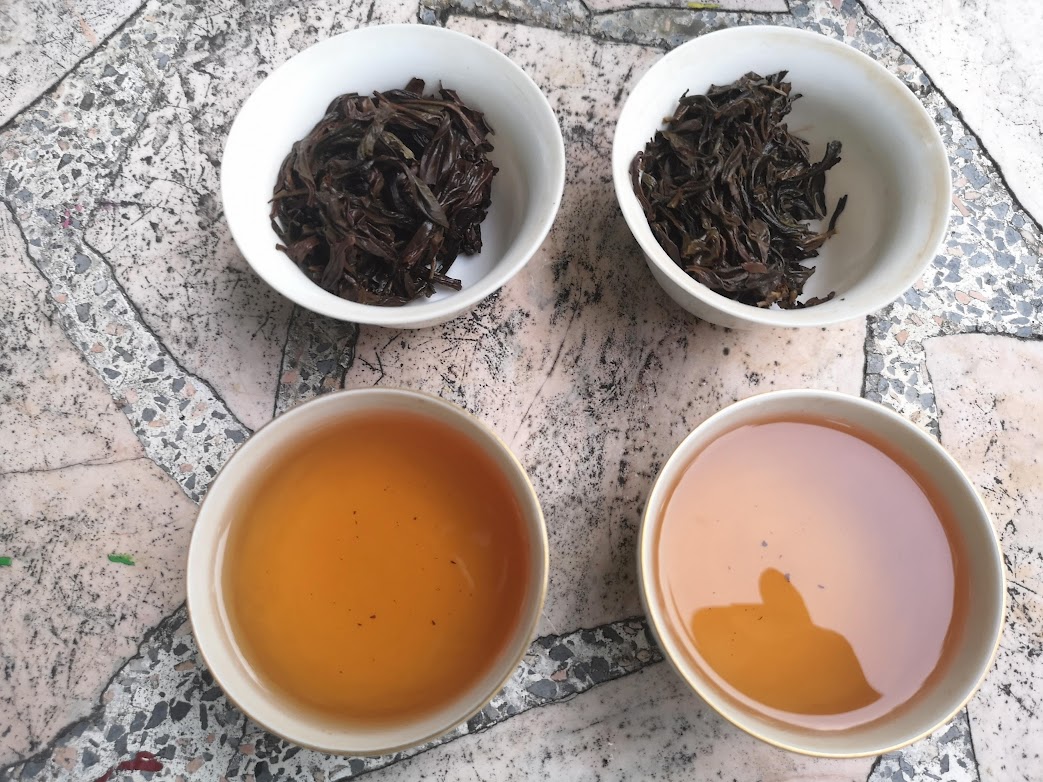
honey orchid left, in all photos


This reviews two more Dan Cong from an ITea World sample set, sent by them for review. The last two were exceptional (orchid and magnolia fragrance versions).

One is the most commonly sold Dan Cong type, Mi Lan Xiang, or honey orchid fragrance (or aroma).  The other version, ginger flower fragrance, I've probably never tried. Their site description of that set follows:


iTeaworld 2024 Christmas Gift Sampler: Fenghuang Dancong Oolong Tea  ($109.90 for 100 grams)


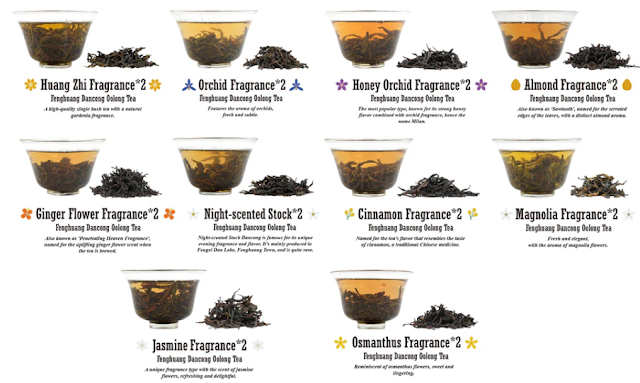
Fenghuang Dancong Oolong Tea:  Huang Zhi Fragrance, Orchid Fragrance, Honey Orchid Fragrance, Magnolia Fragrance, Ginger Flower Fragrance, Osmanthus Aroma, Cinnamon Fragrance, Almond Fragrance, Night-scented Stock, Jasmine Fragrance


I might add a note on their brewing advice, before touching on the subject of value.  They recommend using Gongfu brewing, of course, starting at 6 to 8 seconds, and moving to 10 to 15 seconds, for up to 10 infusions.  That's fine, but I would brew these quite a bit longer, and only get about 6 to 8 rounds out of them.  If I was using a proportion of 8 or 9 grams I'd probably roughly match their parameters, but to me 8 seconds isn't long enough at 5 grams to 100 ml.  That's about preference, not really an optimum.  I'm a sheng pu'er drinker; I can't be brewing teas really light like that, but it is one common form of preference.  It might even work slightly better to isolate flavor aspects, even though that's counter-intuitive.

Is just over a dollar a gram justified for these?  I tend to state over and over that I just won't buy tea at a dollar a gram.  I probably wouldn't buy these.  But for what they are, the quality of the four versions I've now tried, that's about right.  At least they offer sales that could cut that back a little, 20% off if you spend over $100, so it seems this would drop automatically, at least now.  If these really cost 80-some that's a pretty good value.

It feels odd saying that.  Who spends over 80 cents a gram on tea?  People who don't care what the cost is, or who get hooked on types and quality levels of teas that they just can't get for less.  It's better not to do that.  This is where I usually say that other range of similar tea, for this type, isn't as good, in a sense, but it's interesting and pleasant enough that it doesn't matter, it's fine.  With Dan Cong you kind of take a hit.

I will say this:  I just bought decent Dan Cong for a gift at $20 per 100 grams.  It won't be this good, and this range of different DC versions doesn't turn up.  I bought that in a Bangkok Chinatown, and you can't match value or that version offering on the internet, oddly.  I didn't try that exact version I bought, to be clear, but I've bought Dan Cong from that shop three times, I think it was, so you can kind of get a sense of what they sell from that kind of history.  Upper medium quality Dan Cong can be really nice, if you can find it.  Online sources wouldn't sell that for less than $40, but it's still 40 cents a gram instead of 80+.  Other Chinatown shops here would probably sell lower quality Dan Cong for more; it was an exception, even for here.

These might all be that little bit better, or at least the first 4 were.  Maybe the honey orchid, Mi Lan Xiang, wasn't quite on the level of the others, but they were all pretty far up there for quality.  So I guess if you really feel that you need to experience what pretty good Dan Cong is like this is reasonable (given the other versions are like the first four, and I expect that there could be some quality variation).


Review:


Honey orchid:  that's nice.  I didn't use an extended first round for these to bump infusion strength to a normal level, so I'll be trying them light for a first infusion.  Character is good; these aspects are nice.  Tone is a little warm; it seems that oxidation level is balanced really nicely, probably supported with very moderate roast input, that is hard to fully place.  It all integrates.  Flavor is floral, of course, hinting a bit towards ripe peach.  The warmth comes across as a touch of cinnamon, at least so far.  Astringency hasn't emerged yet, but being on the light side that would be moderate.  It's a great start.

One might wonder if this seems really familiar, for this being the name for Mi Lan Xiang, the most common form of Dan Cong.  I guess so.  Those still vary a good bit, and this is a novel and positive version of one.


Ginger flower fragrance:  I guess that tastes a lot like ginger flower?  There is a light spice edge to it; it's really interesting.  The general tone is sweet, like jasmine, not even all that far from jasmine.  Again the moderate warmth works really well for this.  Floral tones are plenty bright and intense, and then it's grounded by warmer floral range, and what could seem like a bit of spice.  

This is so fragrant that it's perfume-like.  No tea this good is artificial, I don't think; I mean that volatile compounds give it a positive effect, what I often call liqueur-like, when the flavor context is slightly different.  It'll be interesting trying both slightly stronger.


Honey orchid #2:  I brewed these for about 15 seconds, or just over, not a long infusion time, but plenty for this proportion, for "only" using 5 grams.  Flavor is great.  Intensity picks up a good bit, but it stays in a similar flavor range.  A richness picks up, a thicker feel.  Astringency also does, but it's not sharp or edgy, only tied to that fuller feel.  Flavor definitely includes a lot of warm floral tone and some peach, and again I read the warmer part as being like cinnamon, just not exactly that.  

Ordinarily I'd be brewing 8 or so grams of this, drawing out even more intensity, even for using slightly cut back infusion times.  As long as you keep infusion timing out around 20 seconds that intensity would still be there.  There is no sharp edge to worry about; may as well push this tea a little.  Refinement and balance are great.  There could be a little more depth, and a little more pop, with aftertaste carrying over a little more, so I'm not saying that this is an ideal version, but it's pretty good.  It's definitely in the right range.


Ginger flower:  that ginger edge really comes out; it actually tastes more like ginger this round.  Maybe I was expecting that to be less of a literal description, or maybe ginger flowers also smell like ginger toot.  The sweetness is again like jasmine, with more warmth.  Where the other includes warm tone that's towards cinnamon this is really aromatic incense spice range instead, a set that I don't have clear enough memory of to distinguish between (frankincense, sandalwood, etc.).  

Feel seems a little thicker, and aftertaste does carry over just a little more.  It seems natural to push these just a little harder next round, infusing them for just over 20 seconds, to see what comes of that.  There's nothing negative to work around, so it will be down to trading off maxing out intensity for having them brew less rounds.


Honey orchid #3:  it's funny how someone unfamiliar with this tea type range could be absolutely blown away by this tea version, the strong floral tone, touch of fruit, sweetness, richness, depth, overall intensity, the way it all balances, and so on, and then the other version amps a lot of that up just a little.  Good Dan Cong is really something. 

"Good" is so relative; above average quality versions just tend to be like this, but from how people describe even versions they take to be positive many aren't.  That characteristic astringency edge people describe needing to brew around is a quality issue.  I suspect that low elevation, monoculture grown versions are pushed too hard with chemical fertilizers, leading to that, but of course that's just a guess.

Aftertaste does seem to pick up a little, for adding just a little more infusion strength.  Feel is generally good, it just seems less noteworthy with the other being a little richer.  Maybe the flavor being relatively familiar does cost it a bit in terms of novelty, but it's not as if I'm drinking Mi Lan Xiang versions all the time.  It's been awhile.


Ginger flower:  that's as far as this should be pushed for infusion strength, or maybe this is tipped a little over a natural optimum.  You know when something is enough when it's too much.  The ginger type flavor is still novel and positive, and other floral range is nice, but that jasmine sort of floral note is a little too strong in this.  

Could that flavor have been bumped by contact with actual jasmine flowers?  Sure, it's possible.  I'd guess that's not an input, but the effect would be like this.  It wouldn't draw out that much ginger flavor though.  And the supporting incense spice range warmth is really interesting and pleasant.  This is just how good Dan Cong goes; it's a little surprising that tea can be like that.  If added flavoring could be this clean, balanced, and positive I'd probably drink flavored teas.  Good Wuyi Yancha can be a bit surprising too, but not as much across this floral and fruit range, typically.  That liqueur-like effect can be really strong in some types of those though.


Honey orchid #4:  the feel isn't necessarily thicker or richer, but somehow it picked up a syrupy effect; the texture changed.  That's nice.  Intensity and complexity are good, and depth, but somewhere in that set is the closest thing to a limitation this tea has.  It could hit harder.  I suppose it could be slightly more intense and complex, and could express a little more depth.  It feels like splitting hairs saying that.  Someone could buy a dozen Mi Lan Xiang versions and not get one this good.  But there's a magic that happens when it's all dialed way up, and this quite good, but maybe just short of magical.

This is part of why I feel like chasing quality level optimums is a bad thing, to be clear.  If you need every new and different next experience to be better than all the last you set yourself up for disappointment instead of enjoyment.  This is already so good.  I'm just trying to place it, for people who are really on that page, into Dan Cong.  It would make for a bad goal trying to top this tea, and an expensive one, probably requiring some hit and miss, but it would be possible.


Ginger flower:  at just the right infusion strength this gets pretty close to magical.  The way all those flavors I keep describing come together, with the rich feel, warmth, depth, aftertaste trailing on--it works.  I suppose that ginger and floral mix, not so far off jasmine range, may not appeal to everyone, or that incense spice undertone people might see as less positive than I do.  To me it all really integrates.  I don't think it was a happy accident that made this tea turn out this good; I suspect that whoever made it really knew what they were doing.

That reminds me, in the last meetup at my favorite Bangkok Chinatown shop the owner, Kittichai, was describing how oolong is harder to make than sheng pu'er (in his opinion).  He said that to make sheng the material plays a lot of the role, and if you get the simpler standard steps right it will turn out as well as the material allows.  But oolong is different; there are more steps, more inputs, and more judgment required.  That matches my understanding too, even though I have zero experience with processing tea myself.  The timing for every step needs to be carefully determined, not according to a recipe, but in relation to the material and the conditions, related to how compounds are changing just then.  It's the same for withering, bruising, and oxidation, on to fixing, then later roasting; variable after variable requires tea maker input.

It seems funny saying that since over and over I've said that South East Asian sheng is typically just a little off Yunnan versions, probably related to processing differences.  Some of that could be intentional; people seem to draw out withering or add a limited oxidation step to offset the final bitterness and astringency, the harshness.  In Yunnan if the material is a bit aggressive after processing it just is; you age it some to offset that, not change the processing inputs.  What do I know anyway; I'm just a tea drinker.


Fifth infusion:  in order to not repeat those same aspect lists I'll just combine thoughts in one note for this round, and end this note-taking.

The honey orchid version has levelled off related to changes, not necessarily fading, but maybe giving up a little intensity.  It's quite pleasant like this, and not changed, but a next round would need to be infused longer to get this far.

That ginger tone is always surprising in the other version, when you first taste it each round.  And it being supported by so much floral and spice range is really something.  I suppose the feel could be a little thicker, but there's so much novel and well-balanced range that it's really splitting hairs to point out where it's weakest.


Conclusions:


These are much better than the earlier tasting sets from ITea World.  If you go back and read the wild origin material posts I did those teas are positive, mostly, but they're not complex, intense, balanced, and refined like this, none of them.  Then again this is Dan Cong (and they also cost more); that would be like trying sheng pu'er and saying that other type range just doesn't match it for intensity.  Of course not.  Just across that one dimension these aren't as full-throttle intense as the ordinary range sheng pu'er versions I often have with breakfast.  But across almost every other dimension the aspects really stand out.  

I suppose that only applies if someone loves floral-oriented teas with some fruit and spice range to add depth.  If someone loves green tea or hei cha, and not that range, these may not work as well for them.  To me the appeal seems relatively universal in form, but in practice personal preference isn't exactly like that.  People like whatever they like.


Sunday, January 5, 2025

ITea World orchid and magnolia fragrance Dan Cong


ITea World sent a few sampler sets to try; I'll be awhile working through them.  They include a Christmas and New Year's themed set, which a Dan Cong set is a part of.  I guess that matches the holidays.  And a Longjing set (less seasonal, but nice), and an aged tea set, based on a mix of pu'er and hei cha types.

To back up a little ITea World is a Chinese tea vendor re-branding initiative, shifting focus from an earlier product theme to selling basics, including sample sets, which have diversified to cover a good bit of range now.  I've reviewed a lot of them, and they've initiated promotion through giving out sample sets to lots of people, including many who aren't tea bloggers or the like.  

This all seems fine to me.  It got to be a bit much on Reddit, especially r/tea, because giving sample sets to a dozen or more Redditors--who are into tea--resulted in a posting blitz there.  But the rest works; most of the samples have ranged from basic to slightly better than average in quality and distinctiveness.  Match to represented types has been pretty good.  I suppose a wild origin set was a little less consistent than some of the rest, but that's how wild origin material and versions tend to go; there isn't a narrow, well-defined character range.  Probably earlier, very low cost samples were more basic, limited in quality, but to some extent sets identified as more unique have been better.

Dan Cong is a challenging range, related to sourcing good versions.  A lot of Dan Cong out there is known for including a distinctive form of astringency, which to me relates to low quality.  Better versions aren't so harsh.  Maybe that relates to lower elevation, mono-culture farmed, fertilizer boosted production, and less than optimum processing.  Or who knows; it requires a lot of hearsay input for cause and effect sequences mapping onto final aspects to seem reliable.  I won't be getting into any of that here.

I'll have to lean into judging general quality level and also specifying match to preference, since I can't really remember distinct floral tones.  That would require quite a bit of scent training, or at least a different kind of memory than I possess.  There have been plenty of orchids growing at our house, and lotus flowers, and lots of flowering vines, but I still don't remember those scents well.  I've tried a good bit of Mi Lan Xiang (honey orchid) and Ya Shi (duck shit) Dan Cong versions, but probably won't keep comparing these back to those types much.  That's honey orchid anyway, not the same as the one I'm trying, just plain orchid.  

Onto review then, but I'll add a product listing and limited information after taking the notes.

I just noticed that they ran a sale offering 25 to 30% off ending yesterday, as of time of editing.  Not so helpful mentioning that now.  Chinese New Year is this month though; how could they not have a sale related to that?


That Dan Cong set contains 100 grams of tea, 20 samples of 5 grams each, listing for $110.  $1 a gram is a standard pricing for high quality level tea, but I personally avoid that spending rate.  With that holiday sale it would've been less, maybe around $70.  The relative value depends on the quality level of these teas.  They would have to be pretty far up the scale to justify even that discounted rate, and since I'm writing this after making review notes I can jump ahead to a conclusion about that:  they are pretty exceptional.  

I really didn't expect that; based only on the two versions I've tried these are slightly better than just about anything I've tried from ITea World.  Their teas have been consistently within average quality range, or a bit above that, but not like these.  Of course you really can't judge a whole set from two randomly chosen versions.


It's odd that set doesn't include Ya Shi, duck shit, isn't it?  That type gets a lot of hype in Western tea circles, and good examples of it are nice.  I asked someone in ITea World about that (indirectly), and they covered that in this Reddit post:


The "Top Ten Aromas" of Phoenix Dan Cong was established back in 1996 by professors and researchers from South China Agricultural University. At that time, Ya Shi Xiang wasn’t as popular. So, naturally, it didn’t make the cut.

2. The Evolution of Ya Shi Xiang

Before it gained fame, Ya Shi Xiang was originally known as Da Wu Ye (大乌叶/“Big Dark Leaf”) because of its large, dark leaves. 


That answers another related question, which fragrance name Ya Shi relates to.  I've tried Da Wu Ye, and never made that connection.  These fragrance or aroma names imply that every version tastes relatively identical, which isn't exactly how it works out.  They would be similar, and overlap in flavor, but wouldn't all be one thing.  Even with completely identical plant genetics--which also isn't how that works out, except for with controlled cultivars--microclimate, soil input, and processing differences change outcome, and flavor aspects.


Related to brewing approach to me it would be a real shame to prepare these using Western style brewing, the 3 to 4 grams to a cup of water approach, brewing for 3 to 5 minutes.  A lot of oolong range--and sheng pu'er--gives much better results using Gongfu brewing.

They include extra tea bags with a lot of their sample sets, including these, but I definitely wouldn't use them with this loose tea.  Of course others could see it all differently.


Review:


Magnolia:  that's quite pleasant.  Dan Cong tends to be made in two different styles, or I suppose really as a continuum between those, but it works to describe it as two consistent ranges.  One is lighter in oxidation and roast input, a "greener" version, which this is, and the other is more oxidized and roasted.  I take the second to be more traditional, but who knows.  

Freshness and brightness comes across well, and also depth, complexity, and refinement.  Quality level seems pretty good.  There is some astringency, but this is far from expressing that harsher edge.  Good Dan Cong, and some other oolongs, tend to express a nice liqueur-like character, with the floral range expressed in a way that is reminiscent of perfume or liqueur, and this is like that.  That depth and intensity carries across well as aftertaste, even though this is just getting started.  It's a good start.  

I suppose the deeper, richer, heavier floral tone may be like magnolia, but I really wouldn't know.  It leans a little towards lavender scent and character effect, one of the few flower types I've encountered so many times that it's familiar.


Orchid:  that floral range is really pleasant.  The other was also nice, but this hits hard.  I suppose it does remind me of orchid range, to the extent I could place that.  Of course there are many versions of orchids, and some don't express that much scent.  It's not so far off lotus scent, another familiar flower type.  

The other was rich and full in character, but this is richer, deeper, and warmer.  It's closer to that more oxidized and roasted style, even though it's really more in the middle.  The balance is great, for getting good results from the tea's potential.  

These are a little better than I would've expected.  Pretty good Dan Cong is out there, not impossible to find, but rougher edged, more limited versions are a lot more common.  It's my guess that I've tried a lot of the better range in the lighter style, from trying a lot of Wuyi Origin's range in the past.  Cindy, one of my favorite tea producer and contacts, and a family member of the owners, married another tea producer from Chaozhou, where Dan Cong originates from, so they really do produce both tea ranges, of course along with many other family members.  It would seem hasty to say that this is as good as their teas, or not as good, but these are really pretty good.

Related to a match to my own preference, even though it's early to call, the warmer tones and very distinctive orchid flavors make the second work better, for me.


Magnolia #2:  I'm trying them brewed fast, and light.  Intensity should still be fine, but they'll give up a bit of feel.  This approach is used to offset what is often described as characteristic astringency, but again I've not noticed that being problematic in higher quality versions.

Flavor intensity is still fine, and it's easier to identify flavor brewed lighter (not that it helps; this is some variation of floral range, probably tasting like magnolia).  Some creaminess still comes across, even though the other version had a thicker, richer feel, matching warmer flavor tones, and greater depth.  One bright, almost citrusy aspect range in the flavors is quite pleasant.  It's still floral tone, not actual citrus taste, but it's light and bright in a similar way.  It does lean towards fruit though.


Orchid:  that's really intense, for being brewed so fast, under 10 seconds.  The increased lightness in the other version didn't carry across; this is rich, deep, and complex.  Between both of these this is most intense floral range flavor experience I've been through in quite awhile.  I guess that's a good thing; it is quite pleasant.

This doesn't seem like a traditional match to a Christmas theme, to me, in the sense of it being a conventional pairing, but it does work well as a parallel experience range.  Maybe especially this second version, for including so much warmth and depth.  

Let's get one possible connection out of the way:  could these be flavored teas?  I really doubt it.  It is possible, since there could be much better extracted flavor products out there than I've encountered, but these don't relate to that general range of effect, as I see it.  I've described a part of the first as matching a solvent flavor experience, but I've only encountered this type of form of that in the best oolong versions, also in Wuyi Yancha range.  These are definitely strong and floral in character; unusually so.  But I expect that's just an anomaly from finding much better than average versions.

If these have been scented they would've had to do so using a traditional form of contact with flowers, layering the two together, then separating the leaves back out.  That is more possible.  Again I doubt that happened, but if so these represent achieving very unusually positive results.  The feel of the tea is also too positive; it perfectly matches how a good quality Dan Cong should feel.  I don't think there is any way to adjust that; the material potential and processing had to be good to begin with.


Magnolia #3:  this is good.  It's the comparison with the other version that's making it seem more limited.  Bright, sweet, complex floral tones are quite pleasant.  Feel is nice, and astringency form and level balance well.  Aftertaste experience is pleasant, adding complexity (or the effect of it).  But the other version dials all that up just a little, in a form that I like better, with flavor range I also prefer.  It makes this seem a bit thin, in comparison, even though that's really a style outcome, not exactly a quality limitation.

It probably helps to explain that in terms of flavor description.  This includes a touch of what I tend to interpret as green wood.  To me that's a natural continuation of that bright, light flavor character, the light floral tone leaning towards bright citrus.  But to some extent it's not entirely positive.  I can't directly compare it to green tea range, really, but it works to say that it's remotely similar in some ways.


Orchid:  deeper, warmer, richer, and quite different in floral flavor range; the same description I've already been repeating.  There really is no vegetal flavor similar to green wood in this, but it might work to interpret one part as similar to aromatic wood, similar to incense spice range, sandalwood or the like.  To me the green wood in the other flavor isn't entirely negative, but it could be interpreted that way by some, while this warm spice tone is a positive input.  


Fourth infusion:  these are transitioning some, but the minor shifts don't replace the original character.  It could make for a more interesting review, for some, to hear about very subtle, minor shifts in flavor aspects, but for as many others it would probably seem redundant.  These are surely less than halfway through their infusion cycle, so changes would be more extreme within another four rounds, but I'll still leave off taking notes here.  The main story has been told, and I need to do some housework prior to going out on a play outing with my kids.

If anything the overall effect of the orchid version has dialed up depth and intensity; that's quite pleasant and promising.  Again it's unusual how good this is.  Both, to some extent, but I really like the style and character of the orchid version more.  

Back to the real versus artificial flavor issue, which I've already set aside, conventionally flavored teas tend to wash out the added flavor fairly quickly, over the first few rounds.  That's probably less the case with naturally infused versions, those layered along with flowers, multiple times, in a different kind of fragrance transfer process.  But if anything these are still improving, instead of fading, as they should be at this stage.  I didn't keep track of minor shifts in flavors later on but they did brew more than four more very positive rounds, and didn't fade in an unpleasant way throughout that cycle.


Conclusions:


So are these as good as Wuyi Origin's versions, those made by my friend Cindy?  If they're not they are at least pretty close to that range.  Wuyi Origin's teas wouldn't all represent the same quality level, or a narrow style range, even though they're generally made lighter, at lower oxidation and roast level, which typically shows off tea character well, and suits some material types.  

Quality level for these samples is high enough that it's on to minor distinctions making a difference, like feel and aftertaste factoring in, and subtle emergent range like refinement.  Them representing different styles and types of Dan Cong is also a positive factor; that's not so easy to turn up, at a really high quality level.

There probably is room for improvement in quality; that's almost always the way it works out.  But it wouldn't be an easy difference to appreciate, for most.  These lack flaws, and are made in pleasant styles (so far; again I've only tried two of ten versions).  They're refined, complex, and distinctive, with good intensity and balance.  It's probably that feel could be a little richer, and aftertaste experience could extend a little.  

I've mentioned those aspects as relative positives in the notes, so it's not as if that's a gap, I'm just guessing that the very highest end of the range may be different in that way, that there could still be room for limited improvement.  Another related guess is that you could buy lower quality versions from supposed curator vendors at twice this pricing rate.  These were pretty good.  For someone exploring Dan Cong this is a good place to start, and especially at a discounted pricing level value is quite fair.

An example might help place that.  A local Bangkok Chinatown shop, my favorite one, Jip Eu, sells a very rare type of Dan Cong product:  medium quality, low priced, good value versions.  They're not this good, giving up unique flavor range, positive feel, and refinement, but they're the outlier example of 100 grams of quite pleasant tea selling for $20-some, which you just don't find in Dan Cong.  That wouldn't come up at a US based Chinatown; one input is that I live in Bangkok (most of the time), where just about everything costs less, especially local products, or some imports from China.  

You typically couldn't even find the same thing for $50 in US shops, for twice as much, because it's such a rare find in general.  The type just isn't there.  It's either $1 a gram, or more, for the higher end range, through curator vendors, or whatever Yunnan Sourcing happens to carry for less.  That could be fine, but I bet most of that is closer to that Chinatown version than these samples.