Showing posts with label hunger. Show all posts

Sunday, February 15, 2026

What 5 days of fasting feels like


Not long ago I wrote about fasting basics and some more detailed approach, here, but it occurs to me that there's another dimension that's harder to describe.  Fasting is a unique experience.  It's hard to just describe what hunger is like, once you acclimate, and the form changes.

Of course this has nothing to do with the theme of why to fast, and not all that much with how to do it, but it does overlap with that.  That earlier post was on the latter, and it's hard to pin down what research says, and not as reliable to convey hearsay or first person accounts of benefits.  I think I'm mentally clearer as a result of the practice, for example, but who knows how to place that.  Maybe I'm not, at all.  Maybe ramping up exercise or improving diet caused that, and there is no connection.  Or maybe I lose my mental faculties and don't know it.

So let's run through some parts of what it's like to fast instead, which will cover before and after acclimation.  I'm only having the latter experience now, because I've fasted for at least two months so far, in total.  

I try to fast 4 times a year, at 5 days each, and I'm on day 5 just now, not so many hours away from wrapping it up, at 4 days and maybe 19 hours.  I "call it" early because I fast from one dinner time to the one 5 days later, so for me it works better to "only" fast for 4 days and 22 hours or so, and if it works out to 20 or 21 that's fine too.  Otherwise I'd have to eat that first meal not so long before sleeping, which wouldn't be ideal.  I usually end up drinking milk after dinner the day before a fast, the last food to clear.

Reading back through those last ideas one might think that 5 days of fasting should really be 5 days and 6 nights, so really 5 1/2 days as clock time goes.  Maybe I will try breaking a fast the next morning instead at some point.  The mental pressure of fasting for "only" 5 days is already a bit to get through, though.


Fasting experience themes


Hunger:  the main factor, maybe.  Early on, for the first 2 or 3 trials, your body is shocked by the experience, and hunger is intense.  Physical cravings are coupled with what people call "food noise," repeating thoughts of eating.  Your body releases plenty of ghrelin, a hunger related hormone, so you keep producing digestive fluids, and experience stomach gas and discomfort.  Or at least that's my guess for why it feels like that.

After 4 or 5 fasts the experience completely changes, and that high degree of hunger largely drops out.  But you're still hungry.  It just takes on a feeling of emptiness, that runs in the background, so that if you smell food you really want it, but so that you can go a few hours without thinking about having not eaten.

One might naturally consider what they could drink to lessen the hunger experience (eating doesn't apply; pretty much no one ever eats paper or some other calorie deficient input).  It's normal for people to drink coffee, tea, or herb tea, and some drink diet sodas.  

I've had one diet soda in the past 5 days, a diet Strawberry Cream Pepsi.  It doesn't seem to change much, but I don't drink much of that.  I've had tea every day, and herb tea 3 of the days.  This time I started in on some pandan leaf and roselle tea I bought not so long ago, along with lemongrass tea, that I didn't get to.  All of those are common types in Thailand.  I don't use stevia to sweeten any of it, but I could.  

Related to the tea I usually drink shou pu'er or aged white tea, because they're easy on your stomach, but I also had some hei cha (Fu zhuan) and relatively oxidized sheng pu'er.  It would be nice to drink coffee but I'm not acclimated to drinking my coffee black, and that my hurt your stomach.  

I think it helps most to drink a tisane that you tend to drink a lot of, perhaps mostly because it boosts hydration input.  I can drink three 16 ounce mugs of chrysanthemum, and that adds well over a quart / liter to my daily fluid intake.  It's best to try to drink 3 liters of water a day, if you can, but that's a lot to get down.  You need to supplement quite a bit of salts (sodium, potassium, and magnesium; there's more on that in the earlier post), and I'm always struggling to get the intake amount right, and to work through salt water tasting awful, even in a diluted form.


Special hunger triggers:  I need to go to grocery store every time I fast because I let my food supply run out, and need to re-up it, usually on the last day.  Sometimes chance will have me visiting a market or restaurant with others I happen to be with.  In one sense it's not so bad, but in another it is.  Sometimes I'll cook for other people, and that is a different level of exposure.  Your digestive system can seem to turn back on, even when you just smell food.  

At worst that will lead you back to the earlier phase of stomach growling, that you tend to only experience early in fasting trials.  I just went grocery shopping on day 4, taking my mother-in-law to a store, and it was a little like that.  But even that level of exposure you acclimate to.  Cooking not so much.


Stress:  this is the other part of the experience of hunger.  It feels like an extra underlying stress, to me not completely unlike what extreme jet lag feels like.  If your normal stress baseline isn't bad it's no problem, but when other stressors enter in it can be too intense.  It's not hard to be productive when you fast, and that deserves it's own section, the extra mental clarity.  Even walking a lot or light exercise is fine.  But getting it all to balance requires a bit of extra attention.  

For me if other stressors add up too much I'll stop the fast.  The last example that comes to mind is too harsh to cite here, but even if work gets unusually busy it might throw it all off.


Other side effects (dizziness, low energy level, sleepiness):  this probably varies a lot by person, so what any one has to say wouldn't apply broadly.  But I'll include it.  In those first 3 or 4 fasts these negative factors were a lot more to deal with, especially the first two.  That's why I recommend people try period eating first (20-22 hour fasts), then 24, and build up.  I might feel a little dizzy a couple times a day.  Getting electrolyte balance (intake) dialed in offsets a lot of it, but your body seems to also need to adjust to a new range of experience.  If you fasted every other month you might stay well-adjusted to it, but if you let 3 or 4 months go between fasts you might end up adjusting again.

I don't really feel low energy level now, which is strange.  I've been walking 10,000 steps a day for all of the 5 days.  Typically I don't try to do much with losing weight, fasting for other reasons, but since I've climbed to 81 kg (178 pounds), up from 74 kg (163) I'd like to get that to drop again.  My blood pressure has been running high, and it might help.  I've been swimming a lot over the past year, and keep on adding a little extra muscle, so it's not that much fat gain, but it's some.

Lots of other potential side effects could be concerning.  If my electrolyte balance runs low I'll feel mild cramping, mostly in my calves, and that's not good.  That leads back into a longer and off-topic discussion about how hard it is to dial in an optimum electrolyte intake (sodium, potassium, and magnesium).  It should be easy, figuring out how much you need by trial and error, mixing up a diluted batch of that with water, then drinking that over the day (and taking magnesium by pill / tablet, because you need much less).  It's not so simple.  Some of that is probably user error, that I make it harder than it needs to be.  I'm back to just drinking some salt mix a few times a day, mixing it up without measuring it out per day, not using that more standard approach (standard within "fasting circles").  

This Reddit group is what I experience of that online discussion; it all requires some interpretation, and some extreme views come up, but that's normal for social media.  Note that the high end of their fasting wiki recommended electrolyte intake range is an awful lot of salt (or had been; per this following citation it's the opposite now); I have no idea how that could work out.


I take that back; in the past that wiki recommended a high end range of at least 3 grams each of sodium and potassium, and now it's a fraction of that.  There was a "snake juice" recipe for that daily mix for people to drink, and they've deleted that.  Lots of people had complained the high end was way too high, or maybe even the relative average, and maybe moderation staff changed on the page, and the guidance opinions they wanted to share with them.

This is the second version of that advice in two days; I cited it from yesterday (Feb. 15) and it was completely different.  Just keep in mind it's a rough guideline, not a final answer.  Individual requirements and tolerance for dosages would vary.  


One part that was interesting, in past versions of advice there in the r/fasting Electrolytes 101 wiki page, was that you can use either sodium chloride or baking soda, (sodium bicarbonate), and that food grade epsom salts can be used for magnesium input.  There is endless discussion there on what is the best magnesium compound form to supplement.  Maybe glycinate is recommended most, but I use magnesium oxide, because it's cheaper.  The concern is laxative effect.  Magnesium that is absorbed too quickly will cause that, so the compound form matters.  That's what laxatives often are (like milk of magnesia).


mental clarity, positive side effects:  mental clarity is about it for positive changes in the short term.  Even that comes and goes.  There are flashes where I can really get a lot done, and see complicated themes much clearer than I normally would.  My subconscious mind is also in on it; my dreams have picked up a really novel clarity and complexity over the last 3 nights (the first night I had eating hours prior).  

In one dream I dreamt I had accidentally broken the fast by eating, then woke up to realize it was a dream, but woke up in another dream where I experienced that.  I had an interesting exchange about child rearing practices with a fictional character in one last night.  I suppose the waking clarity is more meaningful and impactful.

I think the clarity extends to be a main positive effect from the fasting.  Maybe I'm also experiencing some aging effects less, but this is where it gets hazy.  My hair has returned to mostly colored since taking it up; I've lost the few grey hairs I had, except for very few around my temples, less than 10.  It's strange seeing a hair that's two colors, that had been grey and returned to brown, but I've experienced that.  I'm 57; I really should have greying hair now.  I don't care much about the aesthetic side, since I'm married, and it just doesn't matter, but it's an interesting change.


a visa renewal selfie from last month; you can see some grey hair


More on the vague side, I think that I have more energy when I run now, from greater "metabolic flexibility," or ability to use fat as an energy source.  Who knows; it would be easy to imagine that.  Or training experience tends to change in those kinds of ways over time. 

I think for many a main positive effect is a reduction of "food noise," and an ability to manage diet better.  My diet was pretty good to start out with, and I never snack that much, but I've used the fasts as resets, to make minor positive adjustment.  I keep going back to eating ice cream, and some chocolate, but the overall balance shifts.  It's much harder in the US than in Thailand; when Ben and Jerry's is on sale what can you do?  

I eat more fruit and vegetables than just about anyone now, and prefer that basis for my diet.  I eat some meat, to keep up protein intake, to adjust for exercising a good bit, but I eat nuts as a snack, a good bit of eggs and dairy, and use soy or pea protein shakes as a supplement.  

All that is a bit beside the point; the idea is that it's easier to improve your diet and change habits after a reset, of sorts.  For me I can only make minor changes each time, and if I try to shift too much after a fast it won't work.


risk:  I don't think much about this, but it's worth considering.  What could go wrong?  If your electrolytes get too far out of balance then lots of things could, up to and including having a heart attack.  It's important to get that dialed in as fast as possible, and probably gradually acclimating to fasting makes sense, even though it's more common for people to get the idea to try 3 to 7 days from an online video, and just go for it.  

The problem I do experience with dizziness could be much worse.  In the past 5 days I've stood up and felt light dizziness two or three times, which is pretty moderate.  It's something to keep an eye on.

The main risk is that if you ingest a lot of electrolytes at one time then you will experience diarrhea, even if you haven't eaten in days.  It's that "don't trust a fart" theme.  Then that carries over to "re-feeding;" if you eat low quality food to re-start eating you'll experience that for a couple of days.  

I've only tested that once though, and that was my experience.  I usually eat a burger and fries for a first meal, which sounds pretty low quality, but if you use good ground beef or pork (we don't eat beef much in Thailand), good bread, fresh potatoes or sweet potatoes for the fries, and some vegetables (tomato and spinach, usually), then it's not low quality food.  Of course most people who fast use an even more sensible approach, and eat different things in stages.  

Later editing note:  I ate a burger and fries again, yesterday, and my body digested it in 4 hours or so.  Maybe because I was still hungry and ate some yogurt, a little chocolate, and a bowl of cereal some hours later?  Or maybe looking forward to ending the fast too much prompted more rapid digestion.  What works would always vary by individual anyway.  The riskier "refeeding" cases relate to much longer fasts, well over a week in duration.  Then just winging it wouldn't be safe.


talking about fasting:  this is a bonus tangent; that pretty much already covers fasting experience.  In fasting circles people usually recommend keeping fasting experience a secret, especially during fasts.  Some people react negatively, of course.  In one online story an HR department told the person to start eating, not to fast.  People can be judgmental.  I don't talk much about it, but I don't avoid it either.  If people have problems with accepting someone else not eating, or a life practice they see as absurd, and probably harmful, then that's on them.

You can never really fully explain it.  People can only experiment with fasting and make of it what they do, for themselves, and that would vary by person.  It wouldn't be for everyone.  For some the negative side effects would be a complete deal-breaker.  For others acclimation, that I've been describing, might never seem to happen, even though it's my guess that within 4 or 5 trials most people would see negative aspects reduce.  And then a more primary point, for many there just wouldn't be any point to it, if they're not trying to lose weight, and see the health benefits as possible but not a given, and perhaps unlikely to occur.

I first tried out fasting, as an adult, because I met a guy who claimed he did it for spiritual reasons.  That's not entirely right; in an earlier life phase we would do multi-day juice fasts as some sort of cleanse / detox.  It made more sense in that life context.  I fasted for the very first time at the age of 10 or 11, passing 24 hours, but not fasting to my goal, 36 hours, or one complete day and night after waking.  I don't remember why I did that.  

Then I "fasted" a lot cutting weight as a wrestler in high school; I would go as long without eating as I needed to in order to make a competition weight.  Our team was really strong, and I didn't have the experience to be above average (I wrestled for 2 years), so I had to slot in at varsity wherever I could beat the other guys competing.  Good times!

So not eating for weight loss could work, and those other reasons may or may not be appealing.


Sunday, September 17, 2023

How fasting affects food cravings


A Reddit discussion theme brought this up, related to me practicing and following discussion about fasting.  I've experienced limited changes in food preferences that seem to relate to fasting, but then I've only ever fasted three times for 5 full days, and two other times when I stopped earlier, after 2 or 3 days, mostly related to getting electrolyte input wrong, I think.  I've wrote about that here.

That starting point input is this, from that post and discussion:


I have been fasting for a couple of weeks and apart from losing a bit of weight, realized I obsess less about food now. Anyone else experience this. If so, what are the reason for it?


I don't think I ever did obsess about food so much, but it will work as in intro to describe what I think changed.  I had snacking habits before that seemed to mostly drop out.  I would eat just a little chocolate regularly, and for awhile (even after the two rounds of fasting) I had switched to snacking on mixed nuts between meals.  It wasn't really a negative thing, as I saw it, or an obsession, but I feel even more inclined to just eat three light meals a day now, which really isn't far from how I saw my diet a year ago, before the fasting trials.

Someone mentioned a good reference on food craving experience, the psychology of that, which is a summary of lots of other reference materials.  From scanning their definition of food cravings maybe I never did experience what they describe as that.  I was more into ice cream before, which I would sometimes eat when it was around, but I never saw that as a craving experience.

Rather than go through a summary of the research paper contents, building up from background and definitions, it could be more interesting to start with what they say about fasting changing food experience or habits:


One area in which food cravings appear responsive to dietary reductions is fasting. The direction of change is unexpected. There is evidence that fasting, in both the short-term (Lappalainen et al. 1990) and the long-term (Harvey et al. 1993), is associated with fewer food-craving experiences. This decrease in craving is generalised across all food groups and does not rebound during re-feeding (Harvey et al. 1993; Martin et al. 2006). While such interventions are effective at bringing about weight loss, there is no relationship between the amount of weight lost and reduction in food craving.

This suppression of food craving is consistent with other observations of reduced appetite during weight loss on very-low-energy diets. The paradox ‘less food, less hunger’ is the headline of a study by Wadden et al. (1987)...


Interesting, right?  I'll consider some perspectives from comments in that Reddit discussion and then come back to tying it together with these ideas based on my own experience.


Reddit discussion inputs, versus my experiences


Let's just start with the first two comments, I guess sorted by Reddit karma (upvotes, their version of FB likes):


I usually go through a phase in my fasts where I obsessively scroll r/FoodPorn... so, I guess everyone is different. I do feel more control over my eating though. I use to need to eat every 3 hours or I might punch a baby for looking at me the wrong way. Now 16h is hardly noticeable.


It is interesting how people react to hunger or cravings in different ways, or take the whole experience very differently.  There seems to be a divide between people who avoid any contact with food or the idea of food and others who actually keep in touch with the subject while fasting, as that person does.  Some contact with food exposure while fasting is fine but it seems as well to avoid that, and scrolling the internet related to food content.


There's probably several reasons why this happens (biological, psychological, changes in environment, etc) but I think biologically it's because fasting has a powerful moderating impact on hormones related to hunger.


Hunger experience, and how it changes with fasting exposure, is one of the most interesting parts of exploring fasting.  Not just for abstract self-understanding either; it plays into enabling a different form of control over a main bodily input like eating.  Not just related to not eating, also tying to managing inputs, to eating healthier, to placing snacking in relation to meal inputs differently, and better.

These two inputs tie together quite well with a very general exposure theme I experienced, that links to the point about fasting causing less hunger experience in the end.

The first 2 or 3 times I tried fasting the experience of hunger was very intense.  It just seemed normal to me that people would always experience that.  I might also mention that I decided to fast once when I was 10 or 11 or so (I was a strange kid; I had no exposure to the practice of fasting at all at that point), and only made it through one nearly complete day.  Related to how people fasting count the time that probably was 26 hours or so, maybe 28, so one full day.  I didn't know what to make of the experience then, beyond that hunger experience would be intense.  I wanted to go a full day then, so more like 36 hours, but hunger was driving me crazy, and I ate some cake my family had eaten earlier.

Fast forward 40 years and I tried it again (with some juice fasting in the middle; that's easy enough to do for a number of days, because in a sense you are still "eating," ingesting calories).  Experience of hunger was intense.  The worst of it lasted 3 days or so, easing up after that.  It came in a few different forms, as a base-level feeling of emptiness, as gnawing desire to eat, and as cravings, as immediate urges to eat something I normally would at that time, or triggered by seeing or smelling a food.  The very first day--I don't remember if for an attempt that didn't work or the first 5 day duration; I think the latter--I visited a food market with my wife, and it wasn't so bad, beyond the smell.  Visiting a local fair and restaurant with her the next day also was fine; somehow working through the expectation of eating was no problem.


I was a four days into fasting at this street festival last year


I ended that fast late into my birthday so I had cake and ice cream


Then on the last 5 day fast hunger had dropped out relatively entirely, at least related to those earlier experiences.  My body seemed to adjust, perhaps related to the hormone experience mentioned in the second comment.  I think expectation at the mental level was also a factor; it was easy to just not attach to the idea of eating, to not try to not think about it, since that cycle of avoiding thoughts or desire can be problematic, to instead just accept it and let it go.


Back to the "craving" idea I'm not sure to what extent I ever fit the criteria in that paper, which explicitly describes that there is no singular clear definition of that.  It's a research review style of paper, so it talks around how different studies interpret cravings a little, but then mostly just sets that aside.  I picked up the habit of mostly eating three small meals a day so many years ago that it's hard to keep track; I don't snack that much.  In college we had cafeteria meal plans set up that way (freshman and sophomore years in the dorms), and my parents always tended to eat like that, with an evening desert as an exception.  


It's hard to summarize how it works out related to "less food intake equals less hunger," but thinking back I have some history with that.  I was really thin for my entire 20s and through most of my 30s, in part because I was vegetarian, and because I led a very active lifestyle, for work and sports, and fueled that by eating three moderate meals a day.  Through habit I mostly only ate when hungry, channeled down to those meal times, with some evening snacking included.  Maybe as much related to the vegetarian diet theme I think I kept caloric intake to an absolute minimum, to the extent that whenever I wasn't working or exercising if I would just sit down my body would crash.  Reading was a favorite hobby interest then, which matched well with that.

I tried to practice what I later heard referred to as "intuitive eating," which I didn't have a name for.  I tried to eat what I felt hungry for, adjusting for tuning into what my body needed, versus letting ice cream, potato chips, and McDonald's food become that default.  I didn't drink soda or eat candy much, even though I think I was cutting it close on caloric input, so it would've been natural to crave that.  Maybe a work-around was eating foods like trail mix as a snack, eating just enough to fuel the exercise and other processes.  I kept busy so I never noticed being hungry, until the next meal time brought it up, and by then I needed more food intake, so it all seemed quite natural.  I was 5' 8" and weighed 150 pounds or so, as skinny as could be, but my body was fine with the cycle.


camping in Canyonlands in Utah in the 90s; I would've hiked 10-15 miles a day back then


what that looked like, but this was across the border in Colorado


I'm an inch shorter now (people do tend to shrink as they age), and weigh 15 more pounds, but I seem to eat less than ever.  We seem to get into equilibrium states, and then change to become heavier or lighter isn't as natural as continuing on, if it all balances.


Fasting as a diet reset


One other part links, that is so distinct that a new section seems in order.  Even though I've just described eating a fairly healthy diet in my 20s (and I'm in my 50s now, and that never completely changed) fasting has seemed to help serve as a positive diet reset.  More than ever I appreciate and desire eating healthy, nutrient dense foods, like fruits and vegetables, complex salads, and healthy versions of soups and stews, or plain grilled meats and vegetable.  I've been eating a lot of pumpkin and sweet potatoes for years; that didn't change.  

It's not really directly related but I've been supplementing protein intake for about a year, drinking powder mixed into milk or juice, because I try to not eat too much meat, eggs, or dairy, but my protein demands seem considerable related to running a good bit (15 to 20 miles a week).  Why wouldn't I crave meat, dairy, and eggs, if I'm implying here that natural intuition can guide more ideal diet inputs?  I don't know.  Maybe it all doesn't actually work, and I'm only experiencing what I expect to experience.  I don't crave the protein shakes, at all; I have to remind myself to include that, and often skip it when I planned to but forgot (like with breakfast recently, and yesterday's).

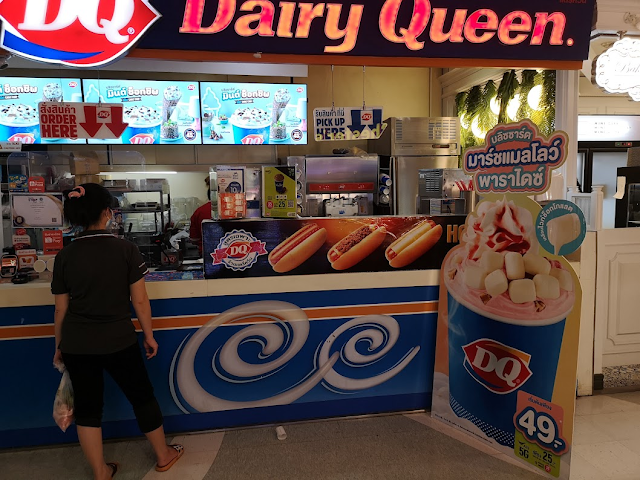
Where I go (physically) seems to partly guide diet as much as these mental factors I'm bringing up.  In visiting malls or shopping complexes I walk by Dairy Queen (which is still more popular here than back in the US), and in the past I'd eat more of that.  


some product offerings are a little out there but I like others


I'm separated from my kids now, and my normal routines, because they're in Honolulu in school and I'm working in Bangkok, so I've not been in malls much for six weeks, and haven't eaten any ice cream in that time.  Thai foods tend to be fairly healthy but I'm almost entirely off those now too, cooking simple and basic food versions at home more.  I go to work in an office infrequently, about once a week, and what I eat there is mixed; sometimes food I bring, sometimes just a pastry or snack out doing an errand, or a couple of times fast food (back to McDonald's, once in that month or so).  It's not like I'm on an ideal diet; I saw Oreos on sale at the grocery store and picked some up, and since I was craving chocolate (maybe from mentioning it here) I bought chocolate covered digestives too.


So what really changed for me, related to this "reset" idea?  I had mentioned that when fasting I noticed a few layers of triggers of what or when to eat, and a snacking response was part of that.  My main version had shifted from chocolate to mixed nuts, eating a small handful a few times a day, but that was probably based on immediate triggered impulse as much or more than a real dietary need, caused by an intake gap.  It's not problematic, eating a half a cup of mixed nuts a day, so it doesn't really work as an example of "corrective action," but the theme isn't different than if it had been chocolate, ice cream, chips, or whatever else.  I've eaten a lot of salads at different times, but cycling back to that as a habit is another example.  

Living in Honolulu with my wife in grad school (where we met) if I ever asked her what she wanted me to make for dinner she would always say salad, every time.  Then I would make an elaborate version of that, with greens, lots of vegetables, extra inputs like raisins or sunflower seeds, home-made dressings, something like soy and sesame, a fruit input, homemade croutons from seasoning and toasting bread, and often with chili seasoned fried tofu.  She loved it because it's not a typical Thai food, and no Thai would ever experience such an elaborate version.  Even if they wanted to vegetables are different here (I'm in Bangkok now), and the set in the US somehow seems really well suited for that.

People in that Reddit fasting sub are more concerned with dieting than I am, naturally.  They will use rotating fasts (rolling 48s or 72s, two or three day cycles on and off eating), or 2 or 3 week long fast durations to maximize that.  I could also stand to lose a few pounds, I guess.  Some people in that group talk about shifting habits even more than I've described, cutting out more negative inputs.  Here's a typical example, from the thread I mentioned as a main starting point:


It’s because the ultra processed / sugary stuff that most people eat is addictive. If you cut it out you won’t crave it anymore after awhile.


That probably works.  Two separate comments second what I've said about the fasting experience time-frame shifting with exposure:


I also have noticed that I lose my food cravings as well after day 3 ðŸ˜œ


The first few times I fasted I obsessed really bad, that was the most difficult part. Over time it has mostly gone away.


There isn't that much discussion input in that post thread because that sort of question comes up over and over, and people tire of answering the same question.

The linked article says a lot more about study input about related patterns: 


So it wasn't only a research review paper, it summarized a series of papers and ideas presented together, back in 2006 ("The Summer Meeting of the Nutrition Society, hosted by the Rowett Research Institute and the University of Aberdeen").  An excerpt of the abstract points to more overlap with what I'm considering here:


Cravings are hedonic responses to food, characterised by their intensity and their specificity.  Food cravings are extremely common, reported by the majority of young adults. They are closely associated with liking but not synonymous with increased intake...  Taking dieting as an example of an assumed influence on food craving, the outcomes of cross sectional studies are mixed and unconvincing. Prospective and experimental research shows a clearer relationship. Dieting or restrained eating generally increase the likelihood of food craving while fasting makes craving, like hunger, diminish. Attempted restriction or deprivation of a particular food is associated with an increase in craving for the unavailable food...


It's all worth a read, just a little dry.

To add one more experiential observation before closing I've noticed since fasting that I tolerate short term hunger experience better, seemingly less triggered by expectations.  I can skip a lunch and I get hungry, as anyone would, but if I eat a good sized late breakfast that doesn't apply, so it's not just about expectations.  Expecting a meal input and actual hunger, bodily demand for calories, seem to be two different things.  

One supposed benefit of fasting is "metabolic flexibility," the ability to use body fat as an energy input, and to some extent it seems to work out like that.  I can go quite light on eating for a day and still run 10k (6 miles) and don't really notice much difference.  Doing light runs during fasts may have helped with acclimation for that.  Before the fasting exposure it seemed like draining glycogen reserves during such runs triggered even more immediate hunger response, and now as long as I eat something later it doesn't really matter if it's calorie dense of not; a large salad will do.  

My phone health app says that I "only" burn 600 or so calories on a 10k run (actually 529 for a 10.1 k run yesterday), and supposedly we store 2000 calories of glycogen reserves in our body, which is why running a 42 km marathon has people hitting a wall when that supply runs out.  Runners can avoid that by eating energy gels and such, or drinking Gatorade, or even by acclimating to use body fat as energy better, back to the metabolic flexibility idea.  I suspect that there is a huge difference in running efficiency at different paces, that my phone app really isn't "in on," and someone running a 3 hour marathon versus a leisurely 4 1/2 hours adds extra caloric demands.  But what do I know; that's just a guess.

For me fasting is about experiencing the experimentation, along with limited interest in health benefits that I could never really confirm anyway.  My own shift in eating patterns and the experience of hunger seems moderate, but it's still interesting.  


In the long run I think it can be valuable to switch around how we see food, to change from considering only what would be pleasant to experience as a next flavor input or satiation experience and instead also consider nutrient intake, what balance of foods may support that.  Of course that process can start at the grocery store, for people stuck in the past who actually prepare foods, or it would extend to what is purchased through an app for many others.  Over time it's easy to appreciate healthier food inputs, or I suppose even to crave them, depending on how you define that.