Showing posts with label 2006. Show all posts

Monday, July 15, 2019

2006 Kokang Myanmar Mei Hua sheng pu'er


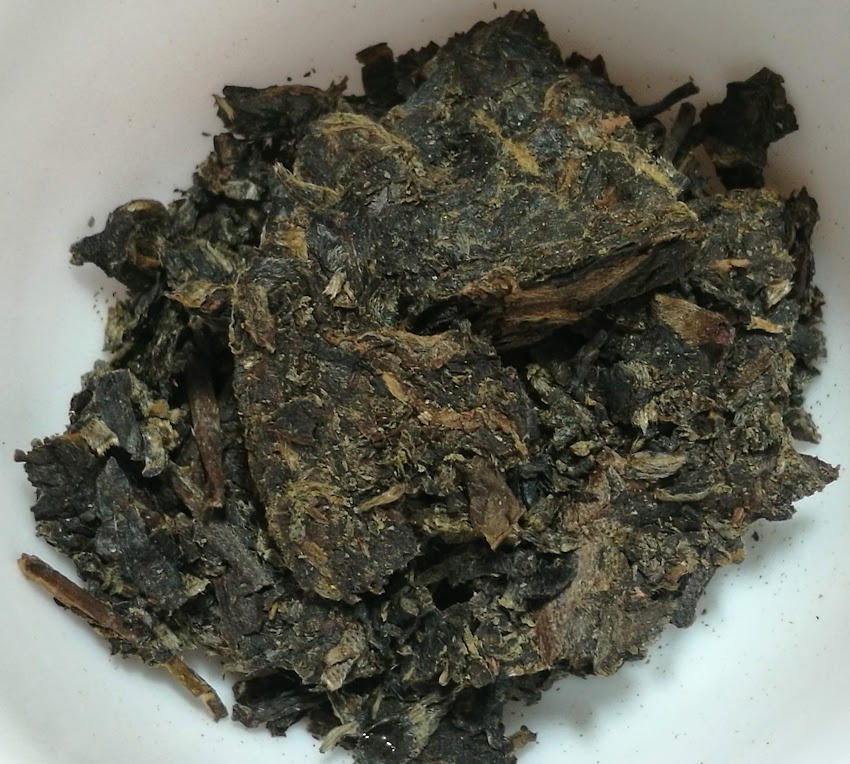
I think the texture looks odd because it had to be ripped apart


I'm reviewing an aged Myanmar sheng; very interesting.

I looked up details of what this is on the order image capture; it's the third one down, from a list of the latest teas I bought from Chawang Shop two or three months ago:


As chance has it I just heard about this same Myanmar tea producer visiting for an expo here (sales convention), but it's the last day, and I already have plans.  We'll see how that goes, if I can change them [I did; it's brutal how far out there that event hall is but it was great meeting them].

That 2012 Daxueshan version stands out as one of the more interesting teas on that list, which I didn't try yet, and the 2008 Yiwu brick.  I'm not necessarily trying them in any order, just what seems natural next, or comes to mind.

This tea may well need a bit more age, in spite of being 13 years old now.  Myanmay sheng tends to be on the bitter side and that's the one comment that stands out related to Kokang produced teas (but the next parts of that story become clearer after meeting that producer and trying a 2018 version, which I just made review notes for).  This is a very compressed cake; that probably slowed the fermentation process, it experiencing limited air contact.


I'll start with a vendor description first:

This little cake come from border area with Myanmar from Kokang (果敢; pinyin: Guǒgǎn), area about 20km outside from China. Kokang county was part of China for long time and is famous for ancient tea gardens. Nowadays the is tea from this area sell to Chinese market as most border teas,

Stored since 2006 in Kokang and this year (2015) sold to Kunming tea seller. This cake will surprise you with the quality and taste. Nice floral aroma, full body and thick,floral sweet with fast huigan. 

This tea is powerful and give many nice infusions !


That's promising that it didn't spend all those years in Kunming; that has to be a good bit drier, and would've caused it to age slower.

It's odd not developing meeting the producer further here, at that expo.  They were really nice.  I probably should split out talking about that to more of a vendor profile post since these reviews run so long as it is.  They discussed their teas and their history for a half an hour, so it really could add up to a good bit of information.


the guy beside me is a 5th generation tea maker, or something along that line


Since the aging and compression issues come up throughout this tasting I'll add a picture from the vendor (Chawang Shop) from 2015 here for comparison:


It was actually still a bit green then, as a 9 year old stored sheng.  That color has darkened in the 4 years since but it was still aging slowly.


Review:


The first infusion is more pleasant than I expected; a bit smoky, with some bitterness still evident.  It's not really fully saturated, so it will take a couple more rounds for a more informed early take.  It has some warmth and sweetness, along with a good bit of mineral, so complex and distinctive that it's covering normal light rock range along with some metal.


The next infusion I went a bit long on, maybe just over 15 seconds, trying to strike a balance between overbrewing what is already wet and getting the rest to open.  I used two rinses with this to remove more of the tea dust, and I've broken form and am filtering the tea, but some dust still gets through.  It's hard separating out really compressed tea.  That could potentially throw off the brewing a little; being more careful to not include it initially might've helped.  Someone once mentioned their practice of setting aside finer dust and ground bits into a separate jar when sorting sheng, mixing the inputs, then drinking that prepared differently; an interesting idea.

This does seem like it's still in the middle of aging.  It's ok as it is, with some warmth and sweetness, somewhat approachable, with what must have been really intense original bitterness leveled off.


On this second round the first flavors list still stands, quite a bit of mineral, that warmth and sweetness, moderate bitterness.  Some extra thoughts on interpreting those:  warmth and earthiness might be towards tobacco (cigar or pipe; I'll refine that further), mineral has backed off metal a little already but the light rock is still strong, and smoke level is moderate.  It's definitely complex; there are surely other layers I'm not getting to yet.  The only issue seems to be that it hasn't made it to a fully aged character yet, that it seems to have some years to go for that.


Tobacco ramped way up on the next infusion; that's closer to cigar for sure.  The sweetness and complexity along those lines probably also relates to dried fruit, but the earthiness is blocking picking it up as clearly.  Switching over to shorter, lighter infusions should help with that.  Smoke might be fading a bit.  This bitterness level is moderate enough that it works, so seeing this as not quite ready doesn't relate to seeing that as overpowering.  It just seems like that sweetness could develop a bit, and the softer flavor range.  Describing it at a more optimum infusion strength (when now finally fully saturated) will help place that.


A five second infusion is better, more than intense enough; this would work doing flash infusions.  A flavor aspect similar to those Tulin tuochas I'd been drinking is present (reviewed here, along with a nice Xiaguan FT iron cake), a musty old wooden furniture range, which isn't as bad as it sounds.  Sweetness and bitterness levels are ok, and the feel isn't bad.  It has a good thickness to it, and overall intensity, and the aftertaste definitely packs a punch; it's quite intense along with the initial taste flavors coming across as such.  Astringency isn't problematic but the feel could still smooth out a bit more.  Tobacco range still takes over the main flavor, with that old furniture filling in, but beyond all that I think the sweetness does tie to a dried fruit, maybe date.

There's a lot going on with this experience, flavor-wise; it would be open to varying interpretations.  Seeing that tobacco as a wood tone might make sense, and others might not see the smoke as essentially completely faded at this point as I do, since a trace is still present.  It's relatively clean in effect; that musty old furniture edge is quite limited, and to an extent I like that, in proper proportion with the rest.  Feel and aftertaste are interesting in addition to the complex flavor.


Sweetness bumps again in the next round; the balance is even nicer.  I'm experiencing smoke as slightly heavier again; I'm not sure why that would keep varying.  With this tasting mostly like tobacco with a little smoke I guess this could work for smokers, or for people who always like the idea of cigars but could never get the experience to work out.  Of course I've smoked cigars before but I missed the part where it seemed like such a pleasant experience that I wanted to keep trying it.  On the subject of alternate flavor interpretations a bit of peat seems to come across too, filling in the part a Scotch-drinking cigar smoker might look for.  I like it, but I could relate to this not clicking for lots of people, including some aged sheng drinkers.


One nice aspect is that it keeps shifting a little each round, the balance of all those flavors.  The feel stays pretty thick and substantial, and the aftertaste hits hard, with the latter changing to some extent with the taste as experienced during drinking it.  The dried fruit part doesn't stand out more than the tobacco / smoke / peat but that sweetness and flavor seems to lend the rest a nice balance.  The aged furniture effect (think old mahogany with a touch of aromatic furniture polish oil) is nice for adding another trace of depth; also better for being so secondary.

I get the sense that this could brew relatively endless infusions using these fast rounds, at this relatively high tea proportion (normal for me, but still high).  It might make sense to brew this in one of those comically small clay pots, a 50-60 ml version that might produce half that or less in brewed liquid; 15 rounds of that would probably be enough tea, with a couple extra after for good measure.


It still changes a little round to round, now something like 8 infusions in, but this seems to tell the story of this tea already.  It's fine to drink right now; it doesn't need more aging in the sense that it's not ready.  I just get the sense that further transition could be positive, that some of that early bitterness and smoke throughout rounds could swap out for more complexity in other forms.  Buying two of these tiny cakes related to that expectation, that it might be interesting later on, and one wouldn't allow for trying it across long periods of time, that I could sample it once a year until it's much improved later on but then wouldn't have much left.

For people who know they are on this page already (from Xiaguan tuocha experience or the like) buying a 5 cake tong would make lots more sense; 5 of these times the $8 cost is still less than aged cakes of any kind.  A half a kilo is a good amount for moving past just trying it now and then, into actually drinking some.  For the right person, centered on that page for preference, buying only a half a kilo might have them kicking themselves a half dozen years later once this tea really hits its form.


so green for a 13 year old sheng version


Comparing different takes on the same tea version


A little more on alternative interpretations might be of interest, a subject I've been venturing into related to reading Steepster reviews.  That vendor description mostly described it as floral, and a vendor-site review comment said this:


The taste is powerful, still bitter and a little bit tart. Smoked prunes, raisins, dried fruits. Aroma is very sweet and pleasant.


Floral I kind of didn't get, but this tea might have changed character a good bit over the past 4 years (or I could've just missed it).  That attribution could work to fill in a lot of the sweeter-range complexity I was having trouble placing only as a fruit input, it just seemed non-distinct to me beyond all the rest.  Floral could even span some range; it could relate to warm, rich floral tone like rose and then also lighter, sweeter, brighter range like plumeria or lotus flower.  I routinely say I'm not familiar with flower smells but I do pick up a plumeria flower walking home once in awhile and smell it while I walk, to give to Kalani at home, and she and I checked the smell of lotus flowers about a week ago in a temple visit.  They're sweet, not completely unlike plumeria, just in a different range.


I like the description of this tea as powerful in the one take; some version of expressing that is necessary to describe it.  It may include some tartness (it does more when you think of it), and smoke and dried fruit works, but it's more centered on tobacco across a lot of infusion range, to me.

It is on Steepster; two reviews there were interesting, one for including comments from two people I've talked to about teas a reasonable amount.  The first review is also interesting for citing a blog review that relies mostly on a flavor-profile chart, the type the Gastrograph app outputs, also related to the work Teapasar was doing on profile charting, both described in this post.

That German-blog linked reference text is simple enough:  Strong astringent and floral.


The second review is by Jay in Hong Kong (JayinHK there, also listing his Tealife.hk vending business):

This tea needs a lot more time to get to where it needs to go—lots of smoke. The material is promising. Lots of chopped leaf, but good flavor and aroma and strength, which I like. This is the kind of tea I like to age, but the extremely high compression mean I probably won’t want to drink this for another ten years, even with Hong Kong storage. When it IS ready, though, I expect it to be incredible!


It's been three years now since that post, so things might have changed a little, but I'd expect he would say the same type of things at this point.  It's probably more drinkable, and it seems smoke has probably faded quite a bit, but not there yet.  It's interesting how green this leaf is; you don't even need to taste it to get some impression that it's aging slowly, surely related to that tight compression.


I'll be back in touch about the much newer versions of sheng and shu I have from the expo meeting, and with more vendor background related to what the Kokang staff said there.  I just finished writing review notes for the 2018 sheng (the short version:  it's very nice!), so it's odd not including that, but this ran long enough already.

Tuesday, May 29, 2018

Potential separated at birth versions review; 2006 Thai HTC sheng


0802 HTC version I bought left, tea Olivier sent right


Olivier's sample; a cool looking chunk


I'd mentioned that an online contact, Olivier Schneider of puerh.fr, had sent some versions of sheng to try (and a little shou and Dian Hong), and that a 2006 Thai material originated HTC sheng was one of them.  I own what's left of a cake of 2006 Thai HTC sheng I bought from Tea Side awhile back, a tea I first reviewed as a sample in 2015.  Of course I'm assuming here that it's ok to call a Thai version of sheng pu'er sheng, even though officially pu'er is a regional designation; that could as easily be read as "sheng pu'er-like tea."

I first reviewed that cake I bought in 2016, and compared it to another sheng version last year, and the tea seemed to have been improving.  That really could have been that I was developing a preference towards it, in addition to actual changes.


the labeling for that Tea Side 0802 2006 HTC cake

It turns out these cakes were probably not identical, but since I don't know they weren't I'll leave that working title, qualified by "potential," suggesting investigation as opposed to a claim.  I asked Olivier about the HTC name and origins of that tea, and he said this:


HTC basically dont exist anymore, so recent production came from several factories who use this name (more or less legally according to the case)...  Most of them have absolutely no connexion with original HTC, some get some knowledge from old master, workers, etc...

It's mostly impossible when you find a HTC cake on the market to know where it came from, except if you really found it in the factory. More or less like "CNNP" cake in China.


Interesting!  I've been drifting away from researching what's what in this blog and just focusing on tea reviews, which I'll mostly stick to here, but something interesting does turn up.


This sample's description cites some background, including mentioning "dry storage," which should be interesting to consider.


Review


Even in the first initial infusion "my" version (the Tea Side 0802 tea) is sweeter, a bit more aromatic, more like the complex scents in incense, frankincense or something such.  Of course I never will get such descriptions right; I'm not familiar with aromatic woods and spices and it's been a long time since my hippie days.

Olivier's sample is a touch smokier, deeper and richer, "darker" in flavor, even though the tea itself is slightly lighter in color.  I'll break both more into aspects on the second round, which will be a fairer comparison of where the aspects are going through later transitions.

good color, not so different


The Tea Side version opened up a lot in that first round.  It tastes a lot like prune now, moving into that particular dried fruit range.  I could swear it didn't taste nearly this much like dried fruit or prune the last time I tried it, but then I've not been drinking it very frequently, checking it a couple times a year.  Beyond that there is an aromatic dark wood range, that spice I'd noticed in the first infusion.  It's nice enough, different.

The smokiness picked up a good bit in the other version, the one from Olivier.  Some of the underlying dark wood or aromatic spice aspect range does seem common but there isn't nearly as much dried fruit range.  It might come across a bit more like date, where that other was close to matching prune.  This has a slightly different body feel too, a bit dryer, with just a bit more structure.  The other tea wasn't thin but the effect was different, and not pronounced.  It really does remain in your mouth after the infusion, but in a different sense than in younger teas, not as intense and location specific, but significant in a different way.

Both of these teas are complex enough that lots of labels could pin down supporting aspect range, probably related to flavors and also feel and aftertaste.  Sweetness, earthiness, and complexity are expressed in a lot of depth of flavor in both.

I went a little longer on the next infusion, not so much doing that varying times to experiment as I tend to but instead because there's lots going on here that's distracting.  Doing reviews with kids in the house is problematic, but it's the life I'm living.  These teas only infused for between 15 and 20 seconds, versus around 10, but the effect is going to be completely different.


Tea Side version left, Olivier's right (the "long" infusion)


The Tea Side / Bangkok stored tea is much different slightly stronger and more opened up.  That dried fruit flavor shifted, no longer straight prune but more complex, more mixed.  Part a bit more like date develops, and the aromatic spice / hardwood notes increase to match the fruit level in effect.  The depth of the flavor is amazing; it just extends down to lots of "lower" level.  Mineral grounding picks up, a bit along the line of wet sandstone.  All those parts are quite clean though, and they integrate well together.


Tea Side version left, a bit darker; could be the storage difference


The smoke is diffusing in the other version, giving way to other range.  I'm guessing these aren't the same tea; they're just too different.  Some of the aromatic hardwood effect is common but the overlap between the two is limited.  The feel is different too, even though the Bangkok version did pick up structure for being brewed a bit stronger and opening up a bit more.  There is a bit more of a autumn forest floor effect in this version.

For both one might interpret a mild supporting aspect range as tobacco but it's nothing like an aged sheng that actually tastes like tobacco, when that's mostly what the tea tastes like.  It's problematic to put a label on these different earthy ranges, and describing that as "some sort of darker wood, or maybe spice" doesn't work well, especially since that would be two different sets for both.  This second tea does taste just a little more like tobacco though; that's how the greater autumn floor range comes across compared to the other dried fruit and mineral.

The Tea Side version falls into a nice balance on the next infusion, not different than before, but somehow evened out across aspects range.  The sweetness and fruit is balanced by aromatic dark wood and underlying mineral, all clean and positive.  Olivier's sample version is improved too, not different, but balancing well at this level.  The touch of smoke is still present but warm autumn floor range aspect, with a touch of tobacco, round out a nice effect, with a nicely structured feel even brewed a bit light.

More of the same on the next infusion; I'll leave off note-taking for now, and see what chasing around these kids require.

at the zoo with the trouble-makers the next day


Conclusions


Both teas were really nice.  They just don't seem all that similar; it seems unlikely they were closely related versions to begin with.  Storage differences could cause variation but it wouldn't seem like this much, to cause them to seem like completely different teas across most aspect range.

About the smoke aspect, Olivier said that teas can develop that as a natural result of an aging change, and that it's possible to notice a difference from an input due to smoke flavoring the tea during processing.  If you'd owned the tea and noticed it not there, and then later it was, unless there was some chance of real smoke contacting the tea that would have to be what occurred.  I guess I'd tried enough young sheng that seemed smoky that I assumed it was usually either from smoke contact during processing or a natural and original aspect in the tea, not an aging related input.

Both versions were nice.  I liked the one I'd owned better due to liking that dried fruit effect more than the earthiness, smoke, and additional tobacco / dark wood range.  I didn't notice that much difference I could clearly attribute to a storage condition difference, to Olivier's being stored in a relatively drier place (per the description, at least), but given the range of differences that may just relate to not being familiar enough with transitions to guess better about that.  The color was different, with that tea much lighter, and it could be that the transition to those sweeter flavors was the result of a faster, therefore more advanced aging process.


I talked to the owner of Tea Side, and he recommended looking at the description for another 2006 HTC cake he sells that does include smoke as an aspect, their 0803 numbered product.  It's conceivable that's exactly what I'm trying.


Or not; it would seem a stretch to try to guess at the probability of that.  It is interesting to consider his description of that tea:


Dry tea smells with bark, dried fruits, spices. In the taste there are various dried fruits: raisins, dried apricots, plums. Light smoky flavor reminds of some Chinese raw puers and makes dried fruits taste more like prunes. There are some savoury wood tones and spices.


Pretty close; maybe.  That page passes on more of the story about the HTC producer but it sounds like there is still more to be told about it:


Old raw (sheng) pu-erh tea from the Thai factory that produces pu-erhs under the name Hong Tai Chang.  The tea is made by a Chinese master, a native of Yunnan. He has been making Pu-erhs for more than 40 years. Then he’s been retired and passed on all his knowledge and experience in producing and storing pu-erhs to his disciple, whom we’re working now with.

Wednesday, August 17, 2016

Tea Side 0802 HTC 2006 Thai sheng re-review


I must admit, I feel like I'm starting all over again with tea in getting back to pu'er (hei cha in this example; it's a Thai tea).  And I don't mean in only a good sense, although that's part of it; I'm way back at figuring out brewing.


Anyway, the tea is a Tea Side 0802 Hong Tai Cha (HTC) Thai sheng hei cha.  It's not really a pu'er since it's from Thailand instead of Yunnan.  Pu'er within Yunnan varies by specific origin location (most blanket statements like that require qualification, but that seems conservative enough to stand alone), and this could be all the more "varied" due to being grown in a different climate.


But that's not really something I'll address here, how it compares to Yunnan versions, or related to tea sourcing issues.  That last subject and the history would be interesting; there are "old" tea trees in Thailand, although old is quite relative, and dating trees is problematic.


About the tea, even the dry tea smell wasn't what I expected.  It comes across a lot like a shou, too dark, too rich and sweet, too much caramel and raisin range, with a bit of old leather.  But clean; no mushroom or peat, none of that other range that can stand out in shou, definitely nothing remotely like fish.  I'd tried this tea before, a sample of it, reviewed here, so it's odd to be going back through all this, being surprised by how it comes across.


Part of why I'm re-reviewing it relates to testing my own experience against my earlier experience, not that I could really separate out error, subjective preference changes, and other possible changes.  What are those, you might wonder, since a nine year old pu'er shouldn't change that much in the 10th year (or could it?).  If storage conditions had changed over the last year it would be different, and people tend to speak of pu'er resting from travel (seriously).


I've had this tea for around two months so it should be feeling ok, settled.  One odd variable is the tea being sold as either 0801 or 0802, apparently two different but closely related teas, perhaps not identical to what I tried last year, one more thing I won't really get sorted out.

Review:


After overdoing it with a Golding Nan Nuo sheng pu'er proportion of tea to water (a real pu'er, with Nan Nuo being one of those distinct regions), and after getting better results the second time, but brewing slightly too thin, I went light to start on this one.

This tasting is going to have to go in rounds, and more ideally several sessions would be better.  I was reading up and watching videos on brewing and drinking pu'er and a Tea DB video talked about trying the same pu'er ten days in a row to get a feel for it; sounds about right.  I'm not sure if those guys actually have jobs to schedule tea drinking around.  On to review then.

The first infusions were way too light, although still nice, interesting fruit and earthy flavors.  Later when I get my sense of taste adjusted I may well drink the tea like that, but I just wasn't getting much out of it at first.

It's early for a tangent, but related to that, I was just talking to a friend about subjectivity in tea tasting, and to me that means a lot of different things.  One thing is that preference determines what is good; very straightforward (eg. tea can be enjoyed at different infusion strengths, a preference which can change over time).  Another is that one person might "get" a taste as plum and another as raisin; a bit more going on there, seemingly that one person is right and the other is wrong, but maybe it's not that simple.  Or two people might have completely different impressions, and this is where it all gets strange.  Other factors could account for real differences, brewing parameter differences, even using different water, or tea ware.


so much for straining

Where am I going with all this?  One other interesting case--interesting to me--is that maybe I could taste a tea differently at different times, for reasons that might not be so easy to explain.  In that post where I tried to comparison taste a black tea from one year to the next to determine that I couldn't separate the effect of different tea versions from year to year.  Now I'd like to do the same for this tea, compare the tea and my sense of taste, and to practice on the type.


Once I did get the tea brewing--it sort of "opened up" after some infusions, and after I lengthened infusion time a little--it was even more interesting.  It was complex enough that it would be hard to describe, but that's the whole point of this exercise.  The tea tastes of dark wood and raisin, maybe a bit of leather, possibly with just a touch of peat (much as I know what that tastes like; maybe I really mean "forest floor").  Oddly by all that I mean the tea is nice.  It has a cool feel, not a dryness, but towards that, something in the range I'd need more vocabulary to say much about.  From there aspects get even harder to describe.  Even if I added another three or four taste aspects I'm not sure I could really describe the tea through them.


It has an earthiness that tastes like actual earth, like dirt, but in a good sense.  That isn't helping describe it, is it?  It's like the smell from digging up roots from under the ground, dirt mixed with an unusual vegetal smell, heavy on minerals, something different.  Oddly that's one of the smells from my childhood, playing with dirt, damming small streams, or playing in basements and root cellars, out in the woods knocking down different kinds of plants for no good reason (I think the last relates more to green tea range though).  It's rounding things off too much to say it's a taste of age itself, but there's something to that.  Like a really old baseball glove, or at least along that line.

So why do I like this?  Maybe there really is no accounting for taste.  Something in all that effect I kind of connect with.  I think it would work good and strong, since there is no astringency to brew around, beyond whatever component is giving it an unusual feel.  I don't mean unusual as in how fresh teas come across, it's a full bodied and complex feel, just different.  Some teas taste better as strong as possible, based on a limitation from one aspect, and more often a great balance point works best, probably how this one goes.

I honestly can't say if this is a good sheng pu'er or not; I don't have enough background to have a clear judgment on that.  Me just liking the tea is a good start.  It has an aftertaste but nothing too unusual, not so lingering.  I'm not sure if that feel is preferable to pu'er enthusiasts or not.  It coats my mouth and tongue in an unusual way, which I feel in the top of my mouth, but I'm not really feeling it in the throat.  I never really got that part anyway, about taste or feel in the throat, how that's such an interesting thing.

junior taster likes hei cha, just a little


My junior assistant had no idea what to make of it so she said it tastes like flowers.  She's stuck on that.  I guess if I had to give it just one taste description I'd go with old leather, which isn't even something I've ever actually tasted, at least not that I remember.  I'll give it another try before I finalize this, and compare it to last year's description.

Re-tasting, a second go and earlier notes:


I tried the tea a second time, with a higher proportion of tea to water, with somewhat similar results.  I didn't need to keep adjusting time to get some flavor out of it but did need to adjust time to keep it in the right range, soft and balanced enough.  The basic flavors were similar, raisin and date, dark wood and old leather, with an odd feel, a slight fullness and dryness, all of which seemed to work.  It's consistent enough with the first tasting, I just need to get parameters dialed in a bit finer.  I'm sure it does evolve across transitions but I wasn't noticing as much of that as I expected, probably related to still messing around with parameters.

This is probably a good place to check that review from last year:


not dark, not green, in the middle

Very nice; the tea is smooth and rich, full flavored, not astringent, complex, a little sweet.  Flavors are all layered together:  plum and fig, molasses, earthy tones, tobacco, a bit of mineral, maybe something like roasted almond in there.  A number of infusions in the flavors mellow a little, deepen, with some of the fruit giving way to stronger earthier tones.  The fig and plum element is still prevalent enough to give good balance, and the texture stays smooth, with just enough astringency to give the tea some body but no bitterness.


Sounds a little better than my last description, but similar, although that difference could just relate to paying more attention.  I'm not sure what it's all about but my kids are louder than ever lately, often engaged in minor battles with their mother, interesting in small doses but not a great background for tea tasting.


Maybe as well to cite the vendor's take, given going this far:


The tea is made from old and wild 200-300 years old trees. This Sheng resembles a sheng of purple bushes in looks - the tea is very dark for its age. This is my absolute favorite among Thai Shengs...

Dry flavor: Raisins, tree bark and spices. Neat leaves are carefully ripened. The infusion looks like dark amber, it's absolutely clear.

Taste: Full-bodied, very smooth (balanced) and intelligent. Nice raisin profile laced with spicy woody tones. Notes of plum are also present. Velvety and spicy aftertaste remains long after the drinking.


Close enough.  The parts about tea tree age are a bit taboo these days but I couldn't resist including it, and his subjective judgment wasn't necessary, but why not.


Conclusion:


Oddly I find myself considering how much I really like this style of tea.  Usually that type of response is easy to sort out, it's right there, I do or don't.  I had said I did, but now I wonder if I like the tea as aspects and a whole experience, or if it's more about the novelty, since this is quite different from most tea experiences.  I think I like it, but it's not that "wow, I love this" experience people tend to express.

It makes me think more about shifts in preference curve, that idea of people acquiring taste for some teas, as they do Scotch, in the other post.  Perhaps a different tea example will put more context to this.  Related to sweetening tea, I recently commented in a Facebook group that there is a natural tendency to evolve a preference away from sweetening tea, expressed as such (quoting myself, again--strange):


There is a natural tendency to use less sweetener over time, as a result of preference change, brewing technique improvement, and from drinking better tea. I only use sugar in masala chai now. There is nothing wrong with the existence of a preference curve or people being at different places on it, and I wouldn't pass judgment on someone that stopped in a different place.


As for preference shifting from one type of tea to another it's not so simple.  I keep referencing back to an idea I'd read in another blog (Tea Addict's Journal) that people drink tea for taste preference first, then others, related to feel and other aspects next (body and aftertaste), and then effect (qi).  I've mentioned before which teas seem like better gateway teas to me (light oolongs, to go with a short version, but it's more complicated related to better oolongs from Taiwan).

So what about pu'er (hei cha, in this case); is there a natural drift in preference to that type?  It doesn't seem to be so simple.  Pu'er is really two types of tea anyway, sheng and shou, and maybe it does work to say shou could function as a gateway to aged sheng preference, or even young sheng (another idea from the Tea Addict's Journal, but then he says lots of stuff).  But really it's not clear to what extent anyone would naturally change what they like over time, or how exposure is going to work related to that, or if there really would be a natural direction or number of likely stopping points.  A lot of people seem to keep drinking broadly related to types.

Some types are trendy, and expectations factor in, group "consensus" direction.  One could find justification to continue to prefer pu'er or oolong in tea groups, and might feel a bit marginalized if black tea seemed best for some reason (or green; both don't get much respect--individual teas can by the types sort of don't).  White teas are different, held in higher regard, fine to cite as a favorite type, but it would seem strange if someone just drank white teas.  For now I'll stay on the same path, trying a broad range of teas, but this is an interesting way to evaluate preference shift, by experimenting with one type I'm not so attached to.