Showing posts with label Dong Ding. Show all posts

Saturday, September 12, 2020

2014 Ali Shan and Dong Ding oolongs


Getting to some samples that were included from back when I ordered teas from Tea Mania (provided by the vendor, Peter). To me their sheng pu'er are just amazing, and a great value.  That was covered in detail in this 2018 Jing Mai arbor review, and 2018 Yiwu "Lucky Bee," and many earlier posts, but this re-review of how the 2016 Lucky Bee Yiwu version is progressing really tells that story. 

I've come to expect that everything from them will be better than one would expect from even good sources. Then again there are levels to source types, and quality and pricing, so I just mean that the teas seem to be on the higher end for quality, while typically in the middle for pricing, a rare occurrence. 
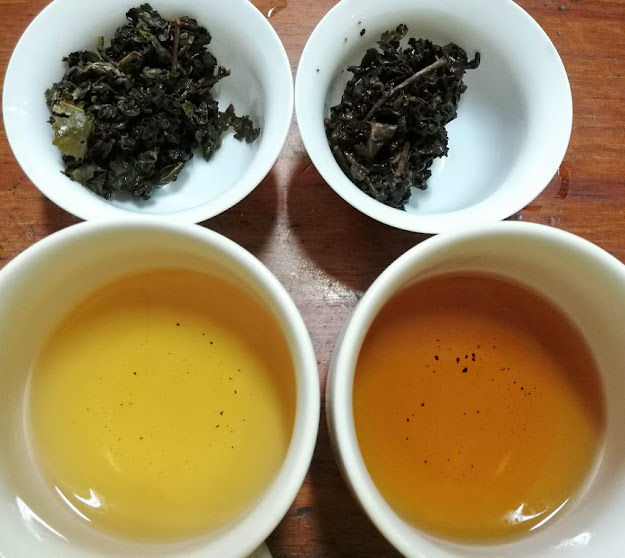
Oolong being aged for 6 years is new to me. I've only tried a couple of examples of well-aged oolongs, over 20 years, and that aging effect wouldn't be the same over a shorter time period. I'll get around to guessing about expectations in comments about the experienced aspects, but without actual background experience to set up a baseline that's not worth much. 

Heavily roasted Wuyi Yancha are said to improve a lot over even a year or two, and would mellow and become more pleasant over this time-frame too, with the roast effect softening and diminishing. That's not how this will go; you can tell from appearance the Ali Shan was light to begin with, and the Dong Ding was never relatively fully oxidized or charred, as Taiwanese "red oolongs" and high-roast Anxi Tie Guan Yin can be, respectively. 


Vendor descriptions: 


This Qing Xin Oolong tea from Ali Shan is a classic Gao Shan Cha (highland tea). Ali Shan, along with Li Shan and Shan Lin Xi, is one of the three regions in Taiwan with highland tea plantations. 

The Ali Shan Qing Xin is warm, full-bodied and has a complex taste profile. The aroma is clearly floral but there are also notes of ripe fruits. The sweetness reminiscent of dark forest honey with a slight woody undertone. The tea is light and airy, but the sweet honey smell lingers in the empty cup for a long time. 

Harvest: Spring 2014 
Taste: Honey sweet with floral aroma and notes of ripe fruits. 
Oxidation: appx. 40% 
Roasting: light-medium Origin: Ali Shan, Nantou, Taiwan. 
Preparation: Per serving 5g, temperature 95°C, time 15s. Rinse leaves gently with hot water before infusing. 

That was selling for 20 CHF, or $20 US, for 50 grams. 


The next tea: Dong Ding  (selling for $25 /  50 grams instead)


Dong Ding is a classic and rightly famous Taiwanese Oolong tea. This Dong Ding is a good example of flavors that a highland tea (Gao Shan Cha) can develop. Delicate floral scents, honey notes and subtle roasted aromas delight the palate and linger in the mouth and cup long after the last sip. 

Like other famous teas, Dong Ding is often and often imitated. Dong Ding is a limited mountain area with limited tea production. Because of its special aroma, Dong Ding style tea is produced in many other tea growing areas. But, even if the cultivar, the style and sometimes even the tea master are the same as on the Dong Ding, its quality and aroma is never achieved. 

Harvest: Spring 2014 
Taste: Flowery, light toasted and delicate honey flavor. 
Oxidation: appx. 40% Roasting: medium Origin: Dong Ding, Lugu Xiang, Nantou, Taiwan. 
Preparation: Per serving 5g, temperature 95°C, time 15s. Rinse leaves gently with hot water before infusing. 


I should add a few thoughts about all that, without getting too far into covering review content, since I've already tried the teas and write this part during editing.  A lot of people would go with full boiling point water; that kind of goes without saying.  It's easier to recommend someone tries both and see what they think than running back through all that.  Given that these have smoothed out a lot with age and some of the more forward, "higher end" flavor has diminished it might be all the more true for them, that hotter water would work better.

It also goes without saying that the Qing Xin reference is to the main, older plant type used for oolongs in Taiwan.  Other posts have covered that; I'll skip going further with it here.


Qing Xin is a more updated transliteration of Chin Shin, table from here


It's not what I expected but not completely surprising that the Dong Ding is oxidized to the same level as the Ali Shan.  I'd have guessed that the Ali Shan wasn't oxidized that much, but this Dong Ding isn't pushing the envelop towards black / red tea range.  The roast input will change character in ways that isn't identical to more oxidation, but it can be tricky splitting back out the two inputs.

I think if I re-tried the Ali Shan I might be able to break down flavor range better, in relation to clarifying what fruit seems to be represented.  I agree that it's primarily floral, and that made it hard to get far with that secondary range, but I suspect that the flavors warming and deepening pull them more towards fruit than when this tea was on the young side.  That oolong version was complex enough that to some extent the broad range of flavor inputs seemed non-distinct, covering floral tone, some fruit, and a touch of supporting mineral, trailing into spice effect just a little.  The Dong Ding seemed to include more straight cinnamon, but it was complex too, with a lot going on in feel range.

I dropped out essentially all discussion of aftertaste range, probably mostly related to experiencing an unfamiliar tea type, and also due to rushing the tasting process.  My normal weekend morning routine is to wake up, eat something, mess around and become more fully awake, then to do a tea review with notes.  Yesterday I got a haircut instead after step 2, and went to a lunch, and then a play area with my kids at noon.  I am concerned about "doing the teas justice" when they are this good and this novel, but if I waited until I had a 3 or 4 hour block of free time I would stop review blogging.  This will be a bit quick and rough as reviews go, because I don't have that much time (so the standard process).


Review 


I let these brew for too long the first round, not because of some strategy of getting them to start faster, just due to looking at something on the internet for half a minute. Not an auspicious start.  This is a little later than I typically start the day for ingesting any caffeine, late morning instead of right away. 

If these had been sheng I'd be talking about how overbrewing teas lets you analyze flaws or limitations in different ways, but for these I'm not sure how it will work out. 


Alishan: very pleasant; floral and fragrant. I expected some of the high end to dissipate, with these evolving more depth to compensate, and it will be interesting to see how that goes. The most intense and forward high end is diminished, even though I let this soak a bit long (towards a minute). A warm spice-like character fills in other range; that's interesting. This is floral too, but it's a warm, muted floral range, shifted from brighter tones to a deeper, warmer floral type. There's no edge to this at all, even for being slightly over-brewed, but that's not really a surprise. 

Dong Ding: this is warmer yet, with cinnamon as the most intense flavor aspect. Again the sharpest, brightest high end flavors seem to have evolved out, with depth and smoothness filling in more character range. I must have mentioned it in the later intro but I have no experience with 6 year old Taiwanese oolong range, that I remember, so it's unfamiliar to me how these are "supposed to be." 

There's a perfume-like character to this that shows up in really good quality oolongs across a broad range. I've mentioned it so many times I don't want to go far with explanation, but it's a little like cognac, not just the floral tone a perfume brings across, but seemingly tied a little to the solvent range. 

This is full in feel in a really novel way too. It's creamy, but not in the same range of senses I would usually mean that. Real cream actually feels quite heavy in your mouth, related to the way it coats your tongue and the rest, and this matches some of that, almost a coating type feel. Lots of oolongs feel thick, and sheng pu'er exhibits a broad range of types of feel and structure, but this is different. 


Second infusion: 


Ali Shan: this picked up "higher end" floral intensity, or maybe that's just from the brewing time difference shifting balance (brewed for 20 seconds or so, drawn out a little to account for not maxing out the proportion). The feel has a pleasant thickness, just nothing like the other version. The warmer range depth isn't different, just less intense. There is some light mineral tone to this, characteristic of Taiwanese high mountain oolongs, but that seems to have softened with the aging process, along with the bright, intense floral range that always reminds me a little of new car smell. Right, like plastic, but more pleasant in effect, and somehow similar, in a way that I'm sure most people wouldn't see as associated. 

It works well; it's clearly very good tea. I personally probably would've liked this better when new; trading out that front-end intensity and brighter range for depth just doesn't improve things, to me. It is interesting experiencing a slightly different version though. This is amazingly clean and smooth; the character is just different. It's not "plummy," the flavor range that more aged oolongs tend to pick up (per limited exposure to those and hearsay input). 

Dong Ding: more of the same; very pleasant. Again warmer tones and cinnamon stand out in this. It was definitely roasted more, and while I'm guessing a well-balanced higher level of oxidation also led to this positive outcome. It is just a guess but I'd expect both contributed to this character, with anything remotely like a "char" edge having dropped out years ago. 

Again I'd probably rather try this as a slightly rougher-edged new version, trading out this smoothness and unusual depth for front-end intensity, even if a bit more astringency and some slightly rougher flavor comes with that. "Rough" is within relative standard range, of course; this had to start out very drinkable as sheng, green, and black teas go. I'll go back to giving these a longer soak for the third round to ramp up intensity (30 seconds), since there are absolutely no negative aspects to "brew around" in these. 


Third infusion: 


Ali Shan: floral range shifted in character. That will be hard to describe, since I've not even grappled with breaking down distinct floral tones so far. This seems closest to lotus flower in nature to me. Before it was complex enough that it probably covered a range, and two or three flower-type descriptions would've been required. That's still true, but that one lotus flower range aspect bumped up. It's not so different than orchid, and given how there are many types of orchid that's already a range, that must cover some scope, but lotus flower has a sweet, rich depth to it, and a unique character. 

It's interesting how this bridges over to spice range as well, with some warm, more neutral floral tones filling in the space between those. A hint of dry mineral gives it depth, but that's adjoining slightly warmer tones that drift into aromatic wood, towards cedar, just not exactly like that. It's odd how this comes across as somewhat simple and approachable but really there is a lot going on, when you focus in on noticing it.  Versus this being interpreted as covering a broad floral range with some mineral and spice I think that fruit tone interpretations would make sense too, related to ripe fresh peach or dried apricot, but it all integrates well enough and covers so much flavor scope that it's hard to break apart.

Dong Ding: straight cinnamon might have picked up a little. Again at first "glance" (in the taste-sensation range) this isn't so different than soaking a cinnamon stick for a minute or two, but really a lot more goes into underlying that experience. There is floral tone supporting that, and a creamy feel that teas almost never exhibit, never mind spices. Vanilla is an exception; real vanilla bean gives an infusion so much texture that it's almost too creamy, like a custard in mouthfeel, and this overlaps a little with that experience, except for the "going too far" part. That liquer / cognac / perfume like aspect isn't pronounced but it also rounds out the rest. 


I'll give these one more longer soak, up towards a minute, and leave off, because I'm due at a lunch today. 

Fourth infusion: 


Ali Shan: not so different than last round, so I'll just say that it's not transitioning much. 

Dong Ding: this also seems to have leveled off, and may even be fading a bit, with those longer infusion times taking a toll on it. These teas are far from finished but they may be declining from here on out. Transitioning aspect range through longer infusion time and more roasting seems to come at a cost for the number of infusions a tea can produce, so it wouldn't be that unusual if this was a round ahead of the other in terms of progression through a cycle. 


Conclusions: 


Excellent teas, interesting in style. Aging seemed to have brought on the changes I would've expected, with the teas picking up some depth at the cost of higher end intensity. They were interesting, novel, and pleasant, clearly very good quality teas, as I would have expected. For someone interested in owning truly aged oolongs, versions aged to older than a decade, buying some like this in a mid-range and hanging on to them might be a great option. Time passes quickly, and any 10+ year old oolong version is going to be really expensive. I didn't check yet what these are selling for but at a guess it's on the moderate side, for what they are.

(Back later) ok, they're $20 and $25 per 50 grams; how to place that?  I'd expect that's about what these would typically cost when new, based on an informed guess about quality level, and you just can't find aged versions like this easily.  When tea types relating to any factor are all but impossible to turn up supply and demand concerns become strange; if there is significant demand the price is whatever the vendor wants it to be, and the type could no longer be available at some point even given high pricing.  I reviewed a comparably aged Oriental Beauty version once and said roughly the same thing, but that was selling for an order of magnitude higher cost than this, several dollars per gram.

To me aged oolong is a strange thing to begin with.  Letting well-roasted Wuyi Yancha settle makes perfect sense but I don't completely "get" aged light rolled oolong.  That said, why not consider an opposing viewpoint from people who do get it.  James of TeaDB writes to advocate the general type here.  He never really gets far with describing that appeal, limited to this statement:

I enjoy drinking pu’erh and happen to own enough that I’ll be aging it for a very long time. But I I also really do enjoy aged oolong… And for partly inexplicable reasons have hardly even a pu’erh cake worth of oolong put away for the long haul.


Liking it is the thing, I guess.  He mentions his own criteria for what he considers as aged in that post:  15 to 20 year old versions.  Buying these particular teas, that I just reviewed, and waiting another 9 years would be a long term project.

Looking back through their earlier posts there isn't much describing what is commercially available for aged oolongs.  Those would tend to come and go, and be found in one-off examples that later disappear, many of which wouldn't necessarily be that exceptional anyway.  James reviews a lot of versions in this post, most contributed by friends, with this conclusion:

Sorry guys. I can’t really wholeheartedly recommend any of the available teas from this report. The western landscape is barren, even more so than matured pu’erh. It’s littered with re-roasted oolongs which can be OK and overly tart/mis-stored teas but aren’t really the same thing as un-reroasted oolongs. There are some OK options (Everlasting Teas, Floating Leaves, Chawangshop, and Tea Urchin) but you’re guaranteed to pay more and expect less.


With that advice being offered in 2016 all of the versions he mentioned as commercially available, and less interesting than the others he tried, would probably no longer be available.  Then again I just pulled up one of those vendor pages and found Tea Urchin still does carry a 1985 Dong Ding, selling for $1 per gram; a steal, if it's a good version.  It's a commonly encountered theme that storing an average quality tea for a long time never tends to convert it into an exceptional aged version, and anything short of relatively optimum storage conditions can turn out a lot worse than that, regardless of the starting point.  That Tea Urchin version description sounds great, and also addresses this point:

After first infusion, the gaiwan lid wafts with sweet notes of honey, toffee apples, salted fluffy white butter popcorn, mixed with heavier aromas of sandalwood, camphor, leather, musty herbal medicines. The tea liquor is a dark amber with the aroma of dried orange peel. The tea floats on the tongue - light bodied but viscous, with a smooth clean mouthfeel. There is very little sourness often found in teas of this age. 


Right, I like teas that are not so sour.  A comment on the first TeaDB post mentioned by Shah (one of those few real tea experts who turn up) covers all this in a short space:

Speaking as that proverbial hard-bitten veteran, who isn’t a huge fan of aged oolongs in the first place, a few comments:

1) Anything that can be said for oolong, can be said for hongcha and baicha. In my experience, hongcha is a better age-performer as a whole. Ie, my home aged hongcha is much tastier than my home aged oolong, for me.

2) Twenty years is not a realistic view of a hobbyist’ perspective of time. Not for puerh, not for wulong.

3) Initial quality matters. As a practical matter, given that aging rich and bitter/astringent puerh makes it more drinkable, you can start with somewhat lower quality and end up with better tea. Aging seems to erode an oolong’s harsh qualities much slower than it does for properly processed sheng. I have not enjoyed some 70’s yancha because of this. Which leads to the next point…

4) For me, age-worthy oolongs have only gotten in rough comparison to puerh within about the last four years. Cheaper yancha is much better processed than it used to be. And puerh is much more expensive than it used to be. I do not typically like aged oolongs much because they tend to be very one-dimensional, and if I want mellow, then I want high quality shu, usually. If one is going to age anything on purpose, it’s best to buy a kilo+ of the highest quality yancha/balled oolong you can afford...


Related to that last comment, then it's back to the same to waiting-game problem, that of setting something aside for 15 years.  I plan to still be alive in 15 years but I'm not setting aside anything but sheng to hang out for a long time and drink later.  Even for that type the quantity and range of what I have on hand is pathetic; I just don't have the tea budget to set aside some extra tongs.  I can buy a little more than I drink from year to year but that's about it.

Related to "setting aside a kilo+" it doesn't really make sense to buy a 100 grams of any tea to age it.  If you try it a few times to see how that's progressing only half would make it through the process, and then it would be gone soon once that extended time had passed.  Sinking $200 or $250 on an aging experiment to buy a kilo of these (or $225, to buy half of each) would be a reasonable expense to some, but for many it would make a lot more sense to set aside 4 or 5 $50 sheng cakes instead.  That would amount to a kilo and a half of tea that wouldn't just become a bit mellow and plummy, although depending on selection some versions might just fade over the long term.

Preference is a funny thing though, and I can definitely relate to the value of pursuing different experiences.  It was interesting trying these very moderately aged oolongs, and they were quite novel and pleasant.


that lunch; decent Thai food, great company


for some reason I don't remember seeing her in jeans.  she often wears dresses.


one part of that play area


I gave up the "second pandemic wave" look


Monday, May 15, 2017

Lin Mao Sen Dong Ding (Taiwanese roasted oolong)


the shop is so beautiful I'll break form related to showing the tea first


This is a review of a version of Dong Ding, a mid-roasted Nantou area Taiwanese oolong, from the Lin Mao Sen shop in Taipei.  I'm reviewing a fair number of basic teas these days, which really relates to different purposes.  I never did try or review a tea from this shop yet, in spite of buying a couple awhile back now, and it works to compare it to a similar type I tried not long ago.  I shared some of this with a couple of monks I know here before I tried it, which is the kind of thing I never tend to do, so that triggered tasting and reviewing it.


I reviewed a similar Nantou roasted oolong from TShop recently, a NYC shop, a tea that tasted nice but gave up a lot related to better examples in body and feel.  It was sold as a modest level version of that tea, so a bit of gap in overall quality level seemed reasonable.  It felt a little like unfinished business though, not describing a better version in detail.


The rest of the back-story of this tea is about visiting Taipei to buy it.  I also visited another great shop there next door, Lin Hua Tai, and reviewed a nice lighter oolong from them here, compared to that TShop tea, and an Oriental Beauty.  Both places are really worth a look if you visit Taipei, and given the wholesale vending theme at both they would be a good place to pick up a good bit of tea.  I bought 150 grams of this one, the minimum amount that both shops typically sell, given that volume orientation.  I still have one "honey black" type to get to from this shop and that will cover all those teas I bought over the Christmas and New Years break, from those two cities on opposite sides of the world.


and they carry teaware, lots of it

Review


The tea is full and creamy, with good flavors.  It's right on where it should be, even early on when it's still opening up.  I'll go over aspects, listing them out, but it's really about that, the way it all works together.

Flavors might not be the most exceptional part but I'll start there.  The tea is bright and sweet, very clean in effect.  It has a creamy feel that extends into a subtle creaminess in flavors that really stands out.  It's not buttery, but there is an effect that spans from feel into taste that seems to relate to cream.  It's a bit floral, but the integrated flavors spans lots of range.  Minerals underlie all the rest, but that scope isn't pronounced.

That medium-ish level of roast stands out, but it's not easy to take in what that is contributing given all the complexity.  It definitely doesn't switch over to tasting a lot like cocoa, spice, or toasted pastry, as more roasted teas might, still light instead.  It reminds me of a lot of teas that tried to strike that ideal balance and didn't quite get there.  If these flavors were off in just a small way, too toasty, leaving behind the floral character, not integrating the mineral undertone properly, or not roasted quite as much, it wouldn't work nearly as well as it does.


Feel and aftertaste are perhaps the real strengths, adding those extra layers to the experience beyond flavor.  It's the opposite of thin, quite full and rich.  The structure coats your mouth in a unique way.  The aftertaste lingers for a full minute after tasting the tea, with a very subtle part of that experience not really ever seeming to end, just continually tapering off.  I keep saying that I'm not as into feel as taste but it does make for a more complex experience when it all comes together, and you sort of perceive the lack when it doesn't.  In a good version of tea it's not so natural to say one aspect range really makes it work and they all kind of hang together.


It's the kind of tea that works really well brewed at different infusion strengths.  The flavor intensity would be fine brewed very lightly, and the feel doesn't become negative even brewed on the stronger side.  It works really well at different infusion strengths for different reasons.  Base tones either stay subdued brewed lightly or ramp up when stronger, with feel going from full and rich on the lighter side to a bit extra thick and intense.  Different people might prefer a different optimum infusion strength or it can be nice messing with that, experiencing a range.


It really took a few infusions for the tea to fully open up but it was bright, creamy, floral and complex throughout that transition.  After getting going it's a bit warmer but doesn't lose anything related to those brighter aspects.  It might move a little towards a light cocoa, or something along that line, but as an aspect that's subdued and integrated.  It could even be interpreted as a difference in how the mineral tones play out, or as something else joining that base profile, in the range of toasted almonds.


A few infusions later--a good number in--the brightness does fade some, and woody tones replace a lot of the floral nature, and mineral picks up.  The creaminess doesn't really fade, or that overall fullness and complexity.


All of this sounds a bit standard for the type, doesn't it?  The interesting part isn't about the length of a flavors list, although that is long enough, or any of those aspects being novel, although many are pronounced in especially pleasant ways.  It's a much better than average tea because of the balance it all strikes.  That roast effect gives it complexity without ever seeming like a medium roast level, related to being able to pin down a direct contribution, but it definitely adds depth.


Many, many infusions in--maybe 15, with the proportion of tea to water a bit heavy-- the tea stays clean, balanced, and positive.  The fullness fades, the brightness gives way a bit, and the aspects transition but it's still great tea, just as it is.  The flavors don't go off in any way, a good sign.  It thins, but even after brewing that many infusions it's still thicker in feel than moderate quality level versions.


This shop was well regarded by others I know that had visited there, and in online recommendations, and this tea is a good indication as to why.  Note that I'm not really trying to place it on a scale related to rare and exceptional versions of this type.  I liked it a lot; it's probably as good an example of this style as I've tried, definitely better than most.


If I'm remembering the price of the tea correctly it was a real steal for tea this good, on par in pricing with options nowhere near this quality level, probably even in comparison with most online vendors.  But then it is a wholesale oriented shop in Taipei, so one might naturally expect to find a good tea at a good price there.


Sukhothai, Thailand; no relation, just sharing it

Wednesday, July 13, 2016

Comparing aged teas, 21 and 30 year old Chin Shin oolongs


Hojo 30 year old oolong (Dong Ding, from Taiwan)


Tea Side 21 year old Chin Shin (from Thailand)


This post is about directly comparison tasting a 21 year old tea from Tea Side (an aged Lao Chin Shin Thai oolong) with a 30 year old tea from Hojo (described as a Dong Ding).  Why review two teas at the same time?  Good question.


The idea was to try to identify common aspects related to aged teas, if such a thing could be done.  If two teas aren't very close in character drinking them together, at the same time, can just make it more confusing, by bringing on a bit of overload.  That's sort of how it worked out but it was interesting anyway, and there was some common context, if not so much similarity.


According to one online reference (see following table from the Tea DB site) given that Dong Ding typically is Chin Shin both teas would be the same cultivar, but of course standard types used for a region doesn't always hold up for a specific version.


Twenty one years is a long time related to the Thai tea industry, still in it's infancy then related to its modern commercial form, unless one considers there really are very old tea plants here, so some forms of making tea go back centuries.  It's my understanding--perhaps not much of a reference source, what sticks in my mind--that one main basis for modern Thai people was immigration of Southern Chinese people on the order of 1000 years ago, with advanced practices like making Chinese pottery imported here later, in response to varying export limitation policies by Chinese government.  That would relate to old forms of Chinese government, to us, but given the span of their history perhaps those were relatively more modern developments by Chinese historical standards.


At any rate it doesn't take much for one person to bring tea harvesting and processing knowledge with them from one country to another, so the state of the industry in Thailand in the 90s wasn't so relevant; the skill of the people involved with making this particular tea was instead.


Comparison tasting


For the first infusion the Thai oolong (21 year old Tea Side tea; I'll reference these by vendor, not that it matters) started to show some nice character,  dark caramel, and earthy tones hard to make out.  At first the Hojo tea (30 year old Dong Ding origin / Taiwan-originated oolong) tasted old, and not in a good sense, musty, hinting towards peat and mushrooms under that.

By the second infusion the Tea Side tea was picking up a lot of complexity, earthy wood tones, some dates (or could be raisins), a dark caramel / toffee; good sweetness and richness in general.  The Hojo tea got even worse, from tasting like something that had been stored in an attic towards tasting like the floor boards in one.  There was interesting complexity under that but it was hard to pick up and appreciate under the nasty front end flavors.  To be fair, the friend that gave me the tea said he didn't notice this mustiness in his version, from the same package, and another friend advised giving older teas several washes rather than a more standard quick one to offset any storage taste issues.


assistant taster; this means approval

My two year old daughter helped me with the tasting, and on the first infusion she agreed the Tea Side tea was much nicer.  By the second infusion she would only taste the Hojo tea but would pass on actually drinking it, just taking a sip and handing it back.  I think she would have agreed that the Hojo tea drew into a more even range after a few infusions but she had dropped out of the tasting due to us limiting her intake of tea.  It was a little odd that the similarly aged Tea Side tea had no issues with any mustiness to clear up through initial infusions, which one might guess related to storage conditions.


On the third infusion the intensity of the Tea Side tea kept picking up, with flavors transitioning, now more like roasted nuts (non-specific nuts, maybe).  There was a trace of rusty earth tone that reminded me of those found in some red wines, not in most versions, not so much in Californian wines, more in the Burgundy range, with just a hint of a component.  Of course the tea didn't taste a lot like wine.  The sweetness was still very nice, altogether a great, complex balance.


At the same infusion the Hojo tea flavors started to clean up, moving to a roasted chestnut effect.  The tea might work out.  Some sweetness finally started to kick in too.  An earthy element was in the range of a tree bark; different, not bad really.  The mustiness was still there but as a faint background element, no longer a negative factor.

Finally less transition was occurring on the fourth infusion, but both teas did change slightly.  The Tea Side tea softened and became slightly earthier, just a little towards a dark wood / leather range.  The Hojo tea flavors cleaned up just a little more, with the mustiness essentially completely dissipated,  with more mineral tones joining in.  The roasted nuts taste shifted slightly to a light wood, but still quite nutty.

I went a little longer on the fifth infusion to keep the flavors standing out, and the interesting character of the teas was all the more so for concentrating fading flavors and changing body.  I might point out that someone inclined to drink very wispy teas, as many would be, could have went much farther in an infusion count covering the same ground.  The teas weren't brewed strong, not even approaching that, but the range of light to medium is very broad, and a more medium strength seemed optimal for allowing for really experiencing the complex aspects in both.  Both teas had a nice body, a good feel to them, just not the fullness and thickness other types of oolongs tend to show, and certainly not a lot of astringency in terms of having an edge.  One of the vendors (Hojo) mentioned that the tea was full flavored but approachable, suitable for all sorts of different people, and I would agree with that, although I would think a reasonable amount of experience would help someone more fully appreciate the range of what was going on with both.

At this stage the sweetness was hanging in there in the Tea Side tea, even though it was fading a little.  The dark caramel and leather moved a little into an unfamiliar wood-bark spice range, not exactly cinnamon, a different one, like one of those intriguing but unfamiliar scents one picks up in an Asian spice market.  The Hojo tea was still getting sweeter, picking up a root spice flavor, in the range of sassafras, a bit bright and round, right in between earthy and fruity; definitely something different.

I tried a relatively shorter infusion next just to see how the effect changed drinking both lighter.  With that complexity and taste range they were both still quite pleasant, holding up well.  Brewed even lighter the Hojo tea tastes still stood out, something related to that flavor range at that stage.  The Hojo tea was interesting, and quite pleasant, and both are unique, but the Tea Side tea component of dark caramel / toffee really worked well with that interesting range of earthy flavors, so it came across as a bit more pleasant.

At infusions beyond count the flavor balance of the Hojo tea got even better, although it was thinning a good bit.  The Tea side tea was still nice but thinning even more, but then it had been at it awhile.


Hojo left, Tea side right; both have a similar unusual color, greyed with age


The taste of age


I've tried aged oolongs before but it's not such familiar ground to me that I can reference it against lots of other similar teas.  When people describe such teas they often don't get far, citing something vague and a bit circular like "it tastes of age."  Both did express an unusual complexity, and beyond that there was an underlying feel to them in common, an impression I couldn't completely place.  I may not have had great versions before but I've not been very impressed with the few others I've tried, but of course it doesn't work to judge a type by a few examples, for all the obvious reasons.  

It's common for people to express a lot about aftertaste or feel related to aged teas, having some effect on the feel in the throat, for example.  With so much going on with tasting two I didn't make an effort to spell that out in the notes, although there was more to the experience than just those complex tastes.  Of course one really shouldn't drink two teas together if the idea is to observe the effect of the tea, the qi, but I'm not particularly tuned into that anyway.


It goes against convention but maybe vendor's descriptions could shed a little more light on all this, starting with the one from Tea Side:


Taste:  A thick, deep taste with rich aroma of cherry, chocolate, sweet red apple. Velvety aftertaste of aged tea with cinnamon and bark notes. It is not like any of the Chin Shin Oolongs that I ever tasted....  In addition to amazing taste and flavor, it gives a very powerful state. By the third-fourth brew different metamorphosis of consciousness begin to happen. The tea has a calming effect, it always brings relaxation to my mind and body and fills me with tranquility and light euphoria....


So my tasting notes missed some of that flavor list, but it was a really complex tea, with a lot going on.  He mentions in a part of that write-up that the tea can vary a lot with different brewing approaches, something I intend to work on verifying.  That definitely matched my impression; it had lots going on, and I didn't feel like I was going to spell it all out in that tasting.


When you drink this tea, you feel a dried fruity flavor. 30 years of maturation makes taste extremely smooth just like vintage brandy.


It was odd that even before reading that the Tea Side tea did remind me of the effect of aged wine (the reference here is from the tasting notes, written before I read that page description); not so much this tea though.  They also explain that ball-rolling was started in between the present time and 30 years ago, which explains the more open leaf presentation of this tea.  Of course I couldn't verify that, but it is interesting that both teas look similar in that regard, with leaves slightly rolled but nothing like the standard form today.

The age made it hard to factor in differences in oxidation or roast, since changes over time combined with the original style inputs of the processing.  I would assume that neither started out as a very lightly oxidized oolong, and that a mid-level roast gave both a complex flavor base as a starting point.

Both teas were interesting, a bit different than any others I've tried, very complex, with lots going on.  I will say this about the Tea Side tea, which I guess helps place the impression it made on me:  I  ordered some before I posted this, just in case.

Wednesday, June 1, 2016

Chaidim Thai vendor update, about a Thai Oriental Beauty and Qingxin


I just met Nedim Behar, the owner of the Chaidim tea company, last Saturday at the Bangkok tea expo (World of Coffee and Tea, which I just posted about) but I'm already writing an update.  It turns out that he does on-location sales, and one location was on the commute home, so I stopped by to talk more about tea, and maybe to pick up that Dong Ding I mentioned but didn't get to.


Chaidim overview


I already mentioned it, but they sell "regular" teas, Thai oolongs, as well as tisanes / herb teas and some blends.  I had tried a Thai Dong Ding-style tea I really liked, a medium roasted oolong made in the style of some Taiwanese teas.  Dong Ding is both the name of a mountain in the Nantou area and used as a general reference for a tea type (although not everyone is probably into that last part, borrowing a narrowly defined regional name as a type-name convention).


It turns out I was trying a better Dong Ding tea, not their ordinary commercial version.  I had tried that second, more mass-produced version in a tea-bag preparation, and it was pretty good, in a closely related style, just not as good as I'd remembered.  We tried two more really interesting teas during this second visit, again not the kind they sell in the prepared boxes, or in any substantial volume, since they don't make a lot of these.  So this post isn't going to work well for that kind of marketing write-up, but it's not about that.


Nedim also makes teas, or takes part in the process, which is why they are making these small-batch, interesting styles of teas.  We also tried a Thai Oriental Beauty, a nice tea.  Of course I've written about at least two other versions, possibly three, with the curled-leaf style types sold by Teaside and Tea Village being essentially the same general style as the one we tried.  I'll get back to what that tea and a second type was like.


His business model is an interesting one, selling boxed, packaged teas through other outlets, and also presenting teas on location, as at that tea Expo, or on-site this week at the Central Food Hall in Chitlom, in the grocery store in that mall.  It's like having a store that moves around; sounds effective, but sounds like lots of work.

Reviewing two teas


They don't ordinarily sell these two teas I'll mention, so odd to be writing about them, but figuring out what better Thai teas are out there is one of my interests.


The Oriental Beauty wasn't so different than those other versions I've tried:  sweet, with an interesting character, heading towards a bit of spice or maybe even citrus.  The smell of the brewed leaf was a lot like chocolate, not just cocoa, but actual prepared chocolate (which I guess would add scent components related to cocoa butter to that of cocoa powder, since sugar doesn't really have a smell).  There must have been a little cocoa in the flavor profile to but it was subtle, folded into the rest. 


It's tempting to compare it to those other two Thai Oriental Beauty teas, although of course there is a limitation in comparing across months of time (the last review was in March).  In part that's what these blog posts are for, to supplement my own memory, and to keep pictures and links organized, so I'll compare against both memory and summary, it just won't work as well as side-by-side tends to.


Those two others seemed consistent enough to refer to them as the same tea, which they might have been.  They both might have been a little sweeter, with a bit more fruit showing up, peach in addition to a mild citrus, maybe a little more cinnamon / cocoa.  I guess since I've not really described them much differently I'm saying they might have been a little more intense, not so unusual for nicer Oriental Beauty versions, to really "pop."  They were all pretty close in style, not so different in effect, and all in a nice range to be in, typical for Oriental Beauty.  This latest tea was obviously not the same since it looked different, like an Oriental Beauty, just with leaves a bit less curled, in between what I've seen of OB and some Bai Mu Dan styles.


Nedim had two other teas there, more limited production higher end tea versions, again typical Thai versions of original Taiwanese oolongs, both based on that county's developed hybrid plant types and replicating the related styles.  He had a Chin Shin (more commonly called Qingxin, maybe, the Chinese version of transliteration versus the one Taiwan still uses) and a # 17 Bai Lu.  Tea from this plant type is more typically and incorrectly sold as Ruan Zhi in Thailand (not really the standard name for that type, per some additional review, not that it's easy to come to one right answer).  If someone is interested I wrote more about those plant types here and  here, with much better references about Taiwanese cultivars referenced than one ever sees.  Chin Shin / Qingxin is used to make Dong Ding, but according to this reference also Alishan and a number of other types:


one cultivar reference version, but none are really the final word


We tried the Qingxin (I'm pretty sure, although I guess it's possible I've mixed that up, just seems unlikely).  So basically this was the same as the two different versions of Thai Dong Ding I'd just tried of theirs, just prepared differently.  It was a bit lighter, but still not the very light roast one usually sees of Thai oolongs, it had more layers of complexity going for it from some additional roasting.

The odd (and cool) flavor aspect was a trace of coffee coming across, related to that bit more roasting.  It wasn't oxidized and roasted until it extended into the range of cinnamon and cocoa as a Dong Ding style can be, heading towards a black tea in character in some ways, but stopping in a very different place, with the roasting effect changing the character.  A friend once mentioned an Indonesian vendor making a tea designed to taste a lot like coffee, also an oolong but even more heavily roasted to bring out that unusual effect, and they confirmed it really is out there, but until I try that tea I'll not go into details, and I don't think there is any online mention to see.

Beyond that one aspect it shared a lot in common with better lightly oxidized oolongs, a full feel, a rich, full character, some mineral aspects kicking in, nothing too vegetal, maybe hinting a little towards floral but nothing like a better Tie Kuan Yin.  I liked it, even though it was still close to a lighter oolong style I'm really burned out on.  Whereas I'd love to drink more of that better Dong Ding this style was more something I could appreciate and leave it at that.  It's probably better and closer to Dong Ding than what one usually buys as a Thai version of that in Thailand, just different.

It's funny how all these aspects don't really add up to a new story, but together they sort of do:  a new vendor sales model in Thailand, essentially a moving shop, a new Oriental Beauty and Thai oolong in a slightly different style.  I would've collected some more aspects and written about it later (I have some floral and blend tea-bag versions to try) but I wanted to mention they are at Central Chidlom, for people here interested in taking a look.  Their teas must be in lots of other places, and although it's sort of just decent commercial tea it works much better to try teas before buying them, talk about what they are, and then only buy what you like.  That's just a description of what a tea shop should be doing, but in this vendor's case they move around.

Tuesday, May 24, 2016

Two classic oolongs from the Trident Booksellers and Cafe in Boulder, CO


One thing I haven't been able to master in blogging is writing a short, simple tea review, the standard form for most such writing.  I'll fail here too, but since Peter Jones of the Trident Bookstore was kind enough to share some exceptional tea samples it's a good opportunity to practice towards that.  I'll review and compare two very different standard oolong types, one from China and the other Taiwan, a dark roasted Tie Kuan Yin and medium-level oxidized and roasted Qingxin.  In an earlier related post, on a Gyokuro Japanese green tea, I definitely drifted way off on a tangent about a scent-based taste element experiment.

The general point here is that better teas are out there, with a context of oolongs being my favorite general category of teas (for some reason for most tea enthusiasts it usually seems to be those or pu'er).  The idea isn't to provide an in-depth analysis of either tea, or to do justice to describing the origin locations and types, since that would take the usual wordy in-depth review to even start on.

There are places in Bangkok (where I live) where you can walk into a cafe and try some nice tea, many more than existed two or three years ago, but it's still not a universal thing here.  A cafe has to really work at it to identify and offer good versions or else selection can be spotty at best, and Peter has obviously put the work in.  He also sent a sample of a good Longjing (Dragonwell), which would be hard to review since the list of flavors approach doesn't capture what a good Longjing is like.  To some extent the flavor can be described (related to toasted rice, or nuts, maybe an element of fresh cut hay, etc.) but the effect of freshness that comes across is hard to capture.

Most of the original supplier information is missing, who actually made the teas, which is fair for sales from a cafe, a different sourcing paradigm than online sales where comparing this information makes more sense.  It's odd reviewing teas sent as samples that isn't under that typing but as mentioned in that first review this was more about sharing tea, an outgrowth of ongoing Facebook tea group discussion than a marketing initiative.  It makes more sense if you know "tea people."

Anyone near Boulder could go to this store, or to another shop on a similar page, and get the rest of the experience, since writing doesn't do it justice anyway.  People living out of range of such shops have their work cut out for them.  They could just stick to coffee, but never mind about tea-bags, which truly are the tea equivalent of instant coffee (which can be ok, but it's not the same thing).


Dark roasted Tie Kuan Yin from Anxi, China (winter harvest version)


Oddly I've not tried many versions of this style of tea, although I have drank lots of the lighter style, and just as oddly the last I remember prior to this was a few months back.  I might start by saying the appearance of the tea is a bit unconventional, as unusually small and dark rolled balls, with more tasting notes following.


The smell of the dry tea is mineral intensive, something like slate, with a lot of roasted element coming across.  One predominant taste element stands out initially:  roasted popcorn.  This is somewhat new to me.  The tea even has a buttery taste and feel to it to go with that, but the next steeps should draw out even more sweetness and complexity.


The next infusion still has that unusual aspect but it's transitioning to a more conventional roasted tea range, with a light, fresh, smooth taste joining in.  This aspect is the same as found in many lighter oolongs, on the less oxidized end of the spectrum, typically prepared as lightly roasted as well.  The flavors are clean and complex, with some floral and light mineral elements joined by traces of what could be fruit.  It's a lot going on for me to express all of it as a list, even with the Gongfu style brewing enabling better experience of the subtle aspects and flavor transitions.


The sweetness really keeps developing through the infusions, with the dark roasted influence shifting to a more familiar expression, one I struggle with describing as other reviews tend to.  It reminds me of black ink, or it could be seen as closer to perfume, even an element found in liquors.  Although the tea is still very sweet and there is more there related to those other lighter ranges the taste of that element is still predominant.  There is still a trace of roasted popcorn but more floral aspects pick up, maybe in the range of a rose. But then I'm not that great with memory of flower scents, so maybe not that.


brewed leaves:  quite dark

An underlying mineral taste is like some variation of rock, never so easy to pin down, maybe granite, and the earth is like a darker wood, maybe not as dark as a mahogany, let's say teak.  It would be understandable for someone else to "get" more floral, since that's still there, or to get hung up on the roast element,  the aromatic component, which really does stand out.  The feel is full and the taste lingers long after drinking, signs of a good tea.  I'm not so sure of the impact of the winter harvest element indicated on the package.


All in all it's a nice tea, interesting, but that heavy roast would make or break it for people depending on their preference related to such things.  Without ever trying one made like this that would be hard to guess at, but trying this tea would let someone know right away.  Dark roasted and lightly oxidized oolongs are not the most typical combination, but this is one conventional style, perhaps most often seen in this form, as TKY.


Nantou Qingxin Taiwanese mid-roasted oolong


There is so much going on with this tea, and so much back-story, that it really deserves it's own post, but in the interest of developing brevity and cutting it back for readers' sake I won't.  But I will start with some background.

Is this Dong Ding, one of the best known types of Taiwanese oolongs?  Maybe.  Per this Hojo (vendor) reference:


The authentic Dong Ding oolong comes from a village called Lugu (鹿谷) in Nantou County of Taiwan. Lugu is a village where the Dong Ding Mountain is located. The altitude of the Dong Ding Mountain is lower than other famous tea growing areas in Taiwan like Ali Shan or Li Shan. However, in judging the quality of tea, altitude is not an important indicator...


I've tried what was presented as Thai Dong Ding before, which is way off, since it's really supposed to be a very limited regional designation, the name of a mountain in a different country.  They must have meant the tea was made from the same plant in a similar style, or something such, but of course growing location does affect the tea.  Sometimes "mountain" in tea region naming is used to describe a narrowly defined mountainous area, not something like Mt. Fuji, so it can just depend.  In this prior post I cover some background on Taiwanese cultivars (really talking about a tea from Myanmar in that, but the plant-type subject overlaps there), and there is more detail in this other post.  That second includes the best reference on Taiwanese cultivars I've yet seen but the site was down at the time of writing this, hopefully just for an update of some sort.


Note that Qingxin is being referred to as Chin-hsin in those post references.  It's very handy how China updated and made their transliteration system consistent some years back, with the only draw-back being that the change-over in convention made reading older materials tricky.  Of course Taiwan doesn't feel a need to be on exactly the same page, so they didn't follow suit.  Or at least that's my understanding; I'm no linguist, and I don't read any version of Chinese language.


Dong Ding, or teas sold as Dong Ding, are typically medium roasted (almost nothing in Wikipedia about them, but maybe it's worth a look, with more about the region).  But this example from What-Cha, described as 30 % oxidized and 50% roasted, looks quite green in comparison, doesn't it?  I can't really fill in the most complete background about conventions from personal knowledge, and can only say that finding a good example of a truly medium level of oxidation and roast is not as easy as it might seem.  This Trident tea should be just a typical example in that regard, but in fact lighter versions can be relatively common.  Finding one with a good medium balance depends on your sourcing choices are working out well.


The tea is very nice.  It's a bit judgmental on my part, but for my preferences it's really on the next level compared to the Tie Kuan Yin, a very well made tea.  I didn't seem to make detailed tasting notes--one tends to lose track--but I've tried it a couple of times now, and made some notes in my mind last time, not really the most secure place to be keeping those.


The tea is rich and full in feel, with a nice flavor profile centered around aspects like roasted almond--the main one--and butternut squash.  The taste actually does have a buttery quality to it, in addition to the feel sort of going there, probably closer to a lightly browned butter versus some lighter oolongs tending towards regular butter.  Those basic tastes are not that far from sweet potato but I don't really get that, and it seems more common to notice it in black teas.


And that's about it; not much content in the mental notes.  As I tried this tea I didn't notice a lot of range of different flavors in terms of a long list, with aspects coming across as an integrated but limited range of different flavors.  What was there was complex and very pleasant, if all that makes sense.  It struck me as the kind of tea one wishes they could find and drink regularly, a step above what most might consider everyday tea.  In some regards it reminds me of one of my favorite teas, the Red Buffalo roasted oolong from Hatvala in Vietnam.  That tea's taste range is a little different, more cinnamon and cocoa than roasted almond and butternut squash, probably with not quite as rich a feel, but the general range and effect related to the oxidation and mid-roast could still be comparable.


This kind of tea works well for lots of types of brewing.  Prepared Gongfu style one could coax out some additional aspects and witness some degree of flavors transition, although perhaps not as pronounced as some other types would enable.  The nice feel and flavors comes across well prepared at different strengths (I checked), and it wouldn't lose much for preparing it Western style compared to some teas that do better with a more limited range of preparation parameters.


brewed leaves:  a little dark

It seems insulting to a tea this good to say it but it would hold up to brewing Grandpa style well, being prepared in a tea bottle and drank at different strengths as unchecked brewing time lets those transition.  For most teas made that way the general point is ease of preparation, not making the most of a good tea, and the main concern is them having limited astringency enabling that to work out.  For this tea one could also appreciate the variation in how it came across brewed differently, and not just accept that it did sort of work to cut preparation steps, or make the tea travel better.


I didn't really notice it changing in flavor profile a lot as I prepared it different ways, with the browned butter versus roasted almond and the rest shifting in proportions to some degree, but the tea was nice enough that it would be a labor of love to become more familiar with it and explore it's potential.  I suppose to some extent my preference for this tea over the first relates to a preference for this style, for balancing a medium level of oxidation and roast versus others appreciating the freshness and more pronounced floral aspects that lighter oolongs can exhibit.


Conclusion


Different teas are different?  Preference dictates which teas one would prefer best, but finding good versions makes all the difference in giving different styles a fair judgement.  Dark roasted Tie Kuan Yin is sort of out of style compared to the "nuclear green" versions (more on that in a related tea blog here, and there are other types he doesn't go into), but for Dong Ding and closely related Taiwanese oolongs being such a standard type finding a good version is not at all a given.  I visited with a tea friend here not so long ago who had just came back from vacation in Taiwan and I don't think we tried any teas as nice as this second one.  At some point it's about both seeking out the better tea examples and then paying a market price for them, since a high demand for good versions is out there.

As a contrast, both the supply and awareness and related demand for those Indonesian teas I just kept going on about is very limited.  Those were the opposite, non-standard types that most people generally don't know exist, potentially much harder to find since there are so few made.  I may have even helped screw that up by spreading the word, but plantations like Toba Wangi will help maintain the balance by producing more of them.  Oddly Taiwan has been moving in the other direction, in related news stories, dropping back production by completely removing some high-mountain farms based on public lands use due to erosion concerns.  This popular article makes it sound worse than it is, and this blog post clarifies the actual status a good bit.  But then all that is tangent, a story for another post, if I even get to it.

For me it's best to not worry too much about which teas I need to try, to take them as they come, but it is nice experiencing both novel teas and good versions of classic types, like these two.