Showing posts with label Giang Pang. Show all posts

Friday, June 21, 2024

Son La and Giang Pang Vietnamese spring 2024 sheng


Reviewing two more very pleasant spring maocha Vietnamese sheng versions, "pu'er-style" teas from Viet Sun.  The last two were very nice, and these might be even better.

Tasting context is a little unusual; I'm trying them at mid-day on a hot Bangkok afternoon.  It must be around 35 C out, or in the upper 90s F.  Heat acclimation is one goal, and also getting out of the house, where my kids are playing video games, and shouting a bit.  I can turn on the room AC in a different part of the house or use outdoor space to get some distance from the noise.


Steve / Viet Sun's descriptions of these:


Sơn La Wild Tree Spring 2024 ($28 per 100 grams)


A very interesting tea from a newly discovered high mountain tea area west of Tà Xùa, Sơn La.

This tea is made from wild growing non-Sinensis varietal trees growing at 2300-2500m. The leaves and stems are bright green with a light purple hue.

The dry leaf has a nutty, raisin, earthy fragrance and brews up slowly into a rich golden soup. This is a gentle tea with a minimal bitterness and no astringency. I get notes of raisins, nuts, green vegetables, tree resin, forest leaves and honey. Long sweet finish and a relaxing qi.

This varietal has thick, hearty leaves so I like to brew a large amount of leaves and do long steeps at 95-100C. I recommend setting aside at least 30 min to fully enjoy this one as it starts off light and usually starts hitting it's stride around the 3rd or 4th steep for me.


Giàng Pằng "1 Big Tree" Spring 24 (had been $31 per 100 grams, now sold out)


A batch made from one really big tree in Lềnh’s father’s garden processed by Steve.

This tea brews up into a rich green golden soup. Heavily floral and vegetal with the characteristic melon/ plum leathery character that is prevalent in good teas from Giàng Pằng. This is a strong tea that goes many rounds with a deep huigan and energizing qi.

This tea performs best over a longer session with many infusions. Set aside 30-60 minutes to fully enjoy this one!


It's strange that Son La version seemed so conventional to me, and not so different than others I've tried.  It's possible that one flavor note in another tea I love also relates to it not being ordinary Assamica.  Often wild and atypical plant material versions have an odd sourness to them, as purple leaf versions can, just across different flavor scope, but what I'm talking about relates to deeper fruit tones instead.

In reading those descriptions I'm sure that I didn't get the most out of them in this tasting related to stopping in the middle.  My wife insisted on doing an errand on short notice, and I only got back to trying them the next day.  Teas don't hold up well here stored at hot and then warm room temperatures overnight; they were ok for drinking a few more rounds, but nothing like the day before.

I have the rest of 100 grams of each to keep drinking, but for others that second version is sold out, understandable since it was just one batch.  It was really lovely too; what Steve calls "the characteristic melon/ plum leathery character that is prevalent in good teas from Giàng Pằng" was just like that, and it was very pleasant.  Both were; readers might want to consider picking up some of the other, and have a look at the tea cakes too.  

And their "Other Category / Uncommon Teas;" I'm not sure what I'll be trying related to which samples Steve sent, or didn't send, but it's worth a look.  And of course their black teas.  Ordinarily I stop well short of explicit marketing but I've ordered teas three times from Steve over the past year or so for a good reason.  It's as well if the word doesn't get out too much, the favorite source gatekeeping theme, but with readership here limited it's fine to talk about it.


Review:


Son La:  bright, fresh, sweet, and complex, even for still opening up.  I gave both a 20+ second infusion time to speed that along but a rinse step seems to work better, I just don't do that.  This flavor profile is familiar, for drinking a lot of Steve's teas.  Honey stands out, and what would most likely be interpreted as floral range, but light fruit also kind of works.  Floral range is hard for me to break down, but fruit might be in between yellow watermelon and lighter citrus.  

There's one deep honey / floral / fruit note that I'm really stuck on now as a personal favorite that's in this, probably a catchy set of flavors, that complement each other.  Bitterness and astringency are very moderate, but then these are just getting started.


Giang Pang:  deeper, warmer flavors; that's interesting.  At first it strikes you as like plum, but then it seems there's more to it than that.  Again non-distinct floral tones could work as a description, but I should probably leave off to the next round to guess a longer set of descriptions.

As a reminder I never read the vendor descriptions before writing the review notes; that plum tone Steve also mentioned does really stand out.


Son La #2:  some limited bitterness and more fullness of feel joined in, right on schedule.  The same set of flavors is present.  This isn't so different than the 2023 Son La cake I just bought another version of, a tea that I've drank a half cake of; not the same, but as I remember with some common ground.  Re-ordering that is a good sign for expression of preference; it's quite good.  This may lean towards that other favorite tea I just ordered in relation to that one flavor set, rich honey, warm floral, and fruit tone that is hard to describe.  It's towards dried apricot, but not quite that.  I suppose if someone was "looking for" some kind of light herbal edge that might be there too, balancing the rest, something light like lemongrass, or holy basil.  

General tone is pretty bright; I guess preference for or against that might determine relation to preference.  I think I'm kind of preference-neutral about that; warmer or lighter and brighter tone ranges can be fine for me.


Giang Pang:  this has more depth; it has filled in some flavor range.  It might be a little more subtle.  Both are fine for sweetness, clean nature, intensity, and complexity though.  It's definitely warmer in tone / flavor range.  Both are pretty sweet, as young sheng goes, or any sheng, really.  Bitterness isn't a main factor for either, maybe just a little more for balance in the other.

Breaking this down to flavor aspects could be tricky.  It includes sweetness, also like honey, and some non-distinct floral tone, and maybe fruit.  Then that's what I said about the other, but they're quite different.  A warmer fruit tone here might resemble dried orange peel, shifting to be more complex than the early plum, and a very light spice range input might be like clove.  I'll brew both stronger and see if that helps with determination.  Often trying infusions quite light works better for that, for some reason, but it's still worth a try.


Son La 3:  not transitioning much.  Richness of feel stands out even more, and mineral edge almost includes a touch of salt.  Those are both positive things, to be clear, at least as I'm taking them.  Feel gains depth and body.  Aftertaste experience is positive, but it could be even more pronounced.  It's odd this isn't more bitter, but then that's also normal for more wild-origin new sheng.  [Later edit:  not so odd at all if it's either not Assamica or a mix of plants including other range; more strange that this is so close to conventional sheng character instead.]


Giang Pang:  greater depth in this stands out, even though that's a subtle higher-level emergent description.  The feel is nice and rich, and aftertaste trails slightly stronger.  Flavors are less intense and complex, and definitely warmer in tone.  

For this being on the subtle side I think a lot of interpretations could work.  One might go on about a mineral input; that's there, and is pronounced.  Warm honey and floral range stand out the most, to me, but interpretation as a dried fruit is possible, not just dried orange peel, but maybe onto something like dried mango.  This does taste like dried mango, now that I think that.  Then I think people more oriented towards spice descriptions might go in different directions with interpretation.  To me it's a touch of clove, but it could seem like other things.


Son La 4:  fruit range might extend a little, along the former lines; I bet that I could describe that differently over a few more infusions.  I'm going to have to go though; my wife is going to have me go to the orthodontist with the kids soon.  It's funny how that mineral shifts form too; that's kind of novel.  Saying it tastes like salt isn't the best description, but there's something novel about what that part contributes.


Giang Pang:  this main fruit tone is evolving too, and the general intensity along with it.  It's still towards dried mango or dried orange peel, but it's somehow shifted in form or balance.  Maybe I can try a few more rounds later in the day and shed more light on these changes.


I didn't get around to trying more rounds until the next day, and as I said teas don't hold up well for that in hot places.  I have tried both again since, and as is typical it has shifted my impression of both.  I think both are a good bit softer in feel and more moderate in intensity than more typical young sheng.  It probably seemed more normal for trying both together.  

Pushing the Son La version a little I could draw out more flavor complexity, towards that raisin range Steve described.  Both are mild enough that it would work to brew them hotter (although using full boiling point water is normal), at a higher proportion, or longer, to see what input shift changes what outcome.  The Giang Pang version expressed even more fruit tones, brewed a bit stronger, some rounds in.  These both might be perfect for people who find sheng too bitter, astringent, and aggressive.


Conclusions


Both are relatively great teas, everything I would've hoped that they would be, even the diversity of character.  It can be hard to remember back but as I recall I like both more than the earlier two I'd reviewed.  

That may not be the most objective conclusion, because this range is what I love most in sheng just now, either bright floral or rich fruit flavors, good complexity and depth, teas being approachable, full in feel, quite sweet, even rich and sweet like honey, and not bitter.  For some not including a typical amount of bitterness, a more standard taste mineral base, and astringency would ruin the effect; fair enough.


I've not mentioned that these were probably oxidized more than is typical, which is a recurring discussion theme in describing a lot of South East Asian sheng.  Maybe they were, maybe not; probably a little.  I get the sense that hot weather tends to make that happen faster, so that even when it's not quite pronounced it's an input.  It would cost versions aging potential, and I'm not sure these would be great in another 15 to 20 years.  

Someone would be crazy to not just drink them, I think.  That cake Huyen gave me in January is down to two sessions worth, a tiny chunk, and I've ordered more from that producer.  The 2023 Son La cake I bought from Steve is half gone, and it would be all but drank if I hadn't left it behind during those three months in Honolulu.  I re-ordered it anyway; I'll finish it this year.  

All of these cakes could pick up depth and even more sweetness over a year or two, so it's not as if the clock is ticking, but I doubt keeping them around for 3 or 4 years would be the best idea.  Or maybe it would be, but I might never find that out.


Running related tangent


That heat acclimation seemed to help a lot with running later that day; on my second run back here in the Bangkok heat it was comfortable enough to run 10 km (6 1/2 miles in freedom units).  My energy level was great, with no aches and pains, and breathing nice and slow.  Even with apparent heat stress showing up in my heart rate it wasn't uncomfortable at all:


I've never experienced any plateau of running at 160 bpm heart rate, and that felt normal.  I suspect it became normal during hill climbs in Honolulu, going uphill around Diamondhead, but I wasn't monitoring heart rate then.  Oddly that rate dropped sharply when I slowed the pace, but then my splits stayed relatively the same, bumping from 6:30 to 6:45:


Not really my normal pace, which is more like 6:20 / km, or lower for a flat course run, but for running in low-30s C / over 90 F that's fine.

The strange part is that I ran almost as fast a pace at a 160 bpm heart rate as later at 125-130, slowing just a little.  In Honolulu I would really be able to relax and run smoother and faster at around 7-8 km, out and back the Ala Wai canal, but even so this seemed extreme.  I thought the device might be having problems sensing input through sweat, but it seemed certain of the consistent results.


ice skating with the kids; that makes more sense here


Saturday, April 13, 2024

Viet Sun Tả Củ Tỷ and Giàng Pằng Autumn 2023 sheng (pu'er)


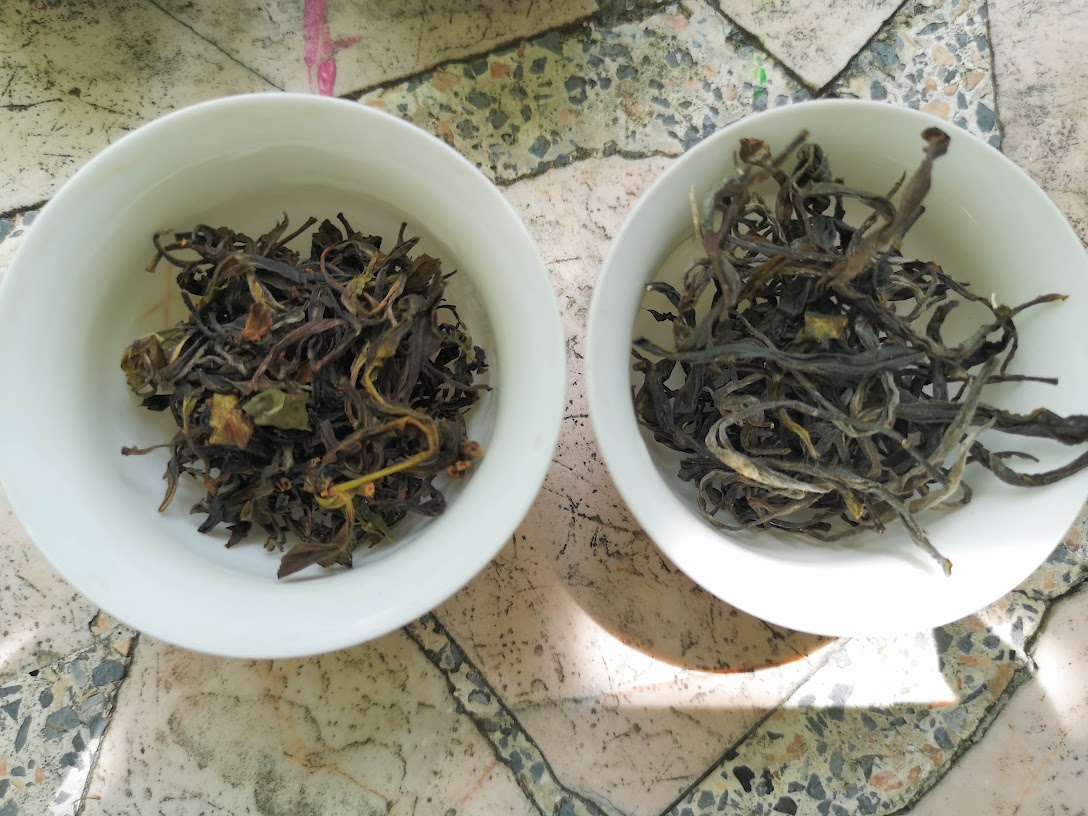
photo lighting isn't dialed in where I'm trying the teas just now


I'm reviewing Tả Củ Tỷ and Giàng Pằng Autumn 2023 sheng pu'er-style teas from Vietnam, from Viet Sun.  There are plenty of earlier Viet Sun reviews of different tea types posted earlier; these were sent by Steve (the owner) as samples when I reordered a good bit more of a black tea that I loved (this one; a new version should be available for this year before too long).


Tả Củ Tỷ Autumn 2023, $36 for 200 grams, (equivalent to $64 per 357 gram cake)


This tea was made in early September from a mixture of medium, older and ancient trees growing in a few different gardens around the area. One of the most interesting parts of this tea is the varied terroir inputs. Some of the raw material was collected from higher elevation rocky/ boulder field gardens and some from lower elevation more clay-rich soil gardens.

This tea brews up quickly into a clear green-golden soup. The flavor is punchy with vegetal mossy and deep forest floral notes. Bitterness and astringency are moderate with a quick floral sweet huigan that develops after the first cup.

I like brewing it at 90-100C for short and then longer steeps.

I believe this is a good candidate for aging as the raw material is good and its aggressive edge should round out nicely after a couple of years.

Picking Standard: 1 bud, 2-3 leaves

Region: Tả Củ Tỷ, Lào Cai

Elevation: 1000-1300m


Giàng Pằng Autumn 2023, $38 for 200 grams, so $68 for 357 grams worth ($68)


This tea was made from ancient trees growing at about 1400m. It brews up slowly into a rich, hazy golden, green soup. Heavily sweet and floral with a melon fruit range and vegetal forest/ almost leathery notes. Low-medium bitterness and astringency. Rich huigan that builds after a few steeps and energizing qi.

Due to being an early season tea, we decided to go with a younger/ buddier pick to minimize huangpian. Expect a more fragrance/ flavor heavy tea this season.

Picking Standard: 1 bud, 2 leaves

Region: Giàng Pằng, Yên Bái

Elevation: 1400m


Review:


Tả Củ Tỷ Autumn 2023:  that's really nice.  The flavor is richer, warmer, and more complex than I would've expected, not the typical pronounced bitterness, vague floral, and underlying mineral a lot of pretty good sheng mostly covers.  

Mineral is warmer, onto almost a metal range, or at least like a mineral-intensive well water effect.  Bitterness is there but secondary to the mineral range, which isn't underlying.  Other flavor is harder to break down.  It reminds me of the scent of a damp forest in spring, but that's not a flavor list.  One part is earthy, like a damp fallen log or mushroom, and another is sweet, a little towards dried fruit, and some could be a spice note.  I'll keep going with breakdown next round.


Giàng Pằng Autumn 2023:  absolutely different, but with a similar effect.  Bitterness is pronounced but not dominant, and mineral stands out in an unusual form, and form of expression.  Sweetness leans towards citrus, and there is more of a vegetal spice input in this, less warm and rich earthy range.  I suppose floral stands out more in this, but that fruit and light spice range is stronger.

Both of those I brewed for longer than usual to skip the part about them being too light to identify, and as a result both were a bit strong, more so than optimum.  At least the initial progression is on track.  I didn't separate the large chunks as much as I normally would, not for a clear purpose, just not so clear this morning, and skipped that step.  Of course you don't want to tear and shred the leaves but it does work to twist them apart without breaking them, the part I didn't do.  

Both samples looked great; I could've done more justice to that taking a better picture of those too.  I've been really busy here (in Honolulu) for about a month, and I overdid it yesterday with a long run (12 km) and walking the better part of that far doing local errands, then cooking and cleaning at home.  Our apartment here is tiny and crowded and my mind feels crowded as well.  All of these are ok problems to have; I don't mind at all.


Tả Củ Tỷ, round 2:  lighter, a more conventional infusion strength.  Bitterness has picked up quite a bit; that's no surprise.  The warm tone, sweetness, and unusual mineral range are all quite pleasant.  This isn't all that oxidized, seemingly, but limited association with black tea range might be pleasant for many, that tone being this warm.  Thickness of feel really picks up, and aftertaste.

I'm still not having luck with flavor list style breakdown.  There's almost a Chinese medicinal herb quality to this, complex and diverse, with parts warm in tone, like unusual dried bark spice, or maybe even mushroom.  It's not mushroomy, tasting like fungus, so maybe that part is more like ginseng, a root spice with a hard to describe flavor range.  It's hard to justify why I'm saying this is warm in tone; it just is.  It tastes a little like dried fruit but that's a secondary and integrated component at most.  There's just a subtle warmth to it, less subtle in the mineral range.


Giàng Pằng:  fruit really picked up in this, and also bitterness.  I brewed these fast, around 10 seconds or so, counting all the pour times, but they're still too strong.  As usual I've used too much leaf material; if I complete that step on autopilot it ends up like this, probably using 7 or 8 grams.  For drinking a lot of one tea with breakfast that's fine, but I won't get as far in review rounds for doing that.  And moderating infusion strength relates to using flash infusions, instead of adjusting brewing timing.

The flavor is lighter and brighter in this.  Again it seems more floral to me, but part is something else, a little citrusy, maybe along the line of lemongrass as much as true citrus, but I could see this as tasting like lemon (dried peel more than the fruit, I think).  It's intense.  I love that effect, of a strong sheng really hitting hard, but people accustomed to other tea types might not.  The feel effect on my mind is hitting hard already, for wrapping up drinking four infusions worth, which really could've been 8, brewed much lighter.

I'm using goji berries that were soaking to clear my palate between rounds.  For wispy light rounds clearing the flavor would be a mistake, not necessary or helpful, but these are a bit strong.  I would recommend eating goji berries daily for health effect, offsetting aging impact and helping with eye and skin health, but then what do I know. 


Tả Củ Tỷ, round 3:   finally light enough to be in a normal infusion strength range, using more of a true flash infusion.  I can relate to strong brewed sheng but it's not ideal for review interpretation.  

Fruit range seems to show up more brewed this way.  There is still bitterness, warm mineral, and vague earthy tones, but a yellow watermelon sort of fruit aspect enters in.  If there is floral range it's on the warm and rich side, but if so it's a bit vague, easy to interpret as something else instead.  

The feel is really nice, full and smooth.  Neither of these has seemed astringent and harsh, as younger sheng can be, but they both give up no intensity at all.  Sweetness and bitterness balance really well.


Giàng Pằng:  bitterness is much more pronounced in this.  It's like that dandelion flower or stem effect; strong, with a corresponding flavor matched to it.  Bright and light floral range stands out more, and what I'm interpreting as a light fruit aspect, which could as easily be regarded as related spice.  It all balances well, but the bitterness isn't for people who aren't already on that page.  

That pairing of a specific type of bitterness and heavy floral towards fruit flavor should be quite familiar from some Yunnan version examples.  The vegetal edge, which I've described here as like flower stem, may not be as common.  I reviewed a version not so far off this that I bought in a Bangkok shop last year, somewhat bitter, sweet, and floral, from a location I don't think I ever mentioned or knew related to it being written in Thai on the label.


TCT, GP, #4:  probably a good round to skip notes; both are not so different, and as usual this runs long, and become repetitive.  10 cups of these is a lot though, so the next round might be the last for notes.


TCT #5:  this is transitioning nicely, even if I'm not going to be able to communicate that clearly in a changing flavor list.  It balances better and better.  To me it's nice that the bitterness is so moderate (relatively speaking; this is bitter as straight aspirin compared to any oolong, and the other more so), and that the sweetness offsets it.  It seems to evolve more towards a warm floral tone, which is rich and full enough that it also reminds me of fruit range.  Oddly the complexity of flavor range makes it hard to separate out 2 or 3 inputs that are causing those effects.  There's a lot going on, which could seem to come across as integrated and uniform, but when you try to describe it it's quite complex.


GP:  this warms in tone a bit, drifting closer to the other.  Bitterness is still more pronounced, but that eases up.  Floral tone is even more pronounced than for the other version.  It would be nice to specify a flower type, but that always has been a limitation for me, remembering how a couple of dozen different flowers smell for baseline reference.  There's one aspect that I've experienced in Yunnan sheng that's catchy, maybe a set of flavors that tend to relate to each other in a certain way, a honey sweetness, combined with a citrus effect, and certain floral range.  It's like a naturally matching set.  


Round 6:  The TCT version is better than ever, pleasant and not challenging at all brewed lightly.  Floral and fruit tones really pop, with fullness and depth supporting those.  A bitter edge hangs in there for the other, the GP version, which lingers as bitterness and residual sweetness, even brewed lightly.  It's pleasant.  For people avoiding bitterness it would be too much, for sure, but for those who love that pairing of bitterness and trailing sweetness it's just the thing.

For combined tasting you can't separate which has the stronger body feel or heady buzz effect but these were clearly strong teas.


Conclusions / comparison to vendor descriptions: 


It will be interesting to go back and check on Steve's interpretation of these and see how he placed them (since I add those after taking notes, during editing).  I feel like my descriptions aren't all that clear or descriptive.

The Viet Sun sales page descriptions work, with a couple of differences in interpretation.  For the Ta Cu Ty "The flavor is punchy with vegetal mossy and deep forest floral notes" really works well; that early warmer and earthier flavor was hard to capture, but reference to moss and deep forest floral goes there, even if it's really about two different themes emerging early and later, per my interpretation.  

Bitterness seemed more pronounced to me for the Giang Pang is described, but "heavily sweet and floral with a melon fruit range and vegetal forest/ almost leathery notes" kind of matches.  There is one part that can be taken as challenging, here referred to as vegetal and almost leathery, which I've compared to plant stem taste input.  The rest balances that nicely, making it seem less like a negative inclusion and more of an integrated set.

It's hard for me to guess about aging potential for these, mentioned in relation to describing the Ta Cu Ty version as aggressive.  Both might be even better after a year or two of settling, but I'm not sure how they would change as moderately transitioned versions (6-8 years), or as fully aged (15-20).  A related comment and tangent about intensity might help place that.

For as intense and aggressive as these have been I would expect the next 3 or 4 rounds to be as good or perhaps better than the earlier experience.  That doesn't relate to high bitterness or astringency, oddly, just overall intensity.  Fall teas are know for being a bit less intense than spring versions, one limitation of the type range, but that's not how these worked out.  

There's a decent chance that the trees weren't challenged by harvesting a substantial amount of summer material to make black tea, as can occur with plantation or somewhat natural growth versions in more developed areas, enabling them to continue to produce leaves naturally high in compounds relating to flavor.  But then again what do I know.


Comparing these to the Son La version I've drank half a cake of over the last year parts of the range is consistent and familiar, even if aspects and style vary quite a bit.  I really like that tea; something about it I can connect with.  Both of these could match it in terms of intensity, in two different senses, but the way those aspects balance is so nice for me.


those old-style buildings are common in lots of local schools