Showing posts with label Laos. Show all posts

Thursday, April 23, 2026

Rishi Wawee Thai sheng (2022) and Phousan Laos sheng (2021)

Thai version right, in all photos (this is the third round)


I've been meaning to try Rishi sheng versions from South East Asia for awhile, and finally got around to ordering two.  Whether or not someone calls them pu'er doesn't matter to me; that are that type, regardless of a Chinese regional designation for that name.  Per my understanding the type was produced in lots of places long before Chinese people adopted that village name for it.  They are these:


Doi Wawee Sheng Pu'er Vintage Spring 2022 ($45 for a 200 gram cake)


The Doi Wawee Pu’er cakes we source are part of the incredible history of tea in Thailand. Throughout northern Thailand there are many old, abandoned tea plantations that have been left to grow wild from centuries past. Known locally by the Thais as “Assam tea,” these trees are part of an ancient tea journey that traces its roots back to the 11th and 12th Centuries...

This 2022 Doi Wawee sheng Pu’er has a wonderful balance of density, power and elegance. The floral and aromatic wood notes are present over the course of the several infusions. For being such a young cake the tea is very smooth and lasting in sweetness. The powerful energy and awakening vibes of Doi Wawee’s ancient tea is incredible.


The history of tea in lots of places has been lost, but the earlier existence of the plants can be confirmed, especially since some can live a long time, so it's a living history.  I don't remember what I've heard about time-frames, but the history of Thailand importing ceramics production from China goes back a long time, for centuries, so tea was probably around too.


Laos Sheng Pu’er Tea Cake Vintage 2021 ($48 for a 250 gram cake)


Our 2021 round cake pressing of the first picked, early spring tea is lively and energetic with luscious wildflower honey, ripe fruit and piney aromas. The Xiengkhoung region of Laos is demonstrating its consistent performance as one of our favorite origins for Pu'er tea. The tea has a long-lasting impact on the palate with a mouthwatering sweetness and deeply refreshing quality. The delicate floral aromas give way to an emerging pungency, stimulating strength and minerality that builds up in the subsequent brews. The tea is pressed a bit hard, so it comes out slowly and elegantly over the course of many infusions...


It is pressed really hard; that will probably slow aging transition.  They mention positive cha qi (feel) in that description too, but I tend to not notice that, unless it's very pronounced.  They mention a little more on local growing areas in the website, about elevation, and include harvest timing; the whole story of both is on the site pages.

South East Asian sheng has been my overall favorite type for a long time.  Thai versions can be very nice, distinctive and pleasant.  Laos versions tend to be less consistent, but in the best cases they're very positive too.  Vietnamese sheng seems to often stray further from Yunnan production style, to include some extra oxidation, or maybe the kill-green step is sometimes different, leading to slightly different results.  I've had exceptional versions from Myanmar, and they might be a little more consistent in general, and as true to type related to Yunnan versions as any of the others.


Review:


Wawee #1:  pretty nice.  A bit of pine comes across early on, and some sort of stone fruit note, close enough to plum, but that interpretation could vary, and it will probably evolve.  It's clean, intense, and balanced, and not at all light in relation to this being the first round.  Bitterness is significant, but also moderate, which is what I would have expected.  

Maybe flavor tones have deepened and warmed since production, since this is a 2022, but I can only guess.  I've tried a reasonable amount of other Thai sheng and this compares well, and is similar in character.  But then it's too early for that level of judgment.


Phousan Laos:  an intense more vegetal note hits right away; I'll need to brew this fast to optimize results around that.  It's in between green wood and mushroom, but warmed and softened a bit, so maybe that's partly cured wood and dried mushroom.  It's missing the fruit range in the other tea.  

One could interpret some of the vegetal range as pine but it seems to represent wood more.  This might evolve towards incense spice, if the less pleasant vegetal range diminishes, based on what it tastes like now.  At least at this level it doesn't really compare favorably to the Thai version at all.  It lacks the same sweetness and cleanness, with flavors that aren't nearly as positive.  You can't really judge sheng by the first round though; they will often develop a bit between the first and third infusion, and continue changing after that.


Wawee #2:  bitterness and vegetal range picked up a lot, which is to be expected.  

I overdo it with proportion, as a matter of habit, generally always using about 8 grams per 100 ml gaiwan.  Since that's my norm I tend to just go with it.  You can use faster infusions and get similar results related to using a more conventional proportion, but they might be more optimum using 5, so you can adjust timing better.  

I was just talking about that with that Teas We Like founder I just met at the last meetup (described in the last post), and I can't really justify the practice of using a high proportion as somehow better.  It's just how my tea brewing evolved.  It's a good way to drink a dozen rounds of tea on the intense side, and I'm drinking for beverage experience more often than tasting, even though I do both, and approach for the two mixed.  If intensity is too high for a round, which can happen, you can just flash infuse the next round and mix them, although I don't do that during review tasting sessions.

The depth is nice.  Astringency / feel filled in, and it's substantial, and bitterness falls into a different balance.  The sweetness and complex flavor range makes it pleasant.  Some aftertaste expression carries over; it's definitely not thin, or limited in any way.  The fruit note is especially pleasant.  Pine isn't really prominent; probably that's something you would either notice in that first infusion or else not get.  I can't say the more vegetal range tastes like wood, but it's hard to place it otherwise.  I would guess this will evolve towards spice some, which is also a best case for the Laos version.


Phousan:  wood is still the dominant flavor.  At least the mushroom edge to that has evolved away already.  There is a more positive spice range entering in; this is improving fast.  That main wood flavor is a well-cured hardwood, with a touch of greener wood range beyond that.  The vegetal scope isn't all that green, so the spice seems to tie in with that.  It could be interpreted as medicinal herb, or even along the line of some type of basil (maybe tulsi / holy basil).  It's starting to work better; I think the third infusion will determine how the rest will go.

I didn't include it in the tasting theme post but we also discussed the use of comparison tasting, that tea vendor / expert and I.  He said that it's a good tool for a beginner to use to notice differences that would be harder to place otherwise, which would help with sorting out tea evaluation in general.  Of course that's part of what I'm doing, and what I started using it for.  It has evolved to where I'm mostly trying two or more teas, but usually two, to get to more versions with less tasting and writing time.  I might do 80 or 90 reviews in a year, and write about well over 100 teas, maybe 150, so I would be writing even more posts to try them one at a time.  I guess it's down to 70-some posts in total and maybe 60 reviews now, but it works out the same.

It may not seem it but writing one detailed review a week is a lot.  It takes more than an hour to write the notes, or maybe two, and another hour to edit photos and text, and add reference citation.  It's not the time that's a concern though, it's the focus required.  You have to use the time that you are most dialed in, rested, and relaxed, or it won't work.


Wawee #3:  overall balance is improving, the way those aspects already described come together.  This isn't really a fair comparison because Thai sheng is among my personal favorites, with lots of what I've tried from the Wawee area.  I've tried a good bit of Laos sheng too, and some was great, but only the Farmerleaf version I mentioned in the last meetup theme post stands out as on the same level as other better versions from elsewhere.  That's in recent memory; I was drinking a good bit of Laos sheng 5 to 10 years ago, and a couple of versions back then were probably pretty exceptional, but more weren't.

I should get around to describing Thai and Laos sheng in relation to Yunnan versions, in terms of style (typical style--both vary a lot), typical quality level, and terroir input.  It's just so much to get to, and every point would involve a troublesome spiral in describing exceptions and normal range of variation.  Maybe I won't.


Phousan:  clearly the best this has been, right on schedule.  Green and cured wood is giving way to more spice range.  It's not just a touch of basil now, something along the line of celery seed is prominent.  I've been using dill seed from our garden as a food spice; it's not too far from that, but probably still closer to celery.  It's more pleasant than this description makes it sound, like some sort of basil and seed spice tisane, with a bit of wood.  Let's free-form associate what makes it more positive, as a flavor list description.

The wood tone I've been describing moving into incense spice range is part of it.  Sandalwood, maybe?  I really should revisit that incense scent theme again somehow.  I have no idea how agar wood would vary, and I've even lost track of what patchouli smells like, which would be a slap in the face for one former Deadhead roommate, and lifetime best friend, who always smelled like that.  Sweetness also picks up; that helps the flavors tie together.  Limited bitterness, which I tend to not mention much, if it's a normal low-background input, probably also helps in this case.  Feel is fine; it has fullness and structure, it just doesn't stand out, so again I see it as normal background context.  I'll revisit this next round, as it continues to evolve.


Wawee #4:  this is where I might start hitting a wall for drinking a lot of tea, and the next round is usually where I tap out.  If I'd been more practical and used 5 gram proportion I could brew these even lighter, and get to a 6th (a dozen in total).  I might mention that I'm re-warming water to keep this brewing using very close to boiling point temperature, not dropped much between that boil and the next infusion, in this case under a minute of cooling.

There's a pleasant sappy feel to this that works well with the rest.  It connects with a positive aftertaste expression.  Flavors have evolved, and I've not kept up with describing that.  I interpret a main pleasant input as fruit, but others might not, and that could even sound wrong to some.  There's a good bit of range, so that it could work best to describe general range scope and then individual flavor inputs.  Stone fruit is on the list, but vegetal range is more pronounced.  Or that really overlaps or mixes with a spice theme, again probably mild incense spice, which more often occurs in a very different overall flavor context.  Bitterness stands out, of course.  Sweetness might include a bit of toffee edge, but that's not easy to pick up, given the stronger vegetal and spice range.  Interpreting more of it as green wood could also work.


Phousan:  spice still stands out, incense spice (mostly), along with seed spice and a touch of basil.  Those warm tones and sweetness are pleasant.  Mushroom and wood have generally dropped out, although someone could still interpret the one part as cured wood, but I see it as having evolved more to incense spice range.

It's hard to guess about how these have evolved over 4 to 5 years, but since I've drank a lot of comparable sheng I could attempt that.  Earlier on they would've been brighter in tone, and even more intense.  Probably some of the early floral range has evolved to what I'm describing now.  It's odd getting to round 4 and never mentioning a floral aspect, but that is a natural transition pattern.  The teas tend to be more approachable in terms of bitterness and astringency evolving; these aren't challenging.  Depth increases, which is kind of an emergent property, not closely tied to just one or more main aspects.

Whether or not they're better--now versus when newer--would depend on preference.  That's if someone is averse to that early bitterness and astringency, or they see it as positive, when coupled with sweetness and bright floral range.  These warm wood and spice tones would have resembled green wood, or other vegetal scope, often sort of like plant stem, and some could find that challenging.  I might prefer a stronger astringency and vegetal edge trade-off when younger, since it couples with freshness and more floral range, typically.

I really don't care for the grassiness in some green teas, but sheng tends to be vegetal in a different way, more along the line of either green wood or edgier fresh herbs, like some other types of greens.  Warmer medicinal spice notes evolve more later, after aging.  Those are often along the line of ginseng, and these will continue in that direction, but change-over will take time.  I don't think these were stored in overly wet / humid and warm conditions, but they're not as preserved as dry storage causes either.  In the middle is good for storage conditions input, letting them evolve kind of slowly, but to keep changing.


Wawee and Phousan #5:  not so different than last round, so this might be a good place to keep this short, and add more final thoughts on a next round.  The Laos version is picking up more sweetness and a touch of fruit, maybe along the line of dried mango; that will probably evolve to be more noticeable, given the transition direction.


Wawee #6:  I'm still using relatively fast infusion times, 10 seconds or so, and that finally relates to intensity dropping.  The tea isn't fading already, but the early infusion strength is reduced.  This is probably an easier intensity level to evaluate, but that kind of thing does shift which aspects you experience.

Everything is integrating more, so it's harder to break it all into a flavor list.  It's the same range as before, but less distinct.  There isn't enough shift in relative balance of aspects to make it worth unpacking that.  

One thing I haven't mentioned:  these leaves vary in color.  That's surely related to them being heated a bit much in some rounds of kill-green (sha qing) processing.  It's complicated how that might work out, or probably did.  A touch of extra roast can add a positive flavor input, according to discussion of this very point by William of Farmerleaf (covered in this post on "oolong pu'er,").  It might add complexity, using a slight range of processed material.  Then it's harder to say how that would work out related to aging potential or tea character changing across rounds of infusion, since--per my understanding--oxidation and roast input both trade out flavor change but slightly limit tea's durability, how many positive rounds it will brew.


Phousan:  the best this has been; it kept evolving positively over the rounds.  It's interesting how the Thai version was so much more positive early on, and now this seems more distinctive, and complex in a different way.  Fruit even evolves, which I guess we can call dried mango, even though it could be closer to dried longan, or something else.  This tea is better than the Thai version at this stage; so odd.  The earlier spice notes are still present, transformed in how they come across, and now supporting tones instead.  Apparent sweetness seems higher, maybe related to how we naturally associate some flavor range as sweet, more than tied to how some compounds cause that effect.

For really preferring dried fruit themes in sheng this is interesting, seeing how other range can fulfill a different but related function, even though this finally does express some fruit as well.  It's interesting how this evolved to be cleaner, fuller, and better balanced, while the other version became less distinct.  I suppose that might mean more to someone else.  I'll brew both on the stronger side, giving them over 20 seconds to infuse, and pass on final thoughts on that.  Seven rounds of two versions is an awful lot of tea; it will be plenty.  I drank water and ate some nuts prior to this round, and took time with this process, which helps with extending it.


Wawee #7:  this heavier infusion strength works well with the tea character at this point.  That sappy feel returns, and a toffee note stands out again.  Incense spice range, alternatively interpreted as cured hardwood, picks back up.  In between the light last round and this more intense form would still be fine, probably a more natural optimum.


Phousan:  ordinarily I wouldn't like a tea with this aspect set description this much (incense spice, seed spice, basil, with a bit of dried fruit).  It all balances well, supported by a positive feel, a nice level of bitterness, and good aftertaste expression.  I suppose it's even possible that this has better aging potential than the Thai tea, even though that aspect set is more familiar to me, and more a match to my evolved preference.  

If I bought just one of these of course it would be the Wawee tea, related in part to my bias for Thai sheng.


Conclusions / other consideration range:


It's hard to evaluate long term aging potential.  Would be these be great in another 10 to 15 years?  As a young sheng drinker I tend to see the transition optimum within the first 3 to 5 years as a good place to drink the teas, if that works well.  Some are best within the first 6 months, and others better 2 or 3 years, only changed some.  Often it's early challenging nature that indicates a related tea's best form will occur 2 or 3 decades later.

I've tried more old Thai sheng that is kind of ok but not great in the 15 to 20 year old range, and probably only a couple that were older (but I do lose track).  These may be like that, destined to still be fine later on, but not exceptional.  Someone would really have to hold onto one to know.

What about value?  This Thai tea is $45 for 200 grams, with the Laos version nearly $48 for 250, so they might be around $80 cakes at a 357 gram standard size.  That's not bad, for what they are, sort of a Western industry norm.  If anything lots of vendors might place the same range at just over $100, especially for valuing limited aging input as a positive, and a cost on the vendor's side.  Of course buying tea within Thailand or Laos you might do better, for equivalent teas.  I've seen vendors play up an old plant source theme and pass off similar teas for a lot more, but that's normal, that's just how pu'er sales often go.

So as I interpret it these are good value, but also just normal in relation to Yunnan range, pretty much at the standard level.  If you interpret the origin novelty as positive, and value the limited aging input then value is great.  There's not a lot available in this price range, to be better or worse.  If you think SE Asian sheng should be priced lower than standard Yunnan range, as definitely occurred over the last decade, then value might not be good.

Over and over again we see gradually increasing product quality, distinctiveness, and desirability pairing with rising product costs.  It would be hard to find examples this good 10 years ago, or maybe even 5, so it's not comparing apples to apples to reference past options.  The same happens with Viet Sun's Vietnamese sheng; their pricing is much higher than it was just a few years ago, but the teas are better.  Yunnan Sourcing's Impression series started out as blends competing with Dayi 7542, at that cost level too, $30-some to $40 per full sized cake, and now they're mostly all in the general $100 range, but again it's better tea.  The days of buying a full sized $40 cake are over, unless you switch back to factory teas, which are more comparable to the older range from South East Asia.  The form is different; factory teas were often mass-produced blends, but the flaws in older off-area teas made the quality level comparable.

People who drank sheng 10 to 15 years ago are familiar with another earlier form that fills in how things worked then, the white paper wrapped higher quality range, generally custom pressings.  Those would often cost up towards $1 a gram, and came with descriptions that would be familiar today, related to narrow origin sources, and probably even old plant input (gushu).  That probably less often related to wild origin material.  We've done well to experience some of that form transitioning to quite good $100 to $140 standard cake offerings, as that became a more mainstream form, now selling for much less.  Maybe not if it's still gushu, but those claims are hard to evaluate now, as then.  This runs too long to dwell on that tangent, but I do associate a range of character as relating to old plant input, to a mineral base effect being different, with greater general depth, perhaps associating with more aging potential.


the Wawee tea plants (credit Rishi site)


All in all these were pretty good.  The former Wawee material versions I've tried set a pretty high bar to match, and the Thai version was in line with that.  It was interesting how the Laos tea evolved through rounds better, after a less favorable start.  Both are pretty good examples of SE Asian sheng range, and both are a pretty good value, for what they are, and where other options stand.

Where else can you get South East Asian sheng, that are as good as these?  Tea Side sells Thai versions, but their pricing is high, so although quality is good value often isn't.  Chawang Shop sometimes sells versions, but I don't think the quality of any stood out, maybe not quite on these tea's level, even though these are just good, but not necessarily great.  That one Farmerleaf Laos tea is better, but it's priced at $140, for a 357 gram cake, costing a lot more.  

Rishi holds up as a good source option.


Saturday, February 8, 2025

Farmerleaf Na Lang Laos sheng pu'er


This is the sheng pu'er version I talked about, I think, that I tried with William and cited in the last post about meeting him, a Spring 2024 Na Lang from Laos.

Since I've already introduced this tea I'm going to strip down these tasting notes to what it seemed like to me, removing a lot of the speculation or tangents.  I'll add a little back in with the conclusions, but this will work well kept shorter, without the usual rambling on.  This is William's site description (part of it):


Spring 2024, medium-big trees from forested gardens (listing for $140 per 357 gram cake)

Na Lang village, Nyot Ou District, Laos

A powerful Yiwu-style tea with great endurance 


This is typically the kind of tea you would find in Gua Feng Zhai for twice the price. The point of this tea is not the fragrance, but the good thickness in the soup and the deep Huigan. 

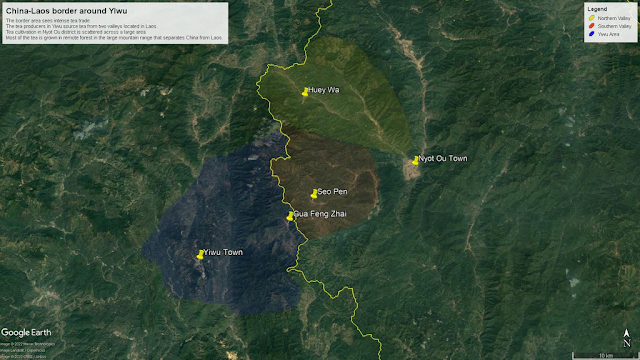
Considering the renown of Yiwu tea, and the high prices its tea fetch, it is not surprising that many tea traders cross the border to Laos and source tea from Nyot Ou district. As a result, most of the tea made in Nyot Ou is bought by tea producers from Yiwu.

Tea grows in the forests of Nyot Ou district along two valleys. The Southern valley is connected to Gua Feng Zhai village through a small road. The environment in which tea grows is similar in Eastern Yiwu and in the two tea producing valleys of Nyot Ou District. Ancient tea trees grow along more recently established gardens in the forests.


from the Farmerleaf site product page


That's a common, well-known theme, that lots of tea from lots of places goes back to China to become pu'er.  I skipped the "pu'er-like tea" limitation earlier, the admission that the type is a regionally limited designation, only applying to teas from Yunnan.  That's a bit absurd, isn't it, given that context, that any tea from Laos, Vietnam, or Myanmar (and less from Thailand) that crosses the border, and is mis-represented in terms of origin, sort of is and also isn't pu'er?  And a very considerable volume of tea undergoes this transition, far more than is ever sold as Laos tea.

It's the best of both worlds for Chinese producers and vendors; they can dismiss those origin area teas as separate and inferior, and then buy them and resell those same teas as the upgraded local version, simply by blending and then mis-labeling them.  Let's move on to how this tea is.

I never do address whether this is like Yiwu or not, a claim made in this description.  I've experienced relatively consistent character in trying a reasonable amount of Yiwu, but it's my impression that I've not experienced a lot more than I've tried, especially related to distinctive versions and higher quality levels.  So I'll just describe what I am experiencing.


I think it makes sense for vendors to never mention much about flavor range.  It would vary over time, and even more so in relation to varying interpretations.  In this review I mention it seeming to taste different when trying this same tea two different times, and I speculate about why that is, real factors that could've changed what I experienced, not just the interpretation.  

William's description doesn't even include a general flavor reference, like "floral," and again I see that as reasonable.  To some it would seem floral, and to others fruity, and different factors could change the compound inputs that these are based on.  It's fine as long as a description can pass on enough range description to draw interest, or inform in some other way.


Review:


First infusion:  a little light, but that's a good way to start, brewing the first round fast to get an initial sense, and letting the second be more typical of the rest.  Flavor is good; quite catchy.  There's a pine-like aspect that others could interpret related to other vegetal range, but only a little.  A fruity tone is something else, on towards juicyfruit gum, or back in the range of natural flavors not really tied to just one, but not so far off tangerine.  Feel is nice; it has some structure, already, but that doesn't seem to track towards being unapproachable.

I've already tried this tea, so this isn't the blind tasting approach I typically use.  I know where this is going, and this tea version is pretty exceptional.  I'll fill in more of an aspects list next round.  

It's completely whole leaf material, not too compressed, so it would be easy to drink it unbroken, but I used some from the parts that had already split off in this tasting, more broken material.  Maybe that's not ideal, but I suppose it's a normal real-life experience form.  I hadn't thought it through getting it ready; depending on how focused in I am I might use the broken material also in the wrapper or carefully separate off some relatively whole leaves.


Second infusion:  that catchy fruit related tone really pops in a stronger round.  Bitterness and astringency really ramp up too; those would be more moderate if someone was more careful about not breaking the leaves.  

The bit of pine, or however that vegetal edge is interpreted, integrates wonderfully with the sweetness, bitterness, fruit tone, and background floral range.  

Intensity is good; I supposed based on what I said in the post about talking with William I should comment on that.  It's not by way of harsh aspects being dominant either; in better quality cakes strong sweetness, bitterness, feel, and positive flavors really stand out.  This is really clean in overall effect; it's not as if young sheng tends to be murky, or to taste like a cinderblock, as comes up more with Liu Bao, but there can be an emergent sort of impression of clarity and cleanness, or lack of that.  

This doesn't seem completely identical to when I first tried it with William.  It was exceptional then, and it is now, but minor inputs can vary, shifting the outcome.  I'm using water from a hot water dispenser and filtration system, so it's not at full boiling point; that changes things.  It's a different version of water.  This leaf is little more broken, as I've mentioned.  We drank this tea in the middle of trying a half dozen versions; that can affect impression and memory.  It seemed to include more bright floral range in that tasting, leaning towards bright citrus, and it probably did, based on those differences. 


Third infusion:  the tone seems to be warming.  It had warmth and depth before, but it's evolving to include a lot of that.  The leaf color is mixed, including some darker range, making me wonder if somehow oxidation level didn't vary a little in this initially.  How?  I'll add more about one thing William said in the conclusions, that might have entered in.

I personally love that effect, when sweetness, flavor complexity, and slight warmth gives a young sheng a much more approachable character.  I suppose people could be mixed on how they relate to that input and effect.  

I'm not doing justice to what I take to be a fruit tone.  It's not so far off dried mango, which surely isn't all one thing, since there are lots of kinds of mangos.  That one flavor input is positive, but it's how it integrates with the rest that works well.  It's intense and refined enough, which can be hard to place within the entire sheng range, or in relation to higher quality versions, or typical Yiwu styles. 

I didn't mention that the intensity carries over to aftertaste experience.  That almost goes without saying, but not completely.


Fourth infusion:  now that warm, sweet aspect tastes more like dried apricot to me, so much so that I'm questioning my earlier interpretations.  It's a lot like apricot, a pretty direct match.  It's quite delicious.  There is plenty of astringency and bitterness to balance it, but it's a quite approachable tea, at the same time.  Someone being more careful than I was to not break the leaves would moderate those parts just a little.

Intensity is so good, and flavors so fresh and bright, that it seems this will go on forever.  It won't; based on trying an earlier cycle this will make a lot of infusions, using the high proportion that's my default, but eventually flavors will thin and bitterness will play a different role.  It's great while it lasts though, which is for awhile.  The bitterness and sweetness stays in your mouth after you drink it, along with that fruit flavor, adding some extra exposure to appreciate.


Fifth infusion:  it's not transitioning all that much, which is as well, because I'm running out of patience for making these notes anyway.  Feel might become richer; that's an interesting shift, for this stage.  It has had pretty good feel structure for this whole cycle, but it gains just a little richness, towards a pleasant sappy feel.  To me that one interesting and positive fruit note integrating with the rest well is the main story, with other range playing a supporting role.  


Conclusions:


It's good, very intense, refined, pleasant, interesting, well-balanced, and so on.  I can't place it in relation to Yiwu range, but this probably is the best Laos sheng I've ever tried, and it might be about the 15th version I've tried.  The warm fruit range was interesting.  Floral tones are often dominant, across a lot of sheng range.  Versions can transition quite a bit, aging over even 9 months or so, but this was quite warm and fruity, and a year of aging input wouldn't cause that.

Back to that oxidation input issue:  William had said that if a producer backs off the kill-green completeness even a little (if I'm remembering this part right) that the stems can not be as fully fixed (compounds inactivated).  Then these can turn redder, more oxidized, as the tea dries, shifting the final character.  Maybe that happened in this?  It would explain the darker colors in some of the material, and also those heavier tones, the fruit range versus the floral, and warmth.

That's all just speculation.  The tea is really nice, the main thing.

Is it worth $140 a cake?  Sure, if someone is open to paying that for it.  It's novel, so there isn't any one established market supply and demand based pricing level.  It could be $500 or 1000, if people are open to paying that.  

There's a general expectation that quality level and range of related experiences out there are the competing factors; there are ways to buy a lot of Yiwu versions, and some other Laos teas, just none that I've tried like this.  If somewhat equivalent versions really do tend to cost $280 instead then maybe this is a great value.  I'm not buying any teas that cost over $100 per cake, so I'm just not part of the whole community, in one sense.  That's about budget limitation, not idealism.  If my tea budget was much different I'd buy this, for sure, but I certainly don't experience that as a regret.  My life balance is something to be thankful for, not to focus on regrets over.

Beyond those concerns the tea character is really interesting and positive.  I've really appreciated the opportunity to try this, and to have some to drink, since William shared a fair amount, not just a sample.  Many thanks to him!


Tuesday, April 5, 2022

Laos Ban Payasi 2014 sheng cake


I'm trying a next tea from a Chawang Shop order, this one from Laos, one of the main reasons I wanted to order from them.  I really liked another from Myanmar I tried awhile back and saw this that I had missed.  I'll let them describe what it is:


2014 Laos Ban Payasi Raw Puerh Cake 200g


Phôngsali is a province of Laos, bordering Yiwu, Yunnan. It is located high in the mountains, approximately 450–1,800 metres above sea level. Phôngsali is well know as ancient tea caravan in the past, is also one of the important origin of yunnan puer tea in history. In recent years, with the ancient tea market continued to heat up, more and more people set their sights on the border tea that come from unknown villages in Myanmar or Laos. 

The ancient tea trees resources in mountain area are extremely rich, but the local tea making techniques are poor. Laos pu'er tea is seldom seen on the market. Many raw materials are bought by Yunnan tea makers and sold as more expensive Yiwu tea...


Ban Payasi is another village, deep in the mountain. This place has many ancient trees and 50-100 years old tea trees. 

...If compare with other two cakes from Ban Komaen, the character of taste is quite different. Tea soup is light yellow with light herbal scent, this tea has unique cool feeling in mouth. Bitter-sweet and powerful, great tea for long term storage !

...Production date : Early March 2014, pressed 19.3.2014

Harvest Area : Ban Payasi, Phongsaly, Lao


It's interesting hearing that, comparing it to what 8 years of relatively dry storage have changed about it.  The review notes tell that story.  

I don't think I've ran across any Laos sheng that seemed overly bitter to me, so I'm not so sure about their impression of a starting point.  I've tried at least a dozen versions so far, I'm sure, so it's not an endless sample set, but that's a bit, probably from some different areas there.


Review:


this round was light but color is washed out in all these photos, for setting being bright


the leaves slightly wetted, still a bit green


First infusion:  warm range indicates that this is partly aged (fermented), as one would expect after 8 years.  It would be much more fermented if it had spent that time here; it will be interesting seeing the difference in transition form, to a limited extent.  Not knowing the starting point that can only go so far.

This is light, so early for breaking down a flavor list, but it's pleasant so far.  Warm tones include mineral undertones, and soft floral range.  It's hard to pin down the warmer range, as spice or something else, which will be easier across more rounds, based on stronger infusions.  I'll skip ahead to the next one then.


Second infusion:  a little strong, even for brewing for about 10 seconds; it's started now.  It's in an interesting place, for green tones still standing out, and warm tones also entering in.  The greener range links to pronounced and aromatic floral range, which hasn't diminished much in relation to how old this tea is (seemingly; maybe it was much stronger, but the typical range only varies so much).  A warmer tone is woody and also aromatic, towards cedar.  Warm mineral tones support both.  Astringency is pretty limited; it has a light edge to it, but it's more a dryness, a type of feel that doesn't include much bite.  Sweetness is nice; it supports the rest too.

The determining factor for how someone likes this tea--at this stage--would be that dryness, which seems to connect with the woody range.  That may be related to what people describe as a sourness entering in when teas are stored quite dry.  It's not sour, so in a sense that would be wrong, but the woody range might be an output from the relatively dry conditions, since dry-stored sheng can tend to include that.  At the same time that it picked up some character some might not like it also retained a lot of floral range that would've faded and transitioned over 8 years stored wetter.  This is "green" enough that it has fermented about as much as sheng would tend to over 3 to 4 years here.


Third infusion:  the vegetal range transitions some in this; lighter and fresher floral tone has linked with a plant-stem sort of input.  To a limited extent the warmer wood tone has faded, so it's as if that replaced it.  Warm mineral stays in place, like the scent of Utah slick-rock.  

How could a mineral range taste be carried in a smell?  Hard to say; the way that we end up tasting in practice seems a bit complicated.  It seems that what we link through association can be interpreted as something it's really not.  That reminds me of a recent interesting input about astringency tying to taste range, through that kind of expectation connection; maybe I'll cite that after the tasting review part.


Fourth infusion:  sweetness seems to stand out even more; odd that would transition.  Aftertaste range is also picking up, the same kind of lingering sweetness that usually accompanies a much higher level of bitterness, but without that.  There's some bitterness in this, but a low enough level I've not even mentioned the concept yet.  Maybe bitterness ramped up some too.  It's odd that the character shifted that much in that way, for sweetness, some bitterness, and aftertaste to all jump a few rounds in.  Brewing it slightly stronger could cause that effect but timing was really limited for that round, under 10 seconds.

So how do I like it?  It's different, at an unusual place for fermentation transition.  I like it, but it might have made more sense to drink this as a younger tea to experience more intense floral range, along with more astringency and bitterness, or as a more aged tea, letting those warmer range tones really develop.  It's right in the middle.  It hasn't "gone quiet" as people describe for teen years sheng pu'er versions; maybe that's still ahead for it.


Fifth infusion:  not so different; I'll take a round off and describe it more on the next.


Sixth infusion:  the floral tones are rich in an unusual way; they seem to be picking up depth.  They're a bit warm, like rose and lavender, but it's more about how they come across than specific flavors.  Wuyi Yancha oolongs of a good quality level pick up a perfume-like aromatic quality, a little towards liqueur in how it comes across, and this is a little like that.  In a slightly different form and context this would seem artificial, like something added to the tea.  

It can't be that for a few reasons; one of them is that it would show up first if so, and rinse out fast, not occur as something that develops across infusions.  And this tea just isn't anything like that; it's above average quality, "off-area," plain sheng.  There was no "plantation tea" to be sourced in Laos in 2014, and not much of it there now.  Wild origin claims are much more believable when that's essentially all that's growing in an area.

I don't love the term "border tea," but I suppose it kind of works.  It trivializes an entire region as being distinctive for being near and somewhat similar to Yunnan, when really all those South East Asian areas are just what they are, not defined by China or the Chinese tea tradition in any way, without that being externally applied.  It's probably the case that Yunnan plants and tea processing did make its way into Laos, Vietnam, Thailand, and Myanmar, perhaps even peaking at a time of greater influence 300 or 400 years ago.  But still, beyond the present dominance of Chinese tea production, ongoing borrowing of processing knowledge, and that sort of lost history there isn't so much connection.  Tea has been in Laos for hundreds of years, and we really don't know what form local production and consumption took 100 years ago.  Inputs like terroir made this tea what it is, along with plant genetics, processing inputs, and so on.

We ran through discussion of all this, related to modern sources and forms, in a meetup discussion with "Mr. Mopar" recently.  Most Laos and Vietnam sheng has been shipped to China to be mixed with and sold as Yunnan sheng, which people can interpret differently, however they like.  I added that vendor citation after writing that; it's pretty well known, not just speculation.  

As I see it the demand for Chinese teas are much higher, so it's simply about the Chinese market extending sourcing of very similar material, which in many cases would be better than equivalent mass-produced, mono-culture farmed, low elevation Yunnan production.  Local Laos processing would be inconsistent; we talked a little about what people like my friend Anna, of Kinnari Tea, have been doing in an NGO project to bring tea processing experts in to conduct training, including William of Farmerleaf, a familiar figure in tea circles.  His videos on that experience are here and here, with the second really cool for being filmed on-site there in rural Laos.

It's interesting that it's hard to see an image of Anna, or to catch a voice or video talk of her describing that process.  She avoids that sort of coverage.  But is she Google-proof?  Here is a video of her talking about Laos teas, the context and specific versions, back in 2016, but of course she's not actually in the video, her appearance.  She did a great voice interview / seminar talk on the Farmerleaf Discord server last year, and I've seen another video version that was similar awhile back, but Google doesn't turn up anything like that.  If you see a seminar notice with her included watch it; she's great, a real asset to that country.

The more general point, which I won't do justice to here, is that Laos tea is relatively undeveloped compared to status in China, but it's not as if it's a range that follows suit and just happens to be just across a border.  I've tried some exceptional and novel Laos teas, including a wild black tea version with a mint aspect that was unlike anything else I've ever encountered (from Anna).  That was like Taiwanese Ruby / Red Jade / #18 but with a spearmint mint input instead of that harsher menthol range typical of those.


Sixth infusion:  I'll probably leave off the notes here; to me it's not as interesting hearing about the second half dozen infusions.  For whatever reason I see them as transitioning a lot less than they are described to in Mattcha's blog posts, mostly just some tapering off.  And this round isn't so different than the last, so there isn't much to add.  That perfume-like heavy floral range is nice, so strange that it joins a much less pronounced warm tone range, and that it hung in there at this intensity for so many years.  To me that's dry storage for you; it preserves the tea, enabling minimal aging transformation, in forms that aren't necessarily more positive or negative than a more conventional humidity range.


Later rounds:  of course it was far from finished.  A pronounced citrus aspect really stood out to me in those later rounds; either I had just missed noticing it before or else transition really seemed to bring it out.  It's odd that kind of thing evolved so late like that, but I could see how pronounced sweetness and floral range might shift in such a way.  You don't think of citrus as likely to be a primary theme in 8 year old semi-aged pu'er, but then this was low in fermentation level.


Conclusions:


I've been considering if dryer conditions and slower fermentation transition process might not be positive for some types of teas.  I really don't think this was bitter and intense to start in the same way Menghai teas often tend to be, but of course I didn't actually try it.  It would be nice to find a trustworthy review of the exact same tea, from years back, and as luck has it Google mentions such a thing:


2014 Chawangpu Ban Payasi (Northern Teaist 2017 review)

(sourced through What-Cha, identified as from Chawang Shop; strange)

The rinse had a smoky, floral aroma, all heavily perfumed hothouse flowers, with a papery kind of note that reminded me of newsprint somehow.

The early steeps showed a medium body that straddled the border between milky and creamy, with that flowery thing sat on top of the typical sheng woody, earthiness.

There was a wee astringent nip in there, too, the kind that tickles the roof of the mouth, but nothing more.

By the second steeping I’d started to sweat profusely in the whole upper body region, especially the back of my neck for some peculiar reason... 

[section about qi cut out; there was more]

During the back-half of the session I got the feeling of bracken covered moorland on a hot summer’s day, and as the astringent note began to tail off it let a sugarsnap pea like sweetness through.


For that tea, the exact same one I reviewed, being 3 years old then, and not so bitter, astringent, or challenging, it seems like it didn't start out that way.  This wasn't really a flavor list or feel intensive review, kind of saying a little about a lot of scope, but a general impression comes across.  

I've read reviews by that guy before, and we've spoken, with his input on tea interest included in a random blog post exploration of tea culture in Sweden awhile back.  He seems fairly balanced and reliable. His writing and approach reminds me a bit of Mattcha's Blog, which I consider to be high praise, since to me that's one of the better tea blogs.

All in all I really liked this tea, the style, and even where it's at for softening and picking up depth due to aging transition, without giving up much of the bright floral intensity.  It helps that I probably would've liked this the first year it was made, so it being relatively preserved works out.  I'm not sure if any negative change occurred related to the storage being dry, or if this would've been better transitioned to a similar level over 3 or 4 years stored here (or 2; this wasn't very far along).  Liking the tea is the main point, and that part worked out.


Saturday, December 4, 2021

Trying two Laos sheng versions


We talked to someone new to vending tea in Laos not so long ago, Danang Thorphialuang.  He's working on a vending site that I'll mention in a later review post.  This is a review of two of his teas, versions of sheng (just not sheng "pu'er," since it's from Laos).

For most of those meetups I wrote a summary of the discussion but in some cases people didn't want any exposure, or in very few the discussion didn't include central themes that made for a good story.  Laos tea in general is one of my favorite themes in tea exploration, but that discussion just didn't narrow down to a few central subjects well.  One of my first introductions to interesting tea related to visiting a coffee farm in Laos and buying some tea too, about 12 years ago.  Anna of Kinnari is one of my absolute favorite tea contacts, and Somnuc (a personal contact) passed on really interesting samples, and meeting Alexander of Laos Tea was a wonderful highlight in visiting Moscow.


with baby Keo visiting a Laos coffee and tea farm


Danang talked about his experiences with Laos tea, and we talked about Laos tea in general, and different trade and development issues.  I suppose I've covered those kinds of themes in more detail in lots of posts here.  We talked about a tisane he helps produce and sell that were new to me, a dried gooseberry version.  I'll review that again in another post, since he sent some to try (and these teas; many thanks to him for that).  It just didn't come together enough, without repeating a lot of what I've said about Laos tea development.  This is in a different area in Laos, towards where the "plain of jars" is, per my understanding.

Danang seems like a nice guy.  That may seem beside the point, since this post is about teas, but to me it's really not.  I've tried to do meetups with people that I deeply respect as individuals more than those I respect as authorities on tea, and it has worked out well to combine the two contexts.  It's idealistic to think that more people who share a beverage choice are more exemplary individuals than average, but in a better world than this one that would be universally true.  As it is I take comfort in it being mostly true.


Review:


#1:  The initial flavor for this includes characteristic bitterness, moderate in level, and complex somewhat earthy and vegetal range beyond that.  This includes a touch of mushroom, but the form seems to be of a type that might transition off after the first round.  I don't really love mushroom flavor in sheng but this is generally positive, and it will probably be much better next round, the typical initial "opening up" cycle.  I'll save the flavor list breakdown for then.


#2:  this is unique in style, in between a lot of other type ranges.  A warm sweetness and richness leans towards black tea and a vegetal edge, stronger than tends to come up in sheng, is more like green tea.  It's even more bitter than the other version, so it's clearly sheng.  I think it will also be much better the next round, but for a different reason, for allowing that bitter edge to settle a little.  I brewed these much longer than I tend to for first infusions, not in the 10 second or so range that might be optimum for a high proportion, but well beyond that to not be mentioning a slow start, and how I can't tell yet how they will develop.  Results were pretty similar for how much I'm getting covered in review notes anyway, just for a different reason.  

When people mention bitterness in sheng that's really talking about a range of aspect experience and intensity.  A most familiar form is from not yet aged, chopped leaf factory teas (Dayi or Xiaguan, or like that); those can be a little harsh.  Then a much milder form can complement typical above average quality sheng, balanced quite differently, or some better versions really are quite bitter, as this is.  It would only work well brewed fast, so I'll try that next round.


#1, second infusion:  a little light; I erred on the side of brewing these a bit fast, 5 seconds instead of longer than 15 the first round, maybe a little overshoot.  That mushroom is already almost completely dropped out.  For this being faint it won't be ideal for complete description, and a slightly heavier round will work better next time.  The rest balances.  Sweetness is ok, at a good level, and feel works, with other complexity supporting the experience.  Refinement and balance are good; for local made teas that's often not the case.  I think this is probably as good as versions presented with all sorts of quality level and style claims.  What I mean will be clearer in description next round.


#2:  sweetness and a floral perfume character really ramped up.  I knew this would improve but not like this.  It still has a bit of extra vegetal edge leaning towards green tea style but this is closer to standard sheng range (to me; I suppose that part is a judgment call).  Sometimes good versions of sheng that lean towards green tea style seem like they would work well as a replacement for green tea, an improvement on that range of experience, and this is like that.  Probably conventional Western brewing wouldn't get great results from this, until someone could really dial in infusion strength.  For this range I think it's much better to use hotter water and then low infusion times to adjust infusion strength; results are much better.  

The richness of that floral tone includes so much range and depth that it might include some fruit too.  Interpretation of which fruit is probably meaningless, given that heavier bitterness and floral intensity mask that part.  It's mostly floral, by a large margin, with rich and heavy floral tones, like lavender, and lighter and brighter range, like plumeria.  The point was that it's so complex and has so much depth that it seems like there's more to it.  It's interesting how proportion is similar for these (but this may include just a little more leaf) but this is on the strong side, while the other is light.  It might have to do with transition pattern as much as anything else.


#1, third infusion:  this is coming in nicely.  A bit of warm tobacco range picks up, adding to mild floral tones present before.  When a mediocre quality sheng ages significantly to taste a lot like a cheap cigar smells that's something else, related, but quite different.  Tobacco range is really complex; it covers a good bit of scope.  Probably somewhat mixed or non-distinct floral range stands out most.  Then a warm tobacco range joins that, which could easily be interpreted as a wood tone.  It's not mushroom; that faded away, or changed to be something else.  


#2:  floral range is really complex in this, and it comes across as much sweeter.  The vegetal range of that has all but faded away now, adding more depth across warmer range.  It's still mainly complex floral tones.  The rich feel complements that rich flavor profile, along with a relatively high level of sweetness.  It's still bitter, but in a much more moderate range, not even all that high as young sheng goes.  Faster (appropriate) brewing probably offset that as much as transition.


#1, fourth infusion:  not so different than last round.  The warm tobacco oriented range along with subdued floral tones is nice.  It's odd how this is a relatively subdued flavor intensity tea with the other on the opposite side.  I suppose for this including that other range it works better, that slight wood tone background and aspect category complexity works well as a lighter tea, where if the other was dominant floral but light it might seem thinner, or more limited.  Where the other is rich in feel this has some slight dryness and structure to it, again which I see as working well for matching both types.


#2:  also not so different than last time.  Sweetness difference stands out a lot in contrast, higher matching floral range flavors for this.  There is a background edge of warm bark spice that gives this complexity, that makes that one heavier dimension of complex floral range work all the better.  Mixed together these might be nice; for experimenting with adjusting proportion it could balance.  I poured the last of these two rounds into one cup and it does add up to a nice middle range.  The more forward floral tone and sweetness in this version probably stands out more but the other gives it better depth than just drinking the second alone.


#1, fifth infusion:  I'll probably drop taking notes here, since I tend to get bored with review process prior to a 10 round cycle.  As I always say late transitions can be very positive and interesting, so it's not about that lack of potential, I'm just over it, and putting readers through an 1800 word review is too much.  It's nice the way that in Mattcha's blog he lists out 14 or so infusions, with a different 3 or 4 flavor description for each round, but I never tend to notice that much shift.

Tobacco range really bumps up in this, a factor for giving it a much longer infusion time, again between 15 and 20 seconds (due to writing a bit and not minding the time, not so much a planned alteration).  It works well for there being other range.  Floral tone underlying that is mild, like chrysanthemum, but it plays a nice supporting role, acting as a base.  I could relate to people interpreting fruit aspects in this like raisin or dried orange peel, but they are subtle in comparison with floral and tobacco range, which I take to seem like a spice scope input.  No one is mixing part of a cigarette into their soup to season it, but the range and profile role is comparable in this.


#2:  again a little strong for using the longer time; the other version is well suited for this infusion time but this isn't.  It's a cool effect how rich the feel is.  Sweetness is a bit much in this too, at this strength, a little cloying.  Again for mixing the two the effect might be better than for either, although the first worked better brewed stronger than for the lighter rounds.

This reminds me of running across a typical idea about how blended sheng versions were traditional in the past, and the push towards narrower and narrower area and character type sourcing is new, and maybe not well-suited for aging transition.  I'll drop descriptions here, and never do much with conclusions, since my impression was probably clear enough already.  These are really nice, much better than I would've expected, as good as a lot of South East Asian sheng that I've tried adjoined with a lot more hype about quality and interesting background.


Tangent about narrow origin versus blended source sheng


This idea was expressed by Lawrence Zhang, in podcast interview with the owner of Crimson Lotus, and re-summarized in a blog post summary in Mattcha's blog (so with a extra layers to this citation, since it's a transcript from a summary):


33:35 “What young sheng puerh characteristics and qualities characteristics are best for aging?”  “Most of the good stuff gets made into single origin puerh which is mostly a function of cost.  It’s very hard to find anyone who wants to put some Laobanzhang material in a some regular old blend… because you can’t sell it for that much because no one will pay for that much  (see my post on Extinct Blends)… after 10 plus years of experience with some of these teas, I’m not convinced that single estate puerh will age that well… or not that interesting…. Old cakes are all blends.”  Old schoolers generally prefer factory teas and blends over single estate.  80% of what I buy and consume are blends.


This reference to "single estate pu'er" is only part or one description of that paradigm.  These two teas I'm trying are from two different production batches that might have come from a relatively limited and nearby source area.  I highly doubt this material was grown on any sort of "estate."  It's not as if re-planted tea farming is unheard of in Laos, but production from older naturally growing material is a common paradigm.  Not that the plants these were from were necessarily all decades old; it grows as a now-wild or feral plant type, so some plants are older and some younger.

Back to the blending versus single-origin theme, a producer could balance inputs in teas by combining versions from any scope of range, from different parts of Yunnan, or just from different relatively local production sources (as I would imagine these two teas are).  Of course lots of inputs like plant genetics, growing conditions, and processing factors all mix.  The paradigms people tend to be familiar with are wild origin tea versus plantation grown versions, differences related to broad or smaller source area regions, processing style varying (including how whole the leaf is), harvesting season related (mainly spring versus fall tea), and plant type age varying.  The "factory" part is about larger producers like Dayi, CNNP / Zhongcha, Xiaguan and many others sourcing tea from lots of places and mixing it. 

It could be a little misleading, what that says.  One might take it as an implication that 20+ year old teas all being blends, almost all made by large tea producers, is an indication that in the past this was regarded as the best approach.  It was just what sheng pu'er was, how it was processed and then sold.  Sheng was also a cheaper version of tea; there was no comparison 20 years ago to most of it now costing between $50 - 100 (standard sized 357 gram cakes), or for "gushu" material now typically being priced in a $1 / gram range, with high demand versions much pricier.  Sheng pu'er is a different thing than it was.  In another 10 years what Lawrence is saying will either be confirmed or proven false, about aging potential tied to styles, but with this "narrow origin" trend largely starting in the last decade it's too soon to call.  Of course since the pu'er boom was in the mid-2000s there would be plenty of exceptions to use as examples that are around 15 years old now, but it's my understanding that the broad style shift occurred a bit after that.

He seems to have addressed that; the claim is that he's already had 10+ years experience with some of these teas.  Fair enough; he's been at this awhile, so his personal experience is as good as any as an indicator.  Let's check for how long, since if it's 12 years that's cutting it close, but over 15 that's easier to accept (not that he couldn't have been drinking aged "narrowly sourced" teas 10 years ago).  This July 2007 Chadao blog post sets his public discussion of pu'er timeline:


The 'Constant Tea Meeting': MarshalN on Blogging about Tea

...It's been almost a year and half since I started my blog. 


So early 2006; almost 16 years ago.  He helps frame where blogging and tea discussion stood at that time:


Initially I had no idea how many people would read it. I figured that if I get 10 readers a day, I would be doing well, since according to some study the average blog is visited by 7 unique visitors every day. While my blog has certainly exceeded that expectation, the fact remains that it is merely a small project, comprising mostly of notes for myself and observations I have gathered along the way.

During this time, however, the blogosphere has blossomed. When I first started, only four of the links on the blog existed -- Babelcarp, CHA DAO, La Galette de Thé, and the LiveJournal Puerh Community. The rest, as far as I am aware, were still in gestation. Now any visit to any of these sites will bring you to even more blogs and journals out there, composed by dedicated tea drinkers like you and me. Just keeping up the reading would mean visiting a dozen or so blogs every week, at least.


So tea blogging and tea discussion really came online in a developed form between 2006 and the middle of 2007; odd that it seemed to shift so fast.  Given people weren't limiting that discussion to brand new teas then we are at a good place for lots of people to have developed impression of teas from 15 years ago, a typical threshold for relatively fully aged teas.  And again no one needs to limit what they try to what was produced right when they entered tea exploration; aged versions of these teas were a common theme in the last century, just not as developed.


The main problem then is going to be sorting out a consensus take on this issue ("after 10 plus years of experience with some of these teas, I’m not convinced that single estate puerh will age that well… or not that interesting...").  He's definitely one of the main experts to listen to for a developed opinion, but he's still just in possession of one more subjective preference.  Two different people could judge the exact same tea differently, based on varying preference patterns.  Lawrence Zhang is credited with accurately representing a traditional Hong Kong perspective and preference for tea styles, but I can't even guess at how accurate or limited that really is.


My son tried these teas with me and I was mentioning to him how that early bitterness in one version would fade and change over even 5 years, but that no one is going to age this particular tea to experience that, and become clearer on effect.  Probably mixing these two together would make sense, then aging that, and that won't happen either.  I did eventually pour the last of two rounds together and maybe they are better that way, more balanced.  I suppose something must get lost in the experience too, the distinctiveness.  

Surely a broad range of sheng versions we come in contact with offset initial input limitations in such a way, and were blended from different sources to create a more balanced and seemingly higher quality final version.  Not just "factory blends," I don't mean; it must occur with what is presented and sold as narrowly sourced off-area versions like these, again created by as simple an extra step as mixing these two types together.

Again many thanks to Danang, for providing a much more interesting tea experience than I expected.  Sheng from outside China can be pretty good, but higher quality, distinctive, and pleasant versions like these are really nice to experience.  I expected them to be a lot more ordinary.


Thursday, November 18, 2021

Tea producer meetup, representing five countries


I debated not writing about this last meetup since the most interesting parts of the discussion, the details about growing and producing tea, I won't be sharing, since most of that is confidential.  Some parts might not be proprietary and related to business differentiation enough that I could share them, but to get the cut-off right I'll only mention general range of what was discussed here, not details, which really were the best part.  Let's start with who joined and why that was even possible.  First, my deepest thanks to all who participated, for sharing information that was really interesting to me and probably directly helpful to others in many cases.

Who joined:  Jason McDonald of the Great Mississippi Tea Company, Rishi Gopaldhara of the Gopaldhara Darjeeling producer, Anna of Kinnari Tea of Laos (a vendor, but also a tea production consultant across broad scope), Nika Sioridze of Georgia--the country--and the Greengold producer, and Narendra Kumar Gurung of Nepal, a private tea grower and processor.  What an honor to meet with them all, really.  My other tea clique joined as well, Ralph, Suzana, and Huyen.  Huyen has experimented some with making tea but it didn't take that many leading questions to move through a range of interesting scope.


To be clear all these people make great tea (or Anna sells it, but she's also involved with processing consulting).  Nika is a bit closer to the starting point than the rest, and that shows up in styles he hasn't perfected yet, but in general his teas are much better than one would expect, already above the level of some much more developed forms.  Even the one oolong, still being worked out, has a great distinctive roasted bamboo flavor aspect that makes it very positive to experience as it is now.  It's also possible to see some degree of ongoing transitions in what Jason is producing, even for trying one set as just a snapshot, but their teas work well for exactly what they are right now too, and don't come across as a work in progress.  In both those cases very positive inputs define their teas as distinct and unique, so it's not just a matter of copying forms and versions elsewhere.  

Rishi and Narendra aren't finished with making adjustments to styles, probably, but both make good representative forms of Darjeeling and Nepal teas, which is a positive thing.  It's almost not fair for Gopaldhara to have such a developed starting point in relation to a lot of other producers and types, but that's how tea goes.  There's another level of Chinese or Japanese producers drawing on even longer term prior production and processing, but I suppose to some extent more developed cultural tea tradition enables a better starting point and established demand but also well-developed competition.

So how and why did we end up meeting in this form?  In talking to Nika about processing issues, about them making adjustments to styles, it occurred to me that we have talked to a lot of people with a lot of exposure to those issues.  Getting them all together to share very proprietary, hard to come by information seemed a stretch, so I initially approached asking them in terms of how they felt about such a thing.  Everyone was completely open and positive; which was really surprising.  To my understanding it's not that none of the others was a direct competitor, although that might have helped, but more than that it seemed like "giving back" related to others having helped them in different ways, which caused them to be more open to sharing knowledge.

It probably didn't hurt that Jason and Rishi had met.  The rest my friends and I have met, in the meetups I keep talking about, but I'd imagine their contact was quite limited.

I won't add details here but the scope of what we covered was interesting, and I can at least share categories, and one very interesting general theme that emerged.  They discussed growing tea quite a bit, challenges that come up in different places (and natural environments), along with issues with market demand, sales channel development, and labor support.  I suppose it's not going too far to say that Jason experiences as much problem with getting staffing for farm labor as anyone else, and what he contributed about research and use of automated harvesting was interesting.  That's not a new subject but the actual approach and equipment does keep evolving.  

Jason also mentioned how climate change is a huge potential challenge for them.  Again it's not a secret that the climate in the US is shifting quite fast, with unusual storms, temperature extremes, periods of high rainfall, and droughts.  They'll make the best of it in compensating for drought, and beyond that the plants will have to try to endure most of the rest, and some plant types just won't.  He didn't talk about hard freezing occurring that far south in the US yet but it's probably only a matter of time.

To skip ahead to a general conclusion, or theme that was interesting, it was fascinating how the different producers were sharing detailed knowledge based on a range of different kinds of experiences and sources.  Of course Rishi was drawing on the inherited knowledge of a very developed business and growing region, even though he's making changes and experimenting with pushing forward from that starting point, adjusting tea styles and processing.  Jason had access to great research derived information; some of what he shared was really interesting, even for being isolated ideas from different scopes (their whole story for tea growing and processing would take a long time to tell).  Anna has broad exposure to what a lot of Laos producers are doing, at a very detailed level, and to how their industry is developing to respond to a lot of internal and external changes.  Nika is newer to tea business but it's fascinating how they've made a fast start based on reclaiming and renewing an older Soviet era plantation, which was interesting to hear about.

Narendra had a conflicting family issue to deal with and was less involved for joining towards the end.  In a sense that's a shame, because Nepal doesn't necessarily stand below other countries in terms of produced tea quality and novel character, in spite of working within a less developed tradition.  The farming and production that Narendra carries on was started by his father, so it's not really new.  He has attempted to translate his own production into a co-op theme, which I've not heard much about in terms of results since we discussed that last a couple of years ago.  I suspect that it was significantly disrupted by the pandemic, as many things were.


a capture version with Narendra


It was nice not talking very much about pandemic disruption and concerns.  We mostly stuck with basic tea growing, harvesting, and processing themes, with just a little added on the distribution and sales side.  If you could talk with a close tea producer friend, and you knew a lot more about those issues than I do, it's the kind of discussion that you might have, but with multiple inputs instead.

One concern is always how it's going to work in terms of flow of conversation; we've never tried to get nine people to meet and converse.  I suppose we never had nine present this time, since a couple joined late and Huyen was called away.  It went really well though, with the odd zig and zag for theme, or missed comment, due to that many joining.  I think Anna might have been able to add more about processing but naturally slipped into a coordinating role, and it was probably as well to lose some input from one member to enable three others to share a lot.  The knowledge and experience everyone was drawing on wouldn't fit in an hour or two of discussion, but what did get covered was a great sample, with some points very relevant and actionable for others.


an early capture with Huyen included; it's hard to get 7 or 8 good images at the same time


The differences in their businesses were interesting, not just about climate and historical / cultural context, but scope and scale, and type.  Jason is ramping up very developed and advanced production for being a half dozen or so years into moving past a background and design review, and initial steps.  They push forward on lots of fronts, at the same time they are ramping it all up, across scope like environment design, equipment use, and sales channels.  

We didn't even touch on combining plain, high quality tea production and blend / flavored tea development, which I see as both a response to a market condition and also "the tail wagging the dog," them proactively changing their tea market as they expand into it.  Tea blends / flavored teas aren't new but their approach to them seems to be, to me.  Rishi is on the opposite extreme, also making a lot of the same changes for experimenting with new range, but drawing on tea tradition that goes way back. Their website mentions that they were founded in 1955, but that's the year his family took over the plantation, which was founded in 1881.

One really interesting difference came up in Jason's approach of drawing on modern research inputs that identify compounds in teas that transition in different ways during processing.  In the end best-case growing and processing practices that derived from that input seemed to map to traditional practices developed from received knowledge and personal experimentation.  

I suppose that theme of transitioning from a very old, grounded tea tradition to it being necessary to make a lot of radical changes just to make a business and "local" tea production theme work was common to everyone.  Laos was a completely isolated and undeveloped country 20 years ago; when I first visited there around 14 years ago they had just finished wiring the more populated half of the country with electricity access.  Nepal might have started on development a little earlier but must be in a roughly equivalent place.  Nika and Georgia's case is fascinating to me, related to their economy going through a reset after the 1990-91 end of the Soviet Union.  He invited all of us to visit there, and I would really love to get to that.  

Without climate change, a pandemic, general economic disruption, and large scale staffing issues a lot shift would be required for tea producers to keep up, but with those factored in ongoing success will require aiming at a moving target.  None of them seem to be getting caught flat-footed, trying to keep on with what tea production had been before; instead quite the opposite.

One part that helped make this possible, that I appreciate even more than the fantastic knowledge sharing, is how these are all people that I respect, admire, and can look up to as good examples of human beings.  None of them are taking short cuts, "doing what they have to do" in difficult circumstances; they're not that kind of people.  They are all paying dues in full, putting the work in, not trying to benefit from others' disadvantages, instead only seeking out successes that they've earned.  I only partly joked with one about how I would trust any of them with watching my kids, the one thing I value most in this world. 

All in all it seemed very successful to me.  I don't doubt that a much longer version wouldn't have ran out of discussion scope, so maybe we will be able to break past form and repeat that meeting version.