Showing posts with label Tea DB. Show all posts

Friday, August 16, 2019

Online discussion of tea sources


to know the origins of your tea you should make it yourself (credit Tea Mania blog)


This is kind of an odd subject, transparency related to online tea sources.  I left that word out of the title (transparency) since it's not the most typical use of it.  Usually when transparency comes up it relates to something else, to tea vendors being completely clear about what products they are selling, and where those are coming from, which producers, if pesticides are used, and so on.  The idea is that falsified product information could be limited through conveying more information, or use of chemicals in production, and that would support fair-trade issues, getting the farmers better compensation.  I'm not sure how much difference any of that ever makes in practice; it probably varies case by case, and is often just marketing spin.

This is something else.   Transparency in online discussion of sourcing options has been discussed lately, specifically by tea bloggers about themselves and other bloggers telling others where they are getting teas.  Not vendor provided teas for review, instead about secret sources and such.

The latest post in an ongoing discussion works as an intro, but it's not quite as clear as it first seems:


Matcha's Blog:  Elitism, Illuminati, and the Secret Inner Circle of Puerh


It's a little more dramatic than things actually seem, and less revealing, but the main theme seems to be that in the past people openly discussed source options for pu'er (or other teas), and now there are newer foreign based channels that have developed that don't get mentioned, which represents a change in online tea culture.  These are sources like Taobao outlets (like a Chinese version of Ebay), foreign vendor site stores, or auction groups, with some of those on Facebook.  All fair enough.

There's a bit of an internal contradiction in that post content because it essentially said that there had been only a half dozen main sources in the past, so that earlier openness wouldn't have been remotely comparable to people using modern forms of overseas sources that are hard to even find out about.  Mentioning a favorite tea on an already known source--the earlier form of transparency, when there were less options--would have been a different thing.

All this really makes more sense in the context of a few other posts, along with comments, since it seems to have come up in discussion through Tea DB blog posts instead.  This latest one mentioning this issue works as a summary, with no one version really filling out the issue:


Tea DB blog:  What I’ve Been Buying Recently (The Past Couple Years)


James (Schergen) does mention one online foreign site source there, a rare case of this discussion becoming more tangible (or transparent, if you want to look at it that way, which really does apply).  As the title promises he mentions where he's been buying tea, just leaving out foreign travel purchasing, which wouldn't apply to people who didn't go to the same places anyway.

Why do I mention all this?  Mostly because it's interesting, and I rarely get around to mentioning interesting online discussion here, unless something really stands out, and usually not even then.

It would be nice if I could say I'm much more "transparent," that I spell out everything I know here, but really I'm not in those sorts of inner circles, and don't buy teas through Taobao, foreign websites, or auctions, or whatever else might not be known about.  Those two bloggers are both more exposed to a lot of range in the world of tea than I am, but then everyone only gets to what they get to, regardless of which scope gets more focus.

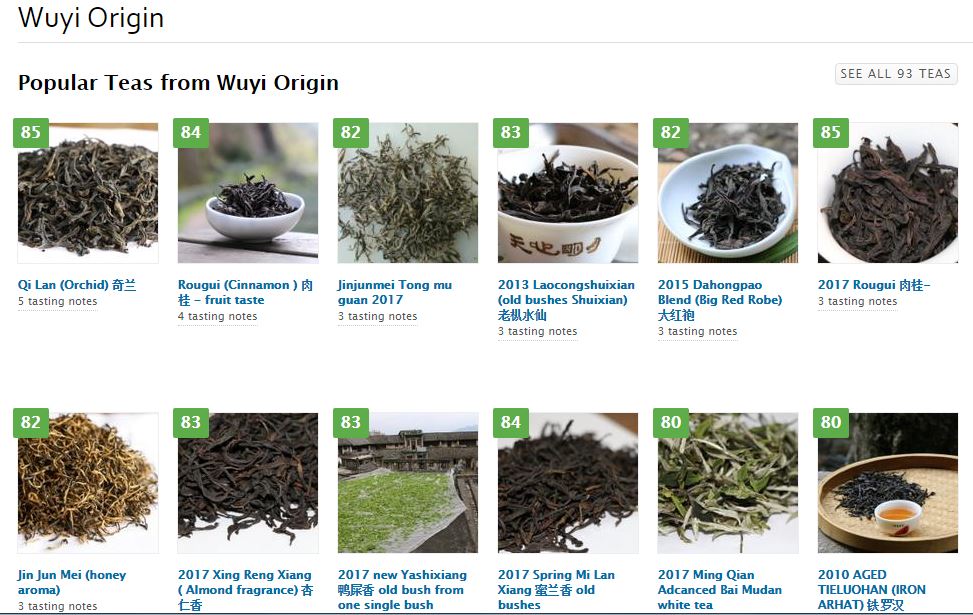
I have mentioned lots of sources that wouldn't make it onto most people's radar in posts, some great options, but for the most part I'm either talking about the main half dozen or so set of Western vendors (maybe now slightly expanded, with Yunnan Sourcing, White2Tea, Chawang Shop, and others on that list for awhile).  Or physical shops it would be hard to get to, like favorites here in Bangkok, or wherever I travel, or online exceptions lots of people already know about (Liquid Proust, King Tea Mall, Farmerleaf, Hatvala, Wuyi Origin, etc.).

Moychay doesn't fit in those categories, but as a Russian version of varied form perhaps loosely equivalent to Yunnan Sourcing--except they sell only their own brands or sourced versions, not factory teas--their name is getting out there.  Sometimes I make connections with smaller vendors and review their teas too; Tea Mania is a good example of that, a vendor based out of Switzerland.  Peter Pocajt, that owner, travels to Asia and buys tea relatively directly--in at least some cases--and can offer interesting products at great value related to that.

That background seems clear enough but I'll spell it out; if a vendor really does buy teas from a producer then there could potentially be more leeway for selling at lower costs, since the cost of tea being bought and re-sold a couple of times wouldn't have occurred within that particular supply chain.  That doesn't mean the tea would have to be good quality, or a good value, but it could add some potential.


I really shouldn't mention much for personal opinion on this original issue, the "transparency" theme, since I'm too far outside it to have an informed take, although of course I will anyway.  It seems worth pointing out that if someone went through a couple of years of sorting out potentially unreliable sources, buying plenty of teas that didn't work out along the way, and making foreign contacts, you wouldn't expect them to mention it all online.

Calling out someone like James of TeaDB (how this seems to have started, in post comments on a related theme long ago) makes for a special case, because he is talking about teas and sourcing on a weekly basis, and to some extent those contacts would be more freely available to him through having more connections.  That doesn't necessarily make sense to me either though; whatever James wants to communicate is exactly the right amount and type of information to pass on.  If he had "secret sources" and didn't want to share them that would be up to him.


This connects more with main-vendor stances on pricing and value than it might seem at first.  I've already mentioned a Tea DB post awhile back citing Yunnan Sourcing mark-up over the last 8 years, and for some types of teas prices are doubling every 5 years or so, based on 15-20 % annual increases.  That's on releases of similar in-house produced versions, but mark-up of semi-aged teas is also significant in many cases.

This discussion isn't so much a critique of vendors for charging too much for new productions, or a problem with related trends, tied to pricing for any range not being fair.  Again the main idea seems to be that semi-aged versions of factory teas (Dayi, etc.) are available through different sources overseas, and online discussion of options falls short of discussing those. 


In doing a round of tea purchases this year I've ran into my own concerns about how a lot of new teas that are only slightly better than what seemed standard not so long ago (4-5 years back) are now selling for $70-90 per standard sized cake, instead of half that much back then.  It's normal for supply and demand to shift, and that seemed to happen.  Vendors costs must have increased too, but of course one wonders if those main vendors aren't earning a lot more profit than they were 5 years ago, based on volumes going up and profit per unit also increasing.  I really don't know how all that factors in together, and that's certainly not intended as an accusation.


It comes up in these discussions that it's the "hot" or most in-demand versions this relates to most, versus more standard offerings (or probably both, with that an interesting special case).  If someone is interested in digging as deep as possible reading all the comments in those posts I cited adds more of others' opinions on the related issues.  I just read an interesting account explaining a little of how all that works (in one case of an "in demand" tea), which overlaps with a group-buy theme that I won't spend time on, here:  Dead Leaves Club; A Brown Mystery: Stamps and Skidmarks.

An interesting sub-theme in that particular story is that storage factors in a lot.  That's a given, but the form is informative and interesting in that account.  The same exact original cake can be stored differently and can vary a lot in present-day value.


Other solutions to a similar problem


Instead of speculating any more about foreign sources or spikes in demand for certain ranges of tea or versions I'll switch back to talking about a much more mundane, less sophisticated topic, about options for buying normal-range teas (sheng) that aren't expensive.  Someone just mentioned that King Tea Mall seemed to represent a good option for this for semi-aged Dayi and other factory teas, to them, but I won't get far with that idea.  I've been reviewing some teas John--that owner--has passed on recently, but nothing along that line though; not semi-aged commercial / factory teas.  The teas I have reviewed were interesting and pleasant and seemed to represent a good value, to me.

We're back to a familiar starting point I've been saying a lot about, since the example of the Chawang Shop 2012 produced tea I just reviewed (a Da Xue Shan version) will do to review this issue.


in the middle of that list


It's not a "factory tea," not from one of the limited set of main producers, more in the range of commissioned versions instead.  Various more-directly sourced teas span a range of paradigms along that same line, with typical stories told and claims ending up settling on common themes.  Again storage issues probably factor in a lot with those teas; the environment they were stored in within the Kunming area was probably a bit cool and dry, which is the subject of a lot of speculation about causing specific aspect features in the versions I reviewed from that order list (almost all of them; the teas were interesting and generally quite pleasant).

That last order price for that tea seems too low.  I tried to look up the price in earlier years but that takes a lot of paging around, and with the current pricing version that low there could hardly be much mark-up.  I didn't find an old listing for it, looking up archived copies of their website.

This 2012 Internet Archive site listing came up related to another tea on that order list, one I liked, which will cover how to approach that type of review:


That went from $7.80 to $10.50 in 7 years.  I'll not mention this post to Honza, the shop owner, just in case it might work as a reminder for him to adjust that sort of thing further.

To some extent the filtering of what's still around could make this approach less promising, checking out what a smaller scale vendor tends to still have, because favorites may well have been sold out, and teas people reported on not liking could be available longer.  Sticking with this example, I liked that 2011 Xiaguan FT cake a good bit more than the 2010 Xiaguan tuocha version also listed, and it seems possible that even more promising versions of similar age sold out of stock earlier.

This would affect those so-called secret sources too, one would expect.  Better versions would also be more highly regarded, would cost more, and would be more difficult to find.

All this doesn't necessarily reduce to a summary claim that main vendor pricing isn't competitive with in-China sourcing, even though at a glance that is what is seeming to be discussed.  There are also other layers of complications involved with those types of broad-stoke comparisons (eg. all the fake tea and bad sources to sort through; it doesn't make sense to compare only best-results cases when that wouldn't be typical of people's initial experience).  If an atypical level of awareness of options could suddenly become broadly known--kind of the objective, looking at the discussion from one perspective--then that would seemingly also extend to exceptional tea version cases (related to both character and value), not just vendor options, and those would vanish faster.

These concerns about other options, in a different form, reminded me of re-trying a Moychay tea that seemed an incredible value.  That was after seeing a post about that tea online, and seeing the cake moving around versions looking for something.  No mini-review here, but I really liked that tea for having interesting, positive character (probably just quite different from the other I've just reviewed), even though it was younger than I'd prefer drinking it most.  It was this:


2016 (pressed in 2017) Moychay Meng Wan Shan sheng


I couldn't find my own review of it, although I must have written one, maybe for an article within the Moychay site since I wrote some there.  I did turn up this aptly named Puerh Blog review looking for that, also mentioned on Steepster:


Heavy-spicy, bitter-fruity, discreetly kräutrig [?] and slightly astringent with very beautiful, intense citrus notes and a long-lasting sweetness. As the 2017 Bangdong rather coarse in processing but delicious and diverse. The citrus notes are reminiscent of Bada or a mild Lao Man E version, very good! A perfect daily drinker for a more than fair price.


That leads me to consider if citrus might have transitioned in the two years since that was written, and onto a tangent about refined / higher quality teas versus daily drinkers, but this is too long already.  I really like that tea, and I suppose that description matches my impression well enough, whether it's aspect-for-aspect or not.

These two example versions together (the Chawang Shop and Moychay unusually low priced options) highlight that you don't necessarily need local sources based out of China and Taiwan to drink interesting versions sold at unusual values.  Maybe to find the lowest market priced semi-aged Dayi you do need to take those extra steps, but then to some extent that discussion is still playing out, and I've only mentioned what may be some opening rounds in bringing up related issues.

Wednesday, April 24, 2019

2007 CNNP 8891 sheng from Yunnan Sourcing


cool looking, nice color, a bit tight as compression goes


same photo with a light turned on; funny how background lighting shifts color


This is the last in a hectic series of review posts I started while I had a few days off with my kids visiting family back in the US, without my wife and I.  I'll go quiet again here for another week or two due to being out of town this weekend, but a TChing post I wrote on tea evangelism should post in that time, so I may add that in this blog too.

This is another interesting tea from a Yunnan Sourcing order.  I never did list what I bought or post a purchase photo anywhere.  I'll let a partial citation of their description serve as an intro (with the rest really worth a read; there's a bit more of an origin story there):


...this tea is incredibly good tasting and has a very unique flavor profile. It's been stored in Guangdong since 2007 in a dry-wet storage condition (wet stored but on the dry side of the wet storage spectrum). The raw material is from Nan Jian area of Yunnan which is technically part of Dali prefecture...

The tea brews up an orange-red tea soup with a pungent aroma of flowers, mushrooms and earth. The taste is clean with no musty wet storage notes, but does have some some earthy notes. There is a kind of pronounced spice and cloves taste and aroma with a strong viscous sweetness throughout...


No rambling from me this time.  I've tried teas of this age but I won't go through comparing them since starting point character and storage differences would cause that to not be meaningful.

Review


The first impression won't tell a lot of the story but it is interesting.  There's a pronounced dry wood tone to the flavor, which could be described as mushroom and earth.  It strikes me more as the scent of an old barn.  Oddly my impression is positive though; that earthiness isn't where it will be in another infusion or two but it's paired well with general warmth and sweetness.  The aftertaste is pleasant, mineral intensive, even a bit towards natural spring scent or long-rusted metal, with a hint of the clove showing through already.  That's why I don't read descriptions before tasting though; that last part really could be suggestion.


Earth picked up a good bit in this second round; I'll have to keep these infusions fast since the flavor intensity won't balance well unless this tea is light, given how it's a bit intense.  I was reading some really interesting pu'er storage experiments in a blog by "M Gault" (Late Steeps) in which he describes flavors as geosmin.  I had to look that up; it's basically dirt.  It's not dirt, although some descriptions of the term tie it back to that, but here is Wikipedia's description (partial):


Geosmin is an organic compound with a distinct earthy flavor and aroma produced by certain bacteria, and is responsible for the earthy taste of beets and a contributor to the strong scent (petrichor) that occurs in the air when rain falls after a dry spell of weather or when soil is disturbed.[1] In chemical terms, it is a bicyclic alcohol with formula C12H22O, a derivative of decalin...

Seems likely this tea tastes like that.  Luckily I like that strange flavor aspect in beets.

The tea isn't musty but it is earthy; what could've been mushrooms but reminded me of well-aged wood has shifted a little towards well-aged hay, beyond fully cured into an old version of it.  Again though, it works.  I'm picking up a lot more mineral input than floral, although a little seems to be present, and the spice range isn't as pronounced as it might be, but it's a cool mix.  It wouldn't be for everyone.  It's funny I've taken to saying that lately; it sort of goes without saying, doesn't it?

Either it's the Bangkok-hot season heat getting to me or else I'm really already feeling this tea on the second infusion, which is not how that usually goes.  I'm not all that sensitive to "cha qi" effects but at their strongest I can notice it, but I'm at a pretty low dosage this far in for the head buzz I'm feeling.  Might be both acting together, the heat and the tea.

I lost focus and let this infuse for over 5 seconds, my typical timing range, a bit long.  It'll be nice seeing where that puts it and noticing the contrast with a flash infusion the next time.  The earthiness tie-in to mushroom makes a lot more sense on this infusion; that's what's going on.  The mineral has shifted to taste a good bit like potato skin, although still also a little like beet. 

It's funny how when I consider these terms (dirt, beet, potato skin, mushroom, well-aged hay, rock mineral leaning towards metal) it doesn't sound like a pleasant thing to experience, but it is.  It's still on the soft and approachable side, nothing is too jarring as flavors or other experience range, and a good bit of sweetness helps all that work.  It comes across as "cleaner" than all that would sound; aging-related flavors can be musty, and this isn't.  If anything the feel is pleasant; it intuitively should be edgier and a bit dry given all that flavor range but it's not.


Brewed faster, a quick in and out, the tea doesn't give up nearly as much intensity as you would expect.  It's not even all that different.  Sweetness plays a slightly larger role in the flavor balance, and heavier mineral drops back.  The aftertaste is still intense, and the feel is still an odd mix of hinting towards dryness and tightening across a lot of my mouth with feeling a bit juicy.  It will be really interesting to see how this changes after just a couple of years here, in a nice and hot, consistently humid place.  I'd bet all of Bangkok is firmly in the wet-wet storage condition per that description spectrum postulated.

It's 97 F here right not, around one of those temperatures I can convert back and forth from C to F easily, close to the 37 C of human body temperature.  Relative humidity is 57% right now, much lower than the typical 70% here, but I think that's because the amount of water in the air has probably gone up just a little but the carrying capacity at this hotter temperature is a good bit higher, hence the lower relative percentage.  I went through all that in this post, which cites this related graph:


Since I'm mentioning it I went a lot further with pu'er storage themes in this article I wrote for a vendor, for Moychay, mentioning a reference on how to make do-it-yourself humidity control packs and one on temperature related aging experiments.

Those black boxes (or whatever shapes) in this graph are recommended environments for IT equipment operation; never mind all that.  The other two colored versions were me messing around with where people say pu'er stores well.  I'd probably draw them differently now since that was from 2017 but the idea is the same.  The point here is that even a relatively small step up in temperature from 33 C to 38 (91 F to 100 F) changes how much moisture the air can hold at those levels.  The air I'm sitting in contains about 22 grams water per kilogram of dry air right now, or way above any of those boxes.

Really it's my understanding now (based on input from M Gault's blog, Late Steeps) that tea can age just fine at whatever temperature, even up to 40, which is good since it is almost that now.  That, and the sheng I have around (the limited amount of it) seems to transition well with age, maybe just a little faster than I'd expect.  The character doesn't seem to have been impacted negatively for it being so hot.  To qualify that, I don't have enough other baseline of experience to be a good judge of such a thing; it's more a vague and poorly grounded impression.


The tea is shifting a good bit over the next infusion, softening, with those different aspects integrating much better.  Clove really does start to make sense as an interpretation of part of the flavor.  The feel still has good complexity but it's different too.

Again on the infusion after it's still shifting; that's a cool experience, after a lot of young sheng I've been drinking lately staying more consistent.  The warm mushroom / aged wood or hay aspect is now as much like a bark spice.  The mineral is still on the deep and earthier side, still including a touch of "geosmin," but milder, different, and more integrated with the rest.

This lighter range is more familiar, not far off that in a couple of different 2006 Hong Tai Chang versions I compared at one point.  A more recent 2006 find in Chinatown had a really heavy earthy flavor, more on the musty side, which I took to likely be storage condition related (but again, I'm guessing at this level of exposure).  I never did report back that within a couple months of trying that tea I tried it again and it was much improved, probably benefiting from airing out a little.

It's odd that this local environment could count as "airing out" but who knows where that Chinatown tea was stored, or even exactly what it was, given the frequency of gaps in how teas are labeled and what they actually are.  As with those other inexpensive teas I just reviewed if you buy a tea labeled as something not overly desirable that kind of helps (with limiting concern about it being "fake"), because a producer isn't going to fake a tea being a relatively generic, lowly regarded, lower-cost source product.  At a minimum they would fake a tea being an in-demand but moderate cost known-vendor version.  If a tea is sold as a $15 cake of Lao Ban Zhang in one sense it's fake but in another it's more or less what it's presented as; as mis-labeled tea.


This tea might be transitioning to thin in intensity just a little; far from brewed out but fading in intensity.  It would have helped going with flash infusions from the start.  I suspect it has just as long a cycle to go, just either drinking it as moderate strength (which is probably better) or extending infusion time.  The leaves being more chopped than I'm accustomed to must have altered how it brews.  I've drank factory teas since first getting into sheng a half dozen years ago, some so finely broken it's almost as much a ground leaf, but more often I'm drinking more whole-leaf versions.


On the next infusion the last description mentioned still works; the tea is still pleasant (where I'll leave off description, something like 8 to 9 rounds in).  I'm happy with this tea.  I'm guessing that it will benefit quite a bit from another 2 to 4 years of getting a little further through aging here but I could enjoy drinking it like this, and will probably try it a few more times over the next year.


Later observation, some online review


I did brew that tea at least another half dozen rounds later and the flavor held up fine, thinning and changing a little but staying positive.  Even without any further aging or change I would really enjoy that tea, and that just getting used to the novel character a little more would already make it seem even more positive, when I already liked it to begin with. 

To some extent it must be a relatively basic tea compared to refined and highly desirable aged versions that get discussed in tea groups.  Since I'm still on the new side related to exposure to aged sheng it's still novel and probably more positive to me.  The cost is moderate, listing at $67 there on YS now; maybe they just forgot to add the standard per year mark-up in this case.  Then again I tried to look up alternative vendors selling it and saw a reference of the pricing from a couple of years ago; it just started really low.

No alternative sources turned up easily in a Google search but in looking that up I ran across a couple of interesting related references.  Tea DB (James) did a review of it; he liked it, especially related to value, but I didn't watch that video yet to get to the details.  The Steepster entry feedback was generally positive, which is probably as well taken with a grain of salt, listing these aspect in the main header description: 


Sawdust, Tobacco, Vegetal, Musty, Raisins, Whiskey, Sweet, Chestnut, Dried Fruit, Floral, Mineral, Mushrooms, Nutmeg, Rose, Spinach, Wet Earth, Caramel, Sweet, warm grass, Earth, Hay, Spicy, Stonefruits, Straw


Maybe it was like that; I'll have to taste it again a few times and try to sort all that out.  Odd that no one borrowed mentioning "clove" from the vendor description. 

Just to be clear, in tasting a tea that's in a less than familiar style, and a complex tea at that, interpretations could vary quite a bit.  I didn't notice that much fruit but about a third of that list appears by name in this review, and some of the rest overlaps a bit (saying it tastes a little like clove is close to saying it tastes a little like nutmeg, even though they're different, and so on).  Tobacco and whiskey are something else; I'll consider that in re-tasting.


talking to Kalani on video call


those two love messing with the app features


Tuesday, June 5, 2018

Wuyi Origin Xing Ren Xiang Dan Cong (almond aroma)


Cindy of Wuyi Origin sent a few samples to try not so long ago and so far I've only reviewed a Lapsang Souchong and Mi Lan Xiang Dan Cong.  Both were really nice, although to be fair people who aren't into fruitier teas probably wouldn't really appreciate either.  Or Dan Cong in general, for that matter, since those universally express pronounced fruit or floral aspects, and it would seem strange for someone to hate fruity tea and love floral versions.

I love citrus and other fruit as main elements in better black teas and oolongs, which explains why Oriental Beauty oolongs are one of my favorite types, or why second flush Darjeeling can really work well for me.  I'm not reviewing much for Darjeeling these days, or even drinking much (beyond trying a decent first flush version in the past week), but for me that sort of thing goes in a cycle.  I've been more inclined towards Chinese blacks, but am trying more sheng and shou, along with some Dian Hong and orthodox Assam.

Of course this is almond flavor Dan Cong, more or less.  Those really do taste a bit like almond but that range can vary.  It will probably be subtle and a bit aromatic, a term people could use in slightly different ways.  Let's see though.  I'll cite the website description of it first, which I didn't read before the tasting:

Location: Wudong village of the Phoenix mountain 

Harvest date: 2017.4.4th 

Cultivar: Xing ren xiang ( Almond Flavor )

Roasting level: Medium roasting, after sorting we roast it by Litchi Charcoal  

Feature: Xing ren xiang, another name is Ju duo zhai 剧朵仔.  At the two side of edge of leaves there are Sawthooth, the leave of this cultivar is very small, thin and long.  This tea has an  obvious almond and nut aroma and very strong tea body.  You can feel the tea energy in the tea soup, enduring, with a long sweet back [finish].


Pretty good, for a description written in English by a non-native speaker (cleaned up a little for form).

Review


I didn't use a rinse on the tea, no short first infusion to be thrown away.  I kept the first infusion limited in timing, around 10 to 15 seconds, even though it really won't express the full flavor range made that way.  Once this tea gets brewing using hot water--boiling point, or at least near that--short infusions would work well, between 5 and 10 seconds.  Or it's possible to drink it stronger; just a matter of preference. 

The tea won't have astringency to work around, as some Dan Cong do.  In my experience that tends to come up more in some types (specific Dan Cong type versions) but really varies more by quality level.  It would be possible to work around astringency a little (if it were present) by using 90 C water instead but more conventional to just go with short infusion times.  One school of thought, covered in this post about oolong brewing temperature, would claim that you'd be out of your mind to use anything but full boiling point water to brew this tea, which would give the best results, but I tend to accept that people could easily use trial and error to see and judge for themselves.


Almond does work as well as anything else to describe the main flavor range but an initial blind impression would probably focus on the floral range instead.  In this tea it's closer to ripe peach than it might often be, usually more prominent in Mi Lan Xiang Dan Cong.  It's complex though, to me balancing almond, that peach fruit, and underlying floral range.  The fruit covers stone fruit range but also a soft version of citrus, and there will be more to say about how the sweetness comes across, about light toffee or whatever else.  And about how the base that's related to astringency works, the unripe fruit theme that's subdued in this version.  There's a lot going on, but the overall effect is simple and unified, not challenging.

I went just over 10 seconds again to get the tea to finish unfurling and opening up, slightly stronger than necessary, but it will make it easy to pass on a full impression.  It's really intense.  Warmer sweet tones did pick up a lot, not exactly close to light toffee but not that far from that either.  Some else might interpret it as close to sugar cane but it's not that either.  The almond range is dominant anyway, coming out even more, with either fruit or floral tones or whatever it is dropping back a little in proportion. 

This is a really nice, complex, and well-refined tea.  The astringency or feel that is present gives it a fullness and hangs around long after drinking it, trailing off in a sweet flavor range that matches the fruit tone more.  The almond flavor is well developed during tasting the tea with sweet fruit and some floral trailing more, an interesting transition.

very slightly stronger; I won't mess around and try a longer steep for this tea


The next infusion I just went around 5 seconds, to see how it works out quite light.  I'm guessing right in between 5 and 10 seconds is the closest match for my preference but it's nice to experience the range.  The intensity at this fast infusion time is interesting; maybe I'm wrong about that part, and quite light is best.  It won't communicate well but all those aspects that I mentioned fall into a great balance in this round.  Each taken alone is nice but together it really works.


The subtlety, complexity, and overall tone remind me of how Ya Shi (duck shit) versions often come across, just not that almond flavor part.  The way the sweetness is expressed is familiar from that, and the underlying floral tone too.  I think part of that is just how well a light-medium roast works for this tea, which would be very light compared to other oolong styles, just more in the middle of the typically lighter Dan Cong range.  It's almost as far from Wuyi Yancha char roast effect as lighter Taiwanese oolongs are, just in a completely different tea version.

It does keep transitioning on the next round, picking up a perfume or liqueur like effect that comes across in some teas.  Using the concept in one way people sometimes refer to that as aroma.  In part it relates to the floral tone picking up but it's also an effect that seems to go beyond taste / flavor changes.  Some of it does seem to be happening related to what your tongue picks up (taste, in one sense), but also to what aroma / scent carries (flavor, used in one limited sense).  Something vaguely related to astringency does give the tea a fuller feel but it's more the opposite of "astringent."


The next infusion is more of the same, really great.  It did continue to cycle through another half of the round of infusions and transition just a little throughout that but I left off here taking notes about it.


Conclusion


I really liked the tea, but then it was just what I expected: complex, well-balanced, characteristic of the type, sweet and intense but subtle and refined at the same time.  But just how good is it?  And how could a reader judge my judgment about that?

Part of what brings that line of questioning up is the familiar exchange where one person claims a tea is a good version in online discussion and then a self-professed "more experienced" tea enthusiast claims that they've had much better tea than that, that it's not even close to the higher end (often even without having tried the tea, which can be regarded as a bit problematic).  I'm not talking about any one specific case but that theme does repeat.  Of course there are ever-higher levels of tea quality for different types, so the claim always could be true in different senses.

In order to resolve that, for a reader to be clear on what I mean and how my judgement matches theirs, I would have to pass judgment on a similar tea already familiar to them and our impressions would have to match.  Even then one would have to just assume that aptitude for judgement and personal preference as a factor remains consistent.  That set of conditions is unlikely, unless I could map out a matrix of reviews of other recognized versions, so I'll go with the next best thing:  trying to find a comparable online description of this tea by someone else, to use third-party input as a benchmark instead.

I couldn't find a 2018 version description, and working from 2017 is going to be slightly less specific, since tea versions will change a little year to year.  Growing conditions aren't completely identical, and some harvest and processing steps require nature to cooperate too.  It would be similar, and of course it's processed by the same people, so for critiquing my review description it wouldn't work but for pegging a general quality level it should, or at least it'll make for a start.  Of course there still are better and worse years for specific teas or general areas. 

One of the three 2017 version reviews on Steepster seems to work to summarize that set of takes (from Tanluwils; nice job!, very clear and detailed):


I’ve had many sessions with this tea and it continues to impress. Dried leaves smell like roasted leaves without any remarkable scent, but once hot water hits them I am immediately hit with rich, almond (yes, really!) essence, sweet buttercream, orchids, and hazelnut. The rinse is thin-bodied, but already exudes a nice mouthfeel. This is a testament to the skill and expertise that went into the roasting, which has enhanced the inherent qualities in the leaf.

The next 4 steeps intensify in aroma, qi, texture, mouthfeel, and flavor. The almond here reminds me of fresh traditional Cantonese almond cookies. It’s very full in the mouth and feels nice in the throat. This one goes strong until the 7th or so steep where it gradually fades. It performs best in a chaozhou red clay teapot.


Steepster reviews can be useful as input, with some interpretation of them required


The tea was a bit like cookies, come to think of it, and I bet I might've expressed more about that creaminess.  That one is most descriptive and the other two are even more positive, with one surprised the tea tastes that much like almonds (the 2018 version did, and also a bit floral and so on), and the third moved to compare the experience to that of romantic love (by Jorge Luis Vazquez Ochoa; again admirable work):


...Difficult to resist its charm. Until the third infusion the tea hugs me, very slowly with an irresistible seduction. Oh my God! its sweetness makes me drunk. Then I was spellbound with it’s flavor. It’s like the kiss of a beautiful woman who just brushes my lips. Then the liquor runs through my body giving it a warmth of life. Then, after the ninth infusion it’s beginning to slow down, but now I’m full of it’s wonderful flavor... 


This next years' version was really good tea but I wasn't quite that affected by it.  If someone hadn't tried Dan Cong on this level before it could be a shocking experience, and for someone who has it would still be really nice.  I suspect that I might be a bit dispassionate in approach to life in general compared to him, which is not necessarily a good thing.

I checked if he'd reviewed the Ya Shi and he had, with really positive things to say about that, but framed in more conventional language.  As I recall that tea was similar in nature (their versions I've tried, including the 2017 he reviewed), just slightly different related to flavor profile.  But then comparing a tea version to one drank a year ago is pushing it; it's easy to remember wrong, at least for me.

Steepster scoring in particular should be taken for what it's worth, defined differently by everyone


Another popular blog reviewed the 2017 version, Tea DB (so a video version; how most of their posts go).  I'd have to summarize them instead of citing something, but the general take seemed to be that it was a high quality tea, most pronounced related to aroma and length of finish, but also with good sweetness and flavor complexity.  Those guys drink Wuyi Yancha and Dan Cong but focus more on sheng pu'er, so their take is far from inexperienced but they probably would have did more with placing it if the tea had been that type.  One funny comment was that since the tea wasn't astringent and had good flavor and sweetness someone's mom might like it.  That's an interesting way to place the tea style, which they joked they would edit back out since it's both sexist and ageist.  But it works.  As long as their mom could use a gaiwan and do 10 second infusions it's easy to brew as well.


It's kind of strange to survey other blogs about a tea, especially since I'm going on about 2017 version reviews, but it was an interesting theme to consider.  This tea is refined and subtle in one sense and straightforward and approachable in another, so it's interesting seeing how different reviewers talked around that.

One take was consistent:  all those reviewers really liked the 2017 version.  The Steepster reviews seemed to frame it as a type you tend to focus on and appreciate more as you drink it, and the Tea DB guys seemed to see it as just another good Dan Cong, but that's how varying type preference and level of exposure goes.  I might prefer Wuyi Origin's Mi Lan Xiang version for flavor intensity and their Ya Shi (duck shit) for being really subtle and unique but this tea is on a comparable level with both.  I agree with some of those comments that Xing Ren Dan Congs don't always taste much at all like almond but this one did, along with other flavor aspect range, which does seem favorable, matching the general type convention and name.