Showing posts with label golden fruit. Show all posts

Monday, March 19, 2018

2010 Kokang Myanmar shou pu'er-like tea


Dayi left, Kokang Myanmar shou right


I'll take a short break from sheng, leaning into that subject a bit much lately.  But I am continuing with trying samples from Olivier Schneider, just mixing types up.  That exploration started with reviewing this pair of sheng samples earlier.  This should be just as nice, trying what looks to be a very interesting tea from Myanmar. 

There's a little history of that area in the related Wikipedia article.  It sounds like it might be interesting to visit, as long as nothing came up for local conflict.  That article's area description:


It is located in the northern part of Shan State, with the Salween River to its west, and sharing a border with China's Yunnan Province to the east. Its total land area is around 10,000 square kilometres (3,900 sq mi).[1] The capital is Laukkai. Kokang is mostly populated by Kokang people, a Han Chinese group living in Myanmar.

Kokang had been historically part of China for several centuries, but was largely left alone by successive governments due to its remote location. The region formed a de facto buffer zone between Yunnan province and the Shan States.[2] The Yang clan, originally Ming loyalists from Nanjing, consolidated the area into a single polity. In 1840, the Yunnan governor granted the Yang clan the hereditary rights as a vassal of the Qing dynasty.  [2] After the British conquest of Upper Burma in 1885, Kokang was initially placed in China under the 1894 Sino-British boundary convention. It was ceded to British Burma in a supplementary agreement signed in February 1897.[3]


Vietnam is the right (the Son La tea producing area), and Phongsaly province in Laos in the North


But for some local politics and a line on the map this could be part of Yunnan, and the tea could be go by the name "pu'er."

I've been drinking more sheng lately, but I did last review a shou in January, a Laos Tea version, which actually might be similar to this.  I think both are made from older local trees, although I never really heard the related details for the Laos tea (that I recall, at least).  That shou was from Phongsaly, a province not marked on this map, but the border has a "1A" road marker that runs just North of that border (the lower East-West part of it, before the road turns North to the West side).


Someone recently asked in an online discussion if older sheng can overlap in aspects with shou, and that hasn't matched my experience.  It always just tastes like shou.  But then I've not drank any sheng that's 15 years old or older (maybe with the exception of in a shop somewhere along the way), quite a significant gap when it comes to experience with that type.  I'll get there, surely sooner since the oldest in that set of samples has now aged for 19 years.


I'll comparison taste this along with a 2014 Dayi "Golden Fruit" shou version I bought last year.  I don't expect that comparison to shed much light on either tea, it will just be interesting seeing the difference as a contrast, or noticing if there really is significant overlap in aspects.  Part is that I'm in the habit of comparing things.


The brokenness of leaves stands out between the two, in preparing them.  The Kokang shou seems to have been stored as a maocha, never compressed, and seemingly was made from more whole leaves than the Dayi version.  That factory tea version was compressed, with the leaf material somewhat chopped up, including stem content as well as leaves. 

The notes description along with this tea follows:


Review


The Dayi tea is smooth and rich.  Per online descriptions of lots of other shou it would seem normal for it to be a bit "off" in some way for still being young, only a one year old tea now, but it didn't express negative earthy flavors, or fishiness, or anything like that last year.  It might lack a bit of complexity as a flaw, and I wouldn't really expect that to change a lot over time.  The aspects it does exhibit are nice, sweetness, fullness of flavor in the range it does show, a creaminess, mild earthiness, a bit of character similar to the Guiness Stout range. 

For an inexpensive "daily drinker" shou, something to have with breakfast or an afternoon snack that doesn't demand too much attention, it seems really nice.  I wouldn't be surprised if it transitioned to a better tea for having been slightly more challenging in it's first half year after being produced, but that would just be a guess on my part, but one based on experiencing changes in other shou versions.


The Kokang shou is completely different.  A bit of char stands out in the initial taste of the tea, actual charcoal flavor.  It's not necessarily negative but also not necessarily positive.  Beyond that it's also complex, with a lot of aspect layers to experience.  The flavor range unfolds as you drink it, and continues after you swallow it, all earthy and deeper-tone mineral fullness.  It's complex; earthiness extends into dark wood tones or maybe even tree bark, potentially interpreted as bark spice instead. Not cinnamon, other bark spices, although it's closest to the Vietnamese version of cinnamon that Rou Gui is closest to, as versions of cinnamon go.
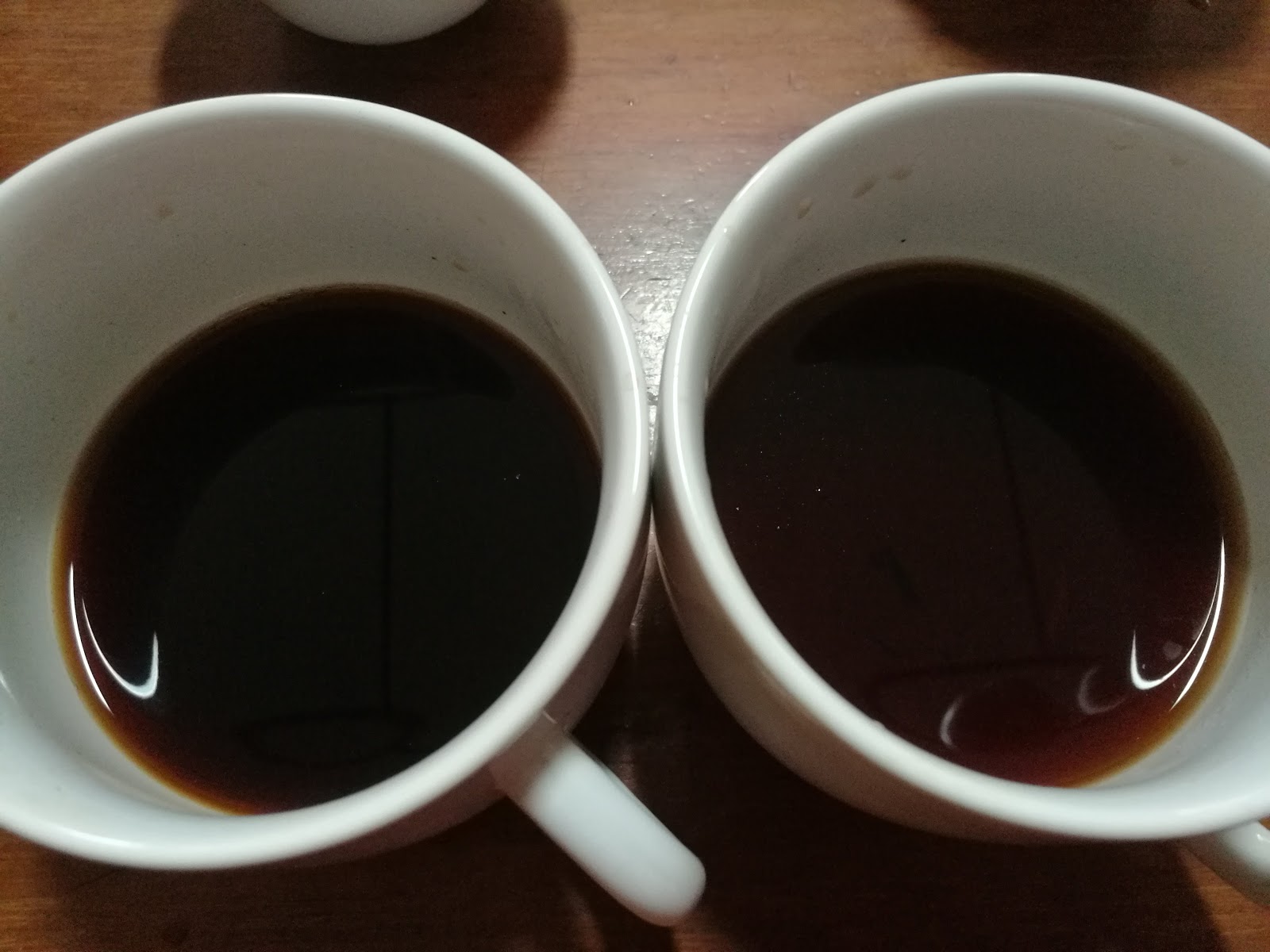

Dayi left, Kokang Myanmar shou right


That one layer of charcoal is most pronounced in the initial flavor aspect hit, but it stays integrated with the rest of the flavor range after too.  For some it could ruin the experience, I guess.  I've tried inexpensive shou that were awful for that type of charcoal being most of the effective flavor range, but that's not what's going on in this.  It's also one of the last traces of flavor aftertaste to go, remaining as a whisper of flavor a minute or two after you actually swallow the tea.

This is only the first infusion; that flavor may fade as others ramp up across later infusions.  I just checked and the other tea, the Dayi, doesn't just leave your mouth immediately after you drink it, but its aftertaste is a lot less pronounced.

Second infusion


The Dayi does pick up a bit of richness.  I wouldn't expect it to develop a lot through infusions but it has improved from the first to the second.  It still has pleasant character, flavor fullness, and if very approachable, but it's a little thin related to complexity.  It was sold as supposedly being designed to pick up fruit flavors but I'm not really getting that.  Imagination helps you cover a lot of ground, and if someone really wanted to maybe they could interpret a dried apricot in some of the flavor, but peach is stretching it, or really even that dried apricot.  It has nice sweetness, I'm just not seeing that as relating to fruit.  This is sort of part of the limitation of the tea; it has plenty of flavor, it just doesn't come across as complex.  It's earthy, again like that rich flavor in a stout (beer), but it doesn't lend itself to listing out flavors.


The char did fade in that next infusion of the Kokang tea.  It's still the most pronounced aspect, for flavor, but has fallen more into balance with the rest, as contributing to a whole instead of being half of what you pick up.  Just a little more transition along the same line and this tea really will be exceptional.  The fullness is cool, the way the intensity somehow crosses into different levels, and how after you swallow the tea the experience is still just getting started.  That charcoal is fading into more of a richer (darker?) mineral dryness instead.  If someone doesn't see that as being "off" then there is nothing unpleasant about this tea.  And again if they did it could be hard to drink; it just depends on preference.  I really like it.


Dayi left, Kokang shou right


Third infusion


These two teas are probably leveling off where they're going to stay, with some additional transition coming later.  The Dayi hasn't changed at all, as far as I can tell.  

That char effect did soften further in the Kokang version, and the balance is quite nice as it stands.  The fullness and aftertaste stand out as exceptional more than the actual flavor profile, to me.  It's a lot fuller in range for flavor than the Dayi too but it's not really as complex as it might be.  It's earthy, with warm mineral tone, dark wood, and tree bark or bark spice, but all that makes for a related set of flavors, or complexity within a narrow range.  I'll give it one more slightly longer infusion to check range and then leave off the note-taking.  It does tell the full story to write out transitions through 7 or 8 infusions but it's a story that tends to get repetitive for a lot of teas.

Having invoked the issue of timing I can explain how I've been preparing both:  using medium length infusion times, as I see it, in the 20 to 30 second range.  Sheng often works out well at light infusions, brewed fast at normal proportions, but for me shou works better a little stronger.  It's possible to drink this tea brewed much more lightly, but a slightly medium-ish infusion strength helps place what's going on, and there's nothing objectionable in either tea to brew around.  It's also possible to drink these types of teas brewed as strong as coffee tends to come across.  I don't prefer shou that way but it works much better than for most other tea types.

Fourth infusion


The Dayi is still nice, not changing all that much for being a bit stronger.  It was a little neutral and mellow in both preparations, with enough complexity to be agreeable but not enough to be really interesting either way.  It does "taste like shou" at least; it's got that going for it.

The dryness and mineral tone pick up in the Kokang version, brewed slightly stronger.  A mineral / rock tone mostly like slate picks up.  Again someone might absolutely love that, or not like it at all.  Now that I think of it this tea reminds me quite a bit of Liu Bao.  It could almost be a Liu Bao, it's just not.  It's softer than those tend to be but that char is normal for those, and the earthy mineral range.  Shou is usually different, sweeter, with a different sort of complexity, more towards leather, molasses, or toffee, or the Guiness stout effect in the other version, potentially extending into dried fruit range, but as often earthy instead.

NYC Chinatown shop shou tuocha; not bad


I should qualify that:  I've drank a bit of shou before but haven't explored that much in the way of better, more expensive versions.  That's true of Liu Bao as well, really, even though I reviewed 4 or 5 of them last year.  I've also not tried much for older shou, so I really can't say anything about how 10 to 15 years of aging tends to affect such teas.  I've tried a couple in that age range, but one or two versions doesn't really inform general patterns very well.


These teas will keep going; they're far from finished.  I've been getting in the habit of dropping note taking after the first half of the infusion cycle since the main point is communicating a general impression.  A tea continuing to evolve in positive ways in later rounds is meaningful, or lasting through a lot of infusions, but I don't expect anything unusual to occur with transitions as these continue.  An aspect description or two might change, and the balance of aspects would definitely shift.


Conclusion


This Kokang tea is interesting, one of the better shou I've ever tried.  I really didn't expect it to remind me of Liu Bao as much as it did, to express that char and dry sort of slate-like mineral range.  The overall complexity of aspects was very nice, better than any of the Liu Bao I've tried, a bit fuller and creamier.  Flavor depth could've had just a little more going on but the feel and aftertaste made for a really interesting experience.

The relation to that char effect in the Kokang tea would really make or break someone's impression of it.  Before drinking those Liu Bao last year I'd have been less open to it, but after those it's just one more aspect that can come up, not overly negative, just not positive.  It was a little intense in the early rounds, and would've thrown off the experience of the tea at that level, but it softened it integrated well with the other earthy flavors.

The Dayi version was ok.  It was nice having it for comparison, even though it seems a bit flat and neutral compared to the other tea.  For an inexpensive version it turned out well enough.  It would've been interesting to compare these to that Laos Tea shou the Russians passed on but I finished that sample.  That tea hadn't struck me as an amazing version of shou but it was nice.


she's always cheerful; at the pool in this


same location, the next week's shoot


family photo; two aunts leaving from a visit

Monday, August 21, 2017

Comparing Yunnan Sourcing Liu Bao and Shou Pu'er


2012 Three Cranes 25017 Recipe Liu Bao


2016 "Golden Fruit" Menghai ripe / shou pu'er cake


Of course it would've been more descriptive to put what the teas actually are in the title, not the vendor name, but the word count runs long.  Here are the descriptions for a number of hei cha I recently purchased to get around to exploring the general type more (along with one black tea a friend recommended, the same friend that recommended the shou):


So there they are; one I'm comparing in this review is the first, a 2012 Three Cranes 25017 Recipe Liu Bao, and the other is a 2016 Menghai "Golden Fruit" Ripe Pu'er, or shou, as I tend to call the type .

I've tried the shou twice already; it's nice.  It would work to review these separately, but comparing them cuts the number of write-ups in half, and adds the direct comparison aspect.

Often comparison is about highlighting subtle distinctions, enabling appreciating something about a feel aspect, for example, or noticing a slight difference in complexity, but at first taste that's not how this is going to go; they'll be quite different.  It's probably mostly just about how I review but I tend to say more about feel and aftertaste aspects when doing individual reviews, and focus more on taste in comparison, as I see it because that level of detail is natural to notice first, and description of it already runs long.

The scent of the Liu Bao is earthy, musty even, like someone's basement.  Not the clean "game room" sort of environment, where there is wood paneling and the old version of living room furniture and a pool table down there, it smells like a musty cob-web covered storage place for jarred food.  It'll be fine though; I don't mean that as saying it's not nice tea.

The shou is good.  I can go ahead and pass on some prior impression before tasting notes.  There is no mustiness to it, it's not overly earthy, no petroleum or tar, and definitely no fishiness.  It's smooth and rich, full in flavor, but to me not necessarily complex in the sense of lots of distinct aspects coming across.  I mostly just get "shou" range from it.  It's good though; well balanced, complex, smooth, and sweet.  The effect reminds me a little of that rich earthiness in Guinness Stout, just not quite as creamy, which to me is very positive.  It's especially nice for containing no negative aspects or roughness at all, so you can drink it at any infusion strength, even really thick, which I just confirmed the second time I tried it.


the shou ("ripe") label


Some background


These posts really do go long enough as it is but I wanted to mention a couple of things first.  Someone reviewed this shou version in a Yunnan Sourcing Fans FB group, and that makes for a good chance to pass on another impression, especially given how developed a flavor-list description was in that:


Nose is wonderfully complex for such a young shu puer: sweet and malty, leather, wet bark, dried figs, brown sugar, caramel are some of the things that come to mind. There is a hint of peach, but it's very subtle and it disappears after a few steepings. Taste is full and creamy, with notes of dark chocolate, licorice, wood and hazelnuts.


I tend to either avoid reading other reviews before trying a tea (most typically), or in some rare cases I intentionally do, but this was in the middle, since I read it by chance a week before first trying the tea and two weeks before this write-up.  For better or worse with my memory that means it wasn't accessible to me in doing this tasting since lots of lists of things, names, and numbers just don't stick for me.  Abstract concepts, events, and personal interactions do; funny how that works.

This is a good place to pass on the Yunnan Sourcing product description too:


The idea was to create a peach taste in the ripe pu-erh.  At this early stage it's hard to taste peach but there is a fruitiness thats developing in the tea and that long-lasting feeling in the mouth that transforms into sweet on the tongue.


Reminds me a little like that hui gan post theme even though it's not really about the same idea.  I may as well pass on the other Liu Bao product description while I'm at it, which goes into storage conditions:


25017 is the recipe number for this traditional medium level fermented Liu Bao tea from the oldest producer of Liu Bao in Guangxi (Three Cranes / Wuzhou Tea Factory)...  The 25017 is wet piled for about 29 days, which is typical for classical Liu Bao.  The result is a liu bao with some bitter, sweet, chocolate and betel nut flavors.  It's got an obvious "chen xiang" (old taste) due to classic style processing and 5 years in hot and humid Wuzhou storage condition.  This has been stored since 2012 and then in 2014 packed into 15 kilogram baskets. The wet storage conditions in Wuzhou have fast aged this tea, but at the same time the tea is not funky or moldy.


comparing dry versions; shou left, Liu Bao right


Review


On to actual review then.  In order to see all of what's going on with these I'll taste the initial infusion (the rinse) but it would probably be a good idea to always do a quick rinse that you don't drink with shou and aged sheng.  I've cited a research article in a post about factors in fermentation that covers one reason why before, about them containing some traces of toxins as output of the two related fermentation processes (related to a role played by fungus and bacteria in both shou and aged sheng).  That's perhaps not exactly standard fermentation, related to another good source description, since the process is based on air contact, but lets stick with that instead of a term that means nothing to most people (microbial ripening, described in that Tea Geek blog article).

I'll start the review on the second infusion, starting out brewing the two teas on the light side.


Liu Bao:  I'm getting a good bit of "damp basement" from this tea, as the scent suggested.  It really takes me back to my brother and sister and I locking each other in a potato storage cave-like basement area in an old house we lived in when I was young (in PA), one of the mustiest places I've ever been.  Oddly that's not all bad.  Beyond the damp earth and mildew tastes mushroom or some other type of fungus comes across next.  That last part is like the scent of the half-moon shaped fungus that grows on trees; earthy in a unique sense.  The tea has redeeming aspects and character, and I suspect it will clean up a bit after another couple of infusions.  There is some sweetness to it, and richness, and other depth, and it comes across as more "clean" than it probably sounds.  At this point in the infusion cycle it's hard to summarize the overall experience as "I like it" but the tea seems to have potential to show more.

The shou is earthy but very clean in comparison.  There's a molasses-like sweetness that really compliments the complex range of other earthier aspects.  It doesn't remind me of peat much at all, as some shou tends to, certainly not of mildew or fungus.  One aspect is towards walnut or roasted chestnut.  Some of the range is a bit towards forest floor, but a clean version of it, the dry-leaf style of an autumn forest, not the damper and peat-like character of a spring forest.  The complexity extends a good bit from there, it's just hard to split into components.

It's hard for me to compare against other better shou I've tried since the two other shou versions I've bought this year weren't quite this good (a standard type of brick and a tuocha).  I think the brick version could potentially have expressed a bit more range of complexity but then that tea, a three year Kunming (aka CNNP, formerly) 7581 brick, tasted a good bit like tar or oil; not really what everyone is looking for in aspects.


Per one take once a shou loses the initial fermentation effect off flavors after a couple of years they don't transition that much.  Per an opposing take they do keep changing and developing over time.  I don't have lots of opinion on that, or enough experience for it to follow clear trends based on what I've tried.  I compared multiple years of one classic shou version quite awhile back (7572 cakes, with those listed in the YS page here, or with a little about that in this post) but attributed the differences to yearly differences in versions, and had little to go on for shou exposure at that point.  More so now but I guess there are levels to that; this is the third I've reviewed this year and I'll probably leave off them for awhile.

shou left, Liu Bao right (both a bit thick looking)


Second infusion


The infusion time was relatively fast, 20-some seconds, but these teas still brewed to be thick looking, a dark reddish brown.  I might try a flash infusion next time to experience them thinner.  I've tested this shou at ridiculous brewed strength the second time I tried it (earlier), going with a really high proportion and even longer times, and it works well across the whole range of however you make it.  Sometimes teasing individual flavor aspects apart for description works better lighter, and I guess personal preference steers what range is most enjoyable, for me different for different teas.  I don't prefer most tea types as strong as possible, and some work lots better much lighter, even without brewing around astringency or whatever else as a factor, but I do tend to like shou on the thick side.

The Liu Bao is cleaning up in character, although it would still be one of the earthiest and mustiest teas I've ever tried as it comes across now.  But it's still nice; cleaner, with good complexity, lots going on.  I think I like it more because of the novelty than the aspects range.  The richness in taste extends a bit towards coffee, maybe leaving off a little short of that, closer to tree bark.  The mustiness has backed off so it's just a supporting aspect, not so negative since I don't mind it.  With the flavor range "cleaner" it comes across as sweeter.  There's a little wild mushroom in flavor but it's not so much tree fungus now as portabello mushroom.  I suspect the tea will really show it's potential in the next infusion.  I wouldn't be surprised if the bark moves just a little into spice, but we'll see.

The shou isn't so different than the last infusion, maybe just a little cleaner and sweeter, but still grounded in a subdued earthiness and complex.  Sorry about contradicting myself related to that, but in one sense it's rich and thick and complex, and in another perhaps a little thinner and simpler than it might be.  Writing literal contradictions might not really seem descriptive.  The taste level is full enough, but there is some range it might be hitting that it doesn't get to, and the feel could be a little fuller, but it is fine as it is.  For a very reasonably priced tea it's quite good.  It is strange to hold a tea to perform up to a price level, and not just examine it for what's there.  I think the same yardstick applies to the Liu Bao, as I remember pricing; it compares well to expectations for teas that don't cost a lot, to the extent one is on that page for evaluation, although that type of musty earthiness wouldn't be for everyone.

I like this shou brewed at this relatively conventional infusion strength but somehow it sort of makes sense to double it, as I did the last time I tried it.  Maybe that's only because it's possible, because it doesn't have any negative aspects that would also double, more than as a criticism about it gaining the effect of complexity and intensity at higher than average brewed strength.

Third infusion


This time I did infuse the teas for about ten seconds, not really a flash infusion but on the short side.

The Liu Bao is the best it's came across prepared this way, which I suspect is as much due to prior rinsing as being prepared lighter.  That earthiness might not really drift towards spice but it's cleaner yet.  It comes across a lot more in the range of tree bark than fungus now.  I suppose others might be split on the complexity really relating to forest floor versus a clean version of peat.  It has a compensating sweetness, and mineral tones, and I suppose with enough interpretation someone could taste out a dried fruit aspect of some sort in it, maybe dried persimmon.  It all works.  It would be way too earthy for a lot of people's preferences but I like it.  I probably wouldn't want to drink it all the time but I could imagine it working as a breakfast tea, or with an afternoon snack, a tea you don't need to focus on that would pair well with some compensating sweet food.

Trying the tea later, in a tasting after this first round, this Liu Bao tasted exactly like brewing charcoal to me.  Now I wonder if it transitioned to that across the infusion cycle or if I completely missed that "mineral" I just mentioned tasting like brewed coals, like carbon.  That's one reason why it's better to try teas a few times for review instead of just writing notes on the first go:  beyond separating out one or two more vague aspects it is possible to completely overlook a primary taste, or "feel" aspect.  The shou doesn't really change.  It doesn't lose much for being prepared quite lightly, although I'd naturally tend to make it a lot stronger.  


The idea of preparing these lighter supporting ease of breaking apart flavor aspects isn't working, but per usual the chaotic background in this house isn't helping with that either.  As a tea-friend put it, tasting works best in a meditative space.  My son has some idea about playing he wants to get to, and my daughter just stamped me three times, the kind that they put on letters, or to show paid entrance to a bar.  But it's the noise that's worse relating to focusing.


she seems low on ink


Anyway, this shou is drifting a little into a spice range, like the darker cinnamon a Rou Gui can show, but still light, with plenty of sweetness.  The sweetness reminds me of caramel, but that could as easily be toffee, or molasses.  I suppose it could taste just a little like peach.  It has a brightness to it, versus a heavier tone one might expect.  The range that is there is quite positive; if there is a weakness to the tea it might be that range not suiting preference, or that it could be a bit more complex.


shou left, Liu Bao right


Fourth infusion


Apparently I really do need to go play so this will be it for the tasting cycle but I think these teas have a good bit more to show.  I'll go longer on this infusion to see how that works out, more like 45 seconds versus 10 the last time, after just under 30 the others.

It's interesting how much that changed the character of the Liu Bao; I take back that guess about the rinsing being a bigger factor than infusion strength; both seem to be factors.  An underlying trace of mustiness remains but this tea is now mostly just earthy, and intense, at least at this infusion strength.  Instead of tree bark this now reminds me of the scent of very old aged wood, of how a 100 year old barn smells.  I could imagine people hating that but I can kind of connect with it.  It's probably cleaner in effect than it sounds.  The tea is also complex, in a sense, but a list isn't coming to mind.  With mineral on one "lower" layer and sweetness on a higher end the aged wood and tree bark fill that in, not really extending into spice much, maybe a little towards an earthier root spice, that hard to pin down range of ginseng, for example.  It must have tasted like charcoal at this point but later infusions went to straight charcoal.

that one trouble maker

The shou is the same; that's going to save on some words.  And I've nothing really to add or conclude at this point in tasting; I liked it.


Conclusion / one more experiment


It's a bit insane but I tried out cold brewing the shou based on trying it yesterday, to get the last of a round of infusions out of it.  In reading up on fluoride levels in tea--there's low risk related to overexposure to that, don't worry--one set of tests said that using a very long infusion time is a good way to extract a lot of it out of tea.  Old tea plant leaves have the most fluoride content by far, per hearsay with that working out to much higher levels in some types of hei cha.  So I might've just been dosed with lots of fluoride.  Per all that research plant leaves from the newest leaves and buds contain the lowest levels and I do tend to drink teas made from those regularly.


The shou is interesting (the other version, from yesterday, the cold-brewed tea).  It's really sweet for some reason; I might even finally be getting that peach.  The taste range is in between fruit and root beer.  It's different; worth a try.  It's strange drinking the tea cold, after the past hour of hot tea tasting in the same general range.  Somehow it makes a lot more intuitive sense to drink other teas cold, black tea, of course, or lighter oolong, but this being as sweet and light as it is helps it to work.  It's not an overly earthy shou brewed hot anyway.

It's also strange tasting the cold version right beside the hot version (a bit cool now; this is taking forever with all the messing around).  It could just be me, or that the cold version was relatively brewed out prior to spending the night in the fridge, but a different aspect range seems to come across a the different temperatures.

As for other conclusions, about the Liu Bao versus the shou, both were nice.  I think I probably liked that Thai Liu Bao I tried not so long ago better, maybe partly since mustiness wasn't a factor in that.  This one is still interesting to me, and generally positive, I just wouldn't want to drink it very often.  Probably the 100 grams worth I have will be enough, or 50 might have been ok, and I can share some.  A Malaysian online friend is really into Liu Bao (which also goes by Luk Bok there), the same one that passed on that input about "gan" in discussion of lui gan in a recent post.  If something comes of input from him versus a standard range of aspects versus what I'm describing I'll pass than on.

About Yunnan Sourcing and international shipping


If any readers aren't familiar with Yunnan Sourcing--which would seem a little odd, to have never heard of them--it would be a good idea to check some of those vendor page links.  They sell an incredible range of teas, lots of types beyond pu'er, so the focus isn't on curating a limited theme of offerings.  To find out more about specific teas places like personal blogs, that Yunnan Sourcing group page, or Steepster could provide additional feedback about them.  It's hard to know how to take one person's opinion based on only reading about unfamiliar tea versions, since preferences and expectations vary, but comparing a few opinions helps counter that.


There was just a discussion about shipping issues in that FB group, related to the timing communicated not getting the point across (they are based in Yunnan, China).  I mention it here since it helps fill in expectations related to buying teas directly from overseas.  Most discussion and comments were about the estimated delivery time descriptions in the options being generally accurate.  Mine came faster than the estimate, but then I live in Bangkok; we're neighbors.


Someone just commented elsewhere that shipping from China to the US costs $22 for a 600 gram package, in case that's helpful, but the way that site is set up there are multiple options, with faster versions costing more, and slower versions less.  At a guess that rate would be for a medium time-frame delivery.  It doesn't seem to matter so much to me if tea takes two weeks versus a month to make a trip but the estimated range for slowest "surface" delivery (sending it by boat), is 36 to 61 business days, and that could test one's patience.  I suppose it's worth considering that it's also the most environmentally friendly option.


I'm guessing this range is for a good bit of tea (credit YS Fan group post)