Showing posts with label Menghai. Show all posts

Sunday, July 19, 2026

Chen Sheng Hao 2020 and 2024 blended sheng pu'er


Someone mentioned really liking a value-oriented Chen Sheng Hao sheng pu'er online awhile back, so I ordered it, and a second cake to make a free shipping threshold (for orders over $70; that's quite fair, on the low side).  I don't remember which cake it was that they liked, of the two that I ordered; probably the 2020 version, but since personal preference varies it could have been either.

I like the idea of producers being able to make above average quality, low cost, blended input sheng pu'er cake versions.  That was always the theme for the Yunnan Sourcing Impression cakes, to be better than Dayi 7542 versions, and not cost much.  They gave up that second part; most Impression versions are over $100 now, or at least they had been, when I last checked.

I've tried a sample set of mixed versions of Chen Sheng Hao sheng before, sent by them for review.  Some samples (mini-cakes) were really exceptional, some pretty good, and some more in an ordinary range, but that was the idea, for them to present a set covering different range.  Previous individual posts would say more about all of that.


There was a problem with the shipping for this; Flash Express, a local Thai shipper, misplaced this on the last transit step.  Eventually I did get it, after some delay.  I think that's the second glitch in getting tea through them in about four tries, so they're around 50-50 for losing and then finding packages again, for me.  

Maybe it relates to the labels not being in Thai script (their local alphabet).  Transliterated place and address name use is very common here, but that may not work well for all local companies.  For people living in Thailand, and ordering tea from abroad, you really need to have it sent by standard mail / EMS anyway, so that import taxation is assigned at the local post office, versus packages being held at an import center, that they can't really make it back out of.  The process worked, this time, and as things worked out I have lots of other tea to be trying and writing about anyway, so the delay didn't matter.  But I'm getting to this fast, after getting it, because I've been curious about it.


2020 Fu Raw Pu-erh Tea  ($57 for a 357 gram cake)


Sourcing from Menghai, Yunnan

Blended (Multi-Region)

Tea tree over 80 years

The specially made Pu-erh was skillfully composed by Chen Sheng Hao with an elaborate combination of selected ecological ancient arbor tree aging material teas from tea mountain in Yunnan, China.

It affords liquid with a pure aroma and fine taste and is characterized by a sweet after-taste all its own. The tea has been well stored in the storage center of Chen Sheng Hao. The storage will help the tea to transform its bitter and astringent character into something rich and complex.


2024 Gan En Raw Pu-erh Tea  ($41 for a 357 gram cake)


Blended (Multi-Region)

Tea tree over 100 years

The 17-year development of Chen Sheng Hao owes much to the recognition and love of tea enthusiasts who have stood by us through thick and thin.

To express our gratitude to all those who have supported the growth of Chen Sheng Hao and accompanied the Chen Sheng Hao brand, we are proud to introduce the "Gan En" Raw Puerh Tea (357g ) and Gan En 99 Ripe Puerh Tea (200g). The name "Gan En 99" (感恩99) is a homophone for "Gan'en Jiu Jiu," (感恩久久) which means "Long-lasting gratitude."

The raw Puerh "Gan En" has a high, lasting aroma, a mellow and full flavor, and a sweet aftertaste.


There isn't really that much in those descriptions about flavor profiles, but that sort of makes sense.  Whatever they would have written originally about a 6 year old version would have kept changing from year to year, and even a description like "pronounced bitterness" may or may not apply well in a few years.  I'll add plenty of my own description here.


Review:  


way overbrewed, obviously; overestimating timing to get them started


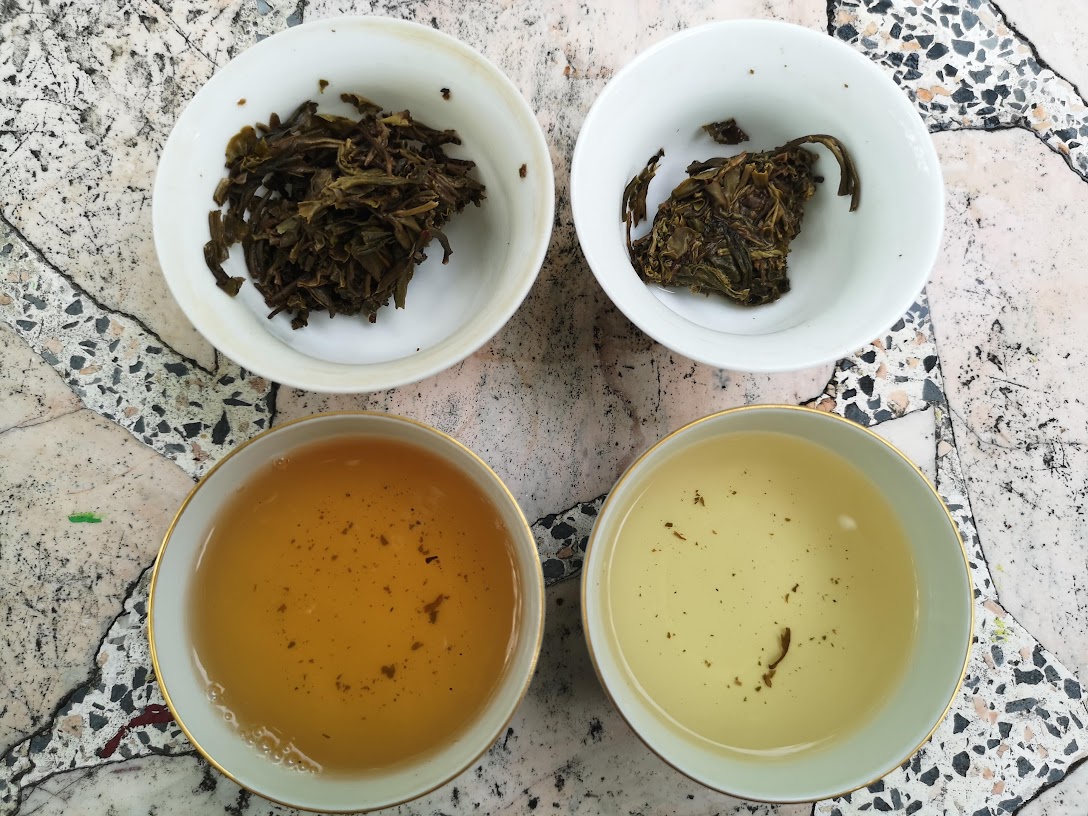
2020 Fu Raw Pu-erh Tea:  warm in tone; I don't remember the age of this, but it can't be that young.  Bitterness and astringency aren't high, yet, which I would have expected from the color, but I'd expect the next round to be quite different.  This is quite promising.  Hints of pleasant warm toned floral range stands out, and there will be plenty of mineral evolving in this, it seems, and other complexity.


2024 Gan En Raw Pu-erh Tea:  a good bit sharper, with more bitterness and astringency, and one unusual vegetal range flavor, that borders on mineral tone, or overlaps with it.  It seems to include some citrus as well, along the line of dried orange or tangerine peel.  

Of course I've screwed up the proportion again; that's more or less my norm now, never adjusting for teas being on the intense side.  These are maxed out, at 8 or 9 grams, which means that I won't get too far through them (or rather I did, by way of drinking a lot of tea, and throwing away the last of some of the rounds).  It would make more sense to brew these using 5 or 6 grams, even for drinking one alone, I just don't usually make tea in that way.


A infusion #2, the 2020 version (I wrote notes without looking up names, which didn't add much later anyway):  brewed light these seem to still be opening up.  Bitterness and astringency are higher, and overall intensity, even for a flash brewed round.  Floral intensity and complexity is good; it's pleasant.  Feel is nice, although that will keep developing, as aftertaste also will.  

For a moderate cost version sheng this already stands out.  It doesn't seem like a lot of blending input has rounded off the more distinctive form of individual aspects either.  It's mostly covering floral range, which can seem a little general, but some depth to that could be different things, like cooked pumpkin or ripe papaya.  A flinty mineral edge is pleasant, and there is warm depth to the mineral as well.  It's nice.


B (the 2024 version):  that one bitter aspect really ramps up.  Someone would have to be ok with significant bitterness to like this.  I've eaten a lot of bitter gourd this year, or bitter melon, maybe some call it, grown in our garden in Hawaii, and this reminds me of that, the vegetal range mixed with pronounced bitterness.  I'm fine with a good bit of bitterness, but I tend to like more approachable sheng more.

This is so bitter that the aftertaste carries over as both bitterness and sweetness, which is interesting.  Usually the bitterness transitions directly to sweetness, but this still includes both.  Other flavor seems to be heavy on mineral.  That citrus fruit tone might re-emerge once the rest settles down a little.


A #3:  not so different; it might be a few infusions until this evolves further.  Bitterness, full feel, with considerable astringency, and warm floral and mineral tones stand out.  The balance is good.  I think it will be better once it loosens up a little more, in a couple more rounds, but it's pleasant now.


B:  other flavor starts to develop beyond the bitterness, but that bitterness really still stands out.  Did I ever read the product description, prior to ordering this?  At least it has plenty of intensity to continue to evolve; there is no way this tea would just die, over any time-frame.  

People might place this vegetal range differently.  There's a sharpness and heaviness to it that reminds me of pine sawdust, for example when you are cutting a lot of plywood, maybe to put a roof on a house.  It's also not unlike bitter melon, or bitter gourd.  I just bought that as a pre-prepared herb tea, sold in Royal Project stores here.  It's a bit intense, to be infusing as a tisane, even in a trace amount, but if it's as healthy as the rough taste implies then it would be worth it.


A #4:  this evolves into a spice range depth; that's pleasant, and a good sign for further aging transition.  It's along the line of an incense spice, some exotic bark flavor, agar wood or whatever (just placing the range; I really can't identify that particular flavor).  It's not really "loosening up" in terms of initial intensity and punch softening, but it should get there.


B:  this does continue to evolve to soften and come across as more complex, but the other has been more approachable and less intense across all the transitions.  I don't find that somewhat extreme vegetal range off-putting; it kind of works.  It's distinctive, and pretty far from the not so pleasant "tastes like kerosene" sheng flavor that puts people off, the more typical factory version input.  Maybe this starts to taste like leather instead of pine sawdust, a positive transition.  

But it's not as unpleasant as that makes it sound.  Sweetness is good, bitterness kind of works, feel isn't so bad, full and intense, but nice enough.  You're in it for the ride, with this degree of intensity, and challenging character, but it works, within that range.


A, #5:  now it loosens up, a little, gaining even more warm spice complexity.  It's hard to pin down what that newly evolved aspect is.  Let's just leave it at warm spice, and give it another read as rounds progress.

In re-trying it during editing I don't mention a dry edge to the feel, which seems to link to a particular range of mineral flavor.  For some people that would balance nicely with the rest, for others it could be inconsequential, and for others yet it could be a deal-breaker, a very negative aspect range that ruins the experience.  Higher end, more expensive, often presented as gushu material sheng tends to be different than this, to express a softer but full feel, and a lot of depth.  So I suppose it's not just personal preference in relation to aspects and styles that factors in, but acclimation to different other ranges of sheng pu'er experience.


B:  this loosens up too; that's pleasant!  Bitterness evolves to soften and fall into a lower range balance with the rest.  Tones seem a little warmer.


A #6:  this integrates as a unified, balanced experience better than ever.  It's definitely punching above its weight for a well-balanced, complex, and intense moderate cost sheng.  Feel is pleasant, and intensity carries over to a nice aftertaste expression.  Warmer mineral tones, now transitioned to include a good bit of spice, balance the lighter mineral, bitterness, and floral range.  

This doesn't include the aggressive, harsher intensity that might indicate it would still be intense in complex in another 25 years, but it doesn't seem like it would just die either.  It's in a nice place for medium age range transitioning, no matter how old or young it is just now.  Within the next 5 years or so it should keep on picking up warmer tones and depth, before it eventually might fall into a "teen years" sort of off character, not balancing as well for changing from one thing to another.  It would be pleasant during those transition years (the next 5), because it's pleasant now.


B:  it's interesting how floral range really seems to pick up in this, as if perhaps it had been there all along, but it needed the bitterness and other vegetal range to quiet down a little to show through.  It has a really pronounced green vegetal note, which I've been describing in different ways, as it keeps evolving.  Sure, it still tastes somewhat like bitter gourd.  But that flavor is quite different when it's hitting hard as a very dominant tone, and when you can get it to integrate with other range (I mean related to cooking with it, but here as it works as one component among others in an infusion).  

This may loosen up well too, over the next 5 years, with that heavy astringency, bitterness, and vegetal range giving way to whatever it transitions to.  It's not as pleasant just now, per my own preferences, but I suppose for people really into bitterness this is already just the thing.  It will probably be the best it has been within another 3 infusions or so, which I may not make it to during this round of note taking.  A dozen rounds of intense sheng is a lot to get through.  I've been throwing away some of the last of these rounds, to get a little further through, but I've been drinking most of it, so I'm 10 intense infusions in, which is an awful lot.  I'll probably do another, to mention some last thoughts on transition patterns.

It kind of goes without saying but brewing 5 or 6 grams of just one of these teas would be a lot more optimum than brewing 8 of both together.  On one level I already knew that, but it's a hard habit to break.


A #7:  the best this has been, but I could write the same words as the last round and those would work.  Warmer mineral and spice tones balance what had been present well.  I'll probably taste both of these again and notice that I missed some pretty obvious flavor descriptions.  I tried that one Viet Sun maocha again, one of the Y Ty versions, and noticed pronounced mint in later infusions, which I hadn't mentioned.  It can work out like that.  

There is so much warmth and depth in this that one part reminds me of a very light roasted coffee flavor.  You know when the berry notes present in some coffee can still emerge, because roast hasn't pulled it so far in the other direction?  Like that.  It's not overly berry-like, but something like dried blueberry might fit one part of it.  I'm not really pushing the tea hard enough to get the most conventional flavor expression out of it; these have still been very quickly brewed infusions.  That would surely mean these are only half spent so far, so that I'll miss the second half of the rounds in taking notes.  That's fine.


B:  again this balances better than ever too.  A full, syrupy feel is much more pleasant than a harsher blast of intensity in earlier rounds.  Sweetness stands out more, and floral range.  One part probably does relate to a dried citrus peel note, which was much lighter earlier on.  It's still a bit intense, and the feel is still a little harsh, in terms of pulling at the sides of your mouth, especially after you drink it.  

This might not have fully "loosened up" just yet; it may be best after a couple more rounds, at infusion 7.  If I had brewed 5 grams instead of 8 it could be much further along, for using longer infusion times, and speeding up that cycle.  Somehow this seemed like a mistake that had to be made.  I really don't understand why, but then I'm guided by intuition as much as reason, and I'm probably just botching lots of range of experience in making random choices like that.


A #8:  it might be time to start using longer than flash infusions for this.  It still provides plenty of intensity in that form, but the character would change some.


B:  for this one intensity is high enough that extending brewing time probably wouldn't help; this is enough.  The aspects description from the last round still works for both though.

A local Thai tea friend, who I don't know very well, that one guy that gets presented as a tea expert, Stephen, gave me a quite bitter sheng version a couple of years ago, that this reminds me of, in part.  It has softened and deepened to be quite pleasant, of course not losing all of that bitterness.  This probably includes a little more of a distinctive vegetal range flavor; that was just straight bitterness, with the usual floral and mineral range supporting that.


Ninth round, combined notes:  the bitterness, feel structure, and intensity ramp up for the first version, when brewed longer.  The balance does shift, back to more typical young or slightly aged sheng range, a couple years into transition.  The other tea picks up even more green wood character.  I suppose I hadn't been calling it that, but that's where it has shifted to now.   


Conclusions:


Very pleasant teas, considerably better than I expected, or even hoped for.  They're not even finished in terms of me getting a full experience of them, in general or for this brewing cycle; I can change brewing process and they'll be much different.  Within another year or two they'll be different in a different sense, actually evolving some in terms of fermentation transition, no matter how old they are.  It will be interesting looking up what these are, and commenting in relation to that.

Related to value you tend to never spend a moderate amount (around $100 for these two cakes, when many in a comparable range cost that for one), and see good results, and these were really nice, for value-oriented versions.  Again opinions would vary on that; some people would love them, and find them much better than the factory sheng that they've been experiencing, and for others accustomed to other range they could both seem off-putting.

The "older" version, from 2020, is at a decent place, for people who like a tea with a number of years of transition.  I'm accustomed to teas transitioning fast, living in Bangkok, and they surely weren't stored that hot or humid.  The storage input seems fine, related to conditions, to the extent someone can say anything about that.  They would've been better preserved, if stored quite cool and dry, so at least they are transitioning.

It's interesting to speculate about the high bitterness level and unusual vegetal nature of the younger 2024 version.  I think within 2 years it will probably come across quite differently, and I can't really guess about how it will change (especially flavor range, I mean).  For a tea sold at that price point it's great, because that's down in moderate cost factory tea range, and it's much better than that.  Of course someone needs to be ok with significant bitterness.  It doesn't include the challenging astringency that comes with low elevation grown, chopped plantation material versions, but it still packs a punch.


If you spend twice as much you can find versions like the 2020 tea that include slightly more distinctive flavor profiles, and more positive feel, but at this selling price point you probably can't do any better, if you can find anything remotely comparable to start with.  It's a perfect tea for a daily drinking rotation, when you feel like that style range; the role I hoped that it would fill.  It might hold up well to another decade of storage, and more complete aging, but I may well not find out, since I'll go ahead and drink it.

The 2024 tea might be much better after 2 or 3 more years of "early" character evolution; time will tell.  It's fine now, if an intense, bitter, somewhat vegetal range experience works for someone (with more floral flavor range expressed, but a little green wood or bitter melon flavor really stands out).  It might age well in the longer term; I really don't know.  One part of the "benchmark" theme related to the Dayi 7542, and the like, or typical Xiaguan character, is that you can expect common, known early character type to change in expected ways, but this is a little different.

Saturday, November 2, 2024

Tea Tracks Mengsong Xiang (2019) and Ya Nua Gushu (2018)


Back to reviewing!  I quit while I visited family in the East Coast of the US, in Pennsylvania, and now I'm back in Bangkok.

I don't want to say too much about these, two sheng pu'er versions from Tea Tracks, sent by a friend to try.  I'm not that familiar with the narrow local areas, although Meng Song kind of rings a bell, and I don't know much about them for backstory.  The website mentions these details:


Meng Song Xiang 2019 - 勐宋  (114 Euro / $124 per 200 gram cake)


Meng Song Xiang is a village in southern Menghai. This tea is made of ancient tree material (gu shu, 古树). It has a full body and a pleasant bitterness, which lingers in the mouth as a fruity sweetness for a long time. Here is a review of the tea (in German): puerh.blog Meng Song review

Taste:  Soft yet bold taste. Upfront bitterness that turns into a sweet sensation.

Trees:  Old trees (gu shu 古树) growing in a natural environment

Origin:  Meng Song, Menghai, Yunnan, China


Ya Nuo 亚诺 2018 (You Le Shan)  (120 Euro / $130 per 200 gram cake)


Ya Nuo is a village on You Le Shan (mountain), one of the old six famous tea mountains in Xishuangbanna. This tea is made of ancient tree material (gu shu, 古树). The tea starts out very softly in the first brews with hardly any bitterness, but develops a nice sensation in the aftertaste. 

This is one of the teas that can clear your head on a cloudy day.

Taste:  Soft and subtle taste that develops a cooling sweet aftertaste.

Trees:  Old trees (gu shu 古树) growing in a natural environment

Origin:  Ya Nuo (village), You Le Shan, Xishuangbanna, Yunnan, China

Harvest:  early Spring 2018


The teas seemed pretty solid when trying them, but it's hard for me to evaluate value in relation to pricing beyond a limited range.  I could tell they seemed pretty good but not really how good.  I suppose then it's on considering how much I like them, setting that aside.  I don't buy pu'er that costs over 50 cents a gram, so of course I would run out of benchmark range. 

These are almost sold out on the website; there won't be much marketing function in describing these, since they'll be gone any day now.  The reviews might be partly about that but also just to communicate about trying teas, and to see what I make of them in notes.


Review:


Mengsong:  pleasant; definitely some bitterness stands out.  This flavor profile is somewhat familiar but I'm not going to do justice to describing it.  Beyond bitterness there is some sweetness, and from there identifying even aspect ranges is difficult.  Floral?  There is definitely a pleasant mineral layer, a little on the dry side, but pleasant in flavor and feel (to the extent that the two ranges map together).  There's good structure to the feel.

So far this just sounds like describing sheng pu'er in general.  It is pretty standard sheng, in one sense, just a better than average version, and only type-typical related to a subset, to Mengsong area versions.  5 years of aging has softened this, probably, although there is still plenty of bitterness and feel structure.  The tones have surely warmed some.  Maybe I'll readjust to reviewing more as rounds go by.


Ya Nua:  to me this expresses a distinctive root spice aspect.  Think along the lines of sassafras, but it's probably not so close to that.  It's not so far off the standard incense spice range, and if I had better scent memory of the main few incense spice versions I could reference one it's closest to.  That has the character overlapping just a little with aromatic wood tones.  Bitterness and mineral are dialed back just a little in comparison with the other, but it's still reasonably intense.  It might slightly less complex.  Better luck with deriving two flavor lists next round.


Mengsong 2:  I brewed these on the fast side for using a relatively high proportion, and for both being on the intense side.  It was still a bit much; I can switch to 5 second rounds to adjust further.  It's not that I forgot that I usually tend to overdo it with proportion, I just didn't offset it.

There's a catchy, familiar range in this I wish that I could describe better.  It's a way in which feel structure, bitterness, floral tone, and mineral all combine, in a very integrated form.  It comes across as a familiar set of aspects, that naturally pair together.  Maybe this is what people would seek out in standard Mengsong experience, a good version of it, but of course I can't claim that.  I don't retain a matrix of memorized local area types, and I might never, regardless of how long I kept trying different things.  

Would people seek out a 5 year old version, and how is the storage input for this if they were inclined to?  Those are harder to answer.  This aspect set is dialed in though; the proportion of everything is as it should be, and there are no flaws, no out of place aspects.  You're signed on for bitterness in drinking it, but to me that's moderate, even if it's higher than I would've expected for a partly age-transitioned tea.  Maybe this wasn't stored in a very humid place.  To me that's fine, aging and changing a tea over more slowly, unless there is a reason to get it moving quickly, for example to get a factory tea that will need 20-25 years to be good to cover that ground in 15.  I suppose at a minimum saying more about the floral range in this would be helpful, but not much comes to mind for labeling it.


Ya Nua:  this picked up a little depth and smoothed out some in character; it's better.  It's slightly more subtle now, but it still has a lot going on.  Bitterness hasn't faded but it's moderate compared to the other.  There is plenty of mineral range and other deeper flavor complexity, it's just not as forward and dominant as in the other version.  Spice tones still make up a main part of the experience.  Feel has decent structure, even a touch of dryness, all of which prevents it from coming across as thin.  At 6 years old (probably 6 1/2) this will head into that range where it shifts over from being new to old right around now, and maybe flavors seeming a little less forward now is a part of that.

As with the other it comes across as quite clean and well balanced to me, lacking flaws or limitations.  I suppose flavor complexity either settling out, for now, or being limited earlier on could be a limitation, but I see that as more character neutral, just how it is.  Something being out of balance would be more what I'm referring to, or a negative aspect.

At two rounds in I'm already feeling this.  I'm finally back in Bangkok, which is why I'm reviewing again, back in this familiar hot and humid environment, and even though it's 9 AM it's warmer than Pennsylvania had been during a cooler mid-afternoon.  It's too bad that more people back there don't appreciate the great tea drinking weather.


Mengsong 3:  this is shifting, in a pleasant way.  A bit more spice tone picks up, not completely unlike the range found in the other, just not the same either.  


Ya Nua:  less transition, but the tones may be warming slightly.  This seems like a good round to let it transition and get back to describing it more next time.


Mengsong 4:  it's interesting how bright and fresh this is, for being a 5 year old tea.  I could try to guess about how this has softened in character over that time, how it would've been more intense and challenging within the first year or two.  In part that would relate to describing what could be taken as positive about somewhat drier range storage.  Or maybe just a medium humidity and heat input range version; it's easy to pick up a biased judgment of norm here in Bangkok, where both are dialed up to maximum.

It's also interesting to consider where this will go from here, what relatively full aging might look like for it, when, and in what character range.  It needs at least another decade, or maybe more for full transition.  It's in a decent place for drinking as somewhat transitioned tea now, I suppose not so far out of entering into the teen years phase, when it might not make as much sense.  I certainly can't project ahead and list out likely flavor range to develop, but the intensity and balance at this stage seem like a good sign, that it's holding up well so far.


Ya Nua:  this is less complex and intense, but it has an interesting character, and plenty of intensity related to providing a pleasant experience now.  It's not muted.  The earlier spice range is still dominant, and a bit of vegetal range might've picked up as well, along the lines of tree leaf, not exactly like wood, but kind of related.  Maybe it only shifted in form, and it had seemed more like aromatic wood earlier, now vegetal in a different sense.  In most forms that would seem like a flaw, a subject I've already referenced, but with plenty of spice tones and mineral range it integrates well in this.

For someone preferring intensity of experience the other might be better.  One might question if this doesn't express a different kind of depth, related to the gushu theme, a standard idea that forward flavors might not be as intense but a base of depth could stand out more.  I don't know.  Both are fairly balanced; both have plenty going on across a significant range.  Underlying mineral range is a strength for both.

A different kind of acid test comes to mind, based on having visited "home" recently, drinking mostly a half dozen versions of tea for a month:  which would I keep returning to, if I had plenty of both?  I really love approachable, interesting, sweeter range, even fruity sheng, more than these two styles.  Sometimes I do crave a more intense experience, and it's not hard to appreciate good quality in tea versions.  Probably I like the Mengsong more.  It's more standard and less novel, in a sense, and would fill more of a craving for intensity and complexity, when that comes up.  I tend to go in cycles, and I'll even drink harsher teas sometimes, a bit here and there for weeks, like not quite ready Xiaguan tuos (which seem to never be fully ready, maybe until 25 or 30 years along, even aged in Bangkok).


Mengsong 5:  better than ever; the character really integrates.  In terms of description it's still about the same, but the balance has shifted to work even better.


Ya Nua:  this is still interesting for being on the subtle side, as sheng goes, related to flavor, which is perhaps a bit odd since it's on the intense side as oolong or black teas go, never mind white tea.  Then it has a lot of depth, including some bitterness, and great mineral range, so the intensity is there, just not in terms of forward flavors, as in the other.

It's breezy out just now; that's not usually the case in Bangkok.  At 9:30 it's sort of cool (30 C / 86 F and 71 % RH), or at least what I'll need to adapt to as cool for here.  At its maximum the PA "Indian summer" was in the mid-80s, but much, much drier.  Running there was fantastic.  It was easy to pick a time to go out when it was only 60 or so (16 C), so "cold" that your body heat would never accumulate.


Mengsong 6:  I'm maxed out for tea, and these aren't changing that much anyway, so this will do for notes.  Again it's interesting and pleasant how the earlier floral tones have transitioned more into a spice range.  The brightness, intensity, and complexity are all quite positive in this.  This seems like the kind of tea everyone should own a cake of, I just don't.  This version should cost a bit, for as good as this seems.  I suppose it's possible that the most recent peak in sheng pu'er costs happened just after this was made, so it might be more reasonable than I expect [not really, unless more current pricing is really high].


Ya Nua:  quite nice; good depth, good balance, interesting character.  I love the other one more, so that offsets that positive judgment some.  I think that has to do with relation to preference as much or more as quality, or it being more interesting.  I suppose local area demand shifts pricing as much as any of those other factors, so cost could relate to what other people seem to value, or at least what the market takes up and promotes.


Conclusions:


Both pretty good teas.  I kept going back and forth over how good while trying them.  They seem better in quality than they are a close match to my own natural preferences; I like them, but they're probably better than a match to my preference indicates.

Since other people sometimes value more aged character ranges that I don't love it can be hard to project ahead to what others might like later on, as they transition more.  Often I'd fill in more guesses about that, but it wouldn't be based on much, and would be unreliable, so I may as well skip that part.

I had a fairly typical experience with trying a tea in this general age range just today, the day after making these notes, so I'll mention that.  I re-tried a Nan Nuo version that I really liked, that I had drank most of the cake of back when it was new, made in a really bright, fresh, sweet, approachable when young style, from 2017.  It was still ok, but not nearly as positive as it had been 6 years ago.  It wasn't simply fading away as much as I'd expected, but it had been a good call to mostly drink straight through that over a year's time back then, setting a little aside to see how it might change later.

These are different, and especially the Mengsong seems to be retaining some intensity and complexity.  The Ya Nua version had interesting character too, it was just more subtle already.  It's interesting how sheng versions need to be made in a very specific style, related to aspects included, and I guess to how versions are processed, or else the flavor tones warm but they seem to oxidize instead of fermenting.  Or so it seems to me, but then what do I know.


back to my favorite tasting spot


cleaning up after a month of unmanaged growth in the garden


October must have been a bit rainy


Sunday, September 8, 2024

Tea Tracks Beng Long and Wa Long sheng pu'er


A tea friend, Jan, started his own vending business some years ago, based in the Netherlands, and he just sent some samples for me to try.  It's mostly pu'er, it seems; perfect for what I like.

As usual I've written notes without looking at details, and since these names don't ring a bell I only knew that it was sheng pu'er.  They're pretty good, so it's interesting going back to see what they actually are:


Beng Long 蚌龙 2022 (21.80 Euro for 100 grams; $24.20 USD)


Beng Long is a village in Menghai, Xishuangbanna. This tea is made from 50 - 70 year old trees, that grow on an elevation of 1800m in a good natural environment. The tea has been stored as Mao Cha for a year in Jinghong before being pressed into small 100g cakes.

We tried this tea multiple times as Mao Cha (unpressed Puerh) and felt it being great as a tea for traveling or a daily drinker.  

Taste:  Probably one of our more upfront bitter teas giving a good energy.

Trees:  50 - 70 year old tress growing in a natural environment

Origin:  Beng Long (village), Menghai, Xishuangbanna, Yunnan, China


It really is kind of bitter, but that might be toning down some after 2 years.  This "daily drinker" theme is interesting; that must mean different things to different people.  This tea is a lot better than that price implies, and if someone takes "daily drinker" to mean decent factory tea this is lots better than that.  But then all that is in the notes.


Wa Long 瓦竜 2022  (65.40 Euro for 100 grams; $72.55)


Wa Long is a village in the Man Zhuan area (close to Yi Wu, Xishuangbanna). This tea is made from mostly from ancient tree (gu shu) material. The trees are growing in a national forest in a very good environment.

This tea starts out with gentle floral notes and gets a bit more bitter over time. It has a mind clearing and relaxing effect.

This tea has been stored as loose leaf tea (mao cha) for one year in Jinghong before being pressed into 100g cakes.

Taste:  Gentle floral notes

Trees:  Old and ancient trees (gu shu) growing in a natural environment

Origin:  Wa Long (village), Xishuangbanna, Yunnan, China

Harvest:  Early spring 2022


I tried both together; in a sense that's to compare versions directly, but also just to write half as many reviews and still cover the same amount of teas.  Getting around to doing the notes and editing once on a weekend is enough.

The price difference is interesting; this costs three times as much, and references the all too familiar gushu theme.


Review:


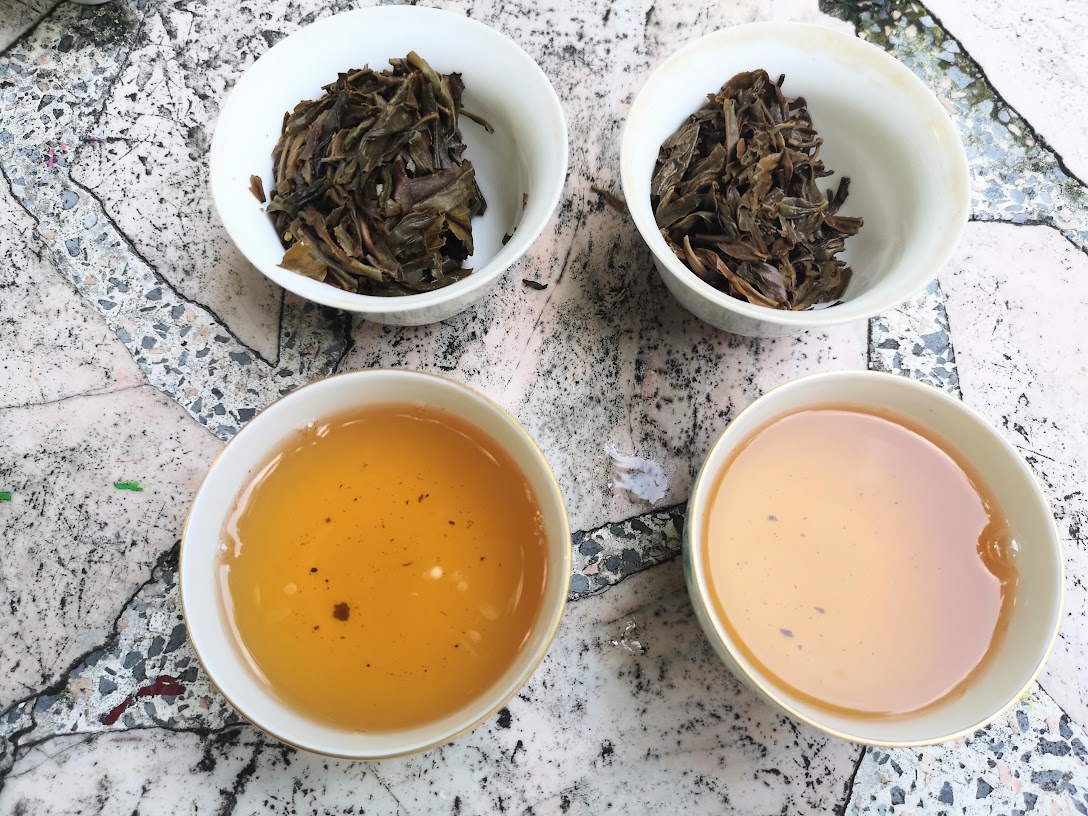
Beng Long on the left, in all photos


Beng Long #1:  that's quite intense; I didn't see that coming.  I let these brew a little longer than I typically do, even for a first round, maybe 20 seconds, and this got started really fast.  The proportion is quite high for these too.  The sample looks to be right at 10 grams, which is a lot.  But then I didn't want to brew 6 or 7, a more optimum tasting amount, and have 3 or 4 left over.  Maybe I should have?  Or brewed 5 and 5?  That would make sense.

I've been brewing versions that are hard to separate as much as this looser form, or samples pressed as coins; I guess that's why this outcome seemed unexpected, even though if you brew a maxed out proportion for 20 seconds that's what happens.

Bitterness stands out, and sweetness, but there is interesting range beyond that.  It expresses unusual vegetal character, and beyond that quite a bit of complexity.  It's probably as well to wait a round to do a list though, to let it get going, and to describe it brewed lighter.


Wa Long:  this is interesting for brewing so dark.  Two years isn't long enough for that kind of transition, even for teas stored here, in the hottest and wettest place imaginable.  Leaf appearance looks mixed in color; maybe parts are oxidized, or some parts a little over-roasted (from pan-frying), or both.  It could be a novel experience, seeing how all that unpacks.  Warmth is interesting in this.  Of course there's substantial bitterness up front too, that stands out more, but this includes a lot of complexity, and depth.  Again I'll do a fast second round and describe both then.


Beng Long #2:  much better balance.  Bitterness is really something in this; it's one of those teas in the higher end of the range for that.  I'm relatively open to those but it can be a challenge, especially for a combined tasting.  As is common bright and even somewhat complex floral range adjoins that, and decent sweetness.  

It sounds like I'm describing a broad regional standard character, doesn't it?  Was that Lincang?  My mind is not retaining information like it had 20 years ago.  The funny part about that is when something sticks it really does, and when it doesn't it's as if there's a system glitch about never holding onto that information range.  If someone's name isn't sticking hearing it a few dozen times won't help.

Not much of a list.  Bitterness, sweetness, and floral range stand out, and the vegetal note is pretty standard, like flower stem, or tasting a tree bud.  It's good, for that kind of style.


Wa Long:  this is tracking in an unusual direction instead.  It includes a lot of that same range too, it overlaps, the bitterness, sweetness, and floral range, but the warm tones are not just different, they're a bit unique.  This reminds me of loving Vietnamese sheng that's atypical (not that this is; some flavor range is unique, and for those I'm talking about something else, a more unusual character).  For those Vietnamese teas some others who tried them didn't like them, seeing them as yeasty, too oxidized, not properly balanced by bitterness and astringency, and just odd.  This is basically in a typical range, with one part novel, some of the flavor.  

It's not breaking down to a description well, at this point.  It's a little towards a warm wood range, or even spice, but it's not distinct yet.  It may cross over through some dried fruit range as it transitions, or go much heavier into spice.  We'll see, and I'll write more of a list as it goes.  

These are pretty intense teas; I suspect the feel will go along with the flavor intensity, and I won't get far through rounds before needing a break.  I'm feeling pretty sluggish from effects from a run yesterday evening, and I have a busy day planned, so that could work out, having a lunch in the middle, and absolutely getting dosed.


Beng Long #3:  overall balance falls together nicely.  For someone on that page, for loving high bitterness, highly floral range this would be perfect.  I might like it more in two more years, once all that settles a bit.  That bright, fresh, intense flavor isn't going anywhere; I wouldn't worry about it dropping out, as can be a real concern with more approachable, sweeter, lighter teas, which often include less bitterness and orient a bit more towards fruit tones.  

It would interesting trying this alongside a Da Xue Shan version I had not long ago, this one, from 2023 (that is Lincang, the broader area).  It was one year younger, and might've been that much more intense and bitter, a little more challenging.  They're kind of similar, and it would be interesting to see just how similar.  

I should've brewed this in two parts, as two 5 gram sessions; these are way too intense maxed out for proportion like this.  It's not like I couldn't possibly foresee that either.  I rely on intuition to tell me how to prepare teas, and which to try, and I don't know that it gets things wrong sometimes, but I'm not always clear on where it's coming from.  Maybe I felt an inclination to really get dosed?  I did get a sluggish start to the day, and have things to do.


Wa Long:  a touch of dryness to the feel structure is entering in.  The warm tones are still hard to separate apart (beyond floral range; a main component).  One part is like aromatic wood, like cedar.  Then it seems to connect with warmer mineral range.  There may well be spice range beyond that, which is hard to really separate out, since those flavors mix as a set.  

I just re-tried a tea (sheng) that tasted a lot like a warmer version of wood, straight wood, and I really don't care for that, and it's not what I mean related to this.  It's mostly bitter, then also floral, with decent sweetness for balance, and then these other flavors are supporting that range.  The main flavor range is fairly conventional.


Beng Long #4:  warmth picks up, and complexity, and it had plenty going on before.  It's odd how this takes a short step towards the other in terms of character.  Bitterness is still the main part of the experience, but it's more balanced now, already.  For brewing half as much of this, dropping proportion, it would be easier to dial that intensity level to where you like it.  Just using fast infusions is working though.

General pleasantness isn't coming across clearly in these descriptions.  Feel is pretty substantial, rich and not too rough or dry, and aftertaste experience adds complexity.  Nothing else is off about it.  That vegetal range does include a little plant stem / green wood tone, but it's secondary, after the bitterness, sweetness, and floral range, so it integrates well.


Wa Long:  that one warm flavor range continues to evolve, as it seemed that it would.  It still does taste a bit like aromatic wood, like cedar, with some spice undertone, but a bit more fruit joins it, something like dried citrus peel, or not completely unrelated dried tamarind.

What about camphor; that flavor keeps coming up in vendor descriptions, when I don't really see it?  Sure, maybe.  There's an edgy and warm medicinal tone to this too, and I think plenty of people would interpret that as camphor.  I tend not to, trying to break it down further to parts that are causing that effect, but it's a little like that.  

It's interesting how the bitterness, warm wood or spice tone, floral range, and some fruit mix in effect.  It's so complex, but it integrates.  It's not really "catchy," not the kind of set of flavors or complex experience that everyone would love, but I think a lot of more experienced pu'er drinkers would completely get it.

I'll drink a bit of water to get this hui gan effect to clear, then one more round, and get back to these after doing other things.  They'll both brew many more rounds, and keep shifting some, but I think the first 5 rounds will tell a lot of the story.  That reminds me of another favorite blogger who always writes out dozen round reviews, always highlighting transitions, mentioning a new flavor aspect for each round, making it sound like he is drinking 3 or 4 different teas, when it's just one.  You can kind of see what you look for in experiencing or reviewing teas; if the focus is on flavor transition then some of it is there to be noticed.


Beng Long #5:  that vegetal range bumped a little this round, for some reason.  It's along the line of kale, although green wood also works as an interpretation.  Again heavy bitterness, sweetness, and floral range dominate even more, and that other aspect stands out a lot for being novel.  Sheng can taste like green wood but the other range seems more common.


Wa Long:  it's interesting how that novel flavor set, which I've said enough about, seems to integrate more and simplify.  It's not as if it's losing complexity (not much, at least), but seems to come across as all one thing more.  For being in this novel range I'd really expect some part of that to be more negative, for an off aspect to be included that makes the rest more challenging.  I guess like green wood; that works as an example, even though to me it's not so negative in the other version.  

This comes across as fairly balanced and refined, where with just a touch of odd flavor or mustiness it wouldn't, at all.  Even a thin spot could throw off that balance, for example if sweetness level didn't support the rest, as it does.

These don't necessarily match what I love most in sheng experience, to be clear.  I'm a fan of quite drinkable versions, including some fruit, and a bit less bitterness, even when that comes at a cost, for example when a version gives up some intensity, or overall balance.  They're good though.


Of course I drank lots more infusions later, I just didn't get back to taking notes.  They may have transitioned a little more, but in general didn't seem so different than where they left off.


Conclusions:


I didn't comment on these in relation to the product descriptions or prices, since I hadn't read that before writing those notes.  It's interesting that one costs three times the price of the other.  The Wa Long does seem better, in a few senses, in a more interesting and pleasant flavor range, with nothing about it seeming negative, or like a flaw.  The Beng Long seemed nice to me too; some people might be put off by a touch of green wood in the flavor range, but to me that was fine, since it integrated fairly well with sweetness and pronounced floral range.

It's tempting to try to summarize a quality level assessment, and then move on to judging value.  Does the tea version that I liked a little more justify costing three times as much?  Local area demand factors in, not just character.  People love the gushu theme, and value it.  Then it's tempting to critique that entire context.

What are they seeing, and valuing?  I've been reviewing other teas that are presented as gushu sheng versions, and others said to have won awards in competitions.  It's not just about teas having good flavor range, complexity, intensity, and balance, with bitterness level and sweetness matching in a positive way, or versions lacking flaws.  An emphasis on depth comes up.  This is hard to even describe; it relates in part to a mineral layer supporting the rest.  

It's a type of intensity, but not forward flavor intensity.  I don't see it as all that positive, in terms of adding that much to the experience.  Some people claim that it relates to very positive aging potential, but I'm not so sure about that either.  I've tried plenty of tea said to be gushu that just went dead, while much more challenging and inexpensive versions were still becoming more approachable.

To me claims of quality level for oolong, green, and black teas are easier to unpack.  Flavor range is emphasized, and in the highest quality levels the aspects I see as "quality markers" make sense.  They're not always so desirable that they make a lot of practical difference between 40 cent a gram tea and 80 cent versions, but at least you can notice them, and they seem positive.  Really if a sheng version has positive and novel flavor range, with good intensity and complexity, good balance, a lack of flaws, and decent refinement it's enough.  All that is a lot to ask from versions that aren't blended--using multiple material inputs--to cover all that range effectively, and mixing different location materials instead trades out some flavor distinctiveness.


In conclusion, these teas are good.  I wouldn't buy 70 cents a gram sheng, but I get it why people can easily have a looser tea budget than I do, and can value unique experiences.  I'd buy decent Yiwu before this Wa Long version, which can be moderate in cost, if it's not "gushu."  It would be more standard in flavor profile, and overall character, so more ordinary, but I like that pleasant, approachable range.  I don't even buy much Yiwu, to be clear; it's more a comparison reference.

I can relate to that other relatively bitter sheng style, it's just also not a favorite range.  I was happy that a local tea friend gave me a whole cake of a version that's like that (200 grams; it's a bit though), so I can drink it when I feel like it.  If Jan meant that once in awhile it's really pleasant drinking something like that grandpa style, mixing up what you experience, in calling it a "daily drinker," then I completely agree.  Or sometimes you just feel like dialing up the bitterness and intensity.  Usually not so much that I want to drink a partly aged Xiaguan or Dayi Jia Ji tuo version, but once in awhile I'll even go that far.

I don't see that tea as being below average in quality level; to me it seems like a good value at that price, even though that does put it in the $80 or so standard size cake range, the low end of where a lot of better in-house vendor produced versions now land.


Thursday, July 25, 2024

Chen Sheng Hao Menghai and Emperor sheng pu'er


I'm reviewing two more of the Chen Sheng Hao sheng pu'er samples sent for review by the producer (many thanks!).  The others have been nice, diverse in style, with some variation in quality level, matching the general descriptions in the site reference for which really stood out.

These are identified as two more of their signature product versions, so they should be nice.  They don't tend to list out a lot of aspect description, just some character reference, as follows: 


2022 Yi Pin Chen Sheng Raw Pu-erh Tea Sample Box


2022 Chen Sheng #1 (陈升一号)

One of the featured and award-winning blended raw Pu-Erh tea of Chen Sheng Hao. Selected early spring large-leaf arbor tree leaves in the Menghai area. It has a balanced taste and good coordination in all aspects of aroma, taste, and “cha qi”. It is friendly to new Pu-erh tea drinkers. 


2022 Emperor (霸王青饼)

Another award-winning and featured Pu-erh tea of Chen Sheng Hao. It is well known as a raw Pu-erh tea that has strong and penetrating characteristics like “Emperor”. It has strong bitterness upfront, penetrating aroma, pronounced salivation and sweet-after-taste, long cooling, and powerful Cha Qi. It can last for 15 infusions and still have good taste. 


As for pricing 2782 baht comes out to $76.55 right now.  I think this had been $79, and that change relates to fluctuation in currency exchange rates.  

Is that good, is the value ok?  It always depends on quality, since it's a relation of cost to quality.  Then different people could be on different pages related to budget, so that for one person keeping spending in a very moderate range would be a fixed requirement (15 to 20 cents a gram, let's say), and for another 40 could be the same as 30.  

This works out to 40 cents a gram, on the high side for pu'er per cake, but samples do run higher, and for exceptional quality level everything shifts a bit, maybe even a lot.  It's jumping ahead a little but for these two that rate seems fine, because they are a bit exceptional, then maybe the more ordinary range versions don't hold up quite as well.  

Looking at the expense in different ways might help place it.  $90 to 100 per cake is pretty standard now for higher quality in-house versions from specialty vendors, and those are often 357 grams, but then you just get the one tea version, and if you don't like it as well, or if it works out to be lower in quality level, then that's it.  As the sample description mentions if you were to drink 7 grams of each per day (one fourth of the 7 cakes) that works out to 28 days supply; about a month's worth.  For me spending around $80 on tea for a month is a good bit, but it's not for lots of other people.


Review:


Chen Sheng #1 (Menghai):  I let these soak awhile to get the brewing started, around 30 seconds, and this is a little too strong.  It's fine for getting a feel for character, just in the opposite form that I usually do, too light for an initial round.  

Of course bitterness stands out.  From there floral range is a main input, all framed around warm tones, over a strong mineral base.  This should come across quite differently brewed at more conventional strength.  A tea friend visiting mentioned brewing teas strong to get a better feel for characteristics not so long ago, and I've sort of been doing that, but it could be more familiar.  This is still pleasant and agreeable, but also too strong.  Flaws or off aspects don't stand out, just that intensity.  

It will be interesting seeing how a somewhat vegetal edge settles at more conventional infusion strengths.  That may well be tied to normal astringency that shows up more early on then settles out.


Emperor:  also too strong.  A perfume-like floral range is quite pleasant in this already.  It has good depth and complexity, and feel is nice, even though it's brewed wrong (wrong for anything but an odd form of evaluation approach).  It's quite promising.


#1, infusion #2:  brewed for just under 10 seconds infusion strength is more typical.  The usual ranges stand out, bitterness, astringency structure, solid mineral base, but there's another catchy aspect that's hard to place, that sort of re-frames the rest.  Along the line of warm spice tone, I think, but there may be some dried fruit in this as well, so it may really be two things standing out as related.  Spice would be vague, but some type of incense spice.  Fruit maybe along the lines of dried Chinese date, jujube.  I love that flavor, and to me it works really well in combination with other warm tone range.


Emperor:  rich and complex floral range stands out in this, but it's not just that.  The feel is quite full; that lends depth to the rest of the experience.  Bitterness might be slightly more moderate than for the other, or at least it comes across differently, positioned against different other aspects.  

With the other tea a couple of aspects pull it into a unique and pleasant balance, and with this it's distributed as an effect from across the entire tea character.  It won't describe clearly, since most of that range is floral.  There's an aromatic, perfume-like character that some better tea versions tend to express, as if some of the solvent effect is also present.  One might think of it as comparable to brandy or cognac instead.  Sweetness is pleasant, but it's how that sweetness comes across, as linked to complex floral and warm-toned range, and associated with a thick velvety feel.  I suppose the other may come across as more structured or drier in feel in comparison, depending on interpretation.


#1, infusion #3:  it's interesting how this comes across as narrow in flavor set range, with a number of inputs kind of closely integrated, but still complex in a different sense.  It's bright but also warm, sweet and approachable but also somewhat high in intensity with good depth.  Bitterness has fallen into a nice balance with the rest, somewhat limited, in relation to where sheng in general or one in this style would be.  It would be way too much for someone who only drinks oolong, but moderate for a young sheng drinker.

That one catchy range is still present; it hasn't transitioned away.  I think it might be a spice range note combining with a clearer underlying dried fruit tone, the jujube.  A hint of citrus picks up.  How am I calling that narrow or simple then, since it's quite a flavor aspect list?  There's an impression that it's all closely linked, that it integrates well, belonging to a somewhat unified whole.  It's complex but the range seems to all link together.


Emperor:  the perfume-like depth of this is really something.  It's almost entirely floral, in diverse floral range, but one part might seem like rich fruit, like dried apricot.  Bitterness comes across as lower in this than the other, but they're no far off.

It's interesting considering what these warm tones mean, where they are coming from.  This is two year old sheng; it shouldn't have transitioned that much, in normal medium humidity and temperature storage conditions.  Here in Bangkok teas change fast, but that's a different thing.  Flavors get heavier and some early range drops out quick, even over two years.  It almost seems like some of this has oxidized some, related to the warmth, dark tea color, and variation in color of the leaves.  I'm more or less a fan of sheng that has transitioned from extra oxidation in processing, it seems, but that would probably come at a cost in relation to long term aging potential.

I should clarify, this is nothing like the Vietnamese sheng I've been drinking that is a short step towards black tea from conventional sheng pu'er style, quite oxidized.  It still seems to represent standard sheng character, just a modified form of it.  Maybe that is from early aging; two years is long enough for things to change.  This version is compressed at a lower level than the other, much looser, and that could make a difference in relation to how it reacts to environment exposure over time.

Probably warm mineral plays more of a role than I'm describing.  It adds a lot to the overall balance, even though the richer perfume-like / brandy / cognac range is more novel, and stands out.

I'm feeling these teas; 6 infusions is a lot to rush through.  I ate a good-sized wheat biscuit breakfast cereal earlier to offset stomach impact, which would offset drug-like effect intensity (cha qi), but still it stands out.  I'll eat a little food and drink water to get back to a normal baseline.


#1, infusion #4:  it drifts towards warmer spice range; that's an interesting transition.


Emperor:  the light citrus note in this shifts, to a different light citrus note.  Like dried grapefruit peel?  It's something novel.  It works with the rest; it's interesting.


#1, infusion #5:  not so different.  I've shifted to brewing these relatively lightly since intensity is fine that way, even optimum, for me.  They're not that far along for being brewed light, after that first round.  These would go for another half dozen rounds easy, but I'll stop taking notes soon, off to do activities with the kids today.  They'll both probably express at least one more interesting transition too; I'll see later, but may or may not make a mental note of that to include it.


Emperor:  similar to last round.  Again the shift in the citrus tone is interesting.


#1, infusion #6:  I decided to try one more round brewed longer, a bit over 30 seconds, back to strong again.  That intensity comes roaring back.  Warm tones stand out a lot more made like this.  Nothing like a flaw emerges, even brewed strong, a good number of rounds in.  I had mentioned a vegetal note that I never got back to; that stands out more in this.  It's almost in between warmer and vegetal range, between cured hardwood tone and heavy mineral, or towards a forest scent.  It's complex; there's a good bit going on.


Emperor:  this is softer and richer.  Warm tones stand out in this too, but in a different way in a different other context.  Rich floral range is still present, and that hint of dried fruit and citrus, a bit obscured by the heavier flavors in this round.  This is pretty nice tea.

I've not made much of splitting out a quality level assessment against preference to type review here.  There's plenty to go on in relation to both, but just listing shifts in the aspects seemed like a lot.  Quality level is good for these.  I can't judge best-of-the-best range, because I'm not out buying $300 cakes, or even sampling that kind of material, but these are definitely decent, well above average.

I like the second version, this one, more for being so novel.  That rich floral and fruit range is nice, and the way a soft but full feel ties it all together.  The citrus note alone really changes how all the rest comes across.  I've not went on much about feel structure or aftertaste here either, again because there was so much to say just about sets of basic flavors shifting.


Pretty good teas; this has been interesting and pleasant.  I didn't make more notes about later changes or additional thoughts after this, so that's it for a summary take.


Friday, June 14, 2024

2022 Yi Pin Chen Sheng Raw Pu-erh Tea Sample Box


A China based vendor reached out about trying teas for review, mostly sheng that sounded nice, so I'm reviewing the first versions from a unique looking sample set here.  

Some of the versions sound promising, but beyond that they're presented as small cakes, which is different, 28 grams each, partitioned in a way that reminds me of candy bar form.  I'm starting with what look to be two of the more basic versions, getting a feel for what they are, and checking on brewing issues related to that form. 


Intro from their website:


Chen Sheng Hao is a leading producer of pu-erh tea from old growth forests in Yunnan Province.

Meng Hai Chen Sheng Tea Co., Ltd. was established in 2007 by Mr. Chen Shenghe, a tea lover who has worked in the tea industry for more than 50 years. 


This set description:


2022 Yin Ban Zhang (银班章)

A blended raw Pu-erh selected materials from the Ban Zhang area. This tea has powerful "Chaqi". The beginning taste is bitter and slightly astringent with quick sweet aftertaste.


2022 Chen Sheng #1 (陈升一号)

One of the featured and award-winning blended raw Pu-Erh tea of Chen Sheng Hao. Selected early spring large-leaf arbor tree leaves in the Menghai area. It has a balanced taste and good coordination in all aspects of aroma, taste, and “cha qi”. It is friendly to new Pu-erh tea drinkers. 


2022 Na Ka (那卡)

“Na Ka” is the sweetness representative of Pu-Erh tea. The soup has an attractive pale-gold color in the cup. The aroma and taste are alluring, exhibiting a noticeable peach-like flavor and strong sweetness in the later infusions. There is also a strong cup scent left behind in the early brews. 


2022 Ban Po Zhai (半坡寨)

Sourced from Nannuo mountain with a light sweet orchid aroma, subtle woody aroma, and lingering sweet aftertaste.


2022 Emperor (霸王青饼)

Another award-winning and featured Pu-erh tea of Chen Sheng Hao. It is well known as a raw Pu-erh tea that has strong and penetrating characteristics like “Emperor”. It has strong bitterness upfront, penetrating aroma, pronounced salivation and sweet-after-taste, long cooling, and powerful Cha Qi. It can last for 15 infusions and still have good taste. 


2022 Chen Xiang Sheng Hua (陈香升华)

A classic sweet raw Pu-erh tea with an elegant floral and bean aroma.


2022 Zhen Ming Qing Bing (珍茗青饼)

Selected large-leaf arbor tree leaves from the Menghai area. This blended raw Pu-erh is gentle and sweet, suitable for tea lovers who are new to Pu-erh tea. 


So I'll be trying the last two, the 2022 Chen Xiang Sheng Hua (陈香升华) and 2022 Zhen Ming Qing Bing (珍茗青饼).  Some of the others sound even nicer but it makes sense to start with what seem to be more basic to adjust to the type range, and sort out brewing, etc.  If there are quality limitations across the set those should come up here.


Review:


Chen Xiang Shen Hua left, Zhen Ming Qing Bing right, in all photos


I broke form and used a quick rinse for these.  They were starting as quarter-disc chunks, 7 grams each, and of course a short rinse didn't cause them to open.  For a pu'er enthusiast familiar with separating compressed tea that candy-bar style of separation isn't at all necessary, but I have no problem with it, and for people new to pu'er it could be much easier.

Color difference between these is significant; the Chen Xiang Sheng Hua version is much darker.  Ordinarily I'd expect that to relate to more aging input or higher degree of oxidation from initial processing, but I'm not really sure.  The first version opening faster would cause it to infuse stronger initially.


Chen Xiang Sheng Hua:  not enough to go by yet; too light.  That's normal for first round infusions.  There is already pleasant warm mineral range; that should develop well, once other aspects join it.


Zhen Ming Qing Bing (Menghai):  again far too light for a flavor list.  It might be lighter in flavor aspect character, but that's about it so far.


CXSH 2:  even more warm mineral tone, without so much joining in beyond that, but intensity did pick up.  It seems closest to warm spice range at this point, of course not exactly cinnamon, but other aromatic spice instead.  Since I've used their descriptions to help separate types to at least a name I can reference their description, floral and bean.  Maybe.  Warm mineral is most pronounced, at this point, and the rest leans towards spice range, it seems to me.


ZMQB:  this is opening slower due to compression being different, higher.  Both could be interpreted as floral, kind of a default common range across a lot of sheng.  This is brighter in tone, and just a little creamy in feel.  I would imagine astringency and bitterness will pick up and that feel and flavor will change a lot.  

I'll use a longer soak for this version to get degree of leaf separation and wetting to even up, probably coupled with pulling it apart a bit after the next infusion.  Of course someone could separate the leaves the old fashioned way while they're dry, with a pu'er knife or pick.  There's one on the table but I wanted to see how this works using the whole chunks.


CXSH 3:  dryness picks up, and intensity.  This is nice, for the range it's in.  I've tried a tea version not so far off this in the last month or so, but that was a wild material origin fall harvest version from Vietnam.  The markers related to quality are good for this, the sweetness, overall balance, the way the astringency feels, lack of potential flaws, and flavor intensity and complexity.  Not in an exceptional sense, but it's nice.

I'm still going with warm mineral standing out most in this, onto spice range beyond that.  It could work interpreting that as bean instead, along the lines of red bean.  I probably love beans a lot more than most people; I was a vegetarian for 17 years, and my absolute favorite desert food is Chinese beans and dried fruit with crushed ice and longan juice.  I could live on that.


ZMQB:  it's funny how slowly this is ramping up in intensity, but then it's still half compressed.  I'll break it apart manually to move that along.  This is why I generally don't like drinking sheng as dragonballs, because it makes the process slower, and mixes infusion of leaves between those first wetted rounds ago and others just opening up.  Of course that might also bump complexity, experiencing flavor inputs in middle-sequence rounds from the leaf material just getting started in early rounds.  It's probably as much about me not being accustomed to that as it actually being inferior.

There's not a lot of bitterness or astringency from this, not even stronger than average flavor intensity.  In splitting it half the material was still bone-dry on the inside, and fully compressed.  Just pulling the chunk apart won't work; it's easy to separate with a pu'er knife while partly wetted.  For people accustomed to separating dry compressed leaf it might make sense to just do it while dry instead.


CSXH 4:  heavy warm mineral is quite pleasant in this.  The feel being just a bit dry is not negative.  I'd ordinarily interpret the flavor as spice, as I've mentioned, then also including cedar wood.  I suppose someone interpreting this as including a bit of camphor would make sense.


ZMQB:  intensity picks up a good bit, but beyond a floral range it's hard to separate out a description.  Feel is more astringent, and limited bitterness enters in.  Sweetness level is fine but not especially pronounced.  Flavors are generally clean, and intensity is ok, it's just not easy to describe as a list.  

Sheng versions can become a bit muted at an in-between stage related to aging but this is not remotely in that situation; at 2 years old it should've started a transition process but should be relatively close to where it started.  3 or 4 years can offset initial astringency some but it wouldn't change that much in 2 years.


CSXH 5:  that spice tone undergoes an interesting and pleasant transition; it picks up.  Feel is nice at this stage too, kind of substantial, but not harsh.  Some of these warm tones people might interpret in a broad range of different ways, as bean instead of spice, or aromatic wood, or camphor (it has an edge to it).


ZMQB:  finally bitterness is getting to where I expected.  I guess the default description of this being floral works.  For me being 10 cups of sheng into this experience I'm almost finished; I also had a few earlier from leaf left over from yesterday.

Noise level and disruption at the house today is atypical.  It's hot out, at 10 AM now, so probably in the mid-80s F (87 F / 31 C; I looked it up), but beyond that workers are here to repair an air conditioner, and a separate set of them are cleaning the other units.  I've taken breaks a few times to move furniture or storage boxes; it's not ideal.


CSXH 6:  balance is nice for this, the way heavier spice range input and warm tones come together.  This isn't really a personal favorite style of sheng but it's not really an uncommon one.  It seems appropriate that a sample set includes a version like this, since warm aromatic tones that lean towards spice is a normal range to encounter, just not as common as lighter toned more floral character, with higher sweetness.


ZMQB:  bitterness and astringency really give this a punch.  It's not as harsh as factory tea versions, which typically absolutely need a good bit of aging to be enjoyable, but this style wouldn't be for everyone either.  This might hold up ok to another 15 years of aging, but it's also a bit approachable now for that to be the case.  Whole-leaf and natural growth sourced teas tend to be a bit milder, and to include more depth and unusual complexity than just strength.

I think I'll probably like the style of other sample versions included more.  Sheng with pronounced bitterness can be fine, but it works best when it complements high sweetness and even more pronounced floral range.  The feel of this is a little dry, which isn't unusual for young Menghai sheng, but it's not necessarily the best style to drink so young.  It doesn't help powering through 6 rounds of two versions at the same time, without any food, or even water breaks, to offset that.

I did try more rounds later, and intensity held up ok across a good number of additional rounds, with no unusual shifts in aspects after this.


Conclusions


I would say this is a qualified success as an introduction.  Brewing process was ok, but one version opening slowly made for an unusually drawn out initial infusion sequence.  Character for both is fine, distinctive and interesting, without much for flaws in aspect descriptions.  

Lack of distinctness of flavors seemed a limitation for the Menghai version; sometimes that occurs when a fall version lacks intensity.  I don't know if harvest time is ever described for these.  I think that's more a problem when tea plants / trees are forced to produce a lot of material for a spring harvest, and then again for black tea production in summer, then stressing the plants to go through it all a third time.  

Probably forcing plantation material tea plants to make a lot of material would also offset aspect distinctiveness, but this could be more naturally grown instead, a general theme tied to lots of different growing contexts and descriptions.  It seems like a harsh edge usually accompanies teas made with emphasis on high production, forced to produce material quickly through chemical fertilizer use, which is why factory tea generally needs a decade and a half to settle, not two years.

These were fine.  The real test will be trying their other teas they describe as more distinctive flagship versions.  

It's interesting considering how these compare to two wild-origin, indigenous producer Vietnamese versions that I just reviewedthat I just reviewed.  These are more typical of Yunnan style sheng, not quite as distinctive and unusual as those.  I suppose quality level was a little higher for those, but that combined with style being less conventional, making them a different kind of thing.  A better test might be comparing those with versions presented as the best of this set instead.


As far as value goes it's hard to judge without trying the versions presented as their highest level range.  This set was $75 for 196 grams, so 38 cents a gram, or equivalent to a standard 357 gram cake costing $135.  That's on the high side but not so far off typical cake pricing, for upper-medium quality level sheng, which is a very pleasant and distinctive range at this point.  It's a hard price range for me to adjust to given sheng pricing was much lower 5 to 10 years ago, but general quality levels and access to more interesting versions has increased.  It might be hard going back to appreciate what sold for $40 a cake a decade ago, when everything cost much less due to inflation occurring since.  

For teas presented as best-quality, most demanded origin ranges normal lower-end conventional pricing range goes out the window, and teas cost whatever they cost.

As a point of reference White 2 Tea, another well-respected Western-facing vendor sells a terroir tasting set of four 100 grams cakes, for $50 (here).  I've heard those criticized for being generally type-typical but a bit too basic (low) in quality level to really capture what works well in sheng type character (which of course is complete hearsay; I've not tried them).  If the better versions of these represent the opposite extreme of the quality scale the much higher per-gram cost would be justified, and they could work much better to explore further into positive sheng range.  

Exploring sheng requires resetting expectations some, adjusting to more bitterness, for example, so starting on the basic side or using a better sample set to explore could make sense.  Or just buying a lot of samples, but per-weight cost tends to be higher for that, and it involves a lot of guesswork and sorting.