Showing posts with label wholesale. Show all posts

Thursday, June 27, 2019

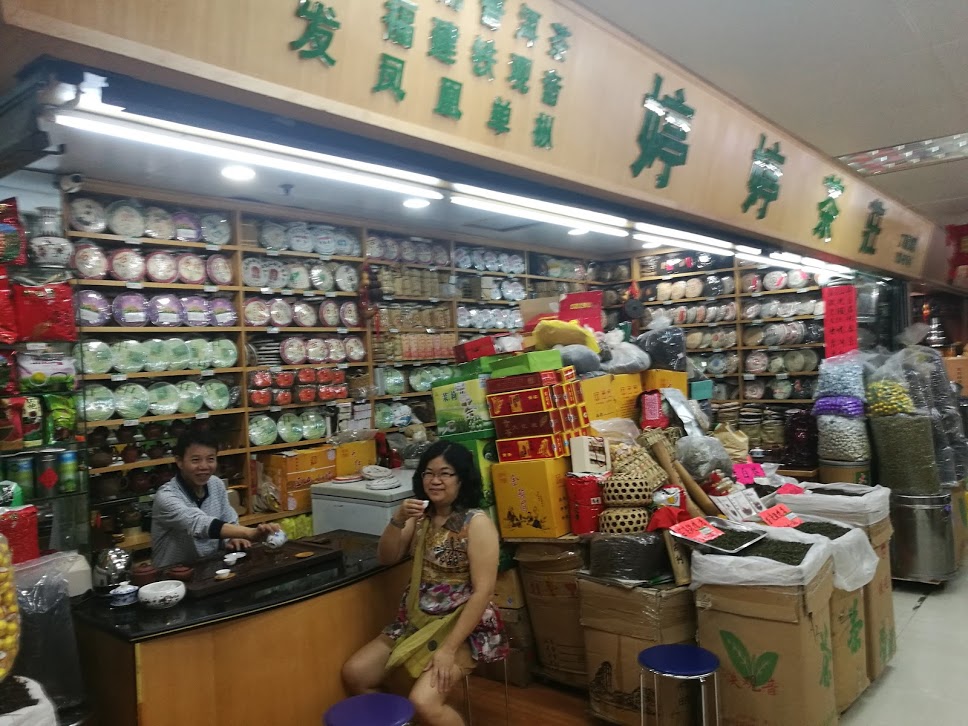
Tea shopping in a market in Shenzhen, China


First published by TChing in three parts, this one and two entries just prior.

I visited a wholesale tea market in China not so long ago, in Shenzhen, and this is about how that went. More than the actual outcome being positive it was an interesting theme, seeing how picking up tea would go differently in China.  Beyond buying it at the grocery store, I mean; selection is slightly better there in that country but the end result would typically still be kind of similar.


cheap pu'er in a Shenzhen grocery store; different (one reviewed here)


To be clear this isn't really about how people make tea in China, how it is experienced.  That subject just came up in a Reddit discussion (here), and there are two good answers to that.  Some people are tea enthusiasts, and they are using gaiwans and clay pots to prepare better teas, similar to Western tea enthusiasts.  Many more others use very simple brewing techniques to drink lower quality level basic teas, or don't drink tea at all.


I'm no authority on Chinese culture since I've only visited that country three times, never to a tea producing area, or with that subject as a main vacation theme. The first time I was there for work, and while waiting for other project members in an odd version of an old local shopping center I hung out in a tea shop. That wasn't exactly my main entry point to tea interest but it was a main step.  A few months after a second visit to China I started a tea blog; maybe that wasn't a coincidence.

Luohu area railway station market; it was near here


I'll back up; a more senior tea blogger I  respect very much passed on advice about shopping for tea in China. His advice, as I took it as a summary: if you don't speak Chinese, and know tea well enough to already know what you want, and to know when you're experiencing it, then local shops won't work out, and you may as well visit overpriced major chain outlets. That actually works, in a sense, but a lot of this will end up touching on possible exceptions.

On that initial shop outing way back when I didn't buy interesting teas (as experienced enthusiasts would judge), or get a great deal on what I did buy. We visited Beijing and Shanghai on that next vacation outing, a year or so later (about 6 years ago--the time flies), and visiting local markets was really interesting. Again I didn't buy tea that was as exceptional or as good a value as basic online sources would sell. Except for running across an unusual green tea version (which I never will reliably identify) that's different. I think explaining how it went in the Shenzhen wholesale market will cover what I mean more clearly.


Visiting the Shenzhen Tea World Terminal Market (location covered here)


Language was a problem in that market, for sure. On the next subject of tasting reliability, I can't blind taste teas for identifying a narrow type or quality level consistently, but given how much tasting I've done over the last three years I'm probably above average at trying to. It hardly matters anyway, because if you can't communicate clearly with a vendor it's only going to work out so well. Vendors would start by assuming that you have little idea what you want, and limited exposure, and talking past that and their own sales expectations wouldn't work well (for general type preference and the next levels of specifics, and price range, whatever it is).

There's a story about someone selling a horse that tries to explain why you need to justify to a Chinese tea vendor that you should even try above average tea, but the parallel never really does make a lot of sense.  The short version:  that one horse wouldn't be the right horse for everyone, so people who don't know tea should drink low quality tea.  Maybe it works, except that they really can't identify expectations through a language barrier, any more than someone can intentionally communicate them.


It was still interesting trying. I was with my wife so I wasn't going to spend any realistic amount of money to buy upper medium level quality tea anyway (the vendors were right, just not for the reason they probably assumed), so the idea was to hack through making the best of buying iffy and cheap tea.  The irony was that I had a good bit of tea either recently on hand or on the way from Western facing Chinese vendors, so it's not that I wasn't spending money on tea, but that part is a longer story.

My wife had spent a bit over half a year studying Mandarin, going to a class one full day a week; it was interesting finding out how far that would go. It barely helped in restaurants; it went how you'd expect it would go.


dim sum in the restaurant beside that market was nice


Of course tea shops are selling tea, and communicating a general type is definitely possible, oolong or sheng, etc. Finding, trying, and buying something is simple enough, and if that process is interesting--and it should be--then it's as well to not focus on the senses in which it doesn't work out.  We walked out with tea.

You would think that tasting teas would make all the difference, that spending countless hours browsing tea groups or vendor sites could fill in lots of levels of background, but not about what you like, but taking a sip would. I'm not at the level of wondering if I like rolled oolongs, Chinese black teas, or sheng pu'er, and to some extent the existence of a broad range of styles and quality levels of any of those throws off exploration being simple.

I find that the more familiar and comfortable I am with a shop the easier it is to get a good read on teas.  Struggling with communication issues came into play there, of course. Initial starting points for expectations or preferences hardly came across at all, but just isolating broad tea types did work. It would be nice to have tried a dozen different teas, or more, to get a feel for what I liked there, but in practice--under those specific limitations, and my wife wanting to leave before we walked in--I didn't taste much.

Again tasting a sample should have indicated what I was getting (unless the vendor trick of swapping out that final purchased product came up), but beyond that risk it's hard to reliably taste on the fly. Slight changes in preparation method and even water used shifts a lot, and mental context is something else altogether. It would be familiar trying teas in random settings after awhile, factoring out some variables, adjusting for randomly trying lots of versions, but for most all that would probably throw things off.

so much 90s sheng for sale seemed a little suspicious, but who knows


Oddly the few teas we bought seemed fine. Not ideal based on preference and what was there, but definitely close enough. Probably if I'd tried to buy teas presented as better versions some of the background on what the teas were wouldn't have been accurate, but leaving off at the "buying something" level cut that risk back.  Two seemed interesting in style and good buys, with potential to improve through aging.  One was just a bad decision; the taste wasn't a favorite range (like mushroom), but the odd feel structure should have been more of a red flag.  Two unusual bundled tea samples were interesting, a Da Hong Pao oolong and a sheng pu'er, and I bought a cheap pu'er pick.


sheng top, Da Hong Pao below (the second wasn't bad, reviewed here)


So in the end the advice to go into a more Western facing outlet and accept paying well over best local shop rates works. Except for the part about dropping out the experience of exploring, the random shopping activity itself, and the mixed-results benefit of buying some moderate quality teas. All that could be pleasant, with unusually positive results, or frustrating, leading to making bad purchase decisions, but beyond the results it should be interesting. It doesn't work reducing a goal to only relating to what you buy, without considering the value in hacking through the unproductive part of the early learning curve. It was nice, all those times.

I'll let some pictures here highlight what turned up, and show how things looked, since all this cuts that short.  Reviews spell it out in painful detail, but as a summary it was cool looking around that market, even if I did buy better tea versions online at essentially the same time instead.


an IT electronics sales area; perfect for buying knock-off tablets


Saturday, April 20, 2019

Trying two low cost sheng bought in Shenzhen


where we bought one tea, a wholesale market in Shenzhen


that vendor had a range of different teas on hand


I wrote about buying a few moderate cost sheng versions on a trip to Shenzhen, China recently (in this trip summary post), and this is a first review of those.  One is from a wholesale tea market we visited (described a little in this Wikitravel entry), the first tea we bought in that place.  The second is a grocery store purchased version of sheng pu'er.


In part buying that second tea related to seeing what it was like as much as to having positive expectations.  There had been discussions of people buying cheap cakes in Chinese grocery stores in a Facebook group and I could relate to people gambling on tea they didn't expect to be very good.  It matched those circumstance so closely that it made me want to try it all the more.  Those people were talking about spending $20 on a cheap cake and this one cost around $10, this time in a Chinese grocery store in a different sense, in a normal version of such a shopping outlet that happened to be in China.

The other tea cost even less, if I'm remembering right, so my expectations weren't that high for both.  I've tried both, on that trip, so this isn't exactly a blind tasting, but it's easier to get a fuller impression in a familiar setting, in a quiet environment with a lot of time to focus.  I'm trying these at noon on one of the hottest days of the year in Bangkok, surely around 35 C / 95 F right now, so not necessarily under ideal circumstances.


The tea from the market, labeled as "300" plus some characters, was presented as a Bulang origin version, if I picked out the right term from the middle of some other things the vendor said in Chinese.  The other tea I didn't know, but there is a review section here with more of a guess.  The wholesale market tea is 2015 and grocery store version 2018 so it's not an ideal comparison in that regard; they'll differ from that one factor alone.


the tea label from the shop in Shenzhen

I'd really planned to skip going through the labels more closely for search terms (producer names), and to use reverse-image lookup approach and the rest, or draw on help from Chinese language speakers to sort out producer names, but I just did it.  Maybe the pine aspect I'm experiencing in one is type-typical for a narrow growing region, and I wouldn't know that for not looking into it. 


Of course most likely the best I could do is turn up Chinese versions of Amazon and Ebay shops selling the same teas (not necessarily knock-offs, since these are inexpensive teas to begin with, unless the one is a knock-off, which could be the case).  Almost every time someone posts a picture of some random low-cost sheng or shu label in a tea group one of two answers comes up:  either the label is completely non-specific or it's some general, low-cost tea manufacturer cited, without clearly identifiable product specifics, which is where this led.


Online search based on labels


I had written in an earlier review draft I wasn't going to try to research these teas, but instead I did just try to look up this tea version (the Shenzhen shop version with a "300" in it), using a reverse image search.  This Alibaba vendor / shop page lists something from the same producer as a National Tea Factory sheng product selling for 28 yuan / RMB, or US $4.20.  I think I paid more like 40 or 50, or approaching $8; maybe I overpaid.  Anyway, that product is listed as shu and the tea I've got is sheng (I'm pretty sure I can tell the difference), and the label seems to say it's by the same maker but the product name is different.  Description there is limited, and it looks like a random cut-and-paste of whatever sheng content they had around.  In one place it cites the Banzhang village, and also the product name "Bohai Qizi cake old class Zhang Pu'er tea."  I could swear that vendor said it was from Bulang.

Messing around with this for a half hour I also used a Chinese text image recognition and translator site (imagetranslate.com) to figure out that 布朗 山 translates as "brown mountain."  Maybe transliterating would've been more informative?  Passing that back through Google translate did render it as "Bulang shan," nice!  It's still just Bulang sheng, what it started out as, and probably a generic version of it.  Another shu version labeled similarly on Taobao lists for 97 yuan / RMB, for what that's worth.


勐海 古 味  kicks out as the read text (looks right to me), which isn't being translated for whatever reason, but Google Translate suggests it means "Měng hǎi gǔwèi."  That first part sounds familiar.  An alternate strategy is to read the rest of the label and see if a manufacturer name turns up, or anything else.

That sort of worked and sort of didn't.  There is a lot of information on the rear label but it's almost all in Chinese.  It's a 2018 tea version; there is that.  On a paper insert a longer name is cited, Meng Hai Lang He Cha Ye Youxian Gongsi.  That could potentially relate to a producer factory name, as cited from a Yunnan Sourcing reference:

Langhe 郎河 : Langhe is a factory of Menghai 勐海 that was founded in 1995. Since then it has built a strong reputation, won awards, and has become one of Yunnan's most renowned brands. Langhe ripe teas are the most sought after from this tea factory. Classic Langhe recipes include 9599, 9579, 9559, High Mountain Ripe, and Gong Ting Ripe. Langhe ripe teas are excellent for long-term aging because they employ traditional light fermentation "wo dui" technique. This light fermentation allows for gradual aging of the ripe teas and retain much of the character of a raw pu-erh tea.


So maybe it's that, but a sheng version.  It was sitting right next to a shu version labeled almost identically too, and I only picked up the sheng.  Dang! 

Further online search doesn't turn up much but this product comes up related to searching that labeled name I mentioned, a $21 250 gram brick of 2015 sheng, also identified as from the Langhe factory.  Who knows if it's even vaguely related.


It's not a given that I've cracked this case anyway.  That 65.5 yuan value converts to $9.77 right now, to be more precise.  A decent $10 shu cake is probably worth checking out, but at the same time I feel like shu tastes more the same across the entire range, where sheng varies more, so it was still a justified call.  It's just that if it turns out this was from a factory known for shu instead I'd have bought that too, and put up with that extra bit of static from my wife about going over 2 kilograms for tea buys. 

Who knows about the generic Tie Guan Yin; it was sitting right beside it, and I bought two packs of that too.


Review

Shenzhen wholesale market "300" Bulang 2015 sheng


Shenzhen grocery store Langhe factory 2018 sheng


"300" 2015 Bulang version left, Langhe 2018 version right


300, 2015 sheng (these will go by nicknames; I'll stick with the initial notes versions):  it's not bad, just a bit light in flavor and overall effect during the first infusion.  Some of that I think is due to not fully infusing yet, so it's probably as well to hold off a round in detailed description.  Bitterness is moderate and tone is warm, not off in any way, just a bit vegetal, towards a warm version of wood.  So far so good but developing along exactly the same line wouldn't be great results, it would just be decent tea.


grocery store tea, 2018 sheng (this may be a Langhe factory tea):  as in tasting this at the hotel while there in Shenzhen the pine flavor aspect stands out a lot.  I guess that's a good thing.  Pine comes up as a flavor aspect in teas, just not usually this pronounced.  It's softer than it might be for a year old inexpensive sheng; it's a bit bitter but not overly so, and not really rough in astringency or other character.

Second infusion


Bulang left, Langhe factory right, a good bit of aging leaf color difference


I gave these around a 10 second infusion time to move through the beginning of the infusion cycle faster, but the next round brewed a bit faster will probably describe how I'd prefer to drink them better.


300, 2015 Bulang sheng:  this is still woody but there's a decent spice aspect coming in, a bit towards root beer (or sassafras).  For tea that cost under $10 a cake this is exceptional; for tea aside from cost considerations it's still ok, just not exactly above average when you fold in better versions. 

If that spice aspect draws out further as this ages a bit more it really could be quite pleasant tea.  The character is unified and distinctive enough that I'm not sure they obtained this result by blending a lot of types of tea inputs together (one main way that producers create decently balanced versions from inexpensive sources); it might just be how a more narrow source happened to be.  It would've been interesting to try it young and see how it got to where it is now, to see what rounded off or transitioned over nearly 4 years of aging, but of course that's not possible.


grocery store Langhe 2015 version (probably):  straight pine, even pinier brewed a little stronger.  Since it's not challenging across any aspect range it worked well that way, but would be optimum brewed slightly lighter.  Mouth feel is slightly dry in this, not exactly ideal, but then I did just brew a young sheng for twice as long as I thought would work for a more ideal infusion strength. 

Given all the vendor buzz about how if you don't buy their forest-source, arbor-grown, or organic-production versions you'll drink lots of pesticides I'm considering that as a possibility too.  I just can't place if it makes any sense that I'd taste pesticides, never mind guess at the flavor or feel that would relate (typically; of course there would be a range of contaminants).  Someone commented on a discussion thread not so long ago that a carrier for some materials would taste like petrochemical (so diesel or gasoline?), but that's just more random hearsay.  All that aside this tea would best be judged at a lighter infusion strength so I'll say more next round.


Third infusion


300:  this version is improving; that root-spice trace is catchy.  Beyond that a warm version of mineral gives it depth, a bit like the smell of a creek bed.  For urban dwellers who that means nothing to rocks have smell, but that varies a lot by rock type and individual setting.  In Pennsylvania (where I'm from) there is a specific smell to a very small flowing water feature, maybe more commonly called a stream.  The smell probably relates more to the local flora and micro-fauna than actual rocks, but at any rate this tastes like those smell.  It probably contains a hint of pine too, or it could just be that I'm "looking for" that aspect due to it being so pronounced in the other tea.


grocery store version:  different pine now, I guess, a bit warmer.  To add description this has moved from tasting a lot like pine needles (maybe spruce?) into picking up more of the resinous tree-sap flavor.  The other tea was soft with a bit of fullness (which I really might have mentioned in that part), but this has more of a resinous feel to it too.  It's not astringency in a typical presentation but it is a version of it.  It works much better brewed light; it's actually pleasant.  It doesn't seem off in any way, as if some of the aspects are negative, but it's unconventional enough that someone's take on how good it is would relate to a match to particular preference.

This reminds me of tasting a Yunnan Sourcing sheng version yesterday that I liked but didn't necessarily love (Yunnan Sourcing  "He Bian Zhai" Wild Arbor Cake), a tea that seemed generally positive but that was unusual enough in character that it would seem reasonable for someone to like or dislike it.  I think in that case some of the positive expectation would be built into the description prior to trying it (presentation as an "old arbor" tea).  If people tasted these three teas side by side they might just split on which they liked better, but knowing one cost a lot more and came with a better back-story would surely factor into that balance.

Fourth infusion


cutting infusion time back might've worked better; the rounds varied


I have things to do (water a lot of plants, mostly; my mother-in-law is out of town, so that's on me) so I'll probably cut this off after this round and drink a few more later, without making notes on those.  Funny, I was running late to getting to that in making initial notes and now I'm about two hours later in editing these same notes almost a week later.  It's 37 C out, a temperature I should be able to convert automatically since that translates to 98.6 F, body temperature.  It felt a lot hotter six days ago just because I wasn't used to it, just getting back from China.  Hong Kong was nice and cool, in the lower 20s (around 70 F).


300:  with a better back-story I'd probably really like this tea.  The feel is moderate in intensity but it works; it's not thin at all, not challenging, but it has some fullness to it.  Aftertaste is limited but it doesn't vanish when it leaves your mouth, it's just not extended or intense.  The flavor is nice, that warmth and root-spice aspect, supported by warm mineral with unusual range.  The woodiness extending into a trace of pine works.  As a main aspect, similar to the other, it would be more of a judgment call if that's positive or not but as a supporting element it's pleasant.  As for alternative reads (takes) on this tea it would be natural to emphasize woodiness more, to go on about tree bark and forest floor as I often enough do.  The sweetness and overall balance make it work, more so than any one or limited set of aspects working well.  A well above average quality level doesn't stand out, related to markers, intensity, or general character, but it still works.


grocery:  brewed lighter and transitioning a little this is better than it has been.  The pine is toning down, turning into more of a warm spice range aspect, trailing from resin over into a more complex range.  It's a bit like the scent of a pile of wood from an old lumbermill, the way that those fine particles of wood ferment and soften into a warmer, sweeter range over time. 

Again I'm guessing that I'm losing readers here.  As a child there was an old lumbermill site on our property, and we would go an play on an enormous pile of very old ground wood particles, which the forest was slow to reclaim.  The scent wasn't necessarily positive or negative to me back then, just normal, typical background.  Of course nostalgia paints it as positive now.  Back to this tea, the sweetness makes it work, it seems, tying together a complex but mostly wood-tone range.  I bet it would be better in another year once the youthful intensity tapers a little and warm tones pick up further, but we'll see.

Conclusions, speculation


I never did really factor in how one tea being nearly 4 years old and the other 1 played into this tasting.  To people brand new to sheng that would mean that the first should have improved to be much better than it originally was, and better than the younger version, and that unless it was quite inferior to begin with it should be better.  Really it's not that simple.  Sheng changes depending on starting point, and some versions are really nice a year or two in, or nearly brand new, and don't improve at all from there, they just change in character.  It can relate to more what someone likes than how objectively positive the transition is.  It's too much to get into all that here, and I couldn't do a mapping of characters to aging transitions summary justice anyway.

Both teas were ok.  I liked the "300" or 4 year old version better, at this stage, but maybe it'll just flatten from here, fade instead of transition in a positive way, and the other will improve.  I bought these inexpensive teas to see how different aging transitions play out, and of course also to try different teas, and to have them to drink, and I'm surprised they are as good as they turned out to be. 

Buying tea online is more completely random than the approach I used seemed to be.  The wholesale market shop owner was of course just trying to make a sale but he probably picked what he thought I'd like, what represented a good value.  The grocery store probably tried to carry a decent tea version, versus an Aliexpress or Taobao vendor maybe instead passing on whatever they could buy for the least.  Tourist-oriented shops are hit and miss; it just depends on the vendor focus and theme.  We didn't see a lot of that there, to be honest, hardly any tea shops scattered around, and less of it than you'd expect in Hong Kong.

Not spending much related more to my wife being with me than that playing any sort of direct role.  I made it out of China with around 2 kg of tea (although 800 grams or so of oolong was more for gifts; that doesn't count), and if I'd been buying more moderately priced versions she would've objected sooner.  As it was when we passed through Hong Kong on the way out her patience for picking up more had already been exhausted, which was unfortunate related to walking by a really promising looking shop in an older commercial area there.

just one more tuocha at least; that's how they get you


Thursday, April 18, 2019

Shenzhen, China trip summary


this was in Hong Kong instead, not really what this is about


The following is from notes made on a trip to Shenzhen, China, which involved a lot of transiting and one whole day spent in Hong Kong as well.  It's partly about tea but doesn't get far with that subject.  I'll add a little more about the main tea wholesale market experience in Shenzhen to one or more review posts about teas and keep that part limited here, so people only into reading about tea could skip this.  It's more about travel with some observations about cultural differences.


visa on arrival processing; probably as well to get that in advance instead


We're in China, in Shenzhen. One odd part of that relates to being cut off from the main parts of the internet that I typically use: Facebook, Instagram, Gmail, Google, YouTube, Maps, my blog, Quora, and Line (the Japanese messaging program Thais use most).  That covers any way that I would normally contact my kids or parents. Wechat is it; that works, but my wife's mother (staying with our kids) doesn't check that or answer calls on it.

I've spoken to my son once in two days here and haven't talked to my daughter yet. They went on to do a whole month in the US as a summer break instead, traveling with us up until Hong Kong. That's the hardest part for me; they were by far my favorite thing about every trip I've taken for the last decade.  I would rather go to Nebraska with them than to a tea producing area without them.  This is really about impressions and travel in Shenzhen though, not that.


parting ways in Hong Kong as they went on to the US


last hours with them, of course catching movies on the plane


It's my second visit here, to Shenzhen, once earlier for work. Work trips don't leave enough free time to get to similar levels of exploration or contact with local culture.  It reminds me of Taipei, Taiwan here; the look and feel is similar. It's modern and developed, but to me it's more interesting how people take that, local variations in perspective or setting.


Huawei products demonstration site tea presentation, back in 2012


My wife is having someone look at something in the hotel room now, maybe an outlet that wasn't working, arguing with the hotel staff about them taking off their shoes. I thought that was common to all of Asia, freaking out about wearing shoes in living spaces.  Maybe the hotel staff get it that half the guests would wear shoes in a hotel room and are less into extending a norm based on practices at home to there.  My wife doesn't see it that way, and most Thais generally wouldn't.

We keep shifting between visiting different types of areas. We are staying in what seems to be a tourism and shopping area, like a very different version of local commercial area themes common in Seoul or Tokyo.  Later someone mentioned it's an older part of Shenzhen but it's my impression that the city itself was mostly developed in the last 30 years, so it's probably not that old.  There would have been a smaller town here prior to that and for all I know it was located where we are now.

Yesterday we visited a wholesale tea market.  That was very cool; I picked up a few interesting teas, even for using next to no budget allowance for that. Communication was a problem there, as it has been throughout this trip.  My wife studied Chinese (Mandarin) for the better part of a year not that long ago but didn't retain enough to get far in conversation.  Her knowing some basic words comes in handy though.  Little glitches came up throughout the trip, like road underpasses being labeled as a "subway."


this is different:  bundled ("witches broom style") Da Hong Pao, I think


Then we visited an old shopping area near the train station, the Luo Han area, or something such. Then onto two different versions of local neighborhoods to check out favorite shopping options of my wife, a Decathlon sports store in a mall and a Carrefour grocery store in a shopping center. It seems only a coincidence that both are French, or at least mostly that.
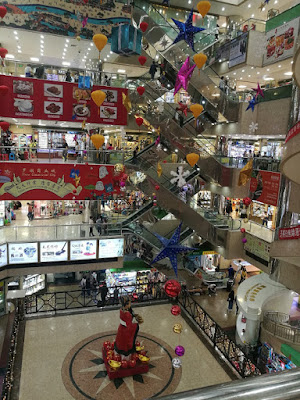
older market area near the train station


To me seeing the neighborhoods was more interesting than the stores. We have Decathlon stores in Bangkok, and I've been to lots of Wal-Marts and Carrefours. It is interesting seeing grocery stores in different countries to see novel foods (the minority of goods; most of what is in those in different countries is the same).  An example: Russia had good black bread, and Thailand has a broad range of curries and dried tropical fruits.  Japan, Korea, and China mostly have foods from those areas that are different, so mostly the same fruits and vegetables as in Thailand are here, given the proximity and Chinese influence there.  In our Chinatown I see dried persimmons as the most interesting novelty, along with herbs and flowers for health treatments that I don't know anything about, which of course came up there.


good mango selection in a local Wal-Mart; that's different


Bangkok is so heavily Chinese oriented beyond foods that it's less novel to me, in the grocery stores and elsewhere.  Modernization evens things out in both places too, the commercial focus.

They had cheap tea in one store, probably not good, but I bought Tie Guan Yin oolong and may pick up two cakes of grocery store pu'er, since I'm curious about it. Selling for $10 a bing / cake it can't be great but if it's drinkable that would be a steal. People worry about pesticides but I'm not so sure. They usually don't worry about fruit grown under the same conditions for some reason.  Later edit:  due to my wife's patience running out I only bought the sheng cake in that grocery store, which seemed really good for that price level, just heavy on pine flavor aspect.  I'll have to live with wondering about that shu.


that grocery store sheng


About culture, people seem normal to me. They're somber in Russia, even more reserved in Japan, unusually laid back in Bangkok, and normal enough in Seoul (maybe a little excitable as Asians go), and so it goes here, people don't seem unusual in any way.

In Hong Kong, where we just only spent a day, it seemed odd that people didn't give me a second look (for being a foreigner), and that applies here too. In cities in general people tend to be reserved, because if you are in the proximity of thousands of people every day you just can't pay attention to very many. As a tourist that's different; you don't take things for granted and filter them in the same way. It reminds me of the saying that you can tell who is a tourist in NYC by who looks up at the buildings. You can tell by who looks around at the other people too, in any city.


Freemont street meets a Chinese food and shopping area


Thais don't fit the mold well for urban culture. When I'm commuting in Bangkok people definitely get that closed-in look about them (beyond staring at a phone), but beyond that they seem less oppressed by crowding, less affected. They walk slowly and seem less withdrawn than in other urban areas. Shenzhen isn't made up of crowded urban spaces to the same extent that Hong Kong and NYC are; it's more open. Taipei stood out to me to strike a great balance of being developed, comfortable, efficient, and friendly, and this matches all that.

It made me wonder what the downside of local culture or environment even is. NYC has crime and people are edgy, Hong Kong is more crowded, people in Moscow are surly (no offense intended; they're great once you talk to them, for the most part); so what's the catch here? Bangkok splits lifestyles by haves and have-nots, but it's not clearly a problem. It's not as I imagine India (which I've not yet visited, so this is based on almost no exposure), where the have-nots might not have a toilet. Poorer Bankok residents eat noodles from food courts instead of mall restaurant foods; it's not so bad. I eat that a lot in those places too, as most people in Bangkok do.

There will always be income and social status levels, but I'm not seeing it as worse than average here.  If anything the opposite stands out, and no one looks particularly poor, or wealthy, for that matter.  Some of that is surely due to my limited exposure.  I know some of the wealthiest people in Bangkok, only a few, and you don't tend to see them in malls.  Even running across people much further down the scale but still high on a percentage-income basis just requires going to different places.  I wonder how so many people in Bangkok can afford to eat in mall restaurants, for example, where spending over $10 on a meal seems like a lot to me, due to the lower end range being so much lower.  It's not that we're poor but it works well to live modestly to have more money to spend on travel or on things like kids' education and activities.


People are friendly here. They typically don't speak much English, so there is that. As usual we've made a hash of planning and rely on others for help to get around, asking directions instead of using a map app, and they're good about helping out. There are a few tea shop locations in Shenzhen saved on my Google Maps, which I'll be able to access again back in Hong Kong--bad planning.

Yesterday a girl took us to a Carrefour--that grocery store theme--walking with us for just over 5 minutes from the subway station. That act of selflessness was touching; she really didn't need to do that, and almost anyone else would have did some pointing and let it go. She seemed gender neutral; interesting those themes carry over here. I don't care how she manages image or personal identification (or how anyone does, for that matter). I wanted to give her something to let her know what it meant to us but just failed that part. A tip seemed a little insulting and we couldn't come up with anything else fast enough.  I tried to think through if I would have done the same thing she did and I can't say for sure that I would have.


the nicest person we met in Shenzhen, even though we could barely speak to her


It's impossible to describe local culture, even beyond only getting a limited feel for it as a visitor. A lot comes across about how people experience their reality but it's vague, and hard to place an impression versus an actual reality.  I've expressed elsewhere that it took between 2 and 3 years to get a feel for the Thai perspective from living and working in Thai society, to begin to see things as they do. I'm not completely there yet, after 11 years, and for spending three weeks in total in China--across three visits--I'm not far along at all with that related to here. I can mention anecdotes or parts that are interesting to me though.

The other trip I haven't mentioned yet was to Beijing and Shanghai, coming up on 6 years ago now, just before this blog was started.  I think an early post is even reviewing a tea from that trip, but since we had traveled a lot back then (more than now) I don't think I made a big deal of having been there recently.  Again as a tourist you only get so much exposure; I could tell how people were on the surface in that visit, and not much else.  We had a nice local guide there in Shanghai for one of my son's best friends being part of a Chinese family living here stationed for work for a year or two, then moving back.  I suppose that made for more exposure, visiting them for dinners and such back when they lived in Bangkok.  For whatever reason my son's two best friends at an international school were both from China, and my daughter's two at the same school were from Taiwan and Japan--international enough.


embracing looking like tourists; Kalani is sort of in the photo, in one sense


at the Bangkok zoo; the guide I mentioned is on the left


Yesterday it occurred to me how novel it is that restaurant servers here don't need to be particularly nice. Some of that relates to tips being a main component of pay in the US, but Thais are pleasant across the board, even though tipping isn't a big part of their culture.  You most typically add 20 baht as a thanks, 60 cents, and the restaurant pays them to work instead.


late night local dinner, more a snack


We stopped for a very late night dinner yesterday, after 11, and the server seemed more like a customer for not interrupting his meal to talk about our options. He didn't even stand up. People are generally pleasant but it's only an option, and even in service roles they often take the other option. A lunch server was just as short with us in a different restaurant.  My wife brings it on by being demanding; it's good that they push back a little to set up a proper balance.


Both meals were excellent, by the way.  Even the service seemed fine to me, they just weren't as nice as I usually am to random people, without being in a service role. I'm finally getting into dim sum, some dozen years after first thinking the texture of steamed foods was too soft trying it for the first time back in Honolulu.


People seem genuine. That's hard to place, how in being agreeable and pleasant Thais give up expressing their real experience.  No one in any culture expresses exactly what they think and feel all the time but as an American I can appreciate people being more open and genuine, filtering things less.  I really liked that about Russians.  They take it a little far, in not valuing being superficially pleasant even as much as in Chinese culture, but to a really cool degree what you see is what you get, and they'll say what they think.  I just met a very kind Russian woman here who seemed very reserved personally; of course that kind of thing varies by person and per local area culture too.


Digital detox has been an interesting experience, coming to what is essentially China's version of Silicon Valley to get off smart phone use. Again they block a lot here. Even though my phone works my Huawei only has Chrome loaded for a browser so it can't access the internet.  Later someone claimed in online discussion that there was a way to adjust for that, it would just be hard to sort out since Google search would be the main way to look that up, and he cited a reference about it on Youtube, both of which you can't access in China. I know a couple of people on Wechat; of course I sent them messages.
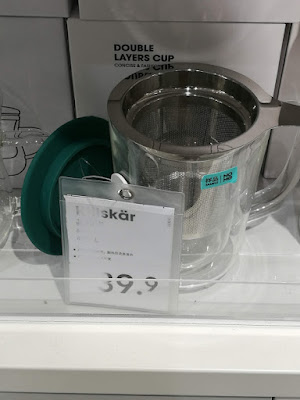
this cool Norwegian infuser only cost $6, but I didn't buy it


Second set of notes


Onto final thoughts about visiting Shenzhen already; the time just flies. We've done an unrealistic amount of shopping, and so much walking that my legs are sore.  The subway is amazing here, cheap, efficient, and easy to use, but that always brings up the walk from whatever station to where you are going. Surprisingly I'm coming back with 2 kilograms of tea. It's modest versions, mostly pu'er, with 4 200 gram packs of cheap Tie Guan Yin for gifts (which to me doesn't count). All the pu'er could take a few years to get to, due to how aging concerns work out, so it's not too much.

I wouldn't live on that inexpensive oolong, since quality and traces of pesticide contamination could be a real issue, but I don't think drinking one pack of it represents a significant risk.  I think "tea people" tend to overstate that though.  It gets used for marketing a lot, and people extend interest in tea drinking experience to health concerns, wanting it to be a positive input, which also maps onto concerns about risk.  If you drink 2 kilograms worth of one type that is contaminated with one type of toxin the risk becomes very real, but if you mix sources of teas and mainly use sources that seem trustworthy the risk seems lower than for food items, which seem to not be as thought-through.


one inexpensive cake from the wholesale market, Bulang, I think


the 20 yuan oolong version relates to around $3 per 200 grams (I think)


We made it out to see a bay-side park in what seemed to be suburbs, a better outing for getting a feel for the layout of town and different areas than to see a beautiful natural area. Apparently there is a whole main section of town over on the West that we completely didn't get to, where a few even larger buildings are. In the middle there isn't as much, but there is subway system coverage throughout. It's the opposite of Bangkok, with the system built out to handle expansion, while Bangkok works on linking old neighborhoods little by little, by small station extensions. It has to be easier and much less costly to build it all out first, but then they do pay ahead for an infrastructure they're not fully using yet.  There's probably enough build-out that it makes sense now but in 20 years it will work out much, much better than delaying all that building by 30-40 years.


by the sea, more or less


My impression of China didn't really change; I like it. It was nice to get more of a feel for local culture here.  On the culture side people seem nice, just normal, really. The appearance of people might serve as a marker for how the local culture comes across.  The look is a little casual, not as far developed into trendy and specific looks as in Korea and Japan, distinct clothing styles. Bangkok is closer to here in that regard with a bit more for observed trends shifting looks. Or maybe I'm only judging from seeing plainer people here, while in Bangkok we go to the whole range of demographic level settings for visiting lots of types of places in different contexts. I get the sense that we're seeing tourists in the area we stay in, but I don't know that for sure.

As clothing trends go younger women are wearing cut-off jeans shorts a good bit, and there's a trend towards wearing formal-originated flowing styles that are cool. Neither seem familiar in Bangkok. I lose track of what is trendy there but specific garments and colors seem to come and go there. At a recent party for college age girls in a restaurant we visited (back in Bangkok still) they were all wearing two piece matching skirt and short shirt outfits; that must relate to a current trend back there.  Guys seem to get a pass on wearing anything specific, in Bangkok and in general.  Dressing better or more informally are still options but it never seems to carry over to wearing specific things.


My sense is that the cultural is informal in general here. That works for me, being from a rural area in PA, and spending a lot of time in the CO mountains. People don't look backwards or poorly dressed, just informal.  Japanese people dressed better with more style, and it seemed to vary in Korea, with one part of the culture emphasizing public image quite a bit, and the rest not so much.  Russians looked a lot more serious; that stood out more than what they wore, and went along with not wearing much for different colors. Winter had them wearing a lot more clothes there. I didn't notice much for trends in wearing specific colors here but lighter clothes somehow work better in light colors, with plain black and dark blue mixed in.

In Bangkok people are more colorful.  I lived in Hawaii last in the US; casual clothes and brighter colors worked there too.  Little did I know there that mostly wearing flip-flops would carry over for another decade here.


the typical Western-culture input in the background


Food here would depend a lot on your budget, which is why we ate some really basic versions. Dim sum finally made more sense, after over a decade of getting used to different flavors and textures. We ate in local places, including twice in a version of a food court style diner. We even ate street food, a Chinese variation of pad Thai, fried noodles, with a pickled vegetable included that really worked.  One eating street nearby was amazing, with different stalls selling lots of odd foods. We had an odd sour and spicy noodle dish there, along with different snack foods, fried potato and steamed buns and such. My wife had bubble tea a few times, and we tried grape ice cream sold at McDonald's. We never really did splurge to go higher end.


absolutely not where tourists would go


The main thing that stood out to me was how much the neighborhoods we walked to through looked like Seoul or Taipei, especially the latter. They were spacious and comfortable, modern but not new looking, with lots more parks and open living spaces than comes up in Bangkok. There were bike paths and running trails all over. It felt like a modern and comfortable city, nothing like how crowded and urban Beijing and Shanghai felt.  Bangkok is kind of a mess in comparison, although the old mixed with new theme has a different sort of appeal.  But snarled Bangkok traffic has no upside.

The one new mall we visited seemed relatively empty; that part is familiar from Bangkok, that they build those before there is really demand for one in some cases. Compared to what I've seen of Hong Kong it seemed new and open, with a more positive energy.


I liked the old-style market by the railroad station better


a 12 story mall in Hong Kong; a cool touch to add a sky in it


Conclusions


Not much for conclusions; we spent a quick five days and took a nice look around.  I never really did get a sense of what was limited there compared to in other places, to what potential downsides were to local culture or perspective.  More newly developed areas like that tend to lack as deep a connection to older forms of culture, but then that fades away fast enough in places like Bangkok too.  People might like other areas or cities better for lots of reasons, or experience what isn't there as a gap.


from Hong Kong; we made a request to a tea-related deity


We definitely didn't do exploration justice related to experiencing culture, or natural themes, or anything beyond shopping and eating, with higher level dining never even coming up.  Wikitravel fills in everything we didn't get to.  The people were nice enough, but then people almost everywhere are.

We bought drones for both our kids; they'll be happy we focused on such themes related to that.  My wife wasted half a day on IT gadget shopping only to buy a spare phone battery and to have two cracked phone screen covers replaced (probably nearly for free; she's a fierce negotiator).  We almost bought a family friend a $150 tablet but didn't.  It was nice enough for me just to take a look around, and all the more fortunate I could buy three sheng cakes and one aged brick of modest-quality while there.  I'll say more about the tea part in reviews, with notes already made up for two of those cakes.


at least the silliness comes across online too