 |
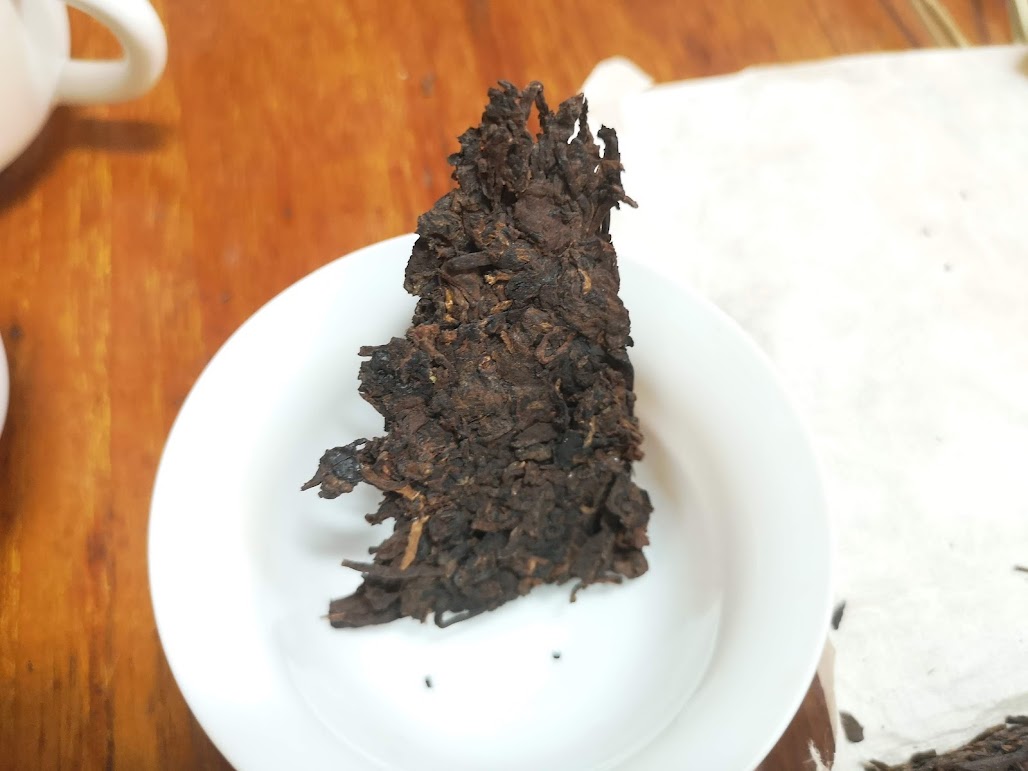
the Chawang Shop Jinggu brick version |
This is a novel form of review, trying two shu pu'er versions that I expect both will need some more time to settle, related to not being very old. I thought that earlier covid taste sensation impact would still be a problem at this point but it's been clearing up fast over the last 4 or 5 days, and that's pretty much behind me now.

Here's what they are:
Krasnodar shu puer, 2021 (from Moychay, a Russian vendor)
An experimental tea made in Khosta region from local tea cultivars (harvest 2019) using the Menghai Shu Puer «wodui» technology.
In appearance: medium sized curved flagella of dark brown leaves and buds, a small amount of thin cuttings and sticky lumps of «chatou». The aroma is intense, with notes of baked chestnut, toasted bread and spice. The infusion is transparent, with a chestnut-yellow shade.
Since this is listed as unavailable (out of stock, or perhaps to be returned to stock again later) there is no pricing listed, which I suppose is as well given the current events context, which I'll add more about after the other tea's details. It's interesting seeing the tasting comments; as usual some people really liked it and others didn't at all. The style is a bit unconventional, and I think the tea needs time to rest to really be at its best. It doesn't say when it was fermented (wet piled), which is really most relevant with regards to when it will be rested from that process, not the harvest date.
2021 Chawangpu Jinggu Lao Shu Zhuan 400g
Material for this brick come from two villages in Jinggu and collected from 2018-2020. Larger leaves from spring and autumn harvest, also called huang pian, are pure old tree material. Fermented in Menghai during winter 2020 by well experienced master and the result is very good!
Dark and clean tea soup with some dry fruit notes. Sweet and smooth.
15USD per 400g brick is special offer !
Manufacturer : Cha Wang Shop
Production date: Harvest 2018- 2020, pressed 11/2021
Harvest Area : Jinggu area, Puer
That pricing is unusual, per a separate post notice a special offer related to the tea not being fully rested yet, and as a kind of bonus to regular customers, not selling at that value related to a conventional business practice. This tea is probably better than some of the shu cakes Yunnan Sourcing sells for $60 (at a guess; I've tried versions of their Impression sheng cakes, and at least one other in-house version, which were all nice, but not their shu). I'm basing that guess related to placing a lot of shu versions, and to me this is well above average, rated against my preference. That does include that it really seems to need a bit more rest, maybe even another year of it. There's one standard style of heavy, peat-intensive, fully fermented shu, that can transition to lighter flavors and creaminess with some age, and this isn't exactly that, which I see as positive, since I like that, but I like positive variation from that more.
Lots of shu made now seems to be maxed out for fermentation level, but this might be backed off a bit from that. It's possible this has good potential for a 10+ year old version as a result but to me that would only make sense to check out related to buying a few of these cakes tied to value, not so much in terms of seeking out absolute best results. It's decent shu, at a minimum, but to me aging shu doesn't usually tend to make enough difference to warrant a decade worth of storage oversight and wait. The first year or two can really straighten out newly made character, letting it settle, but to me the whole point of shu is that it's easy to drink and really doesn't need time to reach an optimum.
There's not much to add about this one tea being Russian, related to that war, currently the main news item. Obviously my full sympathy goes to Ukraine, and the sympathy I have for Russians suffering economic impact is a bit tempered by the comparison to that far more severe case, and the cause, that their own government initiated an unjust war, and what I see as murder of a neighboring country's civilians and ongoing war crimes. All the same citizens of Russia didn't cause this, any more than citizens of the US caused a relatively unjust war against Iraq (the second one; them taking over a neighboring country that first time wasn't ok, just as it's not for Russia to do that now). Some Russians might believe state propaganda and see it as a just war but everyone I hear from online expresses the opposite.
Russia, the US, and China really need to move past all this, and do their best to work towards the common good of their own citizens and that of other countries. Of course that's not the kind of world we live in. What Russian leaders are in the process of doing goes a couple steps further than the horrors that are the norm, and the most severe economic sanctions in history are a natural outcome from that.
I'm a fan of all three of those countries' cultures, and others. Visiting Russia four years ago was one of the most memorable experiences of my life, as visiting China three times was. It's a shame that appreciation can't extend to the leadership of any of the the three.
 |
a friendly Russian offering guidance in the Moscow subway; how I remember the people there |
 |
friendly Russian tea shop staff; there were no exceptions from that theme |
Moychay will take the same hit the rest of Russia does. This post isn't intended as implying that Westerners should be ordering tea from Russia at this time; how that works out per a standard perspective is obvious enough, and it would make sense to get back to that only after this war gets resolved. Supporting a foreign Moychay branch wouldn't necessarily offset the end goal of these sanctions, since there must be few Russian companies not operating at a loss just now, outside their oil and gas industry, so tax revenue trickling back to the Russian economy wouldn't be much of a factor, related to companies operating at a loss.
These posts are never actually intended as direct marketing, I'm just passing on what I think about teas. If I say that I think a tea has a really unusual character, is of unusual quality level, or represents an exceptional value, then I guess that could be implied, but even then it's just sharing perspective, not a sales pitch. It goes without saying that personal preference, quality judgment, and impressions about value would tend to always vary. The judgments here about shu needing a rest period to offset fermentation related aspects probably wouldn't be all that universally accepted either; it's just one person's opinion, based on trying moderate amounts of shu (only dozens of versions versus hundreds).
Review:
 |
Moychay left; coloring is washed out related to light level for that image |
 |
both teas were normal shu color, brown |
 |
Moychay version left, Chawang right, in all images |
Moychay Krasnodar shu: nice! I think this will clean up a bit with more time to settle, but it's nice like this. A warm, dark bread tone dominates it, complete with dark rye and fennel seed tones. Fermentation related funkiness isn't on the level I would've expected for this being less than a year old [if it is; fermentation timeline is implied in that 2021 date], but that does vary.
A nice cocoa range supports that grain scope. It has enough sweetness and complexity that it seems likely that fruit will fill in more once this settles a bit. That mix sounds nice, dark grain, earthy seed range spice, cocoa depth, with good sweetness, and it is. There's a little off-malt fermentation related flavor, which could be interpreted as in mineral range, not so far off cement block scent, but I'd expect that to only be an early round theme in this.
Chawang shop Jinngu: the first aspect that hits you is an odd flavor input, not exactly like that cement block taste in the other but related, more towards wet slate, with a bit of mortar cement mixed in. Again I think age will mostly drop that out, but for being stronger and more dominant than in the other tea it might take longer. This version is from late last year, apparently packed at the end of November, so it is a bit early to be tasting this. In looking at the description it was fermented in the winter of 2020 (which can mean two different things, that it's two years old or else more like one), and only re-steamed and pressed over the last 5 months. But then it's not as if the "settling" step occurs on a fixed timeline.
Beyond that moderate level of funky range there is interesting scope. It seems a little lighter, maybe less fermented than the other, with a lighter fruit and spice range potentially showing through. It should be easier to describe next round. Sourness stands out more in the first version when finishing this round of both together; this tea isn't sour, but there is an odd flavor aspect present. Fermentation tastes should fade for both over the next year, or maybe even six months, given how the hot and humid Bangkok climate tends to speed up any transitions teas might go through, positive or negative.

Moychay Krasnodar shu, second infusion: the sourness that stood out more in direct comparison seems stronger this round. I suppose it works better for me because that flavor range, mostly around dark bread, naturally pairs with some sourness in the dark bread form, so it's easier to accept for sort of being expected, or even easy to overlook. The cocoa tone is already starting to give way to a heavily roasted coffee input; this will probably finish an early transition cycle and be different next round.
Chawang Jinggu: this is brewed stronger; that's apparent from just the appearance. I didn't get the proportion (weight) to match, which is easy to get wrong when pairing compressed and loose teas, estimating amount by eye. It's not that far off, and how fast these brew at different phases probably came into play as well. The fast rinse for the Moychay tea was strong; it would make sense to be careful to only use a very fast rinse for that tea to avoid stripping out too much flavor. I actually drank part of that rinse to check it, versus just tasting it, not that afraid of toxins as by-products from the fermentation process, even though they are present.
This is cool for being so distinctive. That cement range mineral is moving towards struck match already, a lighter mineral tone, with plenty of warmth, richness, and depth filling in behind that. It's better than my description implies; the complexity is good, and overall balance is nice. It really probably does need a half a year to a year to keep settling, not really showing its full potential yet, as is probably true of the other version too. This particular tea might be even better in two or three years. Fermentation effect just varies, and even for this seeming to be a little on the light side, or maybe more accurately backed off a little from being completely fermented, the funkiness from it is significant. It tastes much cleaner side by side with the other, tasted one after the other, for that sourness missing in this version, but that one flavor tone range is pronounced (cement moving towards struck match).

Moychay Krasnodar shu, third infusion: someone's take on dark breads really would determine whether they love or hate this. I'm on board; I really like it, about as much as I love shu in general.
Chawang Jinggu: this is cleaning up a little, which is nicer. It's hard to say that it's a fruitiness that comes across, but it's along that line, mild spice and dried fruit. The warm aspect range is a bit neutral in this presentation, not clearly any one thing or another. Mild root spice seems the closest match, which tends to be a neutral range, in some forms. I can give both a slightly longer infusion time next round and see how that changes things, since the early transition away from odd flavors seems somewhat complete.
It's a little odd reviewing what isn't present, versus what is, but there's a lot of range of fermentation related flavor that could have occurred but didn't. People describe shu as fishy, and I tend to not notice it in that form as much as many do. Heavy peat flavor is more common, and some can taste like petroleum or tar. Musty range flavors don't come up as often as one might expect, but of course they can.
Moychay Russian shu fourth infusion: I brewed this round for around 20 seconds, versus around 10 for earlier rounds, although these would be fine brewed inky strong doubling that longer time too, to 40 seconds. Fennel seed jumps to a much higher level input balance again, and this seems better this way. Sourness has faded quite a bit but those other stronger flavors are probably also overpowering it. This seems fairly clean at this point, not really off in any way.
Chawang Jinggu: interesting how this changes, brewed stronger. Warm and pleasant tones ramp up, and that cement range odd character has largely faded, but an aromatic floral range ramping up connects with a soapy effect now. It's not enough to really throw off the experience, but different. Those non-distinct woody or spice range warm tones are nice. It's a little closer to cedar this round, versus spice.
I don't know if it's apparent from the description but this seems like it would be a good tea to drink with food, with pleasant complexity and depth, and a neutral enough flavor range that it could adjoin and pair with lots of other range. This would be good with toast and jam. The other tea is a bit more distinctive, probably pairing with a more narrow range for that, but still probably decent with some foods related to reminding me a lot of dark bread.
Permit me a short tangent: the last great dark bread I experienced I bought visiting Russia, some years ago, which I bought in Murmansk. It seemed like it was just a typical version to them, nothing presented as special, but it was fantastic with some cheese I bought there, truly memorable. Ordinary pumpernickel is great in the US, not that I've had it in a long time. There are specialty bakeries here, and I could be seeking out much better bread than I tend to experience, but I eat more Thai food than Western, and tend to buy better lighter bread in Japanese bakeries here, where they're really not into dark bread.
Fifth infusion: not changed enough to write more notes. Both versions are the best they've been though, very nice at this round, and probably not yet finished, although the Moychay version is dropping out faster. Both are good, I think. Both clearly reject the "shu is shu" theme of all versions tasting similar, one critique I've made about the tea type in the past. The general type varies less than sheng, or even oolongs, I think, but these are both positive and distinctive in novel ways. And I think both will be even more exceptional in one more year; it would be a shame to drink through too much of them before they're really ready, even though both are fine to drink now.
Conclusions:
Both were pleasant, interesting, and novel. The Chawang Shop version kept improving over rounds, and held up to a higher number of rounds at higher intensity, with a lot of the most positive range of the Moychay tea extracting earlier. I think the Chawang Shop version included a bit thicker feel, which I really didn't focus on due to combined tasting often limiting the range of aspects considered. It will probably settle into being a more conventional, balanced shu version, with this Russian version staying a bit unusual, which could be good or bad depending on match to preference, and how it changes over the next year of rest.


