|
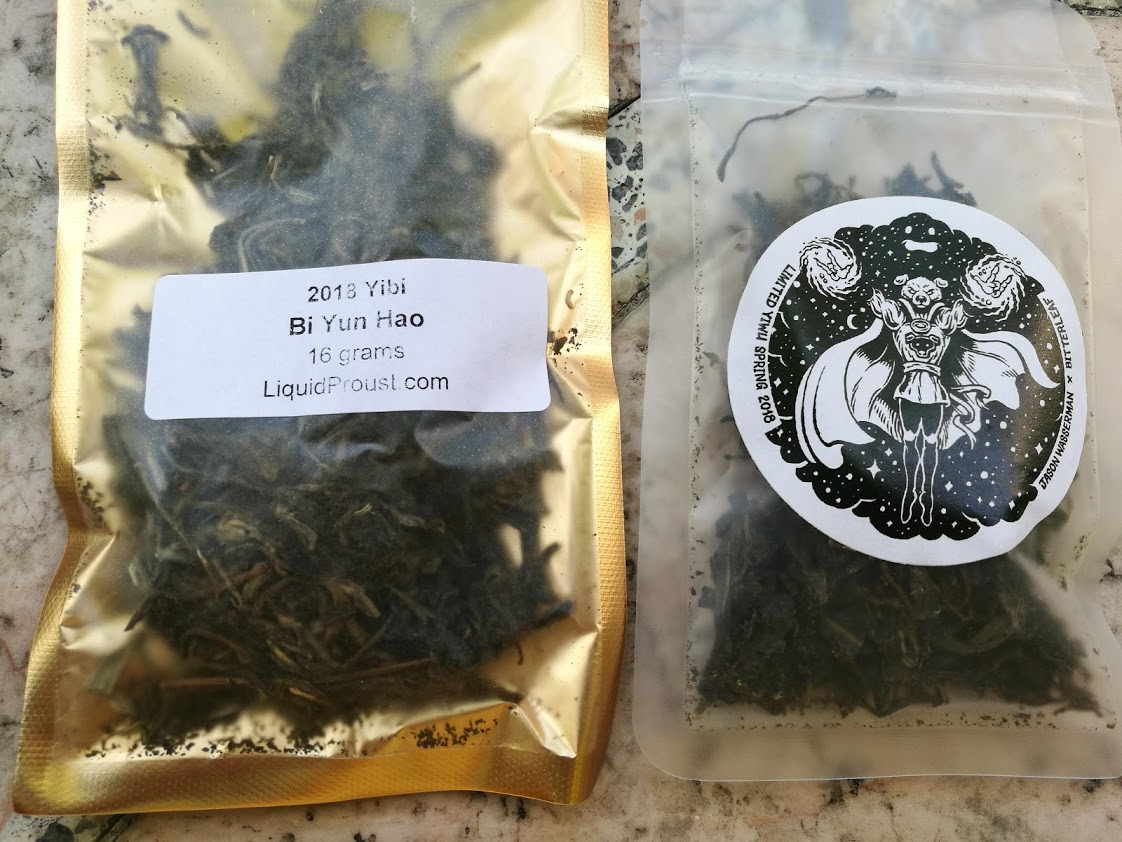
Yibi Bi Yun Hao left, Bitterleaf Year of the Dog right
|
I'm reviewing two more sheng pu'er that were included
in the Liquid Proust Sheng Olympiad set, the second review after trying a pair
from Crimson Lotus and Hojo earlier in the month.
I reviewed these teas with only the label names as background initially, but I'll add more detail to that cited from vendor sites here.
2018 Yibi Bi Yun Hao:
A Tea DB reference describes this producer (briefly):
Small-scale Taiwanese producer focused on Mengla County productions.
Another
sales related reference by a vendor works well as limited background:
One of the tea farms that Biyun Hao focuses on is in Yibi (易比), a village in the southernmost tip of the Yiwu region. Mr Youquan has a long-standing relationship with a farming family here, which enables him to work toward optimal agriculture practices, leaf grading and, especially, processing techniques. Biyun Hao uses traditional production methods: kill-green is done by hand in the wok, and the tea is sun-dried. In this tasting opportunity, we offer four consecutive years of spring Yibi gushu tea: you will receive 1/8th of a cake of each of 2015, 2016, 2017 and 2018 Yibi, for a total of approximately 160g of tea.
That implies a good bit more than it actually says, but I'm fine with that. That was selling for $80, by the way, which maps out to a rough-estimate retail price of a bit over $160 per cake (although they really should add more for collecting a set and selling it as such, and probably do). There's more on that set and other options from that vendor
in this Tea Forum discussion, if more background reading is of interest.
Just for reference this Sheng Olympiad set cost $34 for 75 grams of tea, one of which may or may not have been identical to one from that set (or from the sounds of it the LP / SO version may not have been "gushu;" see following input comment).
Nothing like a review description, sales option, or retail priced turned up for a cake of this tea, or even a clearer description; nevermind. Andrew did say this about it
in the LP Sheng Olympiad description:
...While I have extensive purchases in the Taiwanese puerh market this is a brand that I have decided to step away from. This will offer a unique session as an upgrade from the typical material you find in a daily drinking cake because... well, to be honest this cake is inexpensive.
That doesn't seem clear, though, does it, that inexpensive tea would necessarily be a step up from an ordinary daily drinker? Again, nevermind.
Bitterleaf 2018 Yiwu:
Andrew's description: 12g 2018 Year of the Dog from Bitter Leaf Teas. That's going to help.
That vendor description:
A contemporary classic, this proper Yiwu village raw puer is one of the best examples of a quality tea that fits any budget and that any level of drinker can appreciate.
Formerly known as our Year of the Rooster and Year of the Monkey, this tea is made from the same material as the aforementioned cakes and features a typical Yiwu fragrance, backed by a smooth honey-like sweetness. We highly recommend this tea for both beginner and experienced drinkers alike as its gentle and non-abrasive character make it easy to accept, while the depth and flavour will please any Yiwu fan. This tea also makes a good candidate for both drinking now and storing for the future.
The material for this tea comes from former terrace trees that have been converted to fangyang (放养, lit. “left to grow”) land for the last decade...
Sounds good. It sells for $39 for a 357 gram cake, so at least the price-point implies that it's moderate quality material. Pricing deals with supply and demand, and not just tea quality or style, but given this cake is Yiwu standard pricing would tend to run higher rather than lower per whatever quality it is, given that it's somewhat characteristic of teas from the region. If it's even average quality that price is fair.
Onto review descriptions then.
Review
I tried these without seeing any description, so I only knew the year, producer name, and one location (Yibi wasn't familiar, or really it still isn't, since this ran long enough with adding that). Brewing approach was standard for how I prepare sheng, using very near boiling point water (with most heat loss in using a thermos and delaying between infusions), and a proportion nearing a gaiwan full after leaves were saturated.
 |
YBYH left, Bitterleaf right (just getting started)
|
2018 Yibi Bi Yun Hao: Earthiness stands out right away, but it's situated within a pleasant sweetness and other range that comes across as floral. It's early for aspect descriptions, just opening up, but it seems like this tea will be approachable (not too bitter) and reasonably well balanced. That earthy aspect is a little unusual, in between wet stone and pickle, so slightly sour. Most likely it will all transition to become clearer in the next two rounds, in addition to changing, so it's as well to leave this at first impressions.
Bitterleaf 2018 Yiwu: It's a little light yet, but already starting to show where it will go. For Yiwu (most I've tried, at least) sweetness and pronounced floral tones are characteristic, often with more bitterness and astringency than a style of tea made to be very approachable generally comes across, but not so much so that the teas aren't good to drink right away.
Of course I've just mixed too many factors together for that assessment to make any sense; tea plant input factors beyond terroir and processing step inputs vary outcome, so identifying that much final tea character by region makes no sense. To a limited extent local conventions about processing approach could be consistent across even a relatively broad area, so it might still work to describe sweeping generalities, but only to a limited degree. It's generally best to just describe teas though, and if a comparison reference is really required to pin that down to resembling a specific tea version, one example. Mild bitterness stands out initially in this tea version, with a decent level of supporting sweetness; it's a decent place to start.
Second infusion
 |
YBYH left, Bitterleaf right
|
Yibi Bi Yun Hao: bitterness and sweetness are balancing nicely, and there's plenty of floral tone to make for a nice context. The warmer mineral and slight sourness are still present but the effect has shifted over to mostly mineral range instead, not one that's odd in any way, beyond a trace of a slight original sourness that carries over.
Bitterness is defining the experience, which isn't all that unusual for relatively new sheng. I've not done as much with exploring the range of teas that aren't necessarily ideal for drinking within the first year, and don't require a dozen years of aging to be pleasant, but fall in between. Both these two teas might be examples of that, versions that could soften and lose the brightest intensity over the first two years but which have enough bitterness that this aspect tapering off some would be positive. Or maybe not; this is relatively approachable now. There isn't much astringency to this, compared to the moderate level of bitterness; the feel is quite soft.
Bitterleaf Yiwu: a lot of the same applies for this tea too; bitterness stands out and defines it. I'll have to mostly judge how both stand for drinking them now, since that's what I'm doing, although at the end I could guess out some aging potential projections. It's also on the soft side as feel goes, but then that really could relate to the teas more or less just getting started.
I think sheng versions tend to perform better when you aren't reviewing them, when there isn't a delay to type out these sort of notes between rounds, allowing the teas to cool again before hot water contacts them. If true that would make for a considerable flaw in review input in general, wouldn't it? All the same I'll try a typical short infusion time for both next round to get a positive balance of bitterness with other flavor out of them. I can test that theory by rambling less next round, by getting on with it.
Third infusion
Yibi Bi Yun Hao: complexity is more interesting now; using a fast infusion time did drop the bitterness back into a lighter balance, with plenty of flavor showing through. That infusion time was well under 10 seconds but it could've been even faster related to the results. Sweetness is nice in this, at a good level to match the bitterness. The main aspect range is floral, just a bit non-distinct, maybe related to being complex, or possibly related to being underlied by mineral and joined by earthy range. The earthiness is more towards tree bark now, not far off forest floor, or not too far off a wood tone, hinting a little towards a root spice. Mineral is warm and complex. It all works ok together.
Bitterleaf Yiwu: this is a little brighter in flavor range but closer to the other than I would expect for Yiwu; it has a bit of warmth of character in the mineral, and slight trace of earthy range. It comes across more as biting into a tree branch tip, a live version of a stick, more lively, different in range. Again a non-distinct floral tone sets a context, versus that type of flavor aspect often standing forward in what you notice instead.
Fourth infusion
It wasn't in the tasting notes, but judging from these brewed tea liquid colors the Yibi Bi Yun Hao might have been oxidized a little more. That's a long story to get into, about why that would occur (a longer wilting cycle, referenced
in the last Sheng Olympiad sample review related to a Hojo processing decision) and what it would change. A lot of the effect would be what you might expect; the bitterness and astringency common to sheng would soften some, the tea would sweeten a little, moving just a little towards the character of black tea, but not really getting there, maybe drifting more into an oolong range. It probably trades out some long-term aging potential for making the tea more pleasant right away, although that gets into a judgment call a little.
Yibi Bi Yun Hao: I used the same infusion time, right in between 5 and 10 seconds. Flavors seem to be "cleaning up" in this version, not that it was ever musty, or challenging in any way. The earthiness tied to wood tone (and even spice) transitioned further in that direction. It's not spice in a familiar, strong, clearly defined presentation but it is in that general direction. I've been describing aromatic wood aspects a lot lately as towards cedar or redwood and it's not that, but not so far off it. The woody tone is more like a relatively fresh fruit hardwood, cherry or something such. As such it's fruity, but the scent of a fruit-bearing hardwood isn't fruity in the same way a berry or smoothie of some sort would be. It's more like a wood-tone that hints a little towards cherry.
It's a nice effect, at this stage. Brewed twice as strong I don't think it would seem like this at all; I think the bitterness would still seem to overtake the rest of the range. Someone might protest that bitterness is tongue-based flavor, and I'm discussing olfactory perceived aroma, but as I interpret flavor experience the range isn't as distinct as people tend to describe. Effects mix a bit, and seem to link, or crowd what you experience most, even if in a distinct range. Or maybe I've just walked off the map related to making any sense about tasting experience right there.
Bitterleaf Yiwu: Bitterness still stands out more in this, even brewed that fast. It's not a bad thing; using an infusion time that fast shifts the range of what you experience, and the balance still works well. Bright floral and sweetness counters and balances it; it's a typical but positive and pleasant profile. It could be a little more intense but it's nice.
Fifth infusion
I went a little longer due to messing around; that will provide a different look at the teas, and see if my guess about how that changes things was right.
Yibi Bi Yun Hao: Bitterness is a lot more pronounced at this higher infusion strength, and the mineral aspect ramps up. The rest of the flavor is crowded a bit by that. It's still not bad; the intensity works, and it's not really challenging, just in a different balance. For someone not acclimated to bitterness as a primary flavor component of course it wouldn't work. Aftertaste is stronger (which stands to reason), but the feel is still a bit limited as a tea this young goes for being brewed to this intensity. With that as one of several markers for older-plant source, better-quality teas this doesn't seem to rank high on the scale (at least related to that factor), but it does seem like decent tea. It's not flawed, or unpleasant in character.
The limitation seems to be that the aspects and overall effect are pleasant and positive but to me nothing stands out as exceptional. One trace aspect was more interesting last round but it seems to mostly have generally positive character across a range of aspects and character. I guess that always depends on preference, doesn't it? Floral tone could be better defined, or stand out more, or the earlier earthy and wood range could be different. It's not so much what's present that limits the tea, it's what isn't there, some additional distinctiveness in a positive range. It's fine though.
Bitterleaf Yiwu: the character of this tea is warming, including more deep earthy tones in the mineral range. I suppose I do like this tea better but the floral range could be a little more pronounced, and the amazing intensity some better Yiwu possesses could ramp up. It's fine in a different sense; I like it more than the other version but better Yiwu really tends to "pop" more. Examples would clarify what I mean, but they would muddle things for being me describing aspects from memory, and dropping out an overall assessment of teas' characters for comparing across long periods of time.
Sixth infusion
Yibi Bi Yun Hao: This tea seems to still be improving; that's a good sign, to get better as infusion count continues. It's not that different than the last round, just dropped back in bitterness related to shifting the time back to less. Within the next two or three infusions it will probably require more than a 10 second timing just to stay at this level but for now intensity is holding up, maybe just dropping slightly in how the balance comes across, but still in a positive way. I do like the tea; the two versions are more even when brewed lightly at this count in the infusion cycle. It's odd calling this tea mostly woody and then fruity since I don't think that would be a universal interpretation, or maybe not even a typical one, but that's how it comes across to me. Seeing it all as a broad floral tone range instead would make sense.
Bitterleaf Yiwu: the "warming" of this aspect range continues. It's almost onto a toasted pastry sort of effect, a little towards how very moderately roasted rolled oolongs come across (but only sharing a little range; it doesn't taste like one of those tea versions at all, or feel like one). Again that could be interpreted in lots of different ways: as a different form of floral tone, as wood, towards spice, or as a warm version of mineral. It's complex, so it's not as if there is a simple aspect range that could be interpreted in different ways, instead it's covering broad range that might stand out as different individual aspects, when in fact it covers some scope. Brewed lightly the level of bitterness is nice, moderate, relating to a slight dryness in feel that is catchy (back to the theme of different and seemingly unrelated aspect ranges seeming to connect).
Again related to standard quality markers (intensity, sweetness, pronounced floral tone, pronounced underlying mineral, feel-structure, aftertaste) it doesn't come across as exceptional tea but it does seem nice, "good," in a more limited sense.
Seventh infusion
Usually right around now I'm set for drinking enough tea, but I'm not feeling the effects of these as much as I sometimes do drinking a single version. The cha-qi or drug-like effect must be limited, for both. All the same it is about enough tea.
Yibi Bi Yun Hao: more of the same; the balance is fine, pleasant. I wonder if these aren't blended-source teas, and that's why they seem generally good, decently balanced, pleasant, and made from decent material, but not as distinctive or intense across individual aspects as I'm used to from drinking more "local" versions of SE Asian sheng. I'm guessing that no tea description will actually shed light on that, but I'll look into it during the editing stage.
Bitterleaf Yiwu: this is nice too, settling into a well-balanced place. To add more detail to the last comment the pronounced but non-distinct floral tone in this might be different, more notable, if it came across as more limited in range but still at this intensity level. The tea is nice though.
Conclusions / assessment
These both seem like teas that might work well as versions that are above average as standard factory teas go (just in a different style; not as "designed to age"), and not as distinctive / sourced and produced differently as higher quality new versions (teas that you'd expect to pay over $100 / cake for). A tea veteran just mentioned how he was trying to cut back a bit on the spending related to drinking $200 200 gram commission-produced cakes; these don't seem like that. But they seem fine for what they are, if presented as moderate cost teas.
Then again I don't know what they're sold as, or at least didn't at time of making those notes.
I liked the teas, and if these are both $40 full-sized cakes (going from the listed price for the Bitterleaf version, and the "not expensive" description by Andrew of the other) then they seemed to be quite good quality for that price level. Before I ran across that input (any guess about pricing) I commented in
a Reddit thread about this Sheng Olympiad set that I didn't feel compelled to buy these based on tasting them, but if I was already ordering others and these were an option I might go with adding one as a "daily drinker" related to that quality per price ratio.
They don't seem like they'll age well, necessarily, so I would try to drink at least half the cake right away, in case it just fades away later rather than transitions positively. I think if someone didn't have many cakes around it might make sense to hold onto that last 1/3-1/2 to check on aging progress, but if they did they could just drink straight through these and skip that part without risking much in the way of potential loss.
I made the point earlier that if a style comparison was to be made it would work better to specify that as a comparison with a specific tea, not as related to all Yiwu versions in style, or splitting that into two type groups, "ready to drink / modern style" and "better with some age / more traditional style / more bitter and astringent." It's a judgement call, and potentially bad form to go there, but I can mention a Yiwu version I like better, that I think is comparable in style but better tea at an equivalent price range.
This one, a Tea Mania Yiwu Lucky Bee version (2017 though, one year older, and $45 instead of $40).
Some clarification applies. I tried the 2016 version, not this one (
last year, reviewed here, so I'm projecting back that the experience of the 2017 would be similar now). Inputs change from year to year; it could be not as good, or better, or just different.
Stylistically the Tea Mania version slides a little down that scale I just mentioned too; it was a little more bitter and astringent than ideal initially, which I expected to wear off to roughly perfect later in this year or so (projected back; I tried the tea at two years old, and it wasn't quite as soft and easy to drink as these two as a two-year-old tea versus a one-year-old version). It was also much more intense, more floral, sweet, and bitter, with a more defined underlying mineral layer.
I'm assuming that the 2-3 year old aging ideal works in saying that (that both versions would be good in that age range), related to this tea and my preference. In the past I've experienced the opposite, and I like relatively brand-new Yiwu better, because swapping out that initial intensity comes at too great a cost. It was just an intuition, that the "sweet spot" for aging that Lucky Bee tea would relate to not drinking it brand new or waiting 12 years.
To be clear, I think both of these teas I might like just as well as the Tea Mania version if drinking them within 9 months of production, but it's my impression that the Tea Mania sheng has more potential to soften a little with limited storage time to become a more intense and better balanced version. It's probably even better now; I haven't tried it in the last half a year. I really should order the 2017 version too, if I'm going to keep mentioning that tea.
 |
not related to tea; at a swim lesson (the one on the right is mine)
|
 |
the other one on a swim class break
|