Showing posts with label Korean. Show all posts

Tuesday, August 7, 2018

Seogwang Woojeon first flush (South Korean green tea review)


This is another post related to reviewing samples from Tea Mania, Peter Pocajt's Switzerland based online tea company.  I'm only seeing a reference to a similar second flush tea on the site, versus this being labeled as a first flush version; that's funny.  I have no idea how similar or dis-similar those would be.

I want to guess anyway, because Americans can be like that, eager to have an opinion about things they know nothing about, but I'll skip that part.  It couldn't really be as extreme related to the difference in Darjeeling flushes because they don't fully oxidize the first flush version but then almost always make the second as a true black tea, and both of these are just typical green tea. 

They do that to get the most out of the inherent character in the leaves in Darjeeling, per my understanding.  The first flush lends itself to making a brighter, lighter, intense floral tone version, with a different second flush mineral intensity, earthy aspect, and muscatel / citrus range lending itself to being made into a more oxidized tea, a true black tea.  Of course I'd have to try a fully oxidized comparable first flush or lightly oxidized second flush to really pull it all together, to see what initial leaf character contributed apart from the processing differences.

I'm going to keep this simple; these posts have been running too long.  I will mention some background location details since I've not been reviewing much from South Korea for awhile, from that Tea Mania link I just mentioned:


Origin: Seogwang farm, Jeju Island, Korea.

The tea garden of Seogwang Farm is located on the Korean island of Jeju. It's located in the triangle Korea - China - Japan and is of volcanic origin. Through the 1950m high volcano Halla, which is a UNESCO World Heritage Site, clouds accumulate and therefore it rains often and is foggy. Combined with mild temperatures and mineral rich soils, these are ideal conditions for the cultivation of high-quality tea.


a very cool looking related farming area photo (credit Tea Mania's site)


Review


I brewed this tea on the cool side, maybe too cool, down around gyokuro temperature, closer to room temperature than boiling. It wasn't exactly to optimize the tea, just guessing out parameters.  For that second flush version they recommended 70 to 80 C, but I'm guessing this might've been down around 65 (just a guess, not measured).  I prepared it Western style; something different.

For familiarity with type I'm about as far off as I could be.  I've tried Korean green tea before, that I picked up in South Korea three years ago on a visit there (more a travel theme account of that), but it wasn't sold as an above average quality version.  I did buy tea sold as better quality yellow tea there, and I've tried North Korean green tea made in a Longjing style that was better.  I vaguely recall discussion hearsay that a typical flavor profile might include some type of roasted squash; that's it.


In tasting the tea that's the main flavor that stands out, roasted butternut squash.  Beyond that there's a little pine needle, or rosemary, and beyond that the umami and other vegetal range common to Japanese green teas.  But the balance is sweet, heavy on the butternut squash, with limited umami as some Japanese teas go.  I'd expect that using a bit hotter water would draw out a lot more of that, and the balance of other vegetal range might shift.


I guess that I like it. Green tea isn't my thing but it is quite unique as those go.  That bit of pine is nice, the sweetness is good, and the flavors are clean and bright.  For being brewed using really cool water and a moderate proportion and timing the intensity is good.  The thickness is nice, smooth and full, a bit creamy even.  A little of that sweetness even reminds me of the taste of fresh cream.  I might have did well for final results, but I will try slightly warmer water next round to experience that shift.


in a standard coffee mug too; totally slumming


Using hotter water did change things.  For a tea this good it would be respectful to actually measure that water temperature but I didn't, again.   The shift is what I expected:  there is still plenty of sweet roasted butternut squash as a main aspect but pine picked up, and seaweed, and the flavor became a bit more savory. It's not astringent; brewing even closer to boiling point might draw that out but this didn't.

kind of a cool look, plenty green and bright


A bit of mineral base joins in, like the light rock mineral flavor in better Vietnamese green teas.  It's in average versions of those too but the form and the way it comes across shifts in better versions, a small step towards how Japanese green teas balance.  Upon reflection some of the roasted squash swapped out for green bell pepper too.  For someone who loves green tea this would probably be fantastic; for me it's just good, and interesting.  Again it's the overall balance that works so well, the sweetness, full feel, intense and clean flavors, and the brightness.

Guessing from what I remember of tea shopping experiences in South Korea I bet you'd have to pay dearly to buy this there, maybe even on towards $1 a gram.  The market conditions are the opposite of here in Thailand, it seemed; they don't produce that much tea and it's in high demand. The best Thai oolongs are resold as Taiwanese oolong instead to balance that out here, or at least that's the general understanding that comes up.  I checked the price for this second flush version (the one on the site) and it's CHF 9.9 for 100 grams, or $9.95.  If that tea is anything like this one that's probably a really good deal, less than you'd probably be paying in Seoul.  It sounds like I must be making that up, doesn't it?


There you go; Seoul grocery store tea selling for around $12 for 50 grams back in April of 2015.  Seoul could be different but I've not had great luck with grocery store teas in a good number of different countries.  Those can be ok but not like this tea I'm reviewing, not on this level.


I get the impression that this will probably brew a couple more rounds in its main aspects profile and keep going beyond that. Since I'm used to far more messing around than doing a few Western style infusions amounts to I can keep going.  I like the messing around, doing 7 or 8 rounds of comparison Gongfu style, but it's nice being on break from all that too.  For the last three Saturdays I've been out on tea tasting gatherings and today I'm just off on break.


brewed a little stronger (also darker for being a full cup)


kind of a cool look while brewing


The next round hasn't transitioned that much. I think from the aspects the water was slightly cooler; the sweetness and light range picked back up and the mineral undertone and bell pepper dropped back.  The intensity is just as good, and the roasted butternut squash plays a slightly larger role.  Given how many kinds of pumpkin in between butternut squash and the US version of pumpkin this might be as close to one of those, maybe as much like roasted Japanese pumpkin, a sweet version of the Thai one, with a completely different skin appearance.
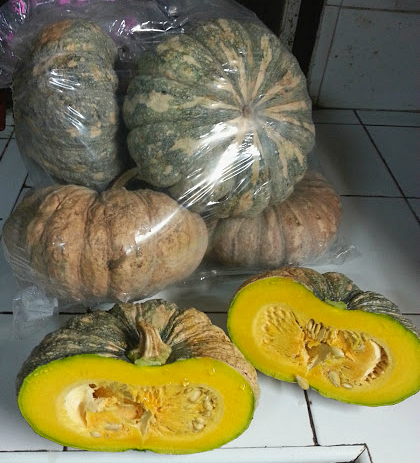

I was living on these after visiting a wholesale market in Isaan


I'll probably drink at least two more rounds, maybe after a break, since these are large mugs of it I'm preparing. But this is a good place to leave off the notes.  I have no doubt that shifting parameters more would draw out much different aspect sets; it would be interesting hitting this with much hotter water to see what happens. Kind of a shame to do that too, maybe, depending on what comes of it.  It might just seem more like a sencha, with more astringency and umami stripped out, but it would have to give up some of that cool aspects set balance.


I did drink more of this later but never added to these notes.  On the whole it seemed a really pleasant and interesting tea, definitely different than any other I've tried before.  It changed quite a bit related to using different water temperatures, so I'd imagine that dialing in any proportion, temperature, and time parameters would take some doing, gauging those to preference.  It didn't have the grassiness that tends to throw me off green teas, and the umami being there but in a lower proportion than for some Japanese tea versions worked better for me.  The umami effect is cool but I'd gladly swap some of it out for a sweet version of roasted squash and a hint of pine needle.


obligatory kids-doing-stuff photo, at the Dusit zoo


some serious looks before swim class the next day


Tuesday, April 28, 2015

Yellow tea explained, and a Korean yellow tea reviewed


This post will cover yellow tea research first, then a review of an example I bought in Korea.  As I mentioned recently it's not informative to review one tea against a type, without reference knowledge of trying others, but at least it fits my "journey to tea" blog theme.


Yellow tea research


Why not start with Wikipedia input:

Yellow tea (Chinese: 黃茶; pinyin: huángchá) usually implies a special tea processed similarly to green tea, but with a slower drying phase, where the damp tea leaves are allowed to sit and yellow... The smell is sometimes mistaken for black if the tea is cured with other herbs, but similarities in taste can still be noticed between yellow, green and white teas.


Sounds good, if a bit vague.  Maybe back to the reference graphic on tea processing, with the long attribution label:   by Sjschen (Own work) [GFDL (http://www.gnu.org/copyleft/fdl.html) or CC-BY-SA-3.0 (http://creativecommons.org/licenses/by-sa/3.0/)], via Wikimedia Commons


yep, add "moist heating," or sitting there wet (can't be that simple right)


Another vendor reference (Tea Trekker) clarifies what these steps really involve:

During men huan [firing] the heated, softened leaf is removed from the tea firing pan, covered with a cloth, and allowed to ‘rest’ for a few hours or as long as a day. This smothering step can be repeated several times over several days... In this step (which is not part of green tea manufacture ) men huan encourages the softened leaf to reabsorb its own aromatics. The results of this step will be expressed later as additional sweetness...


The same reference said the teas can be produced from buds only or from a bud and two leaves, which sounds essentially the same as for white teas, but then resulting in the two different white tea types.  This and other references say the combination of better leaves being used for the process and additional expertise and expense being required lead to limited tea availability and higher cost.  Fair enough.

It sounds a little like the processing step for shou pu'er (also called cooked pu'er), the step that chart called "wet piling," although of course it's not exactly the same.  The variation in those final products indicates it's not so simple to leave a pile of wet leaves sit to result in a better tea.  It can go badly.


World of Tea processing by type chart (credit Tony Gebely; see link)


This seems a good place to mention a separate tea processing reference, found here, included above.  This replaces the yellow tea processing step "moist heating" with "heaped," and omits "rolling."  Of course with more research one could go to the next level of detail of specific steps variations of this processing.  One other interesting difference in both does tie to pu'er (fermented tea / post fermented tea in these, or heicha if you must, since pu'er is really a regional designation), but I'll skip getting into that.


So far nothing about the taste of the tea, which is compared to both green and white teas in processing, but surely with a taste difference.  A relatively well-known mainstream source, Teavana, describes their product as such:  

Unlike any tea you have tasted before... Captivating high floral notes mingle with a smooth honeyed body and a subtle creamy, buttery finish. A perfectly balanced tea.. 


Ok!  The price is on the higher side but not different than the range for white teas, comparable to the cost for both the yellow and black teas I just bought in Korea.  Their site is actually interesting for including good product description, and of course a clear photo, and also a product review section.

It could be in poor taste to make fun of the reviewer comments but I can't help but mention a couple of anomalies (aside from the tea getting really high reviews--it probably is nice).

One said "when I add the right amount of sugar to this tea it bring the honey and buttery notes to the front..."  I'm the first person to advocate someone drinking their tea as they like it but this seems odd, tea blasphemy, but at least I didn't read about someone icing it (which I suppose they could do--it's their tea).

Another person recommended it so highly they mentioned buying five pounds, well over $1000 on one tea purchase.  My wife should be grateful I don't do that, and ease up about the small stock-pile at home I keep trying to drink through.


Another vendor reference (Vicony teas) roughly matches other type descriptions, just a bit more colorful (with more information in the site content):

This rare yellow tea from Mt. Mengshan, Mingshan County, Sichuan province has been a tribute tea from the Tang Dynasty (618-907) to the Qing Dynasty(1644-1911). ...  Meng Ding Huang Ya is mostly made from tea buds picked during the early spring to create a nutritious tea with a mild and sweet flavor and unique fragrance... It is ideal for tea drinkers especially women who like green tea but want to avoid stomach upset that can occur from drinking green tea. Yellow tea is legendary for its healing properties.... this lightly oxidized tea has a mild flavor without the grassy smell associated with green tea.

... one of these few rare yellow teas, Huo Shan Huang Ya, is now only made into green tea so Meng Ding Huang Ya is seen by Chinese tea industry people as "living fossil of tea".


To be clear I'm not saying that this is the same type of tea I bought and will review; the general category of"yellow tea" is supposedly common.  Cool reference though, "living fossil of tea."


It takes some paging through Google search results to get to any reviews.  The Steepster reviews of the Teavana product (mentioned earlier) don't shed much more light on the character:  floral, smooth, subtle, buttery finish.  Actually it seems you never do make it to the familiar blogger posts; on page 9 of searching "yellow tea" a reference page on yellow tea by the "Tea Stylist" includes a short review section, with the tea described as:

 The taste was indeed subtle, but round and a little more vegetal than sweet with no astringency.


I kept reading it to see if I'd missed the actual description but that was it--a subtle review description for a subtle tea.  The point of the reference was really a description of the tea type, and there was a good bit more content on that.

Of course changing a search to "yellow tea blog review" did turn up different results, a review by one of my favorite tea reviewers, Kevin Craig, the Tea Journeyman, covering the yellow tea that stood out the most in the research, a Tealet product.  The review description:

The leaves are fully intact, appearing to be one leaf and bud, with the occasional two and a bud... The aroma of the liquor is delicately sweet and floral, with a slight vegetal scent. The liquor has a light body and a very mellow texture. The taste is delicate, with a nice balance of floral and very light sweet and vegetal notes. There is no bitterness to the taste. The finish and aftertaste are light and floral....

As a yellow tea should be, this Yellow Bud Yellow Tea from Vivid Huoshan displays characteristics of both white and green teas, and yet has characteristics that are unique to yellow teas alone...  It also maintains the fresh vegetal notes of a green tea.


The other Teavana tea is also reviewed by a familiar name in a video review, by Jason Walker, which I'll only cite the location of here.


One more tangent, a health claim related


There are plenty of health claims in different references, even more for yellow tea than most others, for what that's worth.  I never really personally attach to these; maybe the teas are good for you, but who knows.  One research study article did say this about the tea though:

The yellow tea significantly ameliorated the increase in the activity of the alanine- and aspartate-aminotransferases in plasma. Thus, the drinking of yellow tea may contribute to protection against liver injury.


Sounds good, but it's quite difficult to review the study parameters, and who is financially supporting the work.  Just ease up on the binge drinking and your liver will hang in there; no tea will help you if you alternate glasses of whiskey and cups of tea.


Review challenges


Again reviewing one tea of a type is problematic, and the subtlety attributed to the related teas could add to that.  Even silver needle teas demand a reviewer base their impression and preference on more subtle factors than the list of flavors that really could sum up most of the impression of some other tea types.  It's not that black tea or oolong doesn't have subtle elements, or qualities related to the feel or body of the tea, but somehow--in general--a list of flavors and a comment about that dimension seems to do it for some teas but not as well for others.

Regional differences are another unusual factor.  Of course most of these references and reviews are talking about Chinese teas, with an Indian tea reference coming up, again related to a Tealet offering.  Even if this is authentic yellow tea, produced in essentially the same way as Chinese yellow teas, using a comparable tea product starting point, based on similar processing skill, terroir would vary the nature of the tea (differences in location, soil, climate, etc.), so all I've cited would be talking about something else.

To review teas is to be bold, though, with some allowance for personal style, so I'll give it a go.


Review!


I tried the tea!  My first impression was:  unusual, subtle, hard to describe.  At first some taste element reminded me of a black tea, but the body and feel and subtle character more of a white tea.  The different taste components were all subtle, quite light, and complex, but not so easy to distinguish, not pronounced, similar to a silver needle.  


Maybe there was some hint of a floral aspect, but not much, and a sweetness reminiscent of honey, but not pronounced as these can be in a better tie kuan yin.  A trace of a mineral component reminded me of such found green teas, a trace of flint.  Yet another subtle flavor element resembled hay.  The richness of the feel and that taste component could come across as butter instead, but it seemed to me the separate trace of mineral pulled the interpretation of that other separate component in a more vegetal direction, from butter to hay, if that even makes sense.


Something about the set of flavors and character reminded me of the Korean black tea I reviewed, but it was hard to say what.  I think maybe the mineral element was common, or maybe more than one component.  


The tea produced multiple infusions with subtle changes in character, so a more standard, some could even say "proper" review wouldn't summarize flavor components together as I have, but would instead track the elements and transitions across them.  Perhaps later I would as well, but for trying a new tea type it seems as well to keep it simpler.


To back up to the beginning, the tea was presented as small, twisted leaves, without any stems.  The scent was sweet and distinctive, a bit herbal and rich, slightly towards grassy.


It's harder to say if I liked the tea.  It was so unusual I'm still taking it in.  Someone that really loves white teas might love this as well, but although I've tried some and can appreciate them my own palate still seems a bit juvenile for that, back towards black tea, or maybe more accurately more oxidized oolongs, comparatively straightforward stuff.  

I could see how subtle differences in brewing might really affect this tea, or differences in water used, etc.  It could and probably should be optimized.  For some teas brewing them very lightly actually seems to enhance the way the flavors are presented, or maybe that's just my take.

Or, on the other extreme, as one reviewer I'd mentioned here expressed a bit of sugar probably would bring out some of the honey and butter.  It would be hard for me to do that to this tea, even in the name of experimentation; it would be disrespectful to this tea.  I'm reminded of a co-worker trying a taste of a nice Rou Gui I was excited to try, and asking if she could add sugar to it.  I replied no, you can't, you're thinking of a different type of tea.


Is it really a yellow tea?  I couldn't know for sure.  It is an interesting tea, unlike any other I've tried yet.  I also couldn't guess where it stands related to similar teas.  


There is one best reference on Korean teas I've not mentioned yet here, but the range of posts and detail doesn't lend itself to citing a few sentences as review blogs or vendor descriptions might.  I'm referring to Mattcha's tea blog.  Even the tea types aren't always presented there in such a clear-cut fashion as the standard categories, with yellow teas exhibiting a bit of range (here is why).    


A really interested reader might explore a range of posts on that blog, (eg. http://mattchasblog.blogspot.com/search?q=yellow), with further reading about where to get teas in this post, a list of vendors and some sourcing information, a bit dated now from posting in 2010.

Wednesday, April 22, 2015

Review of Japanese black tea (wakoucha)


I tried the black tea I bought in Japan recently.  I wish I could say it was an interesting and positive presentation of a black tea style, but I didn't like it.

Usually it's not so simple; teas have a complex character, and some aspects are positive, others negative, and it's more about appreciating aspects and then noting how it matches overall preferences.  This tea had a strange flavor element that I didn't care for.


looks like tea (maybe a little choppy)


tea label (black tea?)


That taste element reminded me of gaba teas I've tried in the past:  nitrogen-environment processed teas, designed to result in production of a brain function regulating component compound (with the shortened name "gaba").  Maybe such a tea calms you, or possibly it doesn't, with more on the flavor and effectiveness in my earlier research and review post.  You might wonder, why would exposure to nitrogen affect a tea, because it's the main component in air anyway?  Good question.  My understanding, as conveyed by a tea guru, is that the lack of nitrogen forces reactions that would normally be based on oxygen to occur with nitrogen instead, so the tea would be less "oxidized," even though something similar but different would still happen.

It's worth noting that I've only tried such teas produced in Taiwan but the processing was developed in Japan, and it's my understanding that most such are consumed in Japan, perhaps even of those produced in Taiwan, so I don't know for sure that there wasn't some type relation.

But onto a review of this tea.


Review


A general maltiness came across first, and a fraction of a second later that taste element that I'd spoken of.  It's hard to describe; a bit like cardboard or chalk, a mustiness, maybe leaning a little towards wet dirty sock.  In some gaba teas a similar taste tied to a dry feel to the teas, and maybe a little here, but less so.

It was hard to get past that flavor element to evaluate the rest of the tea character.  It didn't have a lot of astringency, and was a little malty, a bit earthy, and if somehow that one taste could be removed it might have balanced into a nice tea.  With it--I'm not sure what I'll do with the tea.  More guesses on what it tasted like:  cork, but not a fresh and light cork similar to balsawood, which would be nicer, or a little like that smell of old books in a library.  I love that smell but wouldn't love it as a flavor in tea.


I almost have to compare the tea to a black tea I just bought in Korea and recently posted about, although the two teas are quite different.  That one lacked an objectionable flavor component, and so seemed superior.  Attributes that weren't as positive as in my favorite teas stood out in the Korean tea, so it was interesting but wouldn't be a favorite.  In both cases I couldn't help but think drinking green teas instead might make more sense, reminded of the expression "when in Rome do as the Romans do."

But I'd been through the opposite experience in Vietnam half a year ago.  I tried a lot of consistently good, distinctive green teas--what they typically drink--and also tried two very nice black teas, and one very good darker oolong, and one nice lighter oolong.  These were interesting not just because they were good but also because they were different than others I'd tried before, as with lots of types of teas I tried from lots of different places.


could be clearer (same for the website)
I could say more about the tea based on reading up on it on a vendor website (the package referenced one:  http://www.mikuniyazengoro.com/).  But that site is only in Japanese.  They also have a Facebook page (page linked here) but it's also only in Japanese, or at least mostly Japanese, since there at least some section heading titles are in English.


Ordinarily if I really didn't like a tea it would be as well to just not write about that particular tea (if you can't say anything nice...), especially given I'm not completely sure what I've bought.  In some other cases I've passed label photos onto foreign friends for translation, but didn't this time, so I've no idea what that site would've told me about that tea, or related product options.


In this case I'm posting all this because it's part of a larger search for teas I've already been discussing, and even a relatively negative result is part of that process.  I'm completely sure this one tea doesn't indicate anything general about the rest of that vendor's teas, and I wouldn't be surprised if there are considerations I'm not taking into account, like it's not really supposed to be equivalent in style to many other black teas I've tried.


Other considerations


Somehow it softened the blow that this tea wasn't sold as a premium tea, that the cost was at least in the normal range (around $10 for 60 grams, versus around $30 for 40 grams for the Korean black tea--not normal, for me).  It wasn't just the expense at stake; it seemed to make a difference how the tea was represented, as much as packaging type and foreign language text did such a thing.  Staff in both tea shops could barely speak English, so hardly offered any input or opinion on the teas.  In Korea the shop had been selling one significantly more expensive black tea--the one that I bought--and one relatively inexpensive one (at a more typical pricing level, likely roughly similar to this tea), so if I'd hated that tea, or if it seemed flawed, it would seem a different thing.

Of course my wife is concerned with how much money I waste on teas, but no need to get into that (it's not much; nothing like a Starbucks habit or bar spending).


To compare further and provide some context, I bought two lower range Chinese teas in a tea shop in Chinatown in Yokohama.  I was there to find Japanese teas, and only there realized they'd probably not sell much in the way of Japanese teas (after they said they didn't), because it was Chinatown.


I've tried two of the four teas, one sold as Wuyi Yancha (more oxidized oolong), the other as shou or cooked pu'er (or at least as compressed tea; labeling wasn't in English, so likely not from the right region for pu'er).  I didn't keep close track of cost for these but it was low; around $20 for a two or three hundred grams of tea.  Both teas I tried didn't seem to be high quality level teas but I liked both more than the two black teas I'm discussing here, in part related to preferring those general types, and also because they were decent teas.  I won't mind drinking them, and wouldn't have reservations about sharing it.


It was interesting they were calling black tea "red" in that shop in Chinatown, and referring to compressed teas as black.  This seemed to come from Chinese terminology, of course, and also helped explain why I might have never found a Japanese black tea without using a different Japanese name (wakoucha).

It's not possible to judge a general tea type by one tea product, so I really can't say much about either Japanese or Korean black teas in general.  As luck had it the two Vietnamese black teas I tried were both quite good, so evidence mounts that there is a generality there, but surely I could have tried two much worse teas based on having less luck.

A comment made on a Japanese black tea blog post (here) referenced another more experienced tea blogger having tried several such teas, and this is how more informed perspectives are developed, over time, based on more sampling.  Of course sourcing is also relevant.  If I'd instead tried a tea a vendor had provided based on trying many such teas and selecting a favorite that would seem a better representative than allowing random chance to lead to only one.

A very limited selection process applied to the Korean black tea; the shop presented two options and identified one as better, potentially based on cost more than the product qualities, although often the two go together.  There also seems a chance that just because the tea was sold as such and was expensive that it still wasn't a great representative of the general type.

Korean tea

It can be misleading to judge by appearance but that Korean tea did include a good bit of stem and the leaves weren't whole, so it seemed at least possible it could have been sorted as that tea product and also as a higher grade.  But who knows.


The Japanese black tea consisted of shredded leaves, typical of machine-processed tea (but again who knows; an informed tea expert might extrapolate from the final-product evidence more effectively).  I tried a machine-processed Cambodian black tea once that didn't look like much but was nice (that I wrote about here), which was nearly given away for free compared to all of these teas.


In conclusion, you really can't conclude much from trying one tea, but I didn't like this one.


Friday, April 17, 2015

Korean black tea review, plus tea haul in Korea and Japan

This post is really about reviewing a Korean black tea but I'll start with pictures of all the teas I brought back from my recent trip to Korea and Japan to start (to Seoul and Yokohama, to be more specific, although we did visit the Tokyo Disneyland).

Maybe it's no wonder my wife is always bored to death with me buying teas, and repeatedly says "enough tea already" on trips, when it's really not.  So this post is dedicated to her; hang in there.


Korean teas!  Middle is black tea (reviewed), plus a green (left) and yellow (right)


Korean teas!  In the the middle is the tea I'm reviewing, and a yellow tea I bought in the same Insadong shop, and a green tea I bought in the Seoul Gyeongdong Market (traditional medicine market).  Since the green tea seems a more typical preparation of Korean teas and it was by far the least expensive ($5 for 150 grams) I'll be interested to see how it compares to the others.

Japanese teas!  left to right, black tea, then roasted green (?), and two others


Japanese teas!  A black tea (wakoucha (Japanese black tea) 和紅茶 ), a roasted green tea (more on what that means to follow), and two relatively "generic" teas I'll also get into later.

Chinese teas!  (we visited Chinatown in Yokohama)

Chinese teas!  Odd, right.  We visited a Chinatown in Yokohama to find tea (in part; my family wasn't interested in the tea) and it turns out they only sold Chinese teas.  These are two wuyi yanchas (one identified as dahongpao, the other left generally referenced), a lapsang souchong, and a pu'er (must be shou / "cooked" ).  It was interesting to see teas from different countries on sale all over in Japan; nice they can appreciate their own diverse green teas and still branch out.


Snacks!  Three of them even tea related, green tea Kit-Kat, Oreos, and Pocky (all from Japan; where else), and a nice graham-cracker type biscuit they sell in Korea (which would be nice with tea).


Korean black tea review


First impression is of a higher grade black tea, the smooth and subtle balanced character.  Mineral elements give it a touch of dryness, in the range of flint.   there is some sweetness, not much of a fruit element compared to mineral, malt (a lot of malt), and light wood (so decent complexity),  maybe a hint of underlying grape, leaning towards a darjeeling flavor spectrum related to some of those elements, but definitely not in general.


The feel of the tea is a bit unique.  It's not really astringent in the normal sense, which comes across as bitterness,  but the dryness is related to a different presentation of astringency.  This ties with the mineral components and also to a long finish (aftertaste).  The effect is very pronounced; the taste of the tea doesn't diminish much for the first 30 seconds after swallowing it.


So that's the tea described; very interesting.  It's not really like any other tea I've tried, although some components remind me of a higher grade lapsang souchong I reviewed,  which was malty, complex and subtle, and very light on smoke (but different). But do I like it?

nice red black tea color

To clarify,  I mean how do these unique and generally positive taste and body elements relate to my subjective preference.  That goes without saying, really, (what "like" means) but I've been drifting towards deconstructing impressions one wouldn't normally express, so I may as well be clear.


I like it but don't love it.   It's quite good tea (based on my judgment,  which is still a work in progress), but I might like it better for swapping out some subtlety and mint and mineral components for a light fruit element and more typical body / feel.


Then again,  since I seek out and try different teas to experience new things it would've been disappointing if it tasted a lot more like any number of black teas I've already tried.  Another reviewer referred to a tea I loved as "juicy" (Indonesian black tea reviewed here) and I loved that impression in that tea, a bit opposite in this one, not that I dislike it.


brewed leaves; a bit chopped, some fine stem
Something about the feel of the tea reminds me of different Taiwanese red jade / ruby teas I've tried (one review here) Taiwanese teas I've tried, and just thinking about that shifts the mineral component impression towards mint. And it seems to really resemble mint, which I'd missed.


This tea's taste elements seem more complex and balance together better than the version of that tea I'd tried, with malt reminiscent of lots of black teas,  and mineral tones that remind me of distinctive Vietnamese tea flavor elements.


All in all a nice tea, and an interesting one.  Not a great value given the tea pricing in the range of a US dollar a gram but worth a try.