Showing posts with label Nika Sioridze. Show all posts

Wednesday, February 2, 2022

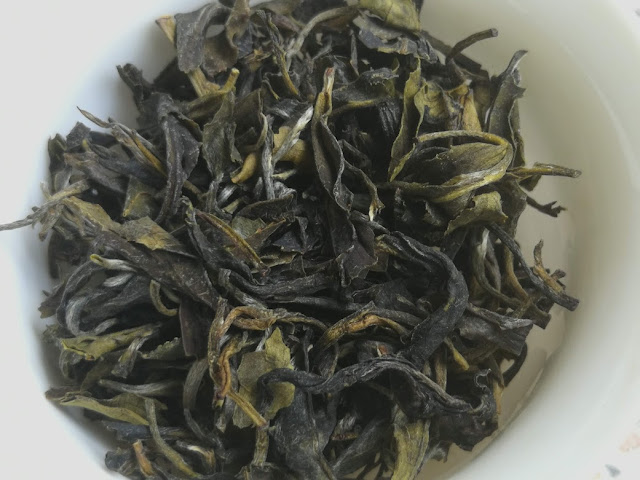
Georgian light oolong, probably similar to baozhong style


I'm reviewing the last of a set of tea samples from that tea contact in Georgia (the country), Nika Sioridze.  There was no particular reason for waiting months to get to it, I just tapered off reviewing in the last couple of months of last year and have a few more varied teas around to try as a result.  Most are really interesting too, including Wuyi Yancha from Cindy (of Wuyi Origin), another US tea from Jason of the Mississippi farm, and a bit of Gopaldhara Darjeeling.

I didn't know what the tea was prior to trying it but the color is a clue; it was probably green tea or light oolong, resembling a baozhong style in appearance.

It makes sense to include a little more about Nika and Greengold; I think this tea might be one that goes by the name Greengold (the company name).  That description doesn't mention oxidation level so I'm guessing by dry leaf appearance, which changes a lot just in relation to lighting and camera settings.  

We talked to Nika in an online meetup summarized here.  That included a comparison tea review of two of their black teas, not normally how I do that.  This post reviews what I interpreted to be two of their oolongs, but one thing confusing this (beyond the samples not being labeled) is that they use local branding names for the teas, not tea type names.  So there are some descriptions for them online, and a presentation through the site with more details, but the mapping is to a separate name type (eg. Fire of Dragon oolong goes by Daisi on their site, I think).

As with any other person or vendor you could reach out with questions about types through their Facebook page, and I did talk to Nika about what this probably is, probably a light oolong.  Or maybe it's that they aren't even trying to replicate a particular Chinese or Taiwanese style, so a partially oxidized but quite green tea is essentially an oolong, but not necessarily a copy of baozhong style.
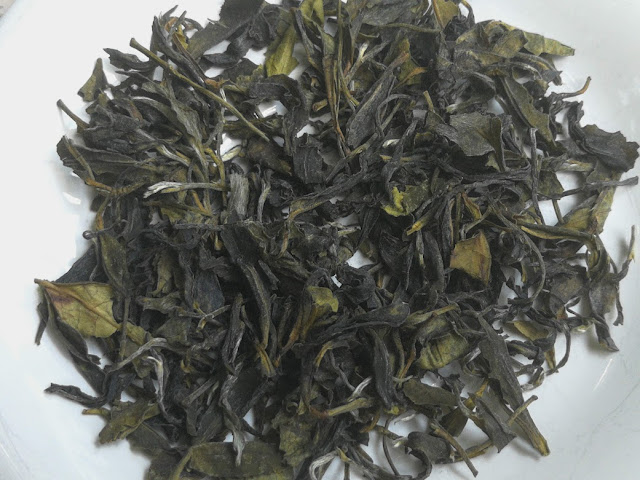

a more spread out arrangement shows off the leaf color variation better


Review:


first infusion:  really light; brewed fast.  Results are promising but this will need a longer infusion time to tell more of a story, and often the first infusion is more about wetting the leaves, since I wouldn't use a rinse with a tea like this.  Flavors are bright, floral and creamy, with a touch of vegetal edge.  This seems closest to very lightly oxidized oolong range, baozhong / pouchong, but it really could be a green tea for all the more I'm picking up so far.  If it is a green tea that ended up oxidizing a little along the way it might not be far off really light oolong range anyway.  A citrus like edge in this is especially interesting, bright and intense, out towards lemon.  Great sweetness helps it all really pop.
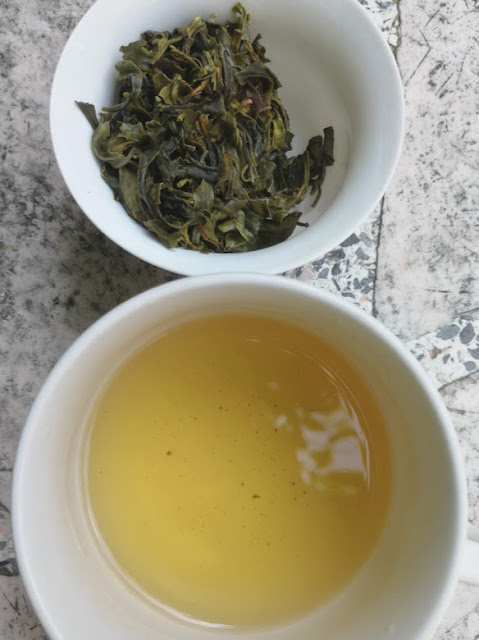


second infusion:  vegetal range is stronger than I'm accustomed to, for being off green teas for so long.  I may never conclude if this is a green tea that oxidized a little or if they intentionally oxidized it, since it seemed like a light oolong last round and further towards green tea this one, but still like a light oolong.  There's a really catchy aspect in this that makes it work well.  It's probably a set of flavors, that towards-lemon citrus, combining with a bright and light underlying warmer range, like some kind of grain, and also complex floral tones.  The vegetal part isn't like bell pepper or bean or anything like that, closer to the sweetness of a sugar snap pea.  

Then there's also a touch of astringency edge that compliments the rest well enough, that is hard to tie to making the most sense with a certain flavor, that seems to link to it.  For example floral range often seems to tie to something like plant stem.  This isn't exactly that, but it's close.  It has a little bitterness and sourness to it, not enough to really throw it off, since the sweetness, freshness, and intense and complex other flavor range integrates well with that.  There's a lot going on.  Nothing in it seems like a clear flaw; even that sourness is clean in effect, and links with the rest.


third infusion:  not transitioning so fast, so similar to last round.  I brewed this faster and lighter, using under a 10 second infusion time, and the intensity and complexity is fine in this, slightly better than using a longer time.  The flavors are so intense that it carries over as a nice aftertaste experience.  

I suppose it wouldn't be perceived by everyone as being how pleasant I judge it to be.  I'm not into standard green tea range, really, and that's the part that should be objectionable, but there's a lot more going on with this than the standard floral + vegetal range.  Astringency gives it some structure but it's still smooth and full; to me that part resembles a very light oolong.  That bright citrus note is unusual for green tea; I think that would make more sense tied to a light oolong too.  Then the floral and snap pea sort of flavors do overlap with green tea range, which can occur in both.  

There's a mineral base to this, and that warm tone I've interpreted as like a grain, that really help the rest tie together, and come across as a complex experience.  The main potential negative would be someone not liking this tea style range.  I think if someone loved oolong-style sheng pu'er (not exactly a universal terminology), versions that are very bright, sweet, fruity and floral, moderate in bitterness and astringency, and drinkable when young then this would really appeal to them.  

People not really into sheng might wonder what I'm talking about; what part of that description is supposed to be negative?  After some exposure you can come to crave the blast of intensity and extended aftertaste that can come with more intense feel and flavor range, with teas that are much more bitter and astringent.  Some people dislike both types (and aspect sets), and mostly only drink aged sheng, or just stick with oolong or black tea.


fourth infusion:  I do anticipate that this will brew a lot of pleasant rounds, and will transition some over the next 3 or 4, but I don't feel like writing a lot more notes, so I'll probably drop that after this round and mention later changes in comments in a conclusion.  Tone is warming a little; that bright lemony citrus edge shifted to seem more like orange.  The sugar snap pea might be shifting to a little deeper and richer range like fresh green bean.  Underlying mineral range is also warming, it's just not as easy to pick that up as the brighter flavor inputs shifting.  

Maybe I should do one more round of notes, letting it brew a little longer to change effect.  Aftertaste range is still pleasant but the bright and sweet floral and fruit range mixes with the vegetal tones in that too, mirroring all of it in a lighter form, so how much someone likes the flavors would map to how they take the aftertaste experience.  It's not a hui gan / bitterness to sweetness effect, because it's not that bitter to begin with, and the taste is already sweet while you drink it.


fifth infusion:  interesting!  I think brewing this stronger had just as much effect as the transition pattern.  Feel is heavier brewed stronger, with more edge, and bitterness experience is much more intense.  This effect does seem to resemble a hui gan kind of carry over more, for bumping up bitterness experience while you drink it.  That citrus part carries over in a really interesting way, more so than how you experience it while drinking it.  

This seems like better tea than it really should be.  I'm not saying that they're just monkeying around with processing inputs to see what comes of it, but they're early in the stages of developing these styles.  Nothing in this experience resembles a flaw to me, and per my understanding that tends to not happen by accident, or through a short period of experimentation.  Intensity, novelty, clean character, and pleasant overall experience are all really well developed in this.  

That plant stem sort of edge might make or break the experience, if someone doesn't tolerate that typical green tea range well.  If it helps placing that it's not so far off the taste of a green tomato, or it works to just say that's it.  Without complex fruit and floral range, warm undertones, grain-like depth, and good sweetness and mild bitterness that would be awful, if it was a main flavor input.  As one part that balances the rest, and emerges more as you brew it stronger over later infusions, to me it's fine.  I would stop short of saying it integrates and complements the rest, making it better, but it all works together.  Brewed lighter that edge diminishes, but then the heavier aftertaste experience, which someone might really value, also drops off some too.

Related to later rounds and longevity this did brew a number of additional positive rounds, but it didn't transition to improve from there, or change in any interesting ways.  Bitterness and that vegetal edge kept standing out more and sweetness and the fruit and floral range just receded, so the first half dozen infusions really were the best.

All in all really nice, and a real surprise.  I'd be more surprised if their other teas weren't so good.  I still think their "Fire of Dragons" version would still be my favorite, but this really works too.


Sunday, October 10, 2021

Greengold Georgian oolongs


Reviewing more Greengold teas, provided for review by Nika Sioridze, with more on who that is and their existing plantation reclamation project in this post.  The others were more basic, black and green varieties, with these two oolongs instead.  I think they are still working through processing variations some with oolong range, so one of these may have not been produced for sale just yet, or maybe it's both.  Either way I would expect these styles to shift a little year to year.  Probably one of the versions is especially experimental, given the outcome.  I liked both but one came across as more of a work in progress.

Some of the same concerns come up related to Indian oolong production, that the outcome, and probably processing approach, isn't really a match for Chinese or Taiwanese styles.  I don't see that as overly negative or problematic.  It would be hard to know what else to call mid-oxidized tea style development, and per the main standard take "oolong" applies.

In a Facebook post they refer to this more oxidized "Fire of Dragon" style as a red tea.  That could be seen as complicating things, using the Chinese term for a black tea, while they refer to other black tea as black tea.  It's not completely unheard of for a vendor to refer to a tea as red to convey an intention to match a Chinese black tea style, or in the case of "red oolong" to imply that it just means "more oxidized."  Purists might complain that "hong cha" literally means "red tea" and figuratively means "black tea," so it's not a black tea style or a modifier meaning "more oxidized."  You can sort it all out easily enough case by case.  This is either intended as a very oxidized oolong, made using a basic processing style, or a less oxidized Chinese-style black tea, which is really exactly the same thing.  

Then some people might want to claim that oolong should stop at 80% oxidation level, with low-oxidation black tea just above that, but those people would be silly to apply a random and meaningless convention in their own preferred way.  There is no distinction to be made between an 80% oxidized tea and an 85% oxidized version; the point of that is to indicate a generality, that really doesn't have a fixed border like that.  And there's more to oolong style conventions than just degree of oxidation level, but that's already enough about all that.


Review


more oxidized "Fire of Dragon" left, experimental lighter oolong right (in all photos)


#1 ("Fire of Dragon," but I just reviewed it blind as a random sample):  this seems slow to get started, lacking much intensity, but I expect that's not because the tea lacks intensity, it's just a brewing effect pattern.  What is present is interesting; it comes across like a really mild black tea.  It's missing a lot of the astringency edge, so I bet this is an oolong, but I've drank plenty of black tea that's like that, processed in such a way to cause that to drop out.  It's not just that black tea flavor, like conventional Ceylon, but mineral base is really pronounced in this too.  I should say more next round instead, and let it get going.


#2 (lighter oolong):  I thought this was probably green tea at first, since their green tea dry leaf looks dark, but a roasted smell to the brewed leaves makes me think otherwise, that it's an oolong.  And the brewed color; green tea would be more yellow, or at least light gold, and this is between gold and amber.  What I take to be a roast input stands out quite a bit, and some sourness, and green tea related range. It's interesting how this is brewed a little strong, based on the same parameters.  That's not really meaningful, how intensity can change a lot over time for different teas; you just account for that in setting infusion time each round. 

This really tastes a lot like a Mississippi origin yellow tea I tried not so long ago, which is strange, given how unique and distinctive that was.  It had an odd sourness to it, which wasn't bad, as I experienced it, mixed with toasted rice and other green tea complexity, including some umami.   By toasted rice I don't just mean that one nutty edge in Longjing, I mean that it included a starchy sort of range, like actual fresh rice.  This is also vegetal beyond what seems to be a roast input and some degree of sourness.  I'd expect it will evolve quite a bit over just one round, so it's as well to say more next round for it too.


#1, Fire of Dragon - second round:  this is gaining a lot of complexity fast, but I think it's not even there yet, that it needs one more round to really show where it's headed.  Interesting!  That earlier black tea edge dropped back, revealing complex flavor that could keep evolving in lots of different directions.  Fruit and spice seem most likely, but this could just get woody, or something I'm not identifying now could dominate the profile next round.  

As I interpret this round a touch of citrus joined in, with spice range a little stronger, maybe root spice related.  Seeing both together as tied to tree bark would make sense, along with a conventional black tea flavor, which has eased up, and the mineral range.  I expect that fruit and spice will keep evolving.  Astringency is in an interesting moderate level, and novel form; it has some fullness, and a very slight edge, but that form is unusual.  The feel is pleasant, just different.


#2, lighter oolog:  again it's roast effect, toasted rice, vegetal range (toasted seaweed, or along that line), with some sourness, so not really different.  Sourness dropped back from dominant to secondary to a lot of the rest, and roast input evened up with the vegetal range, and toasted rice effect.  It might still seem odd that I'm separating "roast" and "toasted rice;" one part of this is like toasted bamboo, a little woody, but really that toffee and grain sort of range, just toasted a lot.  Then the toasted rice part is closer to nutty.  

For anyone familiar with "bamboo pu'er" or falap, the roast effect might relate to something occurring in those, just not extended on to smoke or char.  I've only tried one example of each version, that I can recall, but that bamboo flavor is something that sticks with you.  Of course they cook a lot in bamboo sections and banana leaves here in Thailand, so variations of those inputs used food cooking "vessels" is familiar.  Sticky rice custard roasted in bamboo sections is very familiar, and very pleasant.


#1, Fire of Dragon - third infusion: this did evolve quite a bit, but it's harder than ever to describe.  A novel warm mineral base tone stands out, but what I was describing as spice mixed with Ceylon tea flavor and fruit is much different, and more dominant.  I think what's making it difficult to identify is how a complex bundled set of flavors comes across as unified; that happens.  

One part is a spice range, more or less like a root spice, towards ginseng, but a little softer and sweeter, towards sassafras / root beer.  Then another part leans towards citrus, but it's not exactly that, or maybe just a hint of dried red grapefruit peel.  There is a woodiness to this too, not unlike sassafras wood or leaf (which again is the kind of thing I only vaguely remember from childhood, so switching that to a mild and sweet wood tone works).  

The "tastes like tea" part, that mineral intensive black tea range, is secondary, but integrated with the rest.  I've been avoiding saying "like Lipton" but it's like part of that.  Again feel structure is unique, as soft and complex as oolong range, but not like any conventional oolong.  This is definitely different.  I like it, but someone liking or disliking novelty might tip that judgment balance.


#2, lighter oolong - this transitions by shifting balance of what was there before more than anything, and mapping out a clear weighting probably isn't worth the trouble. I think the range integrates better than in the earlier rounds; it matches together, with the parts supporting each other, and linking.  This really only reminds me of that one US yellow tea I've tried; it's not like any other version.  The sourness links it to Thai wild tree plant source oolongs, a little, and the rest of the range is closest to that as well, in comparison with all other teas.  

I like this tea too, but for this version someone's take on sourness in tea would define subjective preference relationship to it.  I'm ok with it, but only through repeated exposure, because I've adjusted to it as normal.  That roast edge isn't like that Mississippi yellow tea; it didn't have it.  That part is closest to a Yunnan bamboo pu'er I tried.


#1, Fire of Dragon - fourth infusion:  fruit does seem to pick up in this, but a novel form of it.  One part is like dried citrus peel, and another like dried tamarind or mango (between the two; the first of those is a lot warmer and deeper, with dried mango bright and sweet).  I'm not interpreting this as related to floral range but it's easy to see how someone might, seeing one part as rose petal or something such.  

This might seem a little more sour to me if the other tea wasn't a lot more sour.  As I interpret it that fruitiness is really pleasant in combination with a spice-range mid-tone.  The spatial arrangement of flavor layers might be a bit of a stretch but I "see" the mineral as a base (in this, it's just less dominant), then spice, with fruit more forward, or "higher." All that is probably as much a process I use for sorting out parts of tasting experience as something everyone would identify.


#2, lighter oolong: that roasted bamboo flavor is stronger than ever; I really would've expected that to fade instead of develop.  Sourness eases up and it comes across as much sweeter now, a little towards how herb-sweetener works (stevia).  If it lacked other dimensions that might not be pleasant but it integrates well with toasted rice flavor and now-diminished roasted seaweed taste.


Conclusions:


All in all really pleasant and novel teas.  I'd expect these have a few more surprises in order, that this story is only two-thirds told, but that's enough taking notes, enough for me to write and for others to read.  Often I'll make a comment or two about later rounds, but not always [not in this case, and I'm writing this summary a week later].

The Fire of Dragon version didn't seem all that experimental to me; the results are good, and this tea character is ready.  I imagine that they might keep adjusting the other, and will probably make a change to the drying process or fixing step timing that will reduce sourness.  Even with the sourness I still liked it, since I've become accustomed to those two other ranges of teas being a little sour, the one yellow version, and many wild Thai teas.  It's conceivable that all those "wild origin" Thai teas had that aspect in relation to the same processing step flaw, but it seems much more likely that it relates to a normal input from a range of plant genetics.  It was nice the way that the light oolong had so much positive going on, the complex flavors, good overall balance, the pleasant toasted rice and bamboo flavor input.

It's interesting trying new types, in this kind of development in progress form, and they're often not as positive as this second version is.  The first compares well enough to well-oxidized oolongs, or to lower oxidation level, slightly atypical black teas.  It's fruitier than black tea ever tends to be, not a bad type of variation.  It was also really well balanced, and lacking flaws, a quite good tea.


out to a mall; we saw the first movie I've seen in a year (the Bond film, which was ok)


that one Chinese bean desert I keep mentioning, Cheng Shim E


like a date night theme; that never happens


Wednesday, September 15, 2021

Greengold Georgian black and green teas


the bit of green gives away the type


I'm reviewing two more samples from Greengold, provided for review by Nika Sioridze.  I covered background from talking to him about restoring an old tea farm and reviewing two really nice tea versions in this post (with more about them on their website or in a Facebook page).  These next versions were among the most broken leaf included; I wanted to see how this grade or leaf presentation came across before writing a last review comparing the others in the set.

At first I didn't even realize one was green, because the leaf is so dark, but after opening the package and preparing it for brewing it was clear that this wasn't black tea.  I suppose it could've been some kind of atypical version of oolong, the hybrid style versions some producers make.  Even after tasting the tea it seemed a little atypical for green tea character, but still definitely green tea.


Review:


Green (GFBOP, which doesn't mean anything to me):  this is brewed a good bit off optimum parameters, way overbrewed, so I would need to try it again to judge it based on a more ideal preparation.  Brewing temperature should be a little cooler and infusion strength is too high, which dropping back proportion or timing would resolve.  I can still make notes, and get back to that next round, since I typically use a modified Western brewing approach that enables making three infusions.  I'm not really so accustomed to Western brewing now, and I can get complacent for brewing seeming automatic using a Gongfu approach, with changing infusion time round to round as an easy fall-back.

It seems fine, as green teas go.  For those two issues it's not that astringent, a good sign.  It's vegetal but the range is well off "straight grass" or cooked vegetables.  It's really in between the toasted rice / nutty range of Longjing and including other vegetal range, a bit of grass, green bean, some bell pepper.  For me liking Longjing best of all Chinese teas I like it.  Umami stands out, but the flavor range isn't a close match for sencha (no seaweed, related to other flavor), it just leans towards those in that one regard.

This has to be better green tea than this preparation is doing justice to.  Sweetness tends to show through a lot more once you get green tea brewing right, and the astringency and heavier cooked vegetal flavor would drop way back.  Astringency isn't really an issue in this, although it could smooth out a little.  Mineral base is positive, a flinty sort of dry range, that connects with a hint of dry feel for body.  

I think once someone adjusted to get the best character out of it and moved past fixed expectations that lead to interpreting it as a mix in between other green tea styles it would benefit from both.  There's really no benefit in placing it in relation to every other green tea out there; it's surely its own thing.  For description purposes that helps, but for experiencing it that might add an interpretation layer that doesn't make the experience seem more positive, that makes it seem less direct.


black tea (GFBOP):  it's pleasant.  This contains more astringency than I'm accustomed to, for being that much more broken, so it requires an internal shift in expectations, that I'm trying a slightly different thing than the whole leaf versions I tend to always drink.  That makes it sound like I'm questioning whether to add milk or not, and I don't mean that, it's not that far along the scale.  It just has more of an edge, that other kind of feel.  I'm relating a little to how astringency can be interpreted as bitterness, even though it's in a really mild form here, even though the two aspects really are different.  

Brewing parameters aren't way off for this version.  I've even went as far as using different proportions for both, not accustomed to using these different devices together, and really just not focusing in since I'm not all there in the mornings when I write these reviews.

Earthy flavor range stands out most.  It's in between warm mineral and cocoa, and interpreting this as a mix of those two would work.  Or it could seem a little woody, but in a catchy and aromatic way, including a trace of cedar or redwood edge.  It's not the plainer "tastes like wood" effect that brewed out black tea tends to pick up once it's past a certain infusion round stage.  The sweetness has a complexity to it; to me interpretation as including a warm floral aspect would make sense, along the line of rose petal.  It's not citrusy in the sense that second flush Darjeeling can contain a pronounced aspect but one part of the flavor edge could seem related to grapefruit, or grapefruit peel.  To me it's not sour but some others tend to invoke that description when I don't.

It's good; it balances nicely.  There's room for adjusting results a little for this but I get the impression that this is basically what it's going to show.  For how much the other two black teas transitioned I wouldn't be surprised if this varied a lot over Gongfu rounds, or in a second Western infusion.  

Of course the only way to be certain of which brewing approach would work best is to try both, and it wouldn't hurt to try both more than once to account for minor parameter variations, or variation in interpretation related to the taster, my mood shifting some day to day.  Or energy level; that's more of a concern.  I'm not 100% there before 11 on any given Saturday or Sunday, when I often review teas.  How much background shouting or banging is going on in our house changes things too; right now that's a medium level.  I don't have the energy to feel upset about that today, which is usually not a good sign.


looks a lot more like it


Green tea, second infusion:  much lighter, with diminished astringency, and a higher level of sweetness coming across.  The feel picks up a nice depth and creaminess; that's unusual for a green tea.  The mix of flavors isn't so different though, still including toasted rice / nuttiness, some cooked vegetables, a touch of grass, and umami.  A brighter range stands out than did overbrewed, and using too high a brewing temperature, not exactly extending to citrus or light floral but pretty close to both.  Based on interpretation someone add both to the list, light lemon citrus and orchid range floral, those are just non-distinct.  It's nice the way that an aftertaste effect includes more of that range than the rest.

This green tea might have oxidized a little in processing, leading to some of that atypical aspect range (smoothness of feel, creaminess, subdued astringency, and more complex flavor range).  That would explain the darkness of the dried leaf color.  I don't see that as a bad thing.  I've tried Thai or other SE Asian teas that were a bit off the narrowest range of a tea style before that were really positive, and I tend to value what works out well most, not only tea versions at the center of a typical type character.  For a tea from a new region some of that expectation tends to automatically loosen, because there is no existing set of expectations for me to judge Georgian green tea experience against.  This tea is good; that's the main thing.


Black tea:  it evolved well, and improved, not a complete surprise after trying the last two versions and seeing them go through that.  Astringency / dryness dropping back let a really rich feel and flavor range show through.  That diminished dryness and heavy warm mineral stands out a lot, defining the rest of the experience, even though in a sense that serves as a base.  The "tastes like tea" part is really complex, bunched across a narrow range, but intense, comprised of a lot of flavors.  It's woody, in a sense, but again like the aromatic edge of cedar, but not the rest.  One part is similar to the rich sweetness of molasses.  Other warm flavor range could be alternately described as being like leather, spice, or floral range, even though those are all different.  Maybe even towards brandy.

It's good.  If someone really doesn't like that astringency edge in their tea, which would kind of make sense for someone on the Chinese black tea page, then it wouldn't be as good.  For a CTC Assam drinker there is almost no dryness or edge to this, but then that tea range would almost always be adjusted by adding milk and / or sugar.  This is a significant amount less astringent than Lipton, if that helps place it.  It should be; that's tea dust.


Conclusions:


The green tea made a really nice, intense, positive character third infusion; green teas can be a bit durable like that.  This black tea version is good but the green tea kind of stole the show, which is odd given that I tend to not like green teas as much.  It had a nice smoothness instead of an astringency edge, and pleasant sweetness, towards floral and citrus range, with a mix of a lot more going on, even some supporting umami.  That toasted rice range reminded me of Longjing, my personal favorite green tea type.  

The black tea was good, pleasant and complex, without noteworthy flaws, but to me more in the normal pretty good black tea range, beyond flavor complexity and some aspects standing out a bit.  I don't drink that much black tea that's broken leaf at all; probably if I was more accustomed to that now it would seem even better.  It's on the opposite end of the scale as CTC, not harshly astringent, just in a different balance range than whole-leaf Chinese blacks I normally drink (or whole-leaf Darjeeling sometimes, as that has been working out).  I think I might be judging it a bit harshly based on how good the other two black tea versions were; this would be the best Georgian tea I've ever had except for those (a short list, but it's pretty far ahead).

For being somewhat broken leaf versions these are really exceptional.  That's probably partly related to them not being that broken; this would just be normal Darjeeling from most producers, or maybe more whole than the most typical versions of those.  It would be interesting trying these Gongfu style but I won't keep writing review after review of the same teas.  I liked them, and I'll leave the descriptions as these notes put it.  It doesn't really work to say that they were good basic versions of teas; they were better quality than that, and more distinctive.


a normal Bangkok neighborhood near our house, near Ari


blue pea / butterfly pea at the house; we can use a brewed version to test acidity in things


Saturday, September 4, 2021

Greengold Georgian black teas review, and meeting Nika Sioridze


Nika being interviewed, with tea plants (photo shared by him)


We've met with Nika Sioridze in an online meeting with that circle of friends, the producer of this tea, which will help frame a review of two teas he sent earlier (many thanks for those).

The general theme may be familiar to many:  Georgia was a main tea producer under the Soviet Union, with their tea industry crashing during the dissolution of that.  Some tea production continued but not on the same scale.  According to Nika that earlier phase related to producing relatively modest quality tea at the largest scale possible, essentially the broad current perspective on Kenyan and Turkish tea production (for the most part; there would be exceptions).  Now smaller producers and co-operative organizations are pushing forward to try to change that paradigm and create better tea versions, and scale up demand by improving local and international awareness of new options.

I've heard a few accounts of others on a similar page in Georgia; over the past few years that story has been getting out.  The Renegade Tea producer might be the most active on social media (which may correspond to mature forms of tea production too, although it wouldn't have to connect).  If you Google search Georgian teas themed resellers like What Cha list other similar sources, or a blogger like Geoffrey of Steep Stories has probably written about plenty of others (like in this post, from awhile back).

The proof is always in the pudding (or put in the more sensible original British form:  the proof of the pudding is in the eating).  Reclaimed old plantations making new styles of tea based on updated processing steps is a great theme, but it has to translate into a positive beverage experience to work.  Adding a review here goes a long way towards assessing results, with the limitation that this only covers two of a set of a number of samples, with more to follow later.

This story line reminds me of lots of places, but I suppose especially Assam.  Or Nepal isn't so different, or Indonesia, maybe with that latter country all the closer since earlier Dutch plantations are still there, still producing older higher-volume and lower-quality teas, while new forms of plantations draw on new processing and plant types.  Assam seems similar because the history of doing things the older standard way is so entrenched there, with such a clear and recent time period cut-off between the possibility for new approaches not existing and then coming to life.  Per my understanding restrictions in place on types of businesses and agricultural practices in Assam only changed within the last half dozen years or so.  Other parts are a close match:  mixed use of varying cultivars and mixed backgrounds in experimenting with processing, and drawing on foreign influence as much as prior mass-production themes.

So one might wonder what Nika has added that's unique to Georgia in that discussion.  One novel difference is that a lot of plants were there, growing untended from that earlier era, which ended within the time-frame of 30 or so years back.  The "feral tea plantation" theme is different in Georgia than elsewhere in relation to that time-frame being so well-defined, so recent in the past but still removed (relatively), and for a larger scale of plants still being there to work from.  Nika talked about how along with moving as quickly as possible on the path to making really good tea they could ramp up production to a certain number of tons.  This isn't like starting from a bunch of seedlings.


again all onsite photos were contributed by Nika


It's obvious to ask about tea plant types:  what's growing?  Nika passed on that they are growing a local strain, a type of Kolchida cultivar, and also Qimen (/ Keemun), a Chinese plant type used to make black tea.  A distinctive flavor aspect made me wonder if that's not common among that set of Georgian types (I've seen a number listed beside a Kolchida cultivar elsewhere, so apparently there are variations). I'll get back to that idea in the review.

Nika's personal story was interesting.  He's from an agriculture background, so expansion into tea was from that side, which is probably a great background to draw on.  He explained how input from one person in particular, with ties to tea production in Nepal, helped speed up that difficult processing learning curve.  Obviously processing equipment import relates too.  We didn't get too far into any one side of the entire range, for starting with general background.  The talk about local awareness, preference, and expectations being on the basic side related to black tea styles and quality is so common to what I've written about other countries I'll skip going into it.  Nika sees foreign markets as the best early consumer for what they make, which will scale up over the next few years, since a lot of that awareness shift has already occurred elsewhere.

So it really comes down to just how good the tea is so far; how far along have they come with processing skill, and how suitable are the plants that are growing to compete with higher quality and more distinctive black teas from elsewhere?  In particular, one might wonder where they stand in relation to a region like Assam, if style and quality could be compared across varying origins like that.  I'm not going to take that last step all the way to conclusions, but maybe I'll go further with it in subsequent reviews.  I've tried revised form high quality orthodox Assam from a number of small producers, and from a co-op and a large plantation also on that page.  For a starting point describing two versions of these teas will be enough.


mixed and OP (mixed left, still mostly whole leaf)


He sent samples divided by type, including OP and mixed input categories.  It would've been most sensible and effective to compare two from one category (leaf wholeness set), then to re-review two from another.  Of course I didn't do that; I tried one of each to start. Why, why!?  I have to go by intuition.  I was curious how results would work for mixed forms, and the samples are large enough I can re-taste a version if it seems in order.

Of course I didn't "cup" these using a standard Western brewing plantation-output evaluation form either, that thing with the sets that look like lidded mugs, tasting from a bowl with a spoon, etc.  I prefer teas prepared Gongfu style, and I see that as presenting just as valid a result as Western brewing.  

A Western brewing approach can give very different results, and those might even be slightly more positive, for brewing very broken leaf material (so not these).  Not overbrewed per the ISO standard format, where the idea is to use a consistent approach well suited to identifying flaws.  That must be quite functional, it's just not the page I'm on.  


Review:


Mixed left, OP right (for non-regular readers I'm not into straining)


Mixed sample (less whole leaf, but mostly that):  it's nice.  There's more astringency edge than I'm used to from drinking the softest Chinese and American grown teas lately, but this is a really pleasant level of astringency, and quite moderate compared with most black tea produced.  There seems to be a cocoa edge to this, and some degree of fruit.  It's really far from any version I would consider adding milk and sugar to, at other end of the quality and astringency level scale.  

There is a touch of malt but it's not strong at all compared to Assam.  It seems to have a pleasant mintiness to it, not really strong and towards eucalyptus like for Ruby / Red Jade / #18 from Taiwan, more a touch of light and sweet mint, like light and sweet spearmint instead of peppermint.  It will be interesting to see if that develops or gets harder to notice.  It's great; hopefully the first.


OP:  this brewed a lot slower for not being as broken, so where the other could be backed off a little for infusion time this version is just getting started.  It's much milder, seemingly not developed to where it's headed just yet.  Character is nice.  It's a little more woody, but light cocoa and mild spice range fills that in.  It must be similar to the other version, more than I am noticing, but it's still developing.  I'll need to adjust brewing to go faster on the first version, with the timing I used ok for this one (out towards 20 seconds, but probably not that long, even counting the pours).  I'll leave off and add more description next round.


interesting how much faster the "mixed" version extracts, but not unusual


Mixed, second infusion:  really nice, coming in well even for that infusion being quite fast, under 10 seconds.  12-15 might be optimum for now but it's nice trying teas slightly weaker and stronger to see how that changes things.  That touch of mint hangs in there.  It would be easy to not identify that flavor at all, to see it as mixing in along with other wood, fruit, cocoa, and spice range.  It's complex, and not easier for me to break apart into a list for me not drinking as much black tea these days.


OP:  still on the light side, even though this did brew twice as long as the other version.  Whole leaf teas are like that; brewing time changes, and outcome in relation to experienced aspects and flavor proportions.  It's hard describing that one mineral intensive, towards woody aspect that many would see as just tasting like black tea.  I would've expected to like this version more than the first, for being more whole-leaf, but it doesn't include some of the same flavor range as the other, and the astringency in the more broken version balances really well.

I'll try to get infusion times relatively close to an optimum next round and focus in on a flavor list more.


Mix, third infusion:  pleasant, not so different. I think that mint really is something exceptional I'm "getting," not just interpretation or imagination.  Mild astringency edge is nice, one of the next things that stands out, but at a positive level.  I suppose related to taste it seems to connect to a warm mineral tone.  As to the remainder cocoa does seem to be part of it, and from there what I interpreted as fruit earlier could just as easily be floral, along the line of rose, or something such.  Earthier flavor, not so far off the warm mineral taste range, is towards tree bark, an earthy version of it, but still like a dry hardwood version.  A very slight resinous edge could seem like pine to someone, but at that level of trying to identify ever more faint aspects interpretation is probably more of a factor than what one is actually tasting.


OP:  this is pleasant too, it just suffers in comparison for having less going on.  It's odd saying that, since really the softer, full, rich character should be exactly what I prefer, based on liking Chinese black teas the best (Dian Hong, I suppose, Yunnan blacks, but other black teas are nice too).  If a smooth woody tone here shifted to include just a bit more cocoa or that fruit / floral range it would be better, changing an overall interpretation a lot.  

It's a lot harder to derive a flavor list from this version.  It's woody, with root spice beyond that, or maybe with those two switched in order, and beyond that traces of what occurred in the other do seem to be present.  A warm mineral edge is much lighter, and the cocoa and the rest is hard to clearly identify for mixing together beyond the main flavors.  I can't tell if there is any mint tone to this or not, so I guess that's saying that there's not.  Other range adds complexity without flavors standing out as identifiable.  

There are no flaws; I've not really done much with describing that, but it makes a lot of difference.  Feel is full and flavors are clean.  Sweetness could bump a little but what is present balances the rest.  I would be guessing to cite any causes (guessing based on so little it's of limited value or likelihood), but the material used to make the first might have been better, leading to results I like a little more, versus the broken leaf form somehow making it more positive.  It would be interesting to let Nika fill in more about the backstory for tea plant types and growing conditions, in case they would explain that [from earlier notes; he did, but it's hard to map to type].  


Mix, fourth infusion:  I'll probably stop taking notes here, since I've got things to do.  It's interesting how the color is so much darker in this version, even for being brewed a lot faster.  Different compounds would extract for broken leaf tea, or at least in a much different proportion, but the idea is one thing, and then seeing and experiencing it is interesting.  The intensity is backing off a little but it's not so different than the last round.  For stretching it from here results would probably be less positive, with that edge picking up while other positive flavors keep fading, but this is surely fine for giving another few very nice rounds.


OP:  if someone valued moving away from that astringency edge as much as possible this would clearly be a better tea version.  In terms of other flavor aspects present it might give up a little to the other version.  It's good though, and very positive.  It's not fading or losing appeal in terms of aspect range; if anything it's the best it has been.  It's interesting for being complex, with a broad range of flavors contributing, but a lot of it isn't distinct.  Cocoa seems noteworthy to me, just less pronounced than wood and root spice.  The more subdued warm floral range really could be interpreted as dried fruit instead, towards raisin but maybe lighter, more like a dried pear or apricot.  Or it could be both, accounting for why it's hard to place.  Interpretation varies how one might take that quite a bit.  To one person this might seem like straight wood, to another very complex across a broader range than I've just described.


Conclusion:


Both are nice, both overlapping in nature but different.  It's strange I kind of did like the broken version better, in those notes, but it seemed likely that the whole leaf version would be much more positive across the next 3 to 4 infusions. It definitely did work out like that.

The second whole-leaf version kept on improving further after those first four rounds, while the other tapered off.  It picked up a cool brandy-like character, along the line of dried fruit like raisin, but really extending into that liqueur like taste, maybe even towards red wine.  Even for whole leaf versions it's a little odd for a black tea to change or improve that much after the first four rounds like that.  I suppose it could be partly about that positive character always having been present earlier, at lower levels, then with most of the wood-tone flavor effect dropping out to let it show through.  Both teas made a number of additional positive rounds though.

All in all this tea is much better than I expected.  It's hard to place it in general terms against a general Chinese black tea character, aspect profile, or quality level, or against Assam orthodox versions.  I will return to that idea as I try other versions.  Tea from everywhere varies in character quite a bit, beyond some very consistent flavor profile themes emerging (first and second flush Darjeeling, Nepal whites, Taiwanese "honey black" teas, some types of Chinese black teas).  Those profiles vary with plant types used, micro-climate and other terroir inputs, the weather that year, processing approaches, and so on.  I get it why people tend to make blanket, sweeping comparisons or cite typical aspects, as I sometimes do, but to an extent that just doesn't work, especially to make general quality level assessments.

These are good teas.  It's absolutely not what you would expect for a plantation a few years into being recovered from inactivity (3 or 4, maybe Nika had said).  That leapfrog step of drawing on Nepal originated processing methods and skill comes to mind as a likely factor.  Probably the people growing this tea drawing on an agricultural background didn't hurt, leading to creating good material to work with.  The maturity of the plants was probably a factor, not needing to rush seedlings through a fast growth process just to get enough to experiment with earlier on, and stretching production to have some volume to sell after that few years.  

For this being the work in progress phase, versus some final end point, they're on track to make some really exceptional teas.  Or really they're kind of already there.  That mint edge and the late-round transition to a unique red wine like character were really something.  I've only tried a few Georgian tea versions prior to this and they were nothing like this, much more "rustic" in nature, not even close to this refined.


I've only ever tried one black tea version with a mint aspect remotely like that one, since it's nothing like the heavier eucalyptus range version in Red Jade / Ruby / # 18.  One wild cultivar version from Laos that Anna of Kinnari Tea shared was like this; perhaps one of the best black teas I've ever tried, if one highly values novelty in tea experience, as I tend to.  Maybe it's not novel in Georgia; maybe it's just normal for that one local cultivar.  I've heard that a mint aspect typical in Russian teas but I've never noticed it, but then I've tried relatively few teas from there.

All in all a cool back story and fantastic start.  It will be interesting seeing what range the other samples cover.