Showing posts with label Sasha. Show all posts

Tuesday, May 7, 2019

On tea themed gatherings, and a local one hosted by Sasha


the perfect size for a small gathering:  small


rough version of a two picture composite photo, his Bangkok apartment view


Typically I wouldn't mention such an event, gathering with a few friends for tea, or meeting new people, unless there is a clear point.  I'm returning to the idea of holding or speaking at events, still in the planning stages, and this ties in with what would work for that, and might also give others ideas for hosting small and informal gatherings.  Sasha is this guy; he and his significant other Nok have turned up in lots of outings mentioned here.

As background context, I just took a week off tea, which doesn't come up so often.  I don't think caffeine and whatever else is in tea is all that potentially dangerous, even long term based on high exposure, but I still try to moderate the habit anyway.  For me that includes getting a break from caffeine once a year or so.  It's also about just taking a break, to keep it from getting too routine.  I made sure to drink a decent amount the day before this gathering, just to help adjust, in case this session went long.  I could say more about how quitting cold-turkey works out, or how I use very limited caffeine input to taper off on breaks, but that's all a complicated subject.


breakfast on a Koh Chang hiking day; they had this strange tea substitute


This made for a good chance to meet an online-associated local tea enthusiast, Pop / Danitha (Thais essentially always have a nickname and a formal name), and her boyfriend Yusuke.  Credit for these tea photos belongs to her; I tend to get too caught up in talking to get around to that.  It's an unusual extra connection that she recommended the tea source in Vietnam for the sheng from there in an online discussion, a tea I'll say a little more about here, and will review later; cool how the themes interrelate like that.

In addition to describing the details of this outing this is also about what might work and might not for informal gatherings, for other tasting formats, but still I'll start with an account of what we tried during that visit.


nice and basic set-up, just enough to cover the function, with no extra stuff


We drank a half dozen kinds of tea or so, a good amount, and all interesting and unique kinds (all but one of which Sasha provided; he is good about sharing novel teas).  Those sessions tend to not follow a very tight tea category subject theme and this time we started on white, tried a Vietnamese sheng I really liked, and moved onto some black teas.  It seems to make sense to taste lighter to heavier and those more or less followed that pattern.  Sheng is complex enough that it doesn't naturally fit well into being considered light or heavy, but placing the tone in between white and black works.  Following that pattern if we'd drank an aged sheng or shu it would go after a young sheng, and still probably before black tea, but it didn't come up.

Two silver needle or silver tips whites were kind of subtle (how that goes), and one moonlight-white looking atypical white version was a bit towards sweet and savory, pleasant and interesting for being novel.  I think that I've only ever tried one golden snail black tea version before, a coiled-style tea that seems to more or less resemble a black-tea version of bi luo chun.  It was nice; the character was light but really pleasant.  A golden needle was a bit similar but even more subtle, and a good version of jin jun mei was heavier for having a heavy enough flavor tone that it almost seemed like a roasted tea.  There is no such thing as roasted black tea, I don't think, it was just oxidized more and worked out like that.  It covered a lot of range in interesting teas.

The others present didn't seem all that taken by the Vietnamese sheng; so that goes.  I think I've grown to love that characteristic "more local" sheng range, how Vietnamese, Laotian, and Thai Northern region sheng versions seem to be.  The flavors and style might be a little off what is typical for Yunnan versions, an idea I'll be coming back to soon enough in posts here, a couple more times.


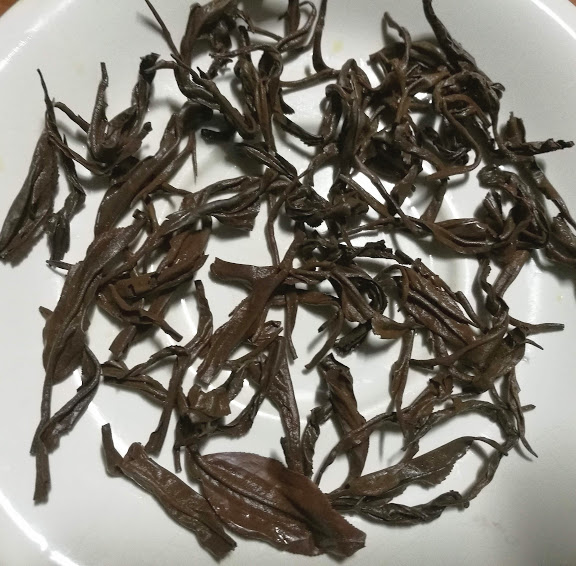
golden needle, or at least that's how I thought of it


unusually shaped black tea, sometimes called golden snail, I think


looks like a Moonlight White (Yunnan version) but I'm not certain it was


a stem-only version I left out; this was nice, subtle and pleasant


Onto the second theme about what works or doesn't work in small gathering tastings, getting back to more about how it went on this one.


Tasting or tea event variations


Narrow theme:  we didn't go there, but for experienced tea enthusiasts who already know each other more (limiting the social introductions scope) a very narrow tea-type theme would work best.  It's easy to compare teas to other very similar teas; it makes it easier to match up minor differences and get a feel for what really stands out from a common baseline (eg. thickness in feel, length of aftertaste, sweetness or bitterness, flavor complexity, overall balance).

Switching between category types moves away from that comparative referencing.  It can get to be a bit much to experience; tasting a half dozen completely different teas in a sitting could easily just become a blur of varied input, while trying that many that are very similar would just be a bit much, with 4 or 5 an easier number to focus on.  If the focus is on the social aspect all that matters less anyway.


a Yiwu village themed tasting event, hosted by Bank (Thaneadpol), on the left

Setting a schedule or conversational tone:  it would be natural to set a very narrow tone for tasting process in some settings, making it more like a wine tasting class.  A central authority on a subject might act as more of an instructional leader or guide.  I wouldn't typically be as into all that; it's nice to talk about other subjects just as much or more as the tea.  Then again it depends on what you are tasting, with who, and why.


In a more social outing when people don't know each other initially random, fragmented conversation can make a lot more sense, which matches up well with not really trying to critically assess the teas, or to compare them to each other.  A local tea expert (of sorts; that's almost always a relative designation) / online contact held a tasting once more along the lines of a wine tasting that followed that premise and structure; everything I discuss here will relate more to themes along a spectrum of a few friends gathering, or something else more in the middle.


meeting a local tea authority at my favorite shop (Kenneth of Monsoon at Jip Eu)


Setting:  this has been coming up as a stumbling block related to doing other public versions of tastings, like that one in a park or in a local zoo.  For a very limited number of people tasting in someone's apartment is perfect, sitting on cushions on the floor in a small circle.  That would work well up to including around a half dozen people; for a group of 8 it just wouldn't hold up as well, and beyond that it wouldn't really work at all.  The park theme was cool for being different, and outdoor, but the noise level in a zoo food-court area for another event really took a lot away from what one could notice about the teas.

Air conditioning is something of a must for tasting now in Bangkok; it's in the upper 30s these days (C; that's upper 90s in F).  I do review tastings around noon now when it's exactly that hot without AC but I've been drinking hot tea in hot weather for years, so it's just normal for me.  The only work-around required is using a napkin to wipe the sweat from my forearms off the keyboard.


trial run at public tea tasting; that guy was an interesting addition


Timing:  tasting in the late morning or early afternoon works, but even drinking a lot of tea in the late afternoon wouldn't match everyone's daily cycle.  We tried to start at 10:30 for this event and of course I ran late; unfortunately that's normal for me.  It might seem like drinking tea for an hour could relate to drinking a lot of tea but 2 to 3 hours works better for a time-frame, given a slow pacing to trying lots of teas, over many very small cups, with plenty of time for conversation.  Tasting one or two teas for a written review can take a good bit over an hour, with some allowance for messing around; the focus on round after round takes time.  I can't relate to the endurance-session theme some people mention about drinking tea non-stop for six hours, burning through a dozen versions or more.


For larger group size:  this moves onto considering what else might work.  Those group gatherings for public tastings did run slightly larger, up to 8 or so people per event, and I've been considering how to go further.  It's way too much of a concession to switch to Western style brewing, but that would enable tasting by 15 people or so, easily enough.  I can only think that having two people pour tea in two groups might enable extending gathering size up to around that level (15).

In theory Gongfu brewing is really about proportion, not the device used or specific quantity, but I could do without ever attempting to brew a half-liter at a time for a large-group tasting by somehow ramping up the same proportion at higher volume to a Western-brewing scale, just based on different ratio and timing.  Someday I probably will try it though, Gongfu brewing at high volume in large ceramic teapot.

Unless there is some formal function demand it would seem like going further to having three or more groups would be too much (but this older 2007 tea blog post covers an event where that made perfect sense given the context, was planned in detail, and worked out).  Even doing two group tastings in one session trades out everyone missing half the discussion and personal association at the event, and doubles up the logistical concerns (gear required, water, setting, matching parallel structure, form, and timing, etc.).


in the middle as events go, small but a little structured


Mixing intro and advanced themes:  this never seems to come up, but at some point it might be a real concern.  Anyone could have appreciated the teas we tried that day but it would seem natural to switch themes if a more narrow-focused tasting was the idea, and to focus more on the tea versus conversation.  In a sense it doesn't matter, but for people already really into the theme and drinking rarer teas the focus might tend to shift on its own.  We barely even commented about the teas at this social gathering, more focused on the thread of discussion, which works for me.  Description doesn't do tea experience justice anyway, it's more something you just do, and I overwork that theme in this blog writing.


Adding background discussion, mixing event themes:  I've been considering this related to doing a health-interest group function event here.  Before those two open, casual tastings I held a couple of more structured events designed to serve as introductions to the subject that were different in tone, one an actual presentation, the other a small-group tasting (in the last picture).  All that would seem to link up well with a narrow-type focus, something like exploring teas from an area, or within a type, to set up focus on the general type, or enable exploration of more minor differences.  Rolling in a secondary underlying theme, like the health aspects of tea, might lead in that direction.  A more set time-table might make it trickier, if the point is to combine tasting and group discussion, especially problematic for larger group size, over 8 people.  I'll see how that goes.


at an expat subject presentation event, more or less


Shop based tasting events:  this always seemed like the most obvious way to work around these issues, to base an event out of a shop.  That would simplify staffing, role assignment, related gear use, and timing, since the location would already be set and time-frame could be an open span of 2 or 3 hours.  I've considered setting this up for some time but haven't just yet.  It's a huge trade-off to just present teas from that shop, and shifts theme to ordinary marketing, and I may never choose to go there.

I've met friends at my favorite shop, a good number of times, so maybe it will have helped experiencing a really informal version of such a theme before.  It's cool how at Jip Eu, my local favorite shop, sometimes the owner will share teas he doesn't even sell (more often than one might expect), so it's not really just product promotion.

Again it all wouldn't work as well if the participant count increases, within a really narrow range.  Back at the outset of planning those public tastings I had thought through last-minute work-arounds for variance in participants (eg. mix in a round or two of Western-brewed tea), but the simplest fix would be to control and limit the number.


a local Seven Suns cafe event; that was an exception


a cool tasting in a Moscow bookstore, with Laos Tea, Alexander and Dasha


always great seeing that baby try it out; Huyen and her nephew on location


Tuesday, February 19, 2019

Placing sustainable, forest-based tea agriculture


I've not met up with Sasha Abramovich or Nok recently, and I finally did again this past weekend.  A local tea celebrity of sorts dropped by, Kenneth Rimdahl of Monsoon teas.  I'll say a little about what we tried and then run through some news related to Kenneth.  He's been doing a lot with a sustainable, forest-friendly tea sourcing that's the main theme here, with just a little on that meeting covered first.

a first outdoor tasting trial awhile back, last year


Tasting tea and hanging out


Sasha brewed two Tea Side teas for us, a 1980 sheng (reviewed here) and a 2006 sheng (re-reviewed here, in comparison with what turned out to be a different 2006 HTC Thai sheng).  It was interesting trying two teas I was already familiar with in a different setting.  The second tea is the first aged sheng cake I ever bought, so I have some at home, but I don't drink it often.  It's nice tea.

Sasha also brewed a few nice sheng samples from Tea Dee, commissioned or shop-produced tea versions that represent the best respected tea shop in Bangkok, owned by Khun Zhang.  Double Dog is as well known but for being a Chinatown cafe, and they also sell tea, but no other Thai business comes close to matching that shop's local reputation related to pu'er.  Oddly I've only visited them once, in a location that has since moved (now in Thanya Park), because that shop is way out towards the airport from where I live and work in the city center.  There's a nice park out there we visit once in awhile, Rama 9 / Suang Luang, but I never get my wife to agree to add tea shopping to the list of days' activities when we visit it.


view from their apartment; that's Benjasiri, the park in the last photo


Not much of a review of teas we tried so far, but I didn't intend for this to go into that.  There's more I could say about the Tea Dee cakes but it would only be a general impression due to writing this days later.  They seemed different from each other, generally sweet and floral in different ways, and like quite good tea material.  They didn't seem to be made in a drink-right-now modern style (more traditional instead), but not overly bitter, astringent, and unapproachable.  They seemed to represent tea that could still be a good value even if selling for over $100 per cake when "young," before aging; that's probably saying enough.

Kenneth brought a couple samples of interesting Ceylon / Sri Lankan teas.  I probably shouldn't say more about one that seemed unique in style and appearance since it represents a work-in-progress for a new product development.  A second (green tea, I think it was) was unique for being able to change color, to switch from the pale gold that green teas are to pink with a little lime added.  That transition capacity is familiar from blue pea / butterfly pea tisane but I've not seen actual tea that does that, until this one.  I definitely like green teas the least of any broad category but that tea was fine too.  The black tea version was a good bit better than "fine;" it was quite nice tea, and not exactly like other better Ceylon I've tried in style.

Onto news about Kenneth then, which does skip a lot of what we discussed that day, and how it went in general.  It was a nice outing.  We drank too much tea but I sort of saw that coming and only tried a couple of tisanes with breakfast.


Kenneth and Monsoon update


Monsoon opened a Bangkok branch around three weeks ago.  I've seen news related to that, but just didn't get around to visiting there or mentioning it here.  It's way out in the South-East of town, not as far as Tea Dee, but closer to that than to city center, my job (the main site), or where I live.  The second main site for the company I work for (not related to tea; the subject is a hobby interest) is actually out in Bangna, on Bangna-Trad road.  It's even further out than that Monsoon shop, and a ten minute drive from Thanya Park (but I use the sky-train here for commuting).

Monsoon's primary theme is selling tea blends, with a focus on Thai-produced forest-friendly tea.  I reviewed a white tea version a couple of years ago and that was nice.  Kenneth talked about that at a TedX talk a year or so back, and the Bangkok Post ran a story on him and the forest friendly tea theme

On a related subject, I ran through details of a different type of related sustainable-production initiative carried out in Laos in this post (which reviews two local tea versions), with a website of the related participating NGO covering more details.


Laos wild tea, photo credit ComitĂ© de coopĂ©ration avec le Laos website (used with permission)


I have mixed feelings about this forest-friendly theme, and the background can be a bit complicated, so that I'll say more about all that here than I did about trying 8 or 9 novel teas earlier in the post.  Kenneth is nice, and he seems genuinely concerned about that sustainability concern; at least that seems to be a good starting point.


Forest-friendly sustainable tea production


Let's get the reservation and potential problem out of the way first:  this theme is at least in part a marketing approach. 

Teas really are healthy, but when a vendor promotes how healthy a tea is they trying to make a sale based on ideas that aren't usually as well-grounded as they represent them to be.  I think there is a good chance that green tea is good for cardiovascular health, and there is some research evidence supporting that, but when a tea vendor makes that claim it comes across more as sales-pitch than them trying to be helpful and informative.  I don't drink green tea much anyway; I don't like it as much, and other versions would overlap in terms of beneficial compounds present.

Some of that type of concern probably applies here.  A complete critique of how the factors are likely to balance isn't possible, self-interest based marketing versus broader-interest based sustainability focus.  It is possible to run through my take on how "real" I think this particular sustainability theme is, so I will cover that.

It's real, but it's not an important factor if the consideration is limited only to being related to tea in Thailand.  Let's back up and examine why I think that (and note that it is only my impression, to an extent).

This 2008 research reference offers us a dated snapshot of tea production in Thailand:


This 14 year old production summary converts to a total land space of 75,076 rai used to make tea.  That converts to 29,600 acres, or 47 square miles, an area of 6 miles by 8 miles.  It's a good bit of land, but essentially nothing at all compared the land used to grow rice, fruit, or palm oil here. 

Let's check on that and use the latter (palm oil production) for comparison:

According to this reference there are (as of 2015) approximately 700,000 hectares of land in use in Thailand for production of palm oil.  That equates to 17.2 million acres.  Put another way there is 58 times more land in use to produce palm oil than tea in Thailand.  That's based on these numbers; tea production probably has increased, and I wouldn't be surprised if that palm oil estimate is on the low side, based on driving past palm plantations for hours in the South, lands that had been cleared of all native vegetation for that use.  The palm oil production growth and land-use are escalating much more quickly too, since the tea industry is probably quite a bit more developed and mature now, with demand leveled off, making it a lot more of a development concern, as shown by this reference:


That's happening mostly in the South of Thailand, related to what climate supports growth of that palm plant type best.  The general idea is that scale of tea production just isn't on the same scale as other agricultural production, so the risk for environmental destruction directly related to tea farming also cannot be.  For all I know logging impact may well be more of a competing concern in the North than other forms of agriculture are, and land-use study might not be as easy to pin down for that kind of thing.

That would seem to point back towards this being a good story that sells tea, a basis for presenting ideas through different channels to promote a business, but not mostly based on a real issue.  Not so fast though; there seems to be more to this, and it doesn't reduce to only being a factor related to tea.


Forest conservation as a broader trend


There are definitely competing interests that relate to land use and forest preservation; this much is clear.  Destruction of standing old-growth forests to produce tea may well be a relative non-issue, compared to the scale of other agricultural-use concerns, but preservation of those forests definitely is an issue.  Thailand, like most other countries, has set up environmental reserves and protections that tie to a broad range of concerns.  I highly recommend reading this background summary on Forest Management in Thailand, prepared by the International Forestry Cooperation Office, a branch of a government protection agency that also involves Thai Royal family support.  Their summary outlines the current status and goals:


...There is no doubt that remaining forests need to be protected and that deforested areas need to be replanted. Moreover, there is no disagreement that local people must be involved in conservation efforts if they are to succeed...

...Forest resources provide a multitude of goods and services, including pulp, timber, nontimber products, medicinal and edible plants, as well as other raw materials such as rattan and bamboo. More than 1,000 recorded species of plants contain medical properties and 30,000-40,000 households harvest them on a full-time basis. Furthermore, 60% of the rural population or roughly 30,000 communities living near forests rely on edible plants for their daily needs and more than 500 species of these plants are sold in local markets throughout the country... 


The past history and regulatory efforts in place described in that short work are too detailed to summarize here, even in citation sampling format like that.  One general theme meets back up with what Kenneth is promoting related to tea:

...Communities located within and near forests have been motivated to participate in the sustainable management of natural resources through well designed conservation policies and legal frameworks, especially those pertaining to forests, which have been amended to address rapid social change and emerging environmental issues...

...Thailand, which once exported timber, is now a net importer and has high expectations of the role forests will play in nature conservation. Since 1989, all natural forest (25% of total area) is protected by law from commercial exploitation...

...Community forests in Thailand are classified into two types: natural and rehabilitated or developed. They can be established on three categories of land: national reserved forest or public and overgrown areas; land under the jurisdiction of other government agencies (e.g., monasteries, educational institutes, military areas); and private locations.

The first type consists of natural forests where people in nearby communities join together to protect them in order to benefit from their productive capacity and to maintain their norms and culture... 


I'm sure that there are functional programs and other initiatives in place that support sustainable, natural-growth land use, even beyond what is described in that reference.  At the same time the more that minimal impact land use can enable economic development the more effective and functional those programs will be in practice.


One additional context detail:  the tea is already there


This part I almost left out, as familiar ground to me since I've been reviewing this relevant background for a couple of years (based mostly on input from Kenneth, and also other sources prior to talking to him), but it wouldn't be familiar to many.  The tea plants are already there, essentially growing wild.  Tea was introduced into areas in Southern China, Myanmar, Northern Vietnam, Laos and Thailand well over a millenium ago. 

Which forms of the tea plants are the most original and native, and the role people played in distributing them are debated, but the consensus take is that wild forms of Assamica (one of two varieties of Camellia Sinensis) first originated in Yunnan, and that movement of the plants to a broader region was probably helped out quite a bit by people.  Thailand was settled by waves of people from China and other places extending back well prior to known history.

It's really something of an unrelated tangent here, but I'll include a citation about the plant-history of tea that relates, and a link to support further reading:

The tea plant was initially domesticated in China over 4,000 year ago (Yamanishi, 1995)... 

...we calculated China type tea and Assam type tea as having first diverged approximately 22,000 years ago, and Chinese Assam type tea and Indian Assam type tea as having diverged from each other approximately 2,770 years ago... 


There is a lot more to that story.  The short version:  tea plants are there, growing relatively wild in the North of Thailand, almost certainly put there by groups of people who aren't well-documented by a known history (but some pre-history is described here).  Kenneth emphasizes that earlier use relates to miang consumption, to practices of eating tea that are common to those in Myanmar (and in Northern India, I think?), and probably other places.  I'm not sure if eating tea really did pre-date brewing tea, locally or elsewhere, or if it's possible to place the two in relation to each other as regional traditional practices over a long time-frame.

Deeper detailed history aside, what I'm trying to summarize here would seem very odd if the idea was to plant some sort of community farms inside forested areas, versus using leaf material from plants that are already growing there (the actual case).  If these forests are destroyed for alternate use, or perhaps even just used for logging (depending on tree-harvesting process used), many of the tea plants and other useful bio-diverse plant-life might be destroyed.


Onto conclusions


It might seem like I'm concluding that every little bit helps, and that what Kenneth is promoting is one small step in the right direction, joining other government initiatives and land-use themes.  That seems at least partly true, if potentially a bit optimistic.  Not all government programs are effective at achieving intended goals, and I'm not sure how much economic benefit "wild" tea development currently has on such concerns, or what the future potential is.

All the same these ideas map together in an obvious way.  The theory and broad government-control directive requires other steps and drivers to support it; that much was cited here in that Ministry of Natural Resources and Environment summary.  It's not "sustainable" in one deeper sense for only government restrictions and NGO monitoring and education efforts to prevent high-impact forest land use; a positive economic driver could potentially also play an important role.


Is it better for the Thai natural environment to buy Monsoon wild-grown tea instead of plantation-produced oolong?  Maybe a little.  There wouldn't be a significant effect from that personal choice on a small scale but to some extent the small inputs would "roll up."  I suspect that Kenneth and Monsoon's efforts round down to making no difference taken alone, but that all such forest-use initiatives considered together are a significant factor, and one that can potentially be extended. 

To me this leads directly on to considering other factors.  If you buy a tea blend sold in a small tin, what about the pit-mine impact from producing that metal, versus use of some other type of packaging?  The mine for the metal ore might be in Laos, with the packaging production in China, and the likely end point for the tin as a landfill in Thailand, with transportation related impact all through those steps. 

This is part of our current set of challenges; sorting out which inputs and causal connections really do make a difference, and identifying how to maximize the cumulative effects of our choices.  It starts out as simply as choosing paper or plastic bags, or deciding to carry re-usable cloth bags instead.  If one person's choice in some regard extends to a factor of a thousand times more impact than which tea source they choose then more focus is better directed there.

In conclusion, how much difference this really makes is hard to place.  But it is one representative part of a very important subject that does need to be addressed.  Probably palm oil farming represents a real land-use issue that needs to be considered and monitored at a national level, more so than tea production.  Of course China is destroying natural areas much faster to ramp up tea production there, because tea is a much larger industry there.


clear-cut tea farming (but not in Thailand or China)


It would be nice if personal beverage choices could make a marginal difference in long-term land use in Thailand.  To some limited extent Monsoon products represent that potential, whether that is actually the main driver for their sourcing framework or not.  I think Kenneth's intentions are good, but of course businesses also need to be profitable, so goals tend to mix.  If profit is motivating this development and natural-growth forest preservation and use is also being supported then it represents a case of multiple forms of values matching up.

For me personally I try to remain skeptical about claims and background descriptions made about tea across a broad range, but also stay open to new ideas, and remain somewhat optimistic.  Drinking a different version of tea won't make much difference, but helping make a little difference could reasonably be experienced as a positive thing.


Friday, August 10, 2018

Assam Teehaus Spring 2018 black tea review


I tried another orthodox Assam version from Maddhurjya Gogoi, that Sasha passed on when I met him a couple weeks ago (from Assam Teehaus).  I've tried a couple, and it's hard to keep track of which one is the absolute best, or how different the batches are, so I'll just go ahead and review the one I got around to writing about.  It was good tea.  "Good" means a range of different things, which is where these wordy tasting notes come in.

I just re-read a post about trying a 2017 version a month ago.  This description is pretty close in general type, just a little off on a detail or two.  I can't say if it sounds better or not; when a tea is kind of similar you really need a side-by-side tasting to help sort that out.  For some types you can base a judgement on a couple of specific attributes, which will make it clear in your memory where you thought it stood for quality level and match to preferences.  These Assam Teehaus teas are pretty good quality overall, with a limitation of being a little non-specific, of mixing a lot of aspect range instead of being as narrow in character as some types.

I haven't described the tea yet, but in a sense all the complexity that I will describe almost comes across as a blend, with some clear common aspect threads through that character.  From what Sasha and Maddhurjya mentioned this may stem from an interesting input: the teas are made from locally sourced plants, so they know the farmers and growing conditions, but a limited variety of tea plants have grown alongside each other.  The tea plant source itself isn't based on monoculture, in terms of growing alone (only tea plants), or in the other sense of being made from a very genetic-specific plant version.  The "terroir" or growing condition inputs are relatively uniform but plant genetics vary. To me that's cool, and surely is a factor that changes the end effect.


This Halmari orthodox Assam version works as a contrast to that.  As a standard plantation tea they would control growing inputs and plant type very carefully and completely, achieving a much more uniform outcome, and a narrow set of aspects.  In general that's a good thing, especially since it can correspond to an experience of aspect intensity.


More than one being better though the two types of tea are different.  That Halmari version really did express a much sharper and more pronounced form of malt, which did come across as the main flavor aspect.  Some of what the Halmari version gained in perceived intensity in a limited range it gave up in terms of losing complexity of flavor. 


For some people the softer, slightly sweeter and broader flavor range in the version I'm reviewing here would be preferable, and for others it might not be nearly as pleasant.  I think Maddhurjya's teas are improving, so while I might have said Halmari's are just better last year--beyond being different--now that's not quite as clear now.

The detailed description will fill in what I mean.

Review


The tea is really nice, complex, sweet, layered, and pleasant.  When people describe Assam as having really intense malt as a dominant aspect this isn't that; it balances a range of different aspects.  There is some malt to it but it doesn't stand out more than other sweetness, earthy aspects, and some dried fruit.  A warm mineral layer provides a base for the rest too.  Breaking all that into a more detailed description is a bit of a task.


A mild form of malt stands out as much as anything, but it integrates with the rest.  Usually that aspect pairs with an edgy astringency but this tea is soft, but with good body.  I've brewed it perfectly, for my preference for the type, using a really heavy handed proportion for Western style (probably more like 5 grams versus 2, but I didn't weigh it), and around a 2 1/2 minute steep.

nice to get back to simpler tea tasting

Next in intensity is fruit.  It's a dark, rich fruit tone that overlaps with earthiness, tamarind or fig (really dried tamarind; the "fig" is to help place that, for people who don't eat it).  Earthiness is hard to place; between a cured leather and aromatic tobacco.  The sweetness level and rich body really make it work, along with all those flavors being really clean.


I went a little shorter on the infusion time next round, to see how drinking it lighter changed it. The first thing that I noticed was that I used hotter water, shifting the flavor to add that one sort of dark toffee aspect.  That came from not prewarming the infusion device cup the first round, I think. 


It reminds me of that post on oolong brewing temperature, where a couple main themes emerged, so I'll do a tangent and talk through some of that (again related to oolong, but some ideas carry over).


Reddit's Tea subforum version (credit)

There was a split between the "always use boiling point" side and the lower temperatures you see on reference tables side, with almost everyone going with boiling point given where that took place (in the Gong Fu Cha group).  I think lower temperatures might work better for Western brewing but I agree that to get the most out of good oolongs you shouldn't do that.  Personal preference muddled there being one final conclusion, except for the "boiling point only" side.  I think using Western style brewing changes things, and I also tend not to go with that for oolongs, although it works better for rolled-style examples than for Wuyi Yancha or Dan Cong (in my opinion).


A friend made an interesting observation, that if someone is a cigarette smoker they would naturally want the most intensity they could get, which still even relates when brewing a tea very lightly, in this divide related to drawing out the one edgier aspect range.  As I take it there is a parallel in the difference between these first two black tea infusions; a slight edge showed up due to pre-warming the brewing device.  Or maybe I'm over thinking all this.


Again in this round the complexity is good, even brewed a little lighter.  The malt comes out more in this infusion, tied to different, richer mineral and earth tones.  The flavor is quite intense but the feel is still full but soft. It would be hard to screw up brewing this tea, and that rich, full flavor would go well with different kinds of food.  For tea enthusiasts into sitting and contemplating a dozen Gongfu rounds of refined, complex aspect tea that could be quite an insult to a tea, to say it's good with food, but then this style wouldn't be for everyone in a way that does seem to dove-tail with that factor.


For people moving on from lower quality loose black teas it would be perfect, and for more experienced tea drinkers it would just depend on the range they could appreciate. Not everyone drinks black tea, never mind individual styles.  I like it, but then I seem to appreciate diversity quite a bit, teas being pleasant in completely different ways.  Sometimes I do brew very subtle, complex, or sophisticated teas Gongfu style with breakfast, but more often I like something more simple that's going to work well as two or three mug-fulls brewed Western style, something I don't have to think about.

More input from Maddhujya


In the last post I mentioned some difficulties that Maddhurjya communicated having in ramping up orthodox tea production:  stable power supply, problems with rough roads, the typical difficulties with sales and marketing.  A lot of that would be common to anywhere.  He did comment on specific forms related to some of the issues in discussion, for example about the power supply:

The biggest challenge is paucity of electricity. The processing unit in our village is almost 1 km away from the Grid Transformer so we don't get proper voltage. And everyday there is power cuts for hours...... We were depending on a diesel fueled genset but unfortunately that also broke down at one point.


I asked him about the mix of different plant types.  That particular issue is interesting to me, not something that necessarily makes a difference in final outcome mapped to consumer preference until you really know a lot about it, but it's still interesting.  He mentioned the range of plant types grown at different sources they use, and which relate to this tea version:

We have TV1, TV9, Panitola 126, TiniAli 17, some wild seed variety and some vegetative clones.  The major input percentage for this tea version is Panitola 126, with Tiniali 17 and TV 1 also mixed in.


That definitely makes my review evaluation sound better, since I'd guessed a mix of plant types had been an influence on the character.  I tried to explain how I saw that to him in discussion, about how a narrow type or a broader input of sources doesn't necessarily seem better, but the outcome seems different (quoting myself this time; a bit odd, that):

Some Darjeeling and plantation Assam teas seem to have a very specific, limited aspect set output, probably through control of both narrow plant type sourcing and processing factors.  That gains something in terms of intensity and being novel, and gives something up in terms of broader aspect range and overall balance.  It's not that one is better than the other, they're just different.   To me it's not that different than a single grape wine versus a blend.  It's a trade-off; one isn't better than the other.  French people seem more inclined towards blends but Americans produce and drink both, only exploring and developing blends more recently.


Oddly I'm talking to someone about sheng just now and this all works in that discussion context too.  But enough with the tangents.

It's also hard to be clear on what differences the various processing step inputs make.  In particular Maddhuryja has been mentioning use of certain machines.  This comment doesn't shed that much light on the broad range but it does work for indirectly pointing towards some of it:

Our Taiwan rolling table is not like Indian rolling tables. The stainless steel used in the rolling table is FoodGrade Steel.  And it has copper teeth on the table to give its tight roll.


I guess these parts add up to what you'd expect for developing tea processing; there are lots of potential improvements to be made and lots of small challenges to hurdle.  The teas are quite good, and still getting better, so in that one important sense it's already working out.  They'll just need to keep making the growing, harvesting, and processing details come together, and ramp up the commercial side.

If any readers would like to play a more active role in promoting local, sustainable tea production this might be a good opportunity, by checking into buying tea from Assam Teehaus.  It's strange for a blog post to express marketing so directly, isn't it?  I think it might get by people that not only small vendors could order this tea, that anyone anywhere in the world could look up Maddhurjya and ask about picking up a kilo of it.  The numbers really wouldn't work out to buy 200 grams of tea from the opposite side of the world but as quantity increases a bit shipping is offset by lower per-unit cost.  This is all familiar ground for Yunnan Sourcing China customers, but I'm not sure how many higher quality Assam drinkers have explored this direction.


Oddly I'm going to be saying something similar related to a very small start-up tea producer in Nepal over the next two weeks.  Not the sales pitch part; the rest, about history and development status.  It's good to see sourcing options development move beyond people only saying they wish there was an alternative to multiple-resale wholesale supply chains and large corporation tea production.  Now there is.  But I don't think the pull on the demand side is enabling this to work well just yet.  Some things just take time, and sometimes multiple variables need to come together for a paradigm shift like this to happen.  It may be that small local retailers play a crucial role, even online versions of those, versus completely direct sales working out.  Time will tell.


with Kalani, dressed for a school presentation


wearing make-up for that event


posing at home beforehand


Thursday, July 19, 2018

Assam Teehaus orthodox Assam, and about a Bangkok tasting


probably a 2017 Assam version, but that wasn't clear


It's been over a year since I met Maddhurjya Gogoi and Bulu Deka along with Sasha Abramovich in the Bangkok Chinatown.  The time just flies.  I met with Sasha again for a trial run at making tea in the park for an event next weekend and he passed on more tea from Maddhurjya (from Assam Teahaus).  I'll say more about that tasting event at the end. 

I talked to Maddhurjya not so long ago, about how things go with him, and it was the usual mix of ups and downs, about new directions and positive steps taken, including processing step and equipment improvements, along with set-backs and typical problems, like local power supplies being a bit unstable.  In an earlier review of one of their teas I covered more of his earlier story, and I'll have to get back to passing on an update about those other later steps.  The main running themes are about small Assam farmers trying to produce better orthodox tea and to sell more directly, to get away from the wholesale middlemen and tea wholesale market models, which are very interesting subjects to me. 

I'll share a few pictures for a start:

Maddhurjya's home; what Assam looks like


Assam region rice field; looks a bit like Thailand


Assam local tea gardens


another local tea garden


It'll be nice to get back to trying good Assam.  Sasha actually passed on three versions, one that looks and smells a little like Jin Jun Mei.  Before you start, of course it's not supposed to be Jin Jun Mei, and if you like we could start with a premise that I've never actually tried a "real" version, even though it's my impression that I have.

The one other sample I'm not trying yet may well be this year's version, and I may still be on last year's version for this session (I think this probably is a 2017 tea).  Either way I have two others to try, and I can sort that out more in the next post.  Black tea that's well sealed won't lose much over the course of the first year, as a green tea definitely would, so it may have faded slightly (if that's the case), or depending on how it was produced it may have improved slightly (the sun-dried tea case).

It'll be nice to try a tea brewed Western style for a review.  I'm just getting over a cold (which goes well; I've been resting a lot this weekend) and this tea type is perfect for that.  That note and context was from tasting last weekend, when I wrote this post's notes; I'm ok now, towards the end of the week. I might miss a subtle flavor or two but I'm not working with a significantly diminished palate since I'm almost over that already, and never was actually congested.  My immune system and I have reached an understanding:  my body lets me know I'm getting sick early on, and if I give it the rest and extra fluids right away that resolves it, and otherwise things go the hard way, and half the time I end up with a secondary infection too.  Onto that tasting.

Review


I think this version improved over the last that I tried, although it is hard comparing a tea against another version from just over a year ago.  I was trying the 2016 version last year, which was nice, but they were still working out optimizing production steps.  Whatever I try today might be surpassed by the next version I already have on hand too.


It has good sweetness, good flavor complexity, nice aspect range for flavor, and it's very clean in effect, no woodiness or trace of anything odd at all.  The flavors are so complex and sweet they lean a little towards fruit, but it doesn't seem like a fruity tea.  There is some malt but it's very tame compared to most of what is produced as Assam black tea, a soft but full feeling tea. 


Some people would miss that citrus / pine needle / malt kick that was present in the Halmari versions I tried a long time back but this does well for working more in a Chinese black tea style, softer and less intense.  I'm using water just a bit off boiling to brew this and ramping that up to right at that level would draw out more of an edge, if that were desired.


After all that I've still not really mentioned a flavor yet.  The main range seems to be cocoa, with a bit of malt in between the typical edgy malt of Assams and the softer, mild and sweet malt in a malted milk ball or milkshake, or Ovaltine.  The trace of fruitiness hints a little towards fig but doesn't quite get to that.  The depth in terms of flavor and the rest doesn't come across as a list of flavors.  It's not complex in that sense, not intense in flavor, just positive in character, not thin, and pleasant for what it does express.  I went light on this first infusion though, a habit carried over from how I prepare tea using a Gongfu approach, so it may develop a bit in the next round.


Pre-warming the infusion cup to bump up brewing temperature this time did seem to shift the aspect range a little, drawing out that more caramel or toffee range sweetness that using hotter water results in.  The dryness and feel picked up just a little too; it's better this round.  It's still towards mild malt and cocoa for main aspects, with some degree of mineral and mild fruit underlying that, not a pronounced or distinct enough aspect to identify as one thing.  Along with that flavor range and feel shifting a little the aftertaste picks up too, the way the tea gains some fullness by leaving your palate a little slower.


There is still a little room for this tea to improve related to adding a little more complexity and a bit more for specific flavors to stand out but it's pretty good as it is.  Most people who think they like Assam probably don't know it can be like this, even though this is just a well above average version, not quite as good as they get.  It works well as a tea to drink with breakfast, tying back to a comment I just made in another post about how most shou pu'er comes across; as pleasant, complex, and enjoyable, good enough to appreciate with food or without but not so complex and refined that you need to just focus on it to really appreciate it.

It's nice to relax about brewing parameters a little, and not just focus on tea for an hour, and handy to have good tea that doesn't require that level of attention for with breaks or breakfast.  I won't brew a lot of the teas I normally drink at work because I won't go through all the Gongfu brewing steps there, both because it looks like a lot of messing around and to an extent it is a lot of messing around.  I will drink tea that needs some focus with a half-hour breakfast, going through a fast 7 or 8 infusions using a clay pot or large gaiwan, because it has become that automatic.

I think the other two versions are the better ones; one made with finer buds, and one the latest version, the 2018 batch.  It was nice doing a simpler version of a review today, and I'll try to keep those reviews simple too, even if there ends up being more to say.  I actually did try one of them, so I know how that's going to go, to some extent, and that tea was closer to what I've tried of other very good Assam versions, a little heavier on bud content, a bit drier, and maltier, and more intense.  One part of the taste is a bit towards pine needle, a little resinous, which is nice.  But I'll get back to that; I didn't make any notes on it yet.


Trying tea in the park


There should be a rare tea-event description post for next week too (related to this event on the 21st), since that meeting with Sasha was to try out brewing in the park (Benjasiri, the one beside the Emporium mall in Bangkok, near the Phrom Pong BTS station).  I can say a little about how the trial went.

Sasha, middle, his wife Nok (right), and Joseph (left)


Hot water was the main concern, and of course they don't have outlets around for people to plug a kettle into.  It is possible to buy a tumbler or thermos refill at the one vendor station by the door near the BTS exit.  At best that's filtered tap water, and it may not even be filtered, which is safe--to drink local tap water boiled--but not ideal, especially for tea.  For space there's a lot, just not in case it rains, and the temperature was fine for drinking hot tea yesterday, just getting a bit warm around 1.

Sasha brought his wife, Nok, and we ran into an interesting local guy, Joseph.  He's originally from Ireland, and we ended up talking through some interesting ideas about spirituality and how it overlaps with normal life experience with him.  I've sort of left off the theme of being a religious seeker but that is still familiar ground, interesting to get back to.  We tried some of that Thai Moonlight White tea from Lampang, and some sheng and shou that Moychay sent, which made for plenty of interesting ground to cover.  As far as what to taste with a larger group next weekend (maybe larger; I don't know how many will show up) sheng may drop out, since it's trickier to brew and harder to appreciate without acclimating to that aspect range first.  We might try shou mei white instead.  This being Thailand I was thinking of trying a Thai black tea from Tea Side too, with those more or less made in a Yunnan Dian Hong style.  We'll see.

this seating area might come in handy, or maybe the ground will do


Beyond the water issue and seeing how brewing in the park went it was interesting seeing what could be different.  I forgot a tray, which would help, and small towels might work well along with paper towels.  It was interesting to see how preparing tea with a gaiwan wasn't necessarily easy for me, due to the mechanics of holding the cup changing when sitting on the ground versus at a table.  I spilled more than usual, even though I prepare tea in a gaiwan almost every other day.  I'll need help; that I already knew, but the limit of what I could do for preparation and how the water heating issue work out made all that clearer.

Two people volunteered to help already, that one Lampang Tea vendor, Noppadol, and a random contact responding to that notice.  It should be interesting.  I plan to shift the format based on how many people are there.  I'll do more pouring tea myself with emphasis on Gongfu approach if it's smaller, and more managing others helping out with Western style brewing if more turn up.  Of course I'll mention how it went here.

a Thai scout


wearing something a bit different