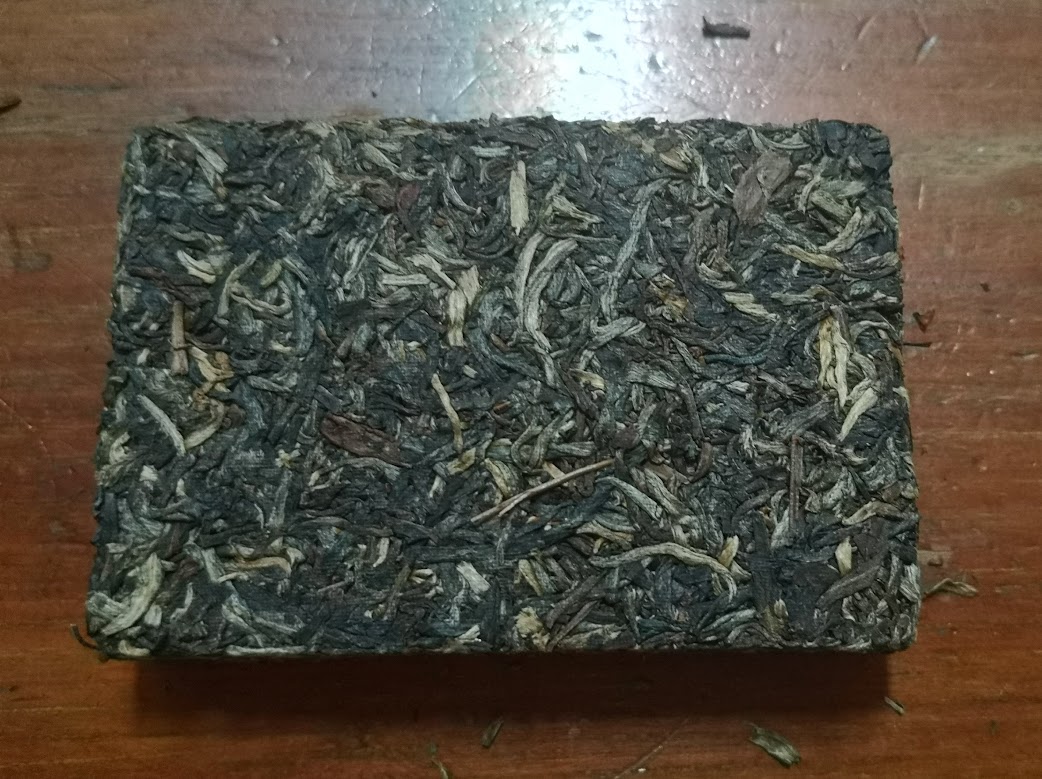
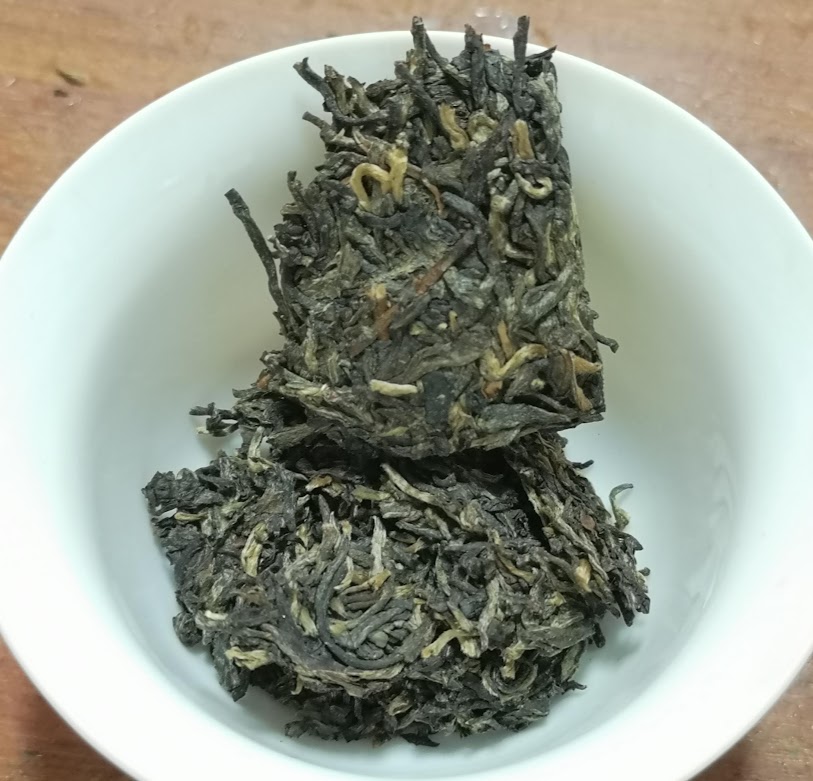
One of the first concerns in a combined tasting is whether or not it makes any sense to try the two teas together. Ideally they'll be very similar, or else it won't shed light on both, and just adds to the tasting workload, trying to do two unrelated things at once. The dates on these initially seem to indicate that will be at least partly not the case; one is older, beyond them being from two different producers, and pressed into two different shapes. Beyond comparison it's also partly about me trying more tea and getting writing done in a longer combined form, but I expect these will be similar in some ways.
I'll back up. I've been purchasing a bit more tea lately (a bit more than not much at all, typically), because I wrote some tea website content for Moychay for limited compensation. It wasn't enough income to change my lifestyle but enough to cover a few decent tea orders (so in a limited sense that did change my favorite hobby interest experience, and lifestyle). Two articles on pu'er storage were a lot more interesting than the other standard reviews, it seemed to me, because review posts tend to just repeat, and subjective interpretations of teas vary too much to be a clear guide anyway. If a reviewer's opinions are similar to your own that can help, but otherwise it's best to hear impressions from a half dozen different people instead and try to average that out.
I've just submitted a post to TChing summarizing four articles I've written on pu'er storage, which will go up soon, but in the meantime I can mention one was
a "basics" general summary drawn from different sources, and
a citation summary reference from some good online sources, including one about making home-made moisture control packs and another on storage conditions side-by-side experiments. Had I mentioned all that before here?
Usually I don't show the typical "haul" photos of what I've bought, beyond for not buying much to have anything to talk about, because that theme gets repetitive in tea groups. It has a strange feel to it, as if it could be more about bragging than discussion. Still, it works for both, and someone could intend that one-upmanship version of tone as context or they could not. For people with more substantial expendable income for tea buys it could seem silly for other people to announce $150 orders of lower medium level quality teas, per their own set of preferences. Some people are drinking from single tea cakes that cost more all the time.
 |
that Chawang Shop order; modest range versions across types and ages, with this tea third from the bottom
|
I don't think I ever will experience my own expectations changing to the extent that I usually drink $1 / gram and up teas. Related to sheng pu'er an interesting twist comes up right away in making and working around such sweeping generalizations: hold onto a lot of versions for a decade and you then have a completely different market-value product on your hands.
About these, I've already tried this Tulin "Dali Nan Jian Xian" T868 version, having bought tuochas of it locally before, at my favorite Chinatown shop here, Jip Eu. I can't make a comparison to a range of Xiaguan versions due to limited prior cake exposure but I am now exploring that range further. I bought a Xiaguan tuoucha of closer to the same production time frame as the 2007 version which might've made more sense to try (looking at that list a 2010 Xiaguan Teji Tuo). I'll get to that; I was just curious about this cake.
A lot of this trial process, for me, is seeing what aspects tend to change in what ways, and where the patterns lead. I guess that was the thinking in adding
a 2006 Fengquing tuocha version in that same set, checking out range and seeing what else to explore further.
Products background:
Here's
a citation of that reference on the Nan Jian Tu Lin brand, along with details about an interesting Yunnan Sourcing related offering, just closer to this Xiaguan version in presentation, as an "iron cake" style bing instead:
Nan Jian Tu Lin tea factory has a long history of more than 30 years producing Pu-erh teas. Their productions are often similiar to Xiaguan productions in their choice of raw materials, blending and processing techniques...
It's hard to turn up a clear product description of exactly what this version is, although a
"Puerh Junky" blog post tried to clarify that:
’07 “T868” Tulin. I got this back when I was in my Tulin tuo stage... I’ve not run across any Tulin that have the smokiness or minerality of XG. Dunno. To my mind there is more similarity with 6GTM productions, expressing bold floral notes with astringency and bitterness.
The T868 sits somewhere between the ’06 Yinhao and the T861, where the former expresses an unmistakable Fengqing/black tea character and the latter is a perfected creation with a more deciduous forest character, imho. The aftertaste in the T868 is long lasting with more incense and wood notes coming through with later infusions...
The idea of working through a preference curve definitely rings a bell. That goes on to discuss aging inputs and speculate about how that version has retained liveliness due to being aged in dry conditions in Kunming, which definitely doesn't apply to what I have, which has been hanging out here in Bangkok for quite awhile:
As most of us know KM storage is slow, though there are differences from one facility to the next. The advantage to these conditions is that for spring material like the T868 nothing gets lost. The production is still lively, springy. Nothing is muffled or mottled. Age has tampened the more brash aspects of a young production while the moderately cool conditions have preserved all of the florality.
Onto considering the Xiaguan description, this time from the Chawang Shop description, from the source. At 8 years along I'd initially expected this Xiaguan cake would be better yet in 4 more years or so, or at least 2 to complete just a bit more mellowing out, with some evolving into different range, but I'd lost track that it had some head start on that per the description.
2011 Xiaguan FT "Yun Mei Chun" Raw mini iron cake 125g
"FT(For Taiwan)" means this small iron cake was a special order of "Fei Tai" Company. Fei Tai Company is the biggest Xiaguan TF and Menghai TF pu-erh tea distributor in Taiwan. It is claimed that the customized products of Fei Tai company reaches a higher quality in Xiaguan TF. The high-level "FT" tea chose better raw materials. Iron cake is tightly compressed, so its qualitative transformation is slow. Definitely tea for longer-term store. High quality early spring large-leafs material from 2009 and 2010, and was used Cang Shan mountain spring water for the steaming process. This cake is not too smokey, typical for Xiaguan teas. The taste is strong and powerful, floral and sweet huigan.
It sounds good, like plenty of background to establish a context, and as if the tea should be pleasant.
"Long term" can mean different things related to storage but as I take it in this case material being 9-10 years old is getting there, but probably not quite where it will be later.
That ties back to the Puerh Junky's earlier input that "Kunming storage is slow," just cited. I'm not necessarily in a hurry, and it would be a lot worse if this ended up tasting musty related to too-damp storage versus just not being as far along as it might be. I've experienced some degree of mustiness fading again later, but given the context of trying to sort out aging transitions having a bit more change yet to go would be good.
Review
 |
Xiaguan version in a gaiwan
|
 |
Tulin sheng; odd seeing a tuocha version separating more easily
|
Xiaguan 2011 FT "Yun Mei Chun" iron cake: this is brewing a little lighter, in part related to it separating more as chunks, compressed a little tighter than the other tuocha. That's a switch, related to typical compression levels for both shapes. The Tulin "Dali Nan Jian Xian" tuocha version is well-compressed tea, but it separated out to be finer loose leaves. I'll probably have to go with a short round for the tuocha next time to even things out, and adjust more from there. At any rate this never was intended as a direct similar-type identical-conditions brewing session; they're going to have similarities but already differ based on initial background.
Even partly saturated the Xiaguan is interesting. There's a faint hint of smoke, a decent level of bitterness (especially for being a light infusion), and an unusual oily feel to the tea, along with dark mineral content that is somewhere between petroleum and well-corroded metal. Oddly that's all pleasant.
 |
Xiaguan left; lighter leaves and liquid on the first round
|
Tulin T868 "Dali Nan Jian Xian" tuocha: this is brewed too strong. Right at the time I was going to pour it my son asked if he could try using the gaiwan, the first time he ever had asked, and going through that experience was worth a lot more to me than getting this infusion right. Of course he poured half of it and the water touched his finger, and he put it down. I showed him how to do it the right way (or a way that works, at least), by holding his fingers and hand at a different angle, but the tea was already quite strong.
Brewed for identical times it would've been stronger since these smaller loose leaves were going to brew without the same form of "opening up" the other would go through. We really might do more of a tutorial and brew something he would like, since tasting some sheng yesterday didn't exactly click for him. His mother is paranoid about caffeine input (although he drank Coke twice yesterday; apparently the caffeine in that somehow poses less of a risk), but there are a few tisanes around to practice with.
 |
cheeky little aspiring tea drinkers
|
I already knew that I like the tea but the aspects and balance I like isn't evident in this round; it's way too strong related to it's own version of earthy aspects and mineral a little towards corroded metal. Brewed correctly all that balances out and the mineral and earthy range supports some sweet, mild character, more like leather or aromatic wood. I'll describe that more next round, as a fast infusion.
Second infusion
Xiaguan: loads of smoke picked up in this round; so that's how this is going to be. There was a time that I really didn't care for smoke in sheng but it helps drinking tea in which that aspects makes more sense than in rough-edged low-quality really young versions. I wouldn't say this works really well; this tea does seem to need a few more years, or 5. It's interesting though, and it might be nice drinking a tea like this from time to time, just moderating infusion strength way back to tone down how all that comes across. I mean the smoke, plus the intense mineral and earthiness, not different than I mentioned last round but a lot stronger, even though the infusion time was much faster.
All this matches one theme I keep going on about, a concern that younger sheng versions may not have enough intensity to transition newer / younger version aspect range into pleasant and interesting forms after a decade or longer of fermentation. After 9 to 10 years this is definitely not going through any muted "teen years" transition, or if it is it was way off the drinkable scale for those first years. For those flavors being in that range the effect still comes across as pleasantly clean, to me. It would seem normal enough for a bit of mushroom or more types of wood to have joined in, but as it stands smoke and those other narrow ranges seem more pleasant than any muddled mix of all that.
Tulin: oddly there is a trace of mushroom in this tea, which comes across as a touch of mustiness, like aged barnwood; interesting it worked out that way. For someone really opposed to an aged sheng version tasting like mushroom it might throw off all the rest, and might not seem so moderate. I guess I'm ok with it. I wouldn't call it "clean" in flavor profile but the supporting mineral and sweetness makes it work. This does seem really aged-out compared to the other, a lot softer, with heavier mineral tones or bitterness shifted in form, assuming those had been present.
It was my earlier impression that I really liked this tea for not having been through so many examples of sheng aged to this level. I have cake of a Hong Tai Chang 2006 sheng version, and I've bought a couple others sold as around that time period, and have tried a reasonable number of samples (
including another HTC version from 2006), but it doesn't add up to a lot. I've tried a lot more of another dozen general types of teas, and nearly as much well-aged oolong and white teas as sheng, if combining those two types together.
 |
keeping it simple
|
Third infusion
Xiaguan: a nice fast infusion time helps moderate that intensity but five seconds comes quickly; this might work well brewed for on the shorter side of that, or at a lower infusion proportion. I stopped myself short of filling the gaiwans enough to pack out with wetted leaves but might have anticipated that intensity would be an issue for both of these. Smoke gives way to a bit more of the dark mineral / corroded metal in this round, but the bitterness falls into a decent moderate level brewed quickly, with pleasant sweetness. I like it. Again it probably will soften and transition positively over a few more years (or 5), but instead of that being a disappointment it's kind of what I expected in this case.
Maybe I really should have picked up a second, since it's only a 125 gram cake, smaller than the larger size Xiaguan tuocha I bought by half. Then again that's what re-ordering is all about, picking up what worked best, and trying something new.
It's hard to communicate how this is "clean" in effect, given that I've said it tastes a little like petroleum and rusted metal, but it is, in a limited sense. The sweetness seems to tie to a nice flavor range too, in with molasses-like warm and rich tones. The feel isn't bad, although smoothening out a little would help, and the aftertaste trails off pleasant warm mineral and that molasses sweetness.
Tulin: I hadn't been put off by any aged-effect funk in trying this before but in comparison with the Xiaguan it has some, that old-barn range I'd mentioned. The rest is really nice, sweet and smooth, rich in flavor range, with a sappy feel that coats your mouth, towards how other astringency comes across but quite different in form. Again that warm mineral really hangs around as a flavor aspect after you swallow the tea, with the feel not completely dissipating, lending both teas a pleasant overall impression of complexity. If bitterness or the moderate astringency edge in the other version was an issue for someone this tea would be much better; it's much smoother, of course likely related to the age and probably some to storage conditions.
Value is a main selling point for this tea. I don't think I'll even mention what I paid for it, but in the range of what the other cost. I don't like the idea that someone might read this and consider it a good option for jumping into holding some aged sheng, and buy out whatever the shop has. On the positive side it's interesting, pleasant, and a good-value, and it's rare to even have options of this type when walking into shops. On the negative side if someone could find older Xiaguan versions around online, like this other one, they still don't cost all that much and could be slightly better. They're not that uncommon, but demand is high enough that pricing wouldn't necessarily have to be low, and options would keep selling out.
All this reminds me of one of those folk-wisdom sayings: the best time to plant a tree is 20 years ago; the second best time is right now. I included some younger tuochas in this round of purchases, both to experience their transition over a longer cycle and to try whatever is left after it's ready. That matches an earlier theme of trying
a Dayi (Taetea) Jia Ji version from 2014, which had been improving quite a bit over the last couple of years, although maybe now it's a year or so since I've last tried it. I do plan to get onto doing some middle-age tastings check-ins at some point.
Fourth infusion
 |
Xiaguan left; still a bit lighter
|
Xiaguan: this is falling into a much nicer balance. That one heavy mineral towards earth range is still a little strong but I actually like that. It almost comes across like the char effect in roasted Wuyi Yancha, or the one in scorched versions of Tie Guan Yin. It's not exactly like those, but odd how close it falls in range. When I keep saying this tea will be better later on I don't mean that it's not pleasant now.
Tulin: the too-aged wood tone is lightening up, taking a step towards ordinary range cedar instead. It's odd that I really don't remember that trace of musty aspect from earlier. It stands out a lot more for the other common ground (warm earthy range, mild molasses-like sweetness, wood tones) serving as a common context, with the differences highlighted. Tasting it alone the whole aspects and flavors set wouldn't be framed within that indexing effect. It seems unlikely that the other tuocha was actually different (which I gave away to a local monk; those guys could be a bit challenged when it comes to access to tea shopping). Surely two tuochas from the same set from the same shop are the same, including storage factors.
Fifth infusion
These will go through a later round transition cycle of some sort but the main story might be told by this round. The Xiaguan sheng hasn't transitioned much, but the overall intensity has leveled off a little, so that it's easier to balance using normal infusion times. The feel isn't really astringent but it has an unusual dry edge to it; that may have picked up a little, at least in relation to flavor intensity. It still works.
The "Dali Nan Jian Xian" is the cleanest it has been; I can see why I might not have regarded that trace of mustiness as so problematic since it more or less drops out. The main flavor is still wood along the line of aromatic cedar, like the strong smell you experience in a sauna, but brewed into a tea. The sweetness makes it work, and it's nice how underlying warm mineral gives it a decent balance. The feel doesn't have the same dryness and structure (fullness) the other tea has but to me that's as well; it's pretty far from feeling thin.
Sixth infusion, a bit later
Sometimes it can help to take a break and come back to the teas, to get a fresh approach towards interpretation. That touch of smoke in the Xiaguan, now transitioned more to a light char effect over a heavy mineral range, reminds me a lot of French roast coffee. I'd like it better than French roast coffee, because I'm just not on that page now, and because it has lots of depth beyond what an over-roasted coffee version would. Someone with a good imagination could really riff out a lot of descriptions for what's going on beyond that main range; it's a bit complex, and oddly clean in effect given that primary taste. The aftertaste is so pronounced that it stands up to attempts to clear it by drinking sips of water, to taste the other version without that input.
The Tulin version is where I remember it now; much cleaner in flavor range, plenty intense for a tea that's halfway through an infusion cycle. This is why I've been sneaking those tuochas into the house, and why it felt really unnatural sharing one with that monk. One of the monks I was ordained with (
a long story) mentioned liking sheng, which is why I made that exception, but I couldn't hand it over until I had a couple more.
Aspects descriptions don't really cover why I like this as much as I do. It tastes more like cedar than anything else, and lots of so-so tea versions taste a good bit like cedar (not so often, but it comes up). I don't like the mustiness or touch of mushroom that's still really faint in the background. If I were to say it also tastes a little like spice or dried fruit, or the feel is catchy in a unique way, that would explain it (as an aftertaste description tends not to, for me; that just adds some depth).
This Xiaguan version seems like better tea but I like the Tulin version more. It's aged to a level of subtlety that works for me; I think that's it. There's only so much shifting intensity or balance you can do by messing around with infusion strength. It's not fair to leave it at that since the Xiaguan is a couple years younger, aged slower, and that smoke / char / French roast / heavy mineral range might well soften and turn into something pleasant and interesting, even in just two more years, stored here.
Conclusion
More or less what I expected, but the Xiaguan is better at this stage and age than I expected.
It was odd the Tulin version wasn't exactly as I remembered it but I think that trace of mustiness (starting out as mushroom, moving through old barn smell) over the first 3 or 4 rounds might've stood out a lot more in comparison. Based on drinking this a few times before I think it has another 5 or 6 quite pleasant infusions to go, that it retains positive flavor and just thins in overall effect in the late cycle, so that there's almost no natural place to leave off, and it works to just keep brewing it longer. It would seem really strange to simmer an inexpensive tea version to draw out a really late round but even that might work.
I didn't really explicitly cover it in this review but both these teas seemed quite a good value. Market forces set what teas are worth, where demand meets supply. I've become accustomed to seeing nice descriptions and story lines pushing young sheng offering pricing to $70-90 per 357 gram cake level (20 cents a gram or so), and it's nice seeing pleasant aged versions in a different context selling for around half that. Of course all of this is already just familiar ground to many, since these are standard sheng types.