It's odd that I've turned to explaining how to do things that I'm absolutely not an expert on lately. Similar to drawing on 2 1/2 years of dabbling with fasting to ground a recent post, I've been running for the past 6 1/2 years, but have really only ramped up training to a significant level over the last 3 or 4. Even then that relates to running 20 miles / 30 km a week at a moderate pace, when I'm more active, doing 10 minute miles or 6 to 7 minute kilometers.
The point is that I've changed practice organically, and have evolved to a form that works well for me, working around unusual limitations related to recovery issues (at 56 years old now). Longer runs seem to provide a more complete workout, up to 12 km / 8 miles recently, which I first took up about 14 months ago, but I definitely can't sustain running that far even every other day. So this spring I've been running every third day, mostly, and last year I tried out 3 runs over 5 days, with a 3 day rest cycle, covering an 8 day cycle. Back in Bangkok I typically only run 10 km, since that's a lot, with heat stress as a factor. Sometimes I'll run less, mixing in an 8 km run when I'm not feeling it, or the day is quite busy, but over the last six weeks I've mostly only ran that 12 km.
For everyone who runs a main underlying concern is the goal, or goals. Most people would include health benefit, and for me that's essentially all of the point. I don't run to compete in races, and it doesn't support some other sports performance or more specific fitness goal.
What is "steady state run training?"
I've seen a video not so long ago (a few months back) referencing the concept of weight training using the same weights and reps over a significant period of training time. This opposes a much more standard approach to weightlifting, and athletic training in general, of using "progressive overload" to build up an exercise base, along with progressively increasing demand, which encourages your body to develop an adaptive response. In the case of weightlifting this is probably muscle strength, or maybe hypertrophy (adding muscle mass), but in running it might relate to running pace increase or the ability to run further.
I think generally the same thing is something of a goal, when using this other kind of approach, to train to increase capacity in some sense. It's just a counter-intuitive means to getting there. I'm using the approach of not increasing running pace, or even volume, related to feeling like where I am for total pace and volume is fine, that it fulfills my goals. And probably more importantly, it maxes out my recovery capacity, so that I can exercise at moderate intensity and considerable volume (for me), which isn't easy to escalate to more of either.
It's probably going to work better to explain what I've been doing, and then move onto why, in more detail, instead of laying out the entire theory first. This approach evolved organically, and seems to work for me, coaxing my body to tolerate roughly as much training load as it seems comfortable with. Intensity I could really bump, increasing running pace, if I used more short interval training, but that would involve some injury risk, and trade-off related to experienced volume. Eventually I'll explore that, but for now since I only maintain these higher levels of exercise exposure for a couple months at a time, before something disrupts my schedule. Then I build back up to the same level. It kind of works.
A bit more background
It could seem like I'm going to conclude what type of training provides the most benefit, for a general fitness support goal, but as far as I know there isn't so much consensus on that. One general recommendation is to get 3 hours of moderate intensity cardio exercise per week, which I definitely cover running 20 miles a week, at or just under 10 minutes per mile (200 minutes per week, leaving space for the annual average, since my long-term schedule includes plenty of lower volume weeks).
Maybe that's higher intensity than is necessary, and related to even considering that breaking down exercise intensity is difficult. I'll cover further here how most of that running is occurring between 135 and 145 beats per minute heartrate, but I never really do evaluate if that's a great goal for me.
Here's a very common version of that background guideline (running intensity in relation to heart rate), so universal that Google's AI answer sums it up clearly and accurately:
To find your optimum heart rate training zone by age, you can use the general formula of 220 minus your age to estimate your maximum heart rate. Then, you'll target a range of 50% to 85% of that maximum heart rate for moderate-intensity exercise.
So I'm 56, leaving me with a maximum heart rate of 164. That is roughly as high as I ever go; for maximum intensity over short periods it's fine to maintain 160, and 164 is pushing it. 50 to 85% of that relates to a range of 82 to 140. Sounds low, doesn't it? 82 isn't so bad for a resting heart rate; how am I supposed to do much activity at the level? Mine might drop to 60-some, or maybe 70, but it's not all that low, in comparison with people who run a medium amount.
I still could circle back to original assumptions and goals, but let's follow this on to more details about my training, to see where those numbers are coming from.


For people more familiar with US / imperial unit pacing 6 minutes per km is equivalent to 9.7 minutes per mile, 6.5 relates to 10.5, and 7 equates to 11.3.
All of that pacing is inconsistent enough that to make sense of it I can explain what happens over a 12 km run, then get on to critiquing intensity and pace a bit.
I run less than 1 km before doing a warm stretch, sometimes using a park restroom at that same time. To me it's all a part of the run, so often my first km time will be 9 or 10 minutes, with a couple of minutes of that not actually time spent running. It throws off the pace average meaning much, but again to me it's part of the experience, and I'm comparing run to run, not trying for a certain goal.
The second kilometer is a relatively steep hill climb, up the south side of Diamonhead, even though that time doesn't necessarily reflect that it's the hardest part of the run (the 6:42 second km, here). I take a short break at the top of the hill, as much to enable pushing harder going up it as anything, which is why the third km time is 7:20 (that day; all of these times vary day to day). I think I wasn't really feeling the second uphill on the north side, and walked a bit more, leading to a longer 8:33 minute fourth km. In general short rests are built into two places on the run, at the top of the first hill, and prior to the last 2 km stretch, and taking a third short walk break is really not typical.
 |
the view from the top of that side of Diamondhead (at road level) |
 |
Diamondhead from the Ala Wai canal |
 |
the other side; it's a bit over a mile long |
The 6:01 split relates to a downhill section, of course. I cross an intersection as I'm moving from the Diamonhead area / Kapiolani park part on to out and back the Ala Wai canal; that cross-walk wait led to an 8:01 split. I do a short walking break to catch my breath right at or after 10 km, but it doesn't show up as much delay. I probably ran a 6:15 10th km, and walked for half a minute.
 |
this total distance and time is an app glitch, but this shows the route |
Back to goals, and the steady state theme
I'm running to stay in shape, and because I like to run. Those km split times look to be all over the place but really I'm running between 6:15 and 7 minutes / km essentially all of the time, which is already a good bit of range. But why at that pace? Because it's comfortable; because that's what running at moderate effort works out to.
I will often ramp it up over the last km or two to run faster, bumping heart rate up to 155 at times, and pace up to 6 min / km. It's odd that I can run at moderate effort for 6:20 or 30 pacing, then it really escalates speeding up just a little, but that's how it goes.
One might wonder if it's unsatisfying to not improve, to gradually drop km split times / pace from 7 minutes to around 6 1/2, then to get back "out of shape" during extended travel, or when I take time off to spend more of it with the kids. Not so much. I've been through very minor injuries before, and it's nice to be able to run 20 miles / 30 km a week at moderate intensity, and to almost never experience any of those problems. 3 hours a week of running between 135 and 145 bmp heart rate seems like a decent amount.
I've been swimming quite a bit lately too, a few times a week, for outings of 400+ meters in the ocean for a nice half an hour swim (or maybe 20+ minutes; I don't track that). And I often walk the 10,000 steps in a day; errands and a busy schedule add up, and the kids and I use beach walks as a time to chat and check in.
 |
flag 200+ meters out in the ocean (tourist for scale) |
I do notice that I improve gradually, that slight increase in pace, and that it's most pronounced after I've been running consistently for about 6 weeks. At that level of training burden (the 20 miles / 30 km) it seems natural to give it a break after a couple of months, or even earlier, to let the aches completely drop out.
Other approaches
It would be normal for people to use more frequent runs as a training base, adding 5 to 8 km easy runs on "recovery days." Then also normal to use some shorter interval training to make it seem normal to run faster, to condition down to 5 minutes per km instead. Running quarter mile intervals at much faster pace would help, or any number of varying approaches along that line.

Or maybe not? According to this, which I don't really trust as universally accurate, people in my age group (55 to 59) run 5 k races at an average of 12:08 minutes per mile, or 36 minutes per 5k. That doesn't sound right, does it? I'm running 2 5k distances back to back, at 32 to 34 minutes each, aside from a stretching break, then another 2 km a bit faster, all relatively continuously.
If people are doing park runs without training all that much this makes sense. It would be hard for me to train to break a 25 minute 5k time, no matter what I did, but if I shifted training emphasis to speed conditioning for that distance it would come, in time. In "running circles" there is a lot more focus on the marathon than on a 5k distance, and 10k runs are often seen as fun-runs. People more serious about moderate distances might use local 5k races to test out their current fitness level, running 15 to 17 minute times, but they would be an exception in a local event field.

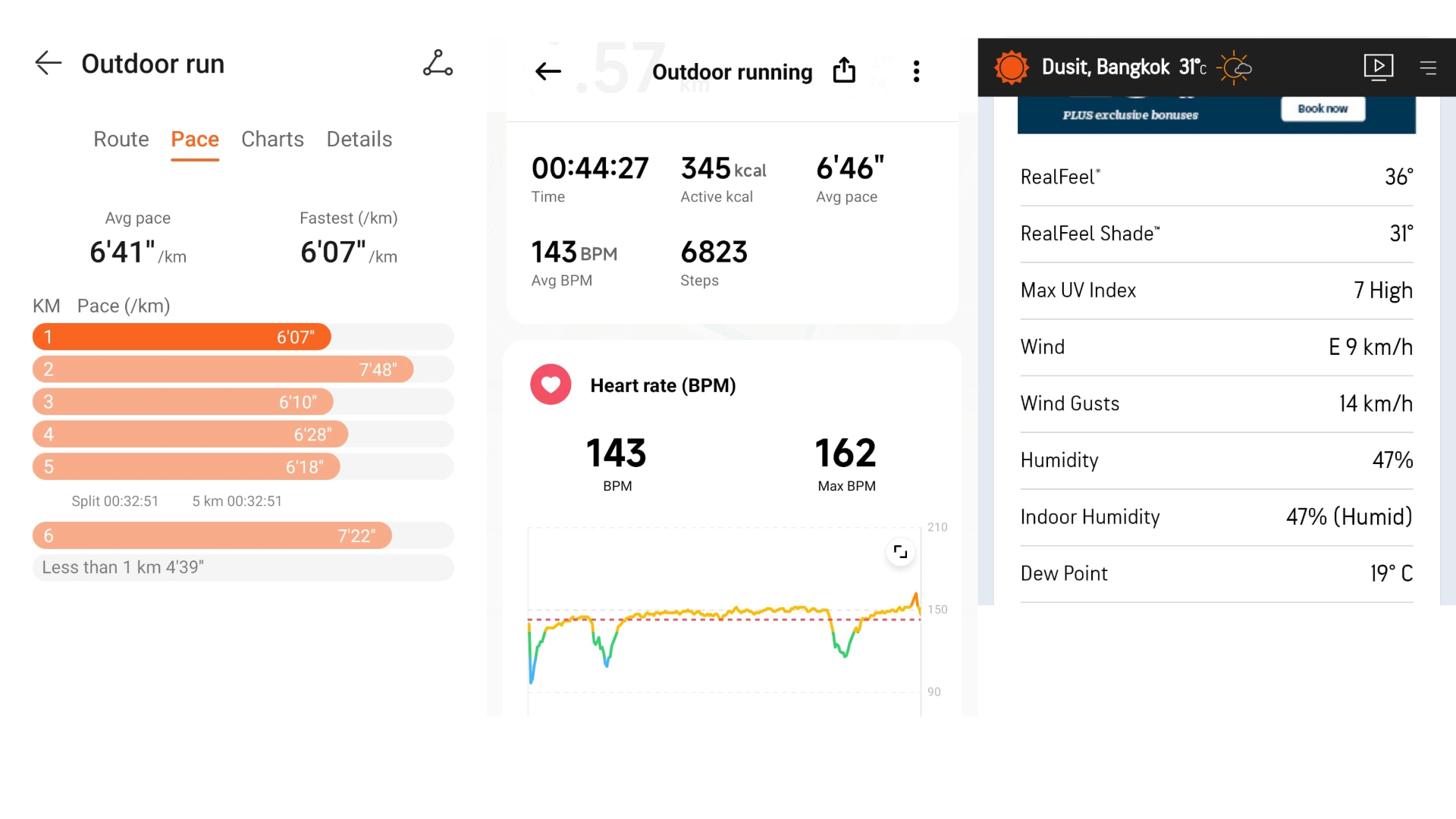
From February 2024; I was a little more consistent then, even though that was in hotter weather, back in Bangkok. The point here is that I'm not really pushing for long-term improvement.

I was more consistent about doing an escalating heart rate / gradually increasing running intensity back then too.
This has just been about passing on what has seemed to work for me. And maybe the higher order theme that whatever suits your goals and experience preferences should be fine, for running, or other exercise forms, or any kinds of hobbies and self-expression. I don't see these running stats as all that impressive, but then the point isn't really to impress anyone.