Showing posts with label training. Show all posts

Saturday, May 17, 2025

My approach to steady state run training


It's odd that I've turned to explaining how to do things that I'm absolutely not an expert on lately.  Similar to drawing on 2 1/2 years of dabbling with fasting to ground a recent post, I've been running for the past 6 1/2 years, but have really only ramped up training to a significant level over the last 3 or 4.  Even then that relates to running 20 miles / 30 km a week at a moderate pace, when I'm more active, doing 10 minute miles or 6 to 7 minute kilometers.

The point is that I've changed practice organically, and have evolved to a form that works well for me, working around unusual limitations related to recovery issues (at 56 years old now).  Longer runs seem to provide a more complete workout, up to 12 km / 8 miles recently, which I first took up about 14 months ago, but I definitely can't sustain running that far even every other day.  So this spring I've been running every third day, mostly, and last year I tried out 3 runs over 5 days, with a 3 day rest cycle, covering an 8 day cycle.  Back in Bangkok I typically only run 10 km, since that's a lot, with heat stress as a factor.  Sometimes I'll run less, mixing in an 8 km run when I'm not feeling it, or the day is quite busy, but over the last six weeks I've mostly only ran that 12 km.

For everyone who runs a main underlying concern is the goal, or goals.  Most people would include health benefit, and for me that's essentially all of the point.  I don't run to compete in races, and it doesn't support some other sports performance or more specific fitness goal.


What is "steady state run training?"


I've seen a video not so long ago (a few months back) referencing the concept of weight training using the same weights and reps over a significant period of training time.  This opposes a much more standard approach to weightlifting, and athletic training in general, of using "progressive overload" to build up an exercise base, along with progressively increasing demand, which encourages your body to develop an adaptive response.  In the case of weightlifting this is probably muscle strength, or maybe hypertrophy (adding muscle mass), but in running it might relate to running pace increase or the ability to run further.

I think generally the same thing is something of a goal, when using this other kind of approach, to train to increase capacity in some sense.  It's just a counter-intuitive means to getting there.  I'm using the approach of not increasing running pace, or even volume, related to feeling like where I am for total pace and volume is fine, that it fulfills my goals.  And probably more importantly, it maxes out my recovery capacity, so that I can exercise at moderate intensity and considerable volume (for me), which isn't easy to escalate to more of either.

It's probably going to work better to explain what I've been doing, and then move onto why, in more detail, instead of laying out the entire theory first.  This approach evolved organically, and seems to work for me, coaxing my body to tolerate roughly as much training load as it seems comfortable with.  Intensity I could really bump, increasing running pace, if I used more short interval training, but that would involve some injury risk, and trade-off related to experienced volume.  Eventually I'll explore that, but for now since I only maintain these higher levels of exercise exposure for a couple months at a time, before something disrupts my schedule.  Then I build back up to the same level.  It kind of works.


A bit more background


It could seem like I'm going to conclude what type of training provides the most benefit, for a general fitness support goal, but as far as I know there isn't so much consensus on that.  One general recommendation is to get 3 hours of moderate intensity cardio exercise per week, which I definitely cover running 20 miles a week, at or just under 10 minutes per mile (200 minutes per week, leaving space for the annual average, since my long-term schedule includes plenty of lower volume weeks).  

Maybe that's higher intensity than is necessary, and related to even considering that breaking down exercise intensity is difficult.  I'll cover further here how most of that running is occurring between 135 and 145 beats per minute heartrate, but I never really do evaluate if that's a great goal for me.

Here's a very common version of that background guideline (running intensity in relation to heart rate), so universal that Google's AI answer sums it up clearly and accurately:


To find your optimum heart rate training zone by age, you can use the general formula of 220 minus your age to estimate your maximum heart rate. Then, you'll target a range of 50% to 85% of that maximum heart rate for moderate-intensity exercise. 


So I'm 56, leaving me with a maximum heart rate of 164.  That is roughly as high as I ever go; for maximum intensity over short periods it's fine to maintain 160, and 164 is pushing it.  50 to 85% of that relates to a range of 82 to 140.  Sounds low, doesn't it?  82 isn't so bad for a resting heart rate; how am I supposed to do much activity at the level?  Mine might drop to 60-some, or maybe 70, but it's not all that low, in comparison with people who run a medium amount.

I still could circle back to original assumptions and goals, but let's follow this on to more details about my training, to see where those numbers are coming from.


For people more familiar with US / imperial unit pacing 6 minutes per km is equivalent to 9.7 minutes per mile, 6.5 relates to 10.5, and 7 equates to 11.3.

All of that pacing is inconsistent enough that to make sense of it I can explain what happens over a 12 km run, then get on to critiquing intensity and pace a bit.

I run less than 1 km before doing a warm stretch, sometimes using a park restroom at that same time.  To me it's all a part of the run, so often my first km time will be 9 or 10 minutes, with a couple of minutes of that not actually time spent running.  It throws off the pace average meaning much, but again to me it's part of the experience, and I'm comparing run to run, not trying for a certain goal.

The second kilometer is a relatively steep hill climb, up the south side of Diamonhead, even though that time doesn't necessarily reflect that it's the hardest part of the run (the 6:42 second km, here).  I take a short break at the top of the hill, as much to enable pushing harder going up it as anything, which is why the third km time is 7:20 (that day; all of these times vary day to day).  I think I wasn't really feeling the second uphill on the north side, and walked a bit more, leading to a longer 8:33 minute fourth km.  In general short rests are built into two places on the run, at the top of the first hill, and prior to the last 2 km stretch, and taking a third short walk break is really not typical.


the view from the top of that side of Diamondhead (at road level)


Diamondhead from the Ala Wai canal


the other side; it's a bit over a mile long


The 6:01 split relates to a downhill section, of course.  I cross an intersection as I'm moving from the Diamonhead area / Kapiolani park part on to out and back the Ala Wai canal; that cross-walk wait led to an 8:01 split.  I do a short walking break to catch my breath right at or after 10 km, but it doesn't show up as much delay.  I probably ran a 6:15 10th km, and walked for half a minute.


this total distance and time is an app glitch, but this shows the route


Back to goals, and the steady state theme


I'm running to stay in shape, and because I like to run.  Those km split times look to be all over the place but really I'm running between 6:15 and 7 minutes / km essentially all of the time, which is already a good bit of range.  But why at that pace?  Because it's comfortable; because that's what running at moderate effort works out to.

I will often ramp it up over the last km or two to run faster, bumping heart rate up to 155 at times, and pace up to 6 min / km.  It's odd that I can run at moderate effort for 6:20 or 30 pacing, then it really escalates speeding up just a little, but that's how it goes.

One might wonder if it's unsatisfying to not improve, to gradually drop km split times / pace from 7 minutes to around 6 1/2, then to get back "out of shape" during extended travel, or when I take time off to spend more of it with the kids.  Not so much.  I've been through very minor injuries before, and it's nice to be able to run 20 miles / 30 km a week at moderate intensity, and to almost never experience any of those problems.  3 hours a week of running between 135 and 145 bmp heart rate seems like a decent amount.

I've been swimming quite a bit lately too, a few times a week, for outings of 400+ meters in the ocean for a nice half an hour swim (or maybe 20+ minutes; I don't track that).  And I often walk the 10,000 steps in a day; errands and a busy schedule add up, and the kids and I use beach walks as a time to chat and check in.


flag 200+ meters out in the ocean (tourist for scale)


I do notice that I improve gradually, that slight increase in pace, and that it's most pronounced after I've been running consistently for about 6 weeks.  At that level of training burden (the 20 miles / 30 km) it seems natural to give it a break after a couple of months, or even earlier, to let the aches completely drop out.


Other approaches


It would be normal for people to use more frequent runs as a training base, adding 5 to 8 km easy runs on "recovery days."  Then also normal to use some shorter interval training to make it seem normal to run faster, to condition down to 5 minutes per km instead.  Running quarter mile intervals at much faster pace would help, or any number of varying approaches along that line.


Or maybe not?  According to this, which I don't really trust as universally accurate, people in my age group (55 to 59) run 5 k races at an average of 12:08 minutes per mile, or 36 minutes per 5k.  That doesn't sound right, does it?  I'm running 2 5k distances back to back, at 32 to 34 minutes each, aside from a stretching break, then another 2 km a bit faster, all relatively continuously.

If people are doing park runs without training all that much this makes sense.  It would be hard for me to train to break a 25 minute 5k time, no matter what I did, but if I shifted training emphasis to speed conditioning for that distance it would come, in time.  In "running circles" there is a lot more focus on the marathon than on a 5k distance, and 10k runs are often seen as fun-runs.  People more serious about moderate distances might use local 5k races to test out their current fitness level, running 15 to 17 minute times, but they would be an exception in a local event field.


From February 2024; I was a little more consistent then, even though that was in hotter weather, back in Bangkok.  The point here is that I'm not really pushing for long-term improvement.


I was more consistent about doing an escalating heart rate / gradually increasing running intensity back then too.


This has just been about passing on what has seemed to work for me.  And maybe the higher order theme that whatever suits your goals and experience preferences should be fine, for running, or other exercise forms, or any kinds of hobbies and self-expression.  I don't see these running stats as all that impressive, but then the point isn't really to impress anyone.


Saturday, May 11, 2024

Run training update from Honolulu, Hawaii; lessons learned


Running has went well while living back in Honolulu; it's a beautiful place to be outside, and the weather is perfect for it.  At least compared to back in Bangkok it is, where it's always way too hot.

This update isn't meant to be informative related to training approach for experienced runners.  I'll still include some "lessons learned" related to experiences at the end, but many runners have been through a lot more training scope than I have.

I've looked into what I might be doing differently if I was training more seriously before, watching the typical training theory videos, which would go better if I was 20 years younger, or on steroids / hormone replacement.  At 55 I need to work around limited recovery capacity.  I'm up to running 37 km / 23 miles per week recently, so related to volume that's not bad, but I'm not running as fast as I was a year ago, so intensity (speed) has needed to drop out, at least until I can work back up to that.


Some general and aesthetic background first:  I live at the Eastern edge of Waikiki, near Diamondhead, and run around Diamondhead three times a week, then out and back the Ala Wai canal after that.  It's beautiful there.  It was a stretch moving up to that weekly volume, but it works out.


view from the Diamondhead hill, on a really early outing


the opposite side of the run, the end of the Ala Wai canal, after circling that volcano


there really are a lot of rainbows here


Back to running progress


That's what run pacing looks like recently, if anything on the fast side.  I brought a watch that tracks heart rate but lost the charging cord on the trip, so I let that part of tracking stats go.  It was interesting varying running intensity but I can feel how that's going, and more typical challenges are pulling together motivation, effort level, sorting through stiffness, and breathing.  

That initial 10 minute km--in the stats / picture--is from walking over to the park (I start it at home since that phone has no active SIM card in it), then a short stretch, with a second warm stretch after a warmup run.  It takes doing loosening up.

A typical route looks like this:


I usually run the 12 1/2 km route, doing the canal out and back; that's slightly longer, going through that other neighborhood area.  There are two hill sections on the route and I'll usually walk a little at the top of the first steeper one, or sometimes both.  Frequency looks like this:


I wasn't running that far at the beginning of April, the current 12 km, and switching over took some doing.  Sometimes I walk a good bit, hike, ride a bike, or swim, and I've been ice skating twice in the past month, and mixing activities can tax training recovery.


Lessons learned


All well and good, but what do I understand differently now after this experience?  I ran an equivalent amount last May, but still my impression of it has changed a little.

Effort required to run at a relatively normal pace, for me, that 6 minutes per km (9 1/2 minute miles), stays on the high side.  I could be clearer as to why.  It seems like it's hard to improve conditioning without varying training intensity, doing faster shorter interval running, so that the normal pace feels more moderate.  That risks injury for me, if I don't take that slow, and for whatever reasons my interest has been to increase training distance instead.  I'm really running to stay in shape, and to experience it, not to train for fast race times.  I don't race.


I haven't fallen into a clear routine for timing, related to exactly when I run, and I think that throws off making improvements.  Early morning is most pleasant, but I'm not a morning person, and that requires running without ingesting any caffeine first.  I need to also eat when I drink tea to protect my stomach, or at least that's how I see it, so I can't run too early if I have a light breakfast.  Sometimes I run in the afternoon instead.

It's interesting how relative effort related to body tension and breathing forms works out.  For pushing it for distance increase it's hard to fully recover, and carrying leg and body tension from not being completely recovered seems to add a lot of extra work (and adds a few minor aches, of course).  It's odd how the two things inter-relate, experience of tension and effort level required to run.  I've experimented with shifting posture, relaxing my shoulders, and using different hand positioning to help with relaxation while running, but I would expect that what works for anyone is a bit individual.

Often I'll experience a very stable, slow form of breathing that only evolves as I fully relax, usually after 6 km.  I might push that pace to as fast as 6 minutes per kilometer, but often that's not fully sustainable, and I'll alternate a faster and rougher breathing pattern.  I don't know what that means, but it seems the faster and shallower form might relate to my body clearing lactic acid or carbon dioxide faster, or maybe I just need more oxygen.

Related to that running theme of muscle and soft tissue recovery, very light activity, like swimming or walking, seems to speed that process up.  Youtube running channel content producers always claim that slow "recovery runs" work better than rest days, and it seems that might be right.


I think I could push it a little harder.  I'm concerned about injury, since I've experienced three very minor injuries in the 5 1/2 years I've been running.  Those issues were nothing that required much treatment, all just extended extra soreness in a tendon or ligament, but taking a month or more off running definitely throws off progress.

It's not just that; part of the running experience is about enjoying it, relatively speaking.  Focusing and leaning into the pace over a shorter run, for example for 45 minutes, isn't so bad, but pushing it doesn't work well with longer hour and a half range runs.  I could emphasize the divide that's already happening in these runs, starting slower, and changing pace at the mid-point / 6 km mark, but part of the conditioning input that's not as clear in the stats listing is about grinding out two uphill sections early on.  Leaning into the hill climbs is a little rough but also kind of pleasant.

To offer others advice, for people regularly doing shorter runs or always at a moderate pace, it worked well for me earlier this year to divide a run into an initial slower pace then a later faster one.  It was odd how close the two were in terms of actual running speed, both essentially right around 6 min / km or 9 1/2 min / mile, but easing off a normal pace just a little made it feel much less intense.  In a sense that's like using the first 5k of a 10k / 6+ mile run as a long warm-up, which is probably not ideal for maximizing training effect, but it took the sting out of working up to normal effort level several times a week.


some of that is heat stress, running back in Bangkok


she is hardly ever in the social media photos


light hikes can be nice here, very scenic


Monday, February 5, 2024

Tracking heart rate while running in Bangkok heat


I'm not sure who a run training update would be interesting for or helpful to, which is why I don't write these very often.  I'm not sharing results on Strava or anything like that either, racing, or running with friends, so I just keep doing it to exercise, as my own thing.

Trying out tracking heart rate is the newest thing.  I suppose what seemed like a minor injury back in October or so had been the newest thing earlier; I never knew what to make of that.  A knee issue seemed inconsistent, as if tendons were sore in different places, maybe moving around because the real cause of the problem was elsewhere, a glute or hip stabilizer muscle issue.  Who knows what it was.

After resolving that through rest and time off, and building moderate intensity weekly mileage back up, to about 30 km per week now, I tried out using a very basic heart rate monitor.  

It's not so uncommon for people to use low heartrate training as a main approach, to calculate some relative low-intensity optimum, and then instead of running miles or km at a set pace to keep heart rate consistent.  That was never the plan; I was mostly just curious what it was.  It seemed interesting to be able to see how heart rate varied with pace, and effort level, and if heat stress seemed to be affecting that factor.  Then later maybe it could be a factor in changing approach.

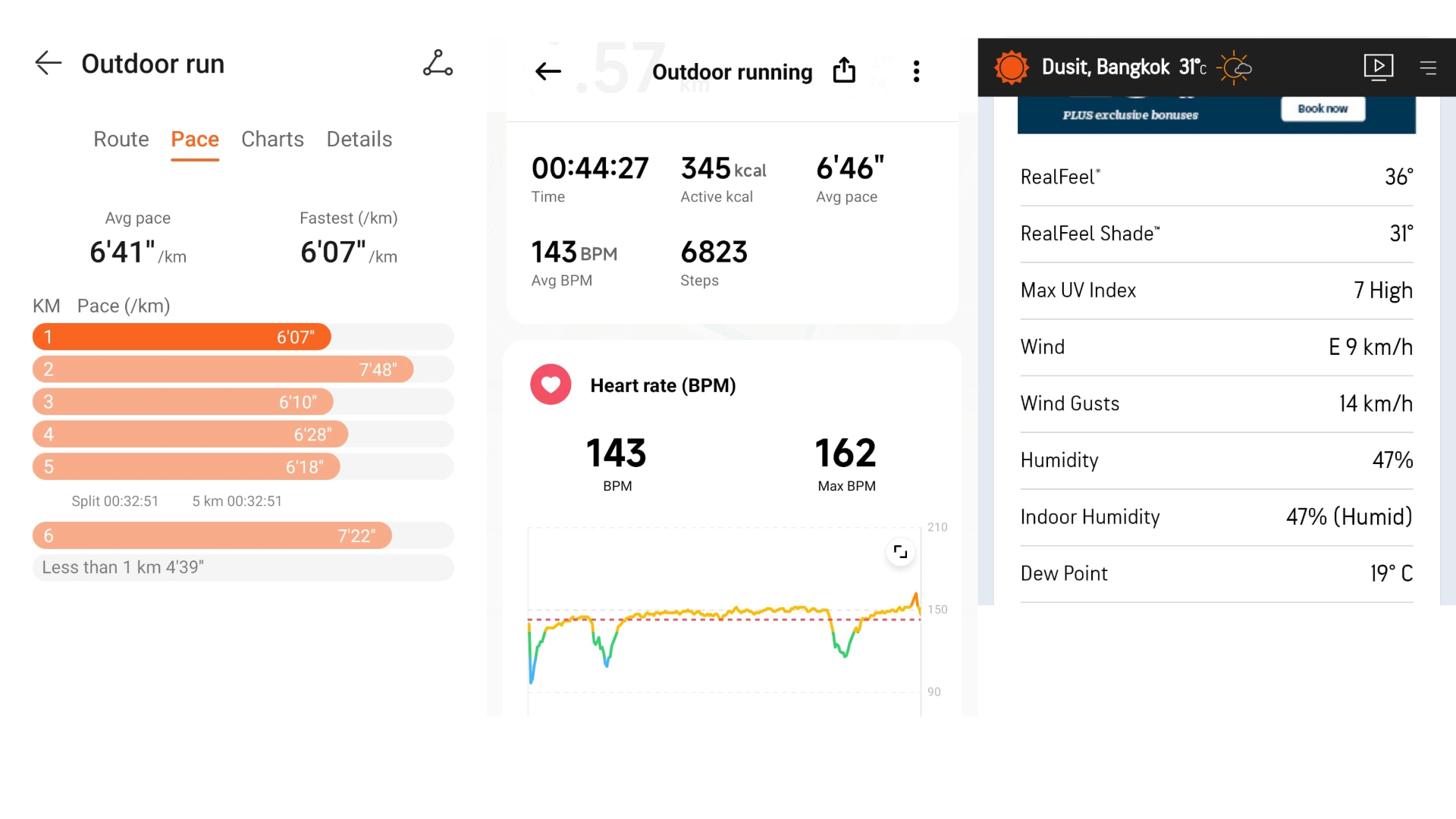
It all worked out as one might expect; a very moderate running pace corresponds to 130 to 135 bpm, and running at higher intensity and a faster pace tops out around 145 to 150.  It seems that related to pace the window spanning the two is not that far apart.  It takes me a lot of effort to run 6 minute kilometers now, even though I had trained to run some of them between 5:30 and 5:45 a year ago.  That was in Honolulu, Hawaii, where it's cooler, with some elevation change on my normal route.  There I could run the 11th and 12th consecutive kilometers at 5:45 on a warm afternoon along a flat course, and in slightly warmer local Bangkok weather now that would be hard.


running alternate intensity 10k at 30 C (86 F)


These both show a new form that I'm trying out, running an easy 5k followed without break by a higher effort, faster 5k.

There isn't all that much training theory behind that.  It combines easing into a session and sustaining some higher intensity running.  The humidity and temperature shift how that kind of thing goes; at a hotter and more humid time maintaining "low" heart rate (135) even at the moderate pace wouldn't work.  It's essentially always in the mid to upper 80s F / upper 20s C in Bangkok, unless you run at 6 AM, and since I'm not a morning person I just try to avoid the low 90s / low to mid 30s C.  I can show how that goes in another stats capture, but I'll add a little about how this workout version shown in graphs feels first.

Running at 135 bpm is fairly relaxed, if it's only 29-30 C, mid-80s F.  I don't know if that's a good or a bad thing; it's my impression that pacing depends on a base level of conditioning, which I'm not qualified to interpret.  It's probably not good or bad, instead just where you are at the time.

Running between 145 and 150 bmp isn't so stressful, but that's as far as I'd want to push it, and sustaining that general level for 5k seems like enough.  In the past I would feel a slight breakdown of my normal equilibrium, energy level, and breathing rate, right towards the end of what I had trained to easily do, and that often related to running 10k in about 1:01 to 1:02, a minute or two faster than using this approach.  That kind of minor difference stands out a lot; running a 30 minute 5k and a 32 minute pace is completely different.  That's the difference between a 6 minute km and a 6:25; it's vast.

I can switch the units, in case someone reading this runs at min / mile:  that's a 9:40 versus 10:20 mile pace (6 to 6:25 min / km).  Again whether that is fast or slow depends on someone's conditioning level.  Anyone routinely training in much cooler weather probably wouldn't tolerate the heat input part of it well, running at 85 to 90 degrees F, regardless of their normal pace.


I always thought it would be easier to train to run faster, much earlier on.  I could break 20 minute 5k race times in high school cross country, and I wasn't all that good a runner, and didn't train that much.  It turns out that running a 4 minute km / 6:26 mile isn't easy to do at age 55, without prior "training up" to that fitness level.  

I had been experimenting with running shorter intervals faster when that odd injury came up, which is probably no coincidence, so in order to avoid that experience I'll have to forego that most natural training approach to drop those times.  If I add some weight training I might become more durable, but I'm not eager to expand training range like that.  I had been walking and swimming more a year or so ago when I managed to push both intensity and volume past where it is now; maybe those really did help with recovery, muscle training, or general conditioning level.


heat impact example; running 7+ k at 31 C (88 F), in the mid-day sun


The other question I had related to the impact of running when it's hotter, when it's not in the mid 80s, but around 90 instead.  A recent outing tested that:


It really wasn't that hot; on that first run it was 30 C, 86 F, and on this second it was 31, 88 F.  The first was in the evening, after dark, and this was in mid-day sun, running between noon and 1 PM, and it really makes a difference.  Of course it does, as humidity level and breeze does (or lack of it), but I mean that you can have a completely different kind of experience, not that it's a noticeable slight change.  

47% humidity is on the dry side for here; I suppose that helped, but running in direct mid-day sunlight was a more problematic negative input.  Those temperatures I've cited are some central Bangkok measurement; I was probably experiencing a broader gap where I actually was, out on a running track / sidewalk environment.

On one running course I complete two 5k laps, with no second warm stretch, and on this route I do either 2 or 3 3.7 km segments, with a warm stretch after 1 km.  On that second heart rate dip (above, during km 6) I was walking to rest, to drop my heart rate, which had been pegged at or near 150 the whole time.  I think that tied to heat stress input, but I haven't fully sorted out other possible variables.  It's easy to write off having any rough outing as heat input, but there's probably more to it.


a track / path around the local royal palace


that running path at night, lit up for some holiday or memorial theme


what it looks like in the daytime


One might wonder, how is this informative or actionable, beyond prompting me to try out that split-pace approach?  I suppose it's not.  I could've felt that the second run described here wasn't going as well without a heart rate stat filling that part in, that I was hot.  I was averaging 6:15 km paces, just not on the two one-km splits with a stretch and walking break, so it wasn't really fast or slow, but it was taking effort to do that.  The second 5k of that earlier run was slightly faster, right on 6 minutes / km instead, at significantly lower heart rate, just below 145 average instead of close to 150.  You can feel that difference.

It's a different thing running against conditioning level versus pushing heat stress tolerance.  You feel a bit tired after an hour of medium intensity running, but that heat stress stays with you, even when only enduring 40 minutes worth of it.  I won't do hour long outings when the heat is getting to me; I could back way off a normal pace and tolerate it better (maybe; I never really try running 7 minute km pace), but it's habit to just stay in a normal pace range and call it a day early.  If I feel off I'll run 6:30 kilometers but beyond that I tend to just pack it in.


Trying out tracking heart rate was only ever about sorting out these patterns, which I had already experienced without tracking that.  I can run a 6 minute km, or 6:30, by feel, even with outdoor temperature input factoring in.  It's odd that the one is such a fast pace for me and other slow; that distribution could be broader.  I think with less heat-stress for running context, actually running when it's below 80 F / 27 C, I could train differently, and make better progress.


In Honolulu now, a daytime high of 78, breezy, with a chance of light rain.  Perfect!


the view running around Diamondhead; pretty nice


Tuesday, May 2, 2023

Running status update; increasing distance and intensity


Diamondhead, the local volcano I run around


As I see it I'm still a beginner runner, so passing on status is still about communicating how moderately developed training goes, and routine changes in that experience.  But I am up to running 15 to 20 miles per week.  My typical route is around Diamondhead, the iconic local Honolulu volcano, a 5 mile distance, with two significant hill climb sections.

Why communicate this?  Ego, I guess, the usual answer, to brag about progress.  But for people thinking of getting into running, or ramping up light training, it may be helpful.  I'm not training for races, to be clear on context, but eventually I could run one.  I just tried out extending my daily run from 8 km to 12 (5 miles to 7 1/2), so I could run a 10k easily enough, or even a half marathon (21 km), but I would have to add even longer runs to prepare for that longer race version.  For now it's not about that social exposure or the experience of testing my conditioning in a time trial.


all metric; I'm definitely not running 6 minute miles


For the longest time, for years, I kept individual run distance or weekly total very limited, at 2 miles per run, doing that three times per week.  I would add extra intensity, fast 800 meter section at the end, instead of ever adding distance.  After a couple of years I doubled that run length, but after disruption from a mild injury I dropped that, only really extending length again a year or so ago (but it's easy to lose track; maybe it was further back).  

The point here is that running for exercise can take a lot of different forms.  My earlier practice replicated what treadmill experience is like, 20 or so minutes on a set course, with potential to change intensity instead of ever adding distance.

A main challenge is increasing either distance, intensity, or frequency at my age, 54, since recovery time is a concern.  I can gradually increase demands if I'm only running about every other day, 3 to 4 times per week, but I can't foresee how getting up to a 40 or 50 mile weekly distance would ever be possible (standard marathon training, according to some).  Maybe with another year or two of gradual increase, but that pace of slow change can be hard to relate to.  But I have already experienced slow transition, over the past year, building up to 10 km runs over months, when that had been closer to a weekly total.


A hill climb input has been interesting, and challenging, changing things in relation to only running flat local routes back in Bangkok, for the 5 months prior.  I lived in Honolulu in Sept. and Oct. 2022, so this local route I started doing back then, but it was new to me.  Adjusting to that demand, normalizing the experience, and increasing pacing took weeks during this stay.  


the view on the ocean side of Diamondhead, nice and relaxing


I guess I'm recommending patience then, gradual increase in new demands.  Prior to moving back here, in March, I seemed right at the cusp of adding "speed work," a different kind of input, while experimenting with longer distance and more runs per week.  The hill experience has replaced that; I didn't get back to running shorter intervals faster just yet.

I've experienced mild injuries twice in 4 1/2 years of running, nothing too severe, but that's why I've been avoiding quicker changes in demands.  Swimming, hiking, and doing a good bit of walking here have been nice for mixing up activity exposure, which seems to help with running recovery instead of offsetting it.


Subjective experience change across the longer term experience have been interesting; I find I like running more and more, as it becomes more familiar.  Pushing the pace to put in faster than average outing times isn't so unpleasant, but my normal range has been limited, spanning 45 to 47 minutes for that nearly 8 km route.  That works out to 9 1/2 minute miles, or a half hour 5k pace, not so fast.

I was always concerned that if I ran with any sort of time tracking--I run with a phone app minding the pace now, and announcing it by km, not a version of sports watch--that I would see half the outings as failures, as slower than average, but with times in such a narrow range it kind of doesn't matter.  I run a little slower when I go out in early mornings, not being a morning person, but it's cool being out there then, so I don't mind.  Adding a short walking section at the top of the most difficult hill actually speeded up the times; I can run a little closer to failure point knowing that a 20 second recovery walk will follow that.


Where is this going, one might wonder.  Sure it can relate to "getting in shape," but with what final limit, or goal?  It's a bit abstract, but when I was younger I ran cross country and track, and ran 10k road races in the 42 to 44 minute time-frame.  It would be nice to be able to replicate that.  I was really training more for 5k distances then, and if I could run a 19 minute 5k that would match that capability.  I wasn't much of a natural distance runner, or a competitive high school racer; 17 minutes would be an ok time, much faster.  Since flat course, daily runs of 10k were at a one hour pace two months ago, which I ran 3 or 4 times a week, I could surely run at least close to a 45 minute 10k now, if not faster.  I'm just not doing races or any work-out based time trials to find out.

As with other parts of my life right now I don't know where it's headed.  I'll return to Bangkok, and to flat route running, within the next month or so.  How quickly I return to Honolulu depends on job hunting progress; maybe in July, or maybe towards the end of August, when my kids return to school.  I'm working remotely now at my Bangkok job, and it would make sense to experience that employment in local form for awhile.

If I did run a 42 or 44 minute 10k race, or decent half marathon time, I'm not sure if I'd taper off training.  Time demands versus return factor in; I'm staying in great shape for spending 3 or 4 hours a week on the hobby, including limited transit time and showering (walking a half a block to the local park).  I'm not sure that I need to be this fit for the next 20 years, that it would be helpful.


I'm not the right person to pass on first person experience with running training, because I'm just not advanced enough, but watching videos on the subject has been interesting.  I'll share some random ideas I've encountered, most of which don't draw on my own exposure all that much.  A last post about running mentions some of those video sources, but once you watch a few running videos on Youtube the algorithm will keep mentioning them, as with any subject.  I had switched over to 10k distance in February in that writing, 3 months ago, but pace isn't so different then, just a little faster, with two hill sections added to the route.


Running with different types of training shoes:  pretty much everyone further along in experience--passing on advice in videos--just assumes that people are going to own a number of different shoes for different purposes, for running longer distances or faster, shorter training sessions, for racing, with more cushioning for slower "recovery runs," and so on.  I don't recover well while running, but I get what they mean.  

I happen to own two pair, related to really wanting to try out a specific shoe, and liking the idea of alternating to offset impact (shoes really do seem to affect running form and experience just a little).  I don't have any further useful advice to add; watching a lot of review videos fills in the rest, but fair warning, it makes you want to buy any number of extra pairs.


Asics Novablast 3; pretty nice


In the reviews and commentary once in awhile sources will mention what they recommend to people asking about owning just one shoe, and they're kind about not being negative about that, but reading between the lines this marks out one divide in their minds between newbies and more serious runners.  That's fine, really; you do need to become more serious if the goal is to put in good marathon times, not so much related to buying a lot of gear, but some of that would enter in.


Training theory:  I'm not relying on much of that, but again the easily accessible and broadly oriented videos on Youtube help pass on starting points, if not more advanced and comprehensive advice.  An example:  it's best to push on to running one longer outing once a week, or week and a half, since this conditions you better than repeating the same distance over and over, or doing medium lengths plus speed work or hill climbs, or whatever else.  What "long" means would vary by person, but the 10 to 15 mile range is often referenced, and there's no reason there would need to be much of a limit.  Recovering from a 15+ mile run would seem problematic, but it seems people trained to endure routine longer distances can run "slowly" for an extended time.  

Other parts about calculating specific workout paces is fascinating, based on current maximum oxygen use capacity, heart rate, lactic threshold (how fast your body can clear carbon dioxide and lactic acid), and whatever else.  Again, watch the videos.  

The minimum "buy-in" to try out these ideas would be a sports oriented tracking watch, to keep pace clearly identified, and to monitor heart rate, main input.  There are different versions of these, so relative cost would surely vary, depending on functionality.  If I was training for a race time goal I'd be into that, but I'm not, I'm just taking fitness pursuit to an odd place.  Of course use of very functional shoes comes into play, and some recovery devices (eg. foam roller), and bumping clothing functionality comes up.  I would experience a completely different cost to run if I were going out in cooler temperate weather to run; being based in the tropics simplifies all that quite a bit.


Effect on daily life:  surely it's just better, right, more energy, increased fitness, and athletic capability?  Kind of, but I've also been describing consistently trying to increase physical demands week to week, keeping that level stable when I'm normalizing the last increase.  I've been a bit sore for a lot of the past 4 1/2 years, and pushing it more over the last year adds extra fatigue.  It's not as bad as one might expect, because if you increase it all too fast you'd be injured, so natural limits enter in, at least in middle age.  I prioritize getting decent sleep more than ever; that takes extra time.  

I don't do much to add to recovery, not using any special devices (I had a foam roller and lost it), not getting massages (although Bangkok is the ideal place for that), or eating much for supplements or special diet, and definitely not longer run energy gels for fuel intake.  Again racing would change things, training for a specific goal, instead of just to get in shape, to progress capability.


Nutrition:  an extension of the last concerns, which I'm not quite on to needing to address with special inputs, but I'm getting there.  I don't normally eat nearly enough protein to sustain vigorous exercise, the recovery part, so I've taken up addressing that on a day to day basis.  My own solutions are easy:  add protein powder drinks (a limited supplement), eat extra eggs when I notice intake drops, drink a little milk (not much), and from time to time eat a good bit of veggie protein, making up large lentil soup or chili batches or whatever else.  I take a multi-vitamin, and supplement potassium and magnesium a little, really an outcome from experimenting with fasting.  

I'm not trying to add calories, or eat any certain amount of fat, or adjust carb inputs.  I eat a lot of nuts as snack food, which is partly about that being a healthy input, and just about liking them.  Dropping out most junk food isn't related, more an outcome of seeing a high cholesterol score last health check, which may or may not be so bad in relation to proportion of good to bad cholesterol type, but still I'm trying to become healthier.  One might expect that I would become thinner, especially for experimenting with fasting a few times, but not really noticeably so.  Swimming seems to tone me up a little, and that change stands out more.


with family


In closing running interest has transitioned to a much more extensive and interesting pursuit, even for staying limited in scope in some ways.  I'm curious about my heart-rate status related to exertion, but running by effort level seems fine, for what I'm doing.

I'll keep going, bumping distance and speed over the next months, trying out new training directions.  It's going to feel like a setback going back into Bangkok heat, but at least we're leading into the rainy season now, which is hot and rainy instead of really hot.  If enough changes I'll check in here about it.


Thursday, March 23, 2023

Protein, muscle, aging, and longevity


Two references I've recently ran across seem to say two completely opposite things about aging, or rather managing and reducing the rate of aging.  Both relate to one particular input, to adjusting protein consumption and amount of bodily muscle tissue.  Offsetting aging is an aggressive goal, but whether that's practical or not it can be interesting to hear about potential approaches, or even uncertain background.

One set of statements and claims by Leo (Laith) of the Leo and Longevity YouTube channel claims that reduced calorie intake, and specifically reduced protein intake, increases lifespan. Another article connects lack of muscle with aging issues, and claims that substantial protein intake is necessary to maintain higher levels of muscle tissue, which increases both longevity and health in later life. I think we can unpack both and resolve this apparent contradiction, to some limited extent. 

A lot of this will be my own speculation, to be clear, and I'm not some sort of medical professional.  I will mention some unusual personal exposure along the way, but that's not intended as clearly defined evidence, just extra anecdotal input.

Let's start with the pro-muscle development article, Muscle Is the Cornerstone of Longevity:


Pumping iron, weight-lifting, strength training—call it what you want, but it is key to living longer, according to Dr. Gabrielle Lyon...
  
“The more muscle mass, the more survivability against diseases,” Dr. Lyon explained. But muscle mass must be maintained to have these effects. It’s a use-it-or-lose-it part of our biology due to sarcopenia. Sarcopenia, as defined by the National Institute on Aging, is “a decline in muscle mass, strength, and function...” ...Weight training is essential to mitigate these effects as we age. When you “stimulate skeletal muscle,” stated Dr. Lyon, “ [you] maintain mobility, mental clarity, hormonal balance, and improve mood.” 

The National Institute on Aging explains that “a big culprit for losing our physical abilities as we grow older is the age-related loss of muscle mass and strength…in addition to making everyday tasks difficult, mobility limitations are also linked to higher rates of falls, chronic disease, nursing home admission, and mortality.” Dr. Lyon emphasized that we should be “focusing on building muscles rather than losing fat. [Muscle] will help you build your body armor to protect you throughout life.” 


...Adiposity [being overweight] is the result of a health problem, not the starting point. It is the same with other chronic diseases “such as type 2 diabetes, heart disease, and fatty liver.” According to Dr. Howard J. Luks, an orthopedic sports medicine surgeon, in his article, Muscle Mass, Strength, and Longevity, he writes “losing active [muscle] tissue can have dramatic consequences. Muscles help us control our glucose levels, use glucose as fuel, and have a role in insulin resistance.” So, instead of thinking of fat as the root cause of health problems, we must understand that it’s no more than the middleman. The actual chain of command is unhealthy muscle tissue, adiposity, then disease. 

But to build healthy muscle tissue, you need protein. “Protein is necessary for nearly every function in the body and every structure,” explained Lyon. “There are 20 different amino acids. We need the nine essentials—histidine, isoleucine, leucine, lysine, methionine, phenylalanine, threonine, tryptophan, and valine—to support many processes that happen within our body. Each amino acid has more than one role; they function as a metabolic signal and are necessary building blocks.” 


So there we have it; per this longer set of conclusions losing core strength and functional muscle tissue causes lots of other health problems, which can all be avoided by weight training and eating enough protein.  The part about core strength limiting risk from falls is familiar enough, but the rest not so much.  I don't want to include too many tangents but this reminds me of an interesting Instagram channel, that relates to how to control glucose spikes in the body, the Glucose Goddess channel:


You probably get the idea; you can adjust what you eat together to prevent blood sugar spikes.  Which are obviously a bad thing, right?  Sort of, or probably, but part of what I'm interpreting that last long cited passage to mean is that with substantial muscle tissue in your body you can store that glucose better, to use it throughout the day, while if you have very little muscle tissue it's going to potentially be more impactful having that sudden digestion input fall a bit out of balance.  

It could've been clearer that muscle tissue actually helps with storing glucose, since one read is that muscles burn more energy, in the statement "muscles help us control our glucose levels, use glucose as fuel, and have a role in insulin resistance."  I think I've drawn that from other background, like this statement by the Cleveland Clinic:


Glycogen is a form of glucose, a main source of energy that your body stores primarily in your liver and muscles...  Your body mainly stores glycogen in your liver and skeletal muscles (the muscles attached to your bones and tendons), with small amounts in your brain.


So with very little muscle tissue your body will either need to work through a blood sugar spike or else convert that energy to fat to do something with it, but muscle lets you store more for medium term use.  Moving on, Leo asserts something else, in the video Protein:  the Key to Longevity, and related to two other follow-up videos in a three part set.

Based on different starting points and evidence, Leo rejects the common "building blocks" model of analyzing dietary inputs, that your body uses proteins, carbohydrates, and fats as energy sources and tissue building inputs (which is certainly correct, but it's only one part of what's going on).  He claims that this model is one partly accurate and descriptive construct, but not the only valid frame of reference. 

At a finer level of internal body process review signaling models apply, that what you ingest triggers specific physiological processes that can be active or inactive, or partially active, not all relating to only energy use or storing fat energy.  Even his complete video, that I'm summarizing here, clearly states he isn't unpacking a large proportion of this background, and narrowing related body processes down to two examples, versus treating how a larger range of them interrelate and apply.

Leo is citing a lot of well known references to low calorie intake being associated with longer lifespan, with links in that video--that part is already familiar to many.  It's very problematic for people to restrict their calorie intake for extended periods of time, for years, so attempts at "dietary restriction" take other practical forms today, including intermittent fasting.  

Leo goes further, claiming that lower protein intake alone can have the same effect, lengthening lifespan, especially related to limiting high levels of specific amino acids (protein building blocks), most specifically two related to red meat consumption, present at far lower levels in vegetarian proteins.  This isn't a guess based on his own reasoning; he is citing the same kind of documented, peer-reviewed animal studies that initiated these earlier conclusions related to calorie restrictions, in studies conducted on fish and rodents.

If the two references are saying opposite things, and the first is based on direct input from a longevity research professional, and the second is based on many seemingly sound research sources, who can we trust? Can both be right? Maybe. I'll not fully unpack or resolve this, but it's possible that the contradiction is only apparent. I'll get to that part, but first I wanted to raise one more anecdotal input, about not personally experiencing aging as much as I expected.  It does connect, and some works as a good framework of ideas for how this might play out in actual application.


A personal account of atypical aging experience


I'm 54 and in pretty good shape. Good diet and some exercise can account for that, or good genetics and luck. But my hair isn't greying much more than in my 20s, my skin isn't wrinkling much, I'm retaining more muscle mass than I think I need, but then maybe that is useful after all, given some of this input. 

I suspect that staying active accounts for a lot of it (I run), but it also seems possible that spending 17 years as a vegetarian helped by keeping my body weight moderate, or even low.  For early adulthood, teens out to close to 40, I weighed about 145 pounds (65 kg) at 5' 8" (170 cm), and I've only recently increased that to 165 pounds / 74 kg.  I wasn't trying to be thin, or to not eat much, it just worked out that way.  

That diet may have led to moderate protein intake over a long time period, and the distribution of amino acids from vegetarian sources would be slightly different (something Leo addressed specifically, best reviewed by watching that video). Even now I eat a lot of fruits and vegetables, and a generally clean diet, and need to work on it to include enough protein to support exercise recovery, from the running.

Genetics is surely a main input; my mother aged somewhat slowly, and my sister also does.  It's probably not a coincidence that both maintained low body weights for their entire lives.  I suspect that eating a very good diet comes into play, along with getting some exercise, or other activity, moderating input of drugs and alcohol, getting enough sleep, and so on, general healthy living.


That first article seems to waive off body weight and fat level as most relevant (or more clearly seeing that as an outcome, not a cause). Maybe it's all relevant, activity level, muscle development, amount of body weight, and positive diet inputs, nutrient levels and on from there.  The modern reductionist tendency for people to look for one key cause is probably misguided, one independent "life-hack" to adjust complex inputs towards a different result by making one or two simple adjustments.


It's even more indirect and hearsay based, but it's a commonly expressed theme in bodybuilding circles that maintaining high body weight from either fat or muscle tissue adds stress to the body, and could impact longevity and long term health.  Of course that's not to be wrongly regarded as directly opposing the initial point that maintaining healthy muscle tissue levels contradicts this view, that carrying excess muscle tissue is a problem.  Higher level male bodybuilders can maintain moderate body fat levels while weighing between 250 and 300 pounds, with female bodybuilders typically not matching that atypical body size, which would be stressful for bodily systems.  Of course intake of drugs enabling that form of growth is a secondary risk factor; no one is "naturally" gaining that kind of muscle tissue weight, and steroids and growth hormone use pose other risks.


All this isn't to speculate that we should just be healthy; that would be an oversimplification.  Retaining a typical younger-life, high activity level of both fitness and muscle tissue probably are healthy.  Leo wasn't claiming that carrying any level of muscle tissue is a problem; he was pointing out that internal physiological processes are "turned on or turned off" when signaled by protein intake, and other factors.  He was seeing an indirect outcome from higher protein intake as a problem.  Let's consider further one such process, the main one he was discussing, from a Google search results reference, on MTOR:


Mammalian target of rapamycin (mTOR) regulates cell proliferation, autophagy, and apoptosis by participating in multiple signaling pathways in the body. Studies have shown that the mTOR signaling pathway is also associated with cancer, arthritis, insulin resistance, osteoporosis, and other diseases. The mTOR signaling pathway, which is often activated in tumors, not only regulates gene transcription and protein synthesis to regulate cell proliferation and immune cell differentiation but also plays an important role in tumor metabolism. Therefore, the mTOR signaling pathway is a hot target in anti-tumor therapy research. In recent years, a variety of newly discovered mTOR inhibitors have entered clinical studies, and a variety of drugs have been proven to have high activity in combination with mTOR inhibitors.


It sounds like this MTOR is a bad thing, and we should stop doing that, but it's not nearly that simple.  It's a key bodily function (internal process), that is required, so the concern here is how often or how long it is "turned on" or active, and the positive and negative effects of maintaining a greater frequency or duration of that internal process (or set of those; it's all not completely clear).  Let's simplify that down a little from a Wikipedia reference:


mTOR integrates the input from upstream pathways, including insulin, growth factors (such as IGF-1 and IGF-2), and amino acids.[11] mTOR also senses cellular nutrient, oxygen, and energy levels.[30] The mTOR pathway is a central regulator of mammalian metabolism and physiology, with important roles in the function of tissues including liver, muscle, white and brown adipose tissue,[31] and the brain, and is dysregulated in human diseases, such as diabetes, obesity, depression, and certain cancers.  


Sounds more positive there, but none of this lends itself to simple interpretation.  As Leo summarized it you can't prevent the mTOR signaling pathway (if I'm using that term correctly), but as he frames it you can help your body regulate how often and to what degree this is active.  He feels that it would be a good thing to do so, and consistently eating a lot of protein throughout the day could actually be very unhealthy.  It's my impression that he's linking general and broad studies that claim that, that higher protein intake levels in animals (fish and rodents, I think it was) correlate with reduced lifespans, and then he's trying to work back to why that would be, even though maybe this isn't a clear and singular cause.  Personally it's hard for me to completely accept any simple conclusions distilled from complex inputs; it's back to this being more interesting to consider than relating to obviously correct conclusions.


Potential resolution


Per my impression of that first long cited passage they are discussing problems with loss of normal levels of muscle tissue, not necessarily related to people being on a spectrum of having more or less.  Exercise inputs, genetics, and those dietary inputs (eating enough or a surplus of protein) would relate to gaining and retaining muscle mass, instead of there being one main input.

Per a common sense interpretation if someone spent a period of years weightlifting to build strength, and muscle mass, and coupled that with a higher than average and high protein diet, this wouldn't be as impactful as spending a much longer time on a primarily carnivorous diet, or even an all-meat diet (a recent health trend, an offshoot of the "keto" fad).  Of course maintaining normal but significant amounts of muscle tissue on a moderate protein intake diet is possible.

This reminded me of how an athlete like Alex Honnold might see this issue, a vegetarian rock climber famous for free soloing El Capitan.  His take:


Humans definitely need protein to maintain muscle mass and be healthy, and athletes certainly need more than sedentary people. But I think that protein is wildly over-emphasized. The average person, in the U.S. anyway, eats far more than they need.

There's evidence that humans have optimum health with a diet around 10-percent protein - that's easily met by just eating greens like spinach. So, it's not like a typical American needs to be seeking out more protein. That said, proteins and fats do help me feel fuller so I do think about the macronutrient breakdown of what I'm eating. 


The part about getting enough protein from spinach is a bit striking, isn't it?  In a GQ article his typical daily diet does sound like something no normal person could live on, never mind a high level athlete, with nothing in it including a substantial amount of protein:


Breakfast:  Muesli with flax meal, banana, hemp milk.

On-the-wall snacks:  Apples, nuts, avocado sandwich (fresh avocado on bread)

Dinner:  Macaroni and cheese with spinach, red peppers and yellow squash, topped with pumpkin seeds.


An average person living on fruit, nuts, vegetables, and granola wouldn't be that impressive, but his feat of athleticism, skill, and mental focus in that one free solo feat is all but unmatched across all of sports, pulled off on a diet most people think couldn't sustain them, whether they exercise or not.


One thing I didn't mention about my own experiences (with a very limited protein-input vegetarian diet) was that I was snowboarding and hiking a lot back then, living in a ski resort, and working long hours in demanding jobs as a restaurant server.  I even rock climbed a little.  I wasn't giving it much thought but in retrospect it's odd how it all worked out, even though none of that is impressive at all compared to high level rock climbing, or any competitive professional sports.


sometime in the 90s, out doing 15+ mile daily desert hikes for fun


last week; I am aging, just not so quickly for mid-50s


It makes you wonder how hormone replacement might factor in, but that's too complicated and involved to pair with these other completely separate concerns.  I suspect that maintaining a high activity level sustains adequate hormone balance, even into advanced age, but what do I know.  

I've known plenty of earlier generation family members who were very active and healthy, some into their 90s, but isolated cases like that aren't necessarily helpful for establishing generalities.  Those old-school, rural-life family members ate from gardens more than markets or grocery stores, and my family hunted as much meat as they bought, but again I'm not reducing that to claims here.  I think that eating a diverse and balanced diet is important, for me ideally including plenty of fresh fruits and vegetables, and then we can place input like these two sets of claims however we like within or beyond that.


Post script:  Leo Rex of Leo and Longevity died not so long ago (Laith really; Leo is an adopted name), and it seems appropriate to mention that here.  It's quite sad, to me, because in one sense it wasn't his time yet, as someone so young, bright, charismatic, and eager to help others.  

Related to his sharing of information online critiques sometimes came up, that he was too eager to experiment with risky "bio-hacking" themes, and offer information that others might base their own unsafe practices on.  This summarized topic example isn't that; eating a lot of protein, or very little of it, surely wouldn't pose or reduce health risks much in comparison with adjusting sleep cycles, using nootropics (mental enhancement drugs), steroids, or using other experimental exercise recovery support drugs.

I have greatly valued Leo's content and input, and wish to honor his contributions by remembering him positively here.  He was a fellow seeker, that many would recognize aspects of in themselves.  Sometimes even the parts that could be negative in some ways, the intensity and focus on shifting topics, and good intentions at times extended towards obsession, or pursuing a search for truth on to involving personal conflict.  Rest in peace, friend.


Wednesday, March 1, 2023

What fasting is like when it doesn't work out


Day one:


This is my fourth trial of fasting, moving on to a habit or accepted regular practice.  It made perfect sense to try it out as an experiment, but I could be clearer on what I expect from this.

It's not losing weight; I didn't weigh myself before or after the last five days, less than a month ago, but at a recent health check I'm 1 kg over my normal weight last year, up to 75 (165 pounds).  My blood pressure was up too, so general health isn't looking better, instead worse.  I've been running a lot lately and wonder if I'm not stressing my body a bit much, if recovery isn't a burden for it.  Of course I ran today, on the first day of the fast too, so it's not as if I'm acting on that as a concern.  

The theory behind that was from online discussion input that if you can burn up some available glycogen reserves on the first day that can speed up switching to ketosis, use of stored fat as energy (mostly that, at least; your body can use your own protein based tissue too, muscle, per my very limited understanding).  Supposedly even hunger might seem less an issue.  It is strange how I keep forgetting I'm fasting today, when in the past days 1 through 3 have always been rough.

There are a list of supposed, somewhat mysterious health benefits attributed to fasting (especially autophagy), and maybe it really is all that, the appeal of something wonderful being possible, just not clearly defined.  I'm also curious if the experience keeps changing, if it gets easier and easier, and some degree of benefit emerges with more exposure.  I may be slightly clearer mentally; something like that.  

I've been eating a continually healthier diet since I've started fasting some months ago, but it seems like the "diet reset" function is largely finished, that I'm as "switched over" in terms of clean diet as I'm probably going to get.  Most sugar and processed food is already out, and I eat a bit like those people who go on and on about it on social media, the streams of ultra healthy meal photos, I just don't mention it.


Day 2


Done already; I woke up in the night and couldn't go back to sleep, and felt an odd and disturbing sensation in my chest, and eventually called it.  I woke to drink water, with some extra electrolytes, but then over an hour later it wasn't resolving, so I ate a snack.

Maybe an electrolyte imbalance?  Seems most likely.  I was very careful about measuring out recommended amounts of sodium and potassium, and took a mid-level supplement range of magnesium, in pill form, in a multi-vitamin, and in a dissolving tablet, about 500 mg worth in total, but it still may have been that.

Two variable conditions came into play, which could've worked together.  I ran yesterday, thinking that it might help switch me over to ketosis to clear glycogen stores.  Since it was a short run (2.1 miles) I bumped intensity, to see how that would go, running that as 4 fast half-mile (800-900 meter) sections.  Of course that went badly; I don't train exactly like that, even though adding a fast 800 meter section at the end is normal for me.  Making a change in form might've been a bad idea.  I hadn't eaten for 15 hours or so at that point but I was expecting reserve energy level to hold over from the day before.  It kind of did, just not completely.

That step definitely seemed to help to smooth transition; I wasn't hungry at all yesterday, and an hour could go by without me thinking of being on a fast.  When I did walk by a snack food I'd often not notice, or the inclination to eat seemed muted.

A second variable was going to a health check-up a week or so ago and registering higher blood pressure than I've ever experienced (150 / 85).  I don't know why that happened.  My mother said that high blood pressure runs in our family, that she switched to experiencing it quite suddenly in middle age, in "spells," and there is probably a trigger I'm not clear on causing it.  

I've been increasing running distance, frequency, and intensity over the past 3 weeks, and that breaks a golden rule of running training, exceeding something like 10% weekly increase in any one or set of those.  That alone could be it, that my body is shocked by the change, experiencing higher recovery demands causing stress.  Or I suppose it's easy to see how working with a standard electrolyte supplementation input may not apply at all coupled with increasing running training.  

I checked total weekly running distance while editing this and I covered about 27 miles in a week, 43 km, when my past total never amounted to half that, at the same time I've been dropping pace down to around or under 6 min / km, around 9 1/2 minute miles, across run distances up to 10k.  Stopping eating without stopping running was foolish, even if it was the plan to take a couple days off for the fast.  It was surely too much recovery demand to put on my body even if all the running occurred just prior to the fast, with the last run in the first half day.


I'll move to Hawaii in two weeks so there's a lot that I wanted to get in (running, fasting, and of course packing), and compressing it together is probably not a good idea.  My kids are there now, and have been there, and I spent last Sept. and October there, so it's an odd staged move.  

I've "trained up" to a point where a lot of new running options are open to me, I'll just have to not rush to try too many at once.  I really should start tracking my heart rate, and just eating a good diet may not be enough, I may need to check into a few extra key supplements.  I switched over to running 6+ miles in distance back in Honolulu last year, including hills there, so it's not really sudden, but checking timing and pace recently probably caused me to increase that.


my longer running route there goes around this, Diamondhead


we live in that background shown there, with my heart and soul in the foreground


I want to distill this to what I take to be a lesson, to advice, but to be clear I'm no authority on any of it, and the main thing I would recommend is caution (so don't do what I do).  Fasting seems like it can be quite safe, interesting to experience, and probably healthy, but dialing in electrolyte supplementation, drinking enough water, and eliminating other variables seems helpful.  Going into it with concern over a health condition is probably always going to raise level of doubts, and with or without that activating a significant risk it could be quite uncomfortable.  Stepping up to longer time-frames seems much better, which I didn't do earlier, but then I pulled the plug on my first fasting trial after three days as a result.

Then there is an odd balance theme that comes up, how keeping busy enough to not focus on not eating seems critical, but being over-taxed by physical and mental demands won't work either.  Something like watching a movie can provide enough distraction, or cleaning the house.  I packed for the move yesterday, or started to, and I suppose it's conceivable that embracing the stress of wondering what I'm going to need, and what's going to happen, could've added mental burden.  During fasting would be a fantastic time to get out and experience a bit of nature, which luckily is all around me where I live now, even though I'm in Bangkok.


papaya in the yard; that squirrel just ate another one, long before it was ready


I don't feel bad about this test not working out.  Of course I'm more concerned about my general health; I keep saying that I'm going to moderate running intensity but I'm addicted.  Maybe I'll test how slowly I can run this evening, or taking a day off would make more sense.  [later edit:  of course I ran, and tried to keep it slow, but did drop below that 6 min / km pace on a light 4 mile run, which seems moderate because it's normal now].


More on electrolytes


It sounds like it should be simple to dial this part in, right?  There's an RDA for minerals like potassium and magnesium, and surely some normal range for sodium, and ingesting that should keep you in the clear.  One problem is that people claim you go through more of those in ketosis, and if you end up drinking a lot of water (which is recommended, to support different body function using different internal energy source), and add in exercise, then who knows what the actual suitable input level is.  

Let's take a look at what I'm working around, that Reddit fasting sub reference, cited in high level of detail here to talk around (but there is more to check out; the rest is worth a look):


So potassium deficiency can cause irregular heartbeat and low magnesium levels insomnia; sounds about right.  Fasting is no joke; I get it why people often recommend consulting a doctor before trying it, which of course I didn't do.  Then you would have the problem that if you talked to 10 different doctors you would probably hear a range of advice, from some seeing it as a great idea with low risk and others saying not to do it, with advice in the middle varying.

Checking RDA is pretty easy, since you just need to look at the back of a multivitamin bottle and multiply out the percentage value (in the US; the same approach could give slightly varying results elsewhere, but it would be similar).  Magnesium (on mine) lists 50 mg as 12%, so that's just over 400 mg per day.  Then it's a bit complicated sorting out bio-availability concerns and amount of a compound in a salt form.

I had read through all this, made simpler for taking a 300 mg magnesium supplement capsule that first morning.  As best I could I sorted out using a variation of what they referred to as "Lite Salt," filling a container of water full of the sodium and potassium mixture for a day (the "chloride" version of both; I had tried mixing baking soda as an input before, as they recommended in one place, but it's disgusting).  It should've been fine.  Maybe especially the magnesium input, since I ended up taking around 500 mg, versus that 300 - 400.  Mixing a day's worth in advance like seems best because you can not worry about tracking amounts, and can mix that solution with water or an herb tea as you like.

Adding running is a variable though; it has been cool out, for us, so level of demand seems to be not as much an input as when I'm running in the mid 90s F (mid 30s C), but I should've tried out a slow, easy run.  I was still undergoing muscle recovery from a run the day before too; it's hard to factor that in, but I guess that process may or may not also utilize electrolytes (why wouldn't it?).

Related to taking it easy, or not, I ran another "short" 4 mile / 6 km outing the evening after bailing the night before, and 10k the next day, and as I finish final editing I'm forcing myself to take a day off.


I discussed in a recent post how getting new running shoes is part of wanting to get out more


I think if people had to wait until conditions were perfect to try out fasting, or extend duration of trials, that they never would get to it.  Work is always going to enter in, or exercise, family demands, or other external stresses.  Some degree of moderation must be required though, which of course I didn't factor in.  Naps are perfect for adjusting energy level imbalances, more of an issue in early fasting trials, but that's not a standard practice most people could include, outside of during weekends.  Days 1 through 3 seem the hardest, so starting on a Saturday could include the first two then.

I was awake in the night some last night, not related to fasting, and it's obvious then that if I had been fasting I might see that as a potentially significant side effect, when really it just varies how long it takes to fall back to sleep.  A lot of it is psychological, that if you expect it all to go well and see minor issues as minor then it's not so bad, but with the opposite negative expectations little issues could add up.  I think that I really did screw it all up for not moderating exercise, as described, that it wasn't mostly about expectations this time.