Sunday, August 6, 2023

Specialty whole-leaf Assam from Maddhurjya


Maddhurjya Gogoi, a tea producing friend in Assam, recently sent me some tea to try and review.  It's been awhile since I've tried Assam on this level, or any Assam, really.  I've been through a few cycles of checking out teas from there, so the range is familiar, but I've been mostly on sheng pu'er for a number of years now.  I've already tried this tea, before tasting it to write review notes, so I know how it works out; it's pretty good, as I would've expected.

I met Maddhurjya on a visit here once before; he's such a nice guy.  Their tea production theme and philosophy is a familiar one, moving to create much better quality, organically produced teas from plants that were producing more ordinary versions earlier on.  They've been at it awhile, allowing time for experimenting with different processing techniques, changing processing equipment use (much earlier on), or even changing plant type inputs.  We didn't discuss all that again; this will just be about the tea.


Maddhurjya is second from right, beside Kittichai, the Jip Eu shop owner


The packaging mentions a number of branding and company names; it's described as Lu Ma Whole Leaf Assam Orthodox, Hand Crafted Black Tea, from MG TE, produced by Chah Bari, operated by Gogoi and Sons, under Assam Teehaus.  The last one is familiar.  They're in Dabohibil Village (Assam, of course).


In the past their tea versions have held their own against any other highest quality Assam I've tried.  Next one might wonder about placing that in relation to Darjeeling, or Chinese teas, or from elsewhere.  Assam is interesting and novel for including a variation of maltiness that comes across much differently in whole-leaf, higher quality versions than in relatively ground leaf tea forms.  The astringency drops out almost completely, reduced to a fullness of mouthfeel effect, so that flavor input stands alone more, combined with better sweetness and other range.  Flavors tend to include dried fruit along with a mineral undertone base.

I've still not covered if the quality level or general appeal can match that of good black tea elsewhere.  Style and aspect variations stand out more than quality level, which varies within any kinds of categories.  To me it's fair to either associate or separate whole-leaf tea production from other quality inputs, depending on what you mean, how you want to use that umbrella term (quality).  Broken leaf tea tends to not be as good as whole leaf versions, although there would be plenty of exceptions to that on both ends, just amazing broken or cut up leaf tea (like most tea from Japan, for example), or plenty of whole leaf versions that just aren't that good. 

Beyond that, comparing like for like, more whole leaf versions from Assam versus Darjeeling, China, Taiwan, Thailand, or wherever else, quality can vary, but in general aspects shift by local plant type, growing conditions, and processing inputs, more than some from a location tends to be better or worse (as represented by the best versions, of course).  Darjeeling doesn't express the same flavor range, or as much intensity (at least in one sense), but refined and very pronounced fruit flavors with good sweetness can stand out more.  Nepal teas can be fantastic in a different way, maybe a little closer to Darjeeling in character, but also just their own thing.

This tea description will help place all that.  I'll brew it Gongfu style, which is a normal approach for me for higher quality, whole leaf black teas.  Water is not far off boiling, and proportion higher than most people would use, probably 7 grams for a 100 ml gaiwan, brewing in less water than that, since that measurement tends to relate to the volume to the top, not how much you use.


Review:


First infusion:  malt hits you first; the usual.  Of course it's a soft and mild version of malt, not the type with a bit of edge, that seems to somehow pair with the astringency.  The depth of this tea is nice, the way layers of aspects combine to provide a really complex experience.  Warm mineral tones seem to support it as a base, but there is range one might interpret as either aromatic tropical wood or spice.  Mind you this tea is just getting started; it's not even fully wetted yet.

Fruit isn't as pronounced, at least yet, but one part tastes a little like dried tamarind.  Even though this first round is brewed a little light the feel is already rich and full, and aftertaste lingers on.  It's hard to describe why that matters in tea experience; how it supports a more complete experience.  The tea drinking experience can seem more limited without those extra dimensions, as a quick flash of a few positive flavors, versus an experience of more depth, when they're present (fuller feel and aftertaste).

I just reviewed two Chinese oolong versions, presented as being two different quality levels by the vendor, or at least that was implied in a cost difference.  A Tie Guan Yin version didn't include any more aftertaste experience than this, even though usually that's more noteworthy in that range of oolongs than in good Indian black teas, and then the other, a Dan Cong, compared more favorably.  


some color difference is from inconsistent camera settings, which I'm not editing to correct


Second infusion:  depth picks up, which wasn't exactly a limitation that first round.  What I'm describing as warm mineral tones, working as a base, combined with dark tropical wood or spice range, similarly more a context background than forward element, really needs even more unpacking, but I'm not sure if I can add a list of extra descriptions or concepts to help with that.  It's interesting how really good Darjeeling can seem to dazzle you with a complex range of pronounced, higher end fruit and floral tones, with pleasant deeper range supporting and balancing that, along with great sweetness, and then this is the opposite; the depth itself stands out.  The higher end might be drifting some to a warm dried citrus peel aspect, with dried tamarind fruit still present, but not overly pronounced.  Then that deeper range is more complex and intense.


I hadn't really thought of all this in those terms before but this may relate to what I love so much about Dian Hong, Yunnan black tea, that it covers both ranges equally.  Some versions can have a nice forward aspect, with less base, and it's more common for others to include a lot of warmer, deeper structure, mineral tones, mild and deep fruit elements, earthy range, etc., missing balance in what I'm describing spatially as a high end.  But often it just balances.  The different flavor range of roasted yam, roasted sweet potato, cacao, and mild spice is well suited for expression as pronounced aspects and deeper tones.


Back to this version, it's not unbalanced, because sweetness and lighter flavors are also present.  But one more cacao element, a touch of raisin, or a little extra other fruit or spice would balance it to expressing forward notes just as much as depth.  Often the more forward aspects can fade while depth picks up over rounds; it will be interesting to see how this changes in relation to that, if the deeper tones really dominate more later, or if the opposite somehow occurs.


third infusion:  the more forward flavor aspects transitioning round to round offsets some of the pattern I'm describing here, the depth standing out more.  There is still a faint edge of warm dried citrus in this, and more that relates to something like dried tamarind (more to place that range; it might differ slightly from that), but more of an autumn leaf tone is picking up, a sweetness and richness across an unusual vegetal range, that's really in between fruit and vegetal ranges.


Permit me a tangent about fallen leaves; the scent of tropical tree and plant leaves is much different than the range of those I experienced living in places like Pennsylvania and Colorado.  PA had deep and rich, very complex, tree vegetation range, so the fragrance of walking in the woods in the fall, or even spring and summer, was very layered and complex.  It's drier and less heavily forested in the high mountains in Colorado, so more spice-like, subtle, lighter fallen leaf scents would stand out.  Since you adjust to the scent range you happen to be in, just as your eyes can relate equally well to a broad range of light levels, to some extent all this would become transparent, just the intensity range you're within just then.  

The tropics are something else.  Vegetation has a sweeter, more floral oriented scent range.  It gives up the depth of a heavier, richer PA forest tone, and doesn't settle on the same lighter, almost spice-like range of CO forests, but in one sense fragrance is much more pronounced.  Sweeping the leaves in the driveway almost makes you want to brew that and try it out.  Some of that is from a range of types of flowers thriving at different times, or aromatic components of trees covering more range.  Back in Hawaii that tied to seed pods seemingly related to tamarind or other fruits, but here in Bangkok the gardens at the house grow dozens of kinds of plants, papaya, banana, lime, and mango, flowering vines, palms, basil, and so on.  

The depth of this tea ties to all that; in a sense it might be a mix of layers of tones that comes across as a base due to the diversity, since it's not that 3 or 4 of those stands out to seem more forward.


fourth infusion:  I brewed this a little lighter, not varying infusion time to see how results vary, but it did work out like that.  Brewed light the lighter flavors stand out more, and the warmer depth is less pronounced.  I think this is more in line with how a lot of people brew most Chinese teas, to try to be clear.  Intensity is still fine, but it would be easy for someone acclimated to mild black tea to like theirs brewed stronger.  

Getting back to a flavor-list approach a round later might help keep this reading length in check, and describe transition patterns better.  I'll get back to a 20-some second infusion time next round, brewing it on the stronger side again, since that works better as an experiential optimum for me.


fifth infusion:  fruit range seemed to shift the most.  What had been dried tamarind with some dried citrus peel might have transitioned a little towards plum.  Of course heavier flavors picked up too, from increasing brewed strength, back to warm mineral tone standing out.  

I'm not mentioning malt so much, for starting out by saying that's the main flavor aspect, right?  It's there too, but it settles into more of a mid-range background context; all the rest stands out in relation to malt.  Malt in CTC Assam seems to link to very dry flavor and astringent feel range, to astringency experience, and that's not present in that form here, since this has good feel structure but not that kind of edge.  Here it's a little more like malted milk ball range, or the malt that gets added to a milkshake (not often enough; I miss that from my childhood), or in Ovaltine.  That blends in better than the stronger and harsher variation; it's easier to almost miss it as one part that integrates with the rest.


sixth infusion:  probably a good place to leave off; this is long enough, and it won't be as interesting a story how this fades over the next half dozen rounds.  For brewing it strong it won't make it far past a dozen infusions.  The more forward, higher end range is definitely not dropping out; there is plenty of fruit left in this, and other more vague but complex aromatic range.  


Conclusions:


This is a really solid, high quality tea.  In terms of a general quality level I don't think this is giving up much to other black teas anywhere.  Flavor range and other character is different, varying naturally along with a range of inputs, but it's "as good" as any other black tea I've tried.  

That's a real accomplishment; it can drop into the background as a natural outcome, that of course any tea can be really good.  But so many inputs had to be controlled to go just right for that to happen.  The tea plants themselves, growing conditions, processing choices, processing equipment used, storage conditions; it all had to go really well.  Weather had to contribute positively; it's not as if all the conditions were something producers can control.  Maddhurjya and his family did a great job.

There is always going to be one more version out there that's distinctive in some other way, or finer and finer quality level steps to climb.  I'm not trying to say that this is the best possible orthodox Assam that could reach the market.  It's pretty far up the scale; interesting, distinctive, balanced, and refined, lacking any noticeable flaws.  

Sometimes I'll mention that pricing relates to the assumed quality level, that teas can be presented as one thing or another, like a Tie Guan Yin oolong version being sold as upper medium range, or a Dan Cong oolong selling as a similar thing, implied as better since the standard type quality range doesn't match directly, the scale of typical offerings.  I don't keep up with how higher quality Assam maps out, or how many alternatives would be anything like this, or some even better (there always is more range).  I suspect that awareness and demand for teas anything like this in both Indian and international markets is still limited, with the same being true in very different senses for Darjeeling, better Nepal versions, good Chinese black tea, and so on.  For whatever reason sheng pu'er awareness and demand "blew up," just in a very limited sense, and oolongs have always been a favorite category of many.  

Someday maybe specialty tea will have its moment, or maybe it will always be a niche interest.  Either way in the meantime this is a good example of what most people are missing out on.  That's too bad but not so bad, given how good Darjeeling and Chinese black teas, and the rest, all are in their own ways.


the last time I saw these guys, just a few days ago, with more separation to follow


Saturday, August 5, 2023

ITeaWorld Mi Lan Xiang Dan Cong and Tie Guan Yin


Tie Guan Yin on the left (of course)


More reviews of teas sent by a vendor for review, part of an effort to get more exposure about their product range by sending teas out to a number of people.  All fair enough!  The last teas were pretty good, but I liked a Yunnan Dian Hong black version more than a Yingde black tea.  I think oolongs will make for a more conclusive finding, since this complex and often refined range of teas really shows off quality level, or on the other side exhibits even minor flaws more clearly.


I've not discussed background with them, so I might only cite some basic product descriptions during editing, and move on to tasting notes here initially.  


I might also mention that side by side tasting can help identify subtle differences in similar teas, for example to make it clear when one has a thicker mouthfeel, or great complexity.  Tasting dissimilar teas like these together actually makes judgement less clear, instead of more so, because it just adds more noise to filter while it's going on, more to experience that doesn't actually help.  I've been through both kinds of combined tastings many times over the last decade so I'm not too concerned about that.  I might've pulled out one or two more minor flavor descriptions for either tea in a singular tasting, but in general the assessment should be the same.


Tie Guan Yin ITeaWorld listing:  (a bit over $15 per 100 grams, converting what I see listed in Thai baht; pretty good value related to already trying it)

There isn't much of a written product description, so I'll paste some background mentioned here, and a spiderweb chart description:

Surrounded by mountains and veiled in mist, Anxi has an average annual temperature of 15-18℃, a frost-free period of 260-324 days, and an annual rainfall of 1700-1900mm. The relative humidity is above 78%. The soil is mostly acidic red soil with a pH value of 4.5-5.6. The soil is deep and rich in organic matter and mineral substances, which contributes to the unique flavor of the Tie Guanyin tea trees.


Mi Lan Xiang Dan Cong listing:  (maybe about $38 per 100 grams, which seems fair, given that it seems like much better quality tea)


From Old Tea Trees over 100 Years Old in Deep Mountains. Sweet. High Brew Tolerance. Low Astringent Taste.

Sexual tea tree varieties over 100 years old.  One tea tree in an area of 6-8 m².  Picked 1 flush a year.

When consuming the tea, the mouth is enveloped by the natural aroma of the tea leaves, resembling a sophisticated perfume. Hence, fenghuang dancong tea is often hailed as a drinkable perfume by tea lovers.


There is a bit to unpack in that description.  It doesn't really break down an aspect description of the tea directly, but it's how one would expect from what is there, true to type, heavy on a particular floral input (what the name is a reference to, honey orchid fragrance), on the sweet side with medium level fermentation input.  Roast level is light enough that you can't clearly identify it, which is good, but it probably was one input.

Sexual (natural) plant reproduction refers to how monoculture, often lower elevation and high chemical input supported farming, can tend to utilize plant clones, versions with identical genetics.  If the plants really are 100 years old, or even just decades old, branch cutting practices of propagation were probably still available back then, which is all it takes to make a genetically identical plant from one already growing.  It doesn't add that much if there is slight genetic diversity from natural plant reproduction (which is a bit similar to how mammals have sex, only relating to pollen exchange instead of the rest for combining genetics).

The "deep in the mountains" part implies natural, and perhaps even organic growing conditions.  It just doesn't say that.  How much space each plant has to grow is a novel inclusion; I suppose that would be relevant, but it doesn't mean much to me.

I tend to take descriptions about tea plant age and growing elevation (not mentioned) with a grain of salt anyway; it would be easy for vendors to include content that may or may not be accurate.  If they are growing and also processing the teas they sell all this should be accurate, but if they actually produce most and also resell some there would be no way to know which was which, and if producer source claims are actually accurate.  

It is important that plants are harvested only once per year, to keep the intensity at a maximum, and preserve the value of the processed leaves that are picked (per input from a producer friend, who also makes Dan Cong).


Review:


Tie Guan Yin:  a little light; not fully opened yet.  People often use a quick rinse step to get rolled oolongs to open to avoid this, a first round that's hard to get much out of.  I brewed these for about 15 seconds, which is probably going to be relatively optimum for getting the Dan Cong started, but it would be as well to hold off on a detailed description for this until next round.  It's pretty good though; the range is about right for a good quality version. 

I should also mention that I'm brewing 7 grams of each, instead of the 3.5 per small sample.  That's not because that's more optimum; it relates to me being quite familiar with that quantity and proportion for brewing approach.  It's pretty much how I prepare all teas, for tasting or for everyday consumption.  It would be good if I could brew 3.5 just as naturally and effectively, but even for paying more attention to the change in process it wouldn't be the same.  

For anyone new to Gongfu brewing, who doesn't have this sort of established preference and routine, just using 3.5 grams is fine, and using longer times, more like 25 seconds or so, until you see if that should be slightly longer or shorter per your preference, or adjust that per round based on results last time.  Later in a cycle, maybe only 5 or 6 infusions in for it going faster at higher proportion and longer brewing times, it might help to bump timing to keep infusion strength up.  One might naturally wonder if there really is an optimum infusion strength by tea type, but as I see it this ties more to preference.


not bad brewing advice, except timing escalation may be a little fast


Dan Cong:  this is more intense, definitely not related to it being more intense in general (although that could be true); it's that this tea form will brew a lot faster early on, the long strips and more oxidized version.  It doesn't need to open up.  It's pretty good; the flavor and character is as it should be.  That oxidation level and very moderate roast balance seem quite favorable to me; often Dan Cong can be a little light in style, not quite to a most natural balance point for oxidation.  Tipping past that optimum balance point would be worse than stopping short, leaning over towards black tea, because even lighter styles are still quite favorable, but it would be a shame to shift this to taste more like black tea (the oxidation level), or to roast it too much (the separate roasting input).

This may be Mi Lan Xiang [editing note:  later added to their website description, confirming that, which hadn't been present earlier on]; it's quite floral, bridging over to lean towards a fresh ripe peach flavor.  The character that is there is all very positive; the flavor is in the right range, mouthfeel is good (but it could be a little thicker), aftertaste lingers, and refinement is good, without any trace of negative aspect inclusion.  The only limitation relates to intensity still being in a moderate range, and thickness of mouthfeel backed off a little, with aftertaste positive but not as extended as it could be.  All this puts too much pressure on final judgement on a first round though; this tea is just getting started.  I'll see if depth and intensity pick up a bit from here.


Tie Guan Yin second infusion:   it's pretty good.  Flavor intensity picks up, and this is in a positive range, including plenty of bright floral scope, typical for the type.  Some of what I was saying in the last round about the Dan Cong repeats here; this seems like pretty good tea, but there seems to be a clear higher quality level beyond this experience.  Flavor range is positive, and right for the type.  Mouthfeel and aftertaste aspect range are fine, both positive, but there is another level beyond this for both to be a lot more intense.  For people new to trying better teas it would be hard to notice that, or to appreciate it whether it's there or not, so to be clear I'm describing what people judging teas conventionally value.  More thick feel and prolonged aftertaste add more dimensions to the tea experience, they give it a much greater depth, more than any one of these being inherently positive on its own is an issue.

Sweetness could bump a little but it's fine.  There aren't any other noticeable flaws, beyond what I've described that I see more as limitations to the quality level.  Medium quality TGY can have more of a sweet corn flavor than floral, and I suppose this flavor range is complex, and someone could judge it as including that, but I see it as primarily floral, and the right range of that, a sweet sort of orchid-like range (but I'm not great with mapping distinct floral descriptions, to be clear).


Dan Cong:  intensity did pick up in this, and it transitioned just a little.  Warmer tones are more dominant, leaning a little towards cinnamon, but not really quite reaching that exact flavor experience, just towards that range.  Floral range still stands out most, a much richer and deeper form than for the other tea.  It still leans a little towards peach flavor but that's harder to pick up related to warmer tones increasing.  A perfume-like character sets in more; I'd like to describe how I see that as relating to a quality marker, using that concept in a non-standard way I've evolved as my own way of interpreting tea experience (not to take credit for renovating tea tasting; the point here is more to separate what I'm saying from expectations that this is how people trained to taste tea tend to describe it).

Trueness to type, good balance, complexity, and intensity can all be valued in tea experience; all of these are positive.  To a limited extent I see certain particular aspects related to each tea type as identifying quality in a different way, only for that particular tea type.  To offer a counter-example I don't necessarily notice such a thing related to the Yunnan black tea (Dian Hong) that I reviewed from ITeaWorld last.  To me that type is great for being approachable, intense, complex, and for conveying the experience of depth even when teas seem to have a simple flavor profile.  No one aspect marks a version out as quite good, or most standard.  The aromatic range I'm describing here, related to this Dan Cong, serves that role.  It's a perfume-like experience, so that in some forms it even seems to take on the character of the solvent in perfume, not only floral aromatic compounds and such.

The tea is good, very pleasant to experience; some of all that might be overthinking it.  To be clear it's not as if I'm saying this is probably an example of a $.75-$1 a gram more exclusive, much higher quality level version; it may well fall into the top end of a rarer middle range of Dan Cong, not quite there.  Really good Dan Cong can be just amazing related to intensity, balance, and refinement.  This is pretty good, and the aspects there are quite positive, but it might fall just a little short of that more intense and refined range.


Tie Guan Yin third infusion:  not much change.  It's nice to experience a pretty good Tie Guan Yin version, and for sorting through Chinatown shop tins you might never encounter one on this level (although you really should, but random shop versions can all be iffy), but it's also limited related to the quality potential it didn't achieve.  If this is selling at a moderate price it's fantastic value tea, and if the pricing is more medium that's just normal, and it would match billing.  Note that the whole range for TGY is generally different than for Dan Cong; ordinary versions tend to be a little lower in quality level, and pricing is reduced to match.  It's not an inferior type, necessarily, it's just one that is often prepared as a commodity tea, produced and sold as higher volume and lower cost versions.  For vendors adding lists of superlatives and demanding the highest pricing for versions this tea version isn't up to that, even though it's probably as good as versions from many vendors who use such tactics, and don't back up the talk appropriately.  

It's a little better than a tea you would just enjoy as a nice complement to breakfast food, and at the low end related to a version being so special it warrants spending an hour outside just focusing on tea experience.  I appreciate what each tea offers, so it's fine for me for that, but many tea enthusiasts would need versions to rate high on some sort of scale of experiences, or even break new ground, and it's not there.


Dan Cong:  this version may suffer from some of the related limitations I've just described but to me it's a little more interesting than that, for a few different reasons.  That very pleasant balance of oxidation level and limited roast input really works (assuming that it's roasted at all, but it must be).  The bridging of flavors across complex range works, the warm spice-like range, pronounced floral, and some fruit.  Thick mouthfeel and drawn-out aftertaste aren't necessarily exceptional, but there's enough going on with them to support an experience of some complexity.  Then a subtle perfume-like character probably tips all that balance positively.  

It also helps that you could try a number of Dan Cong versions (probably Mi Lan Xiang) and they would be similar to this, but not very close to it, so novelty enters in.  Tie Guan Yin is easier to assess for quality level because the aspects experienced tend to be more standard, until you branch into more traditional more oxidized and roasted versions.  That version is the now-common greener and lighter style, which many people highly value and some people hate.

One drawback to doing combined tastings using a high proportion is that you can only get so far through a brewing cycle, unless you have a tolerance for drinking lots of tea.  Or if you are only tasting some and dumping the rest out, but I wouldn't do that.  I'll take a short break and eat something then try one more round, and 8 small cups of this will be plenty for now.  I don't think there is a lot of story to get back to, about how these will evolve across a whole cycle, since the TGY is already not transitioning and the story for the Dan Cong should be more about durability than later change.  Even if I leave off making notes I'll drink the tea, so I can mention it if anything interesting comes up.


Tie Guan Yin, fourth infusion:  vegetal flavor range is picking up but the tea is still nice.  For being a kind of medium quality level TGY this is fine, it's good.  I cut and pasted the vendor descriptions into this post between rounds and this version is priced considerably lower than the other, matching my expectations related to how it comes across.  For me personally I wouldn't want to pay more to experience a bit more depth, flavor complexity, thicker mouthfeel, and extended aftertaste, since the general experience is still similar for these kinds of medium quality level, very light TGY versions.  People naturally value different things though, and holding the opposite opinion and preference is fine too.  Budget comes into play; for plenty of people spending $15 on 100 grams of tea is enough, and for plenty of others it's not different at all from spending $30.


Mi Lan Xiang Dan Cong:  the individual flavor aspects seem to integrate a bit more, seeming less distinct as rounds go on, with the most intense floral range and an early hint of peach giving way to stronger supporting warm mineral tones.  That's still nice, just different.  At this point interpreting some flavor range as aromatic wood instead of spice-tone would make sense.  Strong floral tone is still a main part of the experience.

Quality level interpretation is completely different for this version; it sells for $30-some per 100 grams instead of $15, and it's clearly higher quality tea, of a type that tends to run high in demand, and command higher pricing.  Under $20 per 50 grams is still kind of a lower medium range for Dan Cong pricing, related to how a lot of specialty tea vendors in the US position it.  For this particular type of tea I get it why paying more to climb the quality level ladder makes plenty of sense, for people with this type as a main preference, and the budget to go there.  

I'm a sheng pu'er drinker at this point, and my budget is relatively bottomed-out related to other life-input concerns (moving back and forth between Bangkok and Honolulu, and I've developed a running shoe habit), so all this is fairly abstract discussion related to my own experience.  I haven't bought much tea this year, and whenever I do value--low cost--will be a main factor.

I think this version is quite pleasant, and it's what it should be related to the product description and price range.  Value seems fine.  People can get an impression that Dan Cong is a difficult tea to brew, or that versions tend to include a high degree of characteristic astringency (a bit like flower stem), but really that mostly relates to the quality level just below this range, as I see it.  Lower elevation produced, overharvested and stressed plants, probably stretched for production volume using a lot of chemical inputs, produce a different type of experiential outcome.  I'm not trying to guarantee or support that this is necessarily high mountain, old plant, organically grown tea; hopefully it is, as described (not the organic part; I don't think they said that).  It's good, and those inputs and outcomes are said to bunch together.  Of course good is all relative.


Conclusions:


I've concluded so much in the rest there isn't much to add.  Both teas were good for what they were presented to be.  Both held up for another very pleasant half dozen infusions, or maybe more, I didn't keep a count.  Both are open to broad critique related to aspect by aspect comparison to versions presented and sold as the next quality level up, but the Dan Cong is at a nice equilibrium point for being very pleasant, complex, and refined and still at a moderate price, for that tea type.  


Saturday, July 29, 2023

Most exceptional international airports


A Reddit discussion of US based airports led me to write about this subject, related more to international airports instead.  Any airport flying to another country is an international airport, so many in the US are, so this really mostly relates to airports outside the US, although it does compare the list to American examples, a little.

The context for this is me living and traveling quite a bit in Asia over the last 15 years.  I lived all over the US prior to that, in Pennsylvania, Texas, Maryland, Colorado, and Hawaii, so I visited a lot of US airports earlier on, but 15 years is a long time for conditions and experiences to change.  I've flown in and out of Honolulu twice in the past year; that's the only American airport I have recent experience with.  In the mainland I last flew through JFK, maybe a half dozen years ago now.

My family didn't travel abroad during covid so I'm most familiar, in recent experience, with wherever I've traveled through since, in Tokyo, Osaka, and Seoul, in Haneda, Kanseda, and Incheon.  Prior to that we visited Hong Kong and Shenzhen (China) in 2019, and that Hong Kong airport was fine, but I didn't mention it in this list.  It's about airports that were modern and efficient, pleasant to travel through, but also about interesting features or appearance in them, whatever might make them unique.  It's not as much a ranking of airport services efficiency or completeness as it might sound, more about what stood out to me as interesting.


Cited Reddit post:


I just saw a post about worst airports (in the US, in that version), and although this kind of question comes up all the time I'd like to weigh in on it. I'm living in both Bangkok and Honolulu over the past year (a long story), and I'll add a little about other prior US airport experience, but I've been traveling in Asia a lot more over the past 15 years. My own best list:


Changi in Singapore: in online expat discussions this is always ranked first, for good reason. Everything works so well there that it's crazy, and they include extras beyond efficient services, clean and modern design, good food options, places to sleep, etc., extended out to including a butterfly garden in one terminal building. It feels comfortable there, like a positive place to spend time, or almost utopian in spots, a bit of overkill. The subway system might be the best in the world; it's easy to use, inexpensive, and fast to get anywhere.


the butterfly garden at Changi.  I've seen this, but I think they may have added a new terminal since I've been to Changi, which would've been something like 7 years ago.


this turns up labeled online as from Changi, but it's a mall space.  I think I've been there, awhile back, but that vegetation and the water access parts weren't there then, as I remember.


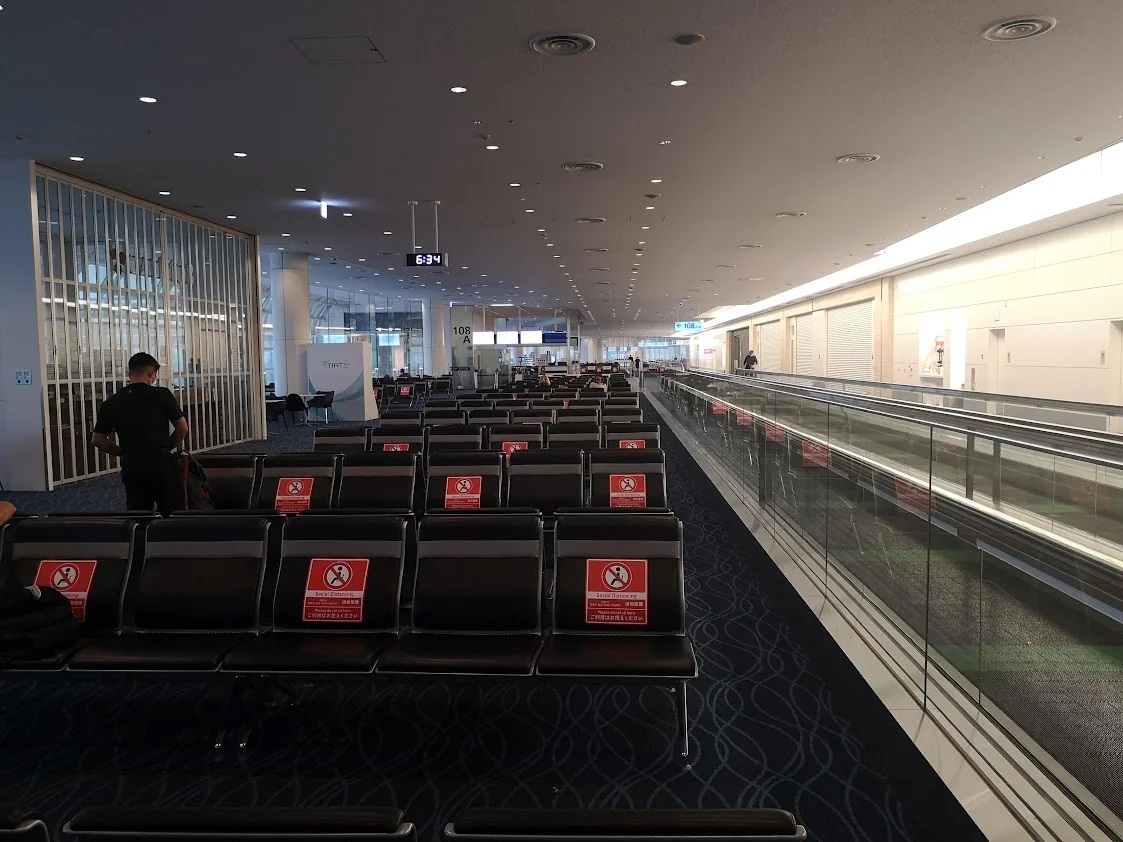
Haneda and Narita in Tokyo: I love Japanese flight experiences and airports; they're efficient, comfortable, and complete in terms of services offered. I flew through Kansai in Osaka once this year and it's not on that level, but it was fine, clean and expansive in terms of seating, with some food options. Little things one might nitpick, about a security process seeming inconvenient, but general processing and services seem exceptional in these two places, and the look and feel. 


 a play area in Narita, April of 2015


It's been awhile since I've been through Narita, which did include limited reclining chairs for sleeping then, and kids' play areas (shown in photos here), but Haneda includes so much seating space that it's easy to lay down and get solid sleep there, which to me changes a lot. Food options are just good in these places, not amazing, but it's enough. For Westerners there are usually donut and bakery places, Starbucks, sandwiches, or fast food, so it's not as if eating local Asian foods is required.


benches and charging station at Haneda in Tokyo (with many rows / areas as priority seating, and so much seating picking emptier sections is an option)


it's hard to capture how much space and seating there really is (Haneda again).  this is a long, linear style airport layout.


Incheon in Seoul: on par with the main Tokyo airports, with good, efficient services, a nice internal space, very clean, good food options, extensive seating, far more than probably makes sense, and even a place to shower (for free, when I last used that). I suppose a different kind of traveler would be evaluating airport hotel space or sleep-pod options but for me if there's a long layover as long as I can get a nice nap I'm fine. I ate some Taco Bell the last time I passed through there; that's a terrible idea, related to consideration for fellow travelers, but it can be nice having comforting Western food / fast food options.


Incheon airport; crazy amounts of seating, lots of charging stations


cultural role-play demo at Incheon; kind of overkill


a kid's play area, a common theme in Japanese airports too, along with good gift shopping


a robot offering information (Incheon again); an information booth works better, but those touches can give places a different feel


Suvarnibhumi in Bangkok: it's ok; it is what it is. It's a modern, spacious building but it's not a great place for food options, efficient internal walking travel (you need to walk a kilometer to pass through), extensive seating (forget about taking a nap anywhere but the floor), easy wifi-access, or broad access to electronics charging stations (all of which I barely mentioned related to the others; to me it goes without saying it's there). 

Internal counter registration, security checks, and immigration are all not very streamlined compared to the others I've mentioned. But the basics are all covered; you can use free wifi, if you figure out how to register for it (which might require internet access; it's funny when a Catch-22 comes up), you can eat, there are options to buy a phone SIM (data access), money exchange and so on, and there's an efficient train into the city, and inexpensive and easy to use taxis. If you know about it there's a good food court where $3 can buy you a decent light meal; good luck finding that anywhere else.


registration area and Thai minor deity statue in Suvarnibhumi


Hanoi airport: it's ok, updated and modernized. I'm mostly mentioning it here because really poor planning had us spend overnight there on a crazy layover once, so we got a feel for the place better. It's not set up for that to be comfortable; we ended up camping out in a nursing room, which was kind of ok. It's modern, with decent food options, and places to buy gifts, so it's fine.


Hanoi airport at night; kind of an odd feel when they're quiet and empty


US airports: Honolulu just isn't supposed to be on the same level, related to being a transit hub like those other places. You fly in and out, and it works for that. Changi makes it incredibly easy to use public transport to get to the rest of Singapore, as the Korean and Japanese airports would, but in Honolulu you can either take a public bus (which is fine, without much luggage) or a more expensive shuttle, which is also fine, if you don't mind spending $50, or whatever that was.


Honolulu's airport is dated in theme and style, but I don't care about that either way


Honolulu's airport makes you miss what you are leaving, in a nice, open-air space


garden space in the Honolulu airport; nice and relaxing


I've traveled most through NYC (JFK), LAX, DFW (Dallas), the Denver airport, and through Pittsburgh and DC, and all the modern versions of US airports are ok, they work. You really don't need an inviting, comfortable feel, lots of food options, places to sleep, shower facilities, internal garden spaces, and so on. Good transportation is nice, clean bathrooms, and efficient processing, and if the latter are limited, as in Bangkok, then you just add some planning time and give up the extra hour of your life to a few queues. 

I definitely wouldn't want to spend 8 hours or more in any US airport, if I could help it (or any, really), but they're not exactly set up for that, as international travel hub versions might be. In the US you show up early and have a couple of beers and that's it, and only hang around when something went wrong.


Russian airport (Moscow, St. Petersburg, or Murmansk), decorated for Christmas


that Russian airport; nice for us to see snow, for living in the tropics


family on the way to the airport, 2014


Kalani and I traveling then, 9 years ago


Keo and Eye in Suvarnibhumi airport in 2009


family picture traveling in Singapore, 2009


recent family photo for comparison