A Reddit discussion of US based airports led me to write about this subject, related more to international airports instead. Any airport flying to another country is an international airport, so many in the US are, so this really mostly relates to airports outside the US, although it does compare the list to American examples, a little.
The context for this is me living and traveling quite a bit in Asia over the last 15 years. I lived all over the US prior to that, in Pennsylvania, Texas, Maryland, Colorado, and Hawaii, so I visited a lot of US airports earlier on, but 15 years is a long time for conditions and experiences to change. I've flown in and out of Honolulu twice in the past year; that's the only American airport I have recent experience with. In the mainland I last flew through JFK, maybe a half dozen years ago now.
My family didn't travel abroad during covid so I'm most familiar, in recent experience, with wherever I've traveled through since, in Tokyo, Osaka, and Seoul, in Haneda, Kanseda, and Incheon. Prior to that we visited Hong Kong and Shenzhen (China) in 2019, and that Hong Kong airport was fine, but I didn't mention it in this list. It's about airports that were modern and efficient, pleasant to travel through, but also about interesting features or appearance in them, whatever might make them unique. It's not as much a ranking of airport services efficiency or completeness as it might sound, more about what stood out to me as interesting.
I just saw a post about worst airports (in the US, in that version), and although this kind of question comes up all the time I'd like to weigh in on it. I'm living in both Bangkok and Honolulu over the past year (a long story), and I'll add a little about other prior US airport experience, but I've been traveling in Asia a lot more over the past 15 years. My own best list:
Changi in Singapore: in online expat discussions this is always ranked first, for good reason. Everything works so well there that it's crazy, and they include extras beyond efficient services, clean and modern design, good food options, places to sleep, etc., extended out to including a butterfly garden in one terminal building. It feels comfortable there, like a positive place to spend time, or almost utopian in spots, a bit of overkill. The subway system might be the best in the world; it's easy to use, inexpensive, and fast to get anywhere.
 |
the butterfly garden at Changi. I've seen this, but I think they may have added a new terminal since I've been to Changi, which would've been something like 7 years ago. |
 |
this turns up labeled online as from Changi, but it's a mall space. I think I've been there, awhile back, but that vegetation and the water access parts weren't there then, as I remember. |
Haneda and Narita in Tokyo: I love Japanese flight experiences and airports; they're efficient, comfortable, and complete in terms of services offered. I flew through Kansai in Osaka once this year and it's not on that level, but it was fine, clean and expansive in terms of seating, with some food options. Little things one might nitpick, about a security process seeming inconvenient, but general processing and services seem exceptional in these two places, and the look and feel.
 |
a play area in Narita, April of 2015 |
It's been awhile since I've been through Narita, which did include limited reclining chairs for sleeping then, and kids' play areas (shown in photos here), but Haneda includes so much seating space that it's easy to lay down and get solid sleep there, which to me changes a lot. Food options are just good in these places, not amazing, but it's enough. For Westerners there are usually donut and bakery places, Starbucks, sandwiches, or fast food, so it's not as if eating local Asian foods is required.
 |
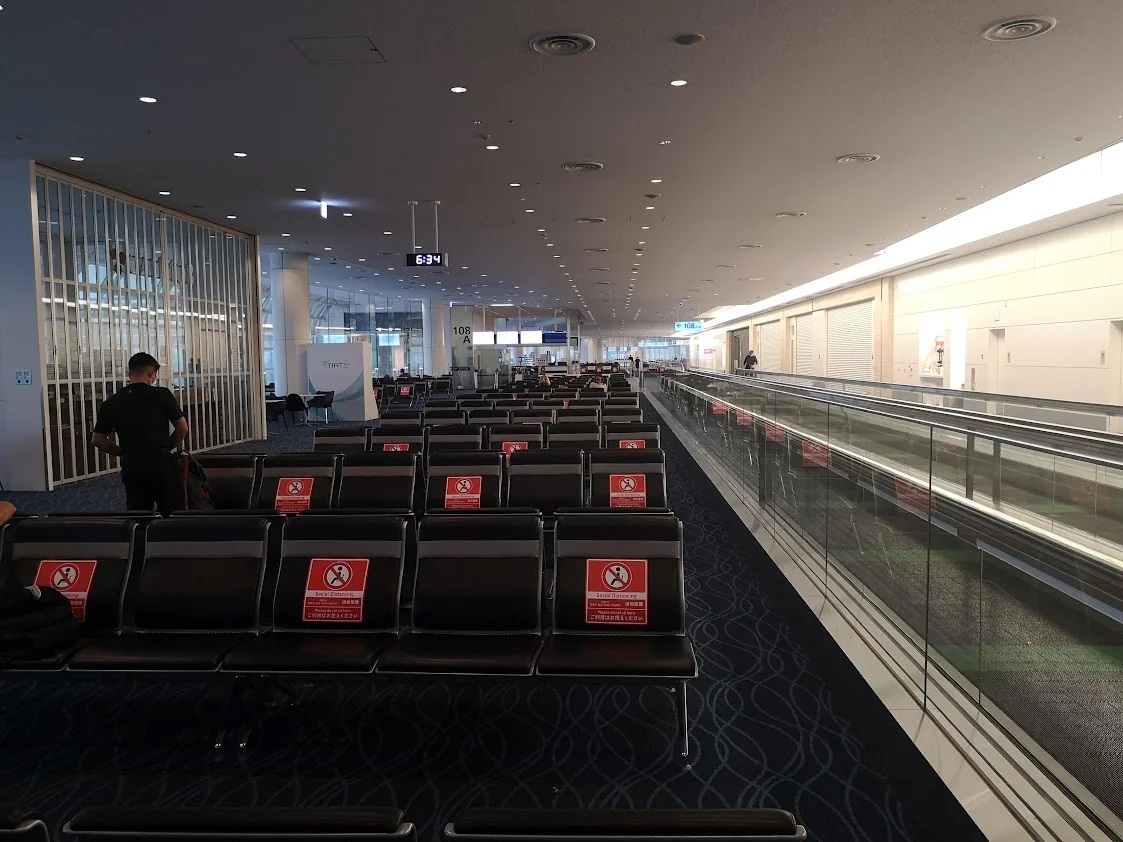
benches and charging station at Haneda in Tokyo (with many rows / areas as priority seating, and so much seating picking emptier sections is an option) |
 |
it's hard to capture how much space and seating there really is (Haneda again). this is a long, linear style airport layout. |
Incheon in Seoul: on par with the main Tokyo airports, with good, efficient services, a nice internal space, very clean, good food options, extensive seating, far more than probably makes sense, and even a place to shower (for free, when I last used that). I suppose a different kind of traveler would be evaluating airport hotel space or sleep-pod options but for me if there's a long layover as long as I can get a nice nap I'm fine. I ate some Taco Bell the last time I passed through there; that's a terrible idea, related to consideration for fellow travelers, but it can be nice having comforting Western food / fast food options.
 |
Incheon airport; crazy amounts of seating, lots of charging stations |
 |
cultural role-play demo at Incheon; kind of overkill |
 |
a kid's play area, a common theme in Japanese airports too, along with good gift shopping |
 |
a robot offering information (Incheon again); an information booth works better, but those touches can give places a different feel |
Suvarnibhumi in Bangkok: it's ok; it is what it is. It's a modern, spacious building but it's not a great place for food options, efficient internal walking travel (you need to walk a kilometer to pass through), extensive seating (forget about taking a nap anywhere but the floor), easy wifi-access, or broad access to electronics charging stations (all of which I barely mentioned related to the others; to me it goes without saying it's there).
Internal counter registration, security checks, and immigration are all not very streamlined compared to the others I've mentioned. But the basics are all covered; you can use free wifi, if you figure out how to register for it (which might require internet access; it's funny when a Catch-22 comes up), you can eat, there are options to buy a phone SIM (data access), money exchange and so on, and there's an efficient train into the city, and inexpensive and easy to use taxis. If you know about it there's a good food court where $3 can buy you a decent light meal; good luck finding that anywhere else.
 |
registration area and Thai minor deity statue in Suvarnibhumi |
Hanoi airport: it's ok, updated and modernized. I'm mostly mentioning it here because really poor planning had us spend overnight there on a crazy layover once, so we got a feel for the place better. It's not set up for that to be comfortable; we ended up camping out in a nursing room, which was kind of ok. It's modern, with decent food options, and places to buy gifts, so it's fine.
 |
Hanoi airport at night; kind of an odd feel when they're quiet and empty |
US airports: Honolulu just isn't supposed to be on the same level, related to being a transit hub like those other places. You fly in and out, and it works for that. Changi makes it incredibly easy to use public transport to get to the rest of Singapore, as the Korean and Japanese airports would, but in Honolulu you can either take a public bus (which is fine, without much luggage) or a more expensive shuttle, which is also fine, if you don't mind spending $50, or whatever that was.
 |
Honolulu's airport is dated in theme and style, but I don't care about that either way |
 |
Honolulu's airport makes you miss what you are leaving, in a nice, open-air space |
 |
garden space in the Honolulu airport; nice and relaxing |
I've traveled most through NYC (JFK), LAX, DFW (Dallas), the Denver airport, and through Pittsburgh and DC, and all the modern versions of US airports are ok, they work. You really don't need an inviting, comfortable feel, lots of food options, places to sleep, shower facilities, internal garden spaces, and so on. Good transportation is nice, clean bathrooms, and efficient processing, and if the latter are limited, as in Bangkok, then you just add some planning time and give up the extra hour of your life to a few queues.
I definitely wouldn't want to spend 8 hours or more in any US airport, if I could help it (or any, really), but they're not exactly set up for that, as international travel hub versions might be. In the US you show up early and have a couple of beers and that's it, and only hang around when something went wrong.
 |
Russian airport (Moscow, St. Petersburg, or Murmansk), decorated for Christmas |
 |
that Russian airport; nice for us to see snow, for living in the tropics |
 |
family on the way to the airport, 2014 |
 |
Kalani and I traveling then, 9 years ago |
 |
Keo and Eye in Suvarnibhumi airport in 2009 |
 |
family picture traveling in Singapore, 2009 |
 |
recent family photo for comparison |