Showing posts with label Chinese. Show all posts

Tuesday, September 22, 2026

On tea market, consumer perspective, and related social media changes in China


a Chinese tea expo (photo provided by Cary)


I've been seeing online content about tea perspectives in China, about how producers and vendors approach tea themes, and how consumer perspective is changing. As an example, So Han Fan, the owner of West China Tea, regularly discusses this sort of thing.  It's a fascinating subject, to me. 

The questions I wrote as part of an interview form exploration cover a lot of scope.  They're answered here by a tea vendor based in China, who I've tea from, Cary of Oriental Leaf.  He has been posting a little about tea themes in China, on Reddit, which was a second starting point for considering this kind of background.  Learning more about their vendor theme and perspective probably works best through an About Us section of their website.


It's worth pausing to consider how we receive information on how tea culture works out in China in "the West."  Vendors pass it on, either those based in China, or who visit there.  The more exposure you get to that scope, especially from different kinds of sources, leads to hearing different kinds of stories and takes.  The owners of a local Bangkok Chinatown shop, with tea making and vending family in Fujian and Hong Kong, tell much different stories than actual Chinese friends, who typically aren't that into tea, in the same kinds of ways.  Vendor and producer friends living in Fujian and Yunnan convey different perspectives.  The varying input doesn't conflict; it's that tea is taken in different ways.

This interview style input drills down into that, with more focus on modern changes, variations in demand, and social media inputs and effects, than on ordinary consumer or "tea enthusiast" perspective.

Cary is a tea enthusiast.  You can tell.  There's nothing wrong with vendors picking up a commercial interest in tea without continually exploring the subject, and self-defining through it, beyond the scope of ordinary appreciation, but it's helpful when the interest leads to ongoing deeper learning.  Only a tea enthusiast would live out the cultural changes to be able to answer these questions in this depth.  I hope that readers enjoy learning from it as much as I have.


-Has the Chinese tea market remained the same over the last few years?  How would you compare it to the Western tea market (related to types preference, overall demand, or other themes)?


Market-wise, the Chinese tea market over the past two to three years—especially following the end of the pandemic—has been experiencing a downturn, with fairly notable declines across major tea categories, particularly Puer, white tea, and rock tea (Yancha), which had previously seen significant market hype. The Chinese tea market can roughly be divided into two categories: business/gifting use and personal consumption.

Regarding the first category, due to the softening of China's economy in recent years, most industries are going through a slump, leading to a cliff-like drop in business gifting demand. To give an example, the Dragon Boat Festival and the Mid-Autumn Festival used to be peak seasons for gifting, with massive shipments leaving the tea market as vendors stocked up specifically for these two periods. However, this year's Dragon Boat Festival saw very poor performance in the tea market, and shipments for the upcoming Mid-Autumn Festival have also fallen short of expectations, remaining rather sluggish. Furthermore, budgets allocated per batch of tea are now being trimmed down to cut costs.

As for the second category—personal consumption—traditional offline tea shop channels are withering away because online live-streaming has captured an increasing market share over the last few years. Live-streaming channels sell well-known premium teas at extremely low prices, though quality cannot always be fully guaranteed. A few months ago, China Central Television (CCTV) exposed a live-streaming ring in Yunnan that sold fake "famous mountain, famous village" Puer teas and faced heavy penalties, which is a prime example of this phenomenon. Aside from Puer, manufacturers of other tea categories are also aggressively deploying online channels, as live-streaming sales seem to have become a major channel for most people to purchase tea.

Regarding tea selection, Puer tea remains a primary choice for personal consumption, and of course, seasonal green teas are also vital consumption staples during their respective windows. White tea is gradually declining after peaking five or six years ago, while oolong tea—especially rock tea—still holds a relatively important position in the high-end market. Fuzhuan brick tea and Liubao tea are still considered niche categories in China, though their markets are slowly climbing. That being said, jasmine scented tea and black tea still boast massive consumption volumes; it is simply that they generate less noise in the market.


well-designed booths turn up in Bangkok, only relating coffee (Chinese expo photo from Cary)


-Can you describe Chinese tea preferences related to generally corresponding to local version preference (eg. the main local types), to often matching up with standard forms (Longjing, Tie Guan Yin), to some other types expanding in awareness and demand, or somewhere in between?  Of course this would vary by person, and individual awareness, so the question relates to standard forms of tea appreciation and broad trends, and how this changes over time.


There are no obvious tea products from a specific origin or particular tea categories showing exceptionally strong performance, nor is there any observed special consumer preference for local teas.

Marketing plays a massive role in tea selection, especially when it comes to choosing specific types of tea. The rise and fall of Puer tea over twenty years ago, the rise of white tea over a decade ago, and the decline of Tie Guan Yin ten years ago all saw marketing play a huge part. Every year, roving tea expos are held in dozens of Chinese cities, with some cities hosting two a year. These serve as a great window for observing trending fashions in Chinese tea, where one can clearly sense that Puer and white tea have been on a downward trend in recent years. Although there are indeed very good, high-quality white and Puer teas on the market, people always harbor a sense of suspicion due to market chaos and a lack of information transparency, meaning these two types of tea do not make as much noise at the expos as they did a couple of years ago. 

When it comes to choosing tea, consumers are quite diverse: some prefer local green teas out of long-standing taste habits, while others are influenced by internet information, chasing after the types of tea that everyone is recommending, especially on platforms like Xiaohongshu (RED note) and Douyin.


-Is tea used as an investment?  Does this apply at all beyond pu’er type scope?  How has this changed over the past few years?  There’s an understanding that a tea investment bubble of sorts collapsed in the last year or so; is that accurate?


Puer tea is frequently used as an investment vehicle, particularly in places like Fangcun in Guangzhou and Yiwu in Zhejiang. White tea has had an impulse in recent years to be crafted into an investment product, but it hasn't been as "successful" as Puer, while other tea categories are rarely viewed as investments. 

Among brands, Da Yi has received the most criticism in this regard, often dubbed "financial tea." A few years ago, the secondary market prices for Da Yi tea would fluctuate dramatically even within half a day. Over the past year or two, along with the softening economy, many people who previously stockpiled tea have been dumping their inventory, triggering a crash in the Puer tea market. This is indeed the case: the Fangcun market in Guangzhou, which was previously the hottest speculative hub for Puer tea, is now exceptionally quiet.


-How are hybrid styles or production of different teas in different places developing?


Such attempts are very common. For example, Fu brick tea now comes in "Golden Flower" versions across almost all six major tea categories—Golden Flower green tea, Golden Flower oolong, and so on—though the taste leaves much to be desired. Of course, there are also items like peach oolong, jasmine-scented black tea, Yunnan oolong, and chenpi white tea. I believe these are efforts made by tea factories to boost sales; every factory is innovating in the hope of igniting a specific market growth point, which might appeal more to young people, especially those who primarily buy tea via the internet. 


Oriental Leaf Fu zhuan (hei cha, with golden flowers fungus)


However, looking at the current landscape, it seems that no single blended or crossover category has achieved massive success yet. On the other hand, regarding production in non-traditional origins, some teas may have been produced elsewhere for a long time—such as Longjing tea produced in Sichuan or Wuyi rock tea produced in Yunnan. But since this kind of practice is inherently deceptive, nobody talks about it openly.


Henan origin Dong Fang Mei Ren (OB) from Wanmu (from this review post)


-If tea demand has decreased has this related to decrease in production?  Is there a change-over in demand type and forms produced instead (eg. expanding Chinese matcha production)?


According to data from the National Bureau of Statistics in 2026, China's tea production in 2025 reached 3.92 million tons, a 4.8% increase. The production end of tea does not appear to have decreased. I believe the decline in demand is primarily driven by economic factors. Furthermore, aside from personal consumer purchases, various modern milk tea/boba tea chains now consume massive quantities of different types of tea. Recently, CHAGEE (a Chinese milk tea brand) launched a Fuzhuan brick tea milk tea in the five northwestern provinces of China, which received quite positive reviews. The milk tea industry indeed consumes a substantial amount of tea.


-How do you place the Western emphasis on Gongfu ceremonial brewing in relation to standard Chinese tea appreciation?  Are there equivalent “tea enthusiasts” in China, who use a different range of brewing approaches, or embrace aesthetic themes differently, or is tea known of and approached differently in certain areas (eg. in tea production areas)?


Tea-drinking methods in China are diverse. Gongfu tea originally only popular in South China (such as Guangdong and Fujian), and it has only been adopted nationwide for about ten to twenty years. Even now, many Chinese people still brew tea in simple glass cups. In the pre-internet era of the last century, different regions truly had distinct brewing methods: the Northwest boiled brick tea with milk, Yunnan and Guizhou roasted tea over open fire, and Fujian and Guangdong practiced Gongfu brewing. Naturally, these traditional methods still exist today.

Many people also share their tea spaces and pursuits of tea aesthetics on Douyin, exhibiting drastically different aesthetic orientations, with each style enjoying a massive following.

I think the Western emphasis on the Gongfu tea ritual is quite normal, as people seek to capture the truest essence and flavor of the tea through ritual.

By comparison, I know some Chinese coffee enthusiasts who own a whole mountain of brewing gear—their grinders, powder distributors, filters, timers, and scales are extremely professional, likely surpassing the equipment sophistication of many Americans and Europeans. Many people in China criticize this approach as going overboard, even circulating videos of Italians making espresso very simply, without all these complex tools. I suppose the Western discussion around the ritual sense of tea is much like the Chinese debate surrounding coffee brewing.


-Can you describe how social media posting, online tea group discussion, and tea blogging work out in China; are there equivalent forms?


As we've discussed before, blogging is essentially dead in China, and BBS platforms or Discord don't exist there; social media is the main channel for tea-related discussions. Moreover, based on my observation, the atmosphere in Chinese tea communities is far inferior to that of Instagram, Reddit, or Discord. There is almost no serious discussion, and the space is saturated with marketing and metaphysical pseudoscience. 

Platforms like red note, Douyin, Kuaishou, Zhihu (which is similar to Quora), and WeChat Official Accounts feature a massive number of tea-related bloggers, but it feels largely one-way—meaning bloggers transmit information to their audience, and user participation goes no further than leaving comments, while online community engagement remains relatively weak. Discussions among tea enthusiasts probably take place more often in offline gatherings or through word-of-mouth among friends.


-Can you describe how your business focus relates to a specific form of tea appreciation, and how it goes connecting with a consumer base with similar interests, or developing type awareness?  Does that go differently in China and in the West?


If I were running an online tea business in China, it feels like I’d only have one real choice: live-streaming sales. I would need a mature streaming team to pull it off, and it would be utterly exhausting every single day. Offline business, on the other hand, relies mostly on acquaintance networks and suffers from severe homogeneity, making it hard to offer truly differentiated products and services. Both paths are draining, which isn't what I want.


livestream tea sales (photo credit and background article)


That’s why we chose to build an online business geared toward the international market. It allows me to reach global tea enthusiasts quite naturally, acquiring customers by sharing written content and imagery, and connecting with a broader community of tea lovers through niche influencers like you, and through online platforms. I much prefer my current state.

Regardless of whether it's domestic or international, I feel the tea business ultimately relies on reputation and repeat purchases. Good tea speaks for itself, driving customer retention and satisfaction. That’s precisely why we started with a relatively niche category like Fuzhuan brick tea. Being right here in its origin region gives us direct access to exceptional Fuzhuan, which is our core advantage.

The same logic applies to our Puer and Liubao teas. Years ago, I tasted some poorly stored Puer and Liubao teas, so I know firsthand what clean, natural dry storage actually means for dark tea. Because of that, we make it a point to convey this philosophy—and the superior tasting experience brought by dry-stored dark tea—directly to our customers.


My take on all of that


It seems very well-informed and insightful.  The parts about tea practice being different in different places, and exploration of hybrid and new styles, all match what I've heard from others.  My favorite Chinatown shop owners have mentioned following those online streaming tea sales before, commenting on how the teas can seem interesting, especially a time-dependent theme like early Longjing sales.  But they also commented that you really can't tell what is what from on-screen appearance and description, so it's a gamble buying anything from them.  The subject of some streamers being more reliable didn't come up in that limited discussion.

Tea vendors developing new business themes in China is also fascinating, mentioned somewhat indirectly here, related to their own experience.  Not much about that carries over to Western exposure, so it's interesting when it does, and all the more interesting when it relates to positive new source options.  

It makes you wonder why there aren't more commercial ties between Chinese sources and a Western market; that has been slow to evolve, in any form.  Social media content sources never overlapped.  There's the "great firewall" as a factor, but you can talk to people in China if they use a VPN, or possibly more directly if there are other connections (eg. they follow a Western blog).

It's all too much to summarize as conclusions here, or extend, and I don't have the expertise to do so anyway.  I've appreciated learning from these ideas, across a lot of different tea oriented scope.


Saturday, September 7, 2024

My own list of exceptional classic tea versions


Someone just asked in a Reddit group (r/tea, the main one) about what others see as the main types someone should get to.  This is close to asking for a personal version of the top 10 classic Chinese teas, just without the Chinese origin limitation, and not exactly in that form.


The original question form:


What are some teas that you think a tea head should/must drink before they die?  What are some teas you couldn’t live without?  All time favourites?


My response


This question reflects a perspective on teas one would have before trying a lot of them. There probably isn't a list that would work for everyone, some 10 best teas listing, coupled with the results of a couple of other 10 best teas listings.

It's interesting to explore teas but it doesn't work so well in a checklist form. You wouldn't really know if the examples that you were trying were type-typical or of relatively high quality, so you'd end up chasing variations for all of it. Any list wouldn't be identical to the next list. Personal preference would factor in. Exploring teas works well as an organic pursuit, heading in different directions, better than looking up and trying 20 accepted good teas.

I've tried most of the teas mentioned here, although only a few yellow teas, so who knows what I tried in that style range. One didn't ring a bell at all, citron grafted Buddha hand: https://cultivatetea.com/products/yongchun-buddha-s-hand-first-day-harvest-2019

That's tea plant stems grafted onto a different plant type, selling for $50 for 4 grams. No thanks.

I can list some that I would see as favorites and basics, more so than my own top 10 or top 20:


Wuyi Yancha / Da Hong Pao: there's a lot to this range, but to me exploring Rou Gui, Shui Xian, and one of the original DHP plant types are a good start, Qi Dan or Bei Dou. When someone claims Ma Tou Yan version is better, from the Horsehead Rock in the nature preserve area, you can set that aside. Sure tea from a high demand area, that is suitable for the plant type, would get plenty of attention in terms of favorable growing, harvesting, and processing, but those ideal and traditional location stories are myths based on some core of truth.

Dan Cong: an amazing range of oolong, with strong fruity and floral aspects, versus a range grounded in mineral tone that is more diverse for Wuyi Yancha.

Longjing: really a good place to start, a very classic Chinese green tea, and one that I actually like quite a bit, but it can be tricky chasing more ideal versions. When you do find a real one it's amazing; the experience of smelling the bag being opened is more intense than tasting one a quality level down. This curator vendor is a good option for buying amazing and type-typical examples of many of these: https://www.tridentcafe.com/green

Glancing through that vendor's selection it looks like maybe 30 types are really distinctive and valued, and some others are interesting exceptions. It's actually like that.

Nepal white tea: amazingly bright, fresh, floral and fruity. Of course that applies more to better versions.

Darjeeling: this is an area, not a tea type. A good number of type variations come from this area, in part separated by flushes, harvest seasons, but also by styles. Good versions are on par with teas from anywhere else, combining complexity, diversity in style, novel flavors, and great balance.

Taiwanese teas: there's a whole list from this country, not as long as from China, but it's a bit much repeating it all here. High mountain rolled oolongs stand out, in a lighter form or more oxidized and roasted. Oriental Beauty oolong can be great. That works as start but adding 3 or 4 more would be more complete. A new set would relate to regions, and oolongs, and another one of those would be Red Jade black tea and another the bug bitten black tea version, which I think has different names.

Fuding white teas: I actually don't love these; I'm including them for completeness. I like better versions of Yunnan Moonlight White better, but plenty of people love Bai Mu Dan, silver needle, even Shou Mei, even though to some extent it could be seen as less promising than the other two.

pu'er: this is where I am now, and it is its own world of teas. I've been drinking mostly pu'er for about 6 or 7 years and I'm just getting started, in spite of trying at least a couple of hundred versions so far, and owning a good bit of this and that. It doesn't work to summarize what it is in terms of young / new versions versus aged, in relation to both broad and narrow production areas, tied to different styles and quality levels, related to variations or exceptions (eg. purple leaf material, huang pian), and of course sheng and shou, the latter being wet-pile processed to emulate aging effect, more or less.

Chinese black teas: there are many. I love Dian Hong, Yunnan versions, but whenever you try a really good example of another kind it re-writes your understanding of that type and range. Jin Jun Mei are novel enough to mention separately, but sorting through a range of those and figuring out what is probably "real" is tough. Even though it's flavored teas people should try smoked Lapsang Souchong early in their exploration, and then a better unsmoked version later on.

other Chinese green teas: I've only tried a few that really made me question green tea being my least favorite category, like Mao Feng and Mao Jian.

Japanese green teas: about time, right? Again it's not a personal favorite. It's really worth trying out a few good sencha and gyokuro to see where you stand on preference for this range.

yellow teas: nah, you can pass on that. It's hype, related to that being a main older traditional style and category. I've only tried a few and didn't like them, even factoring in novelty. Skip all gaba processed teas too; they're awful, and mostly just taste sour.

hei cha: these never make these kinds of lists, I guess for a reason. They're on the basic side, nothing flashy or spectacular, a bit earthy, sometimes edgy, sometimes with odd flavors or a touch of smoke. To be a long term tea enthusiast and never try any of them would seem odd. Liu Bao is so basic that's a good place to start, but that range varies. To me Fu brick teas can be interesting and pleasant; I just reviewed a couple of novel versions with golden flowers, an unusual case of fungus input (in the tea in the ancient world blog).


So what about Vietnamese teas, or Ceylon and Assam, Korean teas, and so on? Georgia (the country) has a novel new tea production tradition going, built on top of an old tradition. I suppose trying a little from here and there would make sense. I was more focused on main specific types range here, centered on what I happen to like, with exceptions that were noted.


What did I leave out?


It doesn't work to make this kind of list complete, even if you keep typing and typing. There's always something else out there, that's classic and wonderful in its own way. I'll mention a few that I skipped.


Anxi Tie Guan Yin: for some this should be on a top 10 list, but to me the modern, light, bright green, brewing to bright yellow style is pleasant in its own way but not great. The older style, that is more oxidized and roasted, can be great. Since it's almost all new style now it's definitely on the top 10 list of things to try but not as pleasant as another 20 on this list.

flavored teas: no jasmine green or white tea, no lotus green, Earl Grey, or jasmine black (a personal favorite). Sure, trying all those is worth it. Leaving them out wasn't about snubbing or putting down flavored teas, I just don't see them as classic in the same way.

masala chai: too novel and well-accepted to even put in the flavored teas category; this is definitely worth trying a few versions of, even getting into making your own batches of it. You would only know what I mean once you try an above average version.

Thai teas: I've been living in Thailand; how can I omit all the teas from here, and from Laos and Myanmar? Or even Indonesia, which makes some pretty good teas now. Are they inferior? Not really. Some style overlap or are borrowed from other places (sheng pu'er, Taiwanese oolongs, black teas range). Not much comes to mind that's completely different, so skipping everything from these three countries doesn't cost you much for new experiences. Eventually trying a few from these places would make sense, to see for yourself. Thailand does make that one orange colored, artificially flavored tea; it's a different thing, but it's nice.

ya bao: a white tea made from tea buds, harvested at a different time than silver needle. These are fine, and some people love them, but they seem a bit like drinking a tisane too. If you love them they are a must-try, and if they seem so-so not worth it, and you'd have to try them to know.

falap / bamboo sheng: there is a set of bamboo-stuffed, roasted or smoked sheng pu'er variations that are really pleasant and interesting (not clearly a sheng pu'er variation according to everyone; that's my own interpretation). This would make my top 30 list of teas to try.

other Japanese teas: hojicha, their versions of plant stem based teas and black teas, and whatever else, especially a really odd fermented tea version. Sure, these would make my list of top 50 teas to try.


It must keep going from there but that's enough. I've not been swept away enough by teas from other areas to include them, but some can be quite good: from Hawaii, the other US, Russia, wherever else.

I've not went far with describing a range of aged teas; people love to try really old versions of different things, which pretty much changes them into something else. OK, people could dabble in that.

If you set out to try 40 or 50 versions of great teas, on a list, to me that's not as pleasant as exploring as you go, following promising directions based on sampling less than ideal quality versions of lots of teas. It takes forever, but that's a positive thing. It's probably best to cover the few most promising ranges early, because maybe you'll tire of exploration. Getting stuck on a narrow range would almost seem a shame, any subsection.

People should probably put off pu'er exploration early on because that can happen with that type. Oolongs and black teas are nice, mixing in some white and green range.


a Chinatown market store, kind of unrelated, but Blogger can use it as a thumbnail


Wednesday, February 15, 2023

Tea culture appreciation versus appropriation


I just caught an earlier discussion between So Han Fan and Riu Liu on this subject, which was quite interesting.  It wasn't what I expected; much more developed and refined, and very insightful, just great really.  One would expect this kind of discussion to never move far off saying that white people new to tea aren't well-trained enough or "Chinese enough" to have a developed opinion worth listening to about Chinese cultural aspects, and that was part of it, but it kept going from there, uncovering layers of how all that really maps out.

I won't be able to summarize everything they said; it covered too much ground.  People should watch that instead of reading this, if it came down to choosing; just put it on 1.25 speed if nearly two hours seems like too much, and listen to it while you're doing something else.  

As far as further commentary here goes let's take it bit by bit, point by point, without ever trying to tackle the grand scope in one go.


white people new to tea aren't well enough informed or Chinese enough to have a developed opinion worth listening to:  this was never expressed or addressed directly, at least in clear detail related to fully unpacking this, but it definitely was a sub-theme that factored in early on.  Both speakers, So Han and Riu, touched on examples of how this really did manifest in real life problems they've experienced personally, and that worked, probably better than a regressive development of ideas, exploring layer after layer of context and assumptions.  

In some of those cases people really did cross over from appreciating Chinese culture (positively engaging with it), exploring it, into taking it on as their own, and using it for personal gain and profit, while promoting overly summarized and partly incorrect ideas.  Without clear examples the nuances of what really happened wouldn't have shown through, and how complex inputs come together.

To back up quite a bit, this already assumes that there is a traditional, unified, accepted, authority based, accurate version of traditional Chinese culture, or strands of that, sets of ideas and practices.  Does this work?  Yes and no, probably.  But then it would really take the nearly two hours to develop only this point.  It's something I've been considering a lot for many years, in the most recent form repeatedly discussing this with a friend who is exploring Chinese tea culture as a research anthropologist, in China, Taiwan, and the US, with only early research and summary academic publication related to China completed.  That anthropologist friend looks for "schools," training organizations, or "masters," and for looking for that kind of thing he is able to find it. So Han and Riu both explicitly covered how it doesn't occur in the form one might expect, as a Westerner, related to exactly that context, which I'll get back to.  

So where does this leave us, setting this aside, if we can't fully unpack this dimension?  It's a little awkward, because it's not clear how we can specify the contrast with a Chinese person who is a part of an original culture, who can speak for that perspective, without clarifying to what extent a unified historical culture even exists.  


Different levels and factors enter in, related to the second part about someone being a suitable representative, brought up by both speakers:  someone being racially Chinese, part of a Chinese culture (foreign or in China, which is different), speaking Chinese languages, exposed to a strand of the tradition ("study under a master" and such), with background engaging with tea producers, vending experience (both a pro and a con, as I see it), and so on.  

Indirectly So Han ends up justifying his position as "Chinese enough" based on family history, race related genetics, language proficiency, visits to China, and contact with producers.  That's Chinese enough, probably, but someone else could try to move the goalposts and demand exposure to some other background or training of some sort, or claim that the sourcing exposure was actually very limited.  Let's set that aside.


tea producers as a reference:  one of So Han's examples is clear and easy to consider, about producers identifying types of tea, with this serving as a more distinct and accurate identifier of type than Western oriented categories.  This gets a little odd; he was saying that a partially oxidized green tea was identified as a green tea by the producer, so it is that, even if Westerners see it as some sort of exception, or not in that category.  It's hard to say if that authority justification would work in every case, but there's something to it.  Then Riu started in on saying that organization of categories and use of concepts might be slightly different within different cultures, which they both developed further, and I'd like to add more on here.

A friend who produces oolong in China once almost apologetically offered that they don't really use the category of oolong (/ wulong) there, and just call tea versions by the name of what they are, per individual plant type input.  The same kind of divide has came up related to saying whether sheng pu'er is a version of hei cha.  A driver for it needing to either be that, or to not be, relates to the familiar initiative for Westerners to put every tea into one of a limited set of main categories (green, black (/ red), oolong, white, hei cha, yellow).  

Per seemingly good input from people familiar with local Chinese perspective sheng pu'er is just sheng pu'er, and hei cha is something else, and they don't need to force that complete division into main groups to work out.  Surely some people in China would want the groups to stick, and they would have their own opinion, but in general it may well just not be a typical Chinese project.  Other examples So Han and Riu covered reinforced that.


Buddhists and Taoists have lineages, but not tea cultures:  a great point by So Han.  I'm not sure this is right, since the "master" and "schools" themes come up in China and Taiwan too, but I agree with and love the point he's making, that tea culture is a living, diverse, locally oriented theme in China instead, not at all unified and codified as religions are.  This single point I keep returning to in discussion with that anthropologist friend, how it may not be valid for some people in China to try to fix, package, and essentially sell one version of Chinese tea culture, regardless of what credentials they can collect together or justify.  Riu mentioned her own experience studying under a "master" (I don't love that term, but it must apply in some cases).  I can't do justice to summarizing that, and would make it less accurate by trying to, so people should check it out there instead (around 53:30, with So Han introducing the set of ideas there first).

To be clear I'm not the right person to try and place those claims of people being masters, with lineages, tied to training classes and certifications, etc., in both China and Taiwan.  Even relatively unified or standard approaches to ceremonial Gong Fu Cha brewing I'm just not familiar with.  Oddly a main stepping stone in exploring tea was a ceremonial brewing demonstration, held at a Huawei product display site on a visit to Shenzhen a decade ago for an IT project, so it's not as if I've never seen any versions of it.


Was that an example of cultural exploitation on their part?  I don't see it that way, but an argument could be made for that, depending on what was presented there, and how it was framed.


how does all this relate to Buddhism scope?:  it's a bit of a tangent but I did study Buddhism for quite awhile, on my own and in academic scope, and was ordained as a Thai Buddhist monk at one point (only for a bit over two months, which is normal in their tradition), and have lived in a Thai Buddhist family for the last 15 years.  So how do these parallel themes overlap or differ; would it be ok for a Westerner to have the same kind of exposure that I've had, or a few years' worth instead of 30, and to position themselves as some sort of teacher, or cultural authority?  Of course not.  Even if a respected member of that tradition officially sanctioned it that would still seem sketchy, especially if it was for-profit.

To be clear it's fine to comment on Buddhist themes in online discussions, for anyone, even with very limited exposure.  There's no reason why someone couldn't answer Quora questions, comment on Buddhism group threads, write a blog, or post videos to Youtube.  It would be best if they clarified their level and type of exposure, but that's up to them.  Selling anything drawing on their own authority in relation to Buddhism, or promoting themselves as a teacher or representative, even without a commercial angle, would be a step too far.  Wearing robes and such would be context dependent, if that would make sense or not, but in general a little would go a long way in terms of adding on such trappings.  It would be as well to not do that, but of course anyone can if they want to.

It's not as if there is a fixed timing or exposure level after which changing a role would make sense, but anyone participating for a few years in such a tradition and then making it their own, taking on the role of teacher and passing on adjusted ideas, would seem to be acting in bad faith, or at least poor judgement.  Tea vendors just selling tea don't parallel this context concern at all, but a little goes a long way related to re-packaging Gong Fu ceremonial or aesthetic practices.  If that kind of thing is offered as something they've taken up as a derived and adjusted individual practice, versus a direct continuation of an older tradition, that changes things a little.  Training certificates make for a strange scope; I'll stop short of getting into that part.


why do Westerners need to apply the Chinese cultural context framework?:  this is more a tangent here than coverage or response to what they said, my thoughts on how this tends to go.  It seems like people don't need for their tea experience to follow a traditional Chinese form, right, they could just drink tea?  A couple of natural exceptions to that come to mind.

Plenty of Western tea enthusiasts love both the experience of drinking tea, the taste, getting brewing right, learning types, etc., and also the formal, ceremonial, and aesthetic forms and aspects.  I don't see anything wrong with that.  Collecting teaware is fine, or setting up a room in a Chinese decoration theme, adopting a formal way of brewing drawn from some external source, even going further and investigating Taoism, and so on.  Once someone starts wearing traditional Chinese clothing it all gets a little strange, because why, and what imagery is being borrowed?  Then it's hard to say where a natural dividing line should occur.  It's subjective.  


my friend Huyen's family appreciates traditional aesthetic range without making it strange


at least the goggles go a step beyond more original scope (credit Wikipedia Gong Fu cha page)


Still I have no problem with that, people adopting and adjusting foreign cultural traditions, but what if the person taking this up is a tea vendor?  Now we're on to that all being a marketing angle, which somehow seems worse.  

Two lines of concerns come up:  is that even ok for someone with limited exposure to these themes, and how would there ever be a line drawn as to when it's ok?  What if So Han was American born Chinese but he didn't speak the language, and hadn't visited China, and learned from text sources and discussions instead?  It's hard to say how that would be different.  Someone could visit China dozens of times and still not have relevant additional cultural input, even though that would tend to come up if they were interested.  Lots of people visit China once or twice and take up a mantle of being an expert, and I've been to China three times, and Hong Kong and Taiwan as many more, and I had limited exposure to tea themes.  Visiting producers changes things, but only a little.  Short visits are tourism, even if someone brings back some tea they bought from a producer.

It's hard to place how it would all be different if So Han was white, if his genetics were different.  Is it really more "his" for being Chinese?  In one sense yes, but in another maybe not.  If he grew up as a third generation Chinese American with almost no contact with that aspect of Chinese culture it would only be "his" in a very limited sense.  If someone else, who is white, somehow entered into close contact with a Chinese family or local culture over an extended time, along with a tea tradition, the genetics would seem to drop out as a most relevant factor.


A European tea vendor friend commented that he is in the no-win situation of cultural borrowing being expected of him, that if he hosts tastings with absolutely no reference to Gong Fu cha background it would be seen as problematic, as not fulfilling expectations.  Then no matter what he learns and incorporates of course it can't apply as a universal, valid, appropriate inclusion from Chinese culture, which is a very diverse thing on its own.  So what should he do?  Probably intention and framing is important, to address why he is including some components, what background he is drawing on, and what kinds of claims he isn't trying to make.  Then of course you can't add a disclaimer to every sentence; that kind of thing could only be an early framing point.


Finer points made in examples in the video:  I think this is worth touching on a little, especially since that Reddit discussion went there, without the clear benefit of someone having an informed perspective to review these points made.  Let's examine some:


American tea enthusiasts rejecting that shai hong is red (black) tea (a sun-dried variation of Dian Hong, Yunnan black tea):  that's crazy; what else would it be?


questioning if green tea can be partially oxidized:  this breaks down to how people use categories, and the Western project of making things fit in boxes doesn't map back to China (as So Han explained).  For the most part I think if a producer says a tea is green tea then it is, with that broad scope potentially varying more than one might expect.  That's a problem with awareness and perspective related to the negative judgment, but to a limited extent people are also just talking past each other.  There are many kinds of green tea made in China, in lots of regions, and it's quite reasonable that some of that scope is unfamiliar.  

This comes up a lot with sheng (pu'er-like tea) made in Southeast Asian countries either being oxidized a bit much (from a long wither, maybe?), heated too hot, so taking on some green tea characteristics, or seeming unfinished by not being heated enough, taking on an in-between-white character.  To me it's still sheng, but a stylistic variation, with aging potential likely impacted, more than there's a concern over any naming or type convention.  Call it whatever you want; that doesn't change what it is.


is yellow tea fermented or oxidized?:  I don't know, really, maybe both.  The person making the comment, interrupting a presentation with a correction, was clearly wrong on that level, so we could almost just stop there.  If a green tea stored wet and warm transitioned based on a chemical reaction involving enzymes and an input from oxygen then it oxidized; if bacteria or fungus was involved it fermented (as we commonly used the term; really food science uses two other terms for both these things), and it could be both.  

There was a time when an oxidation process was often translated as fermentation instead, and it could less than perfectly clear what role bacteria and fungus are playing in some processing.  But again it sort of doesn't matter, and communicating respectfully is more important than taking better and better guesses about such things.


claiming a lot of Chinese tea is at high risk of being contaminated:  I think So Han's explanation of why the context and framing of that perspective is absurd is worth considering.  Again that's the main point, the form and tone of exchanges, but this kind of claim or belief comes up over and over.  I've heard vendors based in China say the same thing (one Chinese and one European, that come to mind).  Was that because of awareness of real risks, due more to personal bias, or just marketing?  

Here in Thailand my wife buys into this bias a lot more than I do because of isolated cases, like people in China once putting melamine (plastic powder) in powdered milk, to increase protein test level results.  The way that played out in the example So Han shared was clearly way out of line, but it's not really only racism that fuels that concern, even though it is mostly that.  

On my first visit to China our local guide went on and on about how many foods are at risk of such problems, and he explained that a whole egg can be "faked," re-created from other ingredients.  I'm not so sure about that, but it's an interesting thought.  The tricky part about interpreting such comments is that it can become a joke to Chinese people to play up the absurdity of the more extreme rumors, so all that part could've definitely been a put-on.  Or urban rumors and myths enter in.  Then people drinking powdered plastic in powdered milk was real, and not necessarily only isolated instances, so the worst cases are definitely bad enough.


what about appropriation being an example of appreciation?:  this seemed to be covered from lots of different angles in the video, on different levels.  People taking up foreign culture based practices are fine, but communicating their own expertise and authority, and utilizing these for their own personal gain, is all typically a step too far.  Even if a good review and sorting process could extract a dozen or two individual aspects of the broad Chinese tea cultural landscape patching those together to serve as a functional "school" of sorts doesn't really work.

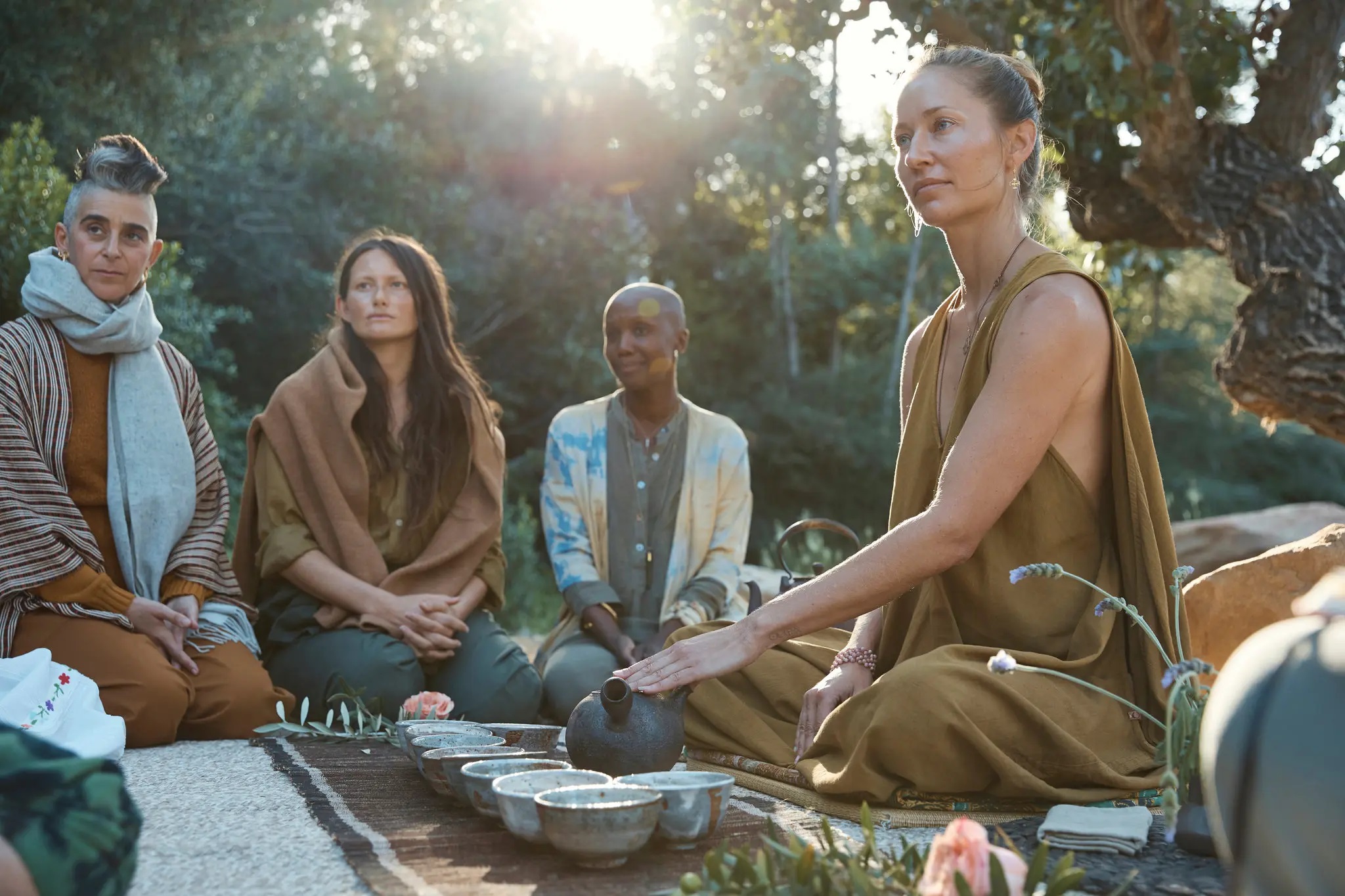
Setting aside vendors taking things a bit far atypical personal practices can seem a bit absurd, viewed in one way.  Lots of people wear natural fiber robes to drink tea out of beautiful hand-made teaware.  Per one take this is functionally ceremonial (it supports relaxation and meditation functions), and also aesthetically pleasing, or it could just seem odd to someone else, or related to a subculture that might be overly dependent on borrowing aspects from other cultures.


a NY Times article sums up a take on an LA subculture (photo credit and article)


a finer point about prior context of discrimination mattering:  So Han raised a good point about how all these ideas don't necessarily stand alone as a guide to what works and what doesn't related to borrowing from other cultures, because the context of how different cultures interact in the present matters.  If there was no racism against Asians, or negative stereotypes at play to work around, different forms of uptake could be regarded as more reasonable, because the broader context would be simpler, and less problematic.  On the negative side Chinese people can be regarded as potentially deceptive, an unfair stereotype since anyone can be like that, and I don't see that as necessarily being a broad cultural condition (even though my wife does tend to claim that "Indians are tricky," even after we've been mutual friends with several Indians, and I count even more as friends).  

This can be a little harder to place than it might seem at first.  Black people in the US experienced a fairly consistent and broad form of racism in the US in the 1950s and 60s, which unfortunately isn't completely resolved today, but discrimination against Asians in the US never took as consistent a form.  There are negative aspects to common Asian stereotypes, and the ongoing culture war surely has made racism worse instead of better, relating to plenty of examples of incidents, but it all varies a lot, and keeps changing.


what about Chinese people exploiting Chinese culture?:  tied to another less than fair or ideal stereotyping anyone with a certain nationality or "race's" genetics can also be granted freer reign to speak for broad traditions that they may or may not have a lot of exposure to, or the right type and degree of background.

In one of my first exposures to differing tea types a local Chinese-Thai woman was selling sheng pu'er.  Looking back what she communicated about tea was quite limited, over the course of a number of visits (her shop was close to where I worked), a bit odd given how that would've factored into selling it.  Per what she shared it seemed like either her father or uncle was into tea, and it wasn't clear that she had learned much about the subject from them.  About 10 years ago I bought a cake of modestly priced "young" or new factory sheng at that shop to drink, to explore and acclimate to the type.  That purchase was based on a recommendation of a fellow visitor there instead of that shop owner, who made no recommendations, related to limiting discussion of any background.  It was probably roughly as poor a choice as I could've made, quite harsh without significant aging input.  Still, it worked out; I acclimated to bitterness, some, and went on to explore oolongs more, returning to sheng exposure and preference some years later, only after her shop had closed.

That shop owner was also selling Chinese artwork, in some seemingly traditional form, having people produce high volumes of quickly made versions using related site space as a studio.  Looked at one way both ventures represented exploiting a connection to "her" culture, two different subject themes which she may or may not have been an expert in, or even as knowledgeable as an average tea enthusiast or fan of art.  Or maybe that's a completely unfair and inaccurate take.  Thais don't put much thought into topics like cultural appropriation, or even racism for that matter, so it wouldn't have been discussed as being an example of that back then.  

Maybe this doesn't connect as well to this point for a second reason, because the stereotype image of Chinese people is completely different here in Thailand.  In one sense it's not negative at all, and in another it could be seen as such.  All that is complicated, and maybe a bit off the point, but somehow it seems relevant to clarify that there isn't the same sort of otherness or negative connotation here that Chinese people would experience in the US in most places.  A lot of people have Chinese ancestry, and people with Chinese family background tend to be among the most wealthy members of society.


That last part may muddy the waters a bit in relation to a strand of other related themes matching up better.  I suppose it works to be mindful that simple conclusions don't work well related to unpacking and understanding complex issues and perspectives.  That's why So Han and Riu offering their thoughts and examples worked so well, because they touched on broader scope issues, then brought up examples of personal experiences relating to those points, and clarified how they saw it all fitting together based on the benefit of hindsight and further consideration.


Thursday, June 11, 2015

Keemun from Peony tea shop (in Silom, Bangkok); a classic Chinese black tea


I checked out a new tea shop and an interesting tea, a Keemun from Peony shop in Silom (Facebook page and related website, which includes a Thai language tea blog about tea basics).

Luckily my wife doesn't read this blog because I still have teas from my last two purchases I've not tried yet, and a few other samples around, but I ran across mention of this shop near my office, so what could I do.

They have a nice selection of single teas and blends (maybe half and half), but at first I was disappointed because I've tried all the types they carry, maybe around 20 single-origin teas.  Some other favorites were there, Lapsang Souchong, Thai oolongs, Tie Kuan Yin, a Bai Mu Dan, a couple nice looking Darjeelings, but I've been drinking all that.  It almost seemed time to start into blends (mint with tea, flowers with tea, etc.) but I smelled the sample tins to see which I might like and the Keemun stood out, sweet and rich.  And it's a tea type I might have only tried a couple times.


Review:


Straight to it then!  I was immediately struck by a nice, sweet fruity flavor, one element reminding me of grape.  Not like grapes usually taste now, I mean concord grape, like Welch's juice.  Which reminds me of eating them from a vine at my great-grandfather's house as a child, growing near a pear tree as I recall.  It was a bit similar to the "wow!" you can get from a nice Darjeeling, and a generally related flavor profile, just not exactly the same.  Another predominant taste was non-distinct stone fruit, maybe plum, with additional mild floral tones.


The flavor profile and feel of the tea were really nice.  Beyond the fruit elements there was a nice underlying earthy tone, malt mixed with a light and subtle wood tone.


To be honest these flavors most people would generally describe as "tasting like tea," since that general "malt" range is common in other black teas that would be familiar, Assam and Ceylon.


In some Chinese black teas the flavors don't always balance in a way that is pleasant, with sweetness  coming across in a way that isn't completely positive (to me), but altogether this tea really worked, nice and pleasant and clean.


There was a bit of astringency but it was still a relatively mild tea, so not as soft as the various roasted oolongs I've been drinking, but far from bitter.  There was just enough astringency to give the tea a nice feel to it, but not at all "brisk," which to most would probably be a good thing.


About the shop, I might also mention it was both a loose tea sales shop and a cafe.  For me I'd just as soon take the tea and go but it does make for a nice alternative to coffee shops.


Brewing instructions tangent:


They included a recommended brewing instructions card, not bad as these go.  I wrote a recent blog post about how these can vary, and the limitations of advising any one set of instructions.  Based on that research and my own experience these would work as a starting point, it's just not quite that simple.  


Without water quantity this is incomplete, and it doesn't address re-brewing multiple infusions (any of the teas would make at least two cups of tea, maybe three or more depending on the tea), but again some of all that depends on preference.


I generally brew black tea at slightly below boiling point for the first two infusions (varying all the brewing process by specific black tea type), and switch to full boiling temperature for the third, but then nobody does that (that I've read of), so what do I know.


Research:


I've tried this tea type before but haven't written it up as a blog post, so I'll add a bit more about it.

It doesn't make for great looking research effort but the Wikipedia article usually isn't a bad place to start, just as well to keep in mind those can be biased or incomplete.  That description mentioned unsweetened cocoa is another common flavor element, and of course thinking that and trying the tea again lets me "get it," but the taste is complex enough it can be hard to separate out all the components.  There's a floral tone (at least one) someone with a more amazing palate might describe in more detail, and also a trace of a mineral element component.


A Teavivre vendor reference goes into more detail about the type, the character and the story of the tea, which they describe as one of China's ten most famous teas:


first produced in the year 1875 after a man named Yu Ganchen traveled to the Fujian Province of China so that he could become privy to the secrets of quality black tea production because prior to that time, the Anhui Province had only produced green teas.  What he learned ... enabled him to produce the world's first Keemun black tea, ... [which] has since become one of the primary teas included in English Breakfast tea blends.


They recommend brewing the tea at 90 degrees Celcius, for what that's worth (194 F).  Related to storage (a subject they mention) the shop sells the tea in the typical plastic / foil layered and self-sealing bags designed for tea.


A non-vendor reference, Wiki-tea, gives an interesting description of the typical taste profile:


The aroma of Keemun is fruity, with hints of pine, dried plum and floweriness (but not at all as floral as Darjeeling tea) which creates the very distinctive and balanced taste. It also displays a hint of orchid fragrance and the so-called 'China tea sweetness.'


They also mention four different more specific types of Keemun, and one related additional type.  As usual trying one decent version of a tea is really just a starting point.


Another Tea Guardian general reference is worth a read for similar descriptions of the tea type, and also more about "English Breakfast" tea:


“English Breakfast” is actually the name of a blend first used by a retailer in New York in 1843, before Keemun black tea appeared in 1875. It was a Mr Richard Davies of “Canton Tea Company” on Chatham Street.... Davis added touches of pekoe (a name for tippy flowery black teas back then) and Pouchong (a Taiwan oolong) to a base of gongfu black tea, and it instantly became a hit. Today different companies have their own blend formulas for it...  However, most better ones use broken grade Keemun as the base.


Beyond that lots of vendors have lots to say about the tea type but it starts to repeat.  Oddly there is a Facebook group just about this type:  https://www.facebook.com/keemunblacktea.  Or maybe that's not odd; I just checked and there are supposed to be 54 million pages now, apparently in addition to the 1.3 billion users.