Showing posts with label gong fu. Show all posts

Friday, January 31, 2025

Ginger flower and honey orchid fragrance Dan Cong


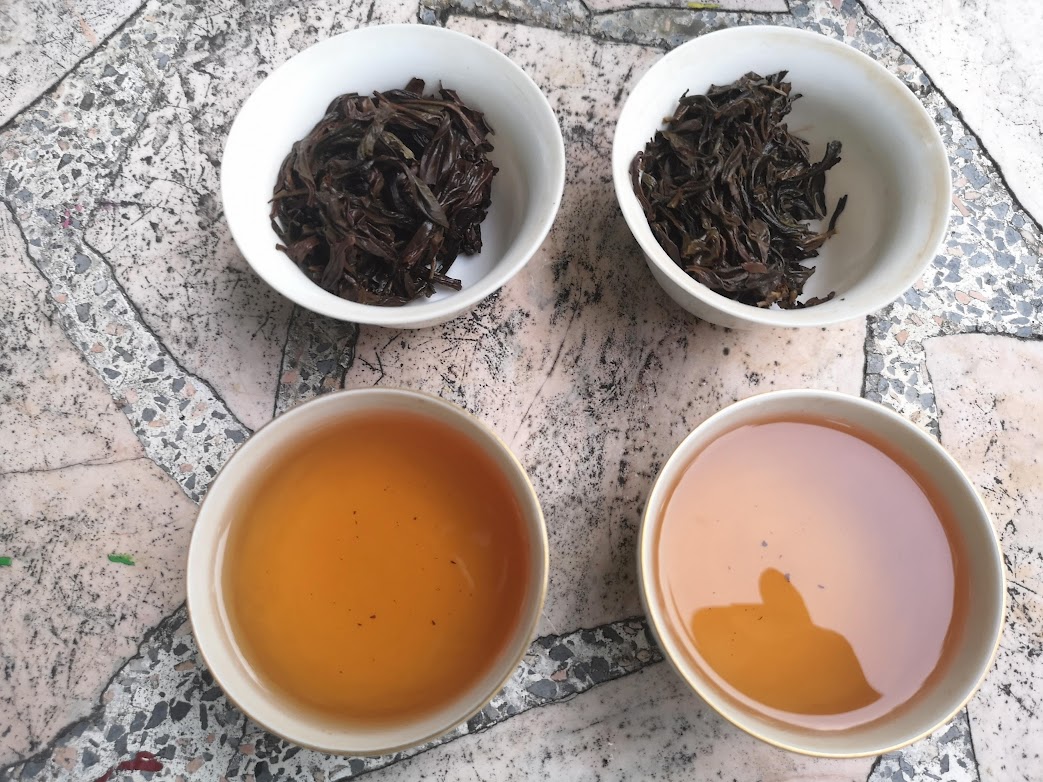
honey orchid left, in all photos


This reviews two more Dan Cong from an ITea World sample set, sent by them for review. The last two were exceptional (orchid and magnolia fragrance versions).

One is the most commonly sold Dan Cong type, Mi Lan Xiang, or honey orchid fragrance (or aroma).  The other version, ginger flower fragrance, I've probably never tried. Their site description of that set follows:


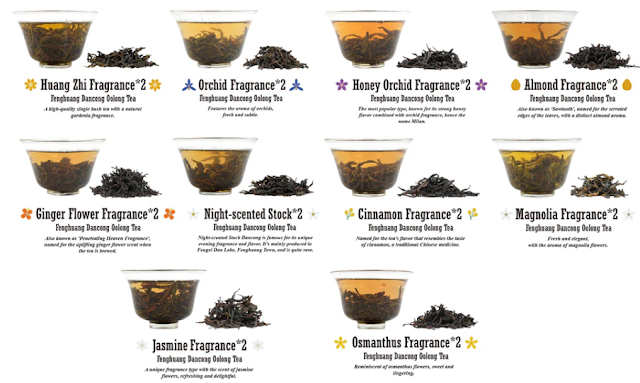
iTeaworld 2024 Christmas Gift Sampler: Fenghuang Dancong Oolong Tea  ($109.90 for 100 grams)


Fenghuang Dancong Oolong Tea:  Huang Zhi Fragrance, Orchid Fragrance, Honey Orchid Fragrance, Magnolia Fragrance, Ginger Flower Fragrance, Osmanthus Aroma, Cinnamon Fragrance, Almond Fragrance, Night-scented Stock, Jasmine Fragrance


I might add a note on their brewing advice, before touching on the subject of value.  They recommend using Gongfu brewing, of course, starting at 6 to 8 seconds, and moving to 10 to 15 seconds, for up to 10 infusions.  That's fine, but I would brew these quite a bit longer, and only get about 6 to 8 rounds out of them.  If I was using a proportion of 8 or 9 grams I'd probably roughly match their parameters, but to me 8 seconds isn't long enough at 5 grams to 100 ml.  That's about preference, not really an optimum.  I'm a sheng pu'er drinker; I can't be brewing teas really light like that, but it is one common form of preference.  It might even work slightly better to isolate flavor aspects, even though that's counter-intuitive.

Is just over a dollar a gram justified for these?  I tend to state over and over that I just won't buy tea at a dollar a gram.  I probably wouldn't buy these.  But for what they are, the quality of the four versions I've now tried, that's about right.  At least they offer sales that could cut that back a little, 20% off if you spend over $100, so it seems this would drop automatically, at least now.  If these really cost 80-some that's a pretty good value.

It feels odd saying that.  Who spends over 80 cents a gram on tea?  People who don't care what the cost is, or who get hooked on types and quality levels of teas that they just can't get for less.  It's better not to do that.  This is where I usually say that other range of similar tea, for this type, isn't as good, in a sense, but it's interesting and pleasant enough that it doesn't matter, it's fine.  With Dan Cong you kind of take a hit.

I will say this:  I just bought decent Dan Cong for a gift at $20 per 100 grams.  It won't be this good, and this range of different DC versions doesn't turn up.  I bought that in a Bangkok Chinatown, and you can't match value or that version offering on the internet, oddly.  I didn't try that exact version I bought, to be clear, but I've bought Dan Cong from that shop three times, I think it was, so you can kind of get a sense of what they sell from that kind of history.  Upper medium quality Dan Cong can be really nice, if you can find it.  Online sources wouldn't sell that for less than $40, but it's still 40 cents a gram instead of 80+.  Other Chinatown shops here would probably sell lower quality Dan Cong for more; it was an exception, even for here.

These might all be that little bit better, or at least the first 4 were.  Maybe the honey orchid, Mi Lan Xiang, wasn't quite on the level of the others, but they were all pretty far up there for quality.  So I guess if you really feel that you need to experience what pretty good Dan Cong is like this is reasonable (given the other versions are like the first four, and I expect that there could be some quality variation).


Review:


Honey orchid:  that's nice.  I didn't use an extended first round for these to bump infusion strength to a normal level, so I'll be trying them light for a first infusion.  Character is good; these aspects are nice.  Tone is a little warm; it seems that oxidation level is balanced really nicely, probably supported with very moderate roast input, that is hard to fully place.  It all integrates.  Flavor is floral, of course, hinting a bit towards ripe peach.  The warmth comes across as a touch of cinnamon, at least so far.  Astringency hasn't emerged yet, but being on the light side that would be moderate.  It's a great start.

One might wonder if this seems really familiar, for this being the name for Mi Lan Xiang, the most common form of Dan Cong.  I guess so.  Those still vary a good bit, and this is a novel and positive version of one.


Ginger flower fragrance:  I guess that tastes a lot like ginger flower?  There is a light spice edge to it; it's really interesting.  The general tone is sweet, like jasmine, not even all that far from jasmine.  Again the moderate warmth works really well for this.  Floral tones are plenty bright and intense, and then it's grounded by warmer floral range, and what could seem like a bit of spice.  

This is so fragrant that it's perfume-like.  No tea this good is artificial, I don't think; I mean that volatile compounds give it a positive effect, what I often call liqueur-like, when the flavor context is slightly different.  It'll be interesting trying both slightly stronger.


Honey orchid #2:  I brewed these for about 15 seconds, or just over, not a long infusion time, but plenty for this proportion, for "only" using 5 grams.  Flavor is great.  Intensity picks up a good bit, but it stays in a similar flavor range.  A richness picks up, a thicker feel.  Astringency also does, but it's not sharp or edgy, only tied to that fuller feel.  Flavor definitely includes a lot of warm floral tone and some peach, and again I read the warmer part as being like cinnamon, just not exactly that.  

Ordinarily I'd be brewing 8 or so grams of this, drawing out even more intensity, even for using slightly cut back infusion times.  As long as you keep infusion timing out around 20 seconds that intensity would still be there.  There is no sharp edge to worry about; may as well push this tea a little.  Refinement and balance are great.  There could be a little more depth, and a little more pop, with aftertaste carrying over a little more, so I'm not saying that this is an ideal version, but it's pretty good.  It's definitely in the right range.


Ginger flower:  that ginger edge really comes out; it actually tastes more like ginger this round.  Maybe I was expecting that to be less of a literal description, or maybe ginger flowers also smell like ginger toot.  The sweetness is again like jasmine, with more warmth.  Where the other includes warm tone that's towards cinnamon this is really aromatic incense spice range instead, a set that I don't have clear enough memory of to distinguish between (frankincense, sandalwood, etc.).  

Feel seems a little thicker, and aftertaste does carry over just a little more.  It seems natural to push these just a little harder next round, infusing them for just over 20 seconds, to see what comes of that.  There's nothing negative to work around, so it will be down to trading off maxing out intensity for having them brew less rounds.


Honey orchid #3:  it's funny how someone unfamiliar with this tea type range could be absolutely blown away by this tea version, the strong floral tone, touch of fruit, sweetness, richness, depth, overall intensity, the way it all balances, and so on, and then the other version amps a lot of that up just a little.  Good Dan Cong is really something. 

"Good" is so relative; above average quality versions just tend to be like this, but from how people describe even versions they take to be positive many aren't.  That characteristic astringency edge people describe needing to brew around is a quality issue.  I suspect that low elevation, monoculture grown versions are pushed too hard with chemical fertilizers, leading to that, but of course that's just a guess.

Aftertaste does seem to pick up a little, for adding just a little more infusion strength.  Feel is generally good, it just seems less noteworthy with the other being a little richer.  Maybe the flavor being relatively familiar does cost it a bit in terms of novelty, but it's not as if I'm drinking Mi Lan Xiang versions all the time.  It's been awhile.


Ginger flower:  that's as far as this should be pushed for infusion strength, or maybe this is tipped a little over a natural optimum.  You know when something is enough when it's too much.  The ginger type flavor is still novel and positive, and other floral range is nice, but that jasmine sort of floral note is a little too strong in this.  

Could that flavor have been bumped by contact with actual jasmine flowers?  Sure, it's possible.  I'd guess that's not an input, but the effect would be like this.  It wouldn't draw out that much ginger flavor though.  And the supporting incense spice range warmth is really interesting and pleasant.  This is just how good Dan Cong goes; it's a little surprising that tea can be like that.  If added flavoring could be this clean, balanced, and positive I'd probably drink flavored teas.  Good Wuyi Yancha can be a bit surprising too, but not as much across this floral and fruit range, typically.  That liqueur-like effect can be really strong in some types of those though.


Honey orchid #4:  the feel isn't necessarily thicker or richer, but somehow it picked up a syrupy effect; the texture changed.  That's nice.  Intensity and complexity are good, and depth, but somewhere in that set is the closest thing to a limitation this tea has.  It could hit harder.  I suppose it could be slightly more intense and complex, and could express a little more depth.  It feels like splitting hairs saying that.  Someone could buy a dozen Mi Lan Xiang versions and not get one this good.  But there's a magic that happens when it's all dialed way up, and this quite good, but maybe just short of magical.

This is part of why I feel like chasing quality level optimums is a bad thing, to be clear.  If you need every new and different next experience to be better than all the last you set yourself up for disappointment instead of enjoyment.  This is already so good.  I'm just trying to place it, for people who are really on that page, into Dan Cong.  It would make for a bad goal trying to top this tea, and an expensive one, probably requiring some hit and miss, but it would be possible.


Ginger flower:  at just the right infusion strength this gets pretty close to magical.  The way all those flavors I keep describing come together, with the rich feel, warmth, depth, aftertaste trailing on--it works.  I suppose that ginger and floral mix, not so far off jasmine range, may not appeal to everyone, or that incense spice undertone people might see as less positive than I do.  To me it all really integrates.  I don't think it was a happy accident that made this tea turn out this good; I suspect that whoever made it really knew what they were doing.

That reminds me, in the last meetup at my favorite Bangkok Chinatown shop the owner, Kittichai, was describing how oolong is harder to make than sheng pu'er (in his opinion).  He said that to make sheng the material plays a lot of the role, and if you get the simpler standard steps right it will turn out as well as the material allows.  But oolong is different; there are more steps, more inputs, and more judgment required.  That matches my understanding too, even though I have zero experience with processing tea myself.  The timing for every step needs to be carefully determined, not according to a recipe, but in relation to the material and the conditions, related to how compounds are changing just then.  It's the same for withering, bruising, and oxidation, on to fixing, then later roasting; variable after variable requires tea maker input.

It seems funny saying that since over and over I've said that South East Asian sheng is typically just a little off Yunnan versions, probably related to processing differences.  Some of that could be intentional; people seem to draw out withering or add a limited oxidation step to offset the final bitterness and astringency, the harshness.  In Yunnan if the material is a bit aggressive after processing it just is; you age it some to offset that, not change the processing inputs.  What do I know anyway; I'm just a tea drinker.


Fifth infusion:  in order to not repeat those same aspect lists I'll just combine thoughts in one note for this round, and end this note-taking.

The honey orchid version has levelled off related to changes, not necessarily fading, but maybe giving up a little intensity.  It's quite pleasant like this, and not changed, but a next round would need to be infused longer to get this far.

That ginger tone is always surprising in the other version, when you first taste it each round.  And it being supported by so much floral and spice range is really something.  I suppose the feel could be a little thicker, but there's so much novel and well-balanced range that it's really splitting hairs to point out where it's weakest.


Conclusions:


These are much better than the earlier tasting sets from ITea World.  If you go back and read the wild origin material posts I did those teas are positive, mostly, but they're not complex, intense, balanced, and refined like this, none of them.  Then again this is Dan Cong (and they also cost more); that would be like trying sheng pu'er and saying that other type range just doesn't match it for intensity.  Of course not.  Just across that one dimension these aren't as full-throttle intense as the ordinary range sheng pu'er versions I often have with breakfast.  But across almost every other dimension the aspects really stand out.  

I suppose that only applies if someone loves floral-oriented teas with some fruit and spice range to add depth.  If someone loves green tea or hei cha, and not that range, these may not work as well for them.  To me the appeal seems relatively universal in form, but in practice personal preference isn't exactly like that.  People like whatever they like.


Sunday, January 5, 2025

ITea World orchid and magnolia fragrance Dan Cong


ITea World sent a few sampler sets to try; I'll be awhile working through them.  They include a Christmas and New Year's themed set, which a Dan Cong set is a part of.  I guess that matches the holidays.  And a Longjing set (less seasonal, but nice), and an aged tea set, based on a mix of pu'er and hei cha types.

To back up a little ITea World is a Chinese tea vendor re-branding initiative, shifting focus from an earlier product theme to selling basics, including sample sets, which have diversified to cover a good bit of range now.  I've reviewed a lot of them, and they've initiated promotion through giving out sample sets to lots of people, including many who aren't tea bloggers or the like.  

This all seems fine to me.  It got to be a bit much on Reddit, especially r/tea, because giving sample sets to a dozen or more Redditors--who are into tea--resulted in a posting blitz there.  But the rest works; most of the samples have ranged from basic to slightly better than average in quality and distinctiveness.  Match to represented types has been pretty good.  I suppose a wild origin set was a little less consistent than some of the rest, but that's how wild origin material and versions tend to go; there isn't a narrow, well-defined character range.  Probably earlier, very low cost samples were more basic, limited in quality, but to some extent sets identified as more unique have been better.

Dan Cong is a challenging range, related to sourcing good versions.  A lot of Dan Cong out there is known for including a distinctive form of astringency, which to me relates to low quality.  Better versions aren't so harsh.  Maybe that relates to lower elevation, mono-culture farmed, fertilizer boosted production, and less than optimum processing.  Or who knows; it requires a lot of hearsay input for cause and effect sequences mapping onto final aspects to seem reliable.  I won't be getting into any of that here.

I'll have to lean into judging general quality level and also specifying match to preference, since I can't really remember distinct floral tones.  That would require quite a bit of scent training, or at least a different kind of memory than I possess.  There have been plenty of orchids growing at our house, and lotus flowers, and lots of flowering vines, but I still don't remember those scents well.  I've tried a good bit of Mi Lan Xiang (honey orchid) and Ya Shi (duck shit) Dan Cong versions, but probably won't keep comparing these back to those types much.  That's honey orchid anyway, not the same as the one I'm trying, just plain orchid.  

Onto review then, but I'll add a product listing and limited information after taking the notes.

I just noticed that they ran a sale offering 25 to 30% off ending yesterday, as of time of editing.  Not so helpful mentioning that now.  Chinese New Year is this month though; how could they not have a sale related to that?


That Dan Cong set contains 100 grams of tea, 20 samples of 5 grams each, listing for $110.  $1 a gram is a standard pricing for high quality level tea, but I personally avoid that spending rate.  With that holiday sale it would've been less, maybe around $70.  The relative value depends on the quality level of these teas.  They would have to be pretty far up the scale to justify even that discounted rate, and since I'm writing this after making review notes I can jump ahead to a conclusion about that:  they are pretty exceptional.  

I really didn't expect that; based only on the two versions I've tried these are slightly better than just about anything I've tried from ITea World.  Their teas have been consistently within average quality range, or a bit above that, but not like these.  Of course you really can't judge a whole set from two randomly chosen versions.


It's odd that set doesn't include Ya Shi, duck shit, isn't it?  That type gets a lot of hype in Western tea circles, and good examples of it are nice.  I asked someone in ITea World about that (indirectly), and they covered that in this Reddit post:


The "Top Ten Aromas" of Phoenix Dan Cong was established back in 1996 by professors and researchers from South China Agricultural University. At that time, Ya Shi Xiang wasn’t as popular. So, naturally, it didn’t make the cut.

2. The Evolution of Ya Shi Xiang

Before it gained fame, Ya Shi Xiang was originally known as Da Wu Ye (大乌叶/“Big Dark Leaf”) because of its large, dark leaves. 


That answers another related question, which fragrance name Ya Shi relates to.  I've tried Da Wu Ye, and never made that connection.  These fragrance or aroma names imply that every version tastes relatively identical, which isn't exactly how it works out.  They would be similar, and overlap in flavor, but wouldn't all be one thing.  Even with completely identical plant genetics--which also isn't how that works out, except for with controlled cultivars--microclimate, soil input, and processing differences change outcome, and flavor aspects.


Related to brewing approach to me it would be a real shame to prepare these using Western style brewing, the 3 to 4 grams to a cup of water approach, brewing for 3 to 5 minutes.  A lot of oolong range--and sheng pu'er--gives much better results using Gongfu brewing.

They include extra tea bags with a lot of their sample sets, including these, but I definitely wouldn't use them with this loose tea.  Of course others could see it all differently.


Review:


Magnolia:  that's quite pleasant.  Dan Cong tends to be made in two different styles, or I suppose really as a continuum between those, but it works to describe it as two consistent ranges.  One is lighter in oxidation and roast input, a "greener" version, which this is, and the other is more oxidized and roasted.  I take the second to be more traditional, but who knows.  

Freshness and brightness comes across well, and also depth, complexity, and refinement.  Quality level seems pretty good.  There is some astringency, but this is far from expressing that harsher edge.  Good Dan Cong, and some other oolongs, tend to express a nice liqueur-like character, with the floral range expressed in a way that is reminiscent of perfume or liqueur, and this is like that.  That depth and intensity carries across well as aftertaste, even though this is just getting started.  It's a good start.  

I suppose the deeper, richer, heavier floral tone may be like magnolia, but I really wouldn't know.  It leans a little towards lavender scent and character effect, one of the few flower types I've encountered so many times that it's familiar.


Orchid:  that floral range is really pleasant.  The other was also nice, but this hits hard.  I suppose it does remind me of orchid range, to the extent I could place that.  Of course there are many versions of orchids, and some don't express that much scent.  It's not so far off lotus scent, another familiar flower type.  

The other was rich and full in character, but this is richer, deeper, and warmer.  It's closer to that more oxidized and roasted style, even though it's really more in the middle.  The balance is great, for getting good results from the tea's potential.  

These are a little better than I would've expected.  Pretty good Dan Cong is out there, not impossible to find, but rougher edged, more limited versions are a lot more common.  It's my guess that I've tried a lot of the better range in the lighter style, from trying a lot of Wuyi Origin's range in the past.  Cindy, one of my favorite tea producer and contacts, and a family member of the owners, married another tea producer from Chaozhou, where Dan Cong originates from, so they really do produce both tea ranges, of course along with many other family members.  It would seem hasty to say that this is as good as their teas, or not as good, but these are really pretty good.

Related to a match to my own preference, even though it's early to call, the warmer tones and very distinctive orchid flavors make the second work better, for me.


Magnolia #2:  I'm trying them brewed fast, and light.  Intensity should still be fine, but they'll give up a bit of feel.  This approach is used to offset what is often described as characteristic astringency, but again I've not noticed that being problematic in higher quality versions.

Flavor intensity is still fine, and it's easier to identify flavor brewed lighter (not that it helps; this is some variation of floral range, probably tasting like magnolia).  Some creaminess still comes across, even though the other version had a thicker, richer feel, matching warmer flavor tones, and greater depth.  One bright, almost citrusy aspect range in the flavors is quite pleasant.  It's still floral tone, not actual citrus taste, but it's light and bright in a similar way.  It does lean towards fruit though.


Orchid:  that's really intense, for being brewed so fast, under 10 seconds.  The increased lightness in the other version didn't carry across; this is rich, deep, and complex.  Between both of these this is most intense floral range flavor experience I've been through in quite awhile.  I guess that's a good thing; it is quite pleasant.

This doesn't seem like a traditional match to a Christmas theme, to me, in the sense of it being a conventional pairing, but it does work well as a parallel experience range.  Maybe especially this second version, for including so much warmth and depth.  

Let's get one possible connection out of the way:  could these be flavored teas?  I really doubt it.  It is possible, since there could be much better extracted flavor products out there than I've encountered, but these don't relate to that general range of effect, as I see it.  I've described a part of the first as matching a solvent flavor experience, but I've only encountered this type of form of that in the best oolong versions, also in Wuyi Yancha range.  These are definitely strong and floral in character; unusually so.  But I expect that's just an anomaly from finding much better than average versions.

If these have been scented they would've had to do so using a traditional form of contact with flowers, layering the two together, then separating the leaves back out.  That is more possible.  Again I doubt that happened, but if so these represent achieving very unusually positive results.  The feel of the tea is also too positive; it perfectly matches how a good quality Dan Cong should feel.  I don't think there is any way to adjust that; the material potential and processing had to be good to begin with.


Magnolia #3:  this is good.  It's the comparison with the other version that's making it seem more limited.  Bright, sweet, complex floral tones are quite pleasant.  Feel is nice, and astringency form and level balance well.  Aftertaste experience is pleasant, adding complexity (or the effect of it).  But the other version dials all that up just a little, in a form that I like better, with flavor range I also prefer.  It makes this seem a bit thin, in comparison, even though that's really a style outcome, not exactly a quality limitation.

It probably helps to explain that in terms of flavor description.  This includes a touch of what I tend to interpret as green wood.  To me that's a natural continuation of that bright, light flavor character, the light floral tone leaning towards bright citrus.  But to some extent it's not entirely positive.  I can't directly compare it to green tea range, really, but it works to say that it's remotely similar in some ways.


Orchid:  deeper, warmer, richer, and quite different in floral flavor range; the same description I've already been repeating.  There really is no vegetal flavor similar to green wood in this, but it might work to interpret one part as similar to aromatic wood, similar to incense spice range, sandalwood or the like.  To me the green wood in the other flavor isn't entirely negative, but it could be interpreted that way by some, while this warm spice tone is a positive input.  


Fourth infusion:  these are transitioning some, but the minor shifts don't replace the original character.  It could make for a more interesting review, for some, to hear about very subtle, minor shifts in flavor aspects, but for as many others it would probably seem redundant.  These are surely less than halfway through their infusion cycle, so changes would be more extreme within another four rounds, but I'll still leave off taking notes here.  The main story has been told, and I need to do some housework prior to going out on a play outing with my kids.

If anything the overall effect of the orchid version has dialed up depth and intensity; that's quite pleasant and promising.  Again it's unusual how good this is.  Both, to some extent, but I really like the style and character of the orchid version more.  

Back to the real versus artificial flavor issue, which I've already set aside, conventionally flavored teas tend to wash out the added flavor fairly quickly, over the first few rounds.  That's probably less the case with naturally infused versions, those layered along with flowers, multiple times, in a different kind of fragrance transfer process.  But if anything these are still improving, instead of fading, as they should be at this stage.  I didn't keep track of minor shifts in flavors later on but they did brew more than four more very positive rounds, and didn't fade in an unpleasant way throughout that cycle.


Conclusions:


So are these as good as Wuyi Origin's versions, those made by my friend Cindy?  If they're not they are at least pretty close to that range.  Wuyi Origin's teas wouldn't all represent the same quality level, or a narrow style range, even though they're generally made lighter, at lower oxidation and roast level, which typically shows off tea character well, and suits some material types.  

Quality level for these samples is high enough that it's on to minor distinctions making a difference, like feel and aftertaste factoring in, and subtle emergent range like refinement.  Them representing different styles and types of Dan Cong is also a positive factor; that's not so easy to turn up, at a really high quality level.

There probably is room for improvement in quality; that's almost always the way it works out.  But it wouldn't be an easy difference to appreciate, for most.  These lack flaws, and are made in pleasant styles (so far; again I've only tried two of ten versions).  They're refined, complex, and distinctive, with good intensity and balance.  It's probably that feel could be a little richer, and aftertaste experience could extend a little.  

I've mentioned those aspects as relative positives in the notes, so it's not as if that's a gap, I'm just guessing that the very highest end of the range may be different in that way, that there could still be room for limited improvement.  Another related guess is that you could buy lower quality versions from supposed curator vendors at twice this pricing rate.  These were pretty good.  For someone exploring Dan Cong this is a good place to start, and especially at a discounted pricing level value is quite fair.

An example might help place that.  A local Bangkok Chinatown shop, my favorite one, Jip Eu, sells a very rare type of Dan Cong product:  medium quality, low priced, good value versions.  They're not this good, giving up unique flavor range, positive feel, and refinement, but they're the outlier example of 100 grams of quite pleasant tea selling for $20-some, which you just don't find in Dan Cong.  That wouldn't come up at a US based Chinatown; one input is that I live in Bangkok (most of the time), where just about everything costs less, especially local products, or some imports from China.  

You typically couldn't even find the same thing for $50 in US shops, for twice as much, because it's such a rare find in general.  The type just isn't there.  It's either $1 a gram, or more, for the higher end range, through curator vendors, or whatever Yunnan Sourcing happens to carry for less.  That could be fine, but I bet most of that is closer to that Chinatown version than these samples.


Sunday, January 14, 2024

ITea World Dan Cong and Tie Guan Yin oolongs


Greetings!  It's been awhile.  My kids spent winter school break here in Bangkok, visiting back from Honolulu, so I took a couple of weeks off this blog, and most of the internet in general.  I should probably never return to the same level of use, but this isn't about the digital detox theme.

I had tried tea versions from ITea World before, samples sent from a new mainstream Chinese vendor for review, in 2023.  They were pretty good; kind of medium quality level, but for being moderate cost versions the value and experience in relation to expectations was fine.  They asked if I wanted to try more, better versions of oolongs this time, and it's always interesting revisiting such themes.  I drink a lot more sheng pu'er than anything else now, but it's interesting checking in with types I've focused more on in the past.

In this review I tried to sort out just how good the versions are.  Better than the last ones, unless I've got that all wrong, this time more upper medium quality, or at the lower end of the highest quality range.  It probably gets tiresome hearing that spelled out in detail, but it does also pass on my take on what differentiates really good tea versions from medium or slightly above average versions, so covering finer points at length serves two different purposes.  

I don't lean into the theme of "quality markers" too much here, something I've not ran across used in exactly the same way I've developed it, but surely a theme that's not unheard of.  Some specific aspects identify what is most desirable in some tea versions; that's it.  For this it's enough to specify what stands out as most positive and what represents limitations in these versions.

They're not listed on the website, except in the sampler version they sent me.  The versions are from different harvests than the earlier oolongs offerings, or else they seem the same, of the same types.  I've not discussed how these are better with the vendor, in any detail.

The set sells for $40 for a 100 gram set of samples, all 5 grams each (so there must be 20--yep, I just counted them), so only that price point will serve as a cost baseline.  40 cents a gram for pretty good oolong is not so bad, as a starting point.  For baseline reference I can buy really good versions of it in the Bangkok Chinatown for $30 for 100 grams, but you would almost have to live in China to have access to the same or better degree of options as there, to be able to buy good versions at low cost.  Cost of teas tend to vary some by type, with some higher in demand, and the Dan Cong in this set may be the kind of version that sells for a good bit more than Tie Guan Yin or Shui Xian (for example).  

What about comparison with online sales options though?  That gets complicated, because online vendors set price points in a broad range of ways, which vary by the value they buy tea at, and their markup, all adjusted quite a bit for their costs, the volume they sell, and what works out well for profit for them.  There is no standard range of norms, really; it varies.  In this I talk as if there is, estimating what comparable quality versions to these would tend to sell for online.  That can be hard to estimate based on product descriptions, because essentially every vendor exaggerates quality levels, describing their own teas in glowing, positive terms, as they kind of should, since a sales function just doesn't couple well with excessive humility about experienced aspects and quality level.

Let's push that consideration a little further, then cite their description, then get on with review notes.  This is a medium quality (or at least medium range price) Mi Lan Xiang Dan Cong from Yunnan Sourcing, not the obvious place to buy teas from provinces outside of Yunnan, but a standard option, selling for $17.50 per 30 grams (so $58 per 100 grams), with their highest quality / cost offering selling for a lot more, more than double that:


This is a lovely middle mountain (中山) elevation Mi Lan Xiang (蜜兰香) from Da An village, grown at an altitude of roughly 900 meters from decades old tea bushes growing wild.

Strong and thick tea, golden yellow tea soup, powerful honey and orchid aroma.  Perfect balance of sweet, bitter and umami with a long lasting mouth-feeling.  Cha Qi is powerful and clean.

This is a high quality Mi Lang Xiang that will surely please even the most discerning Dan Cong connoisseurs!


It sounds good.  One point here in citing that is that tea descriptions should focus on the positive, and another is to spell out a type-typical range:  including floral range, good balance, good mouthfeel, and intensity.  Bitterness and umami not so much; I'm not sure what that's all about.  Sheng is bitter, and umami is found in Japanese green teas, or maybe Mao Feng Chinese green tea, but typically not Dan Cong.  Maybe this Yunnan Sourcing version is better than the one I've already wrote notes for, or maybe it's not as good; you can't tell from a description.


This version from Wuyi Origin, a very, very well regarded direct sales producer site, lists for $60 per 100 grams; it's almost certainly significantly better.  But it's not really fair, comparing tea from a mainstream resale outlet--what both ITea World and Yunnan Sourcing are--with the relative best quality and value source for this oolong in China that I'm aware of.  

This kind of oolong sampler is for a different kind of customer, someone wanting to explore better oolongs than you typically ever find in broad-type online outlets or any local tea shops.  From there people might eventually go on to seek out what pushes on towards being as good as any versions typically get.  The Wuyi Origin cost isn't that much higher but moving on to spend $200 on a tea order isn't for everyone; I personally try to avoid that.  300 grams of the tea I mentioned gets you pretty close, and if "free" shipping isn't built into their pricing you're there.


Let's check that ITea World listing:


Again that's listed for $40 ($39.99) for 100 grams of those samples, packaged in 5 gram samples.  That site shows free shipping kicking in at $39.98, so in theory you could just buy this set.  That would be amazing self-discipline, ordering $40 of tea from a China-based vendor, but you could.

It does say a little more about specific local harvest area, growing elevation, and oxidation level on that page, but it seems as well to get on with describing the teas.  Elevation does matter, and plant age (supposedly over 100 years old for the Dan Cong), but it's as well to go by final outcome, the experienced aspects, and you need to try the tea to determine that.  Or hear from someone you trust on that, I guess, but then even given that kind of input verbal descriptions only go so far.


Review:


Dan Cong:  it's good.  As so often tends to happen this first round is a little light, and therefore harder to really judge, but this is quite nice.  The oxidation input and roast balance is very medium, just as it should be to get to a very positive outcome for this type, complementing the floral range very well.  I'll fill in the standard list of aspects and finer quality level assessment the next time, but this is probably as far up the quality scale as it should be for what I'm expecting of it, fairly far along.  Style is zeroed in, especially roast level, I think; not pretty good but right there.  

This probably is Mi Lan Xiang again, and again it's odd that the package doesn't say that, as with the first version that I reviewed.  I'll cite a website listing after making review notes, and that may fill in this detail (it seems to not; a little odd, really even something that could be taken as a red flag, but again experienced aspects and quality are what matter most, as I see it).  I'm brewing 5 grams, the package amount, which really should be relatively ideal, but I tend to use about 8 grams normally, so I'll have to make an adjustment.


Tie Guan Yin:  the same; this will be easier to evaluate next round, once it has opened up and is more intense.  I think this is better than their last version too, in the range better versions fall into.  Not for traditional style more oxidized and roasted tea versions; this is still the bright green kind.  Markers for quality level include very sweet floral input, ranging into an odd taste sensation form, which I'll describe further next round, almost oddly strong, with a somewhat thick, full feel seeming to emerge.  

I really won't be able to make out the feel brewed lightly and not really opened up but the flavor is fine.  It might include a very light off trace, drifting every so slightly into new car smell range, but that may just be an early round anomaly that drops out right away.


Dan Cong, #2:  brewed much stronger, really a bit excessive, for trying to err on the side of definitely getting this strong enough.  

Feel structure really ramped up as a result, and heavier, earthier flavors.  That's actually better for evaluating feel, but flavor experience isn't optimum like that.  It doesn't include a common harsh astringency edge some Dan Cong does, or many do.  People can make the mistake of thinking that's actually type-typical, when it's my impression that it's really not, that it's common but not a marker of correct style and aspect range.  

People also tend to get astringency and bitterness mixed up, which I find odd.  It doesn't take that much exposure to tea aspects to see them as completely different things, which just happen to sometimes occur together, or maybe they come up together often.  Bitterness is a flavor aspect; that's what aspirin tastes like.  Astringency relates to feel; it's the roughness of texture that occurs in a range of tea types, especially in very chopped or ground up black tea.  Black teas are essentially never bitter (although there would always be exceptions), so if you think your tea-bag tea is bitter you might want to give this some thought.  Taste an aspirin, which is bitter (and also causes an astringency sensation; that's confusing), and see if the flavor part is common to what it experienced in chopped material black tea.  Here I'm claiming that the feel is comparable but not the taste.

At a guess lower elevation, younger plants grown using a lot of fertilizer tends to be very intense, including that strong feel edge (astringency), and older plant, higher grown, less chemical-stressed plants include fantastic flavor and feel character but they're not as intense, at least not in the same ways.  Floral flavor and sweetness can be very pronounced, but a harsh feel edge often isn't (the astringency).  If both flavor and feel are intense in a Dan Cong version it works better to use really short infusion times and hot water to optimize the experience, more so than cutting the brewing temperature, which works, but in a different way.  Don't take my word for that, try it and see what you think.

This would be easier to place if I'd been drinking more Dan Cong over the last few years.  I think it's pretty good, in a well above average quality range, but finer differences mark the highest levels from there.  Different vendors sell what are described as the best of the best range, hyping tea plant age claims, using elaborate descriptions of refined, diverse, and unique feel and flavor experience, but it can be hard to separate hype from likely accurate description.  Only with tasting does one arrive at any subjective impression of that, but online discussion inputs about this or that vendor selling the most optimum versions contradict each other.  As I suppose they should; different versions would vary quite a bit, maybe even as sold by the same vendor, and preferences would vary.

To distill this to a flavor list a perfume-like floral sweetness dominates the experience, along with warm tones surely drawn out through extra oxidation and roast input.  The two ranges really balance.  Warm mineral tone ramps up right at the end of the experience, leading into a sweet aftertaste experience including all of that range.

Even though it's all very positive, about as pleasant, refined, intense, complex, and balanced as it probably would be, for higher volume, diverse type outlet sales, it's my impression that dialing up all of those just a touch is still possible.  Feel thickness is more moderate; there is room for more change in that, and aftertaste intensity is also positive but not at the high end of that range of potential.  It all seems like splitting hairs, but that's how evaluating quality for above average quality versions go.  

At a rough guess this should retail for 50 to 60 cents a gram but not more (or it could sell for less; it's hard to pin down what the best value, quite good quality range versions out there are like).  The 70 or 80 cent per gram range is something else, or $1 or over.  Or maybe that's being a little harsh; this is quite good, and Dan Cong seems to reach $1 per gram quickly enough for a generally good quality range, and this is that.  It certainly doesn't taste like a medium quality tin-packaged version, although the best of those, the atypical examples, fall fairly close, or could be this good.  We'll see how their pricing places it [that never did become clear, because all together sell for 40 cents per gram].


Tie Guan Yin:  I have mixed feelings about this quality assessment too.  If I was evaluating this as either inexpensive, medium range, or higher quality Tie Guan Yin it would easily surpass that first level, and fall either in the higher end of the second or lower end of the third.  Sweetness is good, floral range is pleasant, and dominant, and it contains a catchy towards-plastic aspect that I'm interpreting as generally positive, even though per that description it wouldn't sound it, and someone might really hate that, or else could like it.  Then feel is a bit thin, aftertaste is limited, and intensity and the balance / complexity part isn't bad but not in the highest range.  

Evaluating this against all TGY it's quite good; trying to match it with the highest quality end of the range gives the opposite results, and gaps stand out.  As long as pricing is favorable per quality, the value is good, if the idea is to try above average quality TGY this easily provides that experience.  If the intention is for this to compete with the best of the best it doesn't seem to hold up.  

Then one would wonder about pricing, and I'm not really even sure where the high level range for pretty good TGY stands.  For lots of in-demand and more rare tea types, for any Dan Cong version beyond Mi Lan Xiang, the most common one, the best versions are at or above $1 per gram, fairly universally.  That may not hold as true for Tie Guan Yin, although given how demand patterns work out in China, that the best teas are sought out and competed for, maybe it still works, even though TGY is really the main universal oolong type out there, or one of them, sold as a most-common tea type.  Shui Xian fills that role in Fujian / Wuyi Yancha versions, and TGY from Anxi is even more ubiquitous.

I'll try brewing these for more like 20 seconds, to try them lighter.


Dan Cong #3:  forget about that project of placing this in relation to the highest possible quality levels; related to purely subjective experience value this is solid tea, that works well for me.  The way the warmth and deeper tones integrate and balance with the sweet floral range is great.  Sure it's possible to consider if there shouldn't be a bit more thickness of feel (or quite a bit more), or if complexity and intensity couldn't be dialed up just a little, but this still totally works.  Feel is a bit velvety, just not thick.  

Flavors are complex and balanced, just perhaps leaving limited range for improvement.  But it's quite good.  If this sells for under $1 per gram I think it's probably a good value for that, whether or not you could explore and eventually find a slightly better version at the same cost; for quite near, at, or over $1 per gram and they're probably pushing it a bit.


Tie Guan Yin:  this is nice too.  Mind you I'm working around Tie Guan Yin not really being a personal favorite range, so I'm not going to refer back to that subjective preference assessment, beyond quality.  It's good though, and pleasant.  I don't think it matches the Dan Cong version for how good, even though comparing different types brings up problems in equivalence.  For this style of oolong, lighter rolled versions, thickness of feel is all the more critical, and this seems just a trace thinner than the other, not better in relation to just that aspect.  Sweetness is good, and floral range is fine, but that one slightly off taste aspect trace, which I find to be both catchy and also slightly negative, even though that's odd, a plastic sort of taste, also throws off highest level quality assessment.  

Again if the point is for it to be quite good it's there, well above average, but within the top third of the quality range potential it's near that bottom of the top.  If this is 40 to 50 cents a gram, selling as a next level breakfast tea, that's fair, again even if somewhere else on the internet better tea sells for less.  For anywhere near $1 a gram, or even 60 to 80 cents, it's just too much for what this is.  

For me personally I'd not drink much really light style rolled oolong at all, but I should clarify that I was really on that page very early in my tea exploration, and I would have loved this back then.  Preferences naturally evolve over time, and this is better as a place to start, or explore in early rounds.  

I don't think this holds its own with the higher quality level range from Taiwan, but then a lot of oolong versions from there marketed as such would be generally equivalent, but not better; almost anything selling through high volume mainstream outlets probably would be.  Specialty vendors known for selling only the best range of Taiwanese oolongs would only sell better quality versions than this, but the cost for those would tend to be double or triple what you would buy pretty good Anxi Tie Guan Yin for.


Dan Cong #4:  floral range might develop a bit, picking up more intensity.  That's a good sign; this might continue to evolve positively.  I'm not going to write more notes though; I don't have time to spare for that.  If I remember to I'll add a comment from memory later on how that worked out.


Tie Guan Yin:  this is good, it's just not great.  It's very pleasant, and all the aspects are generally where they should be, just not at the optimum level for many.   Sweetness, freshness, floral range, mineral range adding depth, aftertaste follow-through are all positive, although aftertaste intensity is limited.  Feel gives up a good bit.  For people not experienced in evaluating higher quality versions that wouldn't stand out at all, since you tend to explore and appreciate flavor first.  This is pleasant, likeable.  It will be interesting seeing the cost and the website description, matching both versions up against those.


Later rounds:  these held up fine for a couple of more infusions but then died a bit quickly, which I guess also related to using a lower proportion than I usually do, and longer infusion times.


Conclusions:


These are better than I remember the 2023 ITea World versions being.  Again they're good value, good quality in relation to the selling price, maybe best described as the highest level of upper medium quality range versus the low end of the highest quality scope.  As I'd mentioned for people newer to tea experience what I'm experiencing as significant gaps may not be all that noticeable at all; early on people typically haven't learned to evaluate or value thickness of feel and aftertaste experience.  Related to only flavor they're much better, than when you include review of those aspect expectations.

I liked the Dan Cong a lot more.  I like Dan Cong more than Tie Guan Yin in general, but them getting the oxidation level and roast dialed in made a big difference, and I've not mentioned aspects that stand out as flaws because there weren't any, beyond what could've been more pronounced, feel, complexity, and such.  Flavor range was pretty good for that.  

I am pretty sure it's Mi Lan Xiang, the most common Dan Cong type, for what that's worth.  There is room for improvement in the flavor complexity, intensity, balance, and refinement but all that is fairly positive.  I say that, but if you try this version side by side with a much higher quality version the difference would seem striking.  If you aren't experienced at evaluating teas if you tried both 3 or 4 weeks apart it might be much harder to notice it; it's funny how that works.  It could've been a couple years since I've tried any Dan Cong; after awhile the whole range just becomes familiar, with enough exposure, drinking dozens of versions over many years.

The Tie Guan Yin is pretty decent Tie Guan Yin; I suppose that's good enough.  If you would taste it side by side along with anything from a specialty grocery store this version would seem fantastic in comparison.  Then trying it along with standard $1-$1.50 per gram Taiwanese rolled oolong it would seem to fall way short; it's funny how that works out.

I can respect what ITea World is doing with these teas, making above average versions available at fair pricing.  This is perfect for someone new to exploring oolongs.  Even if someone had been dabbling in trying them for awhile, but wasn't clear on their baseline quality expectations, these could be pleasant and helpful.  Even if the best of all the other versions someone had already tried had been slightly better it would still help place that range.  For people way past both exploration levels maybe trying these wouldn't make any sense, although I guess they could still work as a gift, for someone just getting started.

It's a little bizarre related to my own personal use but these come with a set of tea bag sleeves you can put them in; you can convert this loose tea to bag versions, just using what they've provided.  For a loose tea enthusiast you'd end up considering how else you might use those, since it wouldn't make sense to put this oolong in them to brew it (any other devices you already have around would work better).  

Some people keep sheng pu'er cake dust and small bits aside in a separate jar and brew only that from time to time; those bags might be perfect for that, to take a blend of extra scraps of cakes to the office to drink there.  Or it all works even better together as a gift, in case someone absolutely couldn't figure out how to brew loose tea.  For a non-tea drinker that's less unlikely and absurd; there is a learning curve to go through, and having some related gear definitely helps.  If you took only this sample set to a hotel you'd be set for having some decent tea every day for three weeks; not bad.  Drinking tea only from tea bags for three weeks would seem so strange to any tea enthusiast; the point is that it would work.


reunited with the cats (2 of 3 of them)


lots of errands, play outings, and pausing to enjoy the little things


they got some things for Christmas, just not much


family dinner at a hot pot and sushi buffet place


Saturday, October 14, 2023

Lào Cai Old Tree Black from Vietnam (2023)


This is an interesting looking black tea that I ordered along with the sheng I've just reviewed from Viet Sun.  For whatever reason black tea is the main other type I've stuck with as a preference beyond sheng, even though I drank a lot more oolong earlier on, and can still appreciate versions of it.  I especially like Yunnan style black teas, by definition Dian Hong, since that more or less translates to Yunnan black tea.  

Just to fill in the extra background usually what is sold as Dian Hong is a certain style, most often all leaf material or leaf with some bud, relatively fully oxidized, and oven dried versus sun dried.  The slightly less oxidized versions that are sun dried, which leaves potential for development through aging for a few years, are often called Shai Hong, or sun-dried tea (maybe just translating as dried?  I don't speak any Chinese language variations).

I'll try to keep this post simple, to just describe the tea.  If it helps describe it to comment on oxidation level, or something such, I'll go there, but it would be nice to just say how it is this time.  Here is the Viet Sun description, which I have read before tasting this time (just to mix up the process):


Our first black (red) tea from Lào Cai Province! A buddy hồng trà from old/ ancient trees growing at 1800m in Bát Xát, Lào Cai. The people living in this tea area are primarily of the Red Dao ethnicity.

A fruity, honey cacao fragrance emerges upon first infusion. This tea brews up quickly into a rich crimson golden soup. The flavors I pick up are fruit jam, chicory, malt, cacao, honey with warming spices. This tea has a chicory dark chocolate bitterness with a rich lingering effect in the throat with and an uplifting, focused qi.

Medium oxidation, medium rolling time/ pressure, lower than average air drying temp/ longer drying time. A great option for a morning pick me up or any time when you need a burst of clear headed energy.

This tea goes many rounds. I like to brew it at 85-100 degrees for shorter and then longer steeps...


Sounds good, and it looks nice and smells great in a dry leaf form.  It smells like plum.


Review:


first infusion:  still opening up, but quite pleasant already.  Rich fruit tones and just a trace of cacao already; those will probably evolve.  Feel is rich too, but that should thicken.  

Amount of malt tone present seems to mostly define whether a tea seems similar to Dian Hong or good orthodox Assam to me, and this contains a little, but for that being moderate it's closer to Yunnan style.  People might associate a characteristic dryness or feel structure with even good Assam but really to me that varies by version (so much for keeping this simple, only a description).  Dian Hong often contains type-typical roasted yam or sweet potato, and I can notice that in this, but it's secondary to a rich fruit tone range, and cacao stands out just as much.


second infusion:  I didn't brew this for long, maybe just over 10 seconds, but intensity is pronounced.  Warmer tones and mineral stands out more with brewing a tea stronger; to keep the other range of emphasis on lighter and brighter range I would need to brew this quite fast at this maxed-out proportion, which is my typical approach (probably 8 grams in a 100 ml gaiwan; most of what would fit).

Savory range picks up, along the line of sun-dried tomato.  Fruit is still pronounced, but I would expect dried fruit tones would stand out more brewed quite light.  This would have to work well brewed Western style, but one would have to be careful about intensity, getting that dialed in to not ruin the effect.  For me Gongfu brewing would be a more natural approach.  Cacao (chocolate, basically) is often a dominant flavor aspect when it's present, but it's a supporting aspect in this.


third infusion:  I went light on this round, to check how that does change things, maybe even a little too light, not long over 5 seconds.  It does draw out a lot more of the fruit; the plum nature in the dried leaf scent finally shows through as a main flavor.  Then a roasted sweet potato flavor along with that is pleasant, and a much lighter cacao aspect is still there, but it wouldn't be noticeable without expecting it.  

The feel is still rich, even though this is brewed quite light, and some aftertaste still carries over.  Often Dian Hong contains this kind of pleasant flavor aspect range but often it's really subtle related to producers using summer harvest material for it, while spring and fall leaves go to making sheng pu'er.  This is pretty intense black tea; you can't get away with 5 second infusions of lots of types, and still get ok intensity.

Sweetness level is good; that's implied by the flavors I keep mentioning but I didn't actually say it.


fourth infusion (back to 10 to 15 second infusion time):  this is balancing better and better.  It's complex enough that it starts to taste like some sort of flavored Christmas blend, there is so much going on.  Cacao stands out more than ever, and the fruit tone shifts a little towards a dried tangerine peel effect.  Roasted sweet potato (I think it's that, not yam, but flavor can fall in between those) fades back to form part of a nice base.  Warm mineral is also nice, very moderate in level, but pleasant as a supporting tone.  Oddly all that integrates so well that at the same time it's complex it comes across as all one thing.  It's an interesting effect.


fifth infusion:  not so different than last round.  Warm tones might be increasing slightly, that one "tastes like tea" flavor range, or I guess that could be interpreted as an aromatic spice input in this.  This is probably a good place to leave off taking notes.  It's probably only half finished related to infusion count but the aspects may or may not go through more interesting transitions, versus the balance of what was already expressed just shifting. 


Conclusion:


It's good.  Never mentioning malt again after that first comment related to not noticing much for that.  For some that would be negative, but for me for liking Dian Hong style better it works better.

The next several infusions were just as good, maintaining good intensity and positive flavor balance.  It dropped off fast when that intensity wore off but a couple of extra long infusions were still nice.  This is a really nice breakfast tea, although it's also good enough to be appreciated as a solo session version.  The style matches what I like most in black teas but I think anyone could relate to it; preference wouldn't limit who could appreciate it.  For me this is the kind of tea I could drink a few times a week for a year, and not get tired of it, but of course that part just depends.

Value is quite good for this version.  It's in a range that a lot of Dian Hong falls into as well, but quality and novelty vary a lot for those versions.  I'd expect most costing a comparable amount would give up a lot for intensity, complexity, and novelty.  It is still just black tea, and those only get so refined or novel, but this checks most of the boxes for pleasant character and good balance.  Someone looking for malt tones or heavier feel structure should be drinking good orthodox Assam instead.


a different cat visited for this tasting


Friday, September 15, 2023

Pu'er vendor source options and branding


kind of an ad image version copied from a FB page


Recently discussing how tea vendors use social media led me to consider branding theme issues, what it is that makes some vendors appealing, or to stand out.  This is mostly about pu'er vendors, and it does make a difference, related to different tea types being perceived differently, and target audience varying.  But this is also just more familiar range to me, and it supports narrower discussion better by just focusing on pu'er, even though the same themes repeat for all types and vendor specializations.

A Reddit comment, in a post discussing starting points for switching from coffee to tea, recommending sheng pu'er vendors, works as a start on this context:


Top vendors for puer tea:

white2tea.com - I'd vouch for anything they sell and their monthly club is also great

essenceoftea.com - totally trustworthy as well, also happens to be #2 candidate for monthly club if you want a second one in addition to W2T

liquidproust.com - great samples and diverse teas

Mr Mopar (reddit user, track him down)

(All of these are 100% trustworthy IMO)


It's always odd not seeing Yunnan Sourcing make such a list; it's probably the main outlet in terms of being known and their total sales volume, both in the US and globally.  Maybe not within China but that's a different subject.

Why are these top vendors?  They're trustworthy, this person thinks, and they've had good experiences with all of them.  They're into tea clubs, and a sample set theme from Liquid Proust is sort of related to that.  Mr. Mopar is a tea enthusiast who sells some teas; he's a nice guy, and a good reference, and probably is a reliable and good-value source.  He joined one of the online meetup sessions we held awhile back, and has been helpful in answering questions about teas for years prior.

The style or type of all of these vendors is completely different.  That kind of contradicts the approach I was initially going to take here, claiming that people probably relate to a certain form of vendor, one who presents their vendor role, ethos, and brand in a certain way that resonates with them.  It could instead be that after exploration people cut across such thematic divides to use whatever sources have worked out best, with more focus on the teas they are buying.  Or maybe a shared theme, like tea clubs, does link these sources, and only the rest of the form is different.

At any rate I'm going to outline how I see vendor branding and type here, what seems to work for each vendor to communicate to customers that they are a good source, and even more so what else they represent.  

To be clear a lot of what I'm communicating about brand themes and the tea versions being sold is hearsay I'm passing on; I'm not a routine customer of a dozen different pu'er vendors.  I've bought tea from Yunnan Sourcing, Farmerleaf, and Liquid Proust related to who I'm discussing here, so surely parts about typical offering range, quality levels, and brand themes are either limited or partly wrong.  I've been active in discussing tea themes online for a decade, longer than really makes sense to stick with that.  Maybe that's partly related to being a main Facebook group moderator, and I guess it also could tie back to tea blogging.


Yunnan Sourcing:  the original online broad market source, based around Scott, the owner and founder, working in the Kunming tea market awhile back in the early 2000s.  If I remember right they started out as an EBay outlet, and quickly moved to independent website sales, back when that wasn't really so common.  Browsing their sales site is like a visit to a large market space, where you will never cover most of what is there; they must sell over 1000 version of teas.  They wouldn't be "reliable" in the sense of 1000 (or 2000?) tea versions being consistent; that doesn't match the market theme.

In part growing and building up a customer base as pu'er (and other tea types) awareness and demand also ramped up sets them apart as unique.  It's interesting considering what even existed before Yunnan Sourcing, how people bought tea in the very early 2000s.  I think local shops played a larger role, and that the specialty tea industry in general was much less developed 20 years ago.  Just as individuals only now exploring better tea have trouble knowing where to start entire enthusiast circles were surely a lot less grounded in background experience then.

That part isn't entirely hearsay, or guesswork.  We can still go back and read old tea blog posts from 2000, if they're still "up."  In one of a series of meetups friends and I met with David Lee Hoffman of The Last Resort and Phoenix Collection, and founder of Silk Road, one of the oldest tea sourcing businesses from the 1990s.  His take on tea options and vending in the 1990s could easily be biased or adjusted by later perspective filtering, but a shop manager friend confirmed that there just weren't very many options to buy specialty teas we now see as standard options on a wholesale level in that decade.  I'm talking more here about relatively directly sourced endpoint retail vending, but surely that came even later; that's what Scott of Yunnan Sourcing helped develop.


A Facebook Yunnan Sourcing fans group works well for discussion, and brand promotion, but Yunnan Sourcing was a well-established business long before that came up.  Youtube videos also made Scott seem relatable, and their product descriptions are generally good, quite clear if a bit short (in product listing versions; the video reviews go into detail).  

Altogether it seems like they really know and understand their product scope, which I take to be accurate.  I've bought bad versions of tea from them but the proportion that were quite positive was very high, so that reliability carries over to what you purchase.  Unless your luck is bad, or you have no idea what you like yet, and then maybe not.  It's conceivable that tea scope outside their core (Yunnan versions) could be less reliable, but I wouldn't know.


a shu version separated out candy-bar style; normal enough now, but quite novel earlier on


White 2 Tea:  It's my understanding that along with Global Tea Hut White 2 Tea initiated the monthly tea subscription theme awhile back, a decade ago or so.  It was a good way to bump sales, charging $30 or so back in the day, I think, letting people try unique offerings and feel like they're a part of something, exploring tea without putting lots of review and discussion time in.  

Then their product theme ventures into selling blends of different inputs, and a broad range of offerings at different price points, in different styles, along the line of what the owner happens to like.  Oddly not including any information about the products worked around controversy or complications with that range; the products are named in abstract ways.  So maybe many aren't blends of different materials?  Mention of hearsay information about what versions really are come up in online discussion, but the accuracy of those would be hard to evaluate.

Catchy new pressed forms or mixes of product inputs add more novelty.  It all seems to work as a counter to the oversold traditional themes approach, making dubious claims based on individuals' authority and tea culture history.  For some side-stepping a long (endless) learning curve must be a main positive outcome; if you generally like what they sell you only need to interpret how they describe products, which isn't based on much background description content.  They would still pass on some idea of what things are, experienced aspects and such.

It seems possible that not adapting what other vendors present as traditional cultural forms may resonate with many; no Chinese terminology, no one is wearing a robe in marketing content, little discussion of cha qi (but some), no need to memorize production areas and typical types.  Teaware and tea drinking are two different things but some other content could imply a degree of buy-in to aesthetic themes, owning gear, emphasis on setting, and elaborate brewing process, and some people might want to stay distanced from all of it, to focus on the tea, without memorizing a broad matrix of background information.

This drifts off topic a little, but it's interesting to consider that selling conventional tea types as something unique makes them unique, as the only place across the entire internet they can be purchased.  An example:  Jing Mai sheng pu'er often has a bit of a pine flavor aspect, and if a vendor took that and presented and branded it as "Pine Forest" product, not Jing Mai, you could only buy it from them, even if it's common enough.  Some people might sort out what it is, but even then if you are selling a good quality, good-value, extra piney version even in that case they might not have any interest in shopping around for a different character or better value version.  Maybe most of what White 2 Tea sells really is narrow source origin material, the most common current theme.  Some background hearsay accepts they sell a lot of material blends, but that could be wrong.  It's not that unusual for typical online discussion to be off the mark.


Essence of Tea:  to me this was a clear example of part of that older theme White 2 Tea was reacting against, a traditional style vendor offering clear information about products, selling versions based on curated quality levels and trueness to type claims.  Pricing was always on the high side, adjoining an implied or direct claim that the quality level justified that (and the tea probably is good).  For White 2 Tea it can be hard to compare pricing to standard market value, since the products are identified as unique and abstract individual offerings.  

Maybe it's more accurate to say that White 2 Tea was reacting against other vendors, who tended to come and go, who really leaned into the Tea Master / old plant material version / wild growth / highest quality level / most authentic themes.  Essence of Tea draws on some of that, but they're mostly only presenting products as much better than average tea, tied to quality, not so much framed in those other catchy story-oriented ways.  

This would be a good place to "name names," and blame a couple of vendors for excessive reliance on those themes, or being caught out lying about them, or at least getting parts wrong, but I'll skip that part here.  Vendors sharing authentic interest in parts of Chinese or other background cultures can work, but it generally comes to light at some point when those angles are being manipulated instead of genuinely appreciated.  Of course there's a grey area between the two, or both can happen at once.


Liquid Proust:  Andrew Richardson is basically some guy that got into selling tea, not that the founding of Yunnan Sourcing and White 2 Tea weren't a lot like that (and Crimson Lotus, and Bitterleaf, etc.).  He was into making up novel blends at first, Dian Hong French Toast and such, then passed through an aged oolong phase, getting mixed up in pu'er, the main natural end point for tea preference.  

He was focused on bringing tea to the masses through sample sets, early on giving those away, I think it was.  One is about to come out soon; they're still very value oriented.  It's possible to critique the practice by saying that they're just ordinary tea versions, but that's the point, that you can try a half dozen different ordinary, decent sheng versions for very little expense, many aged.  You can get started, without going through a learning curve or spending much.  Sample sets through other vendors serve a similar purpose, but that tends to cost significantly more, and to not capture the same random sample of standard and unusual offerings.

Now that I think of it I wrote an interview post about Andrew's subsidized sheng sample set theme (the Sheng Olympiad, before that naming dropped out) back in 2017, and we did an online meetup with him in 2022, so together those might capture his perspective transition over 5 years of selling teas.


Mr. Mopar joined that day too, included in summary


Is Andrew more reliable than Yunnan Sourcing, White 2 Tea, or Essence of Tea?  Hard to say.  They're all doing different things.  EOT is more of a curator vendor, and they may be the most consistent, selling the most uniformly high quality teas, which comes at the cost of them costing the most (although I've never tried teas from them, so I really wouldn't know; again I'm passing on general hearsay here).  

White 2 Tea might be a little all over the map; that ends up getting mixed into the limited information they provide about their teas, that they are exploring or even creating new options.  For Yunnan Sourcing selling a thousand or more teas you have to sort it out yourself.  Maybe their in-house brands work as a short-cut to narrowing that quite a bit, or buying samples can offset exploration costing hundreds of dollars.

Andrew is sort of curating, just in a different sense.  He sells what he likes.  This reminds me of an even better regarded modern vendor form and example, Teas We Like, with the theme mentioned right there in the name.  I expect what "they" like is pretty consistent, in line with what experienced tea enthusiasts like (I've tried at least one version of what they sell, but if the same tea is from a different source, as in that case, storage input differences can mean the tea from the same production batch wasn't actually the same).  

In the past tea blogger reviews and online group discussion would serve as ample background reference, but text blogging is generally finished now.  You can check out Mattcha's blog for an example that ran late in ending, or maybe hasn't yet.  Just bear in mind that any tea enthusiast, including bloggers, builds up bias towards vendors selling what they happen to like.  If your own preferences somehow match very closely you can draw on those opinions directly, but otherwise some sorting is required.


Other branding themes tied to social media marketing:


So we have a website version of a Chinese market, a personal choice and style blended creation outlet, a traditional vendor form, and guy who sells what he likes, passing on his own exploration outcomes.  Surely "Mr. Mopar" is close to the last; he literally is a guy selling some of what he has collected over a long time to fund buying even more.  What else could work?

I think Crimson Lotus may not be too far from the White 2 Tea case, just more open about what teas actually are, and more centered on a limited style range (drinkable when young sheng and shu pu'er, which the business founder has mentioned in tea podcast discussion before, so that's hearsay from a decent source).  They make blends of inputs and surely also sell narrow-origin products, but I have no idea which matches their most standard product theme.  I think I've only ever tried one version from them, in a sample set from Liquid Proust, appropriately enough.  I've only ever tried one version from Kuura too, an Australian outlet that's more or less an interpretation of White 2 Tea, offering blends that aren't marketed based on what the inputs actually are (or at least they had seemed to be that earlier on).


Farmerleaf is maybe the main brand version I've not mentioned yet, related to general awareness and buzz (or Bitterleaf; I could mention that I'm also skipping them).  William, the Farmerleaf founder, ran an earlier vending outlet closer to these other forms earlier on, and became more location-based after moving to China.  And marrying a Chinese woman; it's unusual how most of these other vendor cases are structured around that form, I guess except for Andrew, and I don't know the W2T backstory.  That helped William to present teas as tied to Jing Mai origins, with lots of source information, so that he could also produce ample video information content about the background and products.

This is a shift from brand-theme (image) to marketing forms though, right?  The two end up linking naturally.  The type of vendors who passed on second-hand information about old plants, traditional tea styles, and Tea Master inputs could only make that so convincing, based on showing a photo or two and quoting people.  If any of it was ever proven to be inaccurate, which kept happening in isolated incidents, it would all come into question.  William is there in the videos on-site, talking to people, showing the plants and processing steps.  Some of that could still be a little off--what those people say doesn't necessarily have to be true, or the whole truth--but it's quite convincing, and almost all of it matches my understanding based on experience and other source input.  That makes exceptions more interesting, but there are already too many tangents here.

The same happens with group forms and communication outlets, beyond Youtube informational videos showing background.  Crimson Lotus produces and interesting podcast version, not at all focused on their own products, but learning and feeling a connection to them as a source vendor can go together.  Farmerleaf hosts a Discord server, as others must now (Liquid Proust also does), a place for vendor source "fans" to discuss experience, an indirect form of promotion.  


For a more traditional form outlet like EOT a tea club fostering connections would also seem to make sense.  They have a website blog section; that's traditional.  In their About Us section essentially every paragraph mentions their focus on selling good tea, a good summary point for a curator vendor.  Their tea club description probably works as a general summary of what those tend to be about, how they can go beyond selling some samples on a monthly basis:


As with our web store, the tea club has a focus mainly on Puerh tea, but also features Liu Bao, Wuyi Yancha and other interesting teas.  We try to make it enjoyable and educational, with exclusive pressings, comparison tastings & small batch teas.  There are also discounts for club members on featured teas and special promotions.


Other themes:


What else is even possible?  Wouldn't there be a way to reach out to younger people, to combine tea and technology themes, or to couple tea interest with other social sub-themes?  Not so much, for a few reasons.  Let's start with an exception though, of a new type of communication or social networking channel.  Tea apps tend to replicate what other forms of groups had been doing for awhile, with Steepster and Tea Chat standing out as main earlier examples.  Adding a timer or notes function could seem different, but those don't change much, since there are plenty of ways to time infusions or take notes.  

I've ran across discussion of three tea apps under development, and I've written about one in this blog, but as far as I know only one experiences significant uptake, with that one shifting from function themes and networking onto also selling tea.


Steepster still exists, but it's quiet now


Tea interest and potential customer base is still narrow enough that vendors would need to keep focus on that shared interest, and could branch further into source variations, or outlet character themes, but they would have to avoid filtering potential audience, eliminating appeal to broad ranges. 

Global Tea Hut had sort of did that, by mixing the Eastern religion and "progressive" perspective themes, but they never really were a conventional vendor, limiting sales to their subscriptions, as I understood it.  Branding would always involve themes that attract or put off potential customers, but for tea vendors it would seem best to not have that point towards a narrow target group.  I suppose that could still work, if targeting and reach was effective enough, if that group was big enough or enough of them bought in.


photo credit this FB post by Sergey


Moychay, a Russian vendor, maybe their equivalent of Yunnan Sourcing, successfully combines interest in tea itself with aesthetic interest in teaware and specific forms of tea drinking spaces, and to some extent with "Eastern" perspectives.  I think this works better for them related to the intersection between Russian cultural perspective and tea, or more generally to Eastern or Asian themes.  They include tea tasting areas in stores and run "tea clubs," not all that close to a Western cafe, I suppose hard to describe in theme.


To back up a bit I'm in Asia right now, having lived in Thailand for most of the past 16 years, only not being here for 4 or 5 months over the past year (and I've visited essentially all of the main producer countries, except India and Nepal).  Does Thailand seem generally Asian, as people might interpret abstract Asian culture themes?  Sure, or maybe of course not, depending on what someone would mean by that.  It's absurd to narrow cultural patterns down to one broad strand of mixed themes like that.  

So what is Moychay tapping into, related to Asian culture, that may or may not be authentic?  Do people sit on cushions on the floor and use low tables, and use bamboo matting or soft and warm natural colors for background?  Are the elaborate Gong Fu equipment set-ups something any significant number of Chinese people use?  Not really, although the first part of all that probably works better in Japan, sitting on the floor.  Same for emphasis on wood or rock aesthetic, use of natural building materials.  I might add that traditionally people did sit on floors quite a bit more in Thai culture, and made use of outdoor spaces for meals or places to rest, covered patio areas, which later converted to enclosed and more Western indoor AC cooled rooms.

Wooden paneling could come up in lots of places, in a barn in the US, in an old Chinese teahouse, or in design of Thai houses from 50 years ago.  It's comforting and pleasant, regardless of how traditional a designed form ends up being.  Maybe the style being traditionally grounded doesn't matter as much as there being a consistent and pleasant style.  Regardless of theme people need to "get it" and connect with it.

Here in Bangkok a local vendor tried to do something a bit equivalent; Peace Oriental tried to combine general Asian forms into one non-distinct aesthetic style, selling a range of traditional teas.  To me it ended up being pretty close to a modern adjusted form of Japanese aesthetic.  I'd rather have tea in a garden than in a wood paneled or off-white walled space, and at home instead of in a shop, so it's not relevant to me.  It's my impression that such local businesses generally end up selling flavored, sweetened take-away tea versions to draw on better overlap with current local demand.


I think the first Peace Oriental shop iteration; this is the place I visited


later location aesthetics may have evolved a bit


A Westerner might wonder, why use "oriental," a term now rejected in the West as negative in tone?  Political correctness doesn't have the same reach and influence in Thailand.  They're not going to go out and rename a bunch of hotels and spas--and tea shops--because some progressive Americans cancel a word.


Unique vendor themes, support by content


What if a vendor had already established sales of good, basic, well above average quality teas through an online outlet; what could they draw from all of this, or what could they add to a brand theme or story to support that range of options?  It would really depend on what they value.  I like that EOT keeps it simple; they sell "good tea" (and they probably really do).  Or that Andrew sells what he likes and finds interesting.  And that Yunnan Sourcing makes a broad range available to customers, not narrowing that in any helpful way for them, adding work to their selection process, instead offering a crowded market as a unique resource form.  All these approaches are their own thing, based on communicating what the vendors are about.

The other parts and background that can be added, about sourcing themes, organic teas, valuing traditional styles, or non-traditional styles (those blends, different pressed shapes); all can condense into brand theme patterns.  Something simple like cake (bing) wrappers can add to that.  A tea wrapper should say what the tea is, or else it's confusing, requiring a customer write on them or add another label, but beyond that artwork is arbitrary.  


a Crimson Lotus cake; this one


Subscriptions or sample sets are great examples of how to make the same product themes unique, and even more attractive.  Discussion group spaces can do the same, adding background and a sense of community without adding anything substantial at all.


Content is something else though, isn't it?  With text on the way out and photos vying for attention among millions of Instagram accounts it's now down to video.  In a way this is ideal, because the personal perspective connection comes across best in this medium.  Who is William of Farmerleaf, or Sergey of Moychay?  They're right there in their Youtube videos, telling you what is interesting to them, and what they value.  William is a tea geek and Sergey is into Asian culture (Chinese, mostly); if that resonates with you maybe their teas will too, or the opposite influence could occur.  Don Mei of Mei Leaf is the most divisive example of this; to some his persona and enthusiasm really sell his teas, and others feel the opposite effect.

Note that very little of what I'm describing relates to anything like a "cult of personality" effect, as Don Mei is drawing on (not necessarily in an entirely bad way; he's personable).  Andrew talks about himself quite a bit, maybe more so than the teas, but in general these are all unconventional individuals promoting the teas more than their own charisma-based pitch.  Paul of White 2 Tea has shared his own perspective in a tea blog but in general he is all but Google-proof, not putting any focus on himself versus the business.  It's admirable, to me; that also demonstrates consistency and commitment. 


One thing that doesn't seem to work well is keeping it all too generic.  10 years ago having a developed website, broad product selection, decent value, and limited descriptions of products was enough.  That was already a theme.  Now there are hundreds of similar tea outlets in different places.  Offering just a few catchy products can go much further, something that seems unique and attractive, mixing product brand themes, uniqueness, and tie-in to general branding.  

I suppose the industry can thank White 2 Tea for helping develop that, for positioning a lot of what they sell in such a way, even without the same degree of product descriptions.  Back at the beginning that comment on Reddit said about them "I'd vouch for anything they sell."  Can it even work that way, that everything one vendor sells can match well with any set of preferences?  Not really, but one customer's likes can match unusually well with one vendor's sense of taste.  Or bias could also enter in; if you think you'll love every single tea you try under some circumstances some just seeming ok could still spin as more positive.  

People are also inclined to sort themselves into teams in all sorts of odd ways now, in many cases related to liking certain product ranges, or owning certain things.  If you like wearing a Japanese robe or martial arts clothing why shouldn't your tea vendor look like that too.

This must be a main factor in how branding now resonates with customers, right?  Do the expressed values align?  Two vendors with very different look and feel, brand images, could sell identical teas and they could be perceived much differently related to that context.  Value gets folded into that; in some cases selling good quality tea at good value is a main selling point.  Now it's even more common for extensive claims of exclusivity to seem to be supported by high price points, almost more than the opposite, the quality justifying cost.  Those two things aren't necessarily complete opposites, quality and value, since some teas selling for over $1 a gram can still be a great value, but to some extent they can be.  

Related to video content, a vendor presenting content in an aesthetic backdrop might charge significantly more than a Westerner wearing normal clothes in a normal room.  Sometimes the tea would be better in the first case, but it's also possible that it might not be as good.  Again a half dozen examples come to mind related to this very thing happening, to the hype just being hype.


Do people seem to tend to get it all sorted out, trying different tea sources and teas, eventually "seeing through" these less supported claims and context additions?  Yes and no.  Vendors have definitely faded from prominence for weighting brand themes over what they actually deliver, and not offering great quality or value, but even most of those are still around.  In the long run I think vendors who really walk the walk fare better, but the few exceptions where the opposite is true are interesting, where it can be broadly understood that a vendor is selling ordinary tea for a poor value based mostly on spin; how can they do it?  By mastering branding, and use of social media channels and content development, accepting that customer turnover is a part of that approach.  


Disruption of earlier centralized tea discussion--back to Tea Chat, Steepster, and a half dozen main text blogs--limits a narrowing of shared interest that had occurred before.  There are still a couple of dozen main vendors that come to mind, or come up in discussion, as respected and high quality sources, but the field seems more open than ever for well-developed, novel sales approaches.  Standard modern marketing might work better than ever now, using Google and Facebook ads to get the word out.

Building a large Tik Tok following might be enough, even though that's an especially odd example.  A more standard path is probably what Farmerleaf did; start as a conventional source, add in more of a narrow theme (regional tie-in, source-type related, or other), develop content and social media marketing channels, move from sales based on value to much higher price points and focus on quality over time, and put a face on all of it through a main founder image and backstory.  If you can get that to resonate with one or more specific customer types or groups all the better.


Can a brand or source skip all that and put all of the focus on tea (as White 2 Tea isn't actually doing; not using a standard approach can still be a theme)?  Maybe.  Have you ever heard of Trident Cafe and Booksellers?  Probably not, but they source the best possible tea, and go really light on any form of brand-image or broad online promotion.  I would imagine their sales volume would be double or triple where it currently stands if they had taken up a couple of these approaches, putting more of a face on their business, letting online content communicate who they are, expanding reach through social media exposure, giving people more to go on for self-identification connection.  Maybe taking a longer path and letting the tea remain the focus is positive; all the image themes only go so far.

As I read back through this maybe one critical distinction isn't really clear:  a divide between background information and stories or imagery tied to cultural context.  William of Farmerleaf is showing how tea is grown and processed in videos, talking to farmers or people who make the tea.  That's different than emphasis on ceremonial brewing practices, aesthetic teaware or elaborate trays and tables, or historical or mythological stories.  Each could seem attractive to different people, or some people wouldn't care about either.  For sure all tea was made from very specific plant types (even if it was several), grown in one or more micro-climates, and processed according to a number of steps, so the difference here is that you can either value or ignore all the background that made your tea into what it is in the end.


What I'm seeing as the main central theme here is that as long as a vendor can communicate their own genuine, developed tea appreciation forms that can resonate with some others, just not everyone.  Examples come to mind of people (vendor sources) "tapping into" both sets of ideas and themes entirely for marketing purposes instead of communicating their own experience and interest, to actual production background and other parts that can be added.  It always ends up seeming a bit thin, watered down, in comparison with what is presented by more genuine and experienced enthusiasts and vendors.  They're trying to copy something.  In common cases they're literally copying content and images, the equivalent of a high school kid using AI, Wikipedia, or image search to fill in what they should've actually researched on their own.  It's not hard to spot.


To be absolutely and completely clear I'm not blaming anyone I mentioned here for any of that; I think they all did the exact opposite.  Even Don Mei is communicating a slightly exaggerated version of his own experiences, and mixing valuable and functional background information in along with sales pitch.  He doesn't push culture-based aspects; historical stories barely enter in, and he advocates use of simple brewing approaches.  These other vendors I don't intend to critique even to that limited degree (the reference to some exaggeration in descriptions).  

I think they all communicate their own genuine interest in tea, in different forms, and it works, it really comes across.  Surely product uniqueness, consistency, pricing mark-ups, and final value varies for all of them, maybe even within their own range, but sorting all that out is part of the fun of exploring pu'er.