Showing posts with label Mi Lan Xiang. Show all posts

Sunday, March 8, 2026

Trying high quality Dan Cong in a Bangkok Chinatown tea shop


I visited my favorite tea shop to pick up some tea before I travel back to Hawaii, that CNNP cake I reviewed not long ago (a 2007 8281 Mengku origin sheng pu'er), and to get a bit of tea to give to monks I know on the way out of town.

While there the owner let me try some exceptional Mi Lan Xiang Dan Cong (Chaozhou, Guangdong origin oolong, of course).  It was presented as from a single tea plant, which is possible, but you kind of never really know.  The quality was really high; it was at least one of the best Dan Cong versions I've ever tried, and maybe the best.  There wasn't that much room for improvement, only style difference.  

The pricing was eye-watering:  500 baht or $15 for 7 grams, so it's pretty much $2 / gram tea.  Too much, for an ordinary experience.  But I suppose people might see it as a unique experience they wouldn't get around to repeating, that "once in a lifetime" kind of theme.  I don't even consider such things; my tastes and appreciation are fine with drinking ordinary teas.  And I'm adapted to Bangkok pricing ranges, where you can eat a meal for a lot less than $15, or eat and also travel around all day.


To start we discussed processing, relative degree of oxidation and roast.  Kittichai, the owner, said that it wasn't in the modern very lightly oxidized and roasted form, that it was more in a medium range (for both), so a step towards a more traditional, older form.  Really whatever works best for that tea material is best, along with personal preference determining that.  It worked out.  


The scent of the tea was incredibly sweet and floral, or maybe floral and fruity, but very fragrant either way.  It didn't really come to life until he put it in a warmed gaiwan, then it did, even dry.  He was using 4 grams in an 70 ml or so gaiwan (not that I can assess volume like that).  Probably the infusions were even smaller, with the top that you don't fill and the tea taking up space.

It was bright, fresh, fragrant, and intense right away.  The taste was as fruity as floral, even though that type (Mi Lan Xiang) is described as honey orchid, and it's usually more floral than fruity.  It tasted like fresh lychee, the other owner claimed, and that was a good match, even if the power of suggestion may have helped cinch that judgement.

From there it intensified over a few rounds, really turning it up around the 4th infusion.  Sweetness was off the scale, astringency fairly moderate, although there was some, and flavor intensity was crazy.  It was really clean, with great aftertaste expression, and positive mouthfeel.  Good enough to justify the  $2 / gram value?  Who knows.  It was roughly as good as Dan Cong probably gets, although I suppose someone who has been exploring the high end of that range for awhile could judge better.

It didn't transition that much until around 9 rounds in, and then a little astringency started to pick up, which one might interpret as tasting like bitterness, even though the two things aren't the same at all.  It wasn't really pronounced until about the 10th infusion, and we let off around then, or maybe at 11 or 12.

Flavor complexity was so intense that you were just being blasted by floral and fruit range, so it might've been hard to do the normal round by round description of shifts.  If the relative balance of all that was there kept changing I didn't keep track.  It was definitely clean, sweet, intense, balanced, and complex.

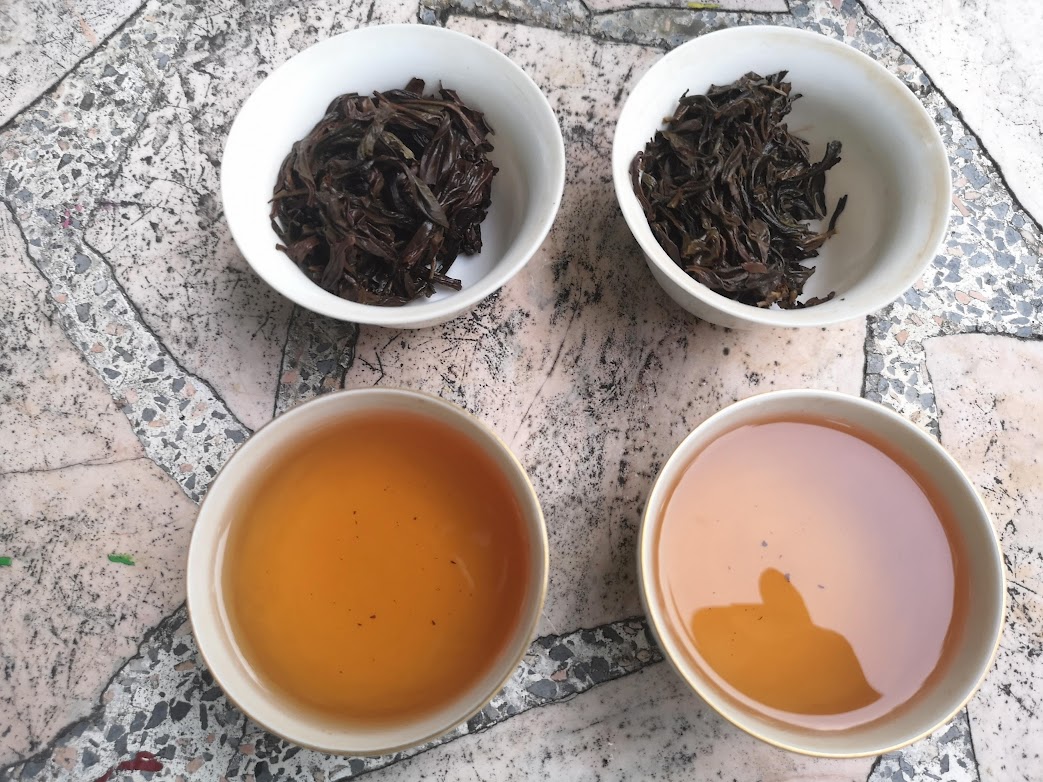
I didn't mention the color; it started out with a pinkish sort of color, then I think it transitioned to a more typical light golden amber oolong range.  I'm not sure what that's about, the extra touch of pink, or if it signifies anything.

Packaging was definitely a bit much; it came in tiny aluminum canisters, like weed might be sold in, if there is such a thing as elaborately high end versions of that.  Then that was in a custom case.  This isn't so unusual for Chinese teas, presented as exceptional; they can go a little overboard.  I suppose status would be part of the appeal, drinking what is expensive, refined, and rare, and the packaging helps support that.  


Things are just different in China too.  One might expect lots of things to be rougher edged or more basic, somehow, but there's a broad higher end range of lots of types of experience or aesthetic context that's more the opposite.  Not that I've ever really been living the high life in China; I've visited that country three times, but as a value-oriented tourist (twice), and on a work trip once.  That almost leads into telling a story or two, doesn't it?  I probably shouldn't, but let's.


I went to China on business a long time ago now, maybe just over 15 years, so what I relate might be dated.  I'll skip the parts about the work context; it was somewhat IT related, since that's the field I work in, and from there it doesn't matter.  I was introduced to better tea in a Gong Fu ceremonial brewing demonstration at the company we visited (probably the one company you might think of).  

They were pretty good about not making it seem like tall, beautiful women were the norm in that country, even though they were that as hosts, and extending that not to make lots of claims about the tea brewing, hyping ancient traditional forms as being something they're generally not.  People might make wishes when they pour tea over tea pets; a fairly basic idea like that comes up.  Maybe that frog relates to money (it is holding a coin), and another to success with family, so it would be a good place / context for asking for a next child.  


Chinese people love to make wishes, as Thais do.  My wife loves to visit Hong Kong temples and go through all of that, or there are lots of Chinese temples in Thailand too.  We just happened to be walking into a local Chinese temple in Korat, Thailand, when we had just picked up Myra, our cat (then a kitten), back in 2021, so I took her in there and asked the multitude of Chinese gods to keep an eye on her.  So far so good.


some people might recognize this old Shenzhen mall space


Hong Kong; a temple, of course


Apparently drinking alcohol plays a role in business connections.  That's probably the last time I've been good and drunk.  The next time we met with another Chinese company I kept it bit more reeled in; it matches an expectation to go there, but it's really a bit much for me, as a non-drinker (now even more so, but mostly that back then too).


Enough stories.  Later I bought some tea in a shop, waiting for others to buy other things, and that started my next level of tea exploration.  But it was all normal enough.


Back to this tea, it was amazing.  Others would probably appreciate it a lot more than I did.  Earlier on in my exploration of teas I was really into broadening my horizons, and trying out exceptional range, and now I'm fine with just drinking good tea, and by that I mean anything with character and aspects one can appreciate.  That's most teas; they just offer different experiences.  Maybe the low end grocery store versions aren't like that, and other ranges that are comparable, but so, so much of tea range is interesting and pleasant, or at least just pleasant.

But it was nice having a unique experience.  I ran through a tasting set of pretty decent Dan Cong from ITea World a year or so ago (more now?), and it was nice trying the other types.  Mi Lan Xiang and Ya Shi / duck shit get most of the attention in "the West."  And they're often quite pleasant, so I suppose that they should, but others are also interesting.  I tried a number of them from Cindy, of Wuyi Origin, and that's a good source for exploring pretty far up the quality scale, at pricing that's quite fair for what they sell, even approaching $1 / gram.


Cindy!


Being more into sheng pu'er I don't even buy that much oolong now, of any kind.  Eventually I'll probably cycle back through a long exploration and experience phase again, but who knows how long that will take.  Good black tea is more my fallback, most often Dian Hong.  By good I don't mean searching out the high end, best of the best, I mean basic and pleasant.  And if good comparable forms are from Thailand and Vietnam I'll drink that instead, so I suppose calling that Dian Hong style tea is more accurate (DH adjacent?).

This shop sells pretty decent, upper medium quality tin packaged Dan Cong, at a much lower price point range.  That's more what I'd drink, but I only buy it there to give away to monks, to save my tea budget for the next sheng cake, or maybe black tea.


that tea I just bought, and already reviewed earlier, 2007, so perfect for getting to now


Friday, January 31, 2025

Ginger flower and honey orchid fragrance Dan Cong


honey orchid left, in all photos


This reviews two more Dan Cong from an ITea World sample set, sent by them for review. The last two were exceptional (orchid and magnolia fragrance versions).

One is the most commonly sold Dan Cong type, Mi Lan Xiang, or honey orchid fragrance (or aroma).  The other version, ginger flower fragrance, I've probably never tried. Their site description of that set follows:


iTeaworld 2024 Christmas Gift Sampler: Fenghuang Dancong Oolong Tea  ($109.90 for 100 grams)


Fenghuang Dancong Oolong Tea:  Huang Zhi Fragrance, Orchid Fragrance, Honey Orchid Fragrance, Magnolia Fragrance, Ginger Flower Fragrance, Osmanthus Aroma, Cinnamon Fragrance, Almond Fragrance, Night-scented Stock, Jasmine Fragrance


I might add a note on their brewing advice, before touching on the subject of value.  They recommend using Gongfu brewing, of course, starting at 6 to 8 seconds, and moving to 10 to 15 seconds, for up to 10 infusions.  That's fine, but I would brew these quite a bit longer, and only get about 6 to 8 rounds out of them.  If I was using a proportion of 8 or 9 grams I'd probably roughly match their parameters, but to me 8 seconds isn't long enough at 5 grams to 100 ml.  That's about preference, not really an optimum.  I'm a sheng pu'er drinker; I can't be brewing teas really light like that, but it is one common form of preference.  It might even work slightly better to isolate flavor aspects, even though that's counter-intuitive.

Is just over a dollar a gram justified for these?  I tend to state over and over that I just won't buy tea at a dollar a gram.  I probably wouldn't buy these.  But for what they are, the quality of the four versions I've now tried, that's about right.  At least they offer sales that could cut that back a little, 20% off if you spend over $100, so it seems this would drop automatically, at least now.  If these really cost 80-some that's a pretty good value.

It feels odd saying that.  Who spends over 80 cents a gram on tea?  People who don't care what the cost is, or who get hooked on types and quality levels of teas that they just can't get for less.  It's better not to do that.  This is where I usually say that other range of similar tea, for this type, isn't as good, in a sense, but it's interesting and pleasant enough that it doesn't matter, it's fine.  With Dan Cong you kind of take a hit.

I will say this:  I just bought decent Dan Cong for a gift at $20 per 100 grams.  It won't be this good, and this range of different DC versions doesn't turn up.  I bought that in a Bangkok Chinatown, and you can't match value or that version offering on the internet, oddly.  I didn't try that exact version I bought, to be clear, but I've bought Dan Cong from that shop three times, I think it was, so you can kind of get a sense of what they sell from that kind of history.  Upper medium quality Dan Cong can be really nice, if you can find it.  Online sources wouldn't sell that for less than $40, but it's still 40 cents a gram instead of 80+.  Other Chinatown shops here would probably sell lower quality Dan Cong for more; it was an exception, even for here.

These might all be that little bit better, or at least the first 4 were.  Maybe the honey orchid, Mi Lan Xiang, wasn't quite on the level of the others, but they were all pretty far up there for quality.  So I guess if you really feel that you need to experience what pretty good Dan Cong is like this is reasonable (given the other versions are like the first four, and I expect that there could be some quality variation).


Review:


Honey orchid:  that's nice.  I didn't use an extended first round for these to bump infusion strength to a normal level, so I'll be trying them light for a first infusion.  Character is good; these aspects are nice.  Tone is a little warm; it seems that oxidation level is balanced really nicely, probably supported with very moderate roast input, that is hard to fully place.  It all integrates.  Flavor is floral, of course, hinting a bit towards ripe peach.  The warmth comes across as a touch of cinnamon, at least so far.  Astringency hasn't emerged yet, but being on the light side that would be moderate.  It's a great start.

One might wonder if this seems really familiar, for this being the name for Mi Lan Xiang, the most common form of Dan Cong.  I guess so.  Those still vary a good bit, and this is a novel and positive version of one.


Ginger flower fragrance:  I guess that tastes a lot like ginger flower?  There is a light spice edge to it; it's really interesting.  The general tone is sweet, like jasmine, not even all that far from jasmine.  Again the moderate warmth works really well for this.  Floral tones are plenty bright and intense, and then it's grounded by warmer floral range, and what could seem like a bit of spice.  

This is so fragrant that it's perfume-like.  No tea this good is artificial, I don't think; I mean that volatile compounds give it a positive effect, what I often call liqueur-like, when the flavor context is slightly different.  It'll be interesting trying both slightly stronger.


Honey orchid #2:  I brewed these for about 15 seconds, or just over, not a long infusion time, but plenty for this proportion, for "only" using 5 grams.  Flavor is great.  Intensity picks up a good bit, but it stays in a similar flavor range.  A richness picks up, a thicker feel.  Astringency also does, but it's not sharp or edgy, only tied to that fuller feel.  Flavor definitely includes a lot of warm floral tone and some peach, and again I read the warmer part as being like cinnamon, just not exactly that.  

Ordinarily I'd be brewing 8 or so grams of this, drawing out even more intensity, even for using slightly cut back infusion times.  As long as you keep infusion timing out around 20 seconds that intensity would still be there.  There is no sharp edge to worry about; may as well push this tea a little.  Refinement and balance are great.  There could be a little more depth, and a little more pop, with aftertaste carrying over a little more, so I'm not saying that this is an ideal version, but it's pretty good.  It's definitely in the right range.


Ginger flower:  that ginger edge really comes out; it actually tastes more like ginger this round.  Maybe I was expecting that to be less of a literal description, or maybe ginger flowers also smell like ginger toot.  The sweetness is again like jasmine, with more warmth.  Where the other includes warm tone that's towards cinnamon this is really aromatic incense spice range instead, a set that I don't have clear enough memory of to distinguish between (frankincense, sandalwood, etc.).  

Feel seems a little thicker, and aftertaste does carry over just a little more.  It seems natural to push these just a little harder next round, infusing them for just over 20 seconds, to see what comes of that.  There's nothing negative to work around, so it will be down to trading off maxing out intensity for having them brew less rounds.


Honey orchid #3:  it's funny how someone unfamiliar with this tea type range could be absolutely blown away by this tea version, the strong floral tone, touch of fruit, sweetness, richness, depth, overall intensity, the way it all balances, and so on, and then the other version amps a lot of that up just a little.  Good Dan Cong is really something. 

"Good" is so relative; above average quality versions just tend to be like this, but from how people describe even versions they take to be positive many aren't.  That characteristic astringency edge people describe needing to brew around is a quality issue.  I suspect that low elevation, monoculture grown versions are pushed too hard with chemical fertilizers, leading to that, but of course that's just a guess.

Aftertaste does seem to pick up a little, for adding just a little more infusion strength.  Feel is generally good, it just seems less noteworthy with the other being a little richer.  Maybe the flavor being relatively familiar does cost it a bit in terms of novelty, but it's not as if I'm drinking Mi Lan Xiang versions all the time.  It's been awhile.


Ginger flower:  that's as far as this should be pushed for infusion strength, or maybe this is tipped a little over a natural optimum.  You know when something is enough when it's too much.  The ginger type flavor is still novel and positive, and other floral range is nice, but that jasmine sort of floral note is a little too strong in this.  

Could that flavor have been bumped by contact with actual jasmine flowers?  Sure, it's possible.  I'd guess that's not an input, but the effect would be like this.  It wouldn't draw out that much ginger flavor though.  And the supporting incense spice range warmth is really interesting and pleasant.  This is just how good Dan Cong goes; it's a little surprising that tea can be like that.  If added flavoring could be this clean, balanced, and positive I'd probably drink flavored teas.  Good Wuyi Yancha can be a bit surprising too, but not as much across this floral and fruit range, typically.  That liqueur-like effect can be really strong in some types of those though.


Honey orchid #4:  the feel isn't necessarily thicker or richer, but somehow it picked up a syrupy effect; the texture changed.  That's nice.  Intensity and complexity are good, and depth, but somewhere in that set is the closest thing to a limitation this tea has.  It could hit harder.  I suppose it could be slightly more intense and complex, and could express a little more depth.  It feels like splitting hairs saying that.  Someone could buy a dozen Mi Lan Xiang versions and not get one this good.  But there's a magic that happens when it's all dialed way up, and this quite good, but maybe just short of magical.

This is part of why I feel like chasing quality level optimums is a bad thing, to be clear.  If you need every new and different next experience to be better than all the last you set yourself up for disappointment instead of enjoyment.  This is already so good.  I'm just trying to place it, for people who are really on that page, into Dan Cong.  It would make for a bad goal trying to top this tea, and an expensive one, probably requiring some hit and miss, but it would be possible.


Ginger flower:  at just the right infusion strength this gets pretty close to magical.  The way all those flavors I keep describing come together, with the rich feel, warmth, depth, aftertaste trailing on--it works.  I suppose that ginger and floral mix, not so far off jasmine range, may not appeal to everyone, or that incense spice undertone people might see as less positive than I do.  To me it all really integrates.  I don't think it was a happy accident that made this tea turn out this good; I suspect that whoever made it really knew what they were doing.

That reminds me, in the last meetup at my favorite Bangkok Chinatown shop the owner, Kittichai, was describing how oolong is harder to make than sheng pu'er (in his opinion).  He said that to make sheng the material plays a lot of the role, and if you get the simpler standard steps right it will turn out as well as the material allows.  But oolong is different; there are more steps, more inputs, and more judgment required.  That matches my understanding too, even though I have zero experience with processing tea myself.  The timing for every step needs to be carefully determined, not according to a recipe, but in relation to the material and the conditions, related to how compounds are changing just then.  It's the same for withering, bruising, and oxidation, on to fixing, then later roasting; variable after variable requires tea maker input.

It seems funny saying that since over and over I've said that South East Asian sheng is typically just a little off Yunnan versions, probably related to processing differences.  Some of that could be intentional; people seem to draw out withering or add a limited oxidation step to offset the final bitterness and astringency, the harshness.  In Yunnan if the material is a bit aggressive after processing it just is; you age it some to offset that, not change the processing inputs.  What do I know anyway; I'm just a tea drinker.


Fifth infusion:  in order to not repeat those same aspect lists I'll just combine thoughts in one note for this round, and end this note-taking.

The honey orchid version has levelled off related to changes, not necessarily fading, but maybe giving up a little intensity.  It's quite pleasant like this, and not changed, but a next round would need to be infused longer to get this far.

That ginger tone is always surprising in the other version, when you first taste it each round.  And it being supported by so much floral and spice range is really something.  I suppose the feel could be a little thicker, but there's so much novel and well-balanced range that it's really splitting hairs to point out where it's weakest.


Conclusions:


These are much better than the earlier tasting sets from ITea World.  If you go back and read the wild origin material posts I did those teas are positive, mostly, but they're not complex, intense, balanced, and refined like this, none of them.  Then again this is Dan Cong (and they also cost more); that would be like trying sheng pu'er and saying that other type range just doesn't match it for intensity.  Of course not.  Just across that one dimension these aren't as full-throttle intense as the ordinary range sheng pu'er versions I often have with breakfast.  But across almost every other dimension the aspects really stand out.  

I suppose that only applies if someone loves floral-oriented teas with some fruit and spice range to add depth.  If someone loves green tea or hei cha, and not that range, these may not work as well for them.  To me the appeal seems relatively universal in form, but in practice personal preference isn't exactly like that.  People like whatever they like.


Saturday, August 5, 2023

ITeaWorld Mi Lan Xiang Dan Cong and Tie Guan Yin


Tie Guan Yin on the left (of course)


More reviews of teas sent by a vendor for review, part of an effort to get more exposure about their product range by sending teas out to a number of people.  All fair enough!  The last teas were pretty good, but I liked a Yunnan Dian Hong black version more than a Yingde black tea.  I think oolongs will make for a more conclusive finding, since this complex and often refined range of teas really shows off quality level, or on the other side exhibits even minor flaws more clearly.


I've not discussed background with them, so I might only cite some basic product descriptions during editing, and move on to tasting notes here initially.  


I might also mention that side by side tasting can help identify subtle differences in similar teas, for example to make it clear when one has a thicker mouthfeel, or great complexity.  Tasting dissimilar teas like these together actually makes judgement less clear, instead of more so, because it just adds more noise to filter while it's going on, more to experience that doesn't actually help.  I've been through both kinds of combined tastings many times over the last decade so I'm not too concerned about that.  I might've pulled out one or two more minor flavor descriptions for either tea in a singular tasting, but in general the assessment should be the same.


Tie Guan Yin ITeaWorld listing:  (a bit over $15 per 100 grams, converting what I see listed in Thai baht; pretty good value related to already trying it)

There isn't much of a written product description, so I'll paste some background mentioned here, and a spiderweb chart description:

Surrounded by mountains and veiled in mist, Anxi has an average annual temperature of 15-18℃, a frost-free period of 260-324 days, and an annual rainfall of 1700-1900mm. The relative humidity is above 78%. The soil is mostly acidic red soil with a pH value of 4.5-5.6. The soil is deep and rich in organic matter and mineral substances, which contributes to the unique flavor of the Tie Guanyin tea trees.


Mi Lan Xiang Dan Cong listing(maybe about $38 per 100 grams, which seems fair, given that it seems like much better quality tea)


From Old Tea Trees over 100 Years Old in Deep Mountains. Sweet. High Brew Tolerance. Low Astringent Taste.

Sexual tea tree varieties over 100 years old.  One tea tree in an area of 6-8 m².  Picked 1 flush a year.

When consuming the tea, the mouth is enveloped by the natural aroma of the tea leaves, resembling a sophisticated perfume. Hence, fenghuang dancong tea is often hailed as a drinkable perfume by tea lovers.


There is a bit to unpack in that description.  It doesn't really break down an aspect description of the tea directly, but it's how one would expect from what is there, true to type, heavy on a particular floral input (what the name is a reference to, honey orchid fragrance), on the sweet side with medium level fermentation input.  Roast level is light enough that you can't clearly identify it, which is good, but it probably was one input.

Sexual (natural) plant reproduction refers to how monoculture, often lower elevation and high chemical input supported farming, can tend to utilize plant clones, versions with identical genetics.  If the plants really are 100 years old, or even just decades old, branch cutting practices of propagation were probably still available back then, which is all it takes to make a genetically identical plant from one already growing.  It doesn't add that much if there is slight genetic diversity from natural plant reproduction (which is a bit similar to how mammals have sex, only relating to pollen exchange instead of the rest for combining genetics).

The "deep in the mountains" part implies natural, and perhaps even organic growing conditions.  It just doesn't say that.  How much space each plant has to grow is a novel inclusion; I suppose that would be relevant, but it doesn't mean much to me.

I tend to take descriptions about tea plant age and growing elevation (not mentioned) with a grain of salt anyway; it would be easy for vendors to include content that may or may not be accurate.  If they are growing and also processing the teas they sell all this should be accurate, but if they actually produce most and also resell some there would be no way to know which was which, and if producer source claims are actually accurate.  

It is important that plants are harvested only once per year, to keep the intensity at a maximum, and preserve the value of the processed leaves that are picked (per input from a producer friend, who also makes Dan Cong).


Review:


Tie Guan Yin:  a little light; not fully opened yet.  People often use a quick rinse step to get rolled oolongs to open to avoid this, a first round that's hard to get much out of.  I brewed these for about 15 seconds, which is probably going to be relatively optimum for getting the Dan Cong started, but it would be as well to hold off on a detailed description for this until next round.  It's pretty good though; the range is about right for a good quality version. 

I should also mention that I'm brewing 7 grams of each, instead of the 3.5 per small sample.  That's not because that's more optimum; it relates to me being quite familiar with that quantity and proportion for brewing approach.  It's pretty much how I prepare all teas, for tasting or for everyday consumption.  It would be good if I could brew 3.5 just as naturally and effectively, but even for paying more attention to the change in process it wouldn't be the same.  

For anyone new to Gongfu brewing, who doesn't have this sort of established preference and routine, just using 3.5 grams is fine, and using longer times, more like 25 seconds or so, until you see if that should be slightly longer or shorter per your preference, or adjust that per round based on results last time.  Later in a cycle, maybe only 5 or 6 infusions in for it going faster at higher proportion and longer brewing times, it might help to bump timing to keep infusion strength up.  One might naturally wonder if there really is an optimum infusion strength by tea type, but as I see it this ties more to preference.


not bad brewing advice, except timing escalation may be a little fast


Dan Cong:  this is more intense, definitely not related to it being more intense in general (although that could be true); it's that this tea form will brew a lot faster early on, the long strips and more oxidized version.  It doesn't need to open up.  It's pretty good; the flavor and character is as it should be.  That oxidation level and very moderate roast balance seem quite favorable to me; often Dan Cong can be a little light in style, not quite to a most natural balance point for oxidation.  Tipping past that optimum balance point would be worse than stopping short, leaning over towards black tea, because even lighter styles are still quite favorable, but it would be a shame to shift this to taste more like black tea (the oxidation level), or to roast it too much (the separate roasting input).

This may be Mi Lan Xiang [editing note:  later added to their website description, confirming that, which hadn't been present earlier on]; it's quite floral, bridging over to lean towards a fresh ripe peach flavor.  The character that is there is all very positive; the flavor is in the right range, mouthfeel is good (but it could be a little thicker), aftertaste lingers, and refinement is good, without any trace of negative aspect inclusion.  The only limitation relates to intensity still being in a moderate range, and thickness of mouthfeel backed off a little, with aftertaste positive but not as extended as it could be.  All this puts too much pressure on final judgement on a first round though; this tea is just getting started.  I'll see if depth and intensity pick up a bit from here.


Tie Guan Yin second infusion:   it's pretty good.  Flavor intensity picks up, and this is in a positive range, including plenty of bright floral scope, typical for the type.  Some of what I was saying in the last round about the Dan Cong repeats here; this seems like pretty good tea, but there seems to be a clear higher quality level beyond this experience.  Flavor range is positive, and right for the type.  Mouthfeel and aftertaste aspect range are fine, both positive, but there is another level beyond this for both to be a lot more intense.  For people new to trying better teas it would be hard to notice that, or to appreciate it whether it's there or not, so to be clear I'm describing what people judging teas conventionally value.  More thick feel and prolonged aftertaste add more dimensions to the tea experience, they give it a much greater depth, more than any one of these being inherently positive on its own is an issue.

Sweetness could bump a little but it's fine.  There aren't any other noticeable flaws, beyond what I've described that I see more as limitations to the quality level.  Medium quality TGY can have more of a sweet corn flavor than floral, and I suppose this flavor range is complex, and someone could judge it as including that, but I see it as primarily floral, and the right range of that, a sweet sort of orchid-like range (but I'm not great with mapping distinct floral descriptions, to be clear).


Dan Cong:  intensity did pick up in this, and it transitioned just a little.  Warmer tones are more dominant, leaning a little towards cinnamon, but not really quite reaching that exact flavor experience, just towards that range.  Floral range still stands out most, a much richer and deeper form than for the other tea.  It still leans a little towards peach flavor but that's harder to pick up related to warmer tones increasing.  A perfume-like character sets in more; I'd like to describe how I see that as relating to a quality marker, using that concept in a non-standard way I've evolved as my own way of interpreting tea experience (not to take credit for renovating tea tasting; the point here is more to separate what I'm saying from expectations that this is how people trained to taste tea tend to describe it).

Trueness to type, good balance, complexity, and intensity can all be valued in tea experience; all of these are positive.  To a limited extent I see certain particular aspects related to each tea type as identifying quality in a different way, only for that particular tea type.  To offer a counter-example I don't necessarily notice such a thing related to the Yunnan black tea (Dian Hong) that I reviewed from ITeaWorld last.  To me that type is great for being approachable, intense, complex, and for conveying the experience of depth even when teas seem to have a simple flavor profile.  No one aspect marks a version out as quite good, or most standard.  The aromatic range I'm describing here, related to this Dan Cong, serves that role.  It's a perfume-like experience, so that in some forms it even seems to take on the character of the solvent in perfume, not only floral aromatic compounds and such.

The tea is good, very pleasant to experience; some of all that might be overthinking it.  To be clear it's not as if I'm saying this is probably an example of a $.75-$1 a gram more exclusive, much higher quality level version; it may well fall into the top end of a rarer middle range of Dan Cong, not quite there.  Really good Dan Cong can be just amazing related to intensity, balance, and refinement.  This is pretty good, and the aspects there are quite positive, but it might fall just a little short of that more intense and refined range.


Tie Guan Yin third infusion:  not much change.  It's nice to experience a pretty good Tie Guan Yin version, and for sorting through Chinatown shop tins you might never encounter one on this level (although you really should, but random shop versions can all be iffy), but it's also limited related to the quality potential it didn't achieve.  If this is selling at a moderate price it's fantastic value tea, and if the pricing is more medium that's just normal, and it would match billing.  Note that the whole range for TGY is generally different than for Dan Cong; ordinary versions tend to be a little lower in quality level, and pricing is reduced to match.  It's not an inferior type, necessarily, it's just one that is often prepared as a commodity tea, produced and sold as higher volume and lower cost versions.  For vendors adding lists of superlatives and demanding the highest pricing for versions this tea version isn't up to that, even though it's probably as good as versions from many vendors who use such tactics, and don't back up the talk appropriately.  

It's a little better than a tea you would just enjoy as a nice complement to breakfast food, and at the low end related to a version being so special it warrants spending an hour outside just focusing on tea experience.  I appreciate what each tea offers, so it's fine for me for that, but many tea enthusiasts would need versions to rate high on some sort of scale of experiences, or even break new ground, and it's not there.


Dan Cong:  this version may suffer from some of the related limitations I've just described but to me it's a little more interesting than that, for a few different reasons.  That very pleasant balance of oxidation level and limited roast input really works (assuming that it's roasted at all, but it must be).  The bridging of flavors across complex range works, the warm spice-like range, pronounced floral, and some fruit.  Thick mouthfeel and drawn-out aftertaste aren't necessarily exceptional, but there's enough going on with them to support an experience of some complexity.  Then a subtle perfume-like character probably tips all that balance positively.  

It also helps that you could try a number of Dan Cong versions (probably Mi Lan Xiang) and they would be similar to this, but not very close to it, so novelty enters in.  Tie Guan Yin is easier to assess for quality level because the aspects experienced tend to be more standard, until you branch into more traditional more oxidized and roasted versions.  That version is the now-common greener and lighter style, which many people highly value and some people hate.

One drawback to doing combined tastings using a high proportion is that you can only get so far through a brewing cycle, unless you have a tolerance for drinking lots of tea.  Or if you are only tasting some and dumping the rest out, but I wouldn't do that.  I'll take a short break and eat something then try one more round, and 8 small cups of this will be plenty for now.  I don't think there is a lot of story to get back to, about how these will evolve across a whole cycle, since the TGY is already not transitioning and the story for the Dan Cong should be more about durability than later change.  Even if I leave off making notes I'll drink the tea, so I can mention it if anything interesting comes up.


Tie Guan Yin, fourth infusion:  vegetal flavor range is picking up but the tea is still nice.  For being a kind of medium quality level TGY this is fine, it's good.  I cut and pasted the vendor descriptions into this post between rounds and this version is priced considerably lower than the other, matching my expectations related to how it comes across.  For me personally I wouldn't want to pay more to experience a bit more depth, flavor complexity, thicker mouthfeel, and extended aftertaste, since the general experience is still similar for these kinds of medium quality level, very light TGY versions.  People naturally value different things though, and holding the opposite opinion and preference is fine too.  Budget comes into play; for plenty of people spending $15 on 100 grams of tea is enough, and for plenty of others it's not different at all from spending $30.


Mi Lan Xiang Dan Cong:  the individual flavor aspects seem to integrate a bit more, seeming less distinct as rounds go on, with the most intense floral range and an early hint of peach giving way to stronger supporting warm mineral tones.  That's still nice, just different.  At this point interpreting some flavor range as aromatic wood instead of spice-tone would make sense.  Strong floral tone is still a main part of the experience.

Quality level interpretation is completely different for this version; it sells for $30-some per 100 grams instead of $15, and it's clearly higher quality tea, of a type that tends to run high in demand, and command higher pricing.  Under $20 per 50 grams is still kind of a lower medium range for Dan Cong pricing, related to how a lot of specialty tea vendors in the US position it.  For this particular type of tea I get it why paying more to climb the quality level ladder makes plenty of sense, for people with this type as a main preference, and the budget to go there.  

I'm a sheng pu'er drinker at this point, and my budget is relatively bottomed-out related to other life-input concerns (moving back and forth between Bangkok and Honolulu, and I've developed a running shoe habit), so all this is fairly abstract discussion related to my own experience.  I haven't bought much tea this year, and whenever I do value--low cost--will be a main factor.

I think this version is quite pleasant, and it's what it should be related to the product description and price range.  Value seems fine.  People can get an impression that Dan Cong is a difficult tea to brew, or that versions tend to include a high degree of characteristic astringency (a bit like flower stem), but really that mostly relates to the quality level just below this range, as I see it.  Lower elevation produced, overharvested and stressed plants, probably stretched for production volume using a lot of chemical inputs, produce a different type of experiential outcome.  I'm not trying to guarantee or support that this is necessarily high mountain, old plant, organically grown tea; hopefully it is, as described (not the organic part; I don't think they said that).  It's good, and those inputs and outcomes are said to bunch together.  Of course good is all relative.


Conclusions:


I've concluded so much in the rest there isn't much to add.  Both teas were good for what they were presented to be.  Both held up for another very pleasant half dozen infusions, or maybe more, I didn't keep a count.  Both are open to broad critique related to aspect by aspect comparison to versions presented and sold as the next quality level up, but the Dan Cong is at a nice equilibrium point for being very pleasant, complex, and refined and still at a moderate price, for that tea type.  


Saturday, February 15, 2020

Lao Cong Mi Lan Xiang (Dan Cong) compared to a 1988 version


Tea Mania Dan Cong, Lao Cong left, 1988 version right


Editing note:  I had missed the correct Tea Mania listing for one of these; I'll change this around, to include reference to both what I thought it was and what it is.

I'm reviewing a couple of interesting looking Dan Cong; different, since I've been off that page for awhile.  They are samples provided for review from Tea Mania; many thanks for that.

I originally only saw this version of Mi Lan Xiang, thinking it was the first younger version, but it's not:

Xue Mi Lan Xiang

...This tea is grown by the family Cha Xiang Si Hai from Fenghuang and thanks to a centuries-old knowledge processed to a superior oolong. The whole family is involved in the harvest and also in the entire tea production. The tea is still traditionally processed like in times of Lu Yu: The leaves are withered and dried in bamboo trays and then roasted over charcoal fire.

Through the high oxidation and the strong roasting is this Dan Cong good storable and particularly interesting for connoisseurs who like to mature vintage teas.

Harvest: Winter 2013
Taste: Honey-sweety with a hint of Orchid.
Oxidation: appx. 30%
Origin: Fenghuang, Chaozhou, China.


I had concluded "If that is what this is that pricing looks too low ($15 per 50 grams); this is a way above average quality version, even as good versions go, based on already reviewing it."  It was really something else, this:


...Tea made of leaves from old tea bushes have a very complex and intense aroma with mineralic notes. The tea is still traditionally processed like in times of Lu Yu: The leaves are withered and dried in bamboo trays and then roasted over charcoal fire.

Through the high oxidation and the strong roasting is this Lao Cong Dan Cong suitable for long storage and particularly interesting for connoisseurs who like to mature vintage teas.

Harvest: Spring 2016 
Taste: Honey-sweet with a hint of orchids.
Oxidation: appx. 55%
Origin: Family operated farm in Tian Lao Po in Wudong, Fenghuang, Chaozhou, China.


It lists for about $50 for 50 grams; unfortunately that is a more standard price for much better Dan Cong.  If it's any consolation it drinks much better than $1/gram standard gushu sheng, although aging potential complicates things; taking that into account who knows. 

The slightly higher level of oxidation (listed at appx. 55% instead of 30) matches this review description, but I didn't frame interpretation in relation to that in comments about aspects.  When I mention that often Dan Cong versions have a touch more astringency, and come across as more intense across the higher notes, that relates to this cause.  Aging also softens a tea, and gives it more complexity and depth but rounds off higher notes slightly, even over the course of "only" 4 years (this was a 2016 version).


There is no current listing for the 1988 version, but I did look up a price using the Internet Archive Wayback machine; it had sold for $35 per 50 grams as of January 2019.  There's no easy way to put any standard retail value on tea that rare but that sounds more than fair.  It's a little rough edged related to aging effect but that's not an experience that everyone is ever going to go through to place.

Review


Lao Cong left (in all photos); I forgot to take this photo before drinking that one


Lao Cong Mi Lan Xiang [a 2016 version, it finally turned out]:  I let this brew a little long, not focused in right away (maybe 20 seconds or just over versus half that being more typical).  It's fine anyway, the astringency just stands out a little more than it would have brewed faster.  There's a general early-round trade-off to be had in brewing tea types in general, since the first round will often be quite light, and stretching that by extending time (as I've just did, just not completely intentionally), won't give the same results as accepting a first light round and brewing a better one the second time.  Onto how it is in more detail.

Floral and fruit tones stand out; this is as it should be.  Sometimes Mi Lan Xiang versions will be relatively straight ripe peach, and sometimes more floral (as the name suggests, honey orchid), and this is floral, clean with good intensity.  I'll fill in more next round, which I'll brew fast.


1988 version:  it's interesting tasting age on a Dan Cong.  This is musty, but I get the sense that will clear up over the next round, and won't be around as much in the third.  It's not exactly right saying it's a clean version of musty but that's sort of what I mean.  It's odd how this is that slate / blackboard mineral aged aspect that stands out a lot in Liu Bao, which I wouldn't interpret as only from aging input in those, instead as part of that tea character.  Maybe I was always wrong about that?

I won't be able to tell much more about this beyond that given how much that is standing out.  It's interesting how going a bit long on infusion time may have made perfect sense.

Second infusion


the aged version is much, much darker


Lao Cong:  this is brewed quite fast; our cat opened the kitchen door, and it's not supposed to be in there, so I rushed process to shoo it.  She and the neighbor cat went in there to look around not long ago; she's not clear on the guest cat house policy.

It's good.  Floral tone is still most pronounced, a warm, rich, deep flavor range.  It trails into heavy mineral that could be interpreted as a start on roasted almonds.  Or maybe it's my associations that are mixing, but either way the complexity extends towards roasted almond flavor.  That does span a rich, heavy nutty flavor range and a deeper mineral tone, not completely unrelated to the slate / blackboard range in the other version, but completely different in effect.

There's a perfume-like character to this that comes out in better tea versions across a broad range.  It ties to the floral tone, in a sense, but it's really as much an aromatic range that matches up with an effect from some liqueurs, like cognac, just much more subtle.  Fruit tone probably picks up a little this round too; it's really complex, across flavor range and other.  Astringency is almost non-existent brewed at this infusion strength.

Dan Cong works well brewed lighter in general, it seems to me, because flavor and feel intensity don't give up much brewed very fast but the astringency component of feel largely drops out.  How much there is of that to start with varies with tea quality, and per some mixed hearsay perhaps with elevation range of plant growth, and due to other complex factors.  However that goes this works; there isn't much astringency edge, as can occur in medium quality versions.


1988 version:  this does seem to be right in the middle of that mustiness dropping out, just not there yet.  It has shifted in effect a lot, now spanning half the experience range versus taking it over.  This is definitely old tea; that part isn't wrong.  It probably won't "go clear" even next round, given how even the balance is between a mustiness that has now transitioned to something else.  Instead of chalkboard / basement flavor range now it's closer to very old barn smell, dry wood that's been around forever.  That's not completely unpleasant, I just don't think it represents what this tea really has to offer for experience yet.

I suppose this is a good place to add that I've not tried that much aged oolong.  I compared two quite old rolled versions in one post (21 and 30 years old at that point), and reviewed a relatively old Oriental Beauty  ("only" 11 years old) not that long ago, so exceptions come up, but not that many.  People tend to extrapolate from what they've tried regardless of sample size, but when you are around a half dozen for count that doesn't work very well.  If you can somehow know that a single version is completely type-typical and of good quality a single experience can go a long way, but it also doesn't really work to take someone else's word on that background applying.

To reduce my own prior experience to a short version rolled oolongs tend to just get plummy (tasting like plum), losing brighter intensity and picking up depth, and depending on storage conditions out around the 20 year mark they might be quite musty, I guess possibly even completely ruined.  Even if the first 3 or 4 infusions is too musty to pick up much beyond that it is possible that other flavor range could hang in there, and it might work to brew past that.  That post comparing two older rolled oolong versions works as a good related account of how that might go; one of those was probably a little rougher than this one.

Third infusion


Lao Cong:  richness picked up a good bit in this, and it already had a thick feel and lots of complexity going on before.  This is a really good quality example of this tea.  It's not impossible to find versions with a lot of great flavor, and flavor complexity, and even positive feel aspects beyond that, but not typically on this level.  The balance is exceptional, the way the aspects I've listed out over the last two rounds work together.  It's a little heavier on underlying mineral than some are, and the rich flavor leaning towards roasted almond (tied to that) isn't completely typical, but it works really well, all signs of this tea being better than most versions by a good bit.

Of course personal preference doesn't drop out, with some objective quality level assessment entirely superseding that; if someone liked a more conventional Mi Lan Xiang better they wouldn't be wrong.  They're often brighter in character, often fruity in peach range versus floral.  Sweetness can be slightly stronger, and it's typical for a characteristic astringency to stand out a little more.  This covers a lot of much deeper range, in terms of flavor, and the feel is richer and thicker.  Aftertaste is significant, that sweetness and mineral range trails over, but it stands out more for the feel than for that.


1988:  it's working better; old furniture flavor has replaced the old barn wood effect.  Aged oolongs can often taste more like this, even for versions that are only a few years old.  Hints of what lies beyond now show up more, a deeper fruit richness, centered on heavy dried fruit range.  Next round the shift might continue enough to pick up more about that part.  I'm stopping short of saying this tea has been too negatively impacted by aging effect but without other positive experience coming after this, in the following rounds, concluding that would work.


Fourth infusion


the pictures get redundant right about here


I went a bit over 10 seconds, versus just under, to see how these work out brewed slightly stronger.  At a really high proportion (or what would be more normal for how I brew a lot of teas, up around 8 or 9 grams per a 90-100 ml gaiwan versus 5 instead, as I'm preparing these) the only infusion time to use would be really fast, at or under 5 seconds.  Dropping the proportion just a little gives you some leeway.  That and it's all I had for a sample size.

I don't weigh teas, to be clear; maybe I'm off on proportions in general, or on what these samples weighed.  It's probably strange that I'm an engineer and much prefer loose process, but then for people clear on the difference between engineering and research science maybe that's exactly what they would expect.  Engineers often tend to get things to work and then shift back to replicating that, even though in theory that's not how things should go.


Lao Cong:  the perfume-like character is much stronger brewed slightly stronger.  This is still mainly in that sweet, rich, floral range.  I've not said much for "what flower;" for as rich as this is it leans a little towards lavender.  It's also still in a typical orchid range, and I can't break that down to different orchid versions.  The sweet range within the floral tone isn't so different than plumeria (that one flower associated with Hawaii, at least in my mind, but all over the place in Bangkok too).  It's just that the rest is richer, even still within the floral range.  It's hard to be clear on what I mean by warm mineral underlying that, and how I see the flavor richness as hinting towards a roasted almond, in relation to how those aspects balance, the relative input of all of it.  So it goes with describing flavors.


1988:  this tea is the best it has been every round; that continues.  The aged furniture effect finally is giving way to a perfume-like aspect, not completely different than in the other tea version, just a bit different in form, and how it works out in relation to the rest.  This still tastes like aged furniture, but picking up a floral oriented perfume / liqueur like additional range balances that, with both fairly even in proportion in this round.

To be clear when I say "aged furniture" I intend that as describing the effect from smelling very old hardwoods, along with aromatic oils typically used to preserve those, with both shifted in aspect range due to long aging.  I tend to go into storage rooms in local Bangkok Buddhist temples that house old religious artifacts and varying furniture; like that smells.  Some people's homes here tend to look like museums, rooms with wood paneled walls, filled with tropical wood furniture, old photos, and artifacts of all kinds, and those can acquire a similar smell.

I do like the tea at this stage.  It's a novel experience; it's almost more about that experience of novelty than a match to conventional likes in aspects.  It works across both but novelty stands out more.

Fifth infusion


It won't do the 1988 version justice but I'll probably let note-taking go after this round.  It just gets to be a bit much, spending two full hours writing a tea review, with the other messing around that comes up.  A second full page of text also seems like overkill, and it doesn't work well to just write about the changes, although that is possible.


Lao Cong:  perfume-like rich floral character keeps increasing.  Or maybe this pegged on maximum related to that and it just takes me by surprise every round.  It's more straight floral now, in proportion, with the underlying mineral and other rich flavor range giving way just a little, with intensity of that floral range seeming to pick up as a result.  This version of this type is so good that it's uncharacteristic, even though I interpret this as a likely perfectly type-typical example of a higher quality version.  Is that clear?  I mean that it's not like a normal Mi Lan Xiang, but instead of this not being how they're supposed to be it may well be the case that this is, and a standard example isn't.

Never mind if that intention isn't clear; the whole point is a bit philosophical.  I expected this tea to be good, because Peter's teas often are, but not like this, redefining potential range a little.  I wonder what he says about it, but then this post will have included that in the first section, if conventional form holds [editing note:  I'll get back to that in conclusions].


1988:  again the best it's been.  I often say that aged oolongs tend to lose flavor intensity across some range, get "plummy" (at least rolled versions, not so much for twisted styles), and pick up depth, but it's hard to describe what that depth relates to in this.  It has it.

I can't say that mustiness has completely cleared but in the conventional sense that category would apply it has, completely.  There's a base slate-mineral layer, and a faint aged wood layer, and more prominent aged furniture scope, and beyond that light but notable floral tone, in perfume-like range, between liqueur and the solvents used to carry perfume scents.  That's a lot going on, with some "deeper layers" grounding all the rest.  Oddly it doesn't come across as complex or intense in flavor at all; it lands on a simple, clean character, which completely contradicts what is implied in that complex description.


So there you have it.  I'm bored with this review process, at least related to taking notes, but I'll drink another 4 or 5 rounds of these.

Two rounds later, now extending infusion times to a bit over 15 seconds to compensate, results are what you would expect.  The Lao Cong version is thinning but still really good.  The other won't "clean up" or change in profile beyond this, but it's pleasant, interesting, layered, and complex as it stands now.  I probably wouldn't want to pay a market value to have this kind of experience but it's really novel [it's out of stock, off the market, but pricing level hadn't been as high as I expected].

Conclusions


All the old conclusions no longer apply related to the Lao Cong version, since I was trying to make sense of why it's that good.  Now the review description matches the listing, related to quality level, what one would expect out of a version a few years old (4, this spring), and the pleasant rich feel, complex flavors, and pronounced underlying mineral.

Some people say that once you try much better tea versions then it's hard to go back to more standard teas.  I don't share that experience; I can drink much better teas once in awhile, recognize and appreciate what they are, and then go right back to drinking more conventional range versions, or lots of interesting teas that still aren't at that level.  I stop short of still enjoying Lipton tea bag tea or CTC Assam but not that much short of that, and if push comes to shove it's novel to drink those with milk and sugar once in a long while.


I drank Lipton in April 2019, doing a caffeine detox on a trip; this was a maintenance dose


The 1988 version was good, in the sense of it being really interesting trying aged teas.  It took four rounds for the storage effect to clear up, so it didn't retain as much of it's potential as it could have, but the rest was certainly novel and complex.

Tuesday, June 5, 2018

Wuyi Origin Xing Ren Xiang Dan Cong (almond aroma)


Cindy of Wuyi Origin sent a few samples to try not so long ago and so far I've only reviewed a Lapsang Souchong and Mi Lan Xiang Dan Cong.  Both were really nice, although to be fair people who aren't into fruitier teas probably wouldn't really appreciate either.  Or Dan Cong in general, for that matter, since those universally express pronounced fruit or floral aspects, and it would seem strange for someone to hate fruity tea and love floral versions.

I love citrus and other fruit as main elements in better black teas and oolongs, which explains why Oriental Beauty oolongs are one of my favorite types, or why second flush Darjeeling can really work well for me.  I'm not reviewing much for Darjeeling these days, or even drinking much (beyond trying a decent first flush version in the past week), but for me that sort of thing goes in a cycle.  I've been more inclined towards Chinese blacks, but am trying more sheng and shou, along with some Dian Hong and orthodox Assam.

Of course this is almond flavor Dan Cong, more or less.  Those really do taste a bit like almond but that range can vary.  It will probably be subtle and a bit aromatic, a term people could use in slightly different ways.  Let's see though.  I'll cite the website description of it first, which I didn't read before the tasting:

Location: Wudong village of the Phoenix mountain 

Harvest date: 2017.4.4th 

Cultivar: Xing ren xiang ( Almond Flavor )

Roasting level: Medium roasting, after sorting we roast it by Litchi Charcoal  

Feature: Xing ren xiang, another name is Ju duo zhai 剧朵仔.  At the two side of edge of leaves there are Sawthooth, the leave of this cultivar is very small, thin and long.  This tea has an  obvious almond and nut aroma and very strong tea body.  You can feel the tea energy in the tea soup, enduring, with a long sweet back [finish].


Pretty good, for a description written in English by a non-native speaker (cleaned up a little for form).

Review


I didn't use a rinse on the tea, no short first infusion to be thrown away.  I kept the first infusion limited in timing, around 10 to 15 seconds, even though it really won't express the full flavor range made that way.  Once this tea gets brewing using hot water--boiling point, or at least near that--short infusions would work well, between 5 and 10 seconds.  Or it's possible to drink it stronger; just a matter of preference. 

The tea won't have astringency to work around, as some Dan Cong do.  In my experience that tends to come up more in some types (specific Dan Cong type versions) but really varies more by quality level.  It would be possible to work around astringency a little (if it were present) by using 90 C water instead but more conventional to just go with short infusion times.  One school of thought, covered in this post about oolong brewing temperature, would claim that you'd be out of your mind to use anything but full boiling point water to brew this tea, which would give the best results, but I tend to accept that people could easily use trial and error to see and judge for themselves.


Almond does work as well as anything else to describe the main flavor range but an initial blind impression would probably focus on the floral range instead.  In this tea it's closer to ripe peach than it might often be, usually more prominent in Mi Lan Xiang Dan Cong.  It's complex though, to me balancing almond, that peach fruit, and underlying floral range.  The fruit covers stone fruit range but also a soft version of citrus, and there will be more to say about how the sweetness comes across, about light toffee or whatever else.  And about how the base that's related to astringency works, the unripe fruit theme that's subdued in this version.  There's a lot going on, but the overall effect is simple and unified, not challenging.

I went just over 10 seconds again to get the tea to finish unfurling and opening up, slightly stronger than necessary, but it will make it easy to pass on a full impression.  It's really intense.  Warmer sweet tones did pick up a lot, not exactly close to light toffee but not that far from that either.  Some else might interpret it as close to sugar cane but it's not that either.  The almond range is dominant anyway, coming out even more, with either fruit or floral tones or whatever it is dropping back a little in proportion. 

This is a really nice, complex, and well-refined tea.  The astringency or feel that is present gives it a fullness and hangs around long after drinking it, trailing off in a sweet flavor range that matches the fruit tone more.  The almond flavor is well developed during tasting the tea with sweet fruit and some floral trailing more, an interesting transition.

very slightly stronger; I won't mess around and try a longer steep for this tea


The next infusion I just went around 5 seconds, to see how it works out quite light.  I'm guessing right in between 5 and 10 seconds is the closest match for my preference but it's nice to experience the range.  The intensity at this fast infusion time is interesting; maybe I'm wrong about that part, and quite light is best.  It won't communicate well but all those aspects that I mentioned fall into a great balance in this round.  Each taken alone is nice but together it really works.


The subtlety, complexity, and overall tone remind me of how Ya Shi (duck shit) versions often come across, just not that almond flavor part.  The way the sweetness is expressed is familiar from that, and the underlying floral tone too.  I think part of that is just how well a light-medium roast works for this tea, which would be very light compared to other oolong styles, just more in the middle of the typically lighter Dan Cong range.  It's almost as far from Wuyi Yancha char roast effect as lighter Taiwanese oolongs are, just in a completely different tea version.

It does keep transitioning on the next round, picking up a perfume or liqueur like effect that comes across in some teas.  Using the concept in one way people sometimes refer to that as aroma.  In part it relates to the floral tone picking up but it's also an effect that seems to go beyond taste / flavor changes.  Some of it does seem to be happening related to what your tongue picks up (taste, in one sense), but also to what aroma / scent carries (flavor, used in one limited sense).  Something vaguely related to astringency does give the tea a fuller feel but it's more the opposite of "astringent."


The next infusion is more of the same, really great.  It did continue to cycle through another half of the round of infusions and transition just a little throughout that but I left off here taking notes about it.


Conclusion


I really liked the tea, but then it was just what I expected: complex, well-balanced, characteristic of the type, sweet and intense but subtle and refined at the same time.  But just how good is it?  And how could a reader judge my judgment about that?

Part of what brings that line of questioning up is the familiar exchange where one person claims a tea is a good version in online discussion and then a self-professed "more experienced" tea enthusiast claims that they've had much better tea than that, that it's not even close to the higher end (often even without having tried the tea, which can be regarded as a bit problematic).  I'm not talking about any one specific case but that theme does repeat.  Of course there are ever-higher levels of tea quality for different types, so the claim always could be true in different senses.

In order to resolve that, for a reader to be clear on what I mean and how my judgement matches theirs, I would have to pass judgment on a similar tea already familiar to them and our impressions would have to match.  Even then one would have to just assume that aptitude for judgement and personal preference as a factor remains consistent.  That set of conditions is unlikely, unless I could map out a matrix of reviews of other recognized versions, so I'll go with the next best thing:  trying to find a comparable online description of this tea by someone else, to use third-party input as a benchmark instead.

I couldn't find a 2018 version description, and working from 2017 is going to be slightly less specific, since tea versions will change a little year to year.  Growing conditions aren't completely identical, and some harvest and processing steps require nature to cooperate too.  It would be similar, and of course it's processed by the same people, so for critiquing my review description it wouldn't work but for pegging a general quality level it should, or at least it'll make for a start.  Of course there still are better and worse years for specific teas or general areas. 

One of the three 2017 version reviews on Steepster seems to work to summarize that set of takes (from Tanluwils; nice job!, very clear and detailed):


I’ve had many sessions with this tea and it continues to impress. Dried leaves smell like roasted leaves without any remarkable scent, but once hot water hits them I am immediately hit with rich, almond (yes, really!) essence, sweet buttercream, orchids, and hazelnut. The rinse is thin-bodied, but already exudes a nice mouthfeel. This is a testament to the skill and expertise that went into the roasting, which has enhanced the inherent qualities in the leaf.

The next 4 steeps intensify in aroma, qi, texture, mouthfeel, and flavor. The almond here reminds me of fresh traditional Cantonese almond cookies. It’s very full in the mouth and feels nice in the throat. This one goes strong until the 7th or so steep where it gradually fades. It performs best in a chaozhou red clay teapot.


Steepster reviews can be useful as input, with some interpretation of them required


The tea was a bit like cookies, come to think of it, and I bet I might've expressed more about that creaminess.  That one is most descriptive and the other two are even more positive, with one surprised the tea tastes that much like almonds (the 2018 version did, and also a bit floral and so on), and the third moved to compare the experience to that of romantic love (by Jorge Luis Vazquez Ochoa; again admirable work):


...Difficult to resist its charm. Until the third infusion the tea hugs me, very slowly with an irresistible seduction. Oh my God! its sweetness makes me drunk. Then I was spellbound with it’s flavor. It’s like the kiss of a beautiful woman who just brushes my lips. Then the liquor runs through my body giving it a warmth of life. Then, after the ninth infusion it’s beginning to slow down, but now I’m full of it’s wonderful flavor... 


This next years' version was really good tea but I wasn't quite that affected by it.  If someone hadn't tried Dan Cong on this level before it could be a shocking experience, and for someone who has it would still be really nice.  I suspect that I might be a bit dispassionate in approach to life in general compared to him, which is not necessarily a good thing.

I checked if he'd reviewed the Ya Shi and he had, with really positive things to say about that, but framed in more conventional language.  As I recall that tea was similar in nature (their versions I've tried, including the 2017 he reviewed), just slightly different related to flavor profile.  But then comparing a tea version to one drank a year ago is pushing it; it's easy to remember wrong, at least for me.

Steepster scoring in particular should be taken for what it's worth, defined differently by everyone


Another popular blog reviewed the 2017 version, Tea DB (so a video version; how most of their posts go).  I'd have to summarize them instead of citing something, but the general take seemed to be that it was a high quality tea, most pronounced related to aroma and length of finish, but also with good sweetness and flavor complexity.  Those guys drink Wuyi Yancha and Dan Cong but focus more on sheng pu'er, so their take is far from inexperienced but they probably would have did more with placing it if the tea had been that type.  One funny comment was that since the tea wasn't astringent and had good flavor and sweetness someone's mom might like it.  That's an interesting way to place the tea style, which they joked they would edit back out since it's both sexist and ageist.  But it works.  As long as their mom could use a gaiwan and do 10 second infusions it's easy to brew as well.


It's kind of strange to survey other blogs about a tea, especially since I'm going on about 2017 version reviews, but it was an interesting theme to consider.  This tea is refined and subtle in one sense and straightforward and approachable in another, so it's interesting seeing how different reviewers talked around that.

One take was consistent:  all those reviewers really liked the 2017 version.  The Steepster reviews seemed to frame it as a type you tend to focus on and appreciate more as you drink it, and the Tea DB guys seemed to see it as just another good Dan Cong, but that's how varying type preference and level of exposure goes.  I might prefer Wuyi Origin's Mi Lan Xiang version for flavor intensity and their Ya Shi (duck shit) for being really subtle and unique but this tea is on a comparable level with both.  I agree with some of those comments that Xing Ren Dan Congs don't always taste much at all like almond but this one did, along with other flavor aspect range, which does seem favorable, matching the general type convention and name.