Showing posts with label CNNP. Show all posts

Monday, April 20, 2026

Meeting a veteran tea enthusiast in a Honolulu meetup


this was a tea meetup in Bangkok instead; I didn't take a picture this time


I just tried holding another open tea tasting / meetup where I am now, in Honolulu.  It was a great success, because I met one of those well-regarded "tea people" you can talk to online, but don't tend to meet very often.  He is one of the founders and owners of Teas We Like, which I interpret to be the best Western facing curated aged sheng pu'er vendor, I think mostly selling teas aged in Hong Kong and Taiwan.  But you can check for yourself.

I can't think of another example of a similar vendor, but all the same they are well-regarded, which isn't always how a vendor covering a limited scope goes.  It's odd that aged sheng would seem like a niche.  There are market-style vendors, like Yunnan Sourcing and King Tea Mall, but that's something else, the opposite of a curator (where they select only very good versions, and list far fewer items).  I can think of one poorly regarded aged sheng curator vendor, but of course there's no need to name names.

I'd planned to meet a half dozen people through Reddit contact, offering others a chance to try teas, and he was the only one who made it from that planning.  Two other neighbors joined, so it was enough.  Really two people is enough for a meetup, so in a sense it was more than enough.  

It doesn't matter who that one person joining is, related to a tea resume, but as I see it there are probably less than a dozen main current sources for good teas overall, within the standard Western acceptance.  Maybe that should be narrowed to "for pu'er," but it might also work in general.  Two main ones are White2Tea and Yunnan Sourcing.  As I see it this source is pretty much on that same level, just in a different theme.  It's still related to pu'er, as those are, which I drink, generally as young / unaged versions.  I just met William of Farmerleaf a year or two back, someone else on that short list of best sources.  

It's nice comparing notes with a like-minded enthusiast, and especially interesting because he takes tea more seriously than I do.  Lots of casual tea drinkers would.  I'll describe what we tried, and try to capture how that part works at the same time, what kind of "seriousness" comparison I'm referencing.

I drink pretty basic teas, and keep the brewing and drinking experience pretty basic.  It's mostly that.  One part is that I have very little tea budget to work with, living between Thailand and Honolulu on a Thai budget, even if it's a decent IT professional income over there (in Bangkok).  It's still pretty low by US standards.  We are poor.  And that's fine; things worked out that way, and it works to just adjust around it.  We get to be middle class again when we live back in Bangkok, as we will again in June and July.

That's only part of it though; my overall tea exposure spans a unique range.  I've been able to try a ridiculous amount of amazing tea related to writing a blog about it, and vendors sharing samples (or considerable volume, but usually it's samples).  I might've tried a couple thousand versions of tea.  Whatever the count would be it's beyond counting.  

Some were amazing quality, high demand, wonderful to experience teas, and others were just unusual related to range, the kinds of teas you just don't get to.  Off the top of my head small-batch Russian shou pu'er comes to mind; who tries that?  Or I've tried a lot Liu Bao and Fu zhuan hei cha over the last couple of years.  One tangent related to Henan province teas, exploring hybrid style approaches there, and a couple of other vendors have shared really nice sheng pu'er, what I tend to drink.  Extended tangents related to Indonesia, Georgian, Nepalese, and Indian teas.

Let's get back to that tasting theme, on to the teas, and I can explain how two tea enthusiasts' experiences and perspectives can vary, based on that interesting discussion.


2024 Farmerleaf Na Lang Laos sheng (reviewed here):  when I met William (of Farmerleaf) he passed on most of a cake of this, which could be the best Laos origin sheng I've experienced.  I've tried a good bit of that type from Laos; this might have been something like the 10th version, or maybe it's a good bit more, since I've tried a few sample sets.  It's pretty good quality, and pretty close to standard Yunnan style, as SE Asian versions go.  Not a close match, but in the general range.  I could add more about terroir inputs versus processing and such, but it seems better to leave that out, since it would be speculative and general.


That new tea friend pays more attention to teas than I tend to, and notices body feel as a main input.  A vendor would need to be able to evaluate teas on a different level, where a tea blogger can just pass on an impression a few times a month, and however that works out is fine.  If a reader's take on teas matches my own that impression could be very useful, but it might not be easy to determine that, without trying a few versions that I've already reviewed.  

The body feel / cha qi thing is something else.  People are either sensitive to that or they aren't, although you could probably develop it.  He drinks teas in the morning before eating, which is a good step towards a fuller experience of that factor, that I don't get to.  It affects pretty much everyone's stomachs negatively, just to different degrees.  For aged versions it makes more sense; the effect would be more limited.

Kind of a tangent, but I've experimented with what I can drink while doing extended water fasts, a few days into not eating.  Sheng pu'er is out, even aged sheng.  Shou works well, and aged white tea and mild hei cha is fine, teas like Fu zhuan.

To me these are all teas--in this tasting list--that I've been drinking for awhile, so it's also hard to carefully experience something I've drank a half a cake of, or in this next case multiple cakes / bings.  The teas are what they have been, over the last year or more.


2024 Quang Tom Vietnamese sheng, a more oxidized version (reviewed here):  again this is a tea I've drank over a full cake of (it's over two now?), so it's a daily drinker basic for me.  Most of what I ever drink is in that range, tied to how I approach tea now, and that budget issue.  

His take on it matches what I experienced of it, that it's a comfort tea, pleasant in a sense, it's just not especially complex, and lacks aging potential.  It's a bit novel, related to few teas outside of SE Asia being like that, but it's not so unusual for Vietnamese production.  Flavors are pleasant, warm, with some fruit range, and a bit of edge and bitterness to give it balance, just not much.  

The 2023 version included a lot of honey flavor, and this has some, but not like that.  It's also flawed by a storage input (as I interpret it, related to first trying that one when quite new), not being dried fully during the pressing process, which didn't ruin the tea, but the effect was surely more negative than positive.


the 2023, left, is even more oxidized


In terms of ranking these teas he said that the Laos version seemed best, and this second best, leaving the next aged cake as the least favorite (lowest quality?; it could relate to novelty, beyond that).  That last version, the one I've not described yet, is a low cost factory tea, not really intended to be something other than what it is.

I suppose this tea version contributes less body feel than the first, that it expresses less cha qi.  Since I don't get that I don't know, and I didn't push him to rate it.  

In discussion I compared this to running:  I don't really "get" the runner's high, even though I must experience the same endorphins others tend to.  I feel less pain during that hormone release, and flow better, but I certainly don't feel high.  With teas that contribute a pronounced enough feel I'll notice it, but not with most.  He confirmed that most teas don't provide as significant a degree of that experience as a limited range that do, so regardless of being tuned in I'm not missing all that much, while drinking basic teas.


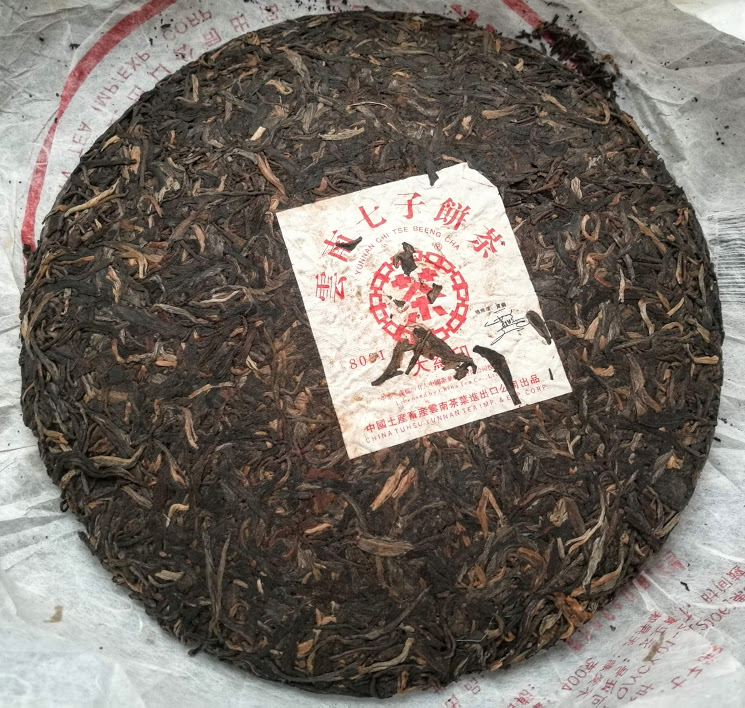
2007 CNNP 8281 (reviewed here):  it's odd that we tried this tea.  In reviewing what else I had on hand, with him and my neighbor, he said that he was interested in this one, especially after smelling the cake.  It's so basic though; it seems odd that someone into the opposite extreme for quality and novelty would find it interesting.  But I kind of get it; it must relate to appreciation for the entire range (of aged sheng), and maybe in part the novelty of a Bangkok storage input.  And maybe for a point of comparison; it can be interesting for a tea enthusiast to try Lipton once every half dozen years, to experience that other range.


comparison with another CNNP version, the 2007 8891


This tea becomes more approachable and pleasant after a few rounds, but to me it's a really basic version even in comparison with the other basics (but then young SE Asian teas are pretty standard for me now; I had three others from Thailand and Vietnam that we didn't get to).  This tea could really use another half dozen years to finish that transition process, and the part about it improving after 3 or 4 rounds relates to it including a rough edge earlier on.  It's not harsh, and definitely not bitter or astringent, but the warm tones are also rough, something remotely along the lines of cardboard, just not exactly that.

My neighbor, who isn't into such teas, might have interpreted some of the novelty as pleasant, but it seemed it mostly came across as unusual.  My new tea friend seemed open to experiencing it, even though the character couldn't cross past favorable in some ways.  I do like that tea; it's clean and balanced enough, for moving through so much transition in 19 years, in hot and humid Bangkok storage.  It works as a breakfast tea, which is my normal context for experiencing most tea.


Take-aways


It was interesting comparing perspective related to a few teas I've been enjoying.  That neighbor, not so into tea, didn't have much for detailed impression to pass on, but it's nice sharing the experience.  I thought that was going to be the event theme, letting other people new to tea try some different things, but it was pleasant even though it mostly wasn't.

A half dozen people tentatively confirming and then not making it is harder to place.  Two explained why they didn't prior to the event, and three either missed it related to just running late or missing something in a chat message.  It's all good.  

Setting this kind of thing up through Facebook worked out better, when I was more active on that.  A more persistent group discussion thread could cover details, linked to an event notice, which is like a limited calendar function.  Facebook direct messaging works a little better.  I started a group related to holding events in Bangkok, here, and although the algorithm now shows almost no one the posts from there at one point it was more functional.  Facebook feeds are mostly promoted content now, or ads; it's why I'm far less active there.

I've ran across input and compared notes with people more conventionally into tea than I am before.  It's hard to know how to express that, since it's a take, and a developed approach, that only applies to a subset of people who are into tea.  I'm not even talking about aesthetics (related to surroundings, wearing a robe, tea pets, or whatever else), ceremonial brewing approach, leaning into using the complete or expanded set of gear, and all the rest, I mean just related to appreciating tea.  There are levels to it.  

I've never portrayed myself as "getting it right," or even taking on the deeper level of just noticing the finer tea aspects, and my own reactions to the teas.  I've explored a lot, and shared a lot about how that went.  During tastings I can spend a couple of hours with a couple of teas, so I do vary the degree of focus, depending on the context.

It was interesting hearing a bit about how following a related but different path goes.  Most people couldn't communicate that clearly, but he could.  Within the noisy environment of a half dozen people meeting for the first time that wouldn't have come across, so the limited attendance was actually ideal, in a sense.  I've recently read one of those traditional quotes from an ancient Chinese tea master to this effect, about how 3 or 4 people sharing tea is ideal, and with 6 or 7 it's complete chaos.  He put it better than I could, even with translation loss of clarity factored in.  

I suppose it all depends on the desired outcome, and how closely people are aligned going in.  And the event theme; someone presenting teas and ideas about the experience would still work well in a group, even for a dozen people, but I've always favored letting the social dynamic in a group gathering share a lot of the focus.  

That's all the easier with two people, even though that might seem counter-intuitive, that the social function actually works better the smaller the group.  Quieter people tend to say very little in a larger group, even with 5 or 6 people, so you end up needing to adjust discussion themes or flow a little to get everyone to engage, and share their own experience.


Sunday, March 8, 2026

Trying high quality Dan Cong in a Bangkok Chinatown tea shop


I visited my favorite tea shop to pick up some tea before I travel back to Hawaii, that CNNP cake I reviewed not long ago (a 2007 8281 Mengku origin sheng pu'er), and to get a bit of tea to give to monks I know on the way out of town.

While there the owner let me try some exceptional Mi Lan Xiang Dan Cong (Chaozhou, Guangdong origin oolong, of course).  It was presented as from a single tea plant, which is possible, but you kind of never really know.  The quality was really high; it was at least one of the best Dan Cong versions I've ever tried, and maybe the best.  There wasn't that much room for improvement, only style difference.  

The pricing was eye-watering:  500 baht or $15 for 7 grams, so it's pretty much $2 / gram tea.  Too much, for an ordinary experience.  But I suppose people might see it as a unique experience they wouldn't get around to repeating, that "once in a lifetime" kind of theme.  I don't even consider such things; my tastes and appreciation are fine with drinking ordinary teas.  And I'm adapted to Bangkok pricing ranges, where you can eat a meal for a lot less than $15, or eat and also travel around all day.


To start we discussed processing, relative degree of oxidation and roast.  Kittichai, the owner, said that it wasn't in the modern very lightly oxidized and roasted form, that it was more in a medium range (for both), so a step towards a more traditional, older form.  Really whatever works best for that tea material is best, along with personal preference determining that.  It worked out.  


The scent of the tea was incredibly sweet and floral, or maybe floral and fruity, but very fragrant either way.  It didn't really come to life until he put it in a warmed gaiwan, then it did, even dry.  He was using 4 grams in an 70 ml or so gaiwan (not that I can assess volume like that).  Probably the infusions were even smaller, with the top that you don't fill and the tea taking up space.

It was bright, fresh, fragrant, and intense right away.  The taste was as fruity as floral, even though that type (Mi Lan Xiang) is described as honey orchid, and it's usually more floral than fruity.  It tasted like fresh lychee, the other owner claimed, and that was a good match, even if the power of suggestion may have helped cinch that judgement.

From there it intensified over a few rounds, really turning it up around the 4th infusion.  Sweetness was off the scale, astringency fairly moderate, although there was some, and flavor intensity was crazy.  It was really clean, with great aftertaste expression, and positive mouthfeel.  Good enough to justify the  $2 / gram value?  Who knows.  It was roughly as good as Dan Cong probably gets, although I suppose someone who has been exploring the high end of that range for awhile could judge better.

It didn't transition that much until around 9 rounds in, and then a little astringency started to pick up, which one might interpret as tasting like bitterness, even though the two things aren't the same at all.  It wasn't really pronounced until about the 10th infusion, and we let off around then, or maybe at 11 or 12.

Flavor complexity was so intense that you were just being blasted by floral and fruit range, so it might've been hard to do the normal round by round description of shifts.  If the relative balance of all that was there kept changing I didn't keep track.  It was definitely clean, sweet, intense, balanced, and complex.

I didn't mention the color; it started out with a pinkish sort of color, then I think it transitioned to a more typical light golden amber oolong range.  I'm not sure what that's about, the extra touch of pink, or if it signifies anything.

Packaging was definitely a bit much; it came in tiny aluminum canisters, like weed might be sold in, if there is such a thing as elaborately high end versions of that.  Then that was in a custom case.  This isn't so unusual for Chinese teas, presented as exceptional; they can go a little overboard.  I suppose status would be part of the appeal, drinking what is expensive, refined, and rare, and the packaging helps support that.  


Things are just different in China too.  One might expect lots of things to be rougher edged or more basic, somehow, but there's a broad higher end range of lots of types of experience or aesthetic context that's more the opposite.  Not that I've ever really been living the high life in China; I've visited that country three times, but as a value-oriented tourist (twice), and on a work trip once.  That almost leads into telling a story or two, doesn't it?  I probably shouldn't, but let's.


I went to China on business a long time ago now, maybe just over 15 years, so what I relate might be dated.  I'll skip the parts about the work context; it was somewhat IT related, since that's the field I work in, and from there it doesn't matter.  I was introduced to better tea in a Gong Fu ceremonial brewing demonstration at the company we visited (probably the one company you might think of).  

They were pretty good about not making it seem like tall, beautiful women were the norm in that country, even though they were that as hosts, and extending that not to make lots of claims about the tea brewing, hyping ancient traditional forms as being something they're generally not.  People might make wishes when they pour tea over tea pets; a fairly basic idea like that comes up.  Maybe that frog relates to money (it is holding a coin), and another to success with family, so it would be a good place / context for asking for a next child.  


Chinese people love to make wishes, as Thais do.  My wife loves to visit Hong Kong temples and go through all of that, or there are lots of Chinese temples in Thailand too.  We just happened to be walking into a local Chinese temple in Korat, Thailand, when we had just picked up Myra, our cat (then a kitten), back in 2021, so I took her in there and asked the multitude of Chinese gods to keep an eye on her.  So far so good.


some people might recognize this old Shenzhen mall space


Hong Kong; a temple, of course


Apparently drinking alcohol plays a role in business connections.  That's probably the last time I've been good and drunk.  The next time we met with another Chinese company I kept it bit more reeled in; it matches an expectation to go there, but it's really a bit much for me, as a non-drinker (now even more so, but mostly that back then too).


Enough stories.  Later I bought some tea in a shop, waiting for others to buy other things, and that started my next level of tea exploration.  But it was all normal enough.


Back to this tea, it was amazing.  Others would probably appreciate it a lot more than I did.  Earlier on in my exploration of teas I was really into broadening my horizons, and trying out exceptional range, and now I'm fine with just drinking good tea, and by that I mean anything with character and aspects one can appreciate.  That's most teas; they just offer different experiences.  Maybe the low end grocery store versions aren't like that, and other ranges that are comparable, but so, so much of tea range is interesting and pleasant, or at least just pleasant.

But it was nice having a unique experience.  I ran through a tasting set of pretty decent Dan Cong from ITea World a year or so ago (more now?), and it was nice trying the other types.  Mi Lan Xiang and Ya Shi / duck shit get most of the attention in "the West."  And they're often quite pleasant, so I suppose that they should, but others are also interesting.  I tried a number of them from Cindy, of Wuyi Origin, and that's a good source for exploring pretty far up the quality scale, at pricing that's quite fair for what they sell, even approaching $1 / gram.


Cindy!


Being more into sheng pu'er I don't even buy that much oolong now, of any kind.  Eventually I'll probably cycle back through a long exploration and experience phase again, but who knows how long that will take.  Good black tea is more my fallback, most often Dian Hong.  By good I don't mean searching out the high end, best of the best, I mean basic and pleasant.  And if good comparable forms are from Thailand and Vietnam I'll drink that instead, so I suppose calling that Dian Hong style tea is more accurate (DH adjacent?).

This shop sells pretty decent, upper medium quality tin packaged Dan Cong, at a much lower price point range.  That's more what I'd drink, but I only buy it there to give away to monks, to save my tea budget for the next sheng cake, or maybe black tea.


that tea I just bought, and already reviewed earlier, 2007, so perfect for getting to now


Saturday, February 21, 2026

2007 8281 Yellow Label Mengku sheng pu'er, compared with 8891


it's like visiting an aunt and uncle there, even though I'm not that much younger


I'm reviewing a tea sample the owners of my favorite Bangkok Chinatown tea shop, Jip Eu, gave to me when I last visited them.  It's a little unconventional that we tried that tea there during that visit, so I'm writing about it again, based on a much closer form of review.  It was nice of them, to give me more to also try later, and perhaps wise of them to get that impression documented in a tea blog, just by handing over a sample.

It's a little odd, but my impression of it changed.  I was fasting that day (the first day of 5), and talking quite a bit instead of focusing in, so two things changed.  Three, really; I also brew tea for myself differently, because I based infusion timing each round on how I liked the last round.  My water source is probably also different (filtered local tap water, but the filtration must vary).

I don't have a listing or site description to provide, under the circumstances.  Jip Eu is on Facebook here, and they're on Shopee, for people online shopping within Thailand (maybe easier to find as "Three Shell Tea").  I looked up online listings, and two different vendors sell this for two completely different price points (the 2007 version, probably the same tea, although I guess this could be sold in different batch numbers, so maybe not identical).  Here is one of them, listed by Crafted Leaf Tea:


2007 Yellow label Raw Puerh - Iron Cake


Tea Bush : Grade 1 Mengku large-leaf tea bush species

Made from supreme old tree Mengku material, this is a high quality raw puerh from a village in the Brown Mount. region. After 13 years of aging this cake has enter its mature stage, most of the strong bitterness & fresh fruitiness of raw puerh has turn into a mature taste crafted by time.  Comparing with our 2003 Premium Yiwu Private Collection Raw Puerh - Chimney. It features less smokiness but with a very well balance of sweetness of ripe puerh and pinewood & mineral bitterness, followed by a lingering light caramel aftertaste. The aroma lingers wonderfully in the throat. After about seven or eight steeps, the taste becomes more tender and mild, and starts to show a light, mellow fruity fragrance.


So they're saying that it's a Mengku, Lincang region tea.  Google's AI input and another listing agree this was made by the Kunming Tea Factory for CNNP release (Zhong Cha).

This second "Dragon Tea House" listing sells this cake for $40, while the other vendor, Crafted Leaf Tea, sells 50 grams for $22.  What should we make of that?  I'll spare you the idle speculation, beyond this summary.  Maybe one isn't "real," maybe one is overpriced, maybe there are other factors.  $40 for a 19 year old standard producer tea does seem low.  This was selling for closer to that than whatever $22 for 50 grams works out to (nearly 50 cents a gram?  come on.).

This other 19 year old CNNP cake is pressed as a 500 gram version, now listing for $104 through Yunnan Sourcing, where I bought it awhile back.  I first reviewed that in 2019 here, seven years ago, and don't seem to have any newer comparison use review to check in on.  People who have been following Yunnan Sourcing for a long time, and drink sheng pu'er, probably have already bought this cake; somehow it became the standard entry point item to try out way earlier on. 


Reviewing tea labels:  this could be a step too far, but in looking at the three labels of the three teas presented as generally the same they don't match.  The Dragon Leaf version has a different bottom producer identifier name, and the yellow mark in the center is slightly offset (although the Crafted Leaf page includes pictures of both types of differently marked labels; strange).  Make of it what you will; it's not intended as evidence of any indirect claim.  Per the owners of this shop they bought a good bit of this tea back in 2007 from a producer outlet when it came out, which on the face of it sounds reliable.  Who knows though.


the Jip Eu cake label


Crafted Leaf Tea version


Dragon Tea House version (note the "product of") section


Review:


8281 left (my cats just broke one of the plainer cups I use most often; not helpful)


8281 Kunming / CNNP 2007:  it's interesting that this is much darker initially, both the leaves and the infusion.  They're both 2007 versions, but the other spent half its time in Kunming, in relatively dry and cool storage, and this tea version came to Bangkok back when it was produced, bought by the shop owners back then.  It has been stored hot and humid.

Flavors are heavy, of course.  It's relatively clean though.  Beyond the heavy mineral base a pine note stands out, and some medicinal herb tone.  Feel has a nice thickness already, and it has only been one short infusion, after a short rinse.  There may be brighter and sweeter spice that will evolve, or maybe even a touch of dried fruit, but I think this will be easier to read next round.


8891:  it is lighter in flavor range, but this has transitioned pretty far along already.  It's not how I remember it.  There could be a faint hint of smoke-like flavor, but beyond the slightly lighter mineral it tastes something like aged bamboo might.  It's not exactly woody, but pretty close to that.  Sweetness is decent; it gives it balance.  There's just a hint of sourness at the finish, which doesn't ruin the effect for me, but I suppose it's not mostly positive.  Going back and tasting the other after this, the same first round, a bit more root spice stands out in that in contrast, towards root beer, or sassafras.  

I'm not sure why but I'm feeling these teas after the first round.  I took a week of drinking a lot less during a 5 day fast, and never really increased back to my earlier level in the week after, so my caffeine tolerance may be low.


the leaf and liquid color difference is noticeable


8281 #2:  these brewed for about 15 seconds, or maybe slightly over, which is a fairly long infusion for a high proportion and strong teas like these.

It's interesting how heavy and strong this flavor profile is, with it being clean at the same time.  This might turn into pretty good tea with another half a dozen years to finish the full fermentation transition process, which is really far along now, maybe equivalent to over 30 years in cooler and drier storage.

Heavy flavors could either be seen as a selling point or a negative, depending on preference.  Quite heavy mineral tone stands out.  It's strong enough that you need to "taste past it" to identify the rest.  One part of the remaining flavor is like a cured tree bark tone (so woody in a completely different sense than the other tea).  Spice range is still present; it links with that, or overlaps, some range of root spice.  Less of the more forward, bright, dry pine note is present, but it's still there, just in a different balance.  Other complexity probably still does relate to medicinal herb range, ginseng and such, but it's all hard to place, integrating with or being overshadowed by the rest.


8891:  complexity is good in this; there's a good bit going on (which is all relative, of course).  And the tone is lighter, which works well.  That hint of sourness at the end is a little more pervasive now.  I don't necessarily see it as a flaw, but if it was swapped out for something else the tea could be much more exceptional.  It seems to connect with a dryness that you feel in the center of your tongue as you drink it, and more just after you swallow.  

I remember this as a heavier and rougher edged tea.  It has mellowed.  The heaviness of flavor tones fading could easily relate to my judgment changing, or my general perspective.  Tasting any tea in combination with another also shifts things; that becomes a fixed baseline, adding a bias for what is a heavy level of any one input, or placing different aspects differently in comparison.

At this point I like the 8281 better, but this early sourness and dryness may be something that evolves out of this version over a few infusions, so it seems too early for that kind of judgment.  I should mention here that some claim that dry storage is "bad" for a tea, not for just slowing down transition pace, but also for imparting a slight sour note to teas.  I never really knew if that holds up, oddly, even though I've tried a good bit of dry stored pu'er.  Storage that is too wet (humid) is said to impart either a mustiness or overly heavy tones to a tea, or maybe both.  Then people talking about relative optimums tends to make for a complicated subject.


8281 #3:  brewing this faster, at 10 seconds, and being a couple of infusions in really lets this tea shine.  The flavor aspects I've been talking about (pine, heavy mineral tones, limited root spice, other medicinal spice) haven't changed, but the balance does shift completely.  Feel is still good, and pleasant aftertaste carries over.  Sweetness level is nice.  It works.  Brewed a bit stronger it probably wouldn't; this tea is pretty intense.


8891:  this also balances the best it has yet.  The bamboo woodiness seems to evolve to more of a sandalwood spice.  That one light sour range aspect is fading, or maybe a lighter infusion makes it seem to drop, but it's still present.  Feel is better.  

It's interesting tasting these and "looking for" the standard descriptors people often apply.  Do they taste nothing like betel nut (which could only be a guess on my part, not having tried that), or camphor?  Maybe the first (8281) does taste like betel nut, and the second like camphor.  Probably that second attribution is more grounded; there is an edge to this tea that kind of matches that.  The first seems to emphasize that light spice range all the more in comparison.


8281 #4:  I'm getting rocked by these teas.  Colors and color definition seems more vivid; it's affecting my vision.  Why didn't I put less tea in these gaiwans?  It's like a mental block, as if I can't.

This tea is really catchy, the way that a root spice stands out, with so much more going on beyond that.  Sweetness picks up, so the rootbeer like tone leans a little towards a dried fruit note input, but it's still really a sweeter range of spice input.

If flavors were a little heavier it would be too much, but for me that part is fine.  It's really clean, supported by great sweetness, rich feel, good balance, and pleasant aftertaste.  Maybe it would've been even better if it had been stored in a slightly cooler and drier place, and aged for 30 years instead of 19.  A decade of extra wait is a significant trade-off; you can't just move yourself through time to experience that.


8891:  that early sourness is losing its place in this tea, for the best.  It lacks some of smoothness and root spice complexity of the other, but a different form of lighter sandalwood sort of range spice is nice in this.  A light camphor edge has seemed to replace the sourness, definitely an improvement.  It might be even better after 4 more rounds, but it would be pushing it to drink just one more.  Let's go there; let's push it.


8281, #5:  I'm giving these more like 20 seconds to see them from a different perspective.  Heavier tones pick back up again; it's interesting how infusion strength varies perceived character like that.  And it's also handy, to be able to shift what you experience so easily.  It was better a little lighter.  That heavy mineral starts to come across almost like a charred tone, where is was part of a less prominent background context, less strong than the root spice, last round.

It's still not bad, not flawed, or too far out of balance, but it's better brewed lighter.


8891:  this version balances just fine brewed a little stronger.  The sourness didn't return; that did evolve out over early infusions, as I guessed might happen.  It might be slightly better than last round for being a little stronger.  It balances well.  One might expect the camphor effect to pick up, brewed stronger, but it's kind of the same, the flavors are just a little more intense, and the feel.  The other is smoother and richer, with this retaining a little dryness, just not in the same form as over the first few rounds, not as pronounced.  

If you drink the other right after this, while the aftertaste is still present, the contrast in it tasting so much more like spice really stands out.  Tried the other way that dryness stands out most in this, tasted right after the other.  It's not all that challenging or negative when you just drink this 8891, but in comparison it's more negative.  


Conclusions:


I tried a couple more rounds later and there wasn't more story to tell based on that.  Of course they didn't fade out and die within the first seven infusions.

I suppose that I like the 8281 more.  Could it be because it's more fermented, further along in aging transition?  Hard to say; that's not impossible.  The 8891 is lighter, smoother, and more balanced than I remember.  I may not have tried this for years.

Both are pretty decent.  I don't think these are what the Teas We Like curator vendor are probably looking for as the absolute best examples of aged sheng potential, but they're decent, and solid.  It doesn't help that I very rarely drink 20 year old range tea at this point; I mostly drink young sheng, within 3 or 4 years of being produced.  It's completely different in character.  It's interesting completing a 1500 word tea review without mentioning bitterness, for example.

What was missing, if these were reasonably well balanced, with pleasant flavor range, and not really expressing clear flaws, but I'm judging them to be good but not great?  Complexity was decent, and balance ok, but they both could've had a little more to offer.  That root spice range in the 8281 could've been more pronounced and spanned more interesting scope.  The 8891 had issues with dryness and light sourness early on, and then later evolved to be more pleasant, but it still mostly covered spice that wasn't so far removed from wood.  I think both will probably be better as 25 year old teas, that having plenty of intensity at this age is a good sign, so both have room to change positively, if only a little.  This 8891 might be fully age-transitioned at 30 years old, as this is going.

I hadn't planned to buy a cake of this but now I might.  As I mentioned I tried it once before, visiting that Chinatown shop, during a fast, on the first of 5 days off eating.  I didn't like it as much as this time.  It helps slowing things down and spending time with a tea, and brewing according to your own preference.  It helps having eaten.  Your sense of taste changes a lot more after 3 or 4 days of fasting, and you can smell the neighbors cooking dinner really far away, but just skipping breakfast changes things, a little.

This tea--the 8281--might be even better with a few more years to complete a transition, or a half dozen.  The 8891 is also much better than it was something like a half dozen years ago when I tried it last (maybe 3 or 4?  I lose track).  These are definitely not fading to not include much flavor intensity.  

To me this range, standard CNNP character, is one of three good examples of favorable and distinctive factory tea production, along with Dayi and Xiaguan.  Maybe people would typically prefer one of those over the others?  I really do like best-case outcome Xiaguan versions.  Or even the barnyard character of well-transitioned more standard range.  Many of their teas come across as rough-edged and basic but that flavor range is interesting.


there is a second cat over on the other side of the fence


Sunday, September 3, 2023

An over the top tea meetup at the Sen Xing Fa Bangkok Chinatown shop


About another meetup, one that resulted in trying a lot of pretty good teas.  I wrote this event summary in the Facebook group I organized it through, the Bangkok Tea Tasting Club I founded there (just cutting out the thanks part):


We tried a crazy range and amount of tea, I think the most I've ever tried at one time.

It covered white tea, green (Longjing), several Wuyi Yancha and Dan Cong, a Taiwanese and a traditional Anxi Tie Guan Yin oolong (so a lot of the main oolong range), hei cha, sheng and shu pu'er. Wow! Odd no black tea; that's almost all that we missed.

I'll write more about details in a blog post. Chinatown shops tend to let you try teas but nothing like that; they took it on themselves to make it into a special tasting event. Then again Sen Xing Fa probably is the best shop for trying a range of teas I know of here in Bangkok, related to the kind of shop it is.


That's what happened, in short.  I'll break it down a little more by topic but will try to keep this short and readable.


Sen Xing Fa (the shop):  they're close to the main tourist area in Chinatown, on a main food street soi off Yaowarat, the main strip.  They sell a really broad range of teas; pretty much all across the Chinese tea range, onto Thai and Taiwanese oolong range.  This shop was the first place I bought decent loose tea in Bangkok (Longjing), on advice from Chinese vendor staff, or at least a second outlet shop of theirs was, in a market alley a few sois over.

It's interesting contrasting this shop and Jip Eu, the one I keep calling my favorite.  They carry a more limited range of teas, but some options really stand out in that range, unusual versions and great value.  Jip Eu's customer base is locals either buying inexpensive Wuyi Yancha / rock oolong, blended Shui Xian or else good Wuyi Yancha versions, and either tourists or local foreigners seem to be the main customer base for Sen Xing Fa.  Sen Xing Fa may be a better place to try teas because it's set up for that as a result; tourists explore range that's new to them more than locals buying similar teas over and over.  SXF carries a lot of Thai oolong as a result, and Jip Eu really focuses most on Chinese teas, with some exceptions.

As to value since that ties just as much to personal preference versus price as to objective quality level--interpreted in one way, at least--you have to sort through options to maximize that anywhere.


Mr. Tian, one of the family member owners


maybe from 2017, added to this 2018 post


who attended:  it was nice seeing two people I've met before, one a member of the early tasting sessions that FB group was founded to support, Noppadol.  He was sort of a co-host of those, and serving as a part-time tea vendor he shared or sold me some very nice tea, including a Thai Lamphang sheng tuocha, and this sheng sample from Myanmar.  A couple of the others I've talked to a good bit by message, so they all felt familiar.  

In a sense the other earlier tasting seemed less formal, more like meeting at an uncle's house to try some teas with friends, in part because of the smaller group size and less structured theme.  This felt like a tea tasting, even working from lighter to heavier teas, the standard approach.


what we tried:  what didn't we try?  I'll just mention unusual exceptions.  An early Longjing / Dragonwell wasn't atypical but for that being a good quality example of the one type of green tea I really like it was nice (they're probably still a good source for that in Bangkok).  Some of the Dan Cong was pretty good, and good range Dan Cong is a really nice experience.  "Good" is all relative; maybe quality level was still in a upper normal range but pleasantness stood out.  Flavor range was very positive, generally type-typical, sweetness pleasant, and astringency quite moderate, with only secondary factors like full feel, length of aftertaste, and refinement falling short of the highest end versions.

We tried pretty good sheng and shu pu'er, an older CNNP shu (99?), and a CNNP / Zhongcha 7542 version from 96, I think it was.  That's more typically a Dayi / Taetea version (recipe), but CNNP did make their own versions earlier on.  Another participant mentioned that the separation between Zhongcha and Dayi may have been different in form in the mid-90s, which is tea history that I'm not clear on.  Storage input for that aged sheng pu'er seemed too clearly positive for the tea to have spent most of the time in Bangkok, since heat and humidity is great for pushing aging transition / fermentation tempo but not for the most optimized outcome for conventional sheng style teas, and the shop staff confirmed that it had spent more time in China, in the Menghai area.

It was interesting trying a pretty good hei cha, light, complex, and spicy, kind of rushing through that for it being at the end, even though it could've been more of a centerpiece of a less crowded tasting agenda.  One oolong was unlike any version I've tried, described as processed to a finish that doesn't involve completely drying the leaves, pressed to small square tablets, and distributed and kept frozen.  After all that it was still not too far off higher end and typical Taiwanese oolong style, but a little different.  

I think a Rou Gui towards the end was better than I could fully appreciate for being so blasted by all that tea at that point.  Quality markers stood out quite positively in that, if I had it right, the few aspects that show how the tea would probably be evaluated in tea specialist circles (feel and aftertaste again, a match to the pronounced cinnamon input, getting the oxidation and roast inputs balanced just right).


our first host in that shop


So that's it; lots of nice teas experienced with good company.  It was great that the shop seemed to really respect that tasting event as something more than a few tea enthusiasts dropping by, which was kind of how I saw it.  If you signed up for that sort of tasting as a paid event--not that anyone would schedule trying that many teas at once, which didn't fit into the 3 hour original scheduled time--you could expect to pay $50 or more (1500+ baht).  

I'm familiar with the shop, and I've been there a number of times, but that still doesn't explain them taking it all that far.  It seemed they saw it as an opportunity to share some tea and make a special event of it, which was really nice of them.  The one staff I had met, a primary owner, showed up late and swapped in as the shop host, and us trying a few extra really interesting versions late in the session is probably another main thing that extended it.  If you visit there they will try teas with you too, and I suppose if you never leave and keep trying them the count could add up.  

A quick word about good form:  if you taste a tea or two and don't like them there's no obligation to buy the teas, but if you do try a number then it's appropriate to buy at least a little of something.  Or so I see it.


That reminds me of a tangent:  if your tea budget is a little loose I tried an aged brick of Oriental Beauty oolong there once that was really something; you might want to check into that.  That was 8 years old (9 now; that was last year), a half-kilo / 500 gram brick selling for $200.  It sounds like a lot given my budget but that's really inexpensive for aged OB of that quality level (although maybe the price went up too; the price of everything else everywhere did).  Maybe some of the other teas there are selling for rates that aren't as good a value related to market rates, but whenever rarity of a type of version come up there may not be a lot of clear comparisons to be drawn on.  They sell basic factory sheng for reasonable prices, or aged Xiaguan tuochas; that's a nice resource to have.  

It's not unusual for something like aged white tea in Chinatown shops to be whatever it happens to be, something unique related to variable starting point and a random aging input, which is exactly why sorting through options in Chinatown shops is all that much more special than conventional online sourcing.  Not as special when you experience misses along with the hits, but if you are trying what you buy first that helps.

On this visit I bought a couple of basic Taiwanese oolongs to give away to monks, and a standard benchmark version Dayi sheng pu'er cake (8582) to try and probably hold onto for awhile; that's more where my budget lands.  Not according to my wife, who is convinced that I have enough tea, but she's a little more open about teas for that particular gift purpose (monks can't shop for their own tea), and I had to spend a little in thanks after that extensive tasting.  It's a little odd trying a dozen or so really interesting and novel teas and then buying very basic factory sheng, but it's a gap in what I own.


the kids visiting there during covid era


Saturday, August 19, 2023

Tea meetup at a Bangkok Chinatown shop, Jip Eu


I've let the subject of tea tastings go for quite awhile, aside from holding one in Honolulu this year.  But a Bankgok Tea Tasting theme Facebook group I started has seen more members join this year than ever before, so it made sense to try to meet some of them.  I was going to my favorite Bangkok Chinatown shop to replace an aged sheng cake (Xiaguan) anyway, so I announced the visit as a meetup in that group.

Four others met with me for a pleasant tasting session there; their participation made the event work.  Writing about it is in part about communicating more to them about what we tried, what the teas were, and leads for buying similar teas.  Of course my main thanks go to Kittichai and his wife, the Jip Eu shop owners, for serving as the actual hosts; he was kind enough to share samples of several teas for us, and to keep pouring rounds for two hours.  For me it's always like visiting an aunt and uncle there, which makes buying good tea at great value all the more pleasant.


Conversation points


This is mainly about the teas, adding more about what they are, and reference links, but I wanted to also pass on the feel of discussion, even though I'll cite very little of it.  It's always interesting starting out with what people already like and experience of teas.  A good lead on visiting shops in Little India came up, but I've lost track of those details; maybe at the very back of Phahurat Market?  There's more on that area here.

Brief discussion of willow herb came up, aka Ivan Chay, a rare tisane type that can be oxidized.  I've tried some really nice versions of those, mostly from Moychay, and other novel and pleasant pressed mixed tisane bars.  It would be more odd that willow herb and tisane blends never caught on if decent tea wasn't also slow to gain acceptance.

From there lots of short tangents related to the teas we tried came up, so I'll skip on to that.


What we tried


2006 CNNP (/ Zhongcha) 8001 sheng pu'er:  later I was thinking about how the tasting theme went from heavy to light and back to heavy, kind of unusual.  I think maybe we had stopped by in the middle of two others trying this aged sheng pu'er, which is characteristic for one style (a bit heavy, earthy, slightly rough-edged for being this far through fermentation, definitely intense).  

Readers may think back to trying 17 year old sheng pu'er versions that seemed pretty fresh to them, still including bitterness, not fully transitioning from earlier slightly harsh range onto milder earthiness.  Storage input plays a big role, along with the initial starting point; Bangkok is as hot and humid as anywhere, pretty close to Malaysian storage.  It's not exactly like 20+ years in Hong Kong or Taiwan, but at least fermentation level is equivalent to that.  

I own part of a cake of this tea, reviewed here.  Note that I reviewed that 4 years ago, when it was 13 years old; those extra years of transition since have made a lot of difference.  Of the three more-aged versions--leaving out a Dayi purple label version in this discussion--I might like the CNNP the least, and see it as least refined, with heavy earth aspects that can come across as rough edges.  I've tried it in the last month or so, part of a normal routine of checking in, and it's good, but the other two I like better.  I have a spare cake of that Dayi sheng (reviewed here in 2020; it's better now too), but the Xiaguan runs a bit low.


silver needle style tea, from Fuding:  it came up that the range was a bit heavy, and Kittichai was nice to help switch theme back to the opposite extreme, brewing a pleasant silver needle version.  I didn't catch much for details; maybe this was partly aged, or maybe not.  My guess is that a slightly higher degree of initial oxidation than might be typical for the type added depth and heavier flavors, but both inputs (that and aging) could lead there, probably in slightly different forms.  It was really nice.  

It's hard to do a flavor-list review here by memory; plenty of mineral base stood out, it seemed quite floral, and there was at least one more aspect in there.  We weren't discussing teas in tea-tasting form, offering rounds of input about flavors and other experience, although more of that came up related to another version.


2022 Thai sheng (pu'er-like tea):  I brought some newish Thai sheng (not pu'er, to most, since that's a Yunnan-restricted designation), it seemed like a good time to try that, moving on to heavier but not exactly heavy range.  That shop specializes in Wuyi Yancha (Fujian rock oolong), and Kittichai has family roots in Wuyishan and Anxi, so trying Tie Guan Yin would also make sense.  We just didn't get to either.  To me Tie Guan Yin isn't the most interesting range, even though it can be pleasant, and it takes a lot of doing to get far with Wuyi Yancha, since you need prior exposure to place any given version, and to see how closely it matches your preference related to all the rest.  True of lots of tea types, I suppose, but with sheng my personal favorite we went ahead and tried a Thai version.

It was nice, fresh and sweet, intense, of course including plenty of bitterness.  There is a characteristic flavor range Thai sheng tends to cover, which I'd mostly describe as floral, but it seems possible that I'm missing one or two aspect descriptions that really pegs it.  I cover the source and reference a review in a later part about vendor background.  

It was fairly well received; people are often exposed mainly to young factory sheng versions instead, which can be a little more undrinkable.  Or to moderately aged versions, not onto optimum transition level yet, or to aged versions that don't express the full potential of the type range.  I suppose the CNNP version might've been guilty of that, but style and aspects relate to personal preference, and lots of aged sheng isn't "refined."


2006 Xiaguan 8653 sheng pu'er (full size cake):  this is what I was there to buy, and Kittichai offered us some to try.  I thought it was good.  It was better received by everyone joining.  To me it tasted a bit like aged leather, but another participant added that it covers a lot of the same scent range from smelling cigars in cedar storage, both the aromatic wood smell and the tobacco, which smells nothing like a burning cigar while in storage.  That really is it.  

I had tried the tea last about 3 days ago (after initially reviewing it last year), and it's much more refined than it had been just 6 months ago.  It has turned a corner in the aging cycle.  I bet in about 2 more years it will be really special, so that I should probably be buying a few of these, but my budget is fairly locked down these days, with the moving back and forth between Bangkok and Honolulu.


after a year more than half is gone; I'm drinking more than just to check on it


Vendor references


I wanted to add a few vendor references before this ran too long, related to what we tried.  Of course Jip Eu themselves are a great reference; all but one of those teas is from there.


Qing Fu Cha:  the owner of this online business, selling Thai sheng and Taiwanese oolong, joined with us.  I've tried some of their Thai sheng before (reviewed here) and it was quite nice, although I'll also mention other fantastic options for other versions.  Their FB page is here, and it's probably possible to find their teas in an online outlet shop, which Google search would identify if so.


Aphiwat:  a small local tea producer, selling Thai sheng, the source for that tea I brought (reviewed here last year, compared to one from Vietnam and to a version from Moychay).  I just ordered some from him today, which I suppose is tea blogger code for either that source's tea completely matched my preference or quality and value makes lots of sense, especially when I'm also listing other good source options here.  

An earlier review of a pressed cake version tells that story.  If I could live on only one tea version right now it would his, or Wawee Tea's.  I drank a 150 gram small cake in that first two-month stay in Honolulu, when my kids first started school there, and repeated that with another Thai tea I mention next on the next stay.


Wawee Tea:  a well-respected Thai sheng producer, who I wrote about here.  I've liked different things I tried from them, but one particular new version last year I couldn't stop myself from all but finishing in short order, almost a whole cake's worth in under two months.  

Mind you new sheng or the Thai sheng profile range isn't for everyone; Kittichai, the owner of Jip Eu, kind of gets it but doesn't love it like I do.  I don't think most versions are suitable for aging, and they would be fine, and a little different, a year or two later, but it's as well to burn straight through them.  You absolutely have to be ok with bitterness mixed with sweetness, and I definitely wasn't for the first half dozen years of trying sheng versions over and over.  Then it clicked.  I don't think there's any need to rush that, to see it as some higher form of preference; if you like it then you like it, and it's fine if you don't.


two of the teas I'm describing, compared with one from Vietnam


Moychay's Thai forest-origin initiative:  I might as well add a third exceptional source, related to Thai sheng I absolutely loved last year, this one, with more background on the source here.  It's possible that it's not quite as close a match to my preference as the other two versions, but in a way that's not fair, given that it was their initial production of the type, past early trials (or I suppose this maocha version was, but they're from about the same time).  

I bet they're right there with the other two producers already.  Wawee Tea has been a producer for decades, I think, and there are reviews in this blog of Aphiwat's teas from 2019.  My guess is that material quality is covered in their case too, that terroir and plant-type issues are dialed in.  All three versions were so similar, in such a narrow related style range, that it would take someone with plenty of exposure to notice differences and have a preference.  


those three teas


One thing I want to repeat to make it crystal clear:  the style of all three matches my own main preference; I don't mean to imply that these are better than teas from elsewhere, especially Yunnan, or even from Myanmar, Laos, and Vietnam, for that matter.  

Of course versions from the most valued narrow origin areas in Yunnan are superior in a few different ways, beyond better aging potential.  But if your preference matches mine something will really click when you first try a really good example, and your whole tea preference will shift a little.  If it's a first encounter with a tea with bitterness as a main aspect that probably won't happen, which is fine.


That Xiaguan cake must have been relatively undrinkable 17 years ago, when first produced.  Some other sheng versions hit an atypical fermentation transition "sweet spot" in the middle instead, softening and gaining depth without needing that decade and a half to be approachable.  But these two polar opposites seem the norm, to me, that sheng is often best within 2 years of being produced, or even right away, or only after nearly 20 years of very appropriate storage conditions input, or longer.  It was nice that we could experience that much of that range in just three versions in this outing.


Sunday, September 22, 2019

2006 China Tea (CNNP) 8001 sheng pu'er


This tea version goes back to when that new friend visited from Germany, Ralph.  He bought this China Tea Company / CNNP / Zhongcha 2006 8001 sheng pu'er tea cake at my favorite Chinatown shop, Jip Eu.  Not only did he say that he liked it but another friend visiting from Germany backed that up (if I know you a little and like you then to me you're my friend, as I use the concept, a bit loosely).  The curiosity got to me, and I also bought a cake.  This is the third version of a similar cake I'll have bought, with more on that in the following.


with Ralph and Jaba at that shop, and Kittichai, the owner


The research on what it is could have went better.  A few online sources mentioned the same version, but then you can find online references to tea cakes that are clearly not what they're labeled as, like that LBZ version I bought from a Chinatown shop here, or most of what's sold on Ebay.  That wasn't even supposed to be LBZ, given the pricing, just a random tea that happened to be mislabeled as that.  Next it becomes a concern not just if a cake is what labeling says that it is, but if that's even a reference to anything that it might actually be.  I'm not going to dwell on all that, but the number system story helps cover what I mean.

8001 refers to specific information, if it follows the convention, which not all cake numbers do.  The first two digits reference the year the tea recipe was developed, serving as a type number, the last a producer number, and the third a grading of leaves, more or less wholeness, but perhaps used in different ways.  So this was--if that holds--a type developed in 1980, from the "1" producer, Zhongcha, CNNP, or China Tea (one of the names of which dropped out at some point, no longer applying, if I'm partly remembering right), with a leaf grade of 0, the highest possible level.  Per input from that other friend, Jens, the third digit is also used to evaluate leaf quality in some instances, not just form / wholeness.  The date is something else; this has 2006 stamped on the label.

Sounds reasonable, right?  So why would I be uncertain that's it?  That probably is what this tea is, what it looks to be.  I just didn't turn up any familiar references, vendors like Yunnan Sourcing selling it, online discussion, and so on.  Dodgy looking Chinese vendors selling seemingly identical cakes isn't conclusive.  All the same the proof of the pudding is in the eating; it's real enough if it's pleasant to drink.  And this would be aiming a bit low for a tea to fake, since it wouldn't have been costly at all back when it was made, and it's not as if this shop just purchased it, so it can't well have been a very recent recreated version. 

There is a second concern, about image of this blog if I review or support a tea being something when in fact it's not that.  I'm not losing any sleep over that; as far as I know I don't have all that much public image to be worried about.  All this part is just framing what I'm thinking about the background.  Obviously I'm still exploring aged sheng, kind of just starting, even though there have been at least a couple of dozen reviews in that general range here.  It takes awhile to start on this particular subject.


I'm reviewing it alongside a 2007 red mark version from Yunnan Sourcing (reviewed here); that will help serve as a baseline.  I remember that tea being a bit rough-edged, extra earthy, but pleasant if someone was ok with that theme. 

This tasting was rushed , conducted in just over half an hour, limited in time due to a swim lesson occurring at 10 AM.  I had woke up early enough to use a full hour for it, about as long as note taking for a half dozen rounds would take, but used a significant amount of that time making French toast.  One has to keep priorities in order.  It wasn't mostly for me but the French toast was quite pleasant; we had it with ham, spiced with cinnamon, nutmeg, clove, and cardamom, so a slightly non-standard version.


More sort of related background:


I'll cite a lot of that Yunnan Sourcing description of that first tea I tried with it here, not all that directly relevant to this different version, but it will describe half of what I'm tasting, the benchmark version:

8891 Red Mark is one of two 8891's released in 2007 by the China Tea Co (aka Zhong Cha/CNNP)... 

...Most importantly this tea is incredibly good tasting and has a very unique flavor profile. It's been stored in Guangdong since 2007 in a dry-wet storage condition (wet stored but on the dry side of the wet storage spectrum). The raw material is from Nan Jian area of Yunnan which is technically part of Dali prefecture. I suspect the given the name "Da Li Cang Shan Xue Yin Yuan Cha" (Dali Town, Cang Mountain, Snow Mark Round Cake) and the font used that this was pressed for the CNNP company by the Nan Jian Tu Lin tea company. The material is fairly tippy, large leaf and obviously pure assamica. Not only that, but the raw material used is not from young plantation bushes as it's quite burly and large in scale.

Compression is medium, not too tight at all and the leaves easily separate in layers from the cake. The tea brews up an orange-red tea soup with a pungent aroma of flowers, mushrooms and earth. The taste is clean with no musty wet storage notes, but does have some some earthy notes. There is a kind of pronounced spice and cloves taste and aroma with a strong viscous sweetness throughout...


It's great that Scott tells you so much about what you are buying, beyond the tea just being what it's supposed to be. 

I really rush the flavor break-down here so I don't get far with interpreting the spice notes, or pinning down earthiness level or type, and skip over doing much with describing feel.  I reviewed that tea initially here, in April, and used it as a benchmark against a similarly aged tea brick I bought in a market in Shenzhen (China) in June, but I won't go too far with cross-comparing the different impressions.  I mention at the end it's not exactly as I remember it, even though I've tried it again a few times between June and now.  The purpose here is for comparison, more than for determining if it's transitioning.

I briefly mention how this compares with another CNNP / Zhong Cha / China Tea company version I've tried again in the last couple of weeks or so, another 2006 version I bought in Chinatown at Sen Xing Fa last year, reviewed here.  That review doesn't say how much I bought that for; if I'm remembering right a bit under 2000 baht / $60, but then that tea is slightly flawed related to storage mustiness (or so it seems to me).  It cleans up in character after the first 4 rounds or so but it's not really as pleasant as this tea through the first 5 rounds, based on these initial tasting notes and my memory of it.


I mentioned the apparently identical listings of it that turned up online weren't promising related to offering background or clear descriptions, but didn't add that Ralph also reviewed the tea in his tea blog (the Daily Tealegraph).  He also lists three Chinese vendor references relating to this tea; anyone interested in checking on that can click through to those.

Review:


2007 8891 left, 2006 8001 right


8891 left, 8001 right (in all following pictures)


2007 8891, red mark:  first infusion is too light to do much with, but it should start to tell something about storage conditions.  This tastes really clean, light in flavor, a sign it wasn't stored overly wet, or even moderately wet-stored, I'd imagine.  To some extent I'm speculating here, in claiming that storage flavor would stand out immediately, pushing past experience into the range of guessing a little.  Flavor that does come across is pleasant, towards tobacco (not matching everyone's preference, surely, but pleasant as aged sheng tasting like tobacco goes).  Within a round or two that will probably shift some.


2006 8001:  completely different; pronounced mushroom and mustiness comes across immediately.  That's not a terrible sign; per past experience that might well clean up a lot over the first two rounds.  Other flavor is along the lines of old barn smell, versus tobacco in the other.  Of course it's not nearly as clean in effect as the other version but to me this is still very promising.  It has intensity and depth, and with some degree of transition it could be quite nice.

Second infusion:


2007 8891:  much improved, probably not completely ramped up yet but getting there.  Sweetness increased, in a toffee-like range.  Tobacco gives way to other flavor complexity, warm mineral base, rich dark wood tone, hinting a little towards aromatic root spice.  It's nice, just a little light still.


2006 8001:  cleaning up but not there yet.  Mustiness fades; it's no longer in the range of mushroom (as much, at least) but there's definitely an aged character to it, like stored items in an old garage or barn.  It's still promising, a bit clean for being that musty, with a lot of depth and complexity.  I expect it will be a good bit cleaner next round, and then more where it's going to be the one after.

Third infusion:


2007 8891:  this could've been brewed slightly longer than the 8 or so seconds I gave it.  Flavor level is appropriate and pleasant but it would be fine a little stronger.  Earthy range is evolving, but since time is tight I won't put effort into unpacking that.  It's clean enough, and pleasant.


2006 8001:  this version is around optimum for intensity level, brewing slightly faster, or else just more intense flavored tea.  It has cleaned up a lot; probably one more round to go for that process to complete, but the character balance is fine now.  If I had an extra half hour for this review (taking notes) it would be interesting to do a more detailed comparison of flavor, adding more about feel differences and aftertaste, but I'm running out of time, off to that swimming class.  Mustiness is still on an even level with the other flavors, even though I could enjoy it like this; we'll see if that keeps tipping next round.  I'll give these over 10 seconds to try them a little stronger.


Fourth infusion:


2007 8891:  more of the same, clean and pleasant, more into light toffee and root spice range now.  Earthiness is present but not necessarily woody or like tobacco, just adding some depth, along with warm mineral.  I think this might have improved since I've first tried it, cleaned up a bit. 


2006 8001:  much better; this did just tip over to tasting less musty and more into warm mineral, earth, and spice range.  It's similar to that other CNNP / China Tea / Zhong cha sheng cake I bought--at least that seems to be that--that needs 3 or 4 infusions to really settle off that initial musty range, but then brews another 10 or so positive infusions.  We'll see about that part, in the case of this version.  Complexity is quite good; that might include a bit of dried fruit, along the line of date, or maybe jujube, Chinese date.


Fifth infusion:


2007 8891:  nice, just a bit light as flavors go.  It's positive, what is there, and feel has a bit of thickness to it, but it's subdued.  Warm earth and mineral give it great complexity, it's more the front end that's a bit light.  It's not how I remember this; I thought it was earthier [and in going back to glance through a first review that description seems to say that].


2006 8001:  this tastes a bit like jujube, dried Chinese date.  It might keep evolving; that main flavor might be a phase it's going through.  Warm mineral is strong beyond that.


Conclusions:


It's more or less what I'd hoped it would be.  I often end up saying an aged sheng version will probably be great when it just has a few more years to finish aging, and this is ready now.  The first two infusions are slightly musty, and that's still evident in the third, but beyond that the taste is relatively clean, balanced, and quite complex. 

It's comparable to the other CNNP version in character, seemingly just relatively different, probably partly tied to storage background.  It seems more fermented, further along in aging, but at the same time a bit more intense than the 8891, just not as clean in aspect range.  But then that other version did seem to improve related to earthiness mellowing out, and maybe some mustiness could fade from this.

It's interesting comparing this to Ralph's impression, from his blog review (an excerpt):


Out comes a dark orange liquid, which reminds of leather, honey, sweet-sour exotic stone fruits, sugary notes, a warm and comfortable tobacco aroma (not to be confused with a colder smokey flavor which I personally dislike) and a typical aged sourbittersweet aroma.

The brewed leaves have a leathery brown color, you can really see the 13 year dry warehouse aging process as this is a very post fermented tea already.

The brew is strong and thick, the steeping times can be kept short for 7-10 seconds. The aroma is wonderful, the honey sweetness in this one is outstanding and it should be a perfect product for further aging...


It seemed fine to me, a lot like that.  Where I left off the notes it was closer to a dried Chinese date than stone fruit but that flavor range was transitioning a good bit per round.  The tobacco distinction he makes is nice; there is a dry, light, flintier range smoke aspect common in some sheng that I also don't care for (although some people do), and this did include a warmer, sweeter, closer to pipe tobacco earthiness instead of that.

I tried both teas another half dozen rounds after the swim class.  The 8891 was still positive but fading, and this 8001 version picked up more mushroom again, maybe somehow related to lengthening infusion times a little, which can shift character, emphasizing some aspects over others.  It was really positive except for that one flavor aspect (dried wild mushroom, to be more precise, close enough to shitake).  The sweetness, depth of flavors, supporting mineral balance and light earth tones, complex fruit range, thickness of feel--all that was fine.  I don't necessarily expect that mushroom is going to drop out over aging for any reason, but I suppose stranger things have happened.


I hadn't mentioned cost, did I?  It sold for 2000 baht, $60, for a 400 gram cake.  I just checked the Yunnan Sourcing 2007 8891 (which I bought about 6 months ago) and it lists for $67 for a 500 gram cake; not so different.  Character is quite different, probably related to aging conditions as much as to the teas not being the same thing.  The leaves in this 8001 version are much more whole than the 8891, although it seems odd that both would be at the far ends of that scale (the 0 and 9, the third digits), odd related to appearance in both cases.

It raised the question, which do I like better?  They're kind of just different.  Not in completely different ballparks for character, but not really similar.  For being more intense and complex this 8001 is better, even though I didn't love that one mushroom aspect.  For being more subtle, a bit cleaner, and not including any rougher earthy aspects in the first three rounds, or towards the end, the 8891 is better.  Feel was fine for both, maybe with the 8891 thinning more later on.  It would really require a slower, more complete tasting session through a dozen rounds to pin down more differences.  I think the other Zhong cha / CNNP cake I'd mentioned might have been more positive in later rounds than both, maybe with this 8001 only clearly the best of the three for 2 or 3 infusions in the middle.

It will be interesting to see what I make of it over more tastings.  And nice to have over a kilogram of similar teas to mess around with, drink over a long time, check on aging transitions, and give away samples of.  It's nice having aged sheng that works as a daily drinker, as something to have 10 quick infusions of with a breakfast, stacking (mixing) some rounds during brewing to speed that along, without worrying about fully appreciating the nuances of the tea.  Shu works for that too, for rushing brewing as an easy to drink tea, but it's nice having a range of types on hand, to pick whichever sounds best that morning.

with her best friend at the swimming class (from that set of kids)


adding some silliness to a warm-up  walk