Showing posts with label Sen Xing Fa. Show all posts

Saturday, August 15, 2026

Visiting a Bangkok Chinatown tea shop (K. Mui Kee Tea)


I've not been exploring Bangkok Chinatown tea shops much, for a long time.  One set of shop owners are so familiar and pleasant to visit with that I kept going to the same shop over and over, really appreciating seeing them, with lots of varying teas already on offer there.  That's to Jip Eu, my favorite local shop, located near the Hua Lampong railway station.

Their building is under repair, so they're closed, so I visited another local shop to buy tea for a gift within the last month (K. Mui Kee Tea, nearby there).  I wrote about trying a very pleasant Dan Cong from them here.


the owners of that other shop, Jip Eu


I just went back to buy more tea for gifts, and visited with the owner and two other guests there.  This is about that.  That shop owner had always seemed pleasant before, and it was a nice chance to visit more.


I don't want to say or imply too much here about the theme of that shop, or general value for what's there, or what else they carry.  But I can cover how trying those teas went, and that paints some of that picture.  You could assume that some of what I'm saying applies more broadly, that these represent their selection, or what I'm saying about value would hold true for others, but I'm not implying that.  

Inconsistency is one of the interesting parts of visiting Chinatown shops.  A version might be great, or value might be exceptional, then for the next tea it can all shift.  It's not that the shop owners can't judge teas well; my take is that working through very diverse forms of sourcing the outcomes naturally vary.  But who knows about likely causes.


Wild origin black tea:  this is what I already gave away for a gift, and what I was there to buy again.  I had only smelled the dry leaf before, but you can get some sense of teas that way.  We actually tried the tea there (not first; this isn't in order).  It is good.  

Maybe the flavor list is a little unique, not matching some standard type expectation, but the flavors were positive, and they balanced well, as the rest of the character did.  I suppose one might interpret something like limited intensity across some flavor range or light body feel as flaws, but to me it was a solid, pleasant, good quality tea.  I would expect that by shifting brewing approach you could adjust for whatever didn't seem as positive, to you.  

I can't really cite a clear flavor list, based on trying that tea yesterday, not focusing on that.  I think it included some dried fruit, and warm tones were what you would expect for black tea, maybe along the line of cacao.  I didn't notice citrus or roasted yam or sweet potato, but that's not to say that I wouldn't if I didn't try it again, and focus in more.

Cost was 500 baht ($15) for 100 grams.  That's pretty good for good quality, novel, distinctive tea like that.  It's not rock bottom pricing, as can occur in Chinatown shops, but you shouldn't be looking for that in a tea version of a type that's all but completely unique.  If the idea is to find a steal on a main type, like standard rolled Tie Guan Yin, that can work.  Really Thai teas should sell for less, and Chinatown shops tend to sell Chinese teas instead (of course).


a Longjing varietal tasting (covered here)


Longing:  this is a good test case for evaluating any Chinatown shop, isn't it?  If you don't already know why it's not important, but this is a pretty standard type.  It's more or less my favorite green tea.  Flavor tends to be nutty, or to resemble toasted rice, with some floral range, and not too much vegetal or grassy flavor (conventionally).  A range of flavor not too far off cashew can tend to pop, integrated with floral range in a unique way.  The effect can be a little like new car smell, but in a very positive sense.  I get it that comparison makes limited sense.

This version was pretty good, pretty far up the scale.  By that I also mean not at the top of the scale, but to me that's fine, if pricing matches.  It was selling for 1000 baht per 100 grams ($30), which to me seems fine for a pretty good version.  Often the best examples can be more like 50 cents a gram, or at least the normal best that you tend to find.

This is the kind of tea that would divide people with that developed preference.  Some would naturally really want to experience that most intense, most type-typical flavor set, and intensity.  But then they would already know buying that quality level for 30 cents a gram isn't how that tends to go.  To me pretty good versions bring across most of the same appeal.


two other Dan Cong versions, more oxidized and roasted (left) and lighter (right)


Mi Lan Xiang Dan Cong:  another good test case / standard type.  Theirs was pretty good.  I didn't catch a selling price, so I won't be able to evaluate if it's good for the price-implied quality level.  If it cost 500 to 600 baht per 100 ($15-18) grams it would be a good deal; if it cost 1000 you might be able to find as good a version for slightly less somewhere else.

That's the most standard type of Dan Cong, another oolong range type.  It's the name of a flower, honey orchid, so it's supposed to taste similar to other versions, and that flower, and I think this did.  It often also tastes a little like ripe peach.  I don't remember if this did or didn't, but I think I came in late in the steeping sequence, so maybe the most intense range had already passed.  Really high quality versions tend to express great character deep into a long round of steeps, but for normal priced versions (25 cents a gram or so, or less) the positive intensity fading over a limited number of rounds is fine.


that might've been between these in style, not so oxidized and roasted or as light


Dian Hong, a version with a lot of buds:  this is my own personal favorite black tea type, Yunnan black.  I tend to like fine leaf versions best, or even from good sized leaves, but buds heavy versions would be in higher demand, and considered more positive, to many.  It tasted like these should taste, and the feel / body seemed fine.  It was heavy on honey and some cacao flavor range, with good complexity and depth beyond that.  


it looked like this, a China Life Dian Hong reviewed in 2016 (the Mei Leaf predecessor)


If this had been a personal favorite style it would've really stood out among the other teas.  I do like it, but for whatever reason I like the leaf based variations more.  They might give up a bit in terms of forward flavor, traded out for more experience of depth, and the conventional flavor range shifts, not so much tied to honey and cacao but more into roasted sweet potato or yam.  For people who love Jin Jun Mei this wasn't so far from that taste range; they would also like it.

Since I'm guessing an appropriate value, even for not knowing cost, I could keep on with that.  This is pretty good quality tea, in a desirable, in-demand style, so a little higher cost range would seem normal.  But black teas tend to be priced lower than Dan Cong oolong, so pretty much everything I sad about the Mi Lan Xiang version also applies directly here.  This probably does cost a little more than the wild origin version ($15 / 500 baht per 100 grams), and that would be fair, related to buds heavy content being distinctive and adding appeal (demand).  To me 1000 baht ($30) per 100 grams would seem a little high, even though in online Western outlets that would still be about right.  Thai Chinatown shops tend to sell at a good value, although that's not always true, and you could still get a "bad deal" on teas in places.


Da Hong Pao (Wuyi Yancha):  a version we tried was fine.  Flavors and other character was in the right range, and it brewed multiple rounds consistently and positively.  We talked about in-house charcoal roasting, related to trying it.  There's a lot that brought to mind, and it was odd sharing how that theme is interesting, and represents distinctive vendor capability, and also serves as a red flag.  I'll add a short version of that here, and not say as much about this tea version.


Per my very limited understanding it's not unusual for Taiwanese oolong vendors to buy essentially unroasted, unfinished tea versions and then roast them to a desired level.  It requires a high degree of skill to do that well.  Producers roast teas under controlled and specific conditions, multiple times, matching the roast input to the existing tea potential.  It's not like just heating them up a standard amount for a standard time, and then they're good.

That's atypical though, again per my understanding.  Most Western vendors would just buy oolongs as finished teas, already roasted.  They would have been processed to match the other processing inputs, the original material character and oxidation level input.  So why else would a vendor need to add roast input?  For two main reasons, and maybe for others as well.

One is to periodically re-roast teas stored over a long time period to restore flavor balance, and compensate for some limited moisture input from storage.  This is a bit touchy, because in modern times, again per my understanding, vendors just seal the teas better to begin with, stored at an appropriate moisture content level, and an older concern about accumulated moisture contact drops out.

A last reason is to cover up flaws in teas.  Vendors might mix a few material inputs that more or less don't completely match with each other (although in the best case they would balance each other perfectly), and cover up inconsistencies in character by roasting it all quite a bit.  Bridging this category and the last, if a tea went completely dead from improper storage roasting might add flavor, even though it's not ideal to let a tea lose most of its original taste.

So one might look on claims that in-house roasting is a positive and important input with some suspicion.  Depending on how it's done, and why, it could be that.  That Da Hong Pao was pretty good, so that's a good sign.  Pretty good is all relative, and let's skip expanding on that for now, and the value part.  I'm also skipping that Da Hong Pao is usually a branding term for either mixed input teas or something random, maybe just Shui Xian, since the most original forms are usually sold as Qi Dan or Bei Dou instead (related plant types).


Another shou pu'er we tried a little of seemed ordinary, but fine.  I'll skip all the extrapolation here, about really placing quality, or guessing about price; we just tried one round of it.


K. Mui Kee Tea; they sell those tea stuffed dried tangerines, a cool thing to try


Other concerns; is this a typical Chinatown shop experience?


It's kind of not.  If shop owners want to try teas with you then they will, maybe even tasting all sorts of things, without really worrying about what you buy in the end.  More often they wouldn't.  A shop might be set up around that theme, as Sen Xing Fa is (a tourist oriented shop not too far away).  These older style, owner ran local shops tend to sell tea at a better value than tourist oriented shops with more staff.


a meetup at Sen Xing Fa; not so many shops would be open to hosting that kind of thing


Or shops might visit and make tea for locals they already know, the case of me visiting Kittichai at Jip Eu.  That's like visiting an uncle, to me.  I buy tea every time, just because it's fair to, and I'm usually there for that, but they'll often brew teas they don't even sell, just to share the experience.

I think this shop owner is unusually nice.  I always had that sense before, even though I may have never tried much brewed tea there.  His reputation is really positive in the local tea community.

So I seem to be saying that the owner is nice, tasting there is no problem, the teas are good, and they are also a good value.  That visit definitely implied all of that.  But I would expect some degree of inconsistency to come up, for some versions to be better than others, and for value to vary.  That's normal for Chinatown shops.  You hedge your bet in having that experience (of inconsistency) when the owner really gets tea, as he seems to, but Chinese tea is a really broad subject.  Even for vendors in the business for decades they tend to know some types better than others, and to have better developed sourcing for some range.

To me this isn't really a significant negative part of exploring teas through Chinatown shops.  Value might not be great all the time, or tea quality, but the normal range is pretty favorable, for better shops.  The worst experiences teach you, and the cost for that instruction tends to be relatively low.


Meeting those other guests was very pleasant.  They weren't so far along the tea exploration path, but they had significant prior exposure, and a fantastic attitude about it all.  They were really nice. 

Tea enthusiasts tend to end up in a strange place related to it seeming normal that people have already tried a half dozen version of dozens of types, and have memorized a couple of books worth of background.  Of course I don't judge people based on how they might do sitting down to write a book about tea off the top of their head.  

In a sense I envy people newer to the interest.  They have so much exploration range to get to, so many instances of trying something new and interesting for the first time.  If you start out trying basic quality tea versions you can gradually drink better and better tea, for years, without it even costing that much.  Just exploring broadly, or horizontally across types (if you like that spatial analogy), you can keep trying pretty good teas indefinitely.  Chinese teas do tend to be unusually diverse, and favorable, with a unique high end related to potential quality level, but it can work in relation to other origins as well.

I can make that more specific.  You could spend 15 to 30 cents a gram on a lot of pretty good teas, and drink different types and characters of versions for years, before it seemed in order to push on to higher quality level, to spend more, in order to really have a more complete experience.  Or you could start "at the top," either way would work.  I just don't think it would work well to explore a lot of the best quality teas out there, and then get around to trying much more basic versions after that.

All of these teas we tried are in the middle, and favorable in character related to that, well above average for quality level and pleasantness.  I could never drink teas better than them, for the rest of my life, and I'd be fine with that.  But people naturally approach all of that in different ways, and it's natural for a perspective on quality levels and what one values to change over time.


The Three Horse Chinatown shop.  I bought some tea there not long ago, but haven't tried any, there or of what I bought (again for a gift; I tend to give away a good bit of tea).  I'd have to recommend going to these other style shops instead, where you can meet an owner and try some tea with them.  Or in Sen Xing Fa it's more just different staff, but they're set up for tasting as part of a routine sales process.


Saturday, July 11, 2026

Chang Kham Thai wild origin Assamica black tea


I'm reviewing another tea from Chang Kham, sent by that business owner for review (many thanks).  He is the family member of the Sen Xing Fa Bangkok Chinatown shop that I have met a number of times over the years, who now runs a shop and outlet by that name up in Chiang Mai (located here).

I just noticed in editing this it was from 2025, so a year old now.  A tea like this probably improves slightly over the first half a year or so, as it settles, and is all the better now.  It probably won't change that much with aging over the next year or two, maybe just fading slightly, but not even all that much of that, if well stored.  

All that is guesswork; I don't mean to imply the level of confidence in that conclusion that it implies.  The main point is that there's not much concern that it wouldn't be as good related to being a year old.  Maybe it's not really better, but it wouldn't just lose intensity or freshness, like a green tea.


A description from their website:


That tea costs 1500 baht for 100 grams ($45), listed on their website.  Is that a good value?

Not really, by Thai local standards, but then there isn't that much tea of this quality level around.  It would be hard to place this against any other Thai version to use as a market price, so I'm really comparing against teas from China.  I can check on one though, since Tea Side is a Western facing outlet that carries exceptions related to what is produced:


2025 Old Trees Organic Black Tea N3, Loose Leaf  ($19 for 100 grams)


Loose black tea from 100-300-year-old trees, the highest quality material.

This is a classic black tea from trees. It is well-fermented and possesses an invigorating strong taste with many semitones and a rich aroma. The taste profile: tea rose, tulips, dried fruits, a little caramel.

Suitable for both, utilitarian consumption with sweets and for the thoughtful tea ceremony. 


The teas are probably fairly similar, but I might like the Tea Side version a little more, since their teas tend to match a Dian Hong style (from what I've tried in the past; it's a guess, related to this tea), and this was one flavor aspect removed from that standard profile (so still pretty close).  

So $45 is a bit much.  You always pay more for teas sold in brick and mortar shops, than in purely online outlets, as a rule, which is somewhat fair.  Their overhead is a lot higher, and they offer you the benefit of trying teas before you buy them (usually; that varies by store).  Also $19 is a pretty good price for what I expect that other Thai tea to be; 20-some would still be ok.

It seems strange blaming a vendor for value when they send a tea for review (many thanks for that!), but I don't intend this that way.  These kinds of really rare teas vendors would source at different pricing, and their marketing and final pricing is up to them.  

It's quite possible that you couldn't find a close equivalent to either of these teas anywhere else.  The supply chains aren't anything like standard farm production, so I'm not clear on what factors go into costs.  And it's possible that the Chang Kham tea is much better than the Tea Side version; only someone who has tried both would know.


Review:


first infusion:  this is good.  The style is distinctive, in a way that's familiar if you try enough versions of black tea; hopefully that comes across in description.  It tastes malty, but not quite as dry and mineral intensive as Assam versions (from that area in India).  It's not exactly like a malted milk ball or milkshake malt, but sort of right in between the two.

Beyond that another flavor included is cacao.  There's a bit of fruit as well, more or less along the line of dried dark cherry.  It's a nice mix.  Feel is rich, even though this is really just getting started.  It even expresses some aftertaste effect, while still starting out.  Through it all that one cacao note stands out, which is a pleasant aspect to bring the rest into a nice balance.

Because this tea lacks a lot of astringency you could brew it as intense as you want, and it would be fine.  The way these flavors are combining, with pleasant intensity, it would be as well to keep infusion strength on the light-medium side, because it will all probably come across well that way.


second infusion:  similar to the first round, but a little stronger.  There is a slight sour note to this, a bit like aged cardboard, that some people could find off-putting, and then for others it would just link to a separate mineral range that works well.  Early in my tea exploration I kept trying versions that went by the name / type Golden Monkey, and they were a bit like that.  Let's check what that might be, from Wikipedia:


Golden Monkey tea (Chinese: 金猴茶; pinyin: jīn hóu chá) is a black tea originating from the Fujian and Yunnan provinces in China. Only the bud and first leaf are picked, and the tea leaves are characterized by the pale gold threading. Golden Monkey tea is a black tea counterpart of Silver Needle white tea. The flavor profile of golden monkey tea is characterized by light, honeyed peach notes, and its lack of astringency. The name "Golden Monkey" can be used for many black teas.

...Despite the fact that tea has been grown in Yunnan for 1700 years, Golden Monkey is a relatively new tea, about 300 years old.[5] It has only been produced for export in the last 13–18 years.


This is a review of a local Thai version from 2014, almost dating back to that range.  I would describe teas differently now, but it sounds at least comparable.


That post describes a taste as resembling cantaloupe, and that might apply to this.  Or one part is definitely like sun-dried tomato, that sweet and savory flavor.  Cacao is still present, but not as the dominant flavor.  Warm mineral picks up, perhaps related to this being brewed a little stronger, or it just evolving across rounds.  All in all it's pretty good.  Again flavor preference in relation to that one flavor aspect is what would determine a take on this tea, if it seems off, or if that's regarded as pleasant, the one balsa wood sort of flavor.  I like it.


third infusion:  not really changing much.  It might pick up a little depth, and coat my mouth a little differently, feeling a little different.  

It's interesting to compare and contrast this with typical Dian Hong range, an overall personal favorite.  That malt note wouldn't be similar; Yunnan versions aren't generally like that.  I guess if they are a Golden Monkey type maybe it could be more common?  I wouldn't know.  Some cacao and range not completely unlike roasted yam is common.  I've not been describing this as like roasted yam, but it's similar, and that's one possible interpretation.  It probably works better for this third round than it had before, so it is probably changing a little.  The way the set of aspects comes across is similar though, even though it all may be shifting slightly.

The feel is nice, but it's hard to describe how or why.  It's rich, and a bit heavy, but quite smooth.  Maybe one might say that it's velvety.  As quality level goes this tea is fine; it's good.  It's more a matter of how it matches or misses related to personal preference for flavors.

I'll brew one more round a bit stronger, and this tea won't be finished, but that should be enough description.  Sometimes late rounds can be just as positive as earlier ones, or teas can thin in ways that aren't as positive, but to me that's usually not a main story of how the tea is.  It's interesting trying tea that is this approachable, in the mild and flavorful black tea range, but then I just did review a couple in relation to buying one from Viet Sun, and them sending a sample.  They weren't completely different than this.


fourth infusion:  that malt note is the strongest it has been, probably in part related to brewing this a little longer, and related to it evolving that way.  For people who have tried a few similar versions of Golden Monkey all of this should be ringing a bell.  As I remember those may not have matched this for some of the minor aspect range that shows a tea's quality, for flavor intensity and complexity, overall positive character, rich feel, and aftertaste trailing over, adding depth to the experience.  

That one balsa wood sort of note was at the center of those experiences too, if I remember right.  I wonder what that's from, if a processing form input causes that, or it's somehow related to using common tea material to start.


Conclusions:


When these kinds of black teas really work for you it's pleasant to drink a kilogram or two of them, to make it a part of a routine rotation.  I wouldn't mind having about 250 grams of this, but I wouldn't want to drink it every week for the next year.  That one malt and balsa wood note isn't something I'd want to repeat experiencing 100 times (although 30 or 40 might be ok).  

But then it's funny how all of that is completely subjective taste dependent.  I'm touchy about a black tea being tart, at all, but if a version has depth I don't mind if flavor intensity is on the low side.  Cacao, roasted sweet potato, and roasted yam are personal favorites for flavor inclusions (so this does cover quite a bit of that too), referring back to the earlier comment about liking the main Dian Hong style best.

It's a good tea version.  It's definitely worth trying this style, to see what you make of it.  I think almost anyone would like this tea, so I'm really focusing on how for some people it might be a personal favorite and for others it wouldn't.


On a completely different subject, Keoni and I checked out a really local shopping center in the Victory Monument area this past week to get a pizza (strange it related to that food choice).  I love those older places; it feels like we're out of town.


Sunday, June 28, 2026

Chang Kham 2025 Thai sheng


this 5th infusion shows color variation in the leaf best


I'm reviewing a sheng version from Thailand from Chang Kham tea (or Changkham; it can be either one).  As I understand it it's more or less a spin-off or secondary brand started by a family member from Sen Xing Fa, a popular Bangkok Chinatown tea shop, started as a physical shop in Chiang Mai.  They also source and sell tea under their own brand.

He sent a few teas for review, Mr. Tian did, that family member.  We aren't in close contact, but I post a lot about reviewing different Thai teas in different places.

Their store in Chiang Mai is located here, and this is the related Facebook page.  There is a limited detail product description in that page, for this tea, or a similar one from another year, but I'll reference it in the Conclusions section instead of here, since there isn't an aspects description to compare against.


This photo is from a tasting at Sen Xing Fa, posted about here, where they were great hosts for a number of tea enthusiasts visiting, sharing a lot of exceptional tea:


from maybe around a decade ago, again at Sen Xing Fa


I was in Sen Xing Fa a couple of weeks ago, to buy some Thai oolong


This post reviews tea I bought in Sen Xing Fa in 2018, not that it's all that relevant to this.  That was an unusual Zhong Cha looking version, what was a lot better than it first seemed, aging well into really nice depth.

At the end of this I'll place this tea experience in relation to trying some other Thai sheng this year, some of which was kind of ordinary, and some really exceptional.


Review:


First infusion:  I gave this a bit too long, in part to get it started, and because I looked at something else online, brewing it for around half a minute.  Proportion is lower than normal, so that I can get through a relatively full cycle without doing a dozen rounds.  Lower than normal for me is anything below 8 grams for 100 ml gaiwan; this might be about 6.

Flavor is great.  Honey sweetness stands out, and plenty of floral range.  Bitterness is pronounced, but then this is brewed a little strong.  I'll try a faster infusion next time and it should fall into a relatively ideal balance.  It could be more fruit that I'm noticing than floral range; it's a little hard doing a breakdown at higher than usual infusion strength.  Honey really stands out most.

Tones are warmer than one would expect, for a one year old sheng.  It has brightness and freshness, but it's also warm.  Mineral base gives it good complexity, and the feel is nice, full, and not harsh.  Aftertaste expression is positive, especially for a first round.


Second infusion:  this is still strong more or less flash brewed, which I take as a good sign.  Good intensity is very positive, unless the rest of the range is harsh, or off.  Honey sweetness still stands out.  It's probably both floral and fruit range in this; there is a lot going on.  I always have trouble identifying the floral aspects, but they're warmer in tone than you would expect.  Fruit flavor is along the line of dried longan, which is a personal favorite among dried tropical fruits.  You can think of it as being like dried mango, if that's not familiar, but it's warmer, sweeter (in a sense), and heavier.

The way it's full in your mouth is pleasant, the feel.  The intensity and complexity combine well with distinctive feel and pleasant aftertaste.  There isn't a hint of a flaw in this; everything that's there works well.   

It's less light, bright, and sharp than the Wawee Tea version I've tried recently, that I also love.  For someone looking for warmer tones in a young sheng, that's not challenging, but still complex, spanning some fruit range instead of just light floral tones, this is perfect.  It's probably pretty good for most people, regardless of preference.  I suppose the bitterness would be more challenging for people not into sheng than I'm considering; it did take me time to adjust to that.  I don't see this as bitter, at all, but that is a main part of what is there.


Third infusion:  bitterness might be evolving a little faster than the rest; this is moving from approachable, sweet and mild sheng range on to more conventional sheng character.  For sheng drinkers that's perfect, for others maybe not so much.  One part of the mildness and fullness, almost creaminess, of the feel reminds me of oolong, but it's definitely sheng.  Intensity is greater, complex flavors are different, feel is more substantial, and bitterness stands out.  

This feel hits all across your mouth.  It's almost as if you are tasting it with your whole mouth, as if it reacts with other parts than your tongue.  The feel includes that part about causing you to salivate a little.  Aftertaste includes a good bit of mineral, not really light or warm mineral, but maybe in the middle, or maybe complex.  This tastes like a more wild or natural origin, older plant tea, to me.  Aftertaste effect could be a little stronger, but what you experience is positive.  

One might consider if flavors are less distinct because this was blended from different material sources, or for other reasons.  At a guess it's just naturally like this.


Fourth infusion:  warmer flavor range picks up, in the mineral, and in the fruit and floral range.  I think flavors are combining, that it's not just 3 or 4 main notes, but that the fruit, floral, and mineral ranges cover a combined flavor aspect scope.  One part seems to involve a warmer version of citrus, like some sort of dried peel.  Honey fades, as heavier mineral tone picks up.  It may be moving towards an incense spice sort of flavor range.  


Fifth infusion:  the camera sees darkened leaf material, mixed in with the rest, more than you notice just looking at the leaves.  A higher than average roast input for some of the material is probably lending it complexity, or maybe it's extra oxidation input, or both.  

I see that as positive, although it's not really completely conventional, for Yunnan sheng.  It doesn't mean that it won't age well, although the transition patterns may be affected some by that.  If most of the material is normally processed, not more oxidized or roasted, it should still change in the normal ways, across a typical time-frame, but any alteration for some of the material would make some difference.  Versions that are notably more oxidized don't tend to age very well at all, beyond a few years.

It's clean and complex, and intensity is good.  I'm not having luck breaking flavors down more.


Sixth infusion:  not so different; I'll leave off taking notes here.  Intensity stays positive, but some of the interesting flavor range (honey and fruit) tends to evolve away earlier on, even though the rest stays positive.  It's still pleasant to drink, just not like it was.


Conclusion:


Thinking back on it this post could seem a little less positive than it would be if I hadn't been drinking such exceptional Thai and Vietnamese sheng lately.  Without meaning to I'm comparing this to some of the best SE Asian sheng versions I've ever tried, just because it worked out that way.  I describe it as very good, but it might just sound normal.

It held its own ok, but that might not have came across in those review notes.  I suppose I liked the Wawee Tea sheng I've recently reviewed a little more, but it was a great match for my own personal preference, and a really exceptional tea version.  Others could easily like this more.

To clarify that, the Wawee Tea version included more bitterness, more intensity, and some extra vegetal range, a sort of green wood edge.  I love that, if it all balances well, along with pronounced sweetness, fruit flavor, and floral range.  It does, in that version.  This tea might be a little fruitier, initially, and probably less challenging. 

It would sound like it's less durable, because I'm describing its character as leveling off in a sixth infusion, where I've been reviewing those other Thai and Vietnamese sheng into 7 or 8 rounds, and changes were still not a sign they were fading.  One part of that related to using a lower proportion, and to brewing the first round for about twice as long as made sense, for 30 seconds instead of 15.  It would more optimum to use shorter infusions for a tea like this, and it would run its course over 8 or 9 rounds, at a normal proportion (again for me at 8 grams).  It would then brew a few more pleasant rounds, maybe totaling a dozen or more.


It's tempting to move on to speculating about a fair market value range, but that doesn't work well.  This Facebook post, which may not be an identical tea version, lists small 200 gram cakes of black tea and "raw tea" for 2000 baht each, for about $60:


I wouldn't age this tea, beyond 2 or 3 years, but it might be good after 15 or 20 more years


That would make it $107 for a 357 gram cake size, which they don't seem to sell.  That's not bad.  It's high for local in-Thailand tea pricing, and normal for Western market range.  I paid less for the Wawee Tea versions, which I do like better, but the Tea Side Western-facing Thai tea online outlet tends to sell teas for more, which may be generally equivalent.

For a tourist visiting they are absolutely not going to find local Thai sheng this good anywhere else.  But then you can't just drop in on Wawee Tea (unless you are in that village, and made arrangements ahead of time), or visit Tea Side, which is an online shop.  So if it costs 30 cents a gram instead of some lower amount that's still a great value.


Friday, December 8, 2023

Bangkok tea shops and cafes; online Thai tea options


It's been awhile since I've written anything about this (6 1/2 years), and for whatever reasons discussing it has come up a half dozen times or so in the last month.  Lots of people visit lately.  Of course this list is centered on my own favorites, but I'll try to map out a range of other options.

Online options are included in the last section; people not able to shop locally in Bangkok might scan through the rest and focus more on that, or just skip ahead.

Edit:  I've added Maps links to these, along with the Facebook or website references they first included, so it should be easy to find out more about these options or to physically finding them.


My Favorites:


Jip Eu (Maps link): my favorite Chinatown shop, where the owners feel a bit like family.  On the positive side they carry lots of teas, lots of types even, and most are sold at great value.  On the negative side it's a hard place to shop, because there is no menu or listing of options, it's not easy to sort out what is in there, and quality and style varies a lot.  Their storage ages sheng pu'er fast--it's Bangkok, so hot and humid--but teas pick up a little extra mustiness, which tends to fade over 3 to 6 months.

They would taste some teas with guests but not over and over, not whatever is in the store; they're not set up as a tourist outlet, selling more to locals who already know what they like.  I never end up trying the same teas twice there.  Their specialization is Wuyi Yancha, rock oolongs from Fujian, but they also have Tie Guan Yin (from China, from Anxi), an odd mix of sheng versions, some aged, Dan Cong, a random selection of black teas, and a little of this and that beyond those.  There's not much Thai tea, but they would have some, maybe just no rolled oolong, the standard form, and no Thai sheng, what I like best.


I've met many kind people there; this is Sasha and Maddhurjya, and Kittichai on the right


Some teas there are good value but of very moderate quality.  A main offering is 50 to 100 baht boxes or paper wrapped squares of Chinese and Thai material blends ($2 to $3 per 70 to 100 grams; very inexpensive).  Sometimes a Shui Xian version (rock oolong again) can be medium quality instead, in those blends, so it can happen that a $3 selection would be equivalent to $10 or $20 worth in a US shop.  That's rare though; usually the quality is so-so for cheaper versions.  

Good higher end Wuyi Yancha tends to sell for 1000 baht / $30 for 100 grams, which is still a good value for being a completely different type of tea.  They don't carry a lot of sheng pu'er but some of the options they do have are good basics.  I keep buying Xiaguan tuochas there, and a fully fermentation-transitioned Tulin tuo is nice for trying basic aged tea range.


K. Mui Kee Tea (Maps link): probably not so different than Jip Eu, and just a block and a half away, another old Chinatown shop.  I've visited a few times but keep going to Jip Eu instead.  They sell different teas in dried tangerine peels (chen pi, the name of the peel sold alone, or sometimes used as a name for the stuffed dried peels).  Those are most often shu pu'er, but can be other types.  That might be good for novelty, for a gift for someone.  Wuyi Yancha or Dan Cong might be ok there but you'd have to try it to check on quality and value to know.


that shop owner is so nice, and I don't even really know him


Sen Xing Fa (Maps link; still on Chinatown shops):  a higher volume, more tourist oriented outlet, closer to the Yaowarat strip area, in a side street that sells a lot of street cafe food.  Selection of Thai and Taiwanese medium quality rolled oolongs is good, but value is just normal for those, with many selling for $15 to 20 per 100 to 200 grams or so.  Selection is broad but quality and value is all over the place; you need to try teas to see what's there.  

Where Jip Eu will try some teas with you, but would draw the line at tasting a lot of versions, or opening some of any kind, you can sit and drink lots of tea with them here.  You pay the price in value related to that though; some teas are good for the selling price, others not so much.  They carry more new / young sheng and shu than the other places already mentioned, and sell more teaware.  Per visiting with a new tea contact recently it's probably not the best place to be buying expensive clay pots, yixing and such.  Moderate quality teacups and the like would be the same as buying them anywhere else, but it's rare to see as broad a range of options as they have anywhere else in Bangkok.


VIP guests and a main owner


they hosted a nice meetup this year.  sheng cakes and teaware are on the other side of the shop


Ju Jen (Maps link) I've only been to this shop a few times but I'll  include it in favorites since my experiences have always been so positive.  It's way out there on Srinakarin road, out towards Bangna and the airport in the Paradise Park mall.  They seem to have a lot of variety, and I'm not sure if there is a specialization.  I bought some interesting mini cakes of pu'er last time I was there, 100 gram versions; that's a nice way to try something different, or it works for the gift theme.  

I'm not sure how many local Thai tea options they carry, but I did just review a pretty good Oriental Beauty / Dong Fang Mei Ren version from there, so at least some.  There seemed to be plenty of teaware around, but I have no idea where they stand on sorting versions or value for clay pots.


Zhennan cafe (Maps link): I've only visited here a couple of times, a cafe in Chinatown, but I suppose it fits here.  Tea selection is limited, and nothing so novel and amazing, related to it being so small, but it has a nice feel, which to me is what cafe experience is all about.  If the listed teas on a menu don't sound interesting they might carry others; it wouldn't hurt to ask.  

There may be lots of similar options all around Bangkok; I hear of other places like this but typically don't visit them.  To be honest I don't love spending any time in cafes; I'd rather buy loose tea and drink it at home.  But visiting that Chinatown can be rough; lots of ground to cover.  It's right beside a main alley market I'd highly recommend, which has a decent tea shop in it, and a few other places to buy very low grade tea and mass produced teaware.  That may sound off-putting to most tea enthusiasts but it can be nice to have an extra glass teapot or a number of extra small cups for gatherings, if you don't already.


an international tea expert and friend visiting Zhennan (John Lim)


the Zhennan cafe owner, and more of the interior


that Soi 6 market alley shop (note the alley has a different name from the North side)


what that market alley looks like


Classics:


Tea Dee (Maps link):  way out beside the Ju Jen shop in the Thanya Park mall there is a store that has long been a favorite among locals, which specializes in in-house sheng pu'er versions, and probably carries some factory versions too.  I've not been there in forever, since they moved from another nearby mall space, but given how they are viewed by others it seems to represent a standard option.  I've never been into the $1 / gram standard gushu sheng range, since that's not within my budget, but this might be the best place to buy that kind of thing in Bangkok.

This raises the question of how many other mall shops like here and Ju Jen are out there.  Very few others, I think.  There are tea shops, or booths selling limited range, but nothing I know of that specialty tea enthusiasts would seek out.  There had been a main one in the Paragon Mall, with a reputation for selling decent tea on the expensive side, but that's gone, and there's only a second branch somewhere else, as far as I know.  Royal Project shops exemplify what other mall-shop exceptions are like.


Royal Project stores (Maps link of one example): some of the oolong from Royal Project stores isn't bad; that's what introduced me to loose tea a dozen or more years ago here.  They're around, in malls and such, or there is one at the airport (Suvarnibhumi).  

For tea enthusiasts into above average quality Taiwanese rolled oolongs the quality probably just isn't good enough, but for buying some inexpensive gifts for people not yet into tea back home this may be perfect, or people would see "daily drinker" range in different ways.  They might carry an extra black or green tea but quality is kind of so-so, so sticking to the oolongs might be better.  Value is good for them, quality in relation to cost.  Tea selection is quite limited but dried fruit and whatever else is sold in those shops might be of interest.  Some sell boxes of plain tisanes presented as tea bag versions, which I buy once in awhile.


Double Dogs (Maps link): the main Chinatown (Yaowarat road) traditional Chinese cafe, also selling some cakes and loose teas.  It's really small; you might go in expecting that it may or may not work out for seating availability, or call ahead to reserve a space if it means a lot to you and you are on a tight schedule (which is no way to experience a Chinatown, but it can come up).  That Soi 7 market alley is right beside Double Dogs, and a wholesale area selling all sorts of random goods is all located on the South side of Yaowarat near here.  The main evening street food vending options are in the same area, as a few herb shops are, which is a good place to stock up on an extra kilogram of chrysanthemum, if one is into that.


this is actually half the cafe (credit a FB page photo)


Monsoon (Asok branch Maps link): local branches of a vendor based out of Chiang Mai.  Most of their selection is flavored teas, presented as wild-origin source material (which they are, but what that means probably isn't completely obvious).  For people open to that range or curious about that theme it's definitely worth checking out.  

There had been a small stall sort of outlet in one of the malls at Phrom Pong, I think in Em Quartier, but the main branch is at Asok, way back in the system of sois (side streets), behind the parts of that area that everyone knows about.  That shop isn't right beside the red-light "Soi Cowboy" area, but not far (but it's safe anywhere in Bangkok, even after dark; no need to worry).  They had sold kombucha at a small cafe type section; that might be nice.  

If value is a main concern then Chinatown shops are a better option; teas are priced at above average market rates, for what they are.  The teas are unique enough that there really is no market rate, so they wouldn't turn up in Chinatown, but you get the idea, you can find equivalent quality teas for less elsewhere, just not the same styles.  There is less to sort out than at Chinatown too; even though the range is mostly flavored blends it's all consistent, where in Chinatown you really don't want to drink any of the below average quality versions, related to it being bad and potential risk of contaminants exposure.


Monsoon holds interesting informative events, like this one on biodiversity research


Dayi / Taetea shops:  the two I've visited in town both closed but there are at least a couple of others.  Google search would let you know where; I don't know, and only mention them here for completeness.  That's the name of one of the three main Chinese factory producers of sheng and shu pu'er, for people not already clear on that.  I don't think seeking out these shops would make sense for buying oolong, black, or green teas, but I did buy two nice pressed white tea cakes in one, shou mei and gong mei.


Grocery stores:  of course this doesn't work, but there must be something to add about this.  I bought a Dayi Jia Ji sheng pu'er tuocha in a specialty grocery store once; exceptions come up.  Of course there are other places to buy those (Sen Xing Fa sells them, from the rest of this list, and Yunnan Sourcing or King Tea Mall are good sources online).  The Thai oolongs grocery stores sell are typically not above average, and average quality range here isn't so great.  

In China it is possible to buy so-so factory sheng pu'er in grocery stores; I just tried part of a cake that's running low I bought in Shenzhen on a visit back in 2019, which was decent--relatively speaking--in spite of selling for next to nothing, around $10 per cake.  Here it's better to avoid all of it, and sheng wouldn't turn up anyway (that one time was the only time I've seen it, except for sheng pu'er tea bags, which I'm not going to dignify with discussion here).  You might be curious about what an inexpensive box of loose Thai oolong might be like, Shui Xian made in more of a Wuyishan style, but it would almost always be pretty bad.  It's better to buy such a thing at shops like Jip Eu or K. Mui Kee Tea.


New options / different themes:


Koto Tea Space (Maps link):  I've never been to this place, but a friend runs it, so it must be nice (and the local buzz is positive too).  It's themed around Japanese tea experience, with emphasis on the aesthetic side, two parts of tea experience I generally try to avoid.  A setting looking nice is fine, some wood paneling, plants, or a water feature, but once there is too much of an elaborate decoration theme or people are wearing robes I'm out.


visiting would be worth it to meet Pop, the owner (photo credit their FB page, from 2021)


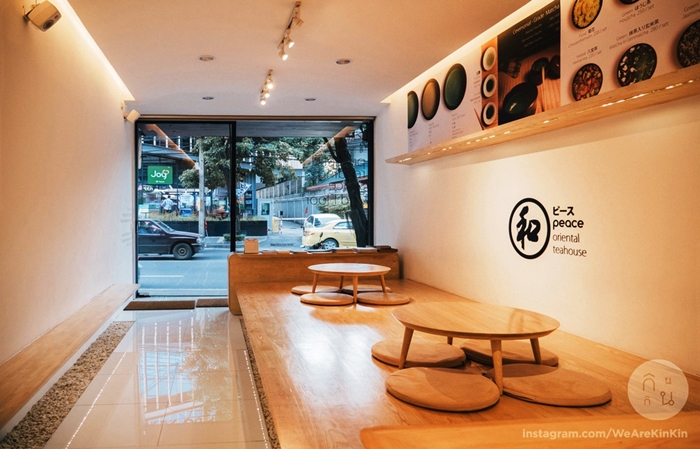
Peace Oriental (Maps link to one branch):  I think an earlier attempt at making a theme like that at Koto Tea Space didn't work for Peace Oriental, and they're on to being more of a standard cafe now, selling blended flavored iced teas and such, as well as more traditional versions.  It could still be interesting, if your path takes you near a branch.  I might've only visited one branch of this chain one time; again I'm just not that into cafes.  If you spend $10 on a decent pot of tea you might as well add 10 more and buy a decent tuocha's worth, or a passable 100 or 200 gram amount.  

Everything I'm saying here is a biased and one-sided take, of course.  I'm not into style as a main attraction in tea shops, and marketing spin pushing pricing for good basic version options to double what they sell for elsewhere.  Some people value style, and a "curation" function can seem to add value, beyond simple tea quality in relation to price.


their older theme was all white space; on to an updated natural materials look


the outlet I visited, which may be closed now


Ong Yong Choon (that is a Maps link) / other local shops:  there are countless places selling all sorts of variations of teas in Bangkok, hundreds if you count bubble tea and matcha outlets, or maybe even thousands.  This place I've named is an old-style tea shop near Wat Pho (a main temple), or more specifically beside the flower market beside Wat Pho.  

More conventional examples would be new forms of cafes, which keep opening and closing every year.  I've heard of 3 or 4 new versions this year but I'm only mentioning places I've not been to here when it makes sense to, when I've heard enough about them to reliably pass on what they are probably like.


Ong Yong Choon, the owners (who are so nice, as I keep saying about everyone)


Traditional shops / Cha Tra Meu:  I've still not mentioned anything about the orange flavored Thai tea, or the versions that look like teh tarik in Malaysia (pulled tea, with added reference to pouring it back and forth), often brewed in what looks like a small wind sock.  Both are around, they're just different kinds of things than specialty loose tea.  If you are in a really old-style restaurant or food court and see that old form of brewing you should try it out, but it's just inexpensive black tea with sweetened condensed milk.

The orange flavored version is something else.  Ordinarily I don't like artificially flavored teas, and it definitely is that, but that is tasty.  There's a shop selling it--Cha Tra Meu, the main one--in the building where I work, and I've never bought a take-out or loose tea version there.  It's not taste preference that stops me from having it; I avoid eating processed sugar and artificially flavored foods.  For exceptions I'll eat donuts and ice cream sometimes, but not drinks that are full of sugar.  For people who are more open to that buying a tin of the flavored loose black tea might be good.  Dairy Queen here did a Thai tea flavor promotion at one point and it's for best for my health that was temporary; it was too good.


In talking to someone recently about why it seems like there are gaps in what is sold in shops here a few factors seem to combine.  Tea awareness and demand is limited, and Chinatown shops already cover that for people who have been into tea for awhile.  Online options increase, sales through Facebook pages, and large Thai tea interest groups / marketplaces are crowded with people selling lots of things (this is only one example).  

Some of those group posts would just be reselling the best of what is sold by small producers through Facebook pages, teas you could buy directly for less, and a lot of the rest would be Taobao or Alibaba purchases, a lot of which wouldn't be good tea, or selling at a good value.  Over time people would probably sort out which individuals are most reliable, and turn-over would weed out some of the least reliable options.  There are limited Western-facing online sales options; let's consider those.


Online:


Unfortunately the best Thai sheng is only available online, as far as I know.  I guess that's a good thing for people reading this who would never make it to Bangkok?  Wawee Tea is a good starting point, a main traditional producer, and Ming Dee is perhaps the other main producer option.  Those kinds of producers would have Facebook pages, or there are lots of online shops in the two main online sales platforms here, Shoppee and Lazada.  I'll skip looking up links here; people can Google search or look up blog posts here that contain those names.  

I didn't really intend for this section to mostly be about Thai sheng; it just worked out that way.  At least some of these outlet sell teas way beyond that range, even though I'm discussing sheng most here, and not the oolongs or black teas as much.  It's what I buy most of and drink myself.


Tea Side is the main Western-facing website outlet.  Value isn't great through them, with decent sheng selling for between 50 cents and $1 per gram, when you can find equivalent versions for far less if you put more effort into it.  For people who don't see spending $100 to 200 as much expense for a tea order, and don't care what that works out to in relation to $ / gram, then they're a great option.  

Their products are consistently good.  Sheng options are fine, or black teas are good, Dian Hong style versions from Thailand.  Aged tea options are also good, but that $200 won't go very far buying from that range.  Their small-batch shu versions are good, and a gui fei bug-bitten rolled oolong was nice in the past.

Let's make that summary more specific related to buying a young version of Thai sheng; what if you wanted to buy a moderate cost, most recent Thai sheng version they sell, how would that go?  There are two identically priced at the lowest cost, $70 for 200 gram cakes, both from 2018, this one a more bitter version.  It's not 50 cents a gram, but that is $130+ for a standard cake, nearly double in-house boutique style productions by other vendors, or 1 1/2 times the higher end of that range.  At that pricing you have a lot of options.  A 2021 version sells for $85 for 200 grams; close enough to that 50 cents a gram level.  It's just not the kind of outlet option where you find this year's tea selling at all, never mind related to style and pricing variations.


Rishi--the US wholesale vendor--sells cakes from different countries, including Thailand; that would be another decent option.  There must be other Western vendors selling Thai sheng, I'm just not familiar with any.  

Let's dig a little deeper; how good would quality and value be?  This is a 2022 Wawee origin sheng "pu'er" version, selling for $45 for 200 grams.  I've bought tea similar to this over the past two years, for slightly less, but $80-some for a standard cake amount is definitely still fair, depending on aspect range and quality.  They carry some Laos teas too; for people who aren't concerned about the $80 or so per cake price range I expect those would be interesting in character, and safe bets for quality level.

I can't say that their teas are definitely as good as Tea Side's, because that's too much generalization, but it's my guess that it comes down to preference instead of quality, and some people might like them more.  It can be natural to assume that pricing must correspond to quality level but varying outlets set pricing differently, and carry different options, and equating cost with probable quality level doesn't work.


Moychay Thai forest tea initiative:  I've written about trying a cake from Moychay's partnership operation in Thailand, with tea versions selling through their Netherlands outlet.  It's tempting to try to describe their teas in relation to what Rishi or Tea Side is likely selling, or Wawee Tea and Ming Dee versions, but it can introduce a lot of error to generalize across a lot of versions, when I've only tried one (or two?; maybe a loose version as well).  The quality of what I tried was quite good, the material was obviously high in potential, and while the style wasn't a complete match for Yunnan versions I liked it.

That theme applies to a lot of South East Asian sheng I've tried; often it's not produced in exactly the same style as Yunnan versions, often varying in ways that I like just as much.  Oxidation level can creep up a bit, maybe due to not rushing the processing steps to offset that, or maybe it's that hotter and more humid local conditions let the tea transition faster during the limited processing time.  Or maybe heating step, the sha qing / kill-green / pan frying step, is slightly different.  Teas can end up trading out some bitterness, astringency, and aging potential for extra sweetness, initial complex flavors, and approachability.  For a version that you plan to drink within 2 to 3 years that can actually be positive; for long-term aging it's not favorable at all.  

It's possible that Tea Side filters what they sell to match Yunnan styles better, so their higher pricing level could be justified, for some.  Or maybe they just charge more; I'm not implying that aging potential / style issue maps out like that across most versions, related to Tea Side matching Yunnan style and Moychay being more like local Thai versions, although it matches my past experiences.

I re-tried a favorite Thai sheng from 2022 just this week--from a local source that's hard to access, not one described here--and it was much different and just as pleasant as last year, not seeming to show great potential for 15-20 year aging, but to me a fantastic tea for drinking right now.  It was not just on par with but slightly better than what I've sampled from all of these other producers (per my preference; that's not intended as an objective judgment).

In terms of positive experience and quality that Moychay tea I tried was good; I think it would also hold its own in the now-standard $80 per standard size cake range, a pricing that's a bit high for me to buy or drink a lot of, even though it's quite standard.  

This autumn version from them sells for 13 Euro ($14--what's up with the exchange rate?), for a 200 gram cake, so that's still very favorable pricing.  Autumn versions give up a little intensity and tend to cost less but that's still a great deal.  They list that one as "green tea," which I think is a translation issue, but it really could be pressed green tea, even though that existing--a pressed cake of green tea--would be stranger than getting a translation wrong.  

This other cake sold as sheng is 239 Euros for a standard size cake (on towards $250).  So it goes with buying pu'er; you can accept what someone says online as input but you never really know until you're tasting the tea, especially if the person offering input hasn't tried a specific version.  Style variations throw off the "good / not good" objective judgments; my absolute favorite Thai sheng not all other pu'er drinkers would even like.  


To complicate things further you can try 2 or 3 versions from a producer and think that those must map to all that they sell, good or bad, but that can vary a lot too.  Buying what they price the highest probably bumps the chances that you'll try their best versions, but even that might not be consistent.  Demand for a type shifts pricing just as much as quality, and many vendors just apply a standard mark-up, so if they get a good or bad deal on material / products your cost can vary by that factor more than quality level.  The smaller the vendor and less direct their source connection the more that applies, but in general pricing mark-up is a commercial function instead of relating to a quality judgement; it can vary a lot.