Showing posts with label online. Show all posts

Monday, August 17, 2026

Wawee Tea red / ruby oolong


This reviews a Wawee Tea red oolong, or more oxidized rolled oolong version.  It's a familiar type, but you really don't need to have any background with this tea type to get it.  Better versions are very pleasant and approachable.  

I compare it to a Bangkok Chinatown black tea version, from my favorite shop, Jip Eu.  I don't think they still carry it, and I don't know the details of what it is, so the point is just highlighting how completely random Chinatown tea sourcing goes.  It's a theme that gets covered in describing a recent Chinatown shop visit to another place, to K. Mui Kee Tea.  I'm fairly certain that this is from China, not local, and that's about it.

I can cite some of a description of a Wawee Tea version that may or may not be identical, since it's last year's, from their Shopee site (but now sold out):


Ruanzhi Oolong Red Tea, Spring 2025, Ruby of Wawee. This Oolong tea is 100% fermented, guaranteeing a sweet, fragrant, and smooth finish


Google thinks it knows what this is, based mostly on a Facebook page post:


Ruby of Wawee is a specialty red oolong (ชาแดงอู่หลงหร่วนจือ) produced by Wawee Tea from Doi Wawee in Mae Suai, Chiang Rai. It is crafted using traditional Ruan Zhi (Oolong No. 12) cultivars processed with a deep 100% oxidation technique, yielding a bright ruby-red liquor that bridges the gap between oolong and black tea.


#12 is really Jin Xuan, and what Ruan Zhi is turns out to be complicated.  This is about how the tea is anyway, not all of that.

Related to value, that was selling 120 grams for 580 baht ($17.50), which is great value for a tea that good.  This could be that 2025 version; I'm not sure what year it was from.


I should also mention that Jip Eu is still closed for building repairs, after a front awning section collapsed earlier.  This would be a good time to buy some tea from them through a Shopee online platform storefront, if someone is in Thailand, to support them during this transition.

Or people might think that since I don't really love this black tea that makes less sense.  Fair enough.  I have had good luck with their Wuyi Yancha, Dan Cong, and jasmine white teas as tin-presented versions, which I don't buy often for myself now, more as gifts for others, since I've sorted out where to buy other versions I'm currently hung up on.  Like Wawee Tea; I just ordered two of those, which I've already reviewed, as very exceptional sheng and black tea cakes.


Review:


Wawee ruby / red / hong oolong:  it's not really opened yet, and won't be fully opened next round either, but this is very promising.  Just the scent includes plenty of rich dried berry and spice, and the flavor does as well, but it's still thin.  The fastest way to speed this along would probably be to use a rinse, then a long first infusion time, after letting the leaves rest a little between steps.  I just started brewing it, not even using a rinse.  I'll add more next round.


Chinatown / Jip Eu shop black:  that's really unique.  It includes a good bit of tartness, which I usually don't like in black teas, but this includes so much dried fruit that it gives off a strong cranberry effect, which kind of works.  And there's quite a bit of cacao. 

I'm not loving the overall effect, due to the tartness, but it's interesting, and still somewhat pleasant.


Wawee oxidized oolong #2:  this is a great version of a "red oolong," or relatively more oxidized oolong.  That oxidation level can overlap with normal black tea range, making it an interesting category.  People sometimes use a percentage to describe it, but who knows how accurate or informative that would usually be. 

Flavor still includes dried fruit, most centered around dried cherry, or possibly blackberry, with some cacao.  The earlier spice edge has diminished and dropped back as a supporting input.  It might be complex, a hint of cinnamon, combined with even stronger nutmeg.  Sweetness, rich feel, and all the rest are very positive.  This is good; well made, pleasant, and interesting tea, well worth talking about.


Chinatown black:  flavors shift, but tartness remains the main flavor input.  For people like me who dislike tartness as a primary black tea flavor this just wouldn't match with preference.  Others would love that more, and for them it could be exceptional.  Tones warm in this, so it comes across differently.  It picks up a dark toffee sort of sweetness, and base mineral increases.  The fruit reminds me more of a tart apple this round, although of course cranberry still works as a description of part of it.  Cacao tastes like dark chocolate; often it's more along the line of hot cocoa.


Wawee red oolong #3:  this is only now fully opened up.  The flavors list is the same though:  dried cherry, some berry, cacao, and spice.  It's a nice mix of sweet, fruity and warm tones; it balances well.  You could try a lot of "red oolong" and not discover a version this positive.  But there's not much more to add in description here.


Chinatown black:  the best it has been, since tartness is easing up.  Warm tones enter in, maybe along the line of spice, or maybe even towards a dark rye bread flavor.  If someone loves tart black teas this could be an exceptional experience.  If they don't it wouldn't be good.

Oddly I can drink brewed roselle (a fairly tart tisane), and I'm fine with it.  I need to add sugar, which offsets tartness being too strong.  Maybe if I added a little milk and sugar to this I'd like it more, but I won't try that.  It's fine that it's mostly a miss for me.  If I had bought 100 grams of it I probably would explore that, and might drink most of it made that way.  I only bought some samples one day awhile back, to try something different there.


Wawee oolong #4:  the warm spice range picks up; it's as nice as it has been, and it was really pleasant before.  This should brew a couple more very positive infusions, then you could keep stretching it.

To me this is an ideal tea version to get people started on tea.  Everyone would love it, and you can't really screw it up by using the wrong brewing approach.  It would work well light or brewed strong, and using really hot water or cooler infusion would be fine (but hotter would be better, I think; there is no astringency to brew around).


Chinatown black:  the best this has been.  It works for me, like this.  Tea evolving to be better and better across rounds is a great sign for quality, but this related more to tartness fading, a normal aspects transition cycle.  Still, it's pretty good quality tea, to be this intense and pleasant 4 rounds in, with earlier rounds brewed at kind of medium intensity.


I'll drop the note taking here.  It will be interesting to see how three more infusions work out, but it won't be much of a story to tell.


Conclusions:


The Wawee Tea version was much better, but then that's not a fair comparison, since it's a relatively favorite type.  In that other Chinatown shop visit post I mention that what you find in Chinatown shops tends to be all over the map, just random, and this black tea exemplifies that.  Some people would love this, so the final result would be the opposite for them.

This Wawee Tea version is pretty solid as oolongs from Thailand tend to be.  Often you can find pleasant enough versions, but they usually lack this distinctiveness, complexity, and balance.  They often brew out a bit faster, not holding together as very pleasant through lots of rounds (the next two were also good, although it was thinning past that point).  I could definitely recommend this, to almost anyone.


To many this "red or ruby oolong" might just seem like black tea, and the oolong part wouldn't make sense.  My take is that it's processed similarly to oolong, from a cultivar used to make oolong (more often), in a rolled form like oolongs.  Mixing the two categories in the naming works; lots of people would be familiar with the general type.  It's closer to a mild, sweet, complex black tea than to oolong, as I've described.


Saturday, September 7, 2024

Online contact and teen social development


I just ran across a few group posts on Reddit about people not being successful at dating, attributing causes to that.  One guy said that he experienced early childhood trauma, and took a decade of therapy to get over that, and couldn't act naturally in dates or relationships as a result.  Fair enough.

My son is just starting into that kind of range, or really getting far yet.  He's 15, so it's still in a normal time-frame, to be on the fence, or just sorting out early interest.  I commented that online contact now must make it all much harder, because his friends don't hang out with him "in real life," and that's only going to be more of a factor in his 20s, that he might experience most of his social contact online.  It's not helpful for real-life forms of contacts, like dating.

I just saw a graph online that clarifies what I was getting at:


this was cited from here, which includes some odd right wing leaning spin


I would imagine this is really limited to "in real life."  He would spend a couple of hours talking to friends while playing online games last semester, daily, which of course impacted his studies and his grades.  In 2013 someone in his age range would have spent over two hours with friends daily, and the average in this graph dropped down to 40+ minutes.

Would that relate to covid, since it's apparently ending in 2020?  Maybe.  But it was around an hour in 2019, prior to covid, and the graph was showing clear annual decline.

For my age group that's not even a half an hour a day, in 2019, and that was under 40 minutes for the entire range, since 2003.  I get it; contact with friends can really drop out in your mid 30s.  A similar pattern of decline has been happening for the 25 to 34 age group though.

Of course this relates to generational differences, in addition to patterns that affect all of society; from 2003 to 2020 the people at each age range shifted over time.  This theme reminds me of the death of malls in the US, how less people want to go hang out in that particular public space.  It's easier to shop online, and in some cases safety issues come up, but overall people seem to be more focused on experiences at home, on watching streaming content, or spending time online.


Back to my son a discussion point came up about encouraging him to go to a school dance, or not, about letting him make his own decisions versus emphasizing that these really are once in a lifetime sort of social opportunities.  He's just not spending that much time with friends in real life.  He tries to arrange more, hiking outings, playing basketball in a park, or they gather to eat sometimes, but his friends are either busy or just not on that page.

He plays a sport; that helps (swimming).  It's time spent with other kids, and it's relatively social, even though there is training to be done.  As far as I know participation in sports isn't in steep decline; the kids still do that.

One point that made me think all this through, in a different light, is how some of my friends in college were fairly undeveloped socially, not having experienced much or any dating at that point.  Most of them pulled it together, and eventually did end up marrying.  It would be harder if someone wasn't in the habit of participating in real life social interaction at all; the starting point would be different.

Of course one theme that comes up is that online dating apps are making things worse instead of better, that patterns of how people match, or don't, makes it harder to meet people.  A broad range of commentary puts the blame for this on women, for most trying to match with a small percentage of the guys.  To some extent this must happen.  The broader conclusion that women are ruining dating I'm not so sure about.  I suspect that this trend for people to socialize mostly online is more of a cause than all women now only choosing a narrow subset of men.  It gets repeated though, surely making it seem more likely to be true.

I think I've mentioned interesting, novel, and odd forms of patterns of relationships being described online before, like in this graphic version, by a "Hoe Math" channel:


This kind of thing is bordering on misogyny, reducing dating habits and women's preferences--or really men's too--down to a simple series of patterns.  This content creator has given this some thought, but I wouldn't be surprised if he hasn't done much actual dating.  If you actually go through it parts do match normal, typical experience though.  

It just probably wouldn't be helpful, since a short summary is that it blames women for putting too much emphasis on physical attractiveness, even though it says roughly the same thing about men.  Maybe people do tend to date and marry people who are generally as physically attractive as them, but it sets aside all the rest about sharing interests and worldview, or personality types matching or conflicting.

So where does all this leave my son?  We encourage him to participate in sports, and activities and groups, and hopefully he will build up social experiences and skills that help him in the next stage of his life, in college and beyond.  How much he dates and whether he attends any one sort of function doesn't matter as much, but to an extent it all connects.

I really am concluding that too much time spent online, even in social contact in online gaming, probably is negative.  15 to 24 year olds might really average around a half an hour of contact with friends now, and that's not much.  It seems to clearly be decreased by lots of people who don't spend any time with friends, in real life. 

This is a very common theme on Reddit too, that someone, male of female, is in their late 20s, reconsidering why they've barely dated at all, or never have, and don't hang out with friends, and have trouble placing meaning in their lives.  Of course all that isn't just due to online games and streamed entertainment; causes are complex.  Someone who experiences normal working hours and a long commute has no time to meet with friends five days a week.

Mostly this post is about sharing that "time spent with friends" reference, and some thoughts on that, versus arriving at actual conclusions in relation to it all.


Friday, December 8, 2023

Bangkok tea shops and cafes; online Thai tea options


It's been awhile since I've written anything about this (6 1/2 years), and for whatever reasons discussing it has come up a half dozen times or so in the last month.  Lots of people visit lately.  Of course this list is centered on my own favorites, but I'll try to map out a range of other options.

Online options are included in the last section; people not able to shop locally in Bangkok might scan through the rest and focus more on that, or just skip ahead.

Edit:  I've added Maps links to these, along with the Facebook or website references they first included, so it should be easy to find out more about these options or to physically finding them.


My Favorites:


Jip Eu (Maps link): my favorite Chinatown shop, where the owners feel a bit like family.  On the positive side they carry lots of teas, lots of types even, and most are sold at great value.  On the negative side it's a hard place to shop, because there is no menu or listing of options, it's not easy to sort out what is in there, and quality and style varies a lot.  Their storage ages sheng pu'er fast--it's Bangkok, so hot and humid--but teas pick up a little extra mustiness, which tends to fade over 3 to 6 months.

They would taste some teas with guests but not over and over, not whatever is in the store; they're not set up as a tourist outlet, selling more to locals who already know what they like.  I never end up trying the same teas twice there.  Their specialization is Wuyi Yancha, rock oolongs from Fujian, but they also have Tie Guan Yin (from China, from Anxi), an odd mix of sheng versions, some aged, Dan Cong, a random selection of black teas, and a little of this and that beyond those.  There's not much Thai tea, but they would have some, maybe just no rolled oolong, the standard form, and no Thai sheng, what I like best.


I've met many kind people there; this is Sasha and Maddhurjya, and Kittichai on the right


Some teas there are good value but of very moderate quality.  A main offering is 50 to 100 baht boxes or paper wrapped squares of Chinese and Thai material blends ($2 to $3 per 70 to 100 grams; very inexpensive).  Sometimes a Shui Xian version (rock oolong again) can be medium quality instead, in those blends, so it can happen that a $3 selection would be equivalent to $10 or $20 worth in a US shop.  That's rare though; usually the quality is so-so for cheaper versions.  

Good higher end Wuyi Yancha tends to sell for 1000 baht / $30 for 100 grams, which is still a good value for being a completely different type of tea.  They don't carry a lot of sheng pu'er but some of the options they do have are good basics.  I keep buying Xiaguan tuochas there, and a fully fermentation-transitioned Tulin tuo is nice for trying basic aged tea range.


K. Mui Kee Tea (Maps link): probably not so different than Jip Eu, and just a block and a half away, another old Chinatown shop.  I've visited a few times but keep going to Jip Eu instead.  They sell different teas in dried tangerine peels (chen pi, the name of the peel sold alone, or sometimes used as a name for the stuffed dried peels).  Those are most often shu pu'er, but can be other types.  That might be good for novelty, for a gift for someone.  Wuyi Yancha or Dan Cong might be ok there but you'd have to try it to check on quality and value to know.


that shop owner is so nice, and I don't even really know him


Sen Xing Fa (Maps link; still on Chinatown shops):  a higher volume, more tourist oriented outlet, closer to the Yaowarat strip area, in a side street that sells a lot of street cafe food.  Selection of Thai and Taiwanese medium quality rolled oolongs is good, but value is just normal for those, with many selling for $15 to 20 per 100 to 200 grams or so.  Selection is broad but quality and value is all over the place; you need to try teas to see what's there.  

Where Jip Eu will try some teas with you, but would draw the line at tasting a lot of versions, or opening some of any kind, you can sit and drink lots of tea with them here.  You pay the price in value related to that though; some teas are good for the selling price, others not so much.  They carry more new / young sheng and shu than the other places already mentioned, and sell more teaware.  Per visiting with a new tea contact recently it's probably not the best place to be buying expensive clay pots, yixing and such.  Moderate quality teacups and the like would be the same as buying them anywhere else, but it's rare to see as broad a range of options as they have anywhere else in Bangkok.


VIP guests and a main owner


they hosted a nice meetup this year.  sheng cakes and teaware are on the other side of the shop


Ju Jen (Maps link) I've only been to this shop a few times but I'll  include it in favorites since my experiences have always been so positive.  It's way out there on Srinakarin road, out towards Bangna and the airport in the Paradise Park mall.  They seem to have a lot of variety, and I'm not sure if there is a specialization.  I bought some interesting mini cakes of pu'er last time I was there, 100 gram versions; that's a nice way to try something different, or it works for the gift theme.  

I'm not sure how many local Thai tea options they carry, but I did just review a pretty good Oriental Beauty / Dong Fang Mei Ren version from there, so at least some.  There seemed to be plenty of teaware around, but I have no idea where they stand on sorting versions or value for clay pots.


Zhennan cafe (Maps link): I've only visited here a couple of times, a cafe in Chinatown, but I suppose it fits here.  Tea selection is limited, and nothing so novel and amazing, related to it being so small, but it has a nice feel, which to me is what cafe experience is all about.  If the listed teas on a menu don't sound interesting they might carry others; it wouldn't hurt to ask.  

There may be lots of similar options all around Bangkok; I hear of other places like this but typically don't visit them.  To be honest I don't love spending any time in cafes; I'd rather buy loose tea and drink it at home.  But visiting that Chinatown can be rough; lots of ground to cover.  It's right beside a main alley market I'd highly recommend, which has a decent tea shop in it, and a few other places to buy very low grade tea and mass produced teaware.  That may sound off-putting to most tea enthusiasts but it can be nice to have an extra glass teapot or a number of extra small cups for gatherings, if you don't already.


an international tea expert and friend visiting Zhennan (John Lim)


the Zhennan cafe owner, and more of the interior


that Soi 6 market alley shop (note the alley has a different name from the North side)


what that market alley looks like


Classics:


Tea Dee (Maps link):  way out beside the Ju Jen shop in the Thanya Park mall there is a store that has long been a favorite among locals, which specializes in in-house sheng pu'er versions, and probably carries some factory versions too.  I've not been there in forever, since they moved from another nearby mall space, but given how they are viewed by others it seems to represent a standard option.  I've never been into the $1 / gram standard gushu sheng range, since that's not within my budget, but this might be the best place to buy that kind of thing in Bangkok.

This raises the question of how many other mall shops like here and Ju Jen are out there.  Very few others, I think.  There are tea shops, or booths selling limited range, but nothing I know of that specialty tea enthusiasts would seek out.  There had been a main one in the Paragon Mall, with a reputation for selling decent tea on the expensive side, but that's gone, and there's only a second branch somewhere else, as far as I know.  Royal Project shops exemplify what other mall-shop exceptions are like.


Royal Project stores (Maps link of one example): some of the oolong from Royal Project stores isn't bad; that's what introduced me to loose tea a dozen or more years ago here.  They're around, in malls and such, or there is one at the airport (Suvarnibhumi).  

For tea enthusiasts into above average quality Taiwanese rolled oolongs the quality probably just isn't good enough, but for buying some inexpensive gifts for people not yet into tea back home this may be perfect, or people would see "daily drinker" range in different ways.  They might carry an extra black or green tea but quality is kind of so-so, so sticking to the oolongs might be better.  Value is good for them, quality in relation to cost.  Tea selection is quite limited but dried fruit and whatever else is sold in those shops might be of interest.  Some sell boxes of plain tisanes presented as tea bag versions, which I buy once in awhile.


Double Dogs (Maps link): the main Chinatown (Yaowarat road) traditional Chinese cafe, also selling some cakes and loose teas.  It's really small; you might go in expecting that it may or may not work out for seating availability, or call ahead to reserve a space if it means a lot to you and you are on a tight schedule (which is no way to experience a Chinatown, but it can come up).  That Soi 7 market alley is right beside Double Dogs, and a wholesale area selling all sorts of random goods is all located on the South side of Yaowarat near here.  The main evening street food vending options are in the same area, as a few herb shops are, which is a good place to stock up on an extra kilogram of chrysanthemum, if one is into that.


this is actually half the cafe (credit a FB page photo)


Monsoon (Asok branch Maps link): local branches of a vendor based out of Chiang Mai.  Most of their selection is flavored teas, presented as wild-origin source material (which they are, but what that means probably isn't completely obvious).  For people open to that range or curious about that theme it's definitely worth checking out.  

There had been a small stall sort of outlet in one of the malls at Phrom Pong, I think in Em Quartier, but the main branch is at Asok, way back in the system of sois (side streets), behind the parts of that area that everyone knows about.  That shop isn't right beside the red-light "Soi Cowboy" area, but not far (but it's safe anywhere in Bangkok, even after dark; no need to worry).  They had sold kombucha at a small cafe type section; that might be nice.  

If value is a main concern then Chinatown shops are a better option; teas are priced at above average market rates, for what they are.  The teas are unique enough that there really is no market rate, so they wouldn't turn up in Chinatown, but you get the idea, you can find equivalent quality teas for less elsewhere, just not the same styles.  There is less to sort out than at Chinatown too; even though the range is mostly flavored blends it's all consistent, where in Chinatown you really don't want to drink any of the below average quality versions, related to it being bad and potential risk of contaminants exposure.


Monsoon holds interesting informative events, like this one on biodiversity research


Dayi / Taetea shops:  the two I've visited in town both closed but there are at least a couple of others.  Google search would let you know where; I don't know, and only mention them here for completeness.  That's the name of one of the three main Chinese factory producers of sheng and shu pu'er, for people not already clear on that.  I don't think seeking out these shops would make sense for buying oolong, black, or green teas, but I did buy two nice pressed white tea cakes in one, shou mei and gong mei.


Grocery stores:  of course this doesn't work, but there must be something to add about this.  I bought a Dayi Jia Ji sheng pu'er tuocha in a specialty grocery store once; exceptions come up.  Of course there are other places to buy those (Sen Xing Fa sells them, from the rest of this list, and Yunnan Sourcing or King Tea Mall are good sources online).  The Thai oolongs grocery stores sell are typically not above average, and average quality range here isn't so great.  

In China it is possible to buy so-so factory sheng pu'er in grocery stores; I just tried part of a cake that's running low I bought in Shenzhen on a visit back in 2019, which was decent--relatively speaking--in spite of selling for next to nothing, around $10 per cake.  Here it's better to avoid all of it, and sheng wouldn't turn up anyway (that one time was the only time I've seen it, except for sheng pu'er tea bags, which I'm not going to dignify with discussion here).  You might be curious about what an inexpensive box of loose Thai oolong might be like, Shui Xian made in more of a Wuyishan style, but it would almost always be pretty bad.  It's better to buy such a thing at shops like Jip Eu or K. Mui Kee Tea.


New options / different themes:


Koto Tea Space (Maps link):  I've never been to this place, but a friend runs it, so it must be nice (and the local buzz is positive too).  It's themed around Japanese tea experience, with emphasis on the aesthetic side, two parts of tea experience I generally try to avoid.  A setting looking nice is fine, some wood paneling, plants, or a water feature, but once there is too much of an elaborate decoration theme or people are wearing robes I'm out.


visiting would be worth it to meet Pop, the owner (photo credit their FB page, from 2021)


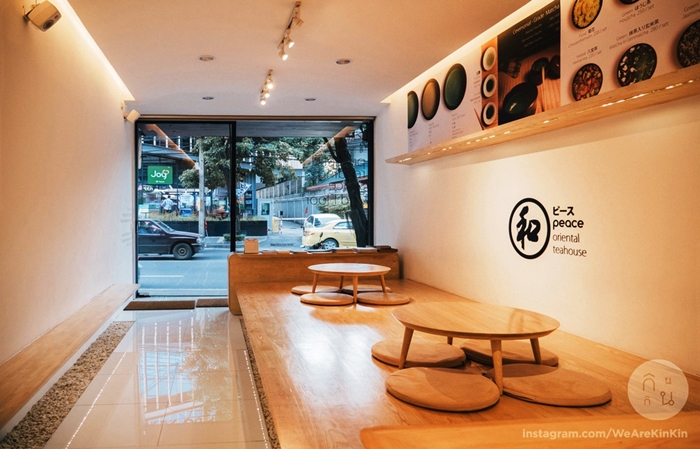
Peace Oriental (Maps link to one branch):  I think an earlier attempt at making a theme like that at Koto Tea Space didn't work for Peace Oriental, and they're on to being more of a standard cafe now, selling blended flavored iced teas and such, as well as more traditional versions.  It could still be interesting, if your path takes you near a branch.  I might've only visited one branch of this chain one time; again I'm just not that into cafes.  If you spend $10 on a decent pot of tea you might as well add 10 more and buy a decent tuocha's worth, or a passable 100 or 200 gram amount.  

Everything I'm saying here is a biased and one-sided take, of course.  I'm not into style as a main attraction in tea shops, and marketing spin pushing pricing for good basic version options to double what they sell for elsewhere.  Some people value style, and a "curation" function can seem to add value, beyond simple tea quality in relation to price.


their older theme was all white space; on to an updated natural materials look


the outlet I visited, which may be closed now


Ong Yong Choon (that is a Maps link) / other local shops:  there are countless places selling all sorts of variations of teas in Bangkok, hundreds if you count bubble tea and matcha outlets, or maybe even thousands.  This place I've named is an old-style tea shop near Wat Pho (a main temple), or more specifically beside the flower market beside Wat Pho.  

More conventional examples would be new forms of cafes, which keep opening and closing every year.  I've heard of 3 or 4 new versions this year but I'm only mentioning places I've not been to here when it makes sense to, when I've heard enough about them to reliably pass on what they are probably like.


Ong Yong Choon, the owners (who are so nice, as I keep saying about everyone)


Traditional shops / Cha Tra Meu:  I've still not mentioned anything about the orange flavored Thai tea, or the versions that look like teh tarik in Malaysia (pulled tea, with added reference to pouring it back and forth), often brewed in what looks like a small wind sock.  Both are around, they're just different kinds of things than specialty loose tea.  If you are in a really old-style restaurant or food court and see that old form of brewing you should try it out, but it's just inexpensive black tea with sweetened condensed milk.

The orange flavored version is something else.  Ordinarily I don't like artificially flavored teas, and it definitely is that, but that is tasty.  There's a shop selling it--Cha Tra Meu, the main one--in the building where I work, and I've never bought a take-out or loose tea version there.  It's not taste preference that stops me from having it; I avoid eating processed sugar and artificially flavored foods.  For exceptions I'll eat donuts and ice cream sometimes, but not drinks that are full of sugar.  For people who are more open to that buying a tin of the flavored loose black tea might be good.  Dairy Queen here did a Thai tea flavor promotion at one point and it's for best for my health that was temporary; it was too good.


In talking to someone recently about why it seems like there are gaps in what is sold in shops here a few factors seem to combine.  Tea awareness and demand is limited, and Chinatown shops already cover that for people who have been into tea for awhile.  Online options increase, sales through Facebook pages, and large Thai tea interest groups / marketplaces are crowded with people selling lots of things (this is only one example).  

Some of those group posts would just be reselling the best of what is sold by small producers through Facebook pages, teas you could buy directly for less, and a lot of the rest would be Taobao or Alibaba purchases, a lot of which wouldn't be good tea, or selling at a good value.  Over time people would probably sort out which individuals are most reliable, and turn-over would weed out some of the least reliable options.  There are limited Western-facing online sales options; let's consider those.


Online:


Unfortunately the best Thai sheng is only available online, as far as I know.  I guess that's a good thing for people reading this who would never make it to Bangkok?  Wawee Tea is a good starting point, a main traditional producer, and Ming Dee is perhaps the other main producer option.  Those kinds of producers would have Facebook pages, or there are lots of online shops in the two main online sales platforms here, Shoppee and Lazada.  I'll skip looking up links here; people can Google search or look up blog posts here that contain those names.  

I didn't really intend for this section to mostly be about Thai sheng; it just worked out that way.  At least some of these outlet sell teas way beyond that range, even though I'm discussing sheng most here, and not the oolongs or black teas as much.  It's what I buy most of and drink myself.


Tea Side is the main Western-facing website outlet.  Value isn't great through them, with decent sheng selling for between 50 cents and $1 per gram, when you can find equivalent versions for far less if you put more effort into it.  For people who don't see spending $100 to 200 as much expense for a tea order, and don't care what that works out to in relation to $ / gram, then they're a great option.  

Their products are consistently good.  Sheng options are fine, or black teas are good, Dian Hong style versions from Thailand.  Aged tea options are also good, but that $200 won't go very far buying from that range.  Their small-batch shu versions are good, and a gui fei bug-bitten rolled oolong was nice in the past.

Let's make that summary more specific related to buying a young version of Thai sheng; what if you wanted to buy a moderate cost, most recent Thai sheng version they sell, how would that go?  There are two identically priced at the lowest cost, $70 for 200 gram cakes, both from 2018, this one a more bitter version.  It's not 50 cents a gram, but that is $130+ for a standard cake, nearly double in-house boutique style productions by other vendors, or 1 1/2 times the higher end of that range.  At that pricing you have a lot of options.  A 2021 version sells for $85 for 200 grams; close enough to that 50 cents a gram level.  It's just not the kind of outlet option where you find this year's tea selling at all, never mind related to style and pricing variations.


Rishi--the US wholesale vendor--sells cakes from different countries, including Thailand; that would be another decent option.  There must be other Western vendors selling Thai sheng, I'm just not familiar with any.  

Let's dig a little deeper; how good would quality and value be?  This is a 2022 Wawee origin sheng "pu'er" version, selling for $45 for 200 grams.  I've bought tea similar to this over the past two years, for slightly less, but $80-some for a standard cake amount is definitely still fair, depending on aspect range and quality.  They carry some Laos teas too; for people who aren't concerned about the $80 or so per cake price range I expect those would be interesting in character, and safe bets for quality level.

I can't say that their teas are definitely as good as Tea Side's, because that's too much generalization, but it's my guess that it comes down to preference instead of quality, and some people might like them more.  It can be natural to assume that pricing must correspond to quality level but varying outlets set pricing differently, and carry different options, and equating cost with probable quality level doesn't work.


Moychay Thai forest tea initiative:  I've written about trying a cake from Moychay's partnership operation in Thailand, with tea versions selling through their Netherlands outlet.  It's tempting to try to describe their teas in relation to what Rishi or Tea Side is likely selling, or Wawee Tea and Ming Dee versions, but it can introduce a lot of error to generalize across a lot of versions, when I've only tried one (or two?; maybe a loose version as well).  The quality of what I tried was quite good, the material was obviously high in potential, and while the style wasn't a complete match for Yunnan versions I liked it.

That theme applies to a lot of South East Asian sheng I've tried; often it's not produced in exactly the same style as Yunnan versions, often varying in ways that I like just as much.  Oxidation level can creep up a bit, maybe due to not rushing the processing steps to offset that, or maybe it's that hotter and more humid local conditions let the tea transition faster during the limited processing time.  Or maybe heating step, the sha qing / kill-green / pan frying step, is slightly different.  Teas can end up trading out some bitterness, astringency, and aging potential for extra sweetness, initial complex flavors, and approachability.  For a version that you plan to drink within 2 to 3 years that can actually be positive; for long-term aging it's not favorable at all.  

It's possible that Tea Side filters what they sell to match Yunnan styles better, so their higher pricing level could be justified, for some.  Or maybe they just charge more; I'm not implying that aging potential / style issue maps out like that across most versions, related to Tea Side matching Yunnan style and Moychay being more like local Thai versions, although it matches my past experiences.

I re-tried a favorite Thai sheng from 2022 just this week--from a local source that's hard to access, not one described here--and it was much different and just as pleasant as last year, not seeming to show great potential for 15-20 year aging, but to me a fantastic tea for drinking right now.  It was not just on par with but slightly better than what I've sampled from all of these other producers (per my preference; that's not intended as an objective judgment).

In terms of positive experience and quality that Moychay tea I tried was good; I think it would also hold its own in the now-standard $80 per standard size cake range, a pricing that's a bit high for me to buy or drink a lot of, even though it's quite standard.  

This autumn version from them sells for 13 Euro ($14--what's up with the exchange rate?), for a 200 gram cake, so that's still very favorable pricing.  Autumn versions give up a little intensity and tend to cost less but that's still a great deal.  They list that one as "green tea," which I think is a translation issue, but it really could be pressed green tea, even though that existing--a pressed cake of green tea--would be stranger than getting a translation wrong.  

This other cake sold as sheng is 239 Euros for a standard size cake (on towards $250).  So it goes with buying pu'er; you can accept what someone says online as input but you never really know until you're tasting the tea, especially if the person offering input hasn't tried a specific version.  Style variations throw off the "good / not good" objective judgments; my absolute favorite Thai sheng not all other pu'er drinkers would even like.  


To complicate things further you can try 2 or 3 versions from a producer and think that those must map to all that they sell, good or bad, but that can vary a lot too.  Buying what they price the highest probably bumps the chances that you'll try their best versions, but even that might not be consistent.  Demand for a type shifts pricing just as much as quality, and many vendors just apply a standard mark-up, so if they get a good or bad deal on material / products your cost can vary by that factor more than quality level.  The smaller the vendor and less direct their source connection the more that applies, but in general pricing mark-up is a commercial function instead of relating to a quality judgement; it can vary a lot.


Friday, June 10, 2022

What are people getting out of tea?


It tastes good, right, and it contains caffeine?  There must be a lot more to it than that.  I was recently talking to someone about tea enthusiast culture, trying to explain my own connection to tea, and how it means different things to other people, about how it's not simple to summarize that range.  That person was an anthropology researcher, which led to interesting consideration of underlying factors.  Some of the main long term appeal of tea doesn't even relate to direct experiential aspects, or a narrow set of social dimensions; it seems more complicated.

So let's get to it, I'll say a little about what I think is attracting people to tea, and keeping them connected, often beyond the range of how other beverage interests are experienced.  I'm mostly leaving out health interest.  Maybe tea is so healthy that's a general context all along, but you can never really connect shifting personal preferences to greater health benefits.  You might "go organic" along the way, or something like that, also taking up tisanes / herb teas, but I don't see that factor as a typical main connection.  For some it could be mostly about that though.

It might seem like I'm discounting some of these experiential aspects or other factors as trivial, or not of significant value, but really that's not my intention.  People can choose what they want to experience and value for their own reasons, and as long as it doesn't harm others, or at some point also themselves, then any basis for choices seems valid.


tea bags, English Breakfast tea:  not really started yet, but those are related.  One might wonder if higher quality tea prepared in pyramid style tea bags couldn't be an exception, since it is better tea. Sure, why not?


flavored teas:  this is at least a gateway, something people can value for novelty and intensity, a nice next step for people acclimated to sugary sodas.  For me this was jasmine green tea, although many years prior I had tried Tazo blends, and if things had gone differently trying those might have led further.  Loose tea was available in the US when I got into tisanes, in the 90s, but it was harder to find then.  In the loosest sense Arizona iced tea in a can is a flavored tea, but of course I mean something else here, the range that you brew.


plain medium quality loose black tea, oolongs:  the main appeal really only starts to show through here, and none of those deeper level, emergent aspects apply yet, like a social dimension.  It's fascinating that tea can extend beyond a commonly known range, and that plain, real tea can match and exceed other flavored versions for complexity and positive character.  Just putting dried leaves in hot water can seem like a novel food preparation step, maybe a little daunting at first, but later on there isn't that much to it, or at least doesn't have to be.


you just can't describe how novel and interesting the actual experiences can be


exploring average or above average loose teas:  things shift here, once you realize that the limited set of versions you've encountered are only the early start, and that quality levels vary, so that even what you tried didn't represent those types and categories well.  All this is still about experienced aspects, for the most part, and on to novelty of experience a bit.  That there is a learning curve becomes clear at this point, which I guess could be taken in different ways.  This is a good stage for sorting out that you can make masala chai yourself, or Christmas themed blends, just a little early for trying versions that aren't from China, Japan, India, or Sri Lanka.


flavor versus mouthfeel, aftertaste, and body feel effect, cha qi:  at first people tend to value taste in teas, and generally need those to be on the intense side to relate to them, hence the flavored tea gateway.  Later on it becomes possible to value other experiential aspects that add depth, like mouthfeel and aftertaste (which can go by different names, like texture or length).  "Drinking tea with your body" (discussed here, and framed in that way, by the godfather of tea blogging) is often described as desirable after a good bit of exposure, appreciating the way teas make you feel, for some more so than all the rest of the experience.  I only notice those effects when they're on the strong side, when it starts to resemble drug effects, and don't really value that.  That said I do drink whatever tea I feel like every morning, and I can't be sure which effects I'm intuitively desiring.  My mood might match a certain experience, across different aspect range, and I can't rule out that I'm connecting types with outcomes in a way that I'm just not clear on.


brewing exploration:  along with getting to slightly above average versions at later stages it becomes clear that the early brewing practices first learned were also only a start.  It seems like tweaking those a bit would lead to much better, stable form practices, but later it becomes clear this is all part of a much longer learning curve too.  The first move in learning is to try to optimize practices, to dial in proportion, timing, and brewing temperature for type, and then later it's clear enough that it's just not that simple, and you can keep varying experience in ways that are just different, not more or less optimal.  Water mineral content factors in; inputs like that take time to sort through.  The shift from a Western brewing approach to Gong Fu brewing tends to come up later, a subject I just wrote about.


references, social connections:  probably before the last step or two the idea that an external reference might help can come up.  It might be an online group; that could make more sense now than looking into a text blog or Youtube channel, or I suppose that might depend on the context, what information one is after.  This kind of slightly deeper dive might couple well with the next steps mentioned here.  This experience level is really a good place to learn a bit and set it all aside, on to exploring some other subject instead, but either the experience, the social connection, or reference links pointing further might lead to the opposite, continuing on.


one old-style tea forum is still active now


placing yourself socially in relation to other tea enthusiasts:  definitely not necessary, but once this starts you're hooked.  Vendors can use this as a form of adding consumer value, but it's not that easy to set up, or to simulate through social media content.  Mei Leaf does a decent job, with high energy, charismatic approach sales pitch mixed with information, indirectly framing customers as a common interest group, not just related to liking tea, but to liking their tea.  Of course once you are further along a learning curve all that is off-putting, because you see it for what it is, a lot like how people try to sell you cars, or anything else.  I've bashed Mei Leaf and praised them at different times, but on the positive side they're packaging information and developing tea interest more than any vendor in the US tea industry, so they deserve to do good business.

Online groups support this step; the Facebook group that I moderate has 25,000 members, and a Reddit tea sub is over 650,000 now.  Discord servers themed around one vendor are that much more direct.  Real life tea social groups fit the form that much better, which can be coordinated through an online form.  Moychay, a Russian tea vendor, runs "tea clubs," commercial meetup spaces that are not really exactly the same as cafes, but this requires a developed tea subculture to work out in that form and on that scale.


a small social event at a local friend's place


owning stuff:  at some point consumer culture kicks in.  At first it's probably about how little someone needs to own to buy in, maybe picking up a basket infuser, ceramic teapot, a gaiwan, kettle, and a bunch of cups, and then later it's about what else one might want to have.  Matching what others own ties to leveling up to their status, even if other kinds of exposure level is a difficult thing to rush.  I remember a funny comment once about how so many people are "pressure cooked experts," and it's really like that.  After about a year of exploring tea it seems like you know about and have experienced a lot, and then after about two years it seems that you know almost nothing.  Owning what others own definitely buys you into one form of participation status though, as trying rare and expensive teas also can.

Owning a tea tray is simple enough, but once you start on clay pots it could never end.  If you start in on sheng pu'er, which isn't a good idea early on, you'll need to own at least one device to break up cakes (compressed teas), and probably an informal variation of a humidor for storage, a range of gear much more complicated than a wine cellar.  Other kinds of tea you generally buy to drink as soon as possible, but once you prefer teas that tend to improve with age collecting becomes a natural fit.


not something I'm so into, but teaware can be cool


coupling secondary interest with tea:  this also makes it all the easier to form a personal connection, the prior point, eg. combining interest in nature with tea experience, or Buddhism or Taoism.  Tea and food pairing would be another example of this.  Tea and health interest I've already set aside, but it never really completely drops out.  Drinking too much tea can be a concern, and it's hard to ever really fully bracket what you hear about potential benefits, for example Traditional Chinese Medicine approaches or connections might come up.


tea, nature, social contact; it can all go together (image credit to Sergey of Moychay, on the left)


connection with Eastern cultures:  a bit of a stretch?  The perception or appeal of this can stand in for real connection, and a little can also go a long way.  You don't need to go straight to ceremonial brewing or tea as meditation practice, but adding just a touch of those as inputs to routine practice adds lots of depth.  If a vendor happens to be Asian it all automatically connects, organically.  Or if a friend or contact is Asian--preferably Chinese, I guess, but tea culture exists elsewhere in Asia--they just need to have an uncle who was really into it, and they're a great reference by association, whether they are actually have much exposure to the subject themselves or not.

All that really sounds too negative, more so than I mean it.  I've lived in Asia (Thailand) for almost 15 years, and not very many people are into tea here, but connections to Indian and Chinese culture are stronger.  Even Japanese culture; we regularly shop in Japanese grocery stores, and our two overall favorite restaurants are popular interpreted versions of Japanese food themes.  I got into tea mainly because it was around, decent oolong at least, and I kept running into other types traveling elsewhere in Asia.  Gong Fu Cha brewing gets complicated, and wearing martial arts clothing I see as a little silly, but it all does connect at some level.  Chinatown is my favorite part of Bangkok, and a set of shop owners there feel like an extra aunt and uncle to me.


really inexpensive teas mostly for gifts, but I drank some jasmine green tea today


I guess to a limited extent whatever they do represents Asian culture


social connections, the next layer of placement:  along with the last two steps people push further into a range of exploration, and already have favorites, not just type ranges but favorite individual tea producers and versions, and developed forms of brewing, leading to ownership of tea gear.  At this level you can make connections with like-minded individuals, not just those who also love tea, but who take it in a similar way as you, related to exposure level and preference.  

One cool part is that with online contact being what it is those people could be anywhere in the world.  Not so much in China, since their internet is a bit walled off, in general, but even there plenty of people use VPNs.  Language issues also shut that down; to the extent there are Chinese equivalents of Western "on the path" tea bloggers or Instagrammers they're not really seeking out Americans or Europeans to talk with about that.


meetup with tea friends in lots of different places


From here I would need to spell out how tea related subcultures tend to work to really fill in what I mean by this in relation to the other connection with secondary interests.  Just being interested in both tea and Buddhism wouldn't be enough; there has to be a social group or vendor center to provide a natural point of connection.  Global Tea Hut is sort of both, tied to Buddhism, "progressive" perspective, and tea sales, and formerly tourism in Taiwan, but I think that part is on hold for now.  Local groups take on characters of their own, often centrally connected by local Facebook group, like this one in NYC.  Most typically the range of interests would just be those generally tied to tea itself:  drinking tea, trying new types, somewhat ceremonial forms of brewing, and interest in teaware.  

It crosses pretty much everyone's mind that at some point they could make money off what they've learned and experienced, and if that works it can be a stable and persistent connection, to continue on as a vendor.  From there social connections could be a helpful business support.


tea as a part of social gatherings:  Alcohol is more familiar as a social drink, and tea won't really offset natural inhibitions in the same way, but it can be a shared interest, a sub-theme to base gatherings on, and a great supporting experience to couple with hours of social contact.  After quite a bit of tea you feel a bit buzzed, and amped up, and since that sets in gradually social experience tone can gain energy along with it.  It's like how drinkers can start out a bit mellow and end up shouting in each others' faces, or dancing to loud music, but based around experiencing a mild stimulant instead.  And you never black out, throw up, get in a fight, or crash your car.  Too much of the wrong type of tea on an empty stomach can make you feel uncomfortable but eating the right kind of snack tends to offset that.


a checklist of types or areas:  this can be tricky, because new ranges turn up just as fast as you can cover your own list.  A set of 6 or 8 most famous Chinese tea types might turn up early on, leading on to trying out Indian and Japanese versions, but then Nepal tea can sound interesting, or one more variation of white tea or hei cha, or a seasonal spring tea experience others talk about.  Once you start on pu'er (sheng) the list is so long that it's never even a clearly defined set, since source areas, aspect sets / styles, producers, vendors, storage age and input, and other factors make for an endless matrix of potential experience.  Then it's on to quality issues, those talked-about source areas, or ancient plant / wild growth versions.

Why do that to yourself, right, trying to drink the ocean, adding arbitrary experience gaps as a main part of your "tea path?"  The learning curve and social connections themes can indirectly cause it.  Every interesting idea, new type, quality level experience, tea source, online tea friend, or real life social connection can lead on to what might come next.  That can be a great thing, if endless rounds of new experience are seen as positive, or else it might seem tiresome and pointless.  You would never really know when you passed a midway point for learning and exposure, until you were clearly approaching a far side, and even then broad gaps in what you haven't experienced would still stand out.

It's not just competition to try the next trendy theme version, or the highest quality levels, that can make this sort of background context off-putting.  Eventually quite a bit of all communication about tea online can seem either like a vendor trying to sell something or a tea enthusiast indirectly bragging about their own broad range of unique experiences.  Endless photos of large tea orders or unusually exclusive versions can make it impossible to match the perceived median experience range, no matter how far you get.  People typically don't mean it that way, I don't think, self-promoting as doing well in such competition.  Explicitly waving off that context in online comments can seem ingenuine, for example citing some unheard of tea version experience along with "by the way, what's in your cup?"


tea subculture leadership / "expert" roles:  it's more that eventually people really do reach the middle of an exposure curve, but I guess to some extent some thin version of status could eventually apply.  You might start a tea group that gains following or activity, or start a tea blog / YouTube or Tik Tok channel / podcast.  Writing text content about what you have learned, or tea current events, is more a theme from the past, but multiple author reference blogs like TChing still do exist, and there are plenty of published books about tea.  

There aren't many vendors with broad YouTube following, and no one I know of related to tea that's not a vendor; only the Mei Leaf channel and Sergey of Moychay's come to mind (discussed further here).  The Tea DB video blog is a good example of this; it's a popular, well developed video blog, the most followed version I'm aware of, and they currently have 7000 followers.  Not bad for the subject of tea, but there must be a dozen channels with a million followers about telling scary stores (like this one, Mr. Ballen, with 6 million followers).

It's a little harder to become the venerated, seasoned expert type without some of those exposure related credentials applying.  The learning curve is so long that it would be hard to distinguish yourself as towards the far side, and people would tend to not care if you are or aren't (as you really shouldn't).  Related to groups it could easily become tiresome answering newbie questions, because of course those repeat.  

Really a lot of that information and perspective sharing applies more to the middle of the learning curve anyway.  Those who know don't talk, and those who talk don't know (or something like that Tao Te Ching reference can work out).  There are groups oriented towards advanced tea enthusiast perspective but none that I know of themed around discussion between people towards that far extreme.  They've mostly already talked it out, or were never interested in that, or move on to a more limited guide role instead.


the end of the path:  is there one, or any number of them?  People experience different forms of this.  Some just move on, ready to explore the next thing, and this is probably more common than embracing the last few steps that I've mentioned.  Developing a caffeine intolerance nudges people in that direction; it is a drug, and long term tolerance varies.  It would also work well to integrate a simplified version of this preference into your lifestyle, and drop out essentially all exploration and self-definition.  

It's not the same thing but it reminds me of an Alan Watts quote about exploring Buddhism (and drugs more, really):  when you get the message, hang up the phone.  That doesn't mean one would need to give up tea, as I see it applied to this context, but dropping discussion and potentially even related social connections might make sense at some point.  That would never happen because someone had explored most of what there is to cover related to tea, since the subject is endless, covering countless types, experience dimensions, and background information, but it's an open option to leave off at any time.

All of this connects with ego, obviously, even the parts that are explicitly about rejecting ego, or ironically maybe especially those.  Owning more stuff, achieving status as an expert, gaining knowledge and experience, even acquiring greater levels of modesty about such status could be clear signs of personal development, for others to respect and hold in high regard.  There are so many other places to put self-definition and external value that it's rare for tea to hold a lot of that meaning for anyone, but all of these dimensions are there to potentially contain it.


Tea as a movement and personal experience


One might wonder why tea is gaining popularity just now, but the opposite question also works, why tea never gained the same degree of popularity as wine, coffee, or craft beer.  Or even matcha, which of course is a tea sub-theme, as boba / bubble tea also is.  General Asian themes might have gained some uptake over the past couple of decades, as martial arts interest increased, and foreign foods in general.  But better tea isn't "having a moment" just yet, and it potentially might never.  Foreign culture can be a great theme to explore for people on that page, and it can mean a lot to them, but it's easier to pick up and maintain an interest in lots of other subjects, most of which require less work and active involvement.  If health benefit is a main goal exercise and good diet stand out as lower hanging fruit.

The diversity of tea, which is part of the positive character, enabling continuous exploration, may also offset the obvious appeal.  Wine comes in a lot of types, often already sold in grocery stores, and opening a bottle is pretty straightforward, or the pour spout on a box, at that other extreme.  I went through shorter exploration cycles with wine and craft beer.  I remember when I first tried putting loose tea leaves in hot water and it seemed interesting, and mysterious, but also really unfamiliar.  I don't remember how much I actually loved the tasting experience, but apparently it was enough to keep trying.


an old-style mall in Shenzhen; buying tea here was one step along the way


Related to my own exploration, and why I never stopped after the first 4 or 5 steps listed here, I coupled tea exploration with learning about social media.  It sounds strange saying that now, but a decade ago social media was still expanding into new forms, and mainstream channels like Facebook, Twitter, and Youtube weren't yet what they are today.  Today it's a much more relevant concern how to limit online social exposure, and media content consumption.  Back then I was wondering what newer forms like Tumblr and Google + were all about, and it helped to combine that exploration with a subject theme, to "add friends," or however that went, around a topic interest.  Blogging was a part of that.  In a sense that only shifted over time, as old-style forums largely went away and newer forms like Discord picked up.  Tea apps are trying to gain acceptance now, and maybe one is actually getting there, the My Tea Pal version, and that set of online friends and I recently talked with a Steeped app founder.  

Still, it's a lot easier to watch content creators tell mafia stories on YouTube, or to follow podcasts, and to some limited extent that can already feel like being a part of a community.  Tea podcasts are out there now but the experiential nature of tea leads to most people not putting focus on watching someone else drink tea, or even learning subject background.  It's like how runners can join groups or watch channels to support their interest but it's still mostly about tying it back to actually running.  

To me the deepest appeal of tea is the pleasantness of quiet, simple, but also multi-layered experience.  It's like how watching a sunset can be much different than almost any other kind of aesthetic experience.  Being present in that moment is the thing, not consuming a designed and packaged experience, or framing yourself in a certain way for others.  Tea can help bring you in contact with yourself.  I suppose that is also why its appeal might never apply to more people, because that's not a page that everyone is on.