Showing posts with label Rishi. Show all posts

Saturday, June 27, 2026

Placing different kinds of tea vendors in relation to types


Over and over people ask online about others' favorite vendors, and one part that gets lost is that there are different kinds of vendors, with different focuses.  Value can vary a lot, and quality level of tea.  Range of what is available from each varies.  

I'm going to try to place different kinds of vendors by category, mostly through the lens of trying teas from a few sources in the past half a year.  I'll need to extend that, to get to other main types and source examples, because I've only bought tea from four sources this year, that come to mind (online; I keep buying tea from a favorite local Chinatown shop, mostly to give away, but also for myself).  That's a lot compared to last year; more than for the whole year.  Of course these aren't intended to represent optimum sources; they just match my own preferences.

Related to the Reddit tea vendors list capture, the image at the beginning, it's strange that there is only three categories there, for beginners, US sources, and teaware.  That leaves out most applicable range, for the rest of the world, and for everyone who isn't a beginner (although it still probably works for 90% of that sub / group).  It's interesting that one cited source, for beginners, mentions curated tea selling for 10 to 30 cents per gram.  That's something of a contradiction, for reasons this further content will describe.


I'll start with a couple main types of sources I didn't get to, and then move on to examples of what I've tried, and how I see those mapping to categories and other comparable source options.  There are pros and cons of using different kinds of sources, that relate to what someone is looking for, in terms of type / style, and value, which I'm describing as cost in relation to quality level.  

A relatively low quality version of tea can still be a great value, if selling for a very low and fair price.  Of course that's only if someone is ok with drinking that tea.  A really costly tea can still be a great value, if quality level, rarity, and market demand all support that it's worth it.  

To put a rough price range to that anything under 10 cents a gram is selling at the low end, for specialty tea.  Under 5 typically relates to a different quality range entirely, for mass-produced, pretty limited in quality tea versions.  You can generally buy really good quality, in-demand versions for 60 or 70 cents per gram, and it all levels off quite a bit around $1 / gram (which is the first reference to why "curated" tea selling for 30 cents a gram or less makes no sense; you can only curate the medium quality level range for that pricing, which is still pretty good tea, but "curation" implies that it's better than that).

This won't mostly be about evaluating value for different kinds of sources, but as I see it that's one main running theme, along with how good the teas actually are, and how unique the teas being offered are.  You can buy above average Anxi Tie Guan Yin from lots of places, or Jin Xuan rolled oolong in Thailand; this is mostly about teas that are more unique, and harder to find.


Places I don't shop


Online market outlets:  in the past Chawang Shop was sort of an exception to this, and I had great experiences buying tea from them.  Yunnan Sourcing is really the main example (and I've had positive experiences buying tea from them too).  King Tea Mall is a well-known and typically favorably regarded source, but according to some Yunnan Sourcing products may be a little more consistent.  King Tea Mall is probably buying and selling more online, and Yunnan Sourcing would use pretty well established upstream sources at this point, since they were already around 20 years ago, operating out of Kunming.


These kinds of vendors offer everything under the sun.  That's less true of Chawang Shop, but I'm using this categorization in a positive sense for them, claiming that they offer a broad range of tea types across a range of quality levels at decent value.  Here's an interesting in-house Jinggu shou pu'er I bought from Chawang Shop 4 years ago, probably not typical of what they sell, but then I'm claiming here that they sell different things, varying grades of sheng and shou, and hei cha, so in a sense it is.  That tea was unusually inexpensive ($15 for 400 gram brick), because they were selling it before it was settled (from fermentation funkiness) as a special offering, and you really need to hold onto it for a couple of years to get good results out of it.

Filtering related to what you want to find is a requirement, and there would be hits and misses, related to quality level and value.  Getting input from others through online group discussion could be helpful.  In the past text blogs or sites like Steepster filled this role, but now Discord discussion is probably more helpful.  Facebook is more or less dying, in relation to tea discussion, and Reddit tea subs tend to be stuck on people repeating the exact same beginner questions every single day. 

Especially related to Yunnan Sourcing the option to buy at sample quantity is a main benefit of using such a source type.  You can buy a couple of dozen samples for the same price as buying a lot of just a few kinds of tea, which you may not like.  Per gram value isn't as good, but it's not a great value buying a tea you don't want to drink.

It would sound as if I've moved on to narrow down sources that work even better for me, and I guess that's fair.


Higher end producer direct sites:  there aren't many of these.  Wuyi Origin is a main example, ran by a family member--as a frontperson--by Cindy Chen, selling great quality Wuyi Yancha, Fujian black tea, and Dan Cong, Chaozhou oolong.  Usually a source selling a broad range is a bad sign, because then they're typically just reselling wholesale outlet sourced teas, or else Taobao sourced versions, but that vendor has family in both places (Wuyishan, Fujian and Chaozhou, Guangdong).


I would buy tea from them, but I've drifted into preference for sheng pu'er.  It happens to people.  They're a fantastic source for really good quality oolong and black teas, which are great ranges for almost everyone.  But tea that good is on the costly side, typically above 30 or 40 cents per gram, with many at 60 or so.  That's still a great value, given that other "curator" sources would sell the same quality level versions for around $1 / gram instead.  

I did just buy tea from a Thai producer, which is another example of a different form of producer-direct sourcing, but I'll list that in the next section.

Gopaldhara is a good example of a Darjeeling garden that sells directly, both within India and outside it (through two different pages).  Their teas are exceptional; they fit the "higher end" description in this category heading.  There are other resale outlets that buy and distribute Indian teas, like Vahdam and Golden Tips, and those are ok too, but buying directly is generally better.  You can find better tea and better values.


really good first and second flush versions from Gopaldhara, reviewed in 2020


Curator sources:  there are a few different variations of these, and they kind of run together with ordinary broad type online sources.  A favorite I recommend is Trident Bookseller and Cafe, in Boulder.  They evolved to source award winning and otherwise amazing versions over time, to sell in-house, and eventually expanded that to limited online sales.  They don't push to expand volume, to contend with other larger outlets; it supplements their other business themes and income streams.

Value is great through them; for what they sell the pricing is really low.  That's only possible because they're a lot more producer direct than almost any other sources.  In a sense they're doing what Tealet had set out to do more than a decade ago, but left off at becoming just another wholesale vendor instead (which is fine; that's the model that ended up working).   I suppose their business model might be problematic, for ramping up volume and earnings.  Trying to sell the best teas at a good value would cut into your potential profit margin, and it might be hard to really ramp up volume.

Why do you never hear of a source like Trident then?  In part due to gatekeeping; people wouldn't mention it to help prevent ruining their own source.  In part because their existing consumer base is probably limited.  And then they don't use a lot of standard broad-form advertising to help with exposure, as a larger volume oriented source like Rishi does.

Other curator or specialty themed vendors are out there, but I can't mention any related to using them as a source.  Floating Leaves for Taiwanese oolongs gets mentioned as an example, but again I've not purchased anything from them.  A good quality curator source in the US would need to sell at high market value just to profit, so their teas would end up all being priced around $1 / gram, which I can't afford.  In terms of old-school, established outlets Tea Habitat has been a known Dan Cong vendor for a long time, since US tea enthusiast circles first came to be back in the early 2000s.  

An example of an established online vendor who blurs this line, with that of an ordinary mixed-types source, might be Seven Cups.  They started as a Wuyishan area main source, and probably retain that focus, but as I recall they were positioned in between the range of curator (selling the best versions at high cost) and an ordinary source (more average quality, selling for less to emphasize value).  This really could be the sweet spot for a lot of people.


Why would you buy tea from them, if you could get better versions for less through Wuyi Origin?  I suppose you wouldn't, if that were true, and you knew about it.  But they would carry more range, and at some point people find sources they like and stop looking.  They don't always want to make it their life's mission to buy the best teas for the best value; they just want to be able to order good tea for good value.  

Most people also aren't going to read 2000 or so word blog post about the subject, which is fine, very understandable.


Where I buy tea (mostly this year, as an example)


I'll use where I've been buying tea as an example, starting with kind of an anomaly.


Rishi / larger outlets:  I only bought two versions from them this year, Thai and Lao sheng versions (pu'er, if that was from Yunnan, but lacking any type name if from South East Asia).  I kept wondering what their versions were like, so finally just ordered some to see (even though they don't represent where I usually buy tea).  They were ok.  They don't hold up well in competition from producer direct sources, but then that's kind of a main running theme here, that you get the best value buying as directly as possible, or from specialized vendors, when possible from sources outside the US.

They would still be fine for buying decent value, higher volume, broad type range, surely better than the average mall outlet that might be nearby.  There aren't that many mall outlets nearby now, since many malls failed in the US, and Teavana folded (was bought by Starbucks, then largely shelved).  

Some of Rishi's other sheng could be better than what I tried; it probably is.  You can't judge a source or a producer from one or two tea versions.  Or a tea type; you see that happen a lot in online discussion, and it just doesn't work.


Wawee Tea / direct Thai sourcing:  oddly I'm not mentioning this as a good option for most readers; they typically wouldn't sell directly outside of Thailand.  But I've just bought really exceptional Thai sheng and black tea from them, and reviewed both here.  


That's a normal, running theme in South East Asian countries; you can buy local versions from very small outlets, or even good sized producers, that wouldn't be readily available / Western facing, through Facebook pages and such.  

Thailand has two online shopping platforms, variations of Amazon or Ebay, in Shopee and Lazada.  Existing small vendors would often sell their teas through there.  There would be even more such sources in Vietnam, another favorite broad origin for me, so let's move on to a Western facing outlet from there next.  I should mention first that 101 Plantation is an example of a main, high volume producer in Thailand, for buying rolled oolong and such, and my favorite Chinatown shop is Jip Eu.  You could buy their teas through Shopee, I think (both of them), but not from abroad.


Viet Sun:  I've bought the most tea from Viet Sun over the past 3 or 4 years, of any source.  They're "Western facing," meaning set up for international shipping, and in the past for credit card payment use, although they mentioned preferring other payment options when I last ordered from them, just a month and a half ago.  Their teas are great.  


Y Ty (Lao Cai) indigenous village produced Viet Sun sheng (reviewed here)


these are so complex that they seem a little different every time I try them


There's a common theme among new, great value, new format vendors that they tend to sell range that's hard to find at great pricing, then later as demand catches up it's more in a normal Western market range.  Their sheng cakes might be priced from $80 to $120 now, or 200 gram versions for half of that; just normal price range, for lots of outlet types.  That would've been $60 to 80 3 or 4 years ago.  Part of that is inflation, and a lot is demand for that supplied tea bumping up.  I doubt that any of it is them increasing their mark-up rate, although that's at least possible.  People find out about types ranges and sources, then demand increases, and costs, starting at producers demanding more.  Usually quality becomes a little more consistent too, so better value is filled in a little on the other end, maybe just not enough to offset higher pricing.

Hatvala had been the earlier more market oriented source I used from Vietnam, and they're still there, and would still be a good source.  That change related in part to me switching to pu'er preference.  They sell some Vietnamese sheng, as maocha (loose versions), but Viet Sun specializes in it, and seeks out a broader range of perhaps more novel offerings.


Back to Thai themes:  Tea Side would be "our" equivalent source.  Their pricing is probably higher than either of these two Vietnamese sources, perhaps related to them leaning into the mark-up a bit more than is the case for those two Vietnamese sources.  As a unique source option whatever they set is the standard market price, because there aren't alternatives.  You have to by sheng for 40 or 50 cents a gram instead of 25 or 30 if there aren't any other options, or just don't buy it.  Maybe it's that limited production at the quality range they sell pushes that same theme "up" a level, and those few higher quality option producers can keep demanding more, as I said was probably now occurring in Vietnam.

Let's check on that, by reference to their pages and offerings.


These are Viet Sun's brand new cake offerings, selling for $45 to 53 for 200 gram versions, so for between just under $90 per standard 357 gram size--which they don't sell--and around $100 on the higher side.  That's actually not bad; that tea is better than just about any Western source version for $100 per standard cake size.


Tea Side's 200 gram cakes are selling for $65 to 85, based on the first four listings, for 32 cents to 42 cents per 100 grams, or $115 to $150 per 357 gram cake quantity.  Is it better than Viet Sun's versions?  I really don't know; it has been awhile since I tried it.  Maybe only equivalent, based on what I last tried however long ago, maybe 5 years back or more.

For someone less concerned about value, about price per gram, and for whom spending a few hundred dollars on tea isn't that much of an expense, then buying a good bit of both teas would make sense, and comparing the two.  It's not like when you order too much fresh green tea, and then a half a year later it's not as good.  Oolongs hold up well to even a couple of years of storage, and sheng changes in ways that are often seen as improvements, as hei cha do.

To me these types of teas evolve well over the first two years, even for styles that aren't favorable for even middle time frame aging, transitioning some over 6 to 8 years.  You can't really buy a 200 gram cake and plan to drink some and then keep some for 20 years, to see a full transition, or at least if you did there wouldn't be much for either consumption purpose.  

I personally wouldn't age these styles of teas anyway (SE Asian sheng, in general).  I tend to only ever experience such teas as 10 or so year old versions, and we can't be sure that the styles from 20 years ago were identical.

Here are some examples of how that has went in practice; reviewing a 2014 Wawee Tea Thai sheng version, and a 2017 version, in 2023, so 6 and 9 year old versions.  Those teas were good, and not really through a more complete 20 to 25 year transition cycle just yet, so it was early to judge them.  This review covers two 2006 Hong Tai Chang versions, reviewed in 2018, with one from Tea Side, so those two were a dozen years old then, just a little further along.  One of those I own a cake of, unless I've got the version wrong, and it's a similar one.  Not so much of it is left now, but I have some I could try as a 20 year old tea.  It's fine, but it would be better if I was more into aged sheng.

I think I'm really referencing three different styles of tea.  The old HTC versions were made by a foreign (Thai) based Chinese producer back then, and Wawee Tea was making their own versions, without direct outside input, back in 2014 to 2017.  The plant material may be the same today, the same exact plants, but we can't be sure that the style is exactly the same.  Presumably they would've only improved processing over time, but there could've been some style shift, to being just different, versus better.  For "better" we need to include "better how," better to drink as new tea or more suitable for 20+ year aging.

Even if someone tries all of these teas just mentioned, as I have, it's difficult to say exactly what you are experiencing is better, worse, or different in style a decade later.  In this writing in 2015 I'm reviewing 2004 Thai "pu'er-style" versions, again from Tea Side, but I can't place how much my own perspective on the same teas has varied in 11 years.  So we make of it what we can.


Unconventional but standard vendor sources:  Tea Mania is the main source that comes to mind related to this (based in Switzerland; that's different).  

That vendor has shared samples with me a couple of times over the last few years, and I've bought more tea from them than from almost any source over the past decade, probably more in total than from Viet Sun.  Not so much recently, because I've been focusing on South East Asian versions and sources.  The styles coming out of Thailand, Vietnam, and Lao have become personal favorites.  Myanmar teas are great too; I've tried a good bit of those, and still own some, some of which has been aging at home for around a decade.

Tea Mania is one of the best sources online, per my judgment, even if only based on their Lucky Bee value oriented Yiwu cakes line.  Their other gushu range versions are more exceptional, of course, but not in terms of value, of quality and pleasantness in relation to prices.  You just can't buy decent Yiwu at low prices.


Tea Mania 2021 Jing Mai and 2022 Yiwu sheng pu'er


Since the main theme here is where I've been buying tea recently I might mention some tea that's in-transit.  I bought a couple of value oriented cakes from Chen Sheng Hao, after reviewing a cool sample set of mini cakes from them a couple of years ago.  Those were higher end, more exceptional teas, but I can't really be buying 50 to 80 cent per gram versions, so this order was about following up on someone commenting online that their lower cost blends are really good.  We'll see; I'll be writing about that a couple of times over the next few weeks.

Some other vendors have been sending me tea that fall into this range.  By "unconventional" I mean outside the normal Yunnan Sourcing / Crimson Lotus / etc., etc. paradigm.  You don't tend to see Chen Sheng Hao mentioned in places like the Reddit r/tea recommended vendors list.  Oriental Leaf, a vendor based in China, sent some exceptional hei cha versions over the past couple of years, novel variations of Fu zhuan or Fu brick teas; they work as another example.  Or Legend of Tea, a Malaysia based vendor, sent some Liu Bao and sheng to review, and they're probably as good a source as any for aged Liu Bao.


Oriental Leaf Fu zhuan hei cha (based on white tea)


Atypical naming stands out about one of those sources; the term "oriental" fell out of favor in "the West" about 15 years ago, regarded as pejorative (as negative).  Here in Bangkok they don't keep up with that kind of political correctness; businesses still use that term in business names, and the average person wouldn't be aware of that change.  But then people mostly only use English as a second language, which changes things.

It could seem odd to buy tea from abroad, in other countries than where it is from, from vendors who aren't producer sources.  But it would make sense to, if they could source better tea than standard US or European vendors are selling, and sell it for less than those places.  You would be "getting in on" lower local pricing in other markets, in this case in China and Malaysia.  Shipping would add extra cost, but it costs money to ship within one country, so it's only adding the difference between that and international shipping.  If it's $20 more then buying at volume could offset that, by a lot.


Let's add a reviewed example of that, from one of those sources, from Legend of Tea (out of Malaysia) to make that point clearer:


Legend of Tea 2024 Mengsong sheng pu'er (reviewed in this blog here in 2025)


This tea sells for 118 RM (Malaysian Ringgit), which is equivalent to $29, for a 200 gram cake.  That price looks like a citation mistake, doesn't it?  3 or 4 years ago it would've been more normal.  Their description:


This year's Xiao Ba Wang is sourced from ecological tea trees in the high mountains of Mengsong Da Man Lü, this sheng Pu-erh boasts a fresh, sweet aroma complemented by the distinctive alpine forest fragrance. Its naturally refreshing profile is soft, sweet, and intricately layered, offering a gentle yet rich tea-drinking experience. Each sip reveals a long-lasting sweetness with a refreshing, full-bodied aroma that lingers delightfully.


That's $50-some for a 357 gram amount that sounds like Yunnan Sourcing's higher end $110-120 or so current Impression cakes.  My review notes adds my impression:


#2:  depth and complexity pick up.  Bitterness starts, but that's still moderate.  Mineral undertone is pronounced, of course in a light mineral range, nothing like in Wuyi Yancha or other roasted oolongs.  Flavor seems to include floral tones, and a creamy sort of feel is adjoined by a touch of creamy flavor.  Sounds like oolong range, doesn't it?  But the feel structure of this is sheng, and the included bitterness, even if it's not challenging...


#4:  more of the same; it isn't changing quickly.  Aftertaste and bitterness may both dial up slightly.  Intensity is definitely good, and again the balance and overall effect is nice, the lack of flaws.  Flavor range doesn't extend to anything so interesting, but it comes across as good tea, pleasant and intense.  

I think I'm feeling the effects already... 


So it was pretty good, which I was characterizing as on the basic side, because I'd been drinking a good bit of distinctive, high quality, kind of expensive gushu around then, teas more in the 80 cents a gram range, $150+ for 200 gram cakes instead of $30.  

I've tried that since, and it's pretty good tea, relatively speaking.  It's much, much better than any standard factory tea; maybe two full levels above that.  I mean in relation to Dayi 7542, and also to many others that don't have the external image of being benchmark versions.  For $50-some for a standard size cake it's underpriced by a lot; from just about any other sources it would cost closer to $100, or maybe over that.


What are standard vendor sources then?


This last category description raises a question:  if those are unconventional exceptions, as sources go, what are the most conventional options?

Yunnan Sourcing comes to mind, but that's only a conventional, standard option related to a category, to what I'm calling a market style vendor, one who sells many produce categories and product versions (thousands, in their China based site, and still a lot in their US site).

For pu'er other main vendors are Farmerleaf, White 2 Tea, Crimson Lotus, and Bitterleaf (beyond King Tea Mall and Chawang Shop being good options, again what I'm calling market style vendors).  They would "only" sell a few dozen versions at any given time, a good selection, but limited enough that you could page through it.  

Rishi, which I mentioned, and Adagio are examples of older form, generalist, medium quality, higher volume outlets.  There's nothing wrong with preferring some relatively conventional rolled oolong, or whatever else might seem a bit standard.  People often like some teas as a comfort tea, or to drink with food, and preferences change over time.


To me Teasenz is a good example of a generalist vendor, based out of China, one who sells a little of different things, that is well-regarded and a good value.  Why them, when there are probably 100 relatively similar outlets online?  It's just an example I'm familiar with, and they've put the time in to be somewhat established as a known brand.  I've bought tea from them at least a couple of times, and it was good, nothing too amazing, but good for what it was represented as.  Actually a shai hong pressed cake I bought in 2017 was well beyond that, this tea; they could also find versions that stand out.


Really there aren't standard generalist vendors, typically.  One builds up an image related to a main theme and type range, if at all (like Yunomi for Japanese teas, or those other pu'er vendors already mentioned).  In some cases they grow to be well-regarded standard options, but more often their businesses just succeed, and they do a little better year to year.


Thursday, April 23, 2026

Rishi Wawee Thai sheng (2022) and Phousan Laos sheng (2021)

Thai version right, in all photos (this is the third round)


I've been meaning to try Rishi sheng versions from South East Asia for awhile, and finally got around to ordering two.  Whether or not someone calls them pu'er doesn't matter to me; that are that type, regardless of a Chinese regional designation for that name.  Per my understanding the type was produced in lots of places long before Chinese people adopted that village name for it.  They are these:


Doi Wawee Sheng Pu'er Vintage Spring 2022 ($45 for a 200 gram cake)


The Doi Wawee Pu’er cakes we source are part of the incredible history of tea in Thailand. Throughout northern Thailand there are many old, abandoned tea plantations that have been left to grow wild from centuries past. Known locally by the Thais as “Assam tea,” these trees are part of an ancient tea journey that traces its roots back to the 11th and 12th Centuries...

This 2022 Doi Wawee sheng Pu’er has a wonderful balance of density, power and elegance. The floral and aromatic wood notes are present over the course of the several infusions. For being such a young cake the tea is very smooth and lasting in sweetness. The powerful energy and awakening vibes of Doi Wawee’s ancient tea is incredible.


The history of tea in lots of places has been lost, but the earlier existence of the plants can be confirmed, especially since some can live a long time, so it's a living history.  I don't remember what I've heard about time-frames, but the history of Thailand importing ceramics production from China goes back a long time, for centuries, so tea was probably around too.


Laos Sheng Pu’er Tea Cake Vintage 2021 ($48 for a 250 gram cake)


Our 2021 round cake pressing of the first picked, early spring tea is lively and energetic with luscious wildflower honey, ripe fruit and piney aromas. The Xiengkhoung region of Laos is demonstrating its consistent performance as one of our favorite origins for Pu'er tea. The tea has a long-lasting impact on the palate with a mouthwatering sweetness and deeply refreshing quality. The delicate floral aromas give way to an emerging pungency, stimulating strength and minerality that builds up in the subsequent brews. The tea is pressed a bit hard, so it comes out slowly and elegantly over the course of many infusions...


It is pressed really hard; that will probably slow aging transition.  They mention positive cha qi (feel) in that description too, but I tend to not notice that, unless it's very pronounced.  They mention a little more on local growing areas in the website, about elevation, and include harvest timing; the whole story of both is on the site pages.

South East Asian sheng has been my overall favorite type for a long time.  Thai versions can be very nice, distinctive and pleasant.  Laos versions tend to be less consistent, but in the best cases they're very positive too.  Vietnamese sheng seems to often stray further from Yunnan production style, to include some extra oxidation, or maybe the kill-green step is sometimes different, leading to slightly different results.  I've had exceptional versions from Myanmar, and they might be a little more consistent in general, and as true to type related to Yunnan versions as any of the others.


Review:


Wawee #1:  pretty nice.  A bit of pine comes across early on, and some sort of stone fruit note, close enough to plum, but that interpretation could vary, and it will probably evolve.  It's clean, intense, and balanced, and not at all light in relation to this being the first round.  Bitterness is significant, but also moderate, which is what I would have expected.  

Maybe flavor tones have deepened and warmed since production, since this is a 2022, but I can only guess.  I've tried a reasonable amount of other Thai sheng and this compares well, and is similar in character.  But then it's too early for that level of judgment.


Phousan Laos:  an intense more vegetal note hits right away; I'll need to brew this fast to optimize results around that.  It's in between green wood and mushroom, but warmed and softened a bit, so maybe that's partly cured wood and dried mushroom.  It's missing the fruit range in the other tea.  

One could interpret some of the vegetal range as pine but it seems to represent wood more.  This might evolve towards incense spice, if the less pleasant vegetal range diminishes, based on what it tastes like now.  At least at this level it doesn't really compare favorably to the Thai version at all.  It lacks the same sweetness and cleanness, with flavors that aren't nearly as positive.  You can't really judge sheng by the first round though; they will often develop a bit between the first and third infusion, and continue changing after that.


Wawee #2:  bitterness and vegetal range picked up a lot, which is to be expected.  

I overdo it with proportion, as a matter of habit, generally always using about 8 grams per 100 ml gaiwan.  Since that's my norm I tend to just go with it.  You can use faster infusions and get similar results related to using a more conventional proportion, but they might be more optimum using 5, so you can adjust timing better.  

I was just talking about that with that Teas We Like founder I just met at the last meetup (described in the last post), and I can't really justify the practice of using a high proportion as somehow better.  It's just how my tea brewing evolved.  It's a good way to drink a dozen rounds of tea on the intense side, and I'm drinking for beverage experience more often than tasting, even though I do both, and approach for the two mixed.  If intensity is too high for a round, which can happen, you can just flash infuse the next round and mix them, although I don't do that during review tasting sessions.

The depth is nice.  Astringency / feel filled in, and it's substantial, and bitterness falls into a different balance.  The sweetness and complex flavor range makes it pleasant.  Some aftertaste expression carries over; it's definitely not thin, or limited in any way.  The fruit note is especially pleasant.  Pine isn't really prominent; probably that's something you would either notice in that first infusion or else not get.  I can't say the more vegetal range tastes like wood, but it's hard to place it otherwise.  I would guess this will evolve towards spice some, which is also a best case for the Laos version.


Phousan:  wood is still the dominant flavor.  At least the mushroom edge to that has evolved away already.  There is a more positive spice range entering in; this is improving fast.  That main wood flavor is a well-cured hardwood, with a touch of greener wood range beyond that.  The vegetal scope isn't all that green, so the spice seems to tie in with that.  It could be interpreted as medicinal herb, or even along the line of some type of basil (maybe tulsi / holy basil).  It's starting to work better; I think the third infusion will determine how the rest will go.

I didn't include it in the tasting theme post but we also discussed the use of comparison tasting, that tea vendor / expert and I.  He said that it's a good tool for a beginner to use to notice differences that would be harder to place otherwise, which would help with sorting out tea evaluation in general.  Of course that's part of what I'm doing, and what I started using it for.  It has evolved to where I'm mostly trying two or more teas, but usually two, to get to more versions with less tasting and writing time.  I might do 80 or 90 reviews in a year, and write about well over 100 teas, maybe 150, so I would be writing even more posts to try them one at a time.  I guess it's down to 70-some posts in total and maybe 60 reviews now, but it works out the same.

It may not seem it but writing one detailed review a week is a lot.  It takes more than an hour to write the notes, or maybe two, and another hour to edit photos and text, and add reference citation.  It's not the time that's a concern though, it's the focus required.  You have to use the time that you are most dialed in, rested, and relaxed, or it won't work.


Wawee #3:  overall balance is improving, the way those aspects already described come together.  This isn't really a fair comparison because Thai sheng is among my personal favorites, with lots of what I've tried from the Wawee area.  I've tried a good bit of Laos sheng too, and some was great, but only the Farmerleaf version I mentioned in the last meetup theme post stands out as on the same level as other better versions from elsewhere.  That's in recent memory; I was drinking a good bit of Laos sheng 5 to 10 years ago, and a couple of versions back then were probably pretty exceptional, but more weren't.

I should get around to describing Thai and Laos sheng in relation to Yunnan versions, in terms of style (typical style--both vary a lot), typical quality level, and terroir input.  It's just so much to get to, and every point would involve a troublesome spiral in describing exceptions and normal range of variation.  Maybe I won't.


Phousan:  clearly the best this has been, right on schedule.  Green and cured wood is giving way to more spice range.  It's not just a touch of basil now, something along the line of celery seed is prominent.  I've been using dill seed from our garden as a food spice; it's not too far from that, but probably still closer to celery.  It's more pleasant than this description makes it sound, like some sort of basil and seed spice tisane, with a bit of wood.  Let's free-form associate what makes it more positive, as a flavor list description.

The wood tone I've been describing moving into incense spice range is part of it.  Sandalwood, maybe?  I really should revisit that incense scent theme again somehow.  I have no idea how agar wood would vary, and I've even lost track of what patchouli smells like, which would be a slap in the face for one former Deadhead roommate, and lifetime best friend, who always smelled like that.  Sweetness also picks up; that helps the flavors tie together.  Limited bitterness, which I tend to not mention much, if it's a normal low-background input, probably also helps in this case.  Feel is fine; it has fullness and structure, it just doesn't stand out, so again I see it as normal background context.  I'll revisit this next round, as it continues to evolve.


Wawee #4:  this is where I might start hitting a wall for drinking a lot of tea, and the next round is usually where I tap out.  If I'd been more practical and used 5 gram proportion I could brew these even lighter, and get to a 6th (a dozen in total).  I might mention that I'm re-warming water to keep this brewing using very close to boiling point temperature, not dropped much between that boil and the next infusion, in this case under a minute of cooling.

There's a pleasant sappy feel to this that works well with the rest.  It connects with a positive aftertaste expression.  Flavors have evolved, and I've not kept up with describing that.  I interpret a main pleasant input as fruit, but others might not, and that could even sound wrong to some.  There's a good bit of range, so that it could work best to describe general range scope and then individual flavor inputs.  Stone fruit is on the list, but vegetal range is more pronounced.  Or that really overlaps or mixes with a spice theme, again probably mild incense spice, which more often occurs in a very different overall flavor context.  Bitterness stands out, of course.  Sweetness might include a bit of toffee edge, but that's not easy to pick up, given the stronger vegetal and spice range.  Interpreting more of it as green wood could also work.


Phousan:  spice still stands out, incense spice (mostly), along with seed spice and a touch of basil.  Those warm tones and sweetness are pleasant.  Mushroom and wood have generally dropped out, although someone could still interpret the one part as cured wood, but I see it as having evolved more to incense spice range.

It's hard to guess about how these have evolved over 4 to 5 years, but since I've drank a lot of comparable sheng I could attempt that.  Earlier on they would've been brighter in tone, and even more intense.  Probably some of the early floral range has evolved to what I'm describing now.  It's odd getting to round 4 and never mentioning a floral aspect, but that is a natural transition pattern.  The teas tend to be more approachable in terms of bitterness and astringency evolving; these aren't challenging.  Depth increases, which is kind of an emergent property, not closely tied to just one or more main aspects.

Whether or not they're better--now versus when newer--would depend on preference.  That's if someone is averse to that early bitterness and astringency, or they see it as positive, when coupled with sweetness and bright floral range.  These warm wood and spice tones would have resembled green wood, or other vegetal scope, often sort of like plant stem, and some could find that challenging.  I might prefer a stronger astringency and vegetal edge trade-off when younger, since it couples with freshness and more floral range, typically.

I really don't care for the grassiness in some green teas, but sheng tends to be vegetal in a different way, more along the line of either green wood or edgier fresh herbs, like some other types of greens.  Warmer medicinal spice notes evolve more later, after aging.  Those are often along the line of ginseng, and these will continue in that direction, but change-over will take time.  I don't think these were stored in overly wet / humid and warm conditions, but they're not as preserved as dry storage causes either.  In the middle is good for storage conditions input, letting them evolve kind of slowly, but to keep changing.


Wawee and Phousan #5:  not so different than last round, so this might be a good place to keep this short, and add more final thoughts on a next round.  The Laos version is picking up more sweetness and a touch of fruit, maybe along the line of dried mango; that will probably evolve to be more noticeable, given the transition direction.


Wawee #6:  I'm still using relatively fast infusion times, 10 seconds or so, and that finally relates to intensity dropping.  The tea isn't fading already, but the early infusion strength is reduced.  This is probably an easier intensity level to evaluate, but that kind of thing does shift which aspects you experience.

Everything is integrating more, so it's harder to break it all into a flavor list.  It's the same range as before, but less distinct.  There isn't enough shift in relative balance of aspects to make it worth unpacking that.  

One thing I haven't mentioned:  these leaves vary in color.  That's surely related to them being heated a bit much in some rounds of kill-green (sha qing) processing.  It's complicated how that might work out, or probably did.  A touch of extra roast can add a positive flavor input, according to discussion of this very point by William of Farmerleaf (covered in this post on "oolong pu'er,").  It might add complexity, using a slight range of processed material.  Then it's harder to say how that would work out related to aging potential or tea character changing across rounds of infusion, since--per my understanding--oxidation and roast input both trade out flavor change but slightly limit tea's durability, how many positive rounds it will brew.


Phousan:  the best this has been; it kept evolving positively over the rounds.  It's interesting how the Thai version was so much more positive early on, and now this seems more distinctive, and complex in a different way.  Fruit even evolves, which I guess we can call dried mango, even though it could be closer to dried longan, or something else.  This tea is better than the Thai version at this stage; so odd.  The earlier spice notes are still present, transformed in how they come across, and now supporting tones instead.  Apparent sweetness seems higher, maybe related to how we naturally associate some flavor range as sweet, more than tied to how some compounds cause that effect.

For really preferring dried fruit themes in sheng this is interesting, seeing how other range can fulfill a different but related function, even though this finally does express some fruit as well.  It's interesting how this evolved to be cleaner, fuller, and better balanced, while the other version became less distinct.  I suppose that might mean more to someone else.  I'll brew both on the stronger side, giving them over 20 seconds to infuse, and pass on final thoughts on that.  Seven rounds of two versions is an awful lot of tea; it will be plenty.  I drank water and ate some nuts prior to this round, and took time with this process, which helps with extending it.


Wawee #7:  this heavier infusion strength works well with the tea character at this point.  That sappy feel returns, and a toffee note stands out again.  Incense spice range, alternatively interpreted as cured hardwood, picks back up.  In between the light last round and this more intense form would still be fine, probably a more natural optimum.


Phousan:  ordinarily I wouldn't like a tea with this aspect set description this much (incense spice, seed spice, basil, with a bit of dried fruit).  It all balances well, supported by a positive feel, a nice level of bitterness, and good aftertaste expression.  I suppose it's even possible that this has better aging potential than the Thai tea, even though that aspect set is more familiar to me, and more a match to my evolved preference.  

If I bought just one of these of course it would be the Wawee tea, related in part to my bias for Thai sheng.


Conclusions / other consideration range:


It's hard to evaluate long term aging potential.  Would be these be great in another 10 to 15 years?  As a young sheng drinker I tend to see the transition optimum within the first 3 to 5 years as a good place to drink the teas, if that works well.  Some are best within the first 6 months, and others better 2 or 3 years, only changed some.  Often it's early challenging nature that indicates a related tea's best form will occur 2 or 3 decades later.

I've tried more old Thai sheng that is kind of ok but not great in the 15 to 20 year old range, and probably only a couple that were older (but I do lose track).  These may be like that, destined to still be fine later on, but not exceptional.  Someone would really have to hold onto one to know.

What about value?  This Thai tea is $45 for 200 grams, with the Laos version nearly $48 for 250, so they might be around $80 cakes at a 357 gram standard size.  That's not bad, for what they are, sort of a Western industry norm.  If anything lots of vendors might place the same range at just over $100, especially for valuing limited aging input as a positive, and a cost on the vendor's side.  Of course buying tea within Thailand or Laos you might do better, for equivalent teas.  I've seen vendors play up an old plant source theme and pass off similar teas for a lot more, but that's normal, that's just how pu'er sales often go.

So as I interpret it these are good value, but also just normal in relation to Yunnan range, pretty much at the standard level.  If you interpret the origin novelty as positive, and value the limited aging input then value is great.  There's not a lot available in this price range, to be better or worse.  If you think SE Asian sheng should be priced lower than standard Yunnan range, as definitely occurred over the last decade, then value might not be good.

Over and over again we see gradually increasing product quality, distinctiveness, and desirability pairing with rising product costs.  It would be hard to find examples this good 10 years ago, or maybe even 5, so it's not comparing apples to apples to reference past options.  The same happens with Viet Sun's Vietnamese sheng; their pricing is much higher than it was just a few years ago, but the teas are better.  Yunnan Sourcing's Impression series started out as blends competing with Dayi 7542, at that cost level too, $30-some to $40 per full sized cake, and now they're mostly all in the general $100 range, but again it's better tea.  The days of buying a full sized $40 cake are over, unless you switch back to factory teas, which are more comparable to the older range from South East Asia.  The form is different; factory teas were often mass-produced blends, but the flaws in older off-area teas made the quality level comparable.

People who drank sheng 10 to 15 years ago are familiar with another earlier form that fills in how things worked then, the white paper wrapped higher quality range, generally custom pressings.  Those would often cost up towards $1 a gram, and came with descriptions that would be familiar today, related to narrow origin sources, and probably even old plant input (gushu).  That probably less often related to wild origin material.  We've done well to experience some of that form transitioning to quite good $100 to $140 standard cake offerings, as that became a more mainstream form, now selling for much less.  Maybe not if it's still gushu, but those claims are hard to evaluate now, as then.  This runs too long to dwell on that tangent, but I do associate a range of character as relating to old plant input, to a mineral base effect being different, with greater general depth, perhaps associating with more aging potential.


the Wawee tea plants (credit Rishi site)


All in all these were pretty good.  The former Wawee material versions I've tried set a pretty high bar to match, and the Thai version was in line with that.  It was interesting how the Laos tea evolved through rounds better, after a less favorable start.  Both are pretty good examples of SE Asian sheng range, and both are a pretty good value, for what they are, and where other options stand.

Where else can you get South East Asian sheng, that are as good as these?  Tea Side sells Thai versions, but their pricing is high, so although quality is good value often isn't.  Chawang Shop sometimes sells versions, but I don't think the quality of any stood out, maybe not quite on these tea's level, even though these are just good, but not necessarily great.  That one Farmerleaf Laos tea is better, but it's priced at $140, for a 357 gram cake, costing a lot more.  

Rishi holds up as a good source option.


Friday, December 8, 2023

Bangkok tea shops and cafes; online Thai tea options


It's been awhile since I've written anything about this (6 1/2 years), and for whatever reasons discussing it has come up a half dozen times or so in the last month.  Lots of people visit lately.  Of course this list is centered on my own favorites, but I'll try to map out a range of other options.

Online options are included in the last section; people not able to shop locally in Bangkok might scan through the rest and focus more on that, or just skip ahead.

Edit:  I've added Maps links to these, along with the Facebook or website references they first included, so it should be easy to find out more about these options or to physically finding them.


My Favorites:


Jip Eu (Maps link): my favorite Chinatown shop, where the owners feel a bit like family.  On the positive side they carry lots of teas, lots of types even, and most are sold at great value.  On the negative side it's a hard place to shop, because there is no menu or listing of options, it's not easy to sort out what is in there, and quality and style varies a lot.  Their storage ages sheng pu'er fast--it's Bangkok, so hot and humid--but teas pick up a little extra mustiness, which tends to fade over 3 to 6 months.

They would taste some teas with guests but not over and over, not whatever is in the store; they're not set up as a tourist outlet, selling more to locals who already know what they like.  I never end up trying the same teas twice there.  Their specialization is Wuyi Yancha, rock oolongs from Fujian, but they also have Tie Guan Yin (from China, from Anxi), an odd mix of sheng versions, some aged, Dan Cong, a random selection of black teas, and a little of this and that beyond those.  There's not much Thai tea, but they would have some, maybe just no rolled oolong, the standard form, and no Thai sheng, what I like best.


I've met many kind people there; this is Sasha and Maddhurjya, and Kittichai on the right


Some teas there are good value but of very moderate quality.  A main offering is 50 to 100 baht boxes or paper wrapped squares of Chinese and Thai material blends ($2 to $3 per 70 to 100 grams; very inexpensive).  Sometimes a Shui Xian version (rock oolong again) can be medium quality instead, in those blends, so it can happen that a $3 selection would be equivalent to $10 or $20 worth in a US shop.  That's rare though; usually the quality is so-so for cheaper versions.  

Good higher end Wuyi Yancha tends to sell for 1000 baht / $30 for 100 grams, which is still a good value for being a completely different type of tea.  They don't carry a lot of sheng pu'er but some of the options they do have are good basics.  I keep buying Xiaguan tuochas there, and a fully fermentation-transitioned Tulin tuo is nice for trying basic aged tea range.


K. Mui Kee Tea (Maps link): probably not so different than Jip Eu, and just a block and a half away, another old Chinatown shop.  I've visited a few times but keep going to Jip Eu instead.  They sell different teas in dried tangerine peels (chen pi, the name of the peel sold alone, or sometimes used as a name for the stuffed dried peels).  Those are most often shu pu'er, but can be other types.  That might be good for novelty, for a gift for someone.  Wuyi Yancha or Dan Cong might be ok there but you'd have to try it to check on quality and value to know.


that shop owner is so nice, and I don't even really know him


Sen Xing Fa (Maps link; still on Chinatown shops):  a higher volume, more tourist oriented outlet, closer to the Yaowarat strip area, in a side street that sells a lot of street cafe food.  Selection of Thai and Taiwanese medium quality rolled oolongs is good, but value is just normal for those, with many selling for $15 to 20 per 100 to 200 grams or so.  Selection is broad but quality and value is all over the place; you need to try teas to see what's there.  

Where Jip Eu will try some teas with you, but would draw the line at tasting a lot of versions, or opening some of any kind, you can sit and drink lots of tea with them here.  You pay the price in value related to that though; some teas are good for the selling price, others not so much.  They carry more new / young sheng and shu than the other places already mentioned, and sell more teaware.  Per visiting with a new tea contact recently it's probably not the best place to be buying expensive clay pots, yixing and such.  Moderate quality teacups and the like would be the same as buying them anywhere else, but it's rare to see as broad a range of options as they have anywhere else in Bangkok.


VIP guests and a main owner


they hosted a nice meetup this year.  sheng cakes and teaware are on the other side of the shop


Ju Jen (Maps link) I've only been to this shop a few times but I'll  include it in favorites since my experiences have always been so positive.  It's way out there on Srinakarin road, out towards Bangna and the airport in the Paradise Park mall.  They seem to have a lot of variety, and I'm not sure if there is a specialization.  I bought some interesting mini cakes of pu'er last time I was there, 100 gram versions; that's a nice way to try something different, or it works for the gift theme.  

I'm not sure how many local Thai tea options they carry, but I did just review a pretty good Oriental Beauty / Dong Fang Mei Ren version from there, so at least some.  There seemed to be plenty of teaware around, but I have no idea where they stand on sorting versions or value for clay pots.


Zhennan cafe (Maps link): I've only visited here a couple of times, a cafe in Chinatown, but I suppose it fits here.  Tea selection is limited, and nothing so novel and amazing, related to it being so small, but it has a nice feel, which to me is what cafe experience is all about.  If the listed teas on a menu don't sound interesting they might carry others; it wouldn't hurt to ask.  

There may be lots of similar options all around Bangkok; I hear of other places like this but typically don't visit them.  To be honest I don't love spending any time in cafes; I'd rather buy loose tea and drink it at home.  But visiting that Chinatown can be rough; lots of ground to cover.  It's right beside a main alley market I'd highly recommend, which has a decent tea shop in it, and a few other places to buy very low grade tea and mass produced teaware.  That may sound off-putting to most tea enthusiasts but it can be nice to have an extra glass teapot or a number of extra small cups for gatherings, if you don't already.


an international tea expert and friend visiting Zhennan (John Lim)


the Zhennan cafe owner, and more of the interior


that Soi 6 market alley shop (note the alley has a different name from the North side)


what that market alley looks like


Classics:


Tea Dee (Maps link):  way out beside the Ju Jen shop in the Thanya Park mall there is a store that has long been a favorite among locals, which specializes in in-house sheng pu'er versions, and probably carries some factory versions too.  I've not been there in forever, since they moved from another nearby mall space, but given how they are viewed by others it seems to represent a standard option.  I've never been into the $1 / gram standard gushu sheng range, since that's not within my budget, but this might be the best place to buy that kind of thing in Bangkok.

This raises the question of how many other mall shops like here and Ju Jen are out there.  Very few others, I think.  There are tea shops, or booths selling limited range, but nothing I know of that specialty tea enthusiasts would seek out.  There had been a main one in the Paragon Mall, with a reputation for selling decent tea on the expensive side, but that's gone, and there's only a second branch somewhere else, as far as I know.  Royal Project shops exemplify what other mall-shop exceptions are like.


Royal Project stores (Maps link of one example): some of the oolong from Royal Project stores isn't bad; that's what introduced me to loose tea a dozen or more years ago here.  They're around, in malls and such, or there is one at the airport (Suvarnibhumi).  

For tea enthusiasts into above average quality Taiwanese rolled oolongs the quality probably just isn't good enough, but for buying some inexpensive gifts for people not yet into tea back home this may be perfect, or people would see "daily drinker" range in different ways.  They might carry an extra black or green tea but quality is kind of so-so, so sticking to the oolongs might be better.  Value is good for them, quality in relation to cost.  Tea selection is quite limited but dried fruit and whatever else is sold in those shops might be of interest.  Some sell boxes of plain tisanes presented as tea bag versions, which I buy once in awhile.


Double Dogs (Maps link): the main Chinatown (Yaowarat road) traditional Chinese cafe, also selling some cakes and loose teas.  It's really small; you might go in expecting that it may or may not work out for seating availability, or call ahead to reserve a space if it means a lot to you and you are on a tight schedule (which is no way to experience a Chinatown, but it can come up).  That Soi 7 market alley is right beside Double Dogs, and a wholesale area selling all sorts of random goods is all located on the South side of Yaowarat near here.  The main evening street food vending options are in the same area, as a few herb shops are, which is a good place to stock up on an extra kilogram of chrysanthemum, if one is into that.


this is actually half the cafe (credit a FB page photo)


Monsoon (Asok branch Maps link): local branches of a vendor based out of Chiang Mai.  Most of their selection is flavored teas, presented as wild-origin source material (which they are, but what that means probably isn't completely obvious).  For people open to that range or curious about that theme it's definitely worth checking out.  

There had been a small stall sort of outlet in one of the malls at Phrom Pong, I think in Em Quartier, but the main branch is at Asok, way back in the system of sois (side streets), behind the parts of that area that everyone knows about.  That shop isn't right beside the red-light "Soi Cowboy" area, but not far (but it's safe anywhere in Bangkok, even after dark; no need to worry).  They had sold kombucha at a small cafe type section; that might be nice.  

If value is a main concern then Chinatown shops are a better option; teas are priced at above average market rates, for what they are.  The teas are unique enough that there really is no market rate, so they wouldn't turn up in Chinatown, but you get the idea, you can find equivalent quality teas for less elsewhere, just not the same styles.  There is less to sort out than at Chinatown too; even though the range is mostly flavored blends it's all consistent, where in Chinatown you really don't want to drink any of the below average quality versions, related to it being bad and potential risk of contaminants exposure.


Monsoon holds interesting informative events, like this one on biodiversity research


Dayi / Taetea shops:  the two I've visited in town both closed but there are at least a couple of others.  Google search would let you know where; I don't know, and only mention them here for completeness.  That's the name of one of the three main Chinese factory producers of sheng and shu pu'er, for people not already clear on that.  I don't think seeking out these shops would make sense for buying oolong, black, or green teas, but I did buy two nice pressed white tea cakes in one, shou mei and gong mei.


Grocery stores:  of course this doesn't work, but there must be something to add about this.  I bought a Dayi Jia Ji sheng pu'er tuocha in a specialty grocery store once; exceptions come up.  Of course there are other places to buy those (Sen Xing Fa sells them, from the rest of this list, and Yunnan Sourcing or King Tea Mall are good sources online).  The Thai oolongs grocery stores sell are typically not above average, and average quality range here isn't so great.  

In China it is possible to buy so-so factory sheng pu'er in grocery stores; I just tried part of a cake that's running low I bought in Shenzhen on a visit back in 2019, which was decent--relatively speaking--in spite of selling for next to nothing, around $10 per cake.  Here it's better to avoid all of it, and sheng wouldn't turn up anyway (that one time was the only time I've seen it, except for sheng pu'er tea bags, which I'm not going to dignify with discussion here).  You might be curious about what an inexpensive box of loose Thai oolong might be like, Shui Xian made in more of a Wuyishan style, but it would almost always be pretty bad.  It's better to buy such a thing at shops like Jip Eu or K. Mui Kee Tea.


New options / different themes:


Koto Tea Space (Maps link):  I've never been to this place, but a friend runs it, so it must be nice (and the local buzz is positive too).  It's themed around Japanese tea experience, with emphasis on the aesthetic side, two parts of tea experience I generally try to avoid.  A setting looking nice is fine, some wood paneling, plants, or a water feature, but once there is too much of an elaborate decoration theme or people are wearing robes I'm out.


visiting would be worth it to meet Pop, the owner (photo credit their FB page, from 2021)


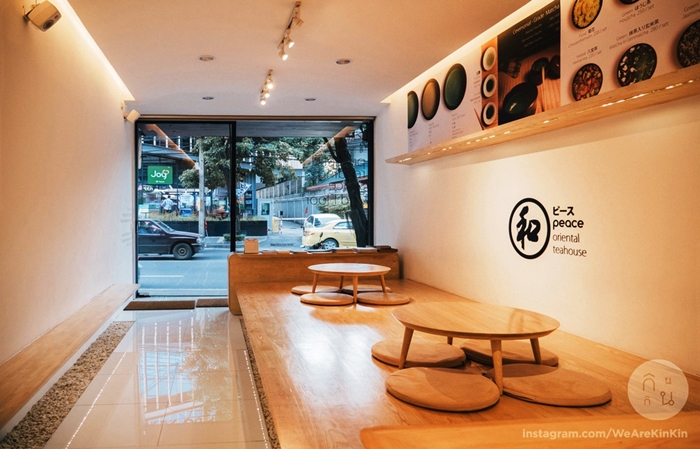
Peace Oriental (Maps link to one branch):  I think an earlier attempt at making a theme like that at Koto Tea Space didn't work for Peace Oriental, and they're on to being more of a standard cafe now, selling blended flavored iced teas and such, as well as more traditional versions.  It could still be interesting, if your path takes you near a branch.  I might've only visited one branch of this chain one time; again I'm just not that into cafes.  If you spend $10 on a decent pot of tea you might as well add 10 more and buy a decent tuocha's worth, or a passable 100 or 200 gram amount.  

Everything I'm saying here is a biased and one-sided take, of course.  I'm not into style as a main attraction in tea shops, and marketing spin pushing pricing for good basic version options to double what they sell for elsewhere.  Some people value style, and a "curation" function can seem to add value, beyond simple tea quality in relation to price.


their older theme was all white space; on to an updated natural materials look


the outlet I visited, which may be closed now


Ong Yong Choon (that is a Maps link) / other local shops:  there are countless places selling all sorts of variations of teas in Bangkok, hundreds if you count bubble tea and matcha outlets, or maybe even thousands.  This place I've named is an old-style tea shop near Wat Pho (a main temple), or more specifically beside the flower market beside Wat Pho.  

More conventional examples would be new forms of cafes, which keep opening and closing every year.  I've heard of 3 or 4 new versions this year but I'm only mentioning places I've not been to here when it makes sense to, when I've heard enough about them to reliably pass on what they are probably like.


Ong Yong Choon, the owners (who are so nice, as I keep saying about everyone)


Traditional shops / Cha Tra Meu:  I've still not mentioned anything about the orange flavored Thai tea, or the versions that look like teh tarik in Malaysia (pulled tea, with added reference to pouring it back and forth), often brewed in what looks like a small wind sock.  Both are around, they're just different kinds of things than specialty loose tea.  If you are in a really old-style restaurant or food court and see that old form of brewing you should try it out, but it's just inexpensive black tea with sweetened condensed milk.

The orange flavored version is something else.  Ordinarily I don't like artificially flavored teas, and it definitely is that, but that is tasty.  There's a shop selling it--Cha Tra Meu, the main one--in the building where I work, and I've never bought a take-out or loose tea version there.  It's not taste preference that stops me from having it; I avoid eating processed sugar and artificially flavored foods.  For exceptions I'll eat donuts and ice cream sometimes, but not drinks that are full of sugar.  For people who are more open to that buying a tin of the flavored loose black tea might be good.  Dairy Queen here did a Thai tea flavor promotion at one point and it's for best for my health that was temporary; it was too good.


In talking to someone recently about why it seems like there are gaps in what is sold in shops here a few factors seem to combine.  Tea awareness and demand is limited, and Chinatown shops already cover that for people who have been into tea for awhile.  Online options increase, sales through Facebook pages, and large Thai tea interest groups / marketplaces are crowded with people selling lots of things (this is only one example).  

Some of those group posts would just be reselling the best of what is sold by small producers through Facebook pages, teas you could buy directly for less, and a lot of the rest would be Taobao or Alibaba purchases, a lot of which wouldn't be good tea, or selling at a good value.  Over time people would probably sort out which individuals are most reliable, and turn-over would weed out some of the least reliable options.  There are limited Western-facing online sales options; let's consider those.


Online:


Unfortunately the best Thai sheng is only available online, as far as I know.  I guess that's a good thing for people reading this who would never make it to Bangkok?  Wawee Tea is a good starting point, a main traditional producer, and Ming Dee is perhaps the other main producer option.  Those kinds of producers would have Facebook pages, or there are lots of online shops in the two main online sales platforms here, Shoppee and Lazada.  I'll skip looking up links here; people can Google search or look up blog posts here that contain those names.  

I didn't really intend for this section to mostly be about Thai sheng; it just worked out that way.  At least some of these outlet sell teas way beyond that range, even though I'm discussing sheng most here, and not the oolongs or black teas as much.  It's what I buy most of and drink myself.


Tea Side is the main Western-facing website outlet.  Value isn't great through them, with decent sheng selling for between 50 cents and $1 per gram, when you can find equivalent versions for far less if you put more effort into it.  For people who don't see spending $100 to 200 as much expense for a tea order, and don't care what that works out to in relation to $ / gram, then they're a great option.  

Their products are consistently good.  Sheng options are fine, or black teas are good, Dian Hong style versions from Thailand.  Aged tea options are also good, but that $200 won't go very far buying from that range.  Their small-batch shu versions are good, and a gui fei bug-bitten rolled oolong was nice in the past.

Let's make that summary more specific related to buying a young version of Thai sheng; what if you wanted to buy a moderate cost, most recent Thai sheng version they sell, how would that go?  There are two identically priced at the lowest cost, $70 for 200 gram cakes, both from 2018, this one a more bitter version.  It's not 50 cents a gram, but that is $130+ for a standard cake, nearly double in-house boutique style productions by other vendors, or 1 1/2 times the higher end of that range.  At that pricing you have a lot of options.  A 2021 version sells for $85 for 200 grams; close enough to that 50 cents a gram level.  It's just not the kind of outlet option where you find this year's tea selling at all, never mind related to style and pricing variations.


Rishi--the US wholesale vendor--sells cakes from different countries, including Thailand; that would be another decent option.  There must be other Western vendors selling Thai sheng, I'm just not familiar with any.  

Let's dig a little deeper; how good would quality and value be?  This is a 2022 Wawee origin sheng "pu'er" version, selling for $45 for 200 grams.  I've bought tea similar to this over the past two years, for slightly less, but $80-some for a standard cake amount is definitely still fair, depending on aspect range and quality.  They carry some Laos teas too; for people who aren't concerned about the $80 or so per cake price range I expect those would be interesting in character, and safe bets for quality level.

I can't say that their teas are definitely as good as Tea Side's, because that's too much generalization, but it's my guess that it comes down to preference instead of quality, and some people might like them more.  It can be natural to assume that pricing must correspond to quality level but varying outlets set pricing differently, and carry different options, and equating cost with probable quality level doesn't work.


Moychay Thai forest tea initiative:  I've written about trying a cake from Moychay's partnership operation in Thailand, with tea versions selling through their Netherlands outlet.  It's tempting to try to describe their teas in relation to what Rishi or Tea Side is likely selling, or Wawee Tea and Ming Dee versions, but it can introduce a lot of error to generalize across a lot of versions, when I've only tried one (or two?; maybe a loose version as well).  The quality of what I tried was quite good, the material was obviously high in potential, and while the style wasn't a complete match for Yunnan versions I liked it.

That theme applies to a lot of South East Asian sheng I've tried; often it's not produced in exactly the same style as Yunnan versions, often varying in ways that I like just as much.  Oxidation level can creep up a bit, maybe due to not rushing the processing steps to offset that, or maybe it's that hotter and more humid local conditions let the tea transition faster during the limited processing time.  Or maybe heating step, the sha qing / kill-green / pan frying step, is slightly different.  Teas can end up trading out some bitterness, astringency, and aging potential for extra sweetness, initial complex flavors, and approachability.  For a version that you plan to drink within 2 to 3 years that can actually be positive; for long-term aging it's not favorable at all.  

It's possible that Tea Side filters what they sell to match Yunnan styles better, so their higher pricing level could be justified, for some.  Or maybe they just charge more; I'm not implying that aging potential / style issue maps out like that across most versions, related to Tea Side matching Yunnan style and Moychay being more like local Thai versions, although it matches my past experiences.

I re-tried a favorite Thai sheng from 2022 just this week--from a local source that's hard to access, not one described here--and it was much different and just as pleasant as last year, not seeming to show great potential for 15-20 year aging, but to me a fantastic tea for drinking right now.  It was not just on par with but slightly better than what I've sampled from all of these other producers (per my preference; that's not intended as an objective judgment).

In terms of positive experience and quality that Moychay tea I tried was good; I think it would also hold its own in the now-standard $80 per standard size cake range, a pricing that's a bit high for me to buy or drink a lot of, even though it's quite standard.  

This autumn version from them sells for 13 Euro ($14--what's up with the exchange rate?), for a 200 gram cake, so that's still very favorable pricing.  Autumn versions give up a little intensity and tend to cost less but that's still a great deal.  They list that one as "green tea," which I think is a translation issue, but it really could be pressed green tea, even though that existing--a pressed cake of green tea--would be stranger than getting a translation wrong.  

This other cake sold as sheng is 239 Euros for a standard size cake (on towards $250).  So it goes with buying pu'er; you can accept what someone says online as input but you never really know until you're tasting the tea, especially if the person offering input hasn't tried a specific version.  Style variations throw off the "good / not good" objective judgments; my absolute favorite Thai sheng not all other pu'er drinkers would even like.  


To complicate things further you can try 2 or 3 versions from a producer and think that those must map to all that they sell, good or bad, but that can vary a lot too.  Buying what they price the highest probably bumps the chances that you'll try their best versions, but even that might not be consistent.  Demand for a type shifts pricing just as much as quality, and many vendors just apply a standard mark-up, so if they get a good or bad deal on material / products your cost can vary by that factor more than quality level.  The smaller the vendor and less direct their source connection the more that applies, but in general pricing mark-up is a commercial function instead of relating to a quality judgement; it can vary a lot.