Showing posts with label Lincang. Show all posts

Saturday, February 21, 2026

2007 8281 Yellow Label Mengku sheng pu'er, compared with 8891


it's like visiting an aunt and uncle there, even though I'm not that much younger


I'm reviewing a tea sample the owners of my favorite Bangkok Chinatown tea shop, Jip Eu, gave to me when I last visited them.  It's a little unconventional that we tried that tea there during that visit, so I'm writing about it again, based on a much closer form of review.  It was nice of them, to give me more to also try later, and perhaps wise of them to get that impression documented in a tea blog, just by handing over a sample.

It's a little odd, but my impression of it changed.  I was fasting that day (the first day of 5), and talking quite a bit instead of focusing in, so two things changed.  Three, really; I also brew tea for myself differently, because I based infusion timing each round on how I liked the last round.  My water source is probably also different (filtered local tap water, but the filtration must vary).

I don't have a listing or site description to provide, under the circumstances.  Jip Eu is on Facebook here, and they're on Shopee, for people online shopping within Thailand (maybe easier to find as "Three Shell Tea").  I looked up online listings, and two different vendors sell this for two completely different price points (the 2007 version, probably the same tea, although I guess this could be sold in different batch numbers, so maybe not identical).  Here is one of them, listed by Crafted Leaf Tea:


2007 Yellow label Raw Puerh - Iron Cake


Tea Bush : Grade 1 Mengku large-leaf tea bush species

Made from supreme old tree Mengku material, this is a high quality raw puerh from a village in the Brown Mount. region. After 13 years of aging this cake has enter its mature stage, most of the strong bitterness & fresh fruitiness of raw puerh has turn into a mature taste crafted by time.  Comparing with our 2003 Premium Yiwu Private Collection Raw Puerh - Chimney. It features less smokiness but with a very well balance of sweetness of ripe puerh and pinewood & mineral bitterness, followed by a lingering light caramel aftertaste. The aroma lingers wonderfully in the throat. After about seven or eight steeps, the taste becomes more tender and mild, and starts to show a light, mellow fruity fragrance.


So they're saying that it's a Mengku, Lincang region tea.  Google's AI input and another listing agree this was made by the Kunming Tea Factory for CNNP release (Zhong Cha).

This second "Dragon Tea House" listing sells this cake for $40, while the other vendor, Crafted Leaf Tea, sells 50 grams for $22.  What should we make of that?  I'll spare you the idle speculation, beyond this summary.  Maybe one isn't "real," maybe one is overpriced, maybe there are other factors.  $40 for a 19 year old standard producer tea does seem low.  This was selling for closer to that than whatever $22 for 50 grams works out to (nearly 50 cents a gram?  come on.).

This other 19 year old CNNP cake is pressed as a 500 gram version, now listing for $104 through Yunnan Sourcing, where I bought it awhile back.  I first reviewed that in 2019 here, seven years ago, and don't seem to have any newer comparison use review to check in on.  People who have been following Yunnan Sourcing for a long time, and drink sheng pu'er, probably have already bought this cake; somehow it became the standard entry point item to try out way earlier on. 


Reviewing tea labels:  this could be a step too far, but in looking at the three labels of the three teas presented as generally the same they don't match.  The Dragon Leaf version has a different bottom producer identifier name, and the yellow mark in the center is slightly offset (although the Crafted Leaf page includes pictures of both types of differently marked labels; strange).  Make of it what you will; it's not intended as evidence of any indirect claim.  Per the owners of this shop they bought a good bit of this tea back in 2007 from a producer outlet when it came out, which on the face of it sounds reliable.  Who knows though.


the Jip Eu cake label


Crafted Leaf Tea version


Dragon Tea House version (note the "product of") section


Review:


8281 left (my cats just broke one of the plainer cups I use most often; not helpful)


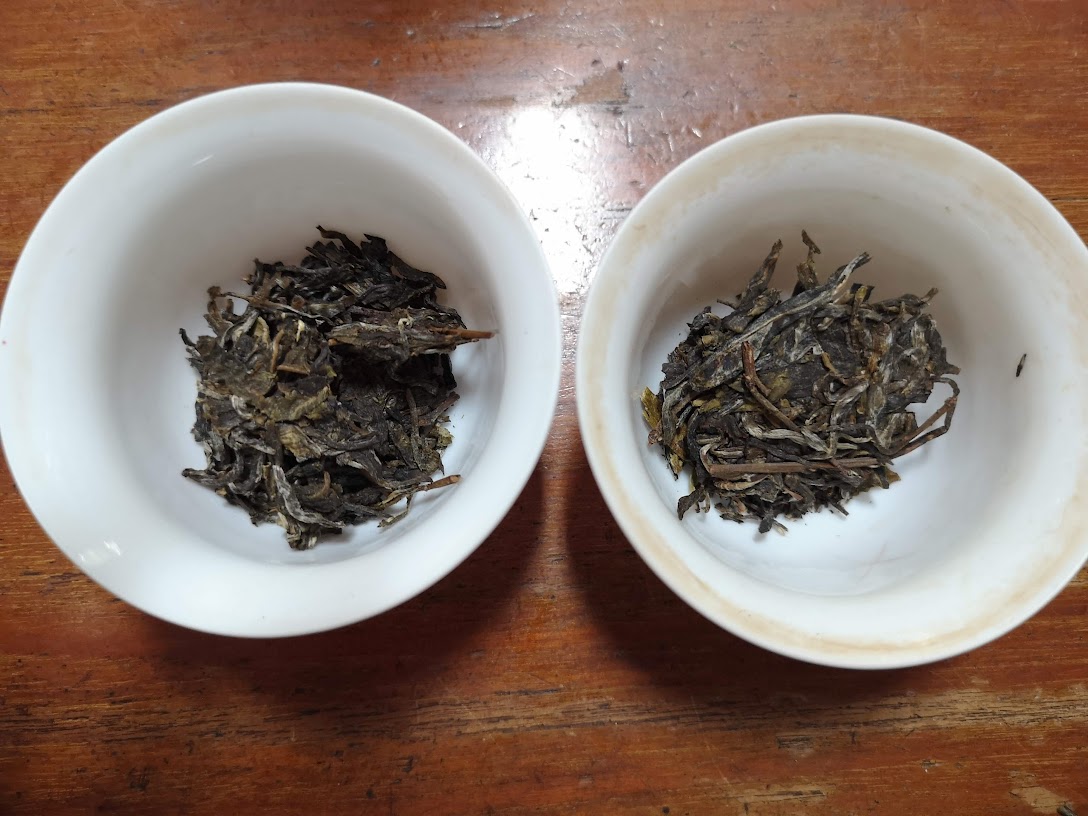
8281 Kunming / CNNP 2007:  it's interesting that this is much darker initially, both the leaves and the infusion.  They're both 2007 versions, but the other spent half its time in Kunming, in relatively dry and cool storage, and this tea version came to Bangkok back when it was produced, bought by the shop owners back then.  It has been stored hot and humid.

Flavors are heavy, of course.  It's relatively clean though.  Beyond the heavy mineral base a pine note stands out, and some medicinal herb tone.  Feel has a nice thickness already, and it has only been one short infusion, after a short rinse.  There may be brighter and sweeter spice that will evolve, or maybe even a touch of dried fruit, but I think this will be easier to read next round.


8891:  it is lighter in flavor range, but this has transitioned pretty far along already.  It's not how I remember it.  There could be a faint hint of smoke-like flavor, but beyond the slightly lighter mineral it tastes something like aged bamboo might.  It's not exactly woody, but pretty close to that.  Sweetness is decent; it gives it balance.  There's just a hint of sourness at the finish, which doesn't ruin the effect for me, but I suppose it's not mostly positive.  Going back and tasting the other after this, the same first round, a bit more root spice stands out in that in contrast, towards root beer, or sassafras.  

I'm not sure why but I'm feeling these teas after the first round.  I took a week of drinking a lot less during a 5 day fast, and never really increased back to my earlier level in the week after, so my caffeine tolerance may be low.


the leaf and liquid color difference is noticeable


8281 #2:  these brewed for about 15 seconds, or maybe slightly over, which is a fairly long infusion for a high proportion and strong teas like these.

It's interesting how heavy and strong this flavor profile is, with it being clean at the same time.  This might turn into pretty good tea with another half a dozen years to finish the full fermentation transition process, which is really far along now, maybe equivalent to over 30 years in cooler and drier storage.

Heavy flavors could either be seen as a selling point or a negative, depending on preference.  Quite heavy mineral tone stands out.  It's strong enough that you need to "taste past it" to identify the rest.  One part of the remaining flavor is like a cured tree bark tone (so woody in a completely different sense than the other tea).  Spice range is still present; it links with that, or overlaps, some range of root spice.  Less of the more forward, bright, dry pine note is present, but it's still there, just in a different balance.  Other complexity probably still does relate to medicinal herb range, ginseng and such, but it's all hard to place, integrating with or being overshadowed by the rest.


8891:  complexity is good in this; there's a good bit going on (which is all relative, of course).  And the tone is lighter, which works well.  That hint of sourness at the end is a little more pervasive now.  I don't necessarily see it as a flaw, but if it was swapped out for something else the tea could be much more exceptional.  It seems to connect with a dryness that you feel in the center of your tongue as you drink it, and more just after you swallow.  

I remember this as a heavier and rougher edged tea.  It has mellowed.  The heaviness of flavor tones fading could easily relate to my judgment changing, or my general perspective.  Tasting any tea in combination with another also shifts things; that becomes a fixed baseline, adding a bias for what is a heavy level of any one input, or placing different aspects differently in comparison.

At this point I like the 8281 better, but this early sourness and dryness may be something that evolves out of this version over a few infusions, so it seems too early for that kind of judgment.  I should mention here that some claim that dry storage is "bad" for a tea, not for just slowing down transition pace, but also for imparting a slight sour note to teas.  I never really knew if that holds up, oddly, even though I've tried a good bit of dry stored pu'er.  Storage that is too wet (humid) is said to impart either a mustiness or overly heavy tones to a tea, or maybe both.  Then people talking about relative optimums tends to make for a complicated subject.


8281 #3:  brewing this faster, at 10 seconds, and being a couple of infusions in really lets this tea shine.  The flavor aspects I've been talking about (pine, heavy mineral tones, limited root spice, other medicinal spice) haven't changed, but the balance does shift completely.  Feel is still good, and pleasant aftertaste carries over.  Sweetness level is nice.  It works.  Brewed a bit stronger it probably wouldn't; this tea is pretty intense.


8891:  this also balances the best it has yet.  The bamboo woodiness seems to evolve to more of a sandalwood spice.  That one light sour range aspect is fading, or maybe a lighter infusion makes it seem to drop, but it's still present.  Feel is better.  

It's interesting tasting these and "looking for" the standard descriptors people often apply.  Do they taste nothing like betel nut (which could only be a guess on my part, not having tried that), or camphor?  Maybe the first (8281) does taste like betel nut, and the second like camphor.  Probably that second attribution is more grounded; there is an edge to this tea that kind of matches that.  The first seems to emphasize that light spice range all the more in comparison.


8281 #4:  I'm getting rocked by these teas.  Colors and color definition seems more vivid; it's affecting my vision.  Why didn't I put less tea in these gaiwans?  It's like a mental block, as if I can't.

This tea is really catchy, the way that a root spice stands out, with so much more going on beyond that.  Sweetness picks up, so the rootbeer like tone leans a little towards a dried fruit note input, but it's still really a sweeter range of spice input.

If flavors were a little heavier it would be too much, but for me that part is fine.  It's really clean, supported by great sweetness, rich feel, good balance, and pleasant aftertaste.  Maybe it would've been even better if it had been stored in a slightly cooler and drier place, and aged for 30 years instead of 19.  A decade of extra wait is a significant trade-off; you can't just move yourself through time to experience that.


8891:  that early sourness is losing its place in this tea, for the best.  It lacks some of smoothness and root spice complexity of the other, but a different form of lighter sandalwood sort of range spice is nice in this.  A light camphor edge has seemed to replace the sourness, definitely an improvement.  It might be even better after 4 more rounds, but it would be pushing it to drink just one more.  Let's go there; let's push it.


8281, #5:  I'm giving these more like 20 seconds to see them from a different perspective.  Heavier tones pick back up again; it's interesting how infusion strength varies perceived character like that.  And it's also handy, to be able to shift what you experience so easily.  It was better a little lighter.  That heavy mineral starts to come across almost like a charred tone, where is was part of a less prominent background context, less strong than the root spice, last round.

It's still not bad, not flawed, or too far out of balance, but it's better brewed lighter.


8891:  this version balances just fine brewed a little stronger.  The sourness didn't return; that did evolve out over early infusions, as I guessed might happen.  It might be slightly better than last round for being a little stronger.  It balances well.  One might expect the camphor effect to pick up, brewed stronger, but it's kind of the same, the flavors are just a little more intense, and the feel.  The other is smoother and richer, with this retaining a little dryness, just not in the same form as over the first few rounds, not as pronounced.  

If you drink the other right after this, while the aftertaste is still present, the contrast in it tasting so much more like spice really stands out.  Tried the other way that dryness stands out most in this, tasted right after the other.  It's not all that challenging or negative when you just drink this 8891, but in comparison it's more negative.  


Conclusions:


I tried a couple more rounds later and there wasn't more story to tell based on that.  Of course they didn't fade out and die within the first seven infusions.

I suppose that I like the 8281 more.  Could it be because it's more fermented, further along in aging transition?  Hard to say; that's not impossible.  The 8891 is lighter, smoother, and more balanced than I remember.  I may not have tried this for years.

Both are pretty decent.  I don't think these are what the Teas We Like curator vendor are probably looking for as the absolute best examples of aged sheng potential, but they're decent, and solid.  It doesn't help that I very rarely drink 20 year old range tea at this point; I mostly drink young sheng, within 3 or 4 years of being produced.  It's completely different in character.  It's interesting completing a 1500 word tea review without mentioning bitterness, for example.

What was missing, if these were reasonably well balanced, with pleasant flavor range, and not really expressing clear flaws, but I'm judging them to be good but not great?  Complexity was decent, and balance ok, but they both could've had a little more to offer.  That root spice range in the 8281 could've been more pronounced and spanned more interesting scope.  The 8891 had issues with dryness and light sourness early on, and then later evolved to be more pleasant, but it still mostly covered spice that wasn't so far removed from wood.  I think both will probably be better as 25 year old teas, that having plenty of intensity at this age is a good sign, so both have room to change positively, if only a little.  This 8891 might be fully age-transitioned at 30 years old, as this is going.

I hadn't planned to buy a cake of this but now I might.  As I mentioned I tried it once before, visiting that Chinatown shop, during a fast, on the first of 5 days off eating.  I didn't like it as much as this time.  It helps slowing things down and spending time with a tea, and brewing according to your own preference.  It helps having eaten.  Your sense of taste changes a lot more after 3 or 4 days of fasting, and you can smell the neighbors cooking dinner really far away, but just skipping breakfast changes things, a little.

This tea--the 8281--might be even better with a few more years to complete a transition, or a half dozen.  The 8891 is also much better than it was something like a half dozen years ago when I tried it last (maybe 3 or 4?  I lose track).  These are definitely not fading to not include much flavor intensity.  

To me this range, standard CNNP character, is one of three good examples of favorable and distinctive factory tea production, along with Dayi and Xiaguan.  Maybe people would typically prefer one of those over the others?  I really do like best-case outcome Xiaguan versions.  Or even the barnyard character of well-transitioned more standard range.  Many of their teas come across as rough-edged and basic but that flavor range is interesting.


there is a second cat over on the other side of the fence


Saturday, November 29, 2025

Lincang and Fengqing (Yunnan) material Fu zhuan


I'm reviewing two exceptional Fu zhuan (hei cha) versions made from Yunnan Assamica material, from the Lincang and Fengqing areas.

This is an unusual theme, re-trying versions of tea I reviewed over a year ago (sent by Oriental Leaf for review; many thanks!).  I think vendors have sent the same samples more than once before; it could be hard for them to keep track, as I have to look up what I've tried in the past.  It should be interesting though, because I've been trying more Fu zhuan style hei cha recently, and quite a bit of Liu Bao over the last few months.  I should be more dialed in to that range.

Part of the point here is to compare the style to the other Fu hei cha processed versions I've been reviewing, with two of those based on white tea material.  This is from Assamica material typically processed into pu'er, from Yunnan.  I'll cite the vendor description to fill that part in and get right to it.


On Taoism - Jingyang Golden Flower Fu Brick Tea - 190g Cake ($38.50 for 190 gram cake)


This 190-gram round Golden Flower Fu tea cake is the miniature packaging version of another of our best-selling 350g cakes. Although it is small in size and a bit lighter in weight, the quality of the tea is the same as that of the popular product.

The classic Golden Flower Fu Brick Tea from On Taoism Tea Factory is a signature product of our tea house.

We offer two options:

One is black-wrapped, made from grade one dark tea from Lincang, Yunnan, with a more intense tea aroma.

The other is yellow-wrapped and made from a particular grade one dark tea from Fengqing, Yunnan, with a deeper tea aroma.

Both types of tea undergo post-fermentation and flowering processes in Jingyang. The buds in the red packaging are more tender, while those in the black packaging are more durable for brewing.

These high-quality compressed tea cakes were produced in 2020. They stand out for their ability to be stored long-term and transform, resulting in a more mellow taste.

The most distinctive feature is the high density of golden flowers in the compressed tea cake. These golden flowers, a beneficial microorganism, signify high-quality Fu Brick Tea. To emphasize this feature, workers split the tea cake in half before it left the factory, allowing you to see the dense golden flowers upon receiving the tea. As mentioned in a previous blog, the number of golden flowers is a crucial quality indicator of Fu Brick Tea; the more golden flowers, the better the quality.

This Fu Brick Tea, with its unique round cake shape, supports the traditional and natural growth of the golden flower fungus. Unlike the brick shape of traditional pressed tea, this tea undergoes a unique post-fermentation process using Jingyang water in Jingyang. This process, involving controlled exposure to moisture and air, enhances the tea's flavor and aroma. Thanks to the cotton paper packaging, the rich, high aroma can be appreciated even before brewing.

The Golden Flower Fu Brick Tea offers a unique taste and brewing experience. The tea leaves, known for their durability, can be brewed over 15 times. The taste combines fresh, sweet notes and a returning sweetness with a clear and bright soup base. The On Taoism Tea Factory maintains a clean workshop, ensuring the tea's high quality without washing.


These probably do change a little year to year, but maybe more in the way shou / shu pu'er transitions quite a bit over the first 3 or 4 years, and then changes are gradual and more limited after that.

That pricing is equivalent to a $72 357 gram pu'er cake.  For some Fu zhuan versions that would be on the high side, but these are exceptional, so that seems fair to me.  It would be hard to find other versions that are as distinctive, high in quality, and pleasant, and especially difficult to find anything better.  From there it's down to styles matching preference, which I hope gets described in the notes.


Review:


Lincang material, black label (left in all photos):  I didn't use a rinse; that's a judgement call.  I'm not sure where conventional wisdom stands for rinsing this particular tea.

Flavor is pleasant, rich and complex.  A dark rye sort of bread like aspect stands out.  It's not as heavy, not as dark, as it might be.  One part is lighter, even leaning towards citrusy.  In between complex tones could be judged in different ways.  One would have to mention spice to fill in a decent list, but it's complex enough spice that it's not simple to break down, along the line of incense related spice.


Fengqing material, yellow label (cream colored, really):  even heavier; this is closer to a dark rye, or on towards pumpernickel.  It's clean though; none of the earthy tones seem musty or off, also true of the other version.  An unusual mineral range stands out in this.  Usually mineral tones are light, like flint or limestone, or else quite warm, onto darker colored rocks range, but this isn't so easy to place.  A different spice tone stands out.  For sure that fungus, the golden flowers, is contributing a lot of that to both, so for people familiar with it I could just say these taste like two different variations of golden flowers.  A bit of beeswax sort of flavor comes through, and beyond that again spice tones are hard to place.  Maybe dried fruit plays a role; I'll try to separate a list better next time, but this will probably transition a little already, with a lot of the outer fungus rinsed off in that round.

In retrying both just before going on to the next round the lighter colored first version, in the black label, has a bit more of a distinctive heavy towards actual fungus range, like an old tree bark or log smells in the forest, and the darker colored second version is lighter and brighter.  Interesting.  I don't remember which of these I liked more the last time I tried them, but it will be interesting to see if that changed.


Lincang, black label #2:  even brewed very fast, under 10 seconds, intensity and complexity are great.  Mouthfeel is even full, with a bit more structure to it than last round.  This is giving off a tree bark sort of tone, in a good sense; it's clean, rich, and complex.  Bright tones stand out too, giving it a nice balance.  It's mostly in the range of spice, perhaps with a bit of dried citrus peel standing out.  This is probably the kind of tea that no two people would describe in the same way, so a text description may be of limited helpfulness.

Sweetness, rich feel (with a hint of dryness), and aftertaste really contribute to the experience.


Fengqing, cream colored label:  warmer tones are interesting, especially in contrast with the other being as light as it is.  That seems to have switched, that I just said the opposite in the first round.  I think that round was about the flavor of the fungus that had been rinsing off, and this one relates as much to brewed tea leaves, which are just getting started.  This tastes more like a dark bread, again.  There's a hint of the warm, rich earthiness present in shou / shu pu'er, that peat range, but not much.  It's light and clean in effect, and integrated with the rest in this.  It's more in the dark bread and spice range.  

To me, based only on limited past exploration, to be clear, you don't tend to see this much complexity, balance, and depth in hei cha of this type, Fu zhuan.  The intensity is unusually pronounced.  As I recall, although I didn't re-read an earlier review, these are made from high quality Yunnan material used to make pu'er, not something a bit less (distinctive, or lower in quality?).  I mean the material probably had more potential than hei cha material often does.  It's not made of sticks either, and probably not based on old leaf material as much.  It's just a different thing, across all of those dimensions, related to origin, plant type, and plucking / harvesting standard.


Lincang, #3:  I gave this a little longer, 15 seconds, although the intensity was fine before, maybe on the high side.  It would probably make more sense to use half as much of this tea, dropping the proportion, and brew it on towards 20 seconds.  That's just habit from maxing out proportion most of the time, not an earlier guess about an optimum.

There's a spice oriented range in this that I'm probably never going to describe well.  It reminds me of the Dune theme; this probably tastes a lot like their melange spice would.  It's full and sort of earthy, but also bright and complex.  It hints as lots of spice tone, and also lighter range like dried citrus peel.  Mineral is a part of it, but it's so integrated that it's hard to place, as light or dark, tasting like some particular rock.  Feel is full and rich, but it has an edge of dryness.  It's like how a black tea might include a touch of astringency giving it a little dry feel.  I suppose some might connect this feel and the flavor to that experience, and say that it tastes like the malt in Assam.  It does, a little.  That's probably what I was missing, to the extent it's not just a set of lots of flavors.


Fengqing:  a creaminess picks up; that's interesting.  It's in the form that creamy feel, sort of tied to tastes, emerges in stout beer, like Guinness.  Hints of rich dried fruit also pick up.  Where the other is spice-oriented with dryness this is now on to really tying back to the heavy, dark bread range, not unlike stout, with sweetness picking up.  Feel is rich and creamy, not dry at all.  It's missing that malt edge in the other, which could be a good or bad thing, depending on preference.  

From there one might see parallel with warm tones in fallen logs, with tree bark.  It's also leaning a little towards cacao, but I don't think many people would make that association, because it's not quite there.  It's the way that rich flavor range, soft feel, and complexity come across that implies something like it.  

At this point I like the cream colored label version better (later I'll swap in tea plant material origin locations for main descriptions).  That complexity, spice, and dryness in the first works, it balances in a positive way, but this second version is really unique.


Lincang, #4:  not so different than last round, so I'll mostly skip repeating it all.  Maybe a bit of extra sweetness picks up, an extra dried fruit oriented flavor that's hard to place, partly related to dried citrus peel, but there is more to it.  As to form of citrus I'd say it's red grapefruit.  An Assam drinker might really love this.  I mean someone drinking really good orthodox, high quality Assam, not the ground up stuff that requires milk and sugar.  It includes some of the same malt and fruit, plus an extra dimension or two.  Astringency is very limited, to just a bit of dry edge, but to me that's a good thing.  


Fengqing:  a different kind of spice range enters in, a root spice effect, along the line of sassafras, just not exactly that.  Warm tones stand out all the more, although I guess that was also true in a different sense in the last couple of rounds.  It's creamy in a slightly different way, leaning towards root beer, instead of stout (actual dark beer).  

This is a really unique tea experience.  Both are, but it seems like parts of the other version's character turn up in other places more, in other types.  You just don't end up drinking teas that land right in between dark bread and root beer for flavor range, or maybe really spanning both, including them.  If that somehow didn't make sense together, if it didn't integrate, this could be really off-putting, but it ties together beautifully.  I'd be surprised if I didn't like this tea version more last time.


Of course the teas kept brewing, without changing character that much over the next few rounds, eventually fading later.


Conclusions:


I had reviewed these earlier here; one of the points of this review is to compare notes.  I brewed them Western style, which isn't typical for me for most tea types.  It's not a bad call, related to this style of tea, but you experience more distinct flavor aspects when you Gong Fu brew them.  It also helps with dialing in infusion strength.  

It makes it hard to compare impressions, because they were made differently, and expressed character differently as a result.  The general impressions match, but this second review adds a lot more detail.  This tea is good enough that you probably should Gong Fu brew it; you see an extra dimension or two that way, and it's worth it.  Or if you don't feel like going through that some of the time results are fine the other way, unlike brewing a lot of range of sheng pu'er, which typicall just doesn't really work out well.

Drilling down to finer flavor aspects more, and feel character, it was interesting how one part of the Lincang range reminded me of good orthodox Assam experience, the slightly drier feel, and touch of malt.  You might only associate the flavor with malt if you could make that connection, since it's natural to be "looking for" other earth, spice, and dried fruit range instead.  

The Fengqing expressed more spice range in the Gong Fu brewing based review, like sassafras, coming out more after the first couple of infusions.  Brewed Western style those same generalities turned up, but in far less specific form.  Someone might have even interpreted it as leaning towards cacao, when I saw it as closer to root beer in the last round.  If it sounds like it's closer to shou / shu pu'er I would say that kind of partly works, but it's not related to peat flavor, which is pretty common in shou.

Compared to the other Fu zhuan versions made from white teas these are just different.  Those might have been a little lighter in character, possibly slightly sweeter, maybe with different pronounced fruit tones.  There was a little fruit range in these too though, and earthiness was present but not in a way that dominated the character, nothing unusual, that necessarily would be regarded as a flaw, or negative input.

I should be able to say which matched my preference most, even though that alone can be tricky comparing over weeks of time, and it doesn't necessarily mean anything to anyone else.  Often when you try a tea a few times your impression changes, and you relate to it differently.  That last Fu zhuan tea was pretty good; I can't say that I like either of these more.  It had a clean, bright, fruit intensive range, with lots of depth, that all balanced well.  But there is something really interesting and appealing about the Fengqing version, the way that particular spice range and varied depth come across.  The other is good too, and for a tea to have with food it might be better, but in terms of this impression I liked the Fengqing version more than the Lincang. 


Tuesday, October 14, 2025

Shaanxi Fu hei cha processed Lincang material


The last review of an Oriental Leaf tea (sent by them for review; many thanks!) was of a relatively unusual type, a Shou Mei white tea used for secondary Fu hei cha style processing.  It was good, and of course unique.  This could be just about anything, based on that.

I wrote the review notes without knowing what it was, which I looked up later.


Chang’an Golden Flower Fu Brick Tea Mini Cake 2022 – Yunnan Leaf, Shaanxi Fermentation


In ancient China, tea merchants carried Raw Mao Cha (黑毛茶) tea from the misty Southern China mountains to the imperial capital of Chang’an, where it became beloved for its warming, restorative character during long Silk Road journeys. Our Chang’an Golden Flower Fu Brick Tea Mini Cake pays homage to that tradition, marrying first-grade Yunnan Lincang 临沧 dark tea leaves with the historic Jingyang 泾阳 fermentation that nurtures the signature “Golden Flower” probiotic bloom.

Beneath its smooth black-brown surface lies an amber-red liquor reminiscent of aged whisky or polished carnelian—bright, clear, and resilient across many infusions. The aroma evokes toasted wood, aged barn oak, and a gentle hint of honeyed dates, while the palate unfolds with velvety malt sweetness, subtle nutty tones, and a whisper of warm earth. Its finish is clean, slightly sticky-sweet like glutinous rice candy, leaving a long-lasting, soothing warmth.

Unlike dense traditional bricks, this 60g thin mini cake breaks apart easily by hand—ideal for gifting, travel, or brewing a single session without waste. Its Chinese name, “Bashui Run Chang’an” (“八水绕长安 Eight Waters Nourish Chang’an”), celebrates the life-giving rivers that cradle the ancient capital of the Tang Dynasty, infusing each cup with the poetic soul of Shaanxi.


So it's something different, again.  Really it would help to unpack more about that general tea type, and distinctive type-typical local variations from that area (Shaanxi province), but I may never get around to that.

I should clarify that Oriental Leaf may specialize in hei cha, and Fu brick style teas, but they sell a broad range.  I think they're sending me these more interesting versions just now because they think I'd find them interesting, and I do.


Review:


#1:  it's tempting to guess the tea type even before listing out aspects.  It's in between black and hei cha styles, it seems.  The color is reddish; that's typically oxidation.  Flavors, the primary range, are mostly black tea oriented, towards fruit and floral, with pleasant mineral grounding that, maybe into dark wood a bit.  But there's something else, a type of spice range that's unique.  And malt; that's back to standard black tea character.  

Maybe there's even a little distinctive sourness, which can come up in some types of black tea, but which stand out in different ways in hei cha.  I'll try a second round to get a different perspective on the tea, brewing it a little lighter, since I let this go a little long, to get the compressed tea to open up.


#2:  woodiness picks up a bit.  Intensity is considerable, especially considering this was a flash infusion.  Proportion is higher than it needed to be, even though it's just in the normal range that I use.  That distinctive spice note stands out.  It's almost closer to what I've experienced in different tisane ranges before, than in standard tea.  It's hard to put a name or type to that though.  It's not dis-similar to some heavier flavor floral herbs, like roselle.  A different part relates a lot more to a bark spice herb, or the like.  To use tasting shorthand people often reference something tasting medicinal, when it's hard to place; I guess that works.  I take that to mean "vaguely like ginseng," but of course it would mean different things.  

It's less similar to a standard black tea form, this round.  Those other flavors pick up, even a range I'm describing as sourness, which people might place in different ways.  Do you know how when you sharpen a pencil in an old-style sharpener, how that graphite mineral smell and the well-cured wood smell mix, in a much more sweet and aromatic form than a bit of wood and graphite shavings should produce?  It's like that.  But a bit more earthiness enters in, like a touch of dried mushroom.  Floral and fruit tones are also present, but they're hard to describe in a distinct way.


#3:  it all ties together all the better.  It may just be how I interpret it, versus an objectively clear transition pattern, but the fruit seems to pick up a bit now.  It's at the overlap between heavy floral range and dried fruit, towards Chinese date, jujube.

It would be funny if this was a tisane blend.  It's too complex, and expresses too much of what stands out in "real tea."  But a tisane like willow herb (fireweed / Ivan chay) can be quite complex, and it's typically not so different than this.  I think this still has too much complexity and depth for it to be that.  There's a limited range and depth to all tisanes, for the most part, which can be hard to work around even when blending inputs.  Real tea gives you that complexity, structure, full feel, and aftertaste input.

Again I'm stumped, for the second time in a row.  I'll try a couple more infusions to discuss transitions, then check what this is.


#4:  it's evolving, just not changing too much.  That distinctive sourness is fading, and richer fruit and floral tones stand out all the more.  If someone used half this proportion that could've potentially happened a little faster, and the final infusion count wouldn't go as far.  

Feel is nice in this, full and rich.  Sweetness is good; without that this particular flavor set wouldn't tie together as well.  It might be that only someone open to novel experiences would like this.  It's really not so far off black tea character, as some flavor aspects go, and it could just be that, but it would have to be a very distinctive version of that, something really different.  But it's not like hei cha forms I'm familiar with either.


#5:  I read what this is:  it's Lincang Assamica material processed using Fu hei cha methods, including exposure to the Golden Flowers fungus.  Cool!  Their description (cited above) is as close as I'm probably getting.  It's interesting that it turns out like this, from those starting points.


Conclusions:


Another fascinating and novel tea, something completely different.  The character was clearly positive, beyond the novelty, including complexity, depth, and balance.  Not everyone would appreciate this experience, but then that's common ground for both pu'er and hei cha experience (or if someone sees them as parts of the same set then that's redundant, unless you add an "other" back in modifying hei cha).

Our descriptions weren't identical but they overlapped quite a bit, and the spirit was the same, just different ways of describing the same tea.  Often vendors hold back from being that descriptive, for a few good reasons.  Teas can change over time, so then a few years later a description might seem off.  And people tend to interpret experiences differently, so conveying the general spirit might still seem to miss getting details right.  It's possible that a vendor might describe a tea in the best possible light, for example leaving "sourness" out as a description, which could seem like adding a biased spin, even though again the aspects list conclusion is fairly subjective.

This tea costs $18 for 60 grams, but it's hard to interpret that value part since this tea probably doesn't exist in any similar form from any other source.  That's costly as hei cha goes, but hei cha comes in a broad range of forms and quality levels.  This quality level of hei cha is unusual, and the style is a lot more novel than that.  It's made from pu'er material, it would seem, one main input to that cost.  I don't think that a per-gram price means much, since that kind of comparison just can't be done.  It works out to 30 cents a gram, for what that's worth.

Intensity of this tea stands out; that could be easy to miss, in a comment about it being a bit too strong for my typical proportion, which I'm using for young sheng pu'er.  It's fine if you flash brew it, not too strong, but using less would make more sense.  That intensity makes sense given that it's Lincang material, which one would expect to be bitter (in the sheng form, maybe not prepared as a hei cha), sweet, clean and complex (in good quality versions), and intense.


In the end this is pretty far from the character of typical inexpensive, lower quality material based Fu zhuan or Fu brick versions (which can be nice; a rough edge here or there doesn't always take much away from pleasant character and interesting flavors).  Let's check Google AI's input about that:


Fu zhuan is a type of Chinese dark tea (hei cha) from Hunan Province that is pressed into bricks and fermented to develop a beneficial fungus called "golden flower" (\(jinhua\)). This unique process gives it a distinctive taste, often described as sweet and herbal with woody notes, and it is historically linked to helping nomads with their high-meat diets. It is known for its potential health benefits, including supporting digestion and has a smooth mouthfeel that is very flexible for brewing.  


Just to clarify this is the production origin site:  Fermentation Site: Jingyang, Shaanxi, China


That description isn't too far off (sweet, herbal, woody).  What I was describing as medicinal bark spice can be interpreted more simply as wood character.  Or as aged barn oak, per the vendor's take.  It's complex enough that a broad range of interpretations would be possible.  And at the same time clean enough in effect that beyond a touch of distinctive sourness (which does seem related to the Golden Flowers typical input, now that I think it through) that there aren't many off or negative aspects to describe in any way.  

It's main strength and weakness is that it's unusual, which people could take in different ways.  The aspects character part is nice.


Wednesday, February 12, 2025

Farmerleaf Jing Mai Miyun and Cang Yuan sheng pu'er


I'm reviewing two more sheng pu'er samples from Farmerleaf, versions William had on hand and shared when I met him in Bangkok recently.  One is their Miyun version, and the other Cang Yuan.  The first rings a bell, and I've added what I remember of it in notes, so for now I'll just list Farmerleaf's site descriptions (partial citations; there are more details on those pages):


Spring 2024 Jingmai Miyun ($60 per 357 gram cake)


The 2024 version of the Miyun is slightly improved. Due to the low demand in fresh leaves this year, we managed to get some of the best 'shengtai' tea in this blend. We've mixed the production of our Liu Dui garden with tea made by our cousin, growing close to Da Ping Zhang plateau. We'll see how this supposedly superior material will develop as the tea ages. 

At the time of release, right out of the pressing factory, the tea tastes lively and vibrant, with a light bitterness, moderate thickness, good sweetness and some Huigan. This is a good tea for beginners and as a daily drinker. 


Spring 2024 Cang Yuan ($86 per 357 gram cake)


Spring 2024

Old tea garden material, Pa Pai village, Cangyuan county, Lincang

Complex fragrance, medium body, good punch without much bitterness

This is a well-balanced tea with plenty to deliver. Somewhat similar in profile to Baka and Hua Zhu Liang Zi, it is a highly fragrant one. 

We haven't visited the area, it is located is a remote county at the border with Myanmar, in the far west of Lincang county.


I might add that samples that have been travelling a bit could lose a little intensity, for going through changes in environment, or being opened and closed.  Both of these could be marginally more intense as carefully stored, full cake versions.  Depending on exposure some aromatic range could even evaporate off, but I'd imagine at most they could have just lost a little intensity.


Review:


Miyun:  it's pleasant.  Flavor complexity stands out already, even brewed lightly, a bit of pine or related vegetal edge, and what comes across as floral range.  Feel has some thickness to it.  Intensity will pick up a little on a second infusion, and it will be easier to add more details.


Cang Yuan:  there's an interesting flavor range in this version.  The other had a nice brightness, and this is warmer toned, towards warm mineral, or maybe cedar / redwood / other spice.  It seems negative, describing a tea as woody, but a supporting note matching cedar isn't so far off incense spice, and it can play a similar role in positive flavor balance.  The rest is nice, the sweetness, other flavor complexity, decent feel, good overall balance.  

It's too early to try to place these in relation to a higher or medium quality level, but that is something that will come up, related to talking to William about such things, and considering it for the last tea version I reviewed.  It's not so much distinct aspects or markers that stand out, but that refinement can be better, intensity, clarity, aspects being distinct and clean, balance, feel playing an extra positive role, and so on.  I don't over-think such things; I'm drinking whatever tea I happen to have, and exploring to the highest possible quality level was never a main part of my own exploration project.

There is an old understanding that people tend to appreciate tea for flavor first, then learn to appreciate body / mouthfeel, then later can identify and value body feel (cha qi).  Of course for the third category I couldn't separate the input of both tasted together, but it seems to me that people often really like a drug-like effect that stands out most when they drink sheng on an empty stomach, a rush of change in internal state that you can't easily notice in the same way if you have eaten.  I'm not really endorsing this breakdown of forms of appreciation here, just mentioning it.  I like how teas come together, and different sets of attributes make different teas appealing.


I think the other, the Miyun version, is supposed to be their more budget-oriented version, so more moderate in quality level.  It would be normal to achieve good results using less exceptional material through blending, to balance what a few inputs can offer, but I don't know if that's part of it.  Of course that could come at the cost of diluting down some of the more positive range of one exceptional version, some really interesting flavor input, or a special kind of feel structure, and so on.


Miyun #2:  the brightness is nice in this; there is a fresh, bright note that combines some floral and near-citrus input.  Sweetness level balances that nicely.  Bitterness is moderate for a young sheng, in the normal range, which is pleasant to me.  Astringency is normal; feel has some structure, and there's some edge to it.  To me it tastes like an above average quality version of a relatively normal style of sheng.  I guess Jing Mai origin range tends to be like this?  Pine sometimes stands out more; you can notice that, but it's probably as much from expecting it and looking for it, and you might not place it without that.

So it's good.  But it feels like I'm leaving out how it could be better, what it would be like.  Across all of that range, which is all positive, it could be dialed up just a little.  Feel is nice, and aftertaste adds to the experience, but it could be richer, with that more pronounced.  It could have more distinct, cleaner flavors.  I think that one bright flavor tone range is a main strength; to me that really works.  A bit of vegetal edge is fine, but then I love teas with much stronger versions of that, that tend to have a different overall balance, with more intensity, sweetness, and different novel flavor inputs.


Cang Yuan:  that one flavor range is nice.  The warm tone matches well with a richer feel, which carries over into a slightly stronger aftertaste experience.  It includes some bitterness but lacks the slight rough edge of the other.  Intensity is moderate, as young sheng goes; I wonder how William would take that?  This is still more intense, complex, and dynamic than any oolong, green tea, or black tea; it's all relative.  It's good.  A hint of dryness matches well with the warm tones, rich feel, and aftertaste expression.  I suppose it plays a similar role in the experience as a vegetal edge and slight roughness in the Miyun version.  

At this stage, judging between the two, I like the way the Miyun aspects fall together.  The brightness and sweetness is offset well by some pine and astringency.  It might be more challenging for someone who doesn't drink sheng, because of those, but then it's hard to say what people not started on acclimating to bitterness would make of any sheng.  I'm not saying much about bitterness in these because it's moderate, to me, but it is present.  To me it balances well in both, not really standing out.


Miyun #3:  there was a sort of synergy to how the citrus-like edge and what I interpret as floral range came together, along with sweetness, and that has developed further.  It almost tastes like a lemon drop candy.  That hits your palate first, as you taste the tea, then feel structure next, then the flavor paired with that, a touch of vegetal edge, then aftertaste after that.  It's a nice complex tasting experience.  To me--and this part is completely subjective--this is the kind of tea you could drink two or three days a week for an extended time, and it wouldn't get old.  It covers basic range in a novel way.  

The Vietnamese tea I've been using for that purpose, one a Son La version from Viet Sun, that I'm on my second cake of, is more intense, but also edgier, even harsher.  I'm fine with that; I don't think it would necessarily be better with a couple more years to mellow out, losing some brightness and intensity in exchange for the sharp edge softening.


Cang Yuan:  it's interesting how different this is.  Flavor profile is quite different, warmer, almost into spice range, but it's hard to place within that.  I could relate to someone interpreting dried Chinese date as a flavor inclusion.  Feel is full instead of being expressed as an edge.  It's not necessarily rich, not quite to that sappy sort of character, but there's some thickness to it.  It's mild, as a sheng this age goes, but there is a good bit going on, across a few dimensions.  This seems like it could be an autumn harvest tea, that limited intensity and slightly reduced range.


Miyun #4:  the aspects integrate better and better, and that lemon sort of edge becomes more pronounced across rounds.  I really like this.  The light vegetal edge and astringency are in a perfect very-moderate range to complement the rest instead of detracting from it.  

I did break form and look at these vendor listings between rounds (always added during editing), and this is what I'd described, their moderate cost version, using blending to optimize results, selling for $60 a cake.  To me it's a great value at this pricing.  William mentions in the description that it's a good year for this particular cake, that the material is better than normal.  I could see how with just a little less of that positive flavor, a little less sweetness, and a touch more astringency and vegetal edge this would be pretty ordinary tea.  As it stands in this it's quite pleasant.

It makes me think about that "daily drinker" theme, what is implied.  It seems to sweep in that you would drink better tea some of the time, and then an inferior, budget oriented version a lot of the time, the kind of thing you'd have with a rushed breakfast.  That mixes two sets of ideas that don't necessarily go together:  quality level (also relating to value), and general character, what kinds of aspects would work best for tea with a breakfast versus what you'd enjoy in an hour long session focused on the tea itself.  Who knows about the second; people would find different experiences most interesting.  

Good black tea is great for a really rushed breakfast, but I can brew 10 cups of sheng pretty fast for a standard experience.  One trick is to use two cups, pouring from one to the other to pull out a bit of extra heat.  Not pouring back and forth; once would do, or if you really like the tea cooler you can drink a little cold water from one first and it will draw out more heat.


Cang Yuan:  it's not really evolving much; it is what it is.  Would this have greater "depth," giving it an extra dimension of experience the other lacks, one relative superior range?  Not really.  That can be meaningful to me, it can work out like that, but in this case it's more just mild, and expresses a novel flavor range, warm in tone, covering a good bit of spice, potentially partly interpreted as whatever else.  

For someone who dislikes the edginess in a lot of sheng this may be perfect.  That would seem odd, seeing young sheng experience as harsh instead of positive, at least in relation to better quality tea range, as these are.  Of course anyone drinking almost any "factory tea" is going to be put off by astringency and high bitterness, maybe appreciating drinking those on the still challenging side 10 years later, or after 25 years of age transitioning.


Conclusions:  


Pretty good, especially for these being on the lower side of their pricing range.  The style of the Miyun suits what I like in young sheng, the brightness, freshness, floral and touch of fruit, and sweetness, which is fine with a bit of vegetal edge.  Feel could be richer, and aftertaste more extended, with hui gan carry-over kind of limited, but to me it all works.  I talked through ordering this or not in my mind, since it's not so much, and this plus some good Dian Hong (black tea) for under $100 is a great value for basic range tea to drink for awhile.  I only drink basic range teas, for the most part, it just varies in character because some is from Thailand and Vietnam, lately.  And I tried a lot of samples last year; that's nice for mixing things up.

The other, the Cang Yuan, seems well-suited for someone initially adjusting to sheng, not quite ok with bitterness and astringency yet.  It's a little odd considering which sheng would be good for people who don't like sheng, but I guess preferences would always map out over a range.

I wouldn't expect aging concerns to be much of an issue for these teas.  They would mellow a little more over a few more years, but they're drinkable now.  Maybe someone else would be looking for a relative optimum that I'm not familiar with, something really approachable.  The slight extra edge to the Miyun might transition better over limited aging, but I can't imagine that there would be any reason to hold onto it for a decade or longer, or even to see what it's like after a half dozen years.  To me it's just not that kind of tea.  

Then again I've bought an extra cake of something similar before, just to see how it turns out; I should go back and figure out what that was, and how it's doing.  It was from Tea Mania, that I bought about a half dozen years ago.  They had this annoying habit of labeling white paper cakes with Chinese letter stamps, so it would be a bit of a project sorting out what it is, even after finding it.  Any sensible person would've just written on the label before stashing it, but I have a few cakes like that, not so easy to identify now.  For the ones in only blank white wrappers I never will know what they were.  At least the experience of drinking them is the same, with or without that background.


I never did guess at why the second version of this lacks intensity to this degree.  I don't think it related to the sample experiencing air exposure; that could change things a little, but not this much, to shift the character to a relative opposite.  Versions from Lincang are known as being more intense and bitter, if I'm remembering that generality right.  But then different factors come into play.  Plant types can vary, and not all local areas within a broad area will be the same.  Micro-climate and terroir issues come up related to local environments.  Harvest season changes things, but these are both spring teas.  

Often more wild-origin teas (which this isn't described as, just natural growth, less managed plantation sourced) are more flavorful and distinctive, and also more mild.  I'm not sure if that relates to plant types varying, or the growing environment changing outcome.  So in the end I really don't know.


Saturday, August 31, 2024

Lincang and Fenqing Fu cake hei cha


Lincang origin version


Fengqing origin version


Fengqing version exterior; it's slightly darker than the other version


Lincang left, Fengqing right, in all photos


I'm reviewing two more Fu brick (cake) teas from Oriental Leaf; many thanks for them sending them for review.  Again these include plenty of golden flowers, Eurotium Cristatum, the fungus said to add positive character, complexity, and maybe even health benefits to this type of hei cha.  I'll start with their description:


On Taoism - Jingyang Golden Flower Fu Brick Tea - 190g Cake ($38.50 for 190 gram cake)


This 190-gram round Golden Flower Fu tea cake is the miniature packaging version of another of our best-selling 350g cakes. Although it is small in size and a bit lighter in weight, the quality of the tea is the same as that of the popular product.

The classic Golden Flower Fu Brick Tea from On Taoism Tea Factory is a signature product of our tea house.

We offer two options:

One is black-wrapped, made from grade one dark tea from Lincang, Yunnan, with a more intense tea aroma.

The other is yellow-wrapped and made from a particular grade one dark tea from Fengqing, Yunnan, with a deeper tea aroma.

Both types of tea undergo post-fermentation and flowering processes in Jingyang. The buds in the red packaging are more tender, while those in the black packaging are more durable for brewing.

These high-quality compressed tea cakes were produced in 2020. They stand out for their ability to be stored long-term and transform, resulting in a more mellow taste.

The most distinctive feature is the high density of golden flowers in the compressed tea cake. These golden flowers, a beneficial microorganism, signify high-quality Fu Brick Tea. To emphasize this feature, workers split the tea cake in half before it left the factory, allowing you to see the dense golden flowers upon receiving the tea. As mentioned in a previous blog, the number of golden flowers is a crucial quality indicator of Fu Brick Tea; the more golden flowers, the better the quality.

This Fu Brick Tea, with its unique round cake shape, supports the traditional and natural growth of the golden flower fungus. Unlike the brick shape of traditional pressed tea, this tea undergoes a unique post-fermentation process using Jingyang water in Jingyang. This process, involving controlled exposure to moisture and air, enhances the tea's flavor and aroma. Thanks to the cotton paper packaging, the rich, high aroma can be appreciated even before brewing.

The Golden Flower Fu Brick Tea offers a unique taste and brewing experience. The tea leaves, known for their durability, can be brewed over 15 times. The taste combines fresh, sweet notes and a returning sweetness with a clear and bright soup base. The On Taoism Tea Factory maintains a clean workshop, ensuring the tea's high quality without washing.


I checked and that larger version (On Taoism - Jingyang Golden Flower Fu Brick Tea - 350g Cake, also from 2020) costs $65.50 for a 350 gram cake (19 cents a gram), which is relatively close in price.


It's a little confusing separating out what I've experienced of the two cakes in relation to this limited description, since I always add the product background after the tasting part.  The black labeled version, the Lincang (on the left in all these photos), is said to have more intense aroma, and the other tan labeled version, from Fengqing, is said to have deeper aroma.  If by deeper they mean warmer in tones that's how I placed it, and it might be slightly more complex.

The color difference is interesting (the Fengqing being darker in appearance); there has to be more to the story about fermentation processing differences.  I suppose in the end it's more about the experience than the story.  Both were good.  I think I liked the Fengqing version more, but that might change, if I brewed both a number of times, in different ways.  I might use a Gongfu / gaiwan brewing approach and relate how that goes in a different post.

As far as value, is $38.50 per 190 grams a good value?  That's 20 cents a gram, equivalent to a 357 gram sheng cake costing about $70.  It's hard to say.  I don't doubt that this is a unique character and quality level offering for hei cha, that if you kept trying lower cost versions, which would be out there, they mostly probably wouldn't match it for quality and distinctiveness, over and over.  There could be exceptions, but you might own kilograms of lower quality teas before you found one, unless sampling first worked out.


The other Fu brick tea I reviewed from them (YXT Jingyang Fu Tea Classic Yellow Can 300g, reviewed here, described in a vendor page here) sold for $50 for a 300 gram tin, so for 17 cents a gram.  It wasn't that far off this range, but as far as I remember these are a bit more distinctive.  I'd have to try all three to really confirm that; I last tried that within the last week or so, but it can be hard placing the finest level aspects.

One difference is whether or not these can be bought as samples; these small cakes cannot.  If someone knows that they like this general range of tea I don't think buying one for $38.50 poses much risk; they're quite nice, and type-typical, if anything just better than average.  Determining which one of the two they might like better is a different story.  To the extent I describe one as more positive than the other that may relate mostly to my own preference.

For background context I'm on day 3 of a 5 day fast, not eating for that time period.  That changes my palate a little but not too much.  Sweetness seems to come across slightly differently.  I'm not concerned about these affecting my stomach, as most tea types would, since I checked on that effect yesterday, trying another Fu version they sent.  It's like drinking shu pu'er; not a problem.


Review:


brewed Western style; this should be as favorable as using a Gongfu approach


#1, Lincang:  pretty good; brewed a little light.  I'm not familiar with Western brewing this type of tea, and also not familiar with how much weight the flakes off this cake amount to.  Eyeing out sheng pu'er to brew in a gaiwan is familiar; it always just works out.  Even for Western brewing sheng I might not get it completely right; I just know how that tea looks in a gaiwan, even if varying compression changes the appearance and form.

Flavor is nice.  Of course it's in that odd range, including a dark bread tone, with a bit of yeast input, warm mineral, and decent sweetness.  A bit of what comes across as non-distinct spice adds complexity.  It might be towards fennel seed, matching the dark bread flavor range.  I'm not noticing much of a dried fruit input; a very limited amount of that range could turn up in similar teas.

Feel is pretty good; on the full side.  Those aspects trail as aftertaste, adding more impression of intensity and complexity.  There are no noticeable flaws.

All that is positive, but how good is this, compared to the other versions, or in general?  It being being brewed differently than I've most often been brewing these and my palate being a little off related to fasting make it hard to judge that.  It might be slightly more complex than the YXT Jinyang version, or slightly more distinctive, but it might not be; I might be remembering that wrong.


Fengqing:  warmer in tone, of course with some overlap.  The dark bread tone is darker, more a pumpernickle instead of a dark rye.  The mineral is darker (warmer, or even heavier, however one chooses to frame that).  

There is still a light aspect range in between yeast and fruit in this, which is comparable in the other version, which I only summarized as yeast-like there, stopping short of describing that as fruit.  It's like a citrus peel sort of edge.  In going back and tasting the first a hint of fruit tone is there too, but more pronounced in this one, easier to pick up.  That might relate to this being brewed slightly stronger; proportion seems a bit higher for it, but only a little.  

Again it's hard to judge the amount in the flakes, the way the tea separates.  It wouldn't be with just a little more exposure, but this tea type is still a little new to me, in the sense of brewing it regularly.  I first explored Fu brick teas ages ago, maybe 7 years back, but of course that doesn't help with judging an infusion's worth by appearance.

Those darker tones and the fruit make this come across as closer to chen pi shu pu'er.  It's not like that, instead much earthier in tone, maybe with a little more depth, and way less citrus.  In this it's a faint hint, not as strong as the yeast-like aspect, which might come across more like an aromatic spice.

This is complex enough that someone with a good imagination could see all sorts of flavors in it.  I suppose brewing both Gongfu style would really lend itself to that; the compounds and flavors that are extracted shifts some round to round.  One of the strengths of this tea type is that you can brew it quite strong and appreciate an intense and complex character.  I didn't this time; these were brewed for about 4 minutes, or maybe 3 1/2.  I'll give them a longer soak next round to see how that goes, but of course some of the input of the "golden flowers" fungus has already extracted, so the flavor profile was going to shift either way.

Someone suggested simmering this type of teas in an online comment.  That could be interesting.  I wouldn't expect it to be so different than using a long soak, a 7 or 8 minute Western infusion, but maybe it would be.  Eventually I'll probably get to that. 


Lincang version leaves, left, are definitely a little lighter


Lincang, second infusion:  this is pretty strong; I let this soak for over 15 minutes, essentially fully brewing out.  The infusion strength is different, and flavors come across differently.  Earthy tones are all the more dominant, a strong version of autumn leaf.  That still includes some bread tones, like a dark rye, again including some spice range, along the line of fennel seed.  

One light tone I associate with the golden flowers (fungus) relates to a yeasty aspect, not completely separated from a brighter fruit tone, but again not exactly like fruit.  If you think of a warm citrus input, like a chen pi / dried tangerine peel, then it seems like that.

Is it better brewed stronger?  I think so.  Body is nice and stout, the feel.  I suppose it even resembles one part of a brown ale or stout beer character, that dark bread-like range.  As with any tea type not everyone would love this, but people on this page for aspect preference would.  It might be a little better than the better of the other two Fu hei cha versions from Oriental Leaf, or maybe just different.  

It would help to try all three together, ideally with brewing dialed in, and probably not while fasting.  My palate is fine, I can taste it in a similar way, it's not like at the end of being sick, when things are muted.  There's just some slight variation.


Fengquing:  this is even more different.  The fruit tone in this shifted; it's not mostly a warm citrus range now.  It's hard to place though, because it's a bit complex.  One part might be like dried apricot, but that's hard to separate out from the warmer tones that are stronger.  Warm earthy range is still a bit like pumpernickel bread, one part of it, and there's warm mineral range, but it's complex, not limited to that list.  Maybe it's just related to this being brewed from a slightly higher proportion but I seem to like it better.

Overall tone is warmer, and there might be a touch more fruit, setting up a different kind of balance or different inputs.  It comes across as more complex and intense.  The wet leaves are much darker; there is more of a story there too.  Looking at the wet leaves the difference in leaf amount is quite limited; this might be brewing to a slightly higher intensity level without that being a main factor.

One nice part of this tea experience is what isn't there; there is no pronounced astringency, no rough feel, no off earthy flavors, and of course no bitterness, or objectionable mineral tones.  You could brew this as strong as you like and there's nothing to avoid or work around.  Or it would work lighter, as in the first infusion.  To me why not go inky strong; it's suited for that.  These would work well thermos brewed, or "grandpa style."

And it's easy on your stomach.  If you try drinking most kinds of teas, especially this much of them, after 2 1/2 days off eating you're going to be in trouble.  Shu pu'er is pretty forgiving for that, and aged white you can get away with, just not at this dosage, drinking four large cups.  I always feel a deep emptiness two or more days into fasting, and that doesn't drop out, but there is no discomfort from drinking these, even plenty of them.


I'll skip taking notes on a third round; I'll need to keep this moderate, and two giant mugs of tea over an hour + is plenty.  It would be nice to conclude if these really were better than the YXT version, but I can't confirm that from memory.  They seemed a little more complex and interesting, but it's a stretch to conclusively say that.  I'll try these brewed Gongfu style later, and see if it works out better, or not as well.  

I wanted to also share photos related to making a holy basil / tulsi tisane during this fast, a chance to use herbs from our garden.  It was quite pleasant, and the first time I've used that herb as a tisane in a long time.


there's a few holy basil plants growing, and a small lime tree in the photo center


I've been brewing tea for the plants too, from fallen leaves