Showing posts with label brick. Show all posts

Thursday, October 2, 2025

Golden flower Fu-style fermented white tea


This tasting experience was unique because I didn't even know the tea type when trying the tea.  I'd initially guessed that it must be a hei cha variation, but then it wasn't clear if that was right when trying it.  

This is from Oriental Leaf, a vendor source based in China that I've tried teas from before.  It was sent for review; many thanks to them!  Their other teas have been pretty solid, some a very good value, so it will be interesting to see how this works out.

It turns out it's white tea, a Fuding Shou Mei made with a secondary processing step, with a reference to golden flowers (the hei cha-specific type of fungus, that is usually intentionally inoculated).

Oriental Leaf's product description adds some detail:


Golden Flower White Tea Single Serve Packs (ten 3 gram individual squares, for $15.50, so around 50 cents a gram)


This exceptional tea redefines the Fu brick category by using premium Fuding Shoumei white tea from Fujian province as its base, creating a truly unique sensory experience.

Key Features:

Innovative Base: Crafted with high-quality Fuding Shoumei white tea, known for its delicate flavor and numerous health benefits.

Extended Aging Process: Meticulously aged for 1095 days (3 years), using 2018 Fuding Shoumei, packaged in 2024 for optimal flavor development.

Dual Fermentation: Undergoes both golden flower fermentation and traditional Fu tea fermentation, resulting in a complex flavor profile.


There's more description, that's just the main points.  It's interesting that this is both an aged tea, now 7 years old, with an atypical secondary processing used.  One main thing is always how it comes across, here reviewed without knowing any of that background.


this looks like pressed black tea, to me, Dian Hong


Review:


1:  malty!  This is nice.  It's probably some kind of hei cha, I'm just trying it completely blind, so I don't know the details.  Versions that get sold as Fu brick are often similar.  It's been awhile, but I think Fu brick might translate to "brick brick."  

This has so much flavor that there's lots more that I could add.  It's creamy as well, and very clean in effect, with good sweetness.  On the flavor list side warm malt notes are present on a base that's not so far off cocoa (or cacao; cocoa is the hot chocolate drink made from cacao).  Other warm tones are towards woody, but not quite wood, more like the warm base scent from well-dried wicker or palm leaves.  There's just a touch of a sour edge, but it wouldn't be natural to interpret this as sour, in terms of primary aspects.  It's quite pleasant.

I'm pretty sure that I'm brewing two 3 gram small square tablets, so 6 grams.  It's a good match for my typical Gong Fu brewing approach.  I'm in a hotel room, a Hop Inn, so the lighting is a bit directional from the window, not exactly ideal.  On the third round I'll try moving it right under the window, instead of beside it, since I've just taken a picture for round 2.  I brewed this a little longer than it really needed, in order to get the two tablets to open up.


that hotel, with an unusual light streaking effect


#2:  much lighter, because I used a long minute-plus steep for round one to get it started.  It's pleasant like this but a typical 10 to 15 second infusion time seemingly isn't ideal for this, since there are no negative aspects or high intensity to "brew around."  20 or 25 seconds is probably better, and it would be fine to drink brewed 45 seconds, quite strong.  Shou / shu pu'er is like that, that stronger is kind of better, but this flavor range is quite different.

Malt still stands out.  Not the harsh edged, mineral intensive malt in Assam, I mean like a malted milk ball, or chocolate malt milkshake.  There's some mineral base to this, but that warm sort of in between woody and spice range note is secondary to the malt, and limited cacao.  It's not completely different than the flavor of cooked bamboo, to switch it back to food flavor range, just one that lots of people may not encounter so often.  It's a normal food item here, in Thailand.  This is actually pretty close to that.


#3:  malt and cacao drop back a little and the bamboo / wicker / dried palm effect picks up.  This is still nice.  A slight sour edge some might find objectionable, but I don't.  This reminds me a little of how some Dian Hong comes across.  This could even be that; it's closer to it in style than to just about any hei cha / Fu brick I've tried.  It's too sweet, complex, and clean to resemble the other range.  My guess is that it's an atypical hei cha, unusual for being a bit better, and closer to how ordinary oxidation changes tea.  

That Dian Hong range can come across as slightly sour too, but it's easy to miss that interpretation, because it's so minor in intensity, and it integrates with the rest of the flavors, which are what you'd expect more.  If I tried this thinking it was black tea I'd probably be mentioning dried fruit; funny how that works out.  It's not exactly like dried tamarind, but along that line.


#4:  this is probably going to "brew out" relatively quickly since I extracted so much of it in a long first round, as much as two early rounds might have using shorter timing.  To me this tea would work well for brewing a smaller number of good and strong rounds, setting aside an expectation to drink 8 to 10 rounds, which applies to other types, and just get 4 or 5 good and strong versions out of it.

The flavors more connected to astringency (which is limited in this) extract more now, in part from using a 45 second or so round instead of around 15.  It's a little towards rust.  I mean that in a positive way; framed more positively it tastes a bit like some forms of bark spice, just forms that people wouldn't tend to be familiar with, not cinnamon.   Or maybe it overlaps some with cinnamon, but lots of the range is beyond that.  The feel changes, and the part like sourness picks up (or it is just sourness, but a moderate and well-integrated expression of it).


#5:  even for stretching this a bit, using those towards a minute brewing times, this is still pleasant.  It's thinning a little already, the character range.  Feel is still nice, and some sweetness still stands out.  It's pleasant.  For a sheng drinker maybe the limited intensity could be an issue, but there's a lot going on, and complexity is good.  A Dian Hong drinker, someone preferring that black tea type, might relate to this especially well.  It would be funny if it is just that.  Malt is heavier than is typical for that type range, but then that's not exactly a typical Fu brick / hei cha marker, that I'm familiar with.  Flavor falls in that general range, for sure, but I'm not sure if it's often exactly that. 

I'll leave off notes here and probably stretch an extra round or two out of this.  It should keep thinning, and that one edge should stand out more.


Conclusions:


Really nice, interesting and pleasant.  Apparently it's a sort of one-off for tea style, a hybrid form, so there was no way I was going to place it trying it blind.

I'm a bit skeptical of vendor site reviews, since those could be made up, or at the least they could filter everything negative off there (some vendors do), but I suppose those people's takes might fill in how others experience it.  They liked it.  The first one is an example of that, and maybe the most detailed input:


The dual fermentation process creates a complex flavor profile that is truly unique.


Was it though?  I guess; the review description had trouble placing it.  And it was very pleasant.  It's a little pricey in relation to standard Fu brick hei cha, but I suppose evaluating it within the range of Shou Mei might make more sense, or really it's not exactly that, given the extra processing input.  It's something novel.  There is no type-typical pricing point for a tea that doesn't exist elsewhere.  

I guess most people would know if they favor repeating experiences with their favorite type and style range of tea, or if they want to explore further in that same direction, if they're still exploring basic ranges, or if very novel experiences are appealing.  This didn't remind me of only white tea or Fu hei cha experience, and sort of combined in some typical black tea aspect range, so it was very unique.


That covers that part; I'll share some more of that limited travel experience, going out to Chonburi, a smaller community an hour's drive outside of Bangkok.


sticky rice as something like a rice pudding, at a local market


dried squid and mortar and pestles; lots of options


looking for stone goods at a local outlet


you don't normally wai to Ronald McDonald; she was a good sport about the photo op


four people ate all of this, a lot of food


back in Bangkok, on Ban That Tong road


the picture version that she told me to delete


Saturday, August 31, 2024

Lincang and Fenqing Fu cake hei cha


Lincang origin version


Fengqing origin version


Fengqing version exterior; it's slightly darker than the other version


Lincang left, Fengqing right, in all photos


I'm reviewing two more Fu brick (cake) teas from Oriental Leaf; many thanks for them sending them for review.  Again these include plenty of golden flowers, Eurotium Cristatum, the fungus said to add positive character, complexity, and maybe even health benefits to this type of hei cha.  I'll start with their description:


On Taoism - Jingyang Golden Flower Fu Brick Tea - 190g Cake ($38.50 for 190 gram cake)


This 190-gram round Golden Flower Fu tea cake is the miniature packaging version of another of our best-selling 350g cakes. Although it is small in size and a bit lighter in weight, the quality of the tea is the same as that of the popular product.

The classic Golden Flower Fu Brick Tea from On Taoism Tea Factory is a signature product of our tea house.

We offer two options:

One is black-wrapped, made from grade one dark tea from Lincang, Yunnan, with a more intense tea aroma.

The other is yellow-wrapped and made from a particular grade one dark tea from Fengqing, Yunnan, with a deeper tea aroma.

Both types of tea undergo post-fermentation and flowering processes in Jingyang. The buds in the red packaging are more tender, while those in the black packaging are more durable for brewing.

These high-quality compressed tea cakes were produced in 2020. They stand out for their ability to be stored long-term and transform, resulting in a more mellow taste.

The most distinctive feature is the high density of golden flowers in the compressed tea cake. These golden flowers, a beneficial microorganism, signify high-quality Fu Brick Tea. To emphasize this feature, workers split the tea cake in half before it left the factory, allowing you to see the dense golden flowers upon receiving the tea. As mentioned in a previous blog, the number of golden flowers is a crucial quality indicator of Fu Brick Tea; the more golden flowers, the better the quality.

This Fu Brick Tea, with its unique round cake shape, supports the traditional and natural growth of the golden flower fungus. Unlike the brick shape of traditional pressed tea, this tea undergoes a unique post-fermentation process using Jingyang water in Jingyang. This process, involving controlled exposure to moisture and air, enhances the tea's flavor and aroma. Thanks to the cotton paper packaging, the rich, high aroma can be appreciated even before brewing.

The Golden Flower Fu Brick Tea offers a unique taste and brewing experience. The tea leaves, known for their durability, can be brewed over 15 times. The taste combines fresh, sweet notes and a returning sweetness with a clear and bright soup base. The On Taoism Tea Factory maintains a clean workshop, ensuring the tea's high quality without washing.


I checked and that larger version (On Taoism - Jingyang Golden Flower Fu Brick Tea - 350g Cake, also from 2020) costs $65.50 for a 350 gram cake (19 cents a gram), which is relatively close in price.


It's a little confusing separating out what I've experienced of the two cakes in relation to this limited description, since I always add the product background after the tasting part.  The black labeled version, the Lincang (on the left in all these photos), is said to have more intense aroma, and the other tan labeled version, from Fengqing, is said to have deeper aroma.  If by deeper they mean warmer in tones that's how I placed it, and it might be slightly more complex.

The color difference is interesting (the Fengqing being darker in appearance); there has to be more to the story about fermentation processing differences.  I suppose in the end it's more about the experience than the story.  Both were good.  I think I liked the Fengqing version more, but that might change, if I brewed both a number of times, in different ways.  I might use a Gongfu / gaiwan brewing approach and relate how that goes in a different post.

As far as value, is $38.50 per 190 grams a good value?  That's 20 cents a gram, equivalent to a 357 gram sheng cake costing about $70.  It's hard to say.  I don't doubt that this is a unique character and quality level offering for hei cha, that if you kept trying lower cost versions, which would be out there, they mostly probably wouldn't match it for quality and distinctiveness, over and over.  There could be exceptions, but you might own kilograms of lower quality teas before you found one, unless sampling first worked out.


The other Fu brick tea I reviewed from them (YXT Jingyang Fu Tea Classic Yellow Can 300g, reviewed here, described in a vendor page here) sold for $50 for a 300 gram tin, so for 17 cents a gram.  It wasn't that far off this range, but as far as I remember these are a bit more distinctive.  I'd have to try all three to really confirm that; I last tried that within the last week or so, but it can be hard placing the finest level aspects.

One difference is whether or not these can be bought as samples; these small cakes cannot.  If someone knows that they like this general range of tea I don't think buying one for $38.50 poses much risk; they're quite nice, and type-typical, if anything just better than average.  Determining which one of the two they might like better is a different story.  To the extent I describe one as more positive than the other that may relate mostly to my own preference.

For background context I'm on day 3 of a 5 day fast, not eating for that time period.  That changes my palate a little but not too much.  Sweetness seems to come across slightly differently.  I'm not concerned about these affecting my stomach, as most tea types would, since I checked on that effect yesterday, trying another Fu version they sent.  It's like drinking shu pu'er; not a problem.


Review:


brewed Western style; this should be as favorable as using a Gongfu approach


#1, Lincang:  pretty good; brewed a little light.  I'm not familiar with Western brewing this type of tea, and also not familiar with how much weight the flakes off this cake amount to.  Eyeing out sheng pu'er to brew in a gaiwan is familiar; it always just works out.  Even for Western brewing sheng I might not get it completely right; I just know how that tea looks in a gaiwan, even if varying compression changes the appearance and form.

Flavor is nice.  Of course it's in that odd range, including a dark bread tone, with a bit of yeast input, warm mineral, and decent sweetness.  A bit of what comes across as non-distinct spice adds complexity.  It might be towards fennel seed, matching the dark bread flavor range.  I'm not noticing much of a dried fruit input; a very limited amount of that range could turn up in similar teas.

Feel is pretty good; on the full side.  Those aspects trail as aftertaste, adding more impression of intensity and complexity.  There are no noticeable flaws.

All that is positive, but how good is this, compared to the other versions, or in general?  It being being brewed differently than I've most often been brewing these and my palate being a little off related to fasting make it hard to judge that.  It might be slightly more complex than the YXT Jinyang version, or slightly more distinctive, but it might not be; I might be remembering that wrong.


Fengqing:  warmer in tone, of course with some overlap.  The dark bread tone is darker, more a pumpernickle instead of a dark rye.  The mineral is darker (warmer, or even heavier, however one chooses to frame that).  

There is still a light aspect range in between yeast and fruit in this, which is comparable in the other version, which I only summarized as yeast-like there, stopping short of describing that as fruit.  It's like a citrus peel sort of edge.  In going back and tasting the first a hint of fruit tone is there too, but more pronounced in this one, easier to pick up.  That might relate to this being brewed slightly stronger; proportion seems a bit higher for it, but only a little.  

Again it's hard to judge the amount in the flakes, the way the tea separates.  It wouldn't be with just a little more exposure, but this tea type is still a little new to me, in the sense of brewing it regularly.  I first explored Fu brick teas ages ago, maybe 7 years back, but of course that doesn't help with judging an infusion's worth by appearance.

Those darker tones and the fruit make this come across as closer to chen pi shu pu'er.  It's not like that, instead much earthier in tone, maybe with a little more depth, and way less citrus.  In this it's a faint hint, not as strong as the yeast-like aspect, which might come across more like an aromatic spice.

This is complex enough that someone with a good imagination could see all sorts of flavors in it.  I suppose brewing both Gongfu style would really lend itself to that; the compounds and flavors that are extracted shifts some round to round.  One of the strengths of this tea type is that you can brew it quite strong and appreciate an intense and complex character.  I didn't this time; these were brewed for about 4 minutes, or maybe 3 1/2.  I'll give them a longer soak next round to see how that goes, but of course some of the input of the "golden flowers" fungus has already extracted, so the flavor profile was going to shift either way.

Someone suggested simmering this type of teas in an online comment.  That could be interesting.  I wouldn't expect it to be so different than using a long soak, a 7 or 8 minute Western infusion, but maybe it would be.  Eventually I'll probably get to that. 


Lincang version leaves, left, are definitely a little lighter


Lincang, second infusion:  this is pretty strong; I let this soak for over 15 minutes, essentially fully brewing out.  The infusion strength is different, and flavors come across differently.  Earthy tones are all the more dominant, a strong version of autumn leaf.  That still includes some bread tones, like a dark rye, again including some spice range, along the line of fennel seed.  

One light tone I associate with the golden flowers (fungus) relates to a yeasty aspect, not completely separated from a brighter fruit tone, but again not exactly like fruit.  If you think of a warm citrus input, like a chen pi / dried tangerine peel, then it seems like that.

Is it better brewed stronger?  I think so.  Body is nice and stout, the feel.  I suppose it even resembles one part of a brown ale or stout beer character, that dark bread-like range.  As with any tea type not everyone would love this, but people on this page for aspect preference would.  It might be a little better than the better of the other two Fu hei cha versions from Oriental Leaf, or maybe just different.  

It would help to try all three together, ideally with brewing dialed in, and probably not while fasting.  My palate is fine, I can taste it in a similar way, it's not like at the end of being sick, when things are muted.  There's just some slight variation.


Fengquing:  this is even more different.  The fruit tone in this shifted; it's not mostly a warm citrus range now.  It's hard to place though, because it's a bit complex.  One part might be like dried apricot, but that's hard to separate out from the warmer tones that are stronger.  Warm earthy range is still a bit like pumpernickel bread, one part of it, and there's warm mineral range, but it's complex, not limited to that list.  Maybe it's just related to this being brewed from a slightly higher proportion but I seem to like it better.

Overall tone is warmer, and there might be a touch more fruit, setting up a different kind of balance or different inputs.  It comes across as more complex and intense.  The wet leaves are much darker; there is more of a story there too.  Looking at the wet leaves the difference in leaf amount is quite limited; this might be brewing to a slightly higher intensity level without that being a main factor.

One nice part of this tea experience is what isn't there; there is no pronounced astringency, no rough feel, no off earthy flavors, and of course no bitterness, or objectionable mineral tones.  You could brew this as strong as you like and there's nothing to avoid or work around.  Or it would work lighter, as in the first infusion.  To me why not go inky strong; it's suited for that.  These would work well thermos brewed, or "grandpa style."

And it's easy on your stomach.  If you try drinking most kinds of teas, especially this much of them, after 2 1/2 days off eating you're going to be in trouble.  Shu pu'er is pretty forgiving for that, and aged white you can get away with, just not at this dosage, drinking four large cups.  I always feel a deep emptiness two or more days into fasting, and that doesn't drop out, but there is no discomfort from drinking these, even plenty of them.


I'll skip taking notes on a third round; I'll need to keep this moderate, and two giant mugs of tea over an hour + is plenty.  It would be nice to conclude if these really were better than the YXT version, but I can't confirm that from memory.  They seemed a little more complex and interesting, but it's a stretch to conclusively say that.  I'll try these brewed Gongfu style later, and see if it works out better, or not as well.  

I wanted to also share photos related to making a holy basil / tulsi tisane during this fast, a chance to use herbs from our garden.  It was quite pleasant, and the first time I've used that herb as a tisane in a long time.


there's a few holy basil plants growing, and a small lime tree in the photo center


I've been brewing tea for the plants too, from fallen leaves


Wednesday, April 24, 2024

ITea World Hubei hei cha (dark tea)


the color didn't look light like that in real life


I'm reviewing the Hubei hei cha / dark tea sample from ITea World, a set they sent free for review (many thanks!).  

Their Liu Bao was pretty good; a bit approachable and mellow as those sometimes go, but that trade-off seemed fine, giving up some intensity along with not including typical edginess, rougher feel and slate mineral base.  

This website information includes limited description of the Hubei version:


It occurred to me during the tasting to look up what this might be in more detail, beyond "dark tea from Hubei," so I'll include a couple of other references about potentially related types after the review section.


Review:


#1:  this is what I really like about hei cha; it's warm, sweet, rich, and mild, with good depth.  It's not distinctive and refined related to a set of subtle aspects standing out and balancing as occurs with good Wuyi Yancha, and not as intense and complex as sheng pu'er, but it's pleasant.  

The flavor comes across as one distinct range, but it is complex in its own way.  That might include woody tone, towards cedar, and mild and deep spice, along the line of incense spice.  And it's just opening up; that list should run longer next round.


#2:  Intensity, complexity, and depth did pick up a lot.  I don't think I'm going to do description justice; a lot of this range is unusual, not all that familiar to me.  It might taste a bit like leather, but in an unusual form, not like a shoe smells, or baseball glove, more how old books smell.  

The tannins related range is interesting, how this isn't all that close to black tea range, or even shou pu'er, but kind of in between the two.  One part tastes like an aspect in black teas, like that tannin edge, but the rest is rich, complex, and earthy, like incense spice, or Chinese medicinal spices.  One part is probably like root spice, yet another range I can't pin down well.  

It's interesting how this tastes like a range of different things that I can't clearly describe.  Sometimes when you read other reviews a flavor you've missed identifying seems clear, something odd like pine smoke, but in this case I might not be able to relate to even a long list.  It might be interesting to cite the vendor's take and a couple of other related product listings, to see what else turns up in those.

The effect is quite clean; this could easily be a bit musty, or contain an off range aspect, but it doesn't.


#3:  the flavors and overall balance shifts.  Intensity is pretty good, and in this drinkable range it could be brewed quite strong and still work.  I'm brewing the 5 gram sample in a 90/100 ml gaiwan, using 10 to 15 second infusion times, and it's still extracting plenty of flavor.  Feel is interesting, the way it really settles on the center and rear of your tongue.  There's a pine-sap like aspect that's picking up, that was present earlier, but was harder to identify when it was less dominant.  

Someone really looking for fruit tones (or that and floral range, two main review description scopes) might cite this as including dried fruit, dried mango or tamarind, and that's part of it, but definitely not the main range.  

A mineral base stands out, linking with the medicinal herb flavor aspect, grounding it in a flavor similar to what I tasted as a child in my grandparent's artesian well.  I suppose that only related to the rock content in that area, that the natural pumping process from underground pressure doesn't add any one particular flavor.


#4:  more of the same, I suppose.  There's a more subtle shift of what had already been there, the balance, but it's not unlike the last round.  Feel and aftertaste ramp up a bit as I brew this slightly longer, but it's not really fading yet.  Intensity is good for this tea version; for a tea this ground up it could extract really fast and then fade, but intensity was quite good to begin with.


#5:  heavier woody tones are picking up, what one would expect from later rounds.  This is moving through a transition cycle fast for being so ground up, and for using 15 second infusion times instead of really short brewing.  For 5 grams per 90 ml gaiwan it works out to brew a bit longer, often longer than this, and then for higher proportion, 8 or so, more standard for me, using quite short infusion times works better, under 10 seconds.

A dried fruit aspect also picks up, but I still can't really identify it.  It would be possible to interpret that as a warm and rich floral tone instead, but I think it's closer to a dried fruit.  It might be closest to dried longan.  I don't suppose that would be familiar to most, but it might be my overall favorite dried fruit.  Once I start on a bag of those I can't stop, and if I ever see that I buy it.  Fresh longan is nice too, and we buy that, but drying it warms the flavor range quite a bit, and the sweetness ramps up, and those are already sweet to begin with.  I might have been mentioning sweetness more in this review; it doesn't stand out as much as in some tea versions but that is what's tying all the rest together, making it seem pleasant.

I think I'll stop notes here because this runs long, and gets repetitive.  I really liked this tea.  For lots of the other ITea World samples they're just pretty good versions of basic types, which is nice, but not all that novel or interesting to me, having been through all that for many years, but this is a little different.  To me hei cha is usually either pretty good or else it kind of clicks, and is that much better, and this works well for me.


What is Hubei hei cha?


Hubei hei cha is probably not all one thing, but a couple of references from other vendors about hei cha versions from that area might be interesting.


2009 Chuan "Qing Zhuan Cha" (Green Brick Tea) 1700g Dark Tea, ZhaoLiQiao Tea Factory, Hubei Province (listing from King Tea Mall); this sells for $5.99 for 100 grams, not much)


"Qing Zhuan Cha" (Green Brick Tea) is a type of dark tea, distinct from green tea, originating from Hubei province. The name "Lao Qing Cha" (Old Green Tea) is used to describe this tea, where "Lao" signifies a traditional naming convention rather than the age of the tea, similar to the term "Lao Shi" meaning teacher, not specifically an old teacher.

As is common with dark teas, the material used for Qing Zhuan Cha is of a rougher texture. This tea is known for its dark appearance, elegant fragrance, and its ability to age gracefully over time.

The tea liquor is a rich red, nearing brown, with a notable brightness that speaks to its quality.

In terms of taste, Qing Zhuan Cha is thick, mellow, and smooth, making it a delightful choice for tea enthusiasts.

This tea is particularly popular among people living in regions like Mongolia and Tibet. It is valued not only for its flavor but also for its digestive benefits and cost-effectiveness, making it a practical and enjoyable choice in these areas.


Sounds nice.


2021 Hubei Dong Zhuang Brand Qing Zhuan Cha 50g, Chawang Shop listing, selling for $3.50 for 50 grams.


Traditional old style dark tea brick from Hubei province made by traditional technique (selection, fermentation, high temperature steaming, compression, drying). This style brick is made for Iner Mongolia - you can see old Mongolian script in wrapper, which is still used in Inner Mongolia. Clean deep orange brewed tea is sweet and herbal flavor in mouth with light floral aftertaste. This tea can be brewed in gaiwan or cook for a long time without astrigency or bitter or also can make nomad milk tea:

Living in Inner Mongolia and some areas adjoining to the province, the Mongolians mainly live on beef and mutton, complemented with rice and vegetables. The brick tea is an indispensable beverage to herdsmen and drinking salty tea with milk is a Mongolian tradition. The salty tea with milk uses green or black brick tea as its main material and an iron pot as the cooker. Fill the iron pot with 2-3 liters of water, and then put 50-80 grams of brick tea pieces into the pot once the water boils. After another 5 minutes, pour milk into the pot with a ratio of 1/5 to water and stir it, and then add certain amount of salt. Once the whole pot of the mixture boils, the salty tea with milk is ready to be served.

"Dong Zhuang" is the abbreviation of Yang Lou Dong tea house. Yang Lou Dong Chibi city is the origin of Qing Zhuan, the invention began in the Tang Dynasty, but the prosperity actually was during the Ming and Qing Dynasties time.


I don't think I'd experiment with making salted milk tea, boiling it together, but that does sound familiar.  It would seem to be at least vaguely related to the yak butter variations made with different types of brick teas.

Looking back it's odd that this tea is a year and a half old, even if it was pre-fermented more than these other product summaries seem to describe.  It wasn't green in character, not bitter, and didn't seem that young.  I'd expect that if it was pre-fermented that it would have more rough edges when so young.  Then again these aren't really clear processing steps summaries, and it's not clear that the three versions are identical in style.  

It's still interesting hearing about other potentially related types, and the main thing is still how the reviewed version comes across, how pleasant it is.  If it's a type of tea that sells for $5 or 6 for 100 grams, and it is similar to these, then the experienced character and quality seem amazing for that low pricing level.  It's common for different quality level versions to sell at different pricing levels; if this is a relatively identical style but a better quality version it may sell at a higher market value.


Tuesday, December 11, 2018

1997 2 kg. sheng pu'er brick (Tibetan style)


in the Tea Village shop tasting area (in October)


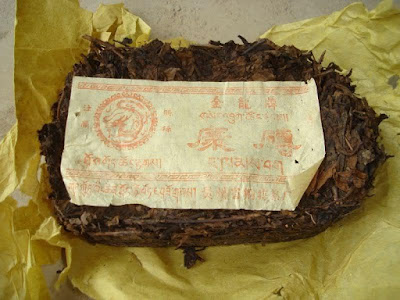
When I last visited the Tea Village shop in Pattaya one owner, Vee, let me try a really interesting version of aged pu'er that seemed as much like a hei cha.  That's essentially what this is.  I'll let his website description of it tell more of the details:


And that's what it is; just a bit of a mystery tea.  The "made in the Tibetan style" more or less says "hei cha" to me, and tasting it does too.  It's a fine material, very hard pressed tea, which was very difficult to extract for a brewing sample.  Vee used a hammer and chisel to remove this part, I think it was, and I used a pick for pu'er, a knife, and eventually a bottle opener (it gave good leverage and mechanics for snapping off small chunks).

You read that one part right; they sell this as 2 kilogram bricks, equivalent to nearly a half dozen typical size pu'er cakes (although it lost weight in storage, so it's down to only 5).  It sells for 12,900 baht, now equivalent to $393.  For five tea cakes worth of tea that comes out to around $80 a cake, a pretty good value for 21 year old tea.  Of course it's not pu'er, so it needs to be compared to a hei cha scale instead (in my opinion), and I doubt there is enough equivalent product on the market for this for there to be any clear fair market value.  If you want it you have to find it first, which is essentially all but impossible, and a vendor can charge whatever they want for it that makes it sell.

As for what the tea tastes like I've had it before, in the shop with him, and it seems like a hei cha to me.  It's smooth, rich, warm in effect, and centered on the plum-like range that I've encountered in other hei cha.  "Plum" may or may not be the best description for a primary taste aspect but it gets across the general range.  Onto tasting notes then.

looking bored with the tea theme right away


I think this was that tea, from trying it there


Review


The story of this tea starts with how hard it was to break up.  That initial chunk Vee used a hammer and chisel to break off, I think.  I tried to use sharp spiked tea pick to flake off some pieces but that didn't really work.  Eventually I used that, along with an actual knife (luckily that didn't end in me impaling myself), and finally a bottle opener to crack off some pieces.  It's a well-compressed tea.


I used a standard brief rinse for this tea, which wasn't going to do much for getting the small chunks of tea started brewing.  It was a judgement call as to how to brew it, related to what I broke off including both dust and small chunks.  It's not optimum to brew two completely different types of material together, since that dust will be starting to infuse within a second round (the first after a rinse), and the chunks will take a few rounds to even get soaked enough to start.  When I drank the tea with Vee we had at least 10 rounds of it and that tea may well have continued for that much longer.  The issue I'm referring to is uneven infusion exposure instead of longevity; one part of the tea will be brewed out (changing flavor to where teas that you discard as spent are in the cycle, often turning woody in flavor character) while the other just starts going.

The obvious work-around is to separate out the finer material and not use it, to set it aside for a later round.  I didn't do that though.  Per my best guess this tea won't "brew-out" to be unpleasant, but instead will retain a similar character and just fade over a very long infusion cycle, so it won't make as much difference.  And as usual intuition is my main guide for how to approach brewing teas; somehow my gut said the right thing is to mix it all and use it together.  Of course it's hard to track how frequently that's wrong.

a bit too light


I brewed the tea for around 10 to 15 seconds for a first infusion, which turned out to be more of a second rinse, too thin to get a lot of effect from.  Then for 30 seconds a second cycle, to get the tea chunks started soaking and to get the dust pretty far along, and mixed those two infusions ("stacked" them, to use the catchier formal term).  From here on a more standard approach should work, something like 15 second brewing times.  I just checked Vee's website recommendation and they said to use two rinses; that makes sense.  From there adjusting time as works best for you is the way to go.


This first infusion won't be the best representation of the tea's character but it's nice.  It has that plum effect already.  Mineral is present as a base but it's in a really soft and subdued form compared to the sheng and shou themes I've been on.  It's the other layers of complex flavors that make this nice, which are harder to pull apart.  One part is like incense spices, frankincense or myrrh (I still have to get my incense habit going to tell what that is though).  Another is a very fine trace of menthol.

As a primary flavor aspect I hate menthol (just a personal preference issue), so that #18 Ruby or Red Jade black teas from Taiwan almost always seem awful to me.  As a minor supporting element that integrates will with the rest is a completely different case; that can be great, and this works.  From there I could keep going but it seems as well to add more description related to a second round instead.

Second infusion


This opened up faster than I thought it would.  It seems to be loosened up and brewing nicely already.  I gave it about a 15 second infusion time, about twice as long as it would need to draw out flavor if astringency or other aspect moderation was an issue but this tea will be nicer at a slightly more intense brew intensity.  That's just a matter of preference; it would work well brewed wispy light or twice as strong again.

The same flavor list as last time applies:  plum, mineral, some supporting spice (which is continuous with some dark wood tones), and just a hint of menthol, which might be more faint, so that I wouldn't identify it in this round if I hadn't noticed it in the last.  It's nice the way that complex mix coats your mouth and remains as an aftertaste effect.  There isn't that much structure to the mouth-feel to talk about; the intense flavors give it a complex over-all effect but not a lot of mouth-feel structure supports or contributes to that.  The wood is similar to redwood, that aromatic, almost spicy range of wood tone.

The mineral is more intense in this round; it really covers such a range that it would be possible to write a short review description of just the mineral.  It's warm and complex in nature, towards that artesian well / red sandstone range.  It extends to being almost metallic, which could be a bad thing depending on the metal character, but it works in this.  It's not completely different than rusted iron bar but it seems to extend to metal-range complexity.  For being a flavor-intensive but simple in structure tea experience this covers a lot of ground.

Third infusion

mostly wetted and loosed up already


It's not transitioning; the taste is like before.  I could keep free-associating to come up with different interpretations for the same set of flavors and other aspects.  Probably the balance of what is there has shifted a little too; there's more that could be said about that.  That menthol background element is so faint that it may or may not be there at all at this point, but I'm going to say that it is.


dried persimmons!  I'm not sure what this coated version is covered with.

Plum still works as a fruit aspect description (for a tea that's more in the mineral and earthy flavor ranges anyway; that just stands out for some reason) but it really is closer to a dried persimmon.


Which reminds me, I was just in Chinatown and walked by those, and the looked really nice, but I was in a hurry and didn't buy any.  I love those; that flavor is as close as anything else to fig (so this tea isn't far from that either), but it's just a little lighter (but just as sweet), less rich but more complex in some sense that's hard to place.


Fourth infusion


I'm running out of time, off to get a haircut after completely losing any style due to not making that work.  It's still similar.  I remember that from trying an awful lot of rounds with Vee; it stays fairly consistent.  I like this character so that's a good thing.  I think the mineral and metal levels move around a little, that the relative proportion of those individual aspects is varying, but the overall character and effect aren't.  The aromatic wood component seems a bit stronger this round.

It's my impression that changing infusion strength shifts that balance a good bit for this type of tea.  It narrows things down that astringency and mouthfeel in general isn't a concern; optimum is whatever seems best for taste.  Aftertaste is substantial too, but it still occurs in a lighter brewed version.  Probably shifting temperature would change things a little too but I can't imagine that using anything other than full boiling point water makes any sense (not that I'll check that).

It's a very nice tea experience.  I've had a hei cha before that this reminds me of, a version of Fu brick.  It's a bit simple in effect; you either like that flavor or you don't.  The flavor is complex, and it wouldn't be familiar to everyone, but to me it's likable.  I'm not going on about how clean it is but it helps a lot that there is no trace of mustiness in this tea, or that the metal, fruit, and earthy range balances as well as it does.

This tea is probably far from finished; there might be another 15 infusions to enjoy out of it.  It'll be nice if it works out that I can do another full session in the afternoon with it since I'll squeeze in a couple of more and be off for now.

Fifth infusion

completely loosened up


The balance of those aspects is definitely shifting around.  It's much stronger towards the redwood / aromatic spice range now, although there is plenty of dried persimmon flavor balancing that (and related sweetness), and a nice dryness from some very complex mineral.  That probably works well as an overall description of this tea, even though earlier the aromatic wood was lighter.


Later infusions


I drank a couple more infusions before going out, and left the tea fully drained to try again the next morning (early afternoon; I got a late start on it).  Using extended infusion times to keep the intensity up changed the character in an interesting way, drawing out more earthy leather range flavor, still with good molasses sweetness, and a bit of spice, again supported by mineral tone.  The molasses and leather trailed into a tree-bark edge, but it was still nothing like astringency in other tea types.


Placing that style; potentially related tea versions


This tea is a little different than anything that I've tried, but all the same I'd like to cover a little more about the teas closest to it in style that I've tried.  I mentioned a Yunnan Sourcing Chinese hei cha that was similar, which was their 2007 Xiang Yi "Hei Cha Zhuan" Hunan brick tea, which I reviewed here.

To be fair to this Tea Village version it probably a was a bit more refined and distinctive, beyond just not being the same thing, maybe because the extra decade of aging helped it, or maybe it started out different.  It definitely doesn't look similar, even though the brewed character shows some similarities.  This tea just reviewed is made of fine material, very tightly pressed, with that other hei cha more from larger leaf pieces, along with a good bit of stem.

the initial chunks of that tea, YS Hunan brick


broken up in a gaiwan


loosely compressed compared to this other tea (credit YS site)


Even though they're probably not the same the character was similar, so I wanted to add a bit more about what it was, from that YS vendor description, which I'll explore further with other types descriptions afterwards.  Part of the point is to try to zero in on what that tea was in more general terms; for example, would it have been pre-fermented or not (as it was described by Vee).


Back to that Yunnan Sourcing Hunan brick description:


This is from the Xiang Yi Tea Factory in An Hua county of Hunan Province.  Xiang Yi is the second oldest producer of Hunan Hei Cha after Bai Sha Xi Tea Factory.

Hei Cha Zhuan (lit. Black Tea Brick) is composed of An Hua grown tea that's been picked and processed with frying, rolling, wilting and then sun-dried.  The bricks are tightly compressed which allows for slow but determined post fermentation. These are unique from Fu Bricks in that the golden flower spores are not introduced into the tea and as such don't exist.

This particular brick was stored in An Hua County of Hunan from 2007 until June 2016.  The smell of the dry leaf is that of dried fruit... very sweet and dense fruitiness happening.  The brewed tea is sweet and thick with (not surprisingly) strong fruit sweetness (think dried plums).  Tea can be infused 7 to 10 times if brewed gong fu style.  We recommend loosening the tea using a pick into smallish chunks layer by layer.  We also recommend using a clay pot and the hottest water possible.


One of things that stands out about this tea, besides the unique character, is the unusual level of value; they sell it for $126 for a one kilogram brick.  Supply, demand, and production costs all factor into a final tea price and apparently this end up being inexpensive.  Description in my review summarized flavor aspects as:

"fig, older hay bale, mineral, and molasses as a start but really I think cocoa sort of works, and there's another dried fruit element that's quite pronounced..."


I think that may have been a bit mustier, and also complex but maybe not in exactly the same way.  It's interesting that this tea version isn't post-fermented through any piling step, isn't it?  At least as presented, but the description from original content could be clearer.  I lose track of what typically is or is not though.  I'll cite a reference about this type (the YS version; not this Tea Village tea, since it's not as clear what it even is), from Tony Gebely's Tea: A Users Guide (a really good general reference for a lot of scope):


Hei Mao Cha (黑猫茶, hēi māo chá), Semi-Finished Dark Tea

Nearly all styles of Hunan hei cha begin with the production of Hei Mao Cha or semi-finished dark tea. Hei Mao Cha is made by fixing, rolling, pile-fermenting and drying fresh tea leaves, usually from descendants of Camellia sinensis var. assamica known as Da Ye Zhong (大叶种) or large leaf type. Another way to refer to Hei Mao Cha is pile-fermented Mao Cha.


Note that this says "nearly all styles," and goes onto say this generally refers to a pile-fermented tea.  Of course the Tea Village product description cites that being made based on a Tibetan tea type instead, not Hunan (China), but versions of that aren't listed in this book reference.  The description of it as "sheng" (which means "raw") refers to it as a non-pre-fermented tea, although I'm not sure if that's intended as a conclusive description or not.

That description cited was only about the general category; a further passage from that User's Guide reference relates to this YS tea type I'd mentioned:


Hei Zhuan Cha (黑砖茶, hēi zhuān chá), Dark Brick or Black Brick Tea

Hei Zhuan Cha is a fermented tea made by steaming Hei Mao Cha and pressing it into special rectangular molds. The bricks are then dried in a warm room and wrapped. The finished product is a rectangular brick with a flat surface, usually without markings.


It doesn't fill in much, and that's especially not helpful for not clearly linking back to the tea type I'm reviewing anyway.

Tony's book does list another type from China most typically used to make Tibetan style yak-butter tea (the association to that country that does come to mind), describing that hei cha as follows:

Kang Zhuan is a style of Nan Lu Bian Hei Cha brick from Sichuan province. Kang Zhuan is made up of a mixture of older tea leaves and stems... Leaves and stems destined for Kang Zhuan are fixed, rolled, and pile-fermented...  Kang Zhuan tea is the tea of choice when making Tibetan Yak Butter Tea. Production of this tea has spread from Sichuan to Hunan and Guizhou.


Not onto Tibetan originated tea yet (given there is such a thing; I think there is), but that does mention that final preparation style from there.  That sounds a lot like a tea I tried from Moychay, an odd looking pressed large brick made from a good bit of stem material and leaves, reviewed here, and pictured as follows:


They made no type or style claims in selling that tea, and even made it clear that it wasn't like other standard types of hei cha.  That review actually covers one of my favorite sheng from them, in the first section, a really nice, fruity version from Nan Nuo.  As far as that tea goes it was a bit rustic; as I remember it tasted a bit like barn door.


Yunnan Sourcing does list a version of that last tea type (mentioned in the Tea:  a User's Guide citation), with the description connecting with that reference:

These "Kang" bricks were produced in the small tea factory in Province of Guizhou and then sent to Tibet where they were stored in a family home for more than ten years.  These are packaged in long (1 meter) bamboo baskets, about 20 to each length.  


credit related Yunnan Sourcing page, the link just cited with the text


Given this tea I reviewed seems to contain no stem material at all (unless that was ground too fine to identify), was finely ground leaves, and was well-compressed into a brick shape instead it doesn't seem to be at all related.  Even if I did research for other different Tibetan style compressed tea versions (a reasonable next step) it would be hard placing those in relation to this tea without tasting them, or probably still difficult even with trying them.  It would be easy to note how close aspects land but not possible to separate out different causes for why (eg. tea plant type differences, growing area as an input, processing differences, where the teas spent the last 20+ years).


At any rate this was an interesting and unique tea; it's always nice trying those.  With more research it would probably be possible to come to a better guess about what this is.  Enjoying it for what it is in the cup doesn't require all that; the tea was nice.


Later edit:  I spoke with a reference about what it is, with a person who would be familiar with it.  That person said it's not uncommon for fannings (ground up tea by-product) to be pressed into bricks in Yunnan, and that those products are usually sold for next to nothing.  Here is an example of one; a 6 kilogram brick that's selling on Taobao for around $29, or a 3 kg version selling for about a third of that.

Of course quality level and material used is going to vary, and how any teas taste. 

Related to the "Tibetan" background and age claims according to that reference this probably has nothing to do with Tibet, and the label doesn't look conventional for being 20 years old.  And the tea itself claims to be from from 1962, pressed onto the surface lettering:  一九六二制  literallly means "Made in 1962."  It's not relatively new raw tea material but it's absolutely not 50+ year old tea, and the claim that it's 21 years old also seems dubious based on this latest input.

I tend to not express views or background about products that is negative here, and I respect and personally like this vendor.  But at a guess this tea is just an inexpensive, relatively recent production made to be sold to tourists.  I doubt Vee knew that, and there's a good chance that he still doesn't.  There's even some chance that's wrong, but I'm completely convinced this reference source is as good as any person one could talk to.  I won't cite who that is explicitly, since there is a convention in tea circles to initiate a dramatic cycle of blame related to anyone making any negative claims at all.

It's common knowledge that one buys all teas under a "buyer beware" context.  If you spend $400 on a unique sheng pu'er-oriented product sold by a local Thai tea vendor you take a risk.  The tea is pleasant to drink, and novel (just a bit thin across feel and aftertaste aspect ranges), so at least one gets reasonable tea as part of the deal, but it had been back-story and potential for high value and rarity enabling that level of expense to make sense. 

This same theme repeats over and over related to online tea sources and local Bangkok Chinatown vendors; you really should expect the story and label content for pu'er to potentially be completely false unless you have clear reason to believe it, and not the other way around.  If you can try a tea first and buy it based on experienced aspects versus a story being told or value claim that's even better.