 |
honey orchid left, in all photos |
This reviews two more Dan Cong from an ITea World sample set, sent by them for review. The last two were exceptional (orchid and magnolia fragrance versions).
One is the most commonly sold Dan Cong type, Mi Lan Xiang, or honey orchid fragrance (or aroma). The other version, ginger flower fragrance, I've probably never tried. Their site description of that set follows:
iTeaworld 2024 Christmas Gift Sampler: Fenghuang Dancong Oolong Tea ($109.90 for 100 grams)
Fenghuang Dancong Oolong Tea: Huang Zhi Fragrance, Orchid Fragrance, Honey Orchid Fragrance, Magnolia Fragrance, Ginger Flower Fragrance, Osmanthus Aroma, Cinnamon Fragrance, Almond Fragrance, Night-scented Stock, Jasmine Fragrance
I might add a note on their brewing advice, before touching on the subject of value. They recommend using Gongfu brewing, of course, starting at 6 to 8 seconds, and moving to 10 to 15 seconds, for up to 10 infusions. That's fine, but I would brew these quite a bit longer, and only get about 6 to 8 rounds out of them. If I was using a proportion of 8 or 9 grams I'd probably roughly match their parameters, but to me 8 seconds isn't long enough at 5 grams to 100 ml. That's about preference, not really an optimum. I'm a sheng pu'er drinker; I can't be brewing teas really light like that, but it is one common form of preference. It might even work slightly better to isolate flavor aspects, even though that's counter-intuitive.
Is just over a dollar a gram justified for these? I tend to state over and over that I just won't buy tea at a dollar a gram. I probably wouldn't buy these. But for what they are, the quality of the four versions I've now tried, that's about right. At least they offer sales that could cut that back a little, 20% off if you spend over $100, so it seems this would drop automatically, at least now. If these really cost 80-some that's a pretty good value.
It feels odd saying that. Who spends over 80 cents a gram on tea? People who don't care what the cost is, or who get hooked on types and quality levels of teas that they just can't get for less. It's better not to do that. This is where I usually say that other range of similar tea, for this type, isn't as good, in a sense, but it's interesting and pleasant enough that it doesn't matter, it's fine. With Dan Cong you kind of take a hit.
I will say this: I just bought decent Dan Cong for a gift at $20 per 100 grams. It won't be this good, and this range of different DC versions doesn't turn up. I bought that in a Bangkok Chinatown, and you can't match value or that version offering on the internet, oddly. I didn't try that exact version I bought, to be clear, but I've bought Dan Cong from that shop three times, I think it was, so you can kind of get a sense of what they sell from that kind of history. Upper medium quality Dan Cong can be really nice, if you can find it. Online sources wouldn't sell that for less than $40, but it's still 40 cents a gram instead of 80+. Other Chinatown shops here would probably sell lower quality Dan Cong for more; it was an exception, even for here.
These might all be that little bit better, or at least the first 4 were. Maybe the honey orchid, Mi Lan Xiang, wasn't quite on the level of the others, but they were all pretty far up there for quality. So I guess if you really feel that you need to experience what pretty good Dan Cong is like this is reasonable (given the other versions are like the first four, and I expect that there could be some quality variation).
Review:

Honey orchid: that's nice. I didn't use an extended first round for these to bump infusion strength to a normal level, so I'll be trying them light for a first infusion. Character is good; these aspects are nice. Tone is a little warm; it seems that oxidation level is balanced really nicely, probably supported with very moderate roast input, that is hard to fully place. It all integrates. Flavor is floral, of course, hinting a bit towards ripe peach. The warmth comes across as a touch of cinnamon, at least so far. Astringency hasn't emerged yet, but being on the light side that would be moderate. It's a great start.
One might wonder if this seems really familiar, for this being the name for Mi Lan Xiang, the most common form of Dan Cong. I guess so. Those still vary a good bit, and this is a novel and positive version of one.
Ginger flower fragrance: I guess that tastes a lot like ginger flower? There is a light spice edge to it; it's really interesting. The general tone is sweet, like jasmine, not even all that far from jasmine. Again the moderate warmth works really well for this. Floral tones are plenty bright and intense, and then it's grounded by warmer floral range, and what could seem like a bit of spice.
This is so fragrant that it's perfume-like. No tea this good is artificial, I don't think; I mean that volatile compounds give it a positive effect, what I often call liqueur-like, when the flavor context is slightly different. It'll be interesting trying both slightly stronger.

Honey orchid #2: I brewed these for about 15 seconds, or just over, not a long infusion time, but plenty for this proportion, for "only" using 5 grams. Flavor is great. Intensity picks up a good bit, but it stays in a similar flavor range. A richness picks up, a thicker feel. Astringency also does, but it's not sharp or edgy, only tied to that fuller feel. Flavor definitely includes a lot of warm floral tone and some peach, and again I read the warmer part as being like cinnamon, just not exactly that.
Ordinarily I'd be brewing 8 or so grams of this, drawing out even more intensity, even for using slightly cut back infusion times. As long as you keep infusion timing out around 20 seconds that intensity would still be there. There is no sharp edge to worry about; may as well push this tea a little. Refinement and balance are great. There could be a little more depth, and a little more pop, with aftertaste carrying over a little more, so I'm not saying that this is an ideal version, but it's pretty good. It's definitely in the right range.
Ginger flower: that ginger edge really comes out; it actually tastes more like ginger this round. Maybe I was expecting that to be less of a literal description, or maybe ginger flowers also smell like ginger toot. The sweetness is again like jasmine, with more warmth. Where the other includes warm tone that's towards cinnamon this is really aromatic incense spice range instead, a set that I don't have clear enough memory of to distinguish between (frankincense, sandalwood, etc.).
Feel seems a little thicker, and aftertaste does carry over just a little more. It seems natural to push these just a little harder next round, infusing them for just over 20 seconds, to see what comes of that. There's nothing negative to work around, so it will be down to trading off maxing out intensity for having them brew less rounds.

Honey orchid #3: it's funny how someone unfamiliar with this tea type range could be absolutely blown away by this tea version, the strong floral tone, touch of fruit, sweetness, richness, depth, overall intensity, the way it all balances, and so on, and then the other version amps a lot of that up just a little. Good Dan Cong is really something.
"Good" is so relative; above average quality versions just tend to be like this, but from how people describe even versions they take to be positive many aren't. That characteristic astringency edge people describe needing to brew around is a quality issue. I suspect that low elevation, monoculture grown versions are pushed too hard with chemical fertilizers, leading to that, but of course that's just a guess.
Aftertaste does seem to pick up a little, for adding just a little more infusion strength. Feel is generally good, it just seems less noteworthy with the other being a little richer. Maybe the flavor being relatively familiar does cost it a bit in terms of novelty, but it's not as if I'm drinking Mi Lan Xiang versions all the time. It's been awhile.
Ginger flower: that's as far as this should be pushed for infusion strength, or maybe this is tipped a little over a natural optimum. You know when something is enough when it's too much. The ginger type flavor is still novel and positive, and other floral range is nice, but that jasmine sort of floral note is a little too strong in this.
Could that flavor have been bumped by contact with actual jasmine flowers? Sure, it's possible. I'd guess that's not an input, but the effect would be like this. It wouldn't draw out that much ginger flavor though. And the supporting incense spice range warmth is really interesting and pleasant. This is just how good Dan Cong goes; it's a little surprising that tea can be like that. If added flavoring could be this clean, balanced, and positive I'd probably drink flavored teas. Good Wuyi Yancha can be a bit surprising too, but not as much across this floral and fruit range, typically. That liqueur-like effect can be really strong in some types of those though.

Honey orchid #4: the feel isn't necessarily thicker or richer, but somehow it picked up a syrupy effect; the texture changed. That's nice. Intensity and complexity are good, and depth, but somewhere in that set is the closest thing to a limitation this tea has. It could hit harder. I suppose it could be slightly more intense and complex, and could express a little more depth. It feels like splitting hairs saying that. Someone could buy a dozen Mi Lan Xiang versions and not get one this good. But there's a magic that happens when it's all dialed way up, and this quite good, but maybe just short of magical.
This is part of why I feel like chasing quality level optimums is a bad thing, to be clear. If you need every new and different next experience to be better than all the last you set yourself up for disappointment instead of enjoyment. This is already so good. I'm just trying to place it, for people who are really on that page, into Dan Cong. It would make for a bad goal trying to top this tea, and an expensive one, probably requiring some hit and miss, but it would be possible.
Ginger flower: at just the right infusion strength this gets pretty close to magical. The way all those flavors I keep describing come together, with the rich feel, warmth, depth, aftertaste trailing on--it works. I suppose that ginger and floral mix, not so far off jasmine range, may not appeal to everyone, or that incense spice undertone people might see as less positive than I do. To me it all really integrates. I don't think it was a happy accident that made this tea turn out this good; I suspect that whoever made it really knew what they were doing.
That reminds me, in the last meetup at my favorite Bangkok Chinatown shop the owner, Kittichai, was describing how oolong is harder to make than sheng pu'er (in his opinion). He said that to make sheng the material plays a lot of the role, and if you get the simpler standard steps right it will turn out as well as the material allows. But oolong is different; there are more steps, more inputs, and more judgment required. That matches my understanding too, even though I have zero experience with processing tea myself. The timing for every step needs to be carefully determined, not according to a recipe, but in relation to the material and the conditions, related to how compounds are changing just then. It's the same for withering, bruising, and oxidation, on to fixing, then later roasting; variable after variable requires tea maker input.
It seems funny saying that since over and over I've said that South East Asian sheng is typically just a little off Yunnan versions, probably related to processing differences. Some of that could be intentional; people seem to draw out withering or add a limited oxidation step to offset the final bitterness and astringency, the harshness. In Yunnan if the material is a bit aggressive after processing it just is; you age it some to offset that, not change the processing inputs. What do I know anyway; I'm just a tea drinker.
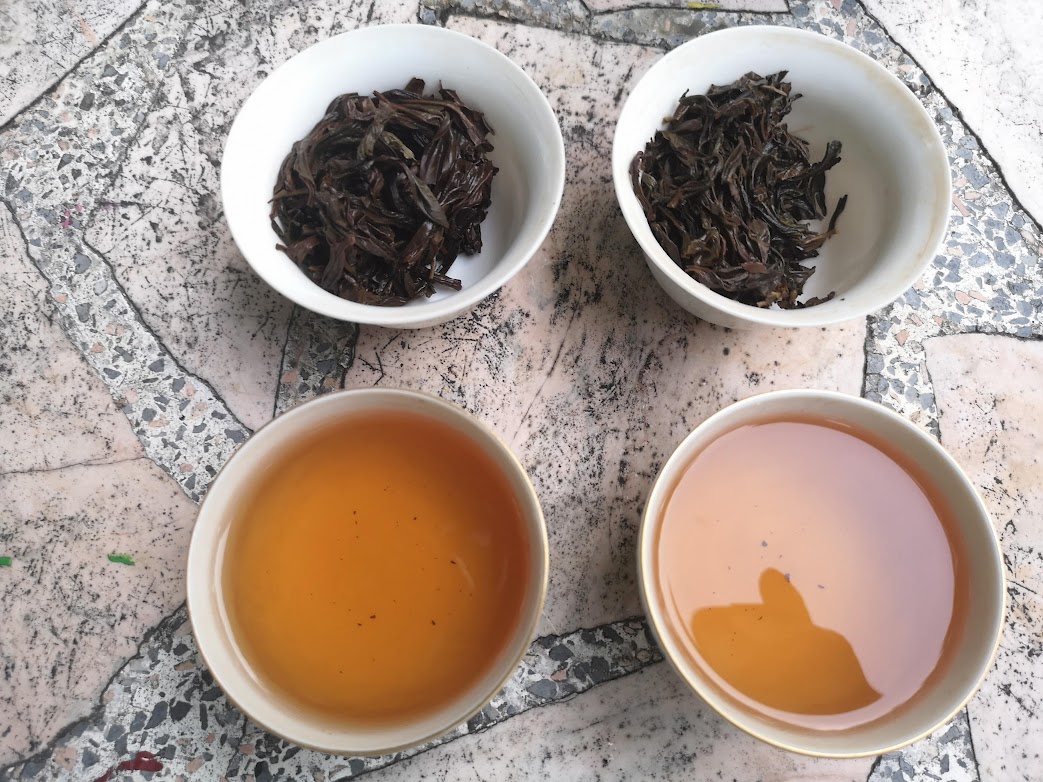
Fifth infusion: in order to not repeat those same aspect lists I'll just combine thoughts in one note for this round, and end this note-taking.
The honey orchid version has levelled off related to changes, not necessarily fading, but maybe giving up a little intensity. It's quite pleasant like this, and not changed, but a next round would need to be infused longer to get this far.
That ginger tone is always surprising in the other version, when you first taste it each round. And it being supported by so much floral and spice range is really something. I suppose the feel could be a little thicker, but there's so much novel and well-balanced range that it's really splitting hairs to point out where it's weakest.
Conclusions:
These are much better than the earlier tasting sets from ITea World. If you go back and read the wild origin material posts I did those teas are positive, mostly, but they're not complex, intense, balanced, and refined like this, none of them. Then again this is Dan Cong (and they also cost more); that would be like trying sheng pu'er and saying that other type range just doesn't match it for intensity. Of course not. Just across that one dimension these aren't as full-throttle intense as the ordinary range sheng pu'er versions I often have with breakfast. But across almost every other dimension the aspects really stand out.
I suppose that only applies if someone loves floral-oriented teas with some fruit and spice range to add depth. If someone loves green tea or hei cha, and not that range, these may not work as well for them. To me the appeal seems relatively universal in form, but in practice personal preference isn't exactly like that. People like whatever they like.


