Showing posts with label Kapiolani. Show all posts

Wednesday, April 3, 2024

Things to do in Honolulu, Hawaii


the main part, doing things with family (I'm not actually conservative, as implied)


As I've mentioned in at least one post that I'm back in Honolulu, this time for 2+ months until the end of the kids' school year.  Job hunting never did work out, so I'm still working remotely in an IT job based in Bangkok.  The kids do well, and schooling goes ok, so the main themes are on track.

This is really about what we've been doing, what a Spring Break is like when you take your local kids to do outdoor activities in the local area.  I guess it overlaps a good bit with what a tourist would do, just without the emphasis on spending thousands of dollars in a week, which just isn't an option.  There is a zoo, aquarium, and museums around, with two great versions related to art and science (Honolulu Museum of Art and the Bishop museum), but this doesn't go into that, even though we covered it all last year.  

Let's go with a few examples to clarify what tourist oriented themes we don't get to:


luaus:  I've never experienced this, even though I spent two years in grad school here, and two other short spans living here recently.  I suppose the food would overlap with what I have already tried, roasted pig and such, then there would be hula or fire dancing.  It's not completely separate from a dinner show at the Polynesian Cultural Center, which I have experienced.


PCC:  this is a theme park based around demonstrating old forms of traditions in Polynesia, in Hawaii and other "local" islands like Guam, Samoa, Fiji and so on.  It's ran by Mormons.  I don't see it as necessarily authentic, but surely most of the show themes tie back to actual cultural history.  In Trip Advisor review comments people either love the experience or hate it, tipped towards people liking it based on self-selection, mostly people on that page going there.


awhile back


Disney / other venues:  I have no idea what a small local Disney outlet is all about.  It's nothing like the full scale Disneyland or Disney World versions, but I don't what it is like.


we did go to a local water park recently, Wet and Wild


whale watching, other boat tours:  we wouldn't go on a boat or take any tours; we are poor locals.  We did go on a whale watching boat tour once, and it was pretty cool, since we saw humpback whales breaching.  You don't need to take a tour to snorkel, although going in the wrong place you will just see the sandy beachfront bottom.


What we have been doing:


Hanauma Bay:  a main draw on Oahu, a nature preserve with great snorkeling.  It's a little sad that high tourist visitation in the past, combined with use of sunscreens with ingredients that harmed living coral, has impacted the ecological health of this area.  They offset that now by requiring use of reef-safe sunscreen and closing the area for two days a week to let it recover, and limiting visitor count.  A good alternative right in Waikiki is Queen's beach, beside the old film screen framework across from the zoo and Kapiolani park (the beach in the local pictures here).


monk seals joined us, sunning on the beach nearby


hikes:  we've did three in the past three weeks, a waterfall hike outside of the city and two ridgeline hike variations at the near edge of the city, one out of St. Louis Heights and the other out of the Manoa valley.  Those last two are essentially the same place.  Manoa falls is the main local hike, along with walking up Diamondhead (volcano crater).  

The great part about local hikes is that you can take a bus for a half an hour or so and be at the foot of a trail, where it's a 45 minute commute for us to get to most local places back in Bangkok, still another 45 minute commute further to completely leave the city.  

Tropical forests are great, the look and feel.  To me ridgelines have an even nicer energy to them, along with great views and pleasant sunny and breezy weather.


Lulumahu falls; a nice spot, but the trail route is a bit confusing


Beaches, Waikiki and others:  some are crowded and not so great, but towards the edges crowds thin and some parts are really nice.  I was seeing sea turtles on most of the early snorkeling outings.  

From our house we can walk over to the nearest nice beach for snorkeling in under 10 minutes (Queen's beach, but it's really just the end of the Waikiki area).  My kids are learning to surf, with my wife trading homemade Thai food for lessons from a neighbor who is an instructor.  It all works out.


the beach near our house, the one edge of Waikiki


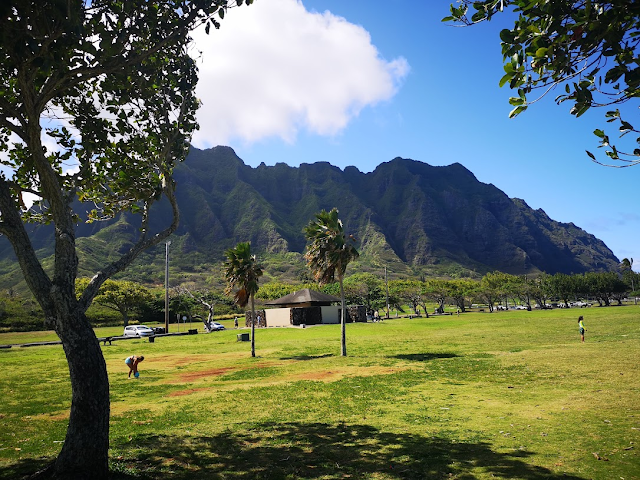
mountain view from a North shore beach


12 years ago, in the same place


running:  I'm back to running around Diamondhead, in much cooler weather than I could hope for in the cool season back in Bangkok, down to 21 C or so, in the 60s F.  I've been too busy with the kids to lean into training, so I've only ran that loop three times.  It seems that with any degree of consistency I could train for cardio improvement easily, with working through heat exhaustion dropped out.


including a walk to a park and stretch; the real pace was a little faster


12 years ago, at the local zoo, with Diamondhead in the background


local parks:  parks are parks, to an extent, but the feel of them here is a little nicer.  The weather is ideal, cool, sunny, and breezy, and the tropical theme makes it all look like a postcard.  

Kalani has been playing volleyball in a park league so we've been practicing for that in the nearest park, and I've been to a couple of her practices, and two games (drifting off the vacation outing theme).  We just bought Keoni a new bike, and he has already started biking around the large local park (Kapiolani), and will move on to wherever else through city streets.  

The parks are mostly for locals to have outdoor space access, for events or picnics and such, with tennis courts there, and with a concert venue (Waikiki Shell) and local event area (Kapiolani Park Bandstand), but tourists might also like walking through to see what's around.  There are two good shave-ice places on the north and northwest side of that park (Monsarrat and Shimazu), and local food and fast food options just up Kapiolani road on the west side. 


There is a magical sort of feel to all of Hawaii that you can only really experience if you slow things down and tune into it, and get at least a little space from malls, hotel spaces, traffic, tours, and crowded beaches.  Tourists rushing around to check off a list of things to do might miss it.  

If necessary visitors should schedule in time to walk along a less crowded beach (they're better on the east side of the island, but the edges of Waikiki are close enough), watch a sunset, or to spend an extra half an hour eating a lunch in a park.  Or a waterfall or ridgeline hike is fine, you just need to remember to take a few deep breaths and experience the environment, instead of only the noise in your own head.  

If you have kids getting that break and extra space may seem impossible, but then it's all the more important to guide them to appreciate and love the feel of the environment, instead of just shouting and stomping through it.


Monday, April 24, 2023

Free tea tasting in Kapiolani Park (Honolulu)


The tea tasting I just held went well, in Kapiolani Park, in Honolulu.  Many thanks to all who participated!  Seven people attended, beyond myself, and my kids stopped by while they played with a volleyball in the park.  We tried most of the teas I had planned to share, swapping out one Thai sheng version for another, and adding some of a black tea I hadn't listed.  Here was that original planned list, in the main Reddit post notification:


Shui Xian oolong, 2022 version, Fujian roasted, twisted style oolong, from a Bangkok Chinatown shop

Shu pu'er, 2017 Menghai version from Moychay

Sheng pu'er, 2018 Yiwu "Lucky Bee" from Tea Mania

Sheng pu'er, 2022 Thai wild forest origin version from a Moychay local production initiative

Sheng pu'er, aged, to be determined, probably a 1980 Thai version from Wawee Tea


I added a Wawee Tea compressed black tea (shai hong), the last tea I've reviewed here, and tried Wawee Tea's sheng pu'er instead of the Moychay version mentioned.  There was no particular reason for the change, there's just something catchy about the Wawee sheng I thought they might relate to.  I'll break down reception of the teas separately, but wanted to overview how it went first, and cover some "lessons learned" thoughts first.

As usual it started late; always the way, but there was a Hawaiian band performance and dancing in a pavilion right beside me to catch.  Using a picnic table in the park was no problem, it just wasn't in the shade, and I ended up a bit sun-scorched as a result, as some guests may have.  All the other details came together, buying some extra cups locally (more spare gear is still back in Bangkok), hot water, etc.  It proved easy to manage, because two people showed up first, then two more, then two left and two joined, so it stayed small.  


The guests joining weren't tea enthusiasts, and had mixed background with tea, but that worked really well, because staying on introductory discussion wasn't too boring for some who had been through all that.  The guests were very pleasant; it can be hard to appreciate how a positive, smooth discussion flow evolves because of everyone's input, but it was like that.  Most people in Hawaii are nice, somehow.  It might seem early to say that, or based on limited exposure, but this stay of 3 months spread over the last 8 or so comes after going to grad school at UH Manoa here, which involved very few negative experiences

That one point brings me to the main thing I think could've potentially went better; I probably talked too much, going on and on about tea background.  People joining might've felt more engaged if they had more space for their own input.  We didn't really get into the tasting notes theme much, sticking with basics, why some teas are compressed, how aging works out, basics of brewing, on main types production inputs, oxidation versus fermentation, storage conditions for aging tea, etc.

Kalani, my daughter, joined at one point to pour tea; that was nice.  My kids have practiced a good bit at home with chrysanthemum, a pleasant and mild tisane, since their mother doesn't let them drink much tea.  I made all the tea with a small gaiwan, which is a Chinese term for a lidded cup.  For a very small group, 5 or less, that still works ok, but it would've went better using a 200+ ml gaiwan (which I have a number of back in Bangkok), instead of having people drink 30 ml or so at a time (a fluid ounce, here), hardly any.  I didn't even include a sharing pitcher in the gear that I used (gong dao bei / cha hai / fairness cup), so slight variations in infusion strength experienced on each round could've come up.


that assistant at a different local park


It went well enough that there's not much to list out for what could've went better, so I'll move back to reception, what guests seemed to make of it.


the tasting set-up and space beforehand


Diamondhead!  none of the pictures do justice to the feel of that space.


a cool stand of trees we were in the midst of


Reception / impressions of the teas


We started with a modest quality Wuyi Yancha (Wuyishan area "rock tea"),  Shui Xian oolong, which only either the first two or first five people tried (easy to lose track).  It's a decent representation of the general range, without notable flaws, and significant roast input, but complexity, intensity, refinement, and depth all could be better.  The basic taste is good for that tea, for inexpensive blended Chinatown versions.  That one isn't really over-roasted or thin, not off in any way, with good sweetness and some nice flavor range.  They seemed to like it.

Shu pu'er isn't for everyone, and that earthiness from the wet piling fermentation, a taste a lot like peat (or even dirt, sometimes), appealed to some and not as much to others.  The novelty seemed well-received.  That's actually a pretty good version, a well-settled Menghai version, from Moychay, and I think that helped, it being better than the rough-edged and limited quality Honolulu Chinatown version that I just had with breakfast.

Sheng pu'er is where things get interesting, because the bitterness either would appeal to people or not so much at all.  And this is also where getting mired in too much background context discussion probably limited more interesting talk about what the people joining made of the experience, what they noticed for flavor inputs, how feel or astringency aspects worked out, and how it worked overall.  I really love that Thai sheng version, but it took me years of exposure and acclimation to like that range of teas as much as I do now.  None of what we tried is really "factory sheng," anything like typical Dayi / Taetea or Xiaguan versions, which are often made from more chopped material, that is often slightly lower in quality, a bit challenging and in need of aging transition input.

The Yiwu we tried later on is better, in a limited sense, more interesting and complex for showing off how some years of age changes things, and in a good place for an optimum for not being a challenging tea to begin with.  Again I didn't prompt discussion enough to get clear feedback about how the two differed per guests' take, but maybe it was a lot to process for them, for going through one type range after another.  They would've needed to either talk through background a lot (as we did), or focus in on experiential range, but covering both could've been a lot.

The aged sheng pu'er version wasn't as positive as I'd hoped, the Wawee 1980 version.  A tea needs to have the right starting point to age well across so many decades, and most versions, even many sheng pu'er versions, would just fade, and slightly odd age-input tastes like mustiness or storage-area flavors could stand out more than positive transitions from an originally very intense tea character.  It was like that; interesting, not really including much for off notes, but clearly quite faded.  I explained how you need a Menghai-type character to begin with to have the potential for very long term aging (if 43 years is seen as that; the pu'er world is so focused on novel experiences and one-upmanship that for some that could just seem like normal range).  It was still interesting, and generally positive, just not including the depth that I'd hoped for, those incense spice or aged furniture notes, evolving positively over rounds.

I wanted to add more on what people seemed to connect with most, but it already seems implied.  All the range of these teas was unfamiliar, for the most part, so the learning and initial experience seemed interesting to them.

That leads to another context theme:  what teas would be more ideal for an introductory tasting than these, what would I have guests try if I had access to everything out there, instead of what I usually drink?  I've only brought a dozen or so tea versions with me for my stay here, of 2 or 3 months.  A visa processing errand will bring me back to Bangkok, either for a week or two or potentially for longer, depending on how job hunt issues work out.  That job search isn't clicking yet; I've had no luck in getting IT services / data center quality assurance / ISO process implementation / internal auditor work to transfer to openings here, but I'm still optimistic.

I usually recommend that people should start on light rolled oolongs, like Fujian Tie Guan Yin (with Taiwanese alternatives often a little better, with careful sourcing).  Or else flavorful, complex, approachable Chinese black teas, like Dian Hong (Yunnan black tea, which is really a broad range).  The one compressed shai hong, a Thai version, isn't too far from Dian Hong range, but it's less flavorful, less sweet, and not in quite as positive a range as more fully oxidized, oven-dried versions in a similar range.  


that Thai shai hong cake; like pu'er, but a little redder


Rolled oolongs I recommend because they're really approachable, pleasant with no acclimation, and easy to brew, in addition to being good at different quality levels.  Light versions can be sweet and floral, and with more oxidation cacao and fruit tones, or whatever else, can enter in.  Lots of sheng is astringent and bitter instead, really rough-edged in lower quality versions, but even the versions I love are surely better with lots of prior exposure.  Shu is fine for a starting point, I think, but then half of everyone would dislike that earthy range.  The roasted oolong we tried, Shui Xian, isn't bad for early exploration, and the roasted flavors range might be familiar to coffee drinkers.  Other versions have more depth and refinement to offer, but starting out with plain and basic examples seems fine.


Lessons learned for a future outing (I probably will do another later)


I think I'll improve as a host if I don't get too caught up in being busy with preparation details and mind how much personal perspective sharing everyone is able to offer.  The most open and outgoing guests, people with the opposite personality type I normally exhibit, in group settings where I'm not essentially presenting, would find openings to share, but that could leave out some others.  I don't think I "talked over" people much (maybe a little?), but I could've been more aware. 

There isn't much I would change.  To try out a different theme it would be interesting to split the difference between describing background (about the teas) and personal experience, what everyone made of it all, especially focused in on people who were less inclined to share thoughts, to give them their own space to share.  It would be nice to switch up tea range but I only have so much with me; I could support another tasting with different versions, but most of the range would be similar.  

I have two more really old sheng versions, samples, from the 70s and 80s as I remember, and either one of those may be much more ideal to show off the potential of that range.  Or both could be quite limited in different ways, maybe really musty from wetter storage input, too heavy on one odd flavor, or from that time period fermentation can transition them to mostly tasting like charcoal.  All of that is why that one aged tea seeming a bit faded by age isn't so bad; it all has to come together for the most positive aspect range to really shine, which is true in different senses across most tea categories and types.

I'd like to close with thanks to the people joining; meeting them all was great.  The mix of people at any given tasting is as much an important part as the teas, the gear and other details, or the host, and it all came together just fine.


that general area, from visiting friends' condo with a view of there


this zoo parking lot view shows just how close it all is to the ocean


Kailua, a more remote beach on the east side of Oahu (later that day)


the view in the other direction, later with some clouds moving through