Showing posts with label hien minh. Show all posts

Friday, June 7, 2019

Vietnamese black tea and Yunnan purple leaf black


Farmerleaf purple leaf black left, Hien Minh right


labeling; this Vietnamese tea is from Ha Giang


I'm comparing a Farmerleaf 2018 "Zi Juan" purple black tea (the leaves are purple, the processing style is just Yunnan black tea) and a Hien Minh (Hanoi shop) 2019 black tea, which is from Ha Giang province in Vietnam per the label, in the far North beside China.

Again comparisons here are for different reasons, sometimes to highlight minor differences in two similar versions, sometimes to use one standard version as a type or quality level baseline for the other, and in some cases just to get through more range in limited weekend tasting sessions, when I get behind.  I don't think it will shed a lot of light on either of these, resulting in as much a style contrast post as anything (based on different leaf material, growing regions, processing, tea age, etc.).  It will be interesting to see if a general impression of one is more favorable. 

It would've made more sense to compare this Vietnamese tea to a Northern Thai version I reviewed a few months ago, but I'll just try them together sometime without the note taking process.

The Farmerleaf tea is sold out, but this is the description listing:


This tea comes from Menglian County, about 40km North West of Jingmai as the crow flies. Mangzhong is a Dai village located close to the county city, at an elevation of 1000m. The plantations were established in the early 2000's around the village.

This tea comes from the Zijuan varietal, also known as purple tea. It is a cultivar selected for the high amount of anthocyanins in the tea leaves, which give the leaves its purple color. Such mutation can appear naturally in the usual assamica varietal of Yunnan, and is also more prevalent in some wild tea species.

Apart from its unusual leaf aspect, the zijuan cultivar features a very special fruity aroma, which comes out very well when the leaves are allowed to oxidize. This black tea displays this cultivar's fragrance, and is therefore quite different from the typical Yunnan Dianhong made of seed-propagated Assamica...


Hien Minh can also be reached through Facebook, and again Pop (Danittha) provided product listings to cite.  I don't think this tea is one of these, even though it's closest to the first, but at least that covers some general scope of what they're offering, which includes plain teas and blends:


Citing health benefits (in those descriptions) can be a bit of a red flag, since researching how well grounded hearsay claims are in better reference materials isn't reassuring, but I tend to ignore marketing themes anyway.  Background locations and information about cultivars or processing steps can be interesting, but in the end how the tea turned out is more relevant.

It's a little odd that the Farmerleaf version might well have been better in the middle of last year (if it was an oven-dried version, which isn't really clear), and the Hien Minh 2019 might well be better next year (if it's actually sun-dried, which seems likely).  A little more on that tied to character aspects occurs in the review.  Black teas are fairly consistent year to year, as types go, so it's less of a factor than it would be for many other tea types.


Review
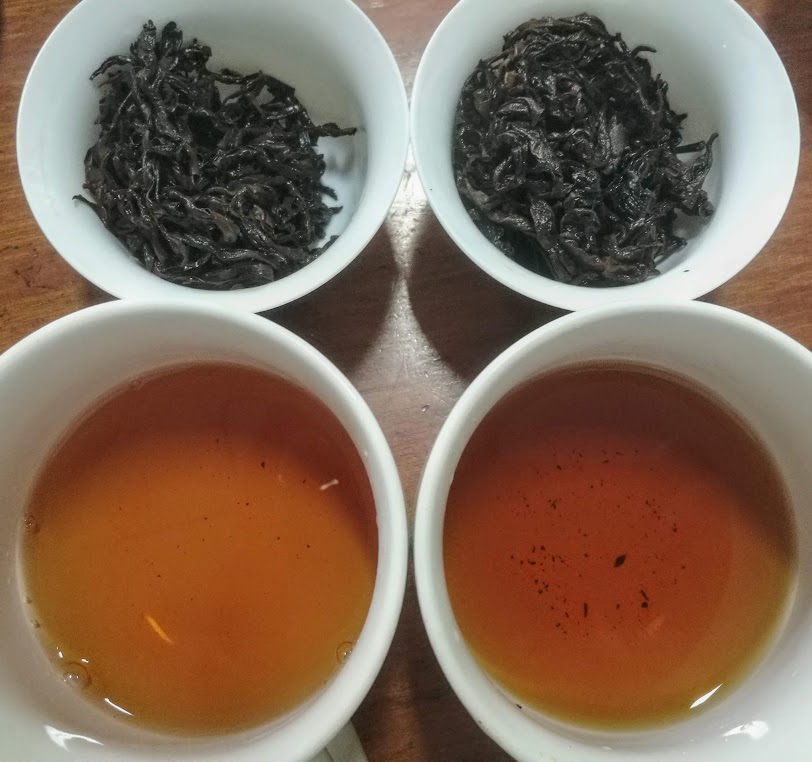

Farmerleaf left; darker leaves and lighter brewed liquid


Farmerleaf 2018 Zi Juan purple black tea:  it's definitely different.  To me tartness is something of a least favorite black tea characteristic, since I prefer warmer, richer tones like fruit, cocoa, roasted sweet potato, and so on, and this includes some tartness.  It's in an unusual form because usually that's on the light side, dominating a flavor profile, and this is softer and warmer, but still a little tart.  Beyond that there's the usual black tea complexity that could be interpreted in different ways, warm tones that don't stand out so much as leather versus dark wood or spice at this point, some floral, and so on.  I'll cover it more next round, as it develops.


Hien Minh 2019 Ha Giang Red Tea:  definitely different; no significant tartness; much warmer and richer in general range.  There is a touch of cinnamon spice, not the main flavor element, but it stands out.  The warm range is complex, but it could be more distinct.  It probably includes a range of related flavors, making it come across that way, some dark wood along with that spice and some malted grain as well.


Second infusion


Farmerleaf:  it's better; tartness faded and intensity picked up, as well as flavor complexity and depth.  Sheng really needs a round or two to develop but other types can change a lot over the first couple of infusions too.  It's a shame when those rounds are much better than the rest but usually it goes the other way. 

It's warmer in nature, leaning a little towards a spice aspect now as well, just not clearly cinnamon or anything else.  The hint of tartness (mostly dropped out, but still present) reminds me of dried cranberry, or maybe that along with other dried fruit.  A hint of savory range is closer to sun-dried tomato, an addition that works well with the rest, integrated, and lending it complexity.  Other flavor complexity probably relates to floral tone, but it's non-distinct.

As to feel and aftertaste it's full enough and not thin, but black teas in general give up a lot in this range to various sheng or oolong, in general.  I don't prefer them as pronounced aspects enough for that to diminish the experience as long as they don't come across as too thin or limited, and this doesn't.  It's pretty good black tea.  Sweetness and balance works, complexity is ok but not really well above average, the overall flavor effect is clean and rich.  From there personal preference determines how well it all works.


Hien Minh:  cocoa really kicked in.  Any impression at this point would relate to preference for or against cocoa in black tea, which I do like.  It's a bit richer and fuller than the other tea version, with more depth and complexity.  Probably leaning into warmer flavors with a main aspect I like versus being a little tart is biasing my interpretation, even though I just mentioned completely separate aspect range, how complex or rich in feel it is versus what the flavor range covers.

If this is a sun-dried tea I'd expect flavor intensity to be limited, it covering more depth but being a bit thin in terms of that, which would develop more over the next year or two, and some of that pattern may hold.  The flavor range is good but the intensity and the higher-end sweetness is a bit muted, a toffee or molasses like taste.

To be clearer on general impression both of these are very nice teas, just different in style and expressed aspects.  Both could add a bit more aspect range here or there to be even better forms of this general range of tea, but both are good examples that are easy to appreciate and like.


Third infusion


Farmerleaf:  warmth might have picked up, adding a little more flavor towards cocoa or cinnamon than the other floral and prior dried fruit aspects, with those others fading.  It's complex in a limited sense but it could be more complex, and flavors could be more distinct. 


Hien Minh:  cocoa still stands out but it transitioned into a slightly musty range, adding a touch of tree-fungus aspect.  It usually goes the other way, that aspects like that fade out over the first two infusions, versus picking up in a transition later on.  It's not storage related, which would seem clear even if the tea wasn't essentially brand new.  It's still quite nice but less positive.


Fourth infusion


This will probably be a good place to leave off.  I'm brewing these at high proportions, and for moderate times but not short infusions, towards 20 seconds.  They could be stretched for another infusion or two but late-round tapering off isn't an important part of the story. 


Farmerleaf:  this is definitely fading but still pleasant, still hanging in there for another positive round.  It's not changing beyond thinning a little, with the range that is present still nice.


Hein Minh:  the mustier aspect faded away already; odd.  Cocoa is still pronounced, and warmer dark wood tones, floral, etc.  That one sun-dried tomato aspect, quite limited in relation to other flavor range, still gives this the effect of being a more complex tea than the other.  If this really is a sun-dried version it will probably pick up some sweetness and flavor aspect intensity over the next year or two and really shine.


Conclusions


Both nice for what they are, different styles of black tea, both typical of Yunnan versions though.  It might be that the character of the purple leaf material could match my preference better, ending up with it being described less positively.  It seemed more floral than fruity to me, beyond tartness matching some fruit range.

It was interesting to try, well worth it for a moderately priced version.  Given that Farmerleaf sells a broad range of black teas (when they're stocked; they tend to sell out) trying a round of samples and then later purchasing what you like best makes sense, just without too much delay.


I'm finishing editing this post just after doing some hei cha tasting, and of course other types keep coming up, and to me black teas and oolongs form my natural preference range, which has evolved to include liking sheng and shu as well over time.  Hei cha versions can be fine too, and white teas can have their own appeal, but good Chinese black teas really stand out as a favorite basic type.


I never did mention an ankle sprain here; at least I have a good nurse to help out


Saturday, June 1, 2019

Tay Con Linh (Ha Giang) 2015 Vietnamese sheng from a Hanoi shop


Based on a suggestion from a friend I bought tea by mail order from a small local shop in Hanoi a couple months ago.  Typically I don't do that, but there are surely a lot of small, local vendors, most without physical stores, that would be much better options for tea sourcing than any that are more standard, both in terms of value and in offering unique tea versions.  Running a physical shop adds a lot of overhead cost (just less in Hanoi than in some other places), so physical shop source value tends to not match purely online sources, but in this case I really wanted to try the teas.

That friend--online only at the time, but I've met her since--is Pop or Danittha.  Thais always have nicknames, mentioned in this post about a local tasting outing.


Pop (Danittha) is beside me, second from right


Here's a Facebook contact for that shop, HIỀN MINH TEA, and their web page for this sheng version (http://hienminhtea.com/green-puerh-2015-pho-nhi-song-2015/) which seems to be down right now; too bad.  I do have a copy of a product description that Pop passed on.


Vietnamese shu can be hit and miss, and I'd take tree age claims with a grain of salt, but tasting tells a lot of the story


That pricing mentioned in that listing photo doesn't work out to much; I'm not confirming that's actually what I paid, and it's too much trouble to look it up again in an email trail or Paypal reference.  It seems like the tea probably has aged and changed since that was written, since it's very smooth and not all bitter now.  If that is the current price still it sells for $13 per 100 grams, or equivalent to a $47 357 gram cake.  No wonder I wanted to buy it.  It's funny how local pricing varies related to Western-facing online equivalents; I won't even mention what friends who travel in the North of Vietnam say you can buy local sheng for there, but it's definitely not priced at well over $100 per kg, no matter what it is.  I should get out more.

South East Asian sheng versions tend to span an interesting range, sometimes quite similar to Yunnan versions and sometimes not so much; the appeal was really more about that than likely value.

Unless I'm mistaken Ha Giang is a province, and the Tay Con Linh reference could be something else, which Wikipedia fills in:


Hà Giang has many mountains, including the two highest peaks, namely, the Tây Côn Lĩnh (2,419 metres (7,936 ft)) and the Kiều Liêu Ti (2,402 metres (7,881 ft)) and forests that provide lumber. It has about 1,000 species of herbal plants. Fauna include tigers, peafowl, pheasants, and pangolin.[3] The town of Hà Giang was heavily damaged during the 1979 war with China[clarification needed][citation needed] but has since been rebuilt.[3]


I could write a post about the tangents that brings up.  One might expect this to be on the border with China, related to that conflict reference and to them producing sheng there, and it is, per the Wikipedia reference map also included here.


This review occurs in two parts, as initial notes and a comparison with another tea (with that approach explained in the second section following).

Initial review


Initially the tea is nice, a bit light yet but soft, rich, and sweet, perhaps with a faint hint of smoke. The other range and flavor is promising.

It's hard to describe. It's vaguely floral, with a light earthy edge, and it doesn't seem woody but it has some vegetal range. It's a little towards spice range but not quite there either.  Maybe in the middle, with an aromatic edge similar to cedar, so woody, but not in the most normal senses. More of the same next rounds, so I'll skip ahead to the next for notes.

Warmth and mineral picks up. Sweetness is still nice, and other flavor complexity, and a mild bitterness balances those well.

I tasted this with Sasha and Danittha not long ago (in that outing mentioned), and they seemed to not love it. Preferences vary; it all works well for me.  I ran through some questions about if it really seems 4 years old, in discussion with others and with the vendor, but to some extent it doesn't matter.  It seemed the leaves might darken more with that much aging, but the character aspect relates to where it started, and expected changes relate to storage conditions, so it's hard to tell.

It's softer and less bitter than standard Yunnan sheng (although maybe not atypical for 4 year old versions); it seems like local style SE Asian versions often do. A Laos version I just reviewed seemed to have a touch more of a catchy taste, a butteriness in both smooth feel and flavor range joining more standard floral flavor. This is nice though.


I expected the brewed leaves to be darker


Second tasting


Those notes seemed really vague to me.  Sometimes I'm a bit hazy in the mornings and what registers could be limited by that.  It seems possible some teas could be less distinct in terms of attributes, flattened out a little for individual aspect intensity, even if general character is still really positive.  Aging could do that at different points in time too, flatten out intensity, and round off more pronounced flavors, lending a balanced character but diminishing specific aspects.

I'm re-tasting this tea along with the 2019 Hekai version that I just reviewed.  They seemed vaguely similar in profile, and the age difference should stand out quite a bit, perhaps even if the Vietnamese tea is really only a year or two old versus four (which I'm not claiming is likely, just saying).  Either way I'll get a clear second impression, and this will provide a way to gauge quality level, to see if there aren't gaps or limitations for either across some aspect range.

On that subject, I didn't get around to speculating what the outcome would be related to drinking a sheng version too young in that Hekai and Guangbie 2019 sheng review, before it had time to properly settle.  I've heard some discussion of that, that it's typical to let the teas rest for a period of time, not so much related to tasting for evaluation, which vendors would have to do, but for consumers to experience them in a more fully developed form.  Who knows though; maybe that varies by tea, or maybe per personal preference.  Since I'd be passing on ideas from discussions more than from personal experience it seems as well to not be more specific, to say how I expect this Hekai version might change over the next two months or so.  I'll try it again then and see.

Review

Hein Minh tea left, from a later round


The Vietnamese version (Ha Giang; I guess I could've been calling this, by a region name at least, or more conventionally as a Tay Con Linh, by specific area) is pleasant; I can see why I liked it.  It's warm in tone, nicely balanced, and subtle, but with reasonable aspect intensity, smooth but full in feel, and so on.  The flavor is hard to pin down.  It's vaguely floral, but on the warmer end of that range, with warm mineral supporting that.  There's a catchy flavor aspect that's faint as of yet, a trace of fruitiness; I'll get back to saying more about that, unless it drops out.

The Hekai has a bit of an edge to it in comparison, a bright freshness with some astringency, almost like a green tea.  It's complex too, showing good intensity, just a bit light for this being the initial infusion.  I'm expecting these to evolve towards each other based on the last impressions of both, or else this won't be a comparison of teas close in style.  At this stage floral tone stands out the most.


On the next round the Ha Giang version is similar, with the cedar wood tone picking up a little.  That really works well for being integrated with a good bit of floral range and sweetness, and with subtle mineral acting as a linked base.

Someone once asked me about always noticing mineral in sheng, and my response really comes in two parts.  One is that if you expect some aspect or general range to be present it's a lot easier to pick it up.  I suppose even if it's really not there, interpreting something else to be that, to extend that just a little.  If I had read "cocoa" in a review description for this tea it might well taste like cocoa to me (and now that I think of it that kind of works).  I expect mineral to be pronounced in sheng, so it seems to be.  Another blogger once mentioned getting stuck on experiencing cherry in black teas, so that almost every one tasted a little like that, requiring going back and deciding when to pull that back out of review notes in a final version for relating to an expectation bias as much as a pronounced aspect.

The other part is that I'm talking about a type of flavor range that sets context for the rest, not something that necessarily stands out, but as part of the general range of all that's experienced.  It would be like picking up a stock base in a food dish as a component used to add an underlying complexity to it, or even like noticing that salt was added, when those are there but don't stand out.  It plays a role but the designed effect is to serve as a background (in food at least, since it's not "designed" in tea), but in the case of tea mineral can work out similarly.


It's odd how that astringency edge stands out more in the Hekai than I noticed the first time.  In part that could be because the other tea completely lacks it, so it stands out in comparison.  It's like biting a tree branch tip, that type of feel combined with a certain expression of bitterness.  It's mild but clearly there, and novel.  This may or may not relate to a typical experience when tasting a brand-new sheng version.  I can sort of see why I thought the two overlapped in character but it's not coming across in direct comparison, at least in the first two rounds.  This is more bitter, but also bitter in a completely different way.  I still wouldn't see this as a relatively bitter version of sheng; that part is still moderate.

Hien Minh left; it is darker 


other 2015 and 2018 sheng versions, reviewed here


The pictures above provide some reference for evaluating leaf color transition.  Photo brightness can relate to lighting conditions and a camera setting; that has to factored back out, to the extent that editing doesn't adjust for it.


On the third infusion the Ha Giang version really levels off to a very nice balance.  It's subtle, but there are interesting layers to the experience, and the aspects integrate well together.  I can see why I just didn't have luck putting a description into words; "floral, cedar, warm mineral" kind of catches it, in a sense, but at the same time completely misses it.  That warmth does extend a bit towards coming across as cocoa, and the sweetness does extend towards coming across as dried fruit.  It's the overall effect and balance that really works, but discussing mouth-feel and aftertaste is going to run into a parallel limitation.  It's quite pleasant but hard to describe why, in what ways.

That specific astringency is only now leveling off a bit in the Hekai version; it may well soften further and allow other deeper-level aspects to show through, as these naturally transition to be stronger.  There's one specific floral tone that's unusually strong and pronounced.  That effect comes across as similar to dandelion, the way a pronounced and distinct bitterness stands out, with a related specific floral range along with that (not that you typically eat dandelion flowers, or that I'm going to claim I kept tasting them as a child).  I guess it's a bit towards orchid but I don't think it's exactly that either, maybe not so far from daisy, very light and bright.  Oddly warmer aspect range joins that, but with bright floral and bitterness standing out that gives it a split in character range, or at least covering a broad scope, however one interprets that.


All this reminds me of why tasting a tea a single time for review is really just passing on a limited first impression.  Ideally a reviewer would taste teas at least three times, but combining sets of notes is a considerable task.  And tasting while making relatively complete notes can take 2 hours, with any degree of other messing around, and I typically only have time for that on two weekend days.  It throws off the experience too, making detailed notes, even though it could be seen as a positive trade-off that it forces you to make impressions clearer, and narrow them to verbal descriptions.  I wouldn't want to do it every day no matter how much free time I had; writing two reviews per weekend wipes out any day of the week to just relax while drinking tea instead.  I try not to drink too much tea as well, only once or twice a day.


I'll leave off this round since this isn't supposed to be a round-by-round comparison anyway.  The Ha Giang (Tay Con Linh) tea hasn't transitioned, but it's still quite positive as it was, well balanced and complex.  It never did work to draw out more specifics for flavor aspects; never mind.

The Hekai is at it's best so far.  This tea probably will level off to a different character within a few months of settling, and the Guangbie version that I comparison tasted it along with just happened to come across as more complex and positive earlier on.  I can see why some of the warmer tones seemed shared between these two versions, or even integrating floral range in a vaguely comparable but different way, but the differences stand out a lot more than similarities in direct comparison tasting.  The brightness and intensity in this tea is different, and the expression of astringency, and form of floral tone, overall character, etc. 

I think the age difference ties in a lot with all that, that these may share range that would come across a lot more if that wasn't a main input.  It's probably closer to true that my impression of similarity was just wrong than that they're quite similar beyond that, and I accurately identified that commonality by interpreting past the age (fermentation transition) differences.