Showing posts with label ripe. Show all posts

Friday, October 9, 2026

Bing Dao origin shou pu'er


I reviewed a sheng pu'er from Bing Dao from Oriental Leaf recently, here, and this is a shou version, the pre-fermented pu'er range.  Many thanks to this vendor for providing this tea for review!

To me two thoughts come up immediately when considering Bing Dao shou pu'er.  1) is it real?, 2) does it make sense to pre-ferment (wet pile) Bing Dao material, to turn it into shou?

It's probably real.  It's from a main producer in that area, Mengku Rongshi, per description from this vendor, so that would comparable to questioning if a Lao Ban Zhang from Chen Sheng Hao is real (known for a long term sourcing contract in that area).  It could still be fake, and people can think whatever they want, and that conclusion is a knee-jerk reaction in some tea circles.  But it's probably not.

Does it make sense to pre-ferment some of the most exceptional tea material you could find in this way?  Not to me, no, but of course it's for people who like shou more than I do.  I'm a sheng drinker, and I'd rather drink above average sheng than the best shou available.  But is seems a bit harsh and judgmental to say that the range shouldn't even exist.  It makes no sense to me, but it would to some others, with different preferences.


Let's consider the vendor listing:


Bingdao Aged Ripe Pu-erh (2026 · Coin Cakes) — Mengku Rongshi


40 grams worth, five 8 gram coins, sells for $14.50, which does sound kind of low in cost.  It doesn't say when the tea material was produced, even though it claims to be aged, which people could take as a second red flag, if so inclined.  The divide between spring and fall material comes to mind; they could be using autumn harvest tea for this purpose, and the material would be worth less to start with, and the origin area would still be the same.  In sheng you can often pick up a bit of difference in intensity and character type, related to autumn harvest versions, but it may not stand out as much in shou.

I tend to value the tea experience more than the story anyway, so it matters less, from that kind of perspective.  Their description:


Ripe pu-erh from the Bingdao growing area in Yunnan — one of the most regarded tea regions in China — fermented using Mengku Rongshi's box fermentation method and aged before release. No waiting required. The tea is ready to drink now, packaged in individual tins of five 8g coin cakes. Each coin is scored with a cross so it breaks cleanly into four pieces — a practical feature for adjusting your brew weight. Available as a single tin (40g) or a full box of eight tins (320g). [that sells for $110, again lower than you would expect).


Bingdao is a tea-growing area in Shuangjiang County, Lincang, Yunnan — the same county where Mengku Rongshi has been based since the family began making tea in 1935. It is one of the most sought-after origins in Chinese pu-erh, known for material with a distinctive character: clean, sweet, with a cooling finish and strong salivation that lingers after the cup is empty. These qualities are not common in ripe pu-erh, where fermentation often softens or masks the character of the raw material. Getting them to carry through into a finished shou pu-erh requires both good material and careful process.


The Process

Mengku Rongshi ferments this tea using their box fermentation method — a controlled approach in which the tea is managed in enclosed fermentation units rather than open large-pile wodui. Temperature, humidity, and timing are monitored and adjusted throughout. The result is a cleaner, more precise fermentation with less of the off-notes that conventional large-pile processing can introduce...


Aroma: Sugar and caramel lead, with a background of fruit and dry wood. The cup aroma carries a clean, candied sweetness.

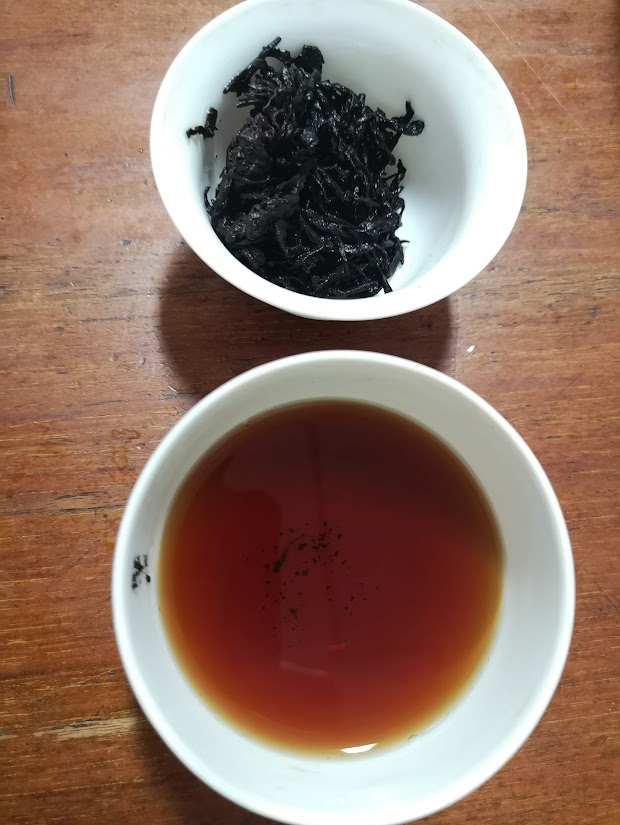
Soup: Deep red, clear, and bright. The texture is smooth — silky is the word that comes up most often. Not thin, not heavy; just even and continuous.

Taste: Sweet and smooth, with a distinct sugar-and-caramel quality throughout. The Bingdao character comes through in the finish: a light cooling sensation on the tongue, strong salivation, and a clean rock-sugar sweetness at the back of the throat that stays for several minutes.


Smaller batch shou processing has been a somewhat well known theme in "the West" for the past decade or so, but there isn't that much of it made, so there aren't lots of options to try different versions.  But it's no secret, and examples do turn up.  It's more typically presented as an experimental approach, not something a vendor has been carrying out for a long period of time, so results might vary.  

Here's an example of a Thai vendor, Tea Side, producing 2016 and 2018 versions, posted in 2019 here.  Those were good.  Not like this, but the material surely didn't have the same potential, and it was the results of processing after some trial and error, but not a couple decades of consistent production (or whatever this relates to).  This was a review of their 2021 version, in 2025, probably representing a more developed, slightly age transitioned version, as a more developed example (which they described as "Chocolate Noir;" both that and this Bing Dao version share pronounced cacao flavor).


Review:


First infusion:  I let this soak for well over 30 seconds, so that it would open up in the first round.  I didn't use a rinse, which wouldn't work as well for a pressed shape like this anyway, since you would be rinsing only the outside surface.

Flavor is really nice.  As shou goes; I'm not a natural shou drinker, which I'll address more in an intro that I add later.  There's a pronounced cacao note, the main thing you notice.  Then an inky minerality, and what comes across to me as rich dried fruit, that could be interpreted differently.  Some shou has a funky sort of fermentation related input that fades after a couple of rounds and if it's in this it's really moderate, and hard to notice.  It can taste like wet cement block, petroleum, fermenting cardboard, or in worst cases like fish, or fermented fish sauce.  There's really none of all that.

Body / feel is really thick, of course.  Cacao carries over most in the aftertaste, so far.  There seems to be a savory aspect included, that's not strong, so it relates more to background, giving it depth.  It tastes a little like sun-dried tomato.  That's quite a lot of aspect range for the first round, but then this is brewed strong.  Shou never really picks up problematic aspects when overbrewed, or put another way, it's hard to really overbrew it.  I'll try it lighter though, and see what that changes.


Second infusion:  this round I brewed for 5 seconds, just long enough to stir the leaves around a bit with the lid, then poured back out.  Intensity and feel strength drop, of course.  The flavor profile doesn't change that much, but how it comes across does.  Warm mineral tone evens up with cacao for intensity.  Fruit isn't as noticeable.  That fruit was so rich and heavy that I'd have to make up a dried fruit type to come close to capturing what it was / is.  Prune is close enough though, dried plum.

This is pleasant brewed light, and intense enough, but probably brewing between 10 and 15 seconds would be an optimum, for me.  That's a really strong infusion strength, for using 8 grams in 100 ml for a tea this intense, but it works for this type.  

Dark bread range seems to enter in as a main flavor range, replacing some of that earlier set, or combining with it.  Really dark bread, like pumpernickel, maybe just without that one seed spice flavor input.


Third infusion:  not so different than last round; that description still applies.  Heavier dried fruit range might be lighter, on towards a dried berry input instead.

Is this so exceptional that it justifies existing, changing what should have been great quality material sheng into a shou / wet pile fermented form?  Preference for types enters into that kind of analysis and conclusion.  To me no; this must have been better as sheng.  But for people into distinctive, unique forms of shou the answer might be different.  It's really for them, not for me.  It will be interesting to see how pricing works out, which kind of factors in, but again that's a separate theme.  I think ordinary but more exceptional factory shou is good enough, and represents the type range well enough, but again that means little coming from a shou drinker.

I've been through this before.  A friend passed on a gushu shou from some known tea area before, and I had trouble placing if it made any sense, for it to even exist.  It has been nice having that better shou available to drink during fasts.  I have other more ordinary range shou around for that, and I might have drank through half a kilogram or so of it on fasts over the last three years (I fast a good bit; four times a year, five days each fast).  But it's nice trying something a little different and better.  I've kept experimenting with what else my stomach can tolerate, without much success beyond aged white tea, and very limited other hei cha range.

In trying this round again the flavors seem to flatten out a little, losing distinctiveness related to covering more scope (now mineral and dark bread, plus cacao, and limited dried fruit).  It's nice that it's so clean; often a touch of what leans towards sourness comes across in shou.  You wouldn't identify it as sourness, necessarily, but it relates to aged books or old cardboard smell in way that starts to be comparable.  Cement block mineral is more of a Liu Bao thing, and more general mustiness often relates to a storage input, or at least seems to.  None of all that is present in this.


Fourth infusion:  the balance of those different flavors is interesting.  I let this brew between 15 and 20 seconds, and that brings back intensity that works better for me, of course related to infusion strength.  

Feel includes some richness and fullness, and aftertaste carries over, but for a sheng drinker all other tea range can seem a little limited related to those.  Shou can be oily and thick, so I guess it's just a different effect, not less of one.

The flavors I had already mentioned integrate well at this stage.  They're harder to identify as separate aspects or notes, which doesn't necessarily enhance or degrade the experience, it's just different.  I suppose the dark bread aspect is shifting towards a lighter spice note, which is still related to that dark bread theme.  You wouldn't really necessarily identify this as tasting like cacao or dried fruit at this stage; it combines with the rest, and mineral base, spice, and dark bread have shifted to be more of what you pick up.  I suppose I see it as including that range, giving it complexity, but you can't really separate out those notes as they seemed to be expressed earlier on.

I'll give this another longer yet infusion time, around 30 seconds, and that might be enough notes for this.  There is late stage transition to note and consider, but I'm often fine with skipping that part, seeing the main story as already told.


Fifth infusion:  it picks up more strength as mineral depth than the rest.  It's a relatively different context for a comparable effect, but Dian Hong black tea can land in a similar place, related to a general pattern, of expressing depth more than forward flavor.  I like that in Dian Hong; it works for me, even though it could easily be regarded as a flaw or limitation in a tea version.  In this it's fine.  I think a shou drinker would relate to it more as I do with that black tea, than how I do trying this round.  It's interesting, and not overly negative, but not necessarily appealing either.

Mineral tone changes.  I really could probably review this tea again and just write about how the mineral tone is coming across each round.  Descriptions of that end up being vague, mentioning rock types, or partial comparisons to non-food related inputs, like fallen tree bark or petroleum.  

I suppose as higher level, general character summaries go this may come across as expressing a clean version of forest floor notes, to some.  That can be very pleasant when it works well, and this is clean and positive.  Imagine yourself sitting by a bubbling spring, in a wet, cool, green forest, on a spring day, with pines sheltering you, and ferns filling in the forest floor.  It tastes a little like that would smell, with wet rocks and fermenting fallen tree logs standing out.  Of course I'm picturing a specific place in describing that; I'm from the forests of western Pennsylvania.  There's a feel to such places that captures your imagination, making you think that animated local spirit influences might actually be real.  I digress.


The tea is pretty good.  I'll add more about that in conclusions, after adding a vendor description.


Conclusions:


It's interesting seeing caramel in the initial product description.  That's the kind of thing that you would notice if you had read it in description, since it would bring it to mind.  Rich, warm toned, relatively sweet tea could always be identified as tasting like caramel or toffee.  I just didn't make that connection.

It's interesting considering how good this is; is the quality level really as high as shou tends to get?  Are the flavors and other character roughly as positive as any other shou that I've tried.  Sure, they are.  That would mean more to me personally if I loved shou more.

It would really seem a waste of this tea to drink it as something your stomach tolerates well when fasting.  Fasting doesn't exactly throw off my sense of taste, but how you relate to flavors is different then.  A baseline for a lot of life experience shifts.  To me it adds an underlying layer of stress to life experience; you are always not doing something, that your body is inclined to do, to eat on a daily basis.

Of course when I re-try a later round I notice pronounced sweetness, which I do associate with caramel (per the comment about the power of suggestion).  I'm writing the edited version in the early afternoon, which isn't usually how that goes.  This is probably the cleanest version of shou I've yet to try; there is no fermentation related murkiness.  It makes you wonder about the actual age; over just 3 or 4 years a lot of the early fermentation effect clears up, any off flavors, but over a decade or more depth picks up, tones clean up a little more, and some limited forward flavor range gets swapped out for that depth.  This could be more than 3 or 4 years old; it would explain that clean character.

For shou drinkers I suppose this would be a must-try sort of version.  Some people might even miss the rough edges, the heavy, complex, intensity that good factory shou brings across, bumping that intensity at the cost of including rougher aspect range, and edgier feel.  This might seem too refined.  But then it's interesting trying extreme ranges of different tea types, to help place the rest.  

To me that even applies to bad tea; that rough, harsh, problematic Chinatown shou, that's earthy in an off way, and a touch sour, helps you place the middle and higher ends of shou range better.  You might not make it through a whole cake of that kind of thing, if you end up buying it, and it might be better for your health if you didn't.  But it's nice experiencing the full range of what tea experience can be.  This version represents the "higher" end instead, which people would relate to differently, depending on their individual preferences.


Monday, October 6, 2025

2022 Tea China Liu Bao compared with a 2004 Legend of Tea version


Tea China version right, in all photos (both are so dark, right?)


I'm reviewing a Tea China Liu Bao tea, from a set that I've already tried a 7542 from (Dayi sheng pu'er).  Of course the 7542 was pretty much what I expected, except for it seeming to pick up a bit of smoke somehow.  I should add that this tea was a sample sent for review; many thanks for that.

This version I'm using for comparison, from Legend of Tea, I've reviewed before, a "Hilltown Tea" producer version, reviewed here.  It's quite good, so this isn't supposed to be an easy challenge, for the other to compare well to it.  There are other Liu Bao versions in the Legend of Tea set I haven't got to yet; I've fallen a bit behind in reviews.

The earlier Tea China information was a little limited, but then for it being Dayi 7542 it didn't need that much introduction.  This is what this tea is:


2022,GuYun01 Aroma Aged Liubao Tea


This sells for around $20 for 100 grams, or $30 for 200 grams.  It seems better to bump volume, given that discount rate.  20 cents a gram is a bit for Liu Bao (with pricing always varying along with quality and availability), and 15 cents a gram naturally sounds better.  Their description:


This aged aroma Liubao Tea GuYun01 is an exclusive product of Teayucafe Teachina, is steeped in heritage. Hailing from the very birthplace of Liubao dark tea, this 2022 vintage has been aged gracefully for 3 years to develop its remarkable character. Has enormous potential for aging

Taste Profile

It boasts a rich, earthy aroma that is characteristic of well-aged Liubao tea. The infusion presents a deep, reddish-brown hue, reflecting its quality. On the palate, it offers a smooth, mellow taste that lingers, embodying the classic “red, thick, aged, mellow” traits.


I'll add a spoiler here and mention that it's a more pre-fermented version of Liu Bao.  That can be a very good thing, depending on results, but I suppose personal preference always factors in.  To me, related to my own preference, young, harsher Liu Bao is generally not so nice, and it takes 10 to 15 years for versions that are more "raw," more matching sheng pu'er in that vaguely related divide, to mellow out and soften.

This is Legend of Tea information:


Chun Xiang 031 Liu Bao 10G | 100G | 250G | 1KG ($65 for 250 grams, available as a 10 gram sample for $4.16)


Lovingly matured for 19 years, this tea has mellowed out with a rich and velvety profile. A true testament of its age, its tea liquor is bold deep red accompanied with an enchanting aged aroma upon steeping.  The taste is a harmonious blend of smoothness and depth, leaving a satisfying aftertaste. Over time, the tea's character intensifies, becoming even more full-bodied and mellowly sweet, making it a prized addition to any tea collection.


That's 26 cents a gram, but again it's a different kind of thing.  It's actually from 2004, now 21 years old.  It's problematic for vendors to cite age like that in their descriptions because they'd need to go back and edit that page every year to keep it accurate.  Not a big deal though.  It may not be that we can call this completely fermented, or fully fermentation transitioned, but 21 years is a good start on that.


Review:


Legend of Tea 1 (a rinse, really; I'll taste it, write notes, and discard most):  definitely in Liu Bao range, heavy on that one set of minerals, a touch of pine, and medicinal herbs.  It's good.  It might "clean up a little" over the next round or two; it's not really musty, but there's a less clean sort of range sort of adjoining the mineral tone.  Mineral is like slate, I guess, or alternatively and less positively you could describe it as like cement block or still-curing cement.  It's fine though, not bad, not negative at all.


Tea China version:  interesting!  Flavors are less intense, but there's a depth to this.  I thought that it would probably not stand up well in comparison, and that may still be the result, but so far so good, even though flavor is less intense.  Tones are warmer.  This is probably more pre-fermented?  Or it could be older; the other I think is a 2011 version, which I'll confirm by checking the Chinese language packaging image later.  It's presented in a small box, which does list Hilltown Tea Company, Liu Bao Tea, and a packing date of December 2024, but that's not the tea production date.  [later edit:  I was remembering the wrong date, from having looked up a version that it turned out not to be during that first review; it's from 2004].

I think this is the shou / shu pu'er equivalent for Liu Bao tea, which is fine.  I could be clearer on how close the processing steps are to sheng for the less pre-fermented Liu Bao versions.  It's definitely not the same, but it's a gap in what I've researched before.  Or actually I have read a bit on it, but not everything sticks in my mind now.  I skimmed through a good reference in an older Global Tea Hut magazine, which I should have already mentioned elsewhere, but that I can link to again here.

That December 2017 Global Tea Hut issue is here; I really need to read through that.


Legend of Tea #2:  I'm brewing these fast because I'm using a really high proportion, brewing the entire 7 or 8 grams both vendors sent as samples.  Using half as much would be fine for Liu Bao, stretching out times a little.  Or maybe better.  

The picture for these I used as the initial image, and it's really dark, even though these brewed for not much longer than 10 seconds.  Later it turned out that this Legend of Tea version really is from 2004, so it aged a good bit to darken brewed liquid appearance, and the Tea China version really is more pre-fermented, more "ripe."  The Legend of Tea vendor is based in Malaysia; that could be a huge factor.  Teas ferment much, much faster here in Bangkok than when stored pretty much anywhere in Yunnan, and Malaysian climate is pretty close to here.


That distinctive set of flavors is pronounced in this, in a well-balanced and pleasant form.  This is Google AI's description of that list, which I'm forgetting part of:


Traditional Liu Bao tea flavors include the distinctive betel nut aroma, along with woody, medicinal, honey, jujube, fungal, ginseng, and pine smoke aromas. The unique "golden flower" (a healthy mold) can also contribute a sweeter taste and is considered a sign of quality.  


I'm not so sure about the golden flower part; that seems to come up more in other hei cha.  Betel nut was what I was forgetting; that's hard to place because I've never tried it.  Maybe I have some limited idea of what that's about from trying teas described in that way, or maybe not.  Jujube is quite familiar; that's Chinese date, usually referenced as the dried version.  It's great.  That's a part of my favorite Chinese originated desert here, a mix of dried fruit and beans with ground ice and longan juice.  Candied lotus is especially pleasant in that, and the beans are better than they sound.

Pine is definitely present, and mineral herb, which I guess could be in the ginseng range (that's familiar, but I've not had the brewed root version for quite awhile).  Wood, I'm not sure.  Mineral one could go on about, trying to narrow down.  It's not completely different than the warm, odd flavor of golden flowers, one part, which includes a yeast sort of flavor, and other range.


Legend of Tea:  this tastes a lot like shou / shu pu'er.  I'd guess that it's Liu Bao, tasting it blind, so not exactly like that, but much closer than the other.  The whole list I've just described for the other one might identify as secondary supporting elements, so it's complex.  But that distinctive warm and rich tone of shou is present, and earthier sort of range, like peat, or dark wood.  This is fairly clean, balanced, and complex, better than I thought it might be.  

Lots of Liu Bao versions are edgy, heavy in mineral, a little too far into cement range.  The complexity can be limited, and a mustiness can enter in.  These warm tones are only present in more fermented versions, which I think can relate to pre-fermentation.  Even though the other is from 2011, probably, that warmth hasn't developed to that level yet, and maybe it never will [later edit:  it's from 2004; being 21 years old it seems even more likely that the tones will only ever become so "warm."] 


Legend of Tea #3:  not transitioning too much, but then I'm using fairly fast infusion times for these, just a 10 second or so brew.  It's probably brewing more within the still damp leaves between rounds than during that 10 seconds, and it's just long enough to get the somewhat dissolved solids to extract out.

What to add?  This is clean, complex, well-balanced, and it has good depth.  Sweetness is fine; it's not really a sweet type of tea, but there's enough for it to balance.  The flavors list is right, in a type-typical range.  Feel is rich, and it expresses some aftertaste.  It's clearly pretty good.  

It's hard for me to put Liu Bao on a scale, as I could with some other types, but I've kept trying it over the last decade.  I've drank about a kilogram of it in that time, probably, even though it's not really a personal favorite.  It's a great tea to have with food, and sometimes you just feel like certain experiences.  And a friend passed on a lot of it, a Malaysian pen-pal friend I've mentioned lots of times here.  I should check in with him again.


Tea China:  this does transition a little; that dried fruit note is coming out, as close as anything to jujube (dried Chinese date).  I'm surprised that this essentially holds its own with the other version.  I didn't lack faith in Tea China's sourcing, it's more that Liu Bao is often not this good.  It's standard to run across harsh-edged, less fermented versions, that are fine after 15 years of settling.  Unless I'm way off, which could happen, this has been pre-fermented, so it wouldn't need nearly that long to shine.  But if Liu Bao is like shou then it would need 2 or 3 years for the funkier range flavors from fermentation to settle back out, a range that can vary a lot (peat, petroleum, etc.).  

I tried a standard brick version of a factory shou once that tasted unusually strong of petroleum, thinking that it was ok, but not the best experience, and then a couple of years later that dropped out, and it was creamy, rich, complex, expressing flavors across a different earthy and warm range.  Then that vendor had went out of business, a Tae Tea / Dayi outlet, selling some other range, so I couldn't buy more.  I don't think that was Dayi or CNNP (Tae Tea or Zhong Cha); another producer instead.

It's hard to judge if this completely different range is better or worse.  It's just different; I think that kind of subjective interpretation would relate to preference.  Quality is pretty good for both.  The first definitely matches what one might expect of Liu Bao better, but a shou pu'er drinker would probably love the second more.  It's not as if there is no pine, related mineral edge, and medicinal herb in this, it's just focused more on warmer range, now into dried fruit.


This has been a lot of tea to drink.  I threw out half the first round, treating it as a rinse, but still 5 cups of relatively intense Liu Bao is a lot.  I broke form and ate a relatively neutral pastry along with these, which I think is a natural fit for Liu Bao, to have it with food.  Anything with strong flavor will throw off a tasting, but it can definitely help your stomach to either eat first or along with the tea.  I'm rushing reviewing now, trying to "catch up" a bit.

Completely another tangent, I just started eating (or drinking) the infused goji berry I have every morning, another part of that Chinese dessert I mentioned.  It would be a natural segue way to say that one of these teas tastes like this, but the second really is closer to Chinese date (jujube).  So why mention these berries?  There's a chance that I'm typing this out not wearing reading glasses, which I don't need or use, because of the dietary input of zeaxanthin and beta carotene from those berries, in part (since I'm pretty far into middle age now).  Lutein is also associate with eye health, but then I already eat a lot of leafy green vegetables, which is normal in Thailand.  


Conclusions:


Most of it is already in the notes.  It's interesting that the comparison version is that much older than I thought, 21 years old now.  This Tea China version is 3; it might settle and improve more over the next 2 or 3 or so, but I wouldn't expect it to change that much in the decade after that.  That's just a guess though, and I've not drank that much "ripe" style Liu Bao for it to be a good guess.

It might seem like as a sheng pu'er drinker I would strongly prefer the first, from Legend of Tea, for being closer to that in theme, if not aspects and style.  I might have liked it a little more, but it was pretty close, for me.  I just don't love Liu Bao enough for that type-typical, somewhat aged range to really stand out to me.  It's good; that seems clear.  I can appreciate it.  But I'm more on a young or moderately aged sheng pu'er page just now for main preference.  That's a complicated subject, and it makes it sound like I'd prefer 10 year old sheng, which of course is not true at all, related to a very different set of transition patterns applying to sheng pu'er.

I tend to emphasize value, in some posts, and then let it mostly drop in others.  These two seem to be priced fairly, for what the teas are.  The other being older, and a "raw" type version seems to probably relate to a natural higher selling point.  It's not so easy to find good "ripe" Liu Bao versions, per what I've experienced (which of course is a bit random), but unaged teas tend to sell for less, given the opportunity and storage costs of keeping a tea around for 21 years. 

This comparison worked out better than I'd hoped.  I was just worried the Tea China version might not compare well, because the other version is pretty far up the scale for Liu Bao experiences I've had, but it turned out to be different in style, and also quite pleasant.


Friday, June 20, 2025

Tea Side 2021 "Chocolate Noir" small batch shu pu'er


I've written about Tea Side small batch shu / shou pu'er before.  It was exceptional.  Valerie of Tea Side recently mentioned finding some of an old batch that is also exceptional.  "Old" here means 4 years old; that's always relative.  A year or two is plenty to air out most shu, to get most of the fermentation effects to settle.  In some cases longer might make a positive difference.  Four years is definitely suitable.

The backstory:  Tea Side experimented with making small-batch, basket fermented shu some years ago.  Typical shu processing involves wet-piling a lot of tea, maybe tons, in a large room environment.  Small batch shu isn't unheard of; they definitely didn't invent that theme.  In theory it can produce very novel results, where larger batch processing is oriented towards achieving a standardized positive result.

I considered tasting this in comparison with another exceptional shu version, which might have shed more light on it, but to save time and keep this simple I won't.  Maybe I can refer to the other range of shu I've tried from memory.  I've reviewed a couple of very exceptional versions this year, one from Vietnam (really an anomaly), and another a great version from Farmerleaf, of course a Yunnan pu'er.  

[Later edit:  this was distinctive enough that comparing it to other versions or making general quality level assessments didn't seem so relevant, so I didn't].


Review:


1:  yep, there is dark chocolate.  Impressions and interpretations can vary, so maybe someone could make it through a whole tasting without placing that, but when you expect that it stands out quite a bit.  This is roughly as good as shu tends to get, sweet, complex, and balanced.  It will pick up intensity on the second round, once it's fully wetted, but it's already good.  Of course there is a pronounced mineral layer beneath the dark chocolate / cacao.  I'll save the rest of the breakdown for next round.

Sometimes I don't mention parameters, but I might as well.  Of course I've not measured an amount, but this looks to be 7 or so grams to me, a good bit, but not maxed out for a 100 ml gaiwan.  Water is hot, but not full boiling point, since I'm using a filtered version that is heated by a hot water dispenser, which wouldn't quite make it to that temperature.  Transferring it through a thermos would drop out a little more heat.  I brewed that for 15 seconds or so, and this next round a little longer, although shorter would also work. 


2:  Marshmallow really ramps up in this.  I've encountered that a half dozen or so times in trying teas, and it's pretty much always really pleasant, as nice an herbal input as one generally encounters.  To me this tastes more like marshmallow than cacao / chocolate at this point, but both are there.  I've included some background on the plant input that marshmallow is copying, or originally included, which is exactly what you'd expect, the root of a plant that grows in marshes used to make a candy version similar to but different from our modern marshmallow form.  If memory serves it was used more as a thickener than for the taste, but both could be pleasant together.

The flavor list seems a bit short, even though this comes across as complex.  It includes marshmallow, cacao, and limited dark-toned mineral.  Some of those warm tones resemble a really light roasted coffee.  Of course it's not bitter, astringent, or harsh in any way, instead smooth and rich.  Sweetness level is nice; the rest combines better for that being present.


3:  I'm brewing this a bit faster, around 15 seconds, mostly to experience variation, if that comes up.  One thing I might've already mentioned is that there is a particular sweetness and flavor to clumps of tea that form in the wet-piling process, called cha tou, or tea heads, and this resembles that particular sweetness and flavor.  For people who haven't tried that it wouldn't necessarily be informative, but if you like shu it should make your list of things to get to.  

There isn't that much variation in shu to try, so I'll list out what I see as other types or themes here.  Small-batch versions can be different, like this one.  High buds content versions taste different, and can be pleasant, sometimes referred to as Gong Ting grade, or imperial or palace grade.  Aged lower fermentation level shu is another type that is valued, often sold as CNNP / Zhongcha versions from the late 90s or early 2000s, usually as bricks instead of cakes.  There are lots of claims about gushu shu, or versions made from desirable material locations, even up to range like Bing Dao, but those claims can be hard to place.  One might try something offered as from a decent Jing Mai source, and let the more exotic range go, since it could be fake more often than real.

This round is slightly less intense for being brewed faster but it's still quite intense.  Aftertaste expression actually increases, for whatever reason, and it might seem a little sweeter.  Thickness of feel and complexity drop a little, brewed less strong.  Flavor range doesn't vary so much; only the balance or proportions of the prior list shift.  Marshmallow is really strong, but that was probably true last round too.

There may be one type-typical description of the cha tou / tea clumps / tea heads standard flavor that I'm missing, a different way to place that.  It's so bright, sweet, and complex that it leans a little towards tangerine flavor, but it's definitely not that.  Like vanilla?  That seems to work better.


4:  Not so different, but a bit more intense and complex.  Since I'm describing this as tasting like cacao and marshmallow one might wonder if it tastes like a s'more.  It does.  I don't think much of the graham cracker carries over, but that's probably still open to interpretation.  

This is already about as much as I'm going to interpret, without trying another half dozen rounds to explain later stage transitions, which would occur.  This already covers the basic, early infusions, main flavors.  Earthy range will probably pick up as this needs to be stretched a bit more to get the same intensity.  Brighter, lighter cacao and marshmallow should keep fading, but probably not that much over the next 3 or 4 rounds, only in the later stage.


As for conclusions, it's pretty good.  The way they describe it works; it's distinctive, complex, pleasant, and exceptional.  It's as good as shu gets.  Related to value or fair cost range people would have to place that for themselves; options and pricing ranges vary from different kinds of vendors.  

It's hard for me to relate to the very highest quality and most distinctive style range of shu, or for that matter for any tea type.  Different versions out there, of different types, sell for $1 a gram or more, but typical shu range is at the opposite extreme, or more in the middle for the best versions.  It's interesting checking Tea Side's listing and seeing where it falls, and how they describe it:


2021 “Chocolate Noir II: A Long-Forgotten Stash” Craft Ripe Pu-erh Tea ($22 for 50 grams)

This shou pu-erh I crafted from old Thai trees, averaging around 300 years in age—the very same material I always used for "Raspberry Pine." The fermentation was completed on December 5, 2021. And the tea then went off into aging to develop the right, well-rounded profile.

Over the following year, I checked in on it regularly, but wasn’t quite happy with the flavor. So I shelved the box higher up in our warehouse and, honestly, forgot about it. After 3.5 years of storage, it resurfaced during an inventory check—and now, I’m completely satisfied with the profile.

This tea unfolds gradually, requiring water as hot as you can get it, and a generous steeping time. We didn’t separate tea heads from loose leaves: the leaves infuse fast, while the heads maintain excellent steeping durability.

The dry aroma is classic—slightly salty, woody. Once rinsed, the scent transforms into soft, sweet woodiness, with notes of chocolate and raspberry jam.

The flavor profile is smooth, dense, and even: teak wood, a solid chocolate body, and a pleasant coffee-like bitterness finishing each sip.

This shou distinctly recalls our “Chocolate Noir”, which was produced later, from different material and slight adjustments in processing. Over years of aging, the raspberry-berry nuances have faded, replaced by a harmonious, rounded fusion of chocolate and wood. However, if your nose is keen, you might still detect faint traces of berry jam in its fragrance.

The aftertaste is lovely: like a childhood chocolate candy, with the gentlest touch of coffee.


It probably would've been better using the hottest possible water, instead of in the 90-some C range, as I brewed it.

It's interesting that I did mention chocolate (also in the marketing) and coffee in this, leaving out reference to jam or dried fruit, and adding that it tasted a good bit like marshmallow to me, and maybe just a little like vanilla.  Interpretations would always vary; that's normal.  The general impression seems about the same.

If someone was open to spending nearly 50 cents a gram on a shu I guess this version might justify that as well as any.  It's probably as good as any shu version I've ever tried, and I've tried a lot, some presented as exceptional.  Still it's just shu.  I never could relate to people focusing on that type range as a primary preference, but then preferences do vary.  

Even for people not so interested in the type it might make sense to buy a little to see what the high end / most distinctive range is all about.  I probably wouldn't, but then having a tight tea budget narrows a lot of choices down to very few.  I wouldn't buy sheng for 40-some cents a gram either, and that kind of offering is a lot more common.


Sunday, February 23, 2025

Reviewing Farmerleaf (Jinggu), Viet Sun (Vietnamese), and ITea World aged shou pu'er


I'm comparing three shou / ripe pu'er versions, one from Farmerleaf (so of course from Yunnan), another from Viet Sun (Vietnamese), and an aged version from ITea World, part of a themed aged tea set.  Going in I kind of didn't know what to expect, but I expected the Farmerleaf version to have an edge, because they've been sourcing pretty good Yunnan teas for awhile.  

I suppose it worked out as one might expect; it was a little better, but the Viet Sun was pretty solid, and novel, and the ITea World version represented well-aged tea well enough.


2023 Ku Zhu Shan  ($140 for 357 gram cake)


Ku Zhu Shan old tea gardens, Jinggu area

Fermented in Menghai in Winter 2023, medium-heavy fermentation

Complex mouthfeel, a hint of aggressiveness

Ku Zhu Shan is a village located east of Jinggu town, it has a lot of 'teng tiao' gardens, in which the tea trees are allowed to grow tall with fewer long branches, it's a special way of pruning the trees. This tends to give a more powerful brew by limiting the amount of leaves growing. 

You can notice the leaves are big and rich in tea buds. This tea has a complex taste which will carry you through a long session. You could even find hints of bitterness if you brew it strong. 


This was pretty good (I add the citations after the notes).  There's no way I'd ever spend $140 on a cake of shou, but at least it's good.


Thượng SÆ¡n Small Batch-Ripe Puerh 2024  ($52 for 250 grams)


A nice small batch production from a new ripe puerh making friend of ours in Hà Giang. The raw puerh used to make this tea is spring 2023 high quality old/ ancient tree material from Thượng SÆ¡n that was wok processed which isn’t too common in ripe puerh production. 

This tea brews up slowly into a rich dark brown/ black brew with some mahogany red hues. Sweet with earthy fragrant wood, and herbal dark sugar notes. This tea retains a bit of bitterness which balances well with the heavy sweetness. Thick mouthfeel and a lasting finish with a relaxing qi effect. 

The high raw material quality of this tea shows over the course of the session and performs well over many rounds. This tea is med-low on the fermentation scale and should age nicely with proper storage. 


The description doesn't sound so different than the Farmerleaf version, but this does cost about half as much.  Note that the sample seems to say that was a 2017 tea version (in the following photo), while this is claiming 2023, so it may not be identical.  There wasn't much shou being produced in Vietnam 8 years ago so it seems likely that writing is wrong, or unclear, especially since this listing from the same location is on his site.  [later edit]:  this was a 2017 version of a tea they sell more recent versions of.  Strange it was produced that long ago.

Quality level, complexity, and depth gives up a little (assuming that it is this version), but for as good as this is I'd definitely buy it instead of that Ku Zhu Shan version.  For people into good shou, who value the difference, the opposite conclusion might make sense, but that's as hard for me to relate to as people drinking Japanese green teas.


For the ITea World sample the information will be limited.  It's from this set, 100 grams of mixed aged teas selling for $76 for 100 grams (so it's by far the most expensive, but it's the rarity of other versions driving that pricing, not so much this version).


iTeaworld 2025 New Year Tea Gift Set (Year of the Snake Edition) - The Collection of 10 Aged Teas: Includes 20-Year-Old Ripe Pu-erh, 40-Year-Old Hei Zhuan (Black Brick Tea), 30-Year-Old Oolong, and more


Not much in there about this tea, or even in the site background.  It's Yunnan shou pu'er; that's it.


Review:


Farmerleaf Khuzhu Shan (the rinse):  I'll just pass an on initial impression, prior to the actual real steeps.  For a flash infusion this is pretty good; it's intense and rich, with good depth and feel already.  This will be a challenge for the other two to match.

Viet Sun (Thuong Son):  much thinner and less intense, but then this is only the rinse.

ITea World:  it's smooth, and has depth, but it's not looking good so far.  But then for this being much older, 2003, it may come around quite a bit after a rinse, removing a lot of what isn't as positive fast.


Farmerleaf KS (first actual infusion):  that's pretty dialed in to good shou range.  Some cacao works as a base, along with general earthiness, and then a bit of spice and dried fruit stands out from there.  Intensity is good; I brewed these fast to try a light round, between 15 and 20 seconds, and it's already there.  Depth is good; feel is nice, pleasantly thick.  Aftertaste doesn't extend as with sheng but it does support the experience of complexity.  It's clean.  Even the early fermentation rough edges seem gone, within two years of this being made.  It's a shame that I don't like shou more; this is a really good example of one.


Viet Sun:  there's an interesting distinctive flavor range in this; thinking it through that was the one way that it could hold its own, given the first version is as good as it seems.  There's a perfume-like note (possibly a foreign input, but the rest of flavor is quite novel, so maybe not), and rich, warm, earthy tones, along with pleasant spice range.  It might be slightly thinner and less intense and complex than the first, probably giving up the most related to depth, whatever I take that to mean.  More fragrant flavor range is quite pleasant, and also clean, but the feel and base flavor range (depth, earthy and mineral tones) doesn't match it.


ITea World:  a pronounced aged furniture input is interesting, like aromatic woods and essential oils that have been resting for a couple of decades, or longer.  It's also relatively clean; I guess age does tend to soften rough edges, and this is 22 years old, with the Vietnamese version 8 years old, plenty of time for a shou to settle.  Related to the Farmerleaf version that lack of age could have limited positive nature, depending on the starting point.  Sometimes inky, petroleum or tar-like flavors can transition into a creaminess, over some time.  It seemed to be a bud-heavy version, that probably wasn't fermented to death (absolutely completely), so it probably retained brighter flavors when new.  Sometimes high bud content shou ends up tasting like cacao, as that did.

Richness and depth are fine, and intensity.  All of these are pretty good, really.  I expect a longer soak will really let the Farmerleaf version shine, and improve the Viet Sun results some, and this will just gain a touch more intensity.  This older version could fade faster than the other two; aging can convert flavors in interesting ways but different kinds of transitions can lead teas to "brew out" faster.  I'm probably using one gram or so less of this version, which won't help it in comparison.  

Related to this showing off what a 20+ year old shou is like this really works.  In terms of matching the complexity and quality of whatever this Farmerleaf version is, and the novelty of the Viet Sun tea, that's asking too much.  It's not noticeably inferior to either, it's on the same general level, and that's already a major victory.


Farmerleaf Ku Zhu Shan (#2):  these brewed for closer to 30 seconds, for a longish soak.  It's unusual how good this is, how positive all the layers of flavors and other aspects are, and how it all comes together.  It will be interesting to hear what this is.  

Plenty of cacao stands out.  That can taste like dark chocolate, or the actual powdered coffee bean, or I suppose even a little like cocoa, but in this it's like ground cacao bean, like what you bake with, or even how the nibs smell and brew out (fresh chunks).  Warmth stands out beyond that, a clean version of earthiness.  The rest blends a bit but warm mineral, some spice tone, and what I take to be limited dried fruit input all combine, along the line of a hint of dried dark cherry, but interpretations would vary.  Balance is good, the completeness of the experience.  As for intensity shou is only ever so intense but this is doing fine with that.  Feel is relatively rich, a little oily; it's positive.


Viet Sun:  actual flavor layers are even more novel in this.  It's expressing something more like novel and mixed spice range.  Warm tones are pleasant, and feel is nice, with some underlying mineral, but it doesn't strike that really unconventional balance of hitting every note in sync that the first (Farmerleaf) version does.  It's good, and it's balanced, just a little lighter and less complex and intense in overall effect.  I really didn't expect it to be this good.  I should be mentioning more of a flaw than a lack of intensity across some scope, like an off flavor, odd feel, something like that.  Vietnam just hasn't been producing high end shou for long, and it's not just a matter of piling up some decent material and keeping it wet but not too wet.

As a sheng drinker it's odd switching this back to personal preference as a filter.  I miss that hit of intensity, the high bitterness, sweetness, strong flavor, intense feel, crazy complexity, and I suppose although I don't acknowledge it often the body rush from consuming it.  These are just pretty good.  Maybe on a cold fall day it would really make more sense; it's probably about 31 out now (C; that's almost 90 F), and ridiculously humid.  You don't crave warm toned teas on a day like this.


ITea World:  aged effect, the old furniture theme, and some extra medicinal spice picks up, along the line of whatever that really diverse set of spices they sell you in Chinatown herb shops as medicine smells like.  Like ginseng?  But really complex; like a few different things.  This is warm too, but as with the Viet Sun version it lacks the same intensity and depth of the Farmerleaf version.  Which is odd, because it has pretty good intensity, complexity, and depth.

I think the high buds input in the Farmerleaf version might be impacting the outcome.  Buds-only white teas can end up relatively flavorless (not always), but even those usually have great depth.  You never drink good Jin Jun Mei and feel disappointed by the lack of complexity, intensity, and depth.  Probably finer leaf material are covering one aspect range, and buds input another, and they overlap to balance really well.  Or maybe that's completely wrong.

I'll do one more round and drop taking notes.  These will transition a little over more infusions, but not enough to make it worth writing or reading about.


Farmerleaf (#3):  not really different, but then it was pretty good over the last couple of rounds.  Maybe I'm making it sound like that good balance and complexity really matches my personal preference more than it actually does.  I appreciate it, and like it, but again I'm a sheng drinker.  For whatever reason I really crave black tea experience as well, and can also appreciate oolong novelty and refinement.  I appreciate that this is so good, but I don't love it.  I think pretty much all shou drinkers would, maybe even across liking different styles, since this has a lot going on, and it's essentially all positive.


Viet Sun:  that atypical flavor complexity shifts just a little but it doesn't change.  This probably wasn't affected by an external flavor input (eg. something nearby in storage), because all types of external flavor inputs fade faster instead of just changing in form.  It didn't really taste off, or adjusted, I'm just clarifying that.  You can probably get any tea to taste like old furniture by storing it in an old furniture cabinet for a half dozen years.  Maybe that's actually not a bad idea.  This just includes unusual flavor range naturally.  


ITea World:  this still tops the others in terms of "aged taste."  Warm slate mineral works as a nice base, sweetness and thickness is fine, then lots of flavor complexity joins that, again in an old furniture and Chinese medicinal / root spice range.  

Drinking this on a winter day could seem magical, in a rustic cabin, maybe with some neutral flavored butter cookies, and snow falling outside.  In comparison with two other good shou versions on a hot day in Bangkok, at 12:30 now, not even in the morning, it's more about comparing strengths, what aspect ranges stand out.  Probably I'm losing something in missing the intensity of experience in sheng, turning up the volume in exposure, while these tea inputs add depth to the set of things you already experience.  That, and warm tones match with cold weather.


Conclusions:


All simple enough, the Farmerleaf version is a little better than the other two, the Viet Sun tea is solid and novel, and the ITea World represents aged shou well, giving up some complexity, depth, and novelty.  For people who haven't tried a lot of 20+ year old teas that part would've seemed more novel than it does to me.  It doesn't come up too often, but pretty regularly.

I really can't relate to anyone paying 40 cents a gram for shou, but if that part is fine the Farmerleaf version is worth it.  To me why even pay 20 cents per gram; decent factory shou might cost two thirds that, and that can be fine, since all shou is as close to the same thing as is true for any tea type (just how I see it; obviously shou drinkers probably don't agree).  Here is an example:


2022 Menghai "7572" Ripe Pu-erh Tea Cake  ($36 for 357 gram cake)


This probably was a little rough-edged for the first couple of years, and may not have fully settled yet.  In Yunnan Sourcing's words:


A classic recipe from Menghai. This is an average blend of 7th grade material that was fermented last year, so the cake does not have that just fermented taste, rather it has already mellowed a bit. Another 6 months to a year down the road and it will make even more improvements in taste and liquor clarity. When brewed this cake will taste a little sweet and lighter than the creamy 7262.


That "7th grade" relates to the material being chopped in form, as much as some general quality level.  All three of these teas surely are better than this, but from a "shou is shou" perspective not by much.  Farmerleaf's equivalent value-oriented entry, 2023 Bangwai Ripe, sells for $36 per cake; I'd probably buy that instead.  

William gave me these samples I'm trying from them on a visit here (many thanks for that), and after checking I have some of a 2023 Mengku version yet to try.  Since it lists for $60 per cake it represents another variation of a good-value theme, just not tea as inexpensive as Dayi versions.  Shou really does vary, from heavier flavored from being fully fermented, to being lighter, or even heavier on cacao range if a version includes more buds.  All three of these being pretty good, and relatively novel, might've made it seem like it's normal for above average shou to work out like that.  If a version is from a reliable source and the character is positive one can be nice, complex and well-balanced, but including a bit more rough edge than these did would be quite normal.

For this ITea World version representing the more ordinary range in an aged tea tasting set it held its own better than I expected compared to two interesting and positive shou examples.  It definitely showed off aged effect the others didn't, and some people would value that more than I probably seemed to.


Saturday, December 21, 2024

2004 HTC shou pu'er and 2011 Xishuangbanna


A friend and I just did a tea swap, and I sent some of whatever was around in exchange for aged shou and hei cha.  So nice!  He is Bruce, living in Chiang Mai; maybe you know him.

One is a 2004 Hong Tai Chang shou, which is probably tea from a Chinese producer made in Thailand, since I've tried a good bit of that.  I own a 2006 sheng cake, or what is left of one.  Tea Side sells those here, an online vendor (where I bought that).  Looking back I tried that as a sample in 2015, and a 2006 shou version also from 2006, and bought that sheng then.  Nine years ago I was not a very good judge of pu'er, and my reviewing and blog writing was a bit rough.  Maybe it still is, but at least in a different sense. 

The other is a 2011 Xishuangbanna version, from Yunnan (so "true pu'er").  Bruce wrote on the label that the 2011 represents a version and style he doesn't like as much, sent for comparison, so we'll see.


Review:


2004 HTC:  it's smooth, rich, and mellow, with decent complexity and depth.  My problem with shou has always been that it all covers too narrow a range; this and the best and worst shou versions I've ever tried are all not so different.  Ok, maybe bad shou really is something else, but it's still a lot closer than for other types, nothing like bad sheng or bad Wuyi Yancha oolong.

There's a hint of fruitiness in this, like a dried berry or cherry.  I'd bet that and going on more about mineral will be the story of this shou.  If you use your imagination it could seem a little like spice, I guess, and that familiar dark earthiness does vary slightly.  This is clean in flavor effect; there's that.  Feel is rich and velvety.  It's good.


2011 Xishuangbanna:  there is something a little off about this.  It has that barnyard sort of flavor, like a scent literally from a horse's stable.  At a minimum it takes me back to experiences with country life from my youth; we had a horse at one point, and lots of other animals were around.  I would go help an uncle bale hay in the fall; there is nothing like that experience, for work seeming like a workout.  A tractor and machine does the baling; the workers' part is throwing it into a wagon, then taking it out and stacking it in a barn.  Those must weigh something like 50 pounds?

This will clean up a little over the next two rounds, I think, and it's not as bad as I'm implying.  It's not good either, not like that really dicey Honolulu Chinatown shou I bought a couple years ago, to fill a gap for not bringing enough tea.  In bad shou you end up talking about fishy range, or petroleum-like character, not just a bit of barn smell.


HTC, #2:  it picks up complexity; that's nice.  This expresses a cool marshmallow flavor aspect that I've ran across before, really a nice flavor in shou, for how it integrates with other earthy range.  Sweetness is good in this, and rich feel, and also complexity, depth, and refinement.  This is roughly as good as shou gets, per my experience.  Then again it's not that far off above average shou either, so if a vendor was charging 60 to 80 cents a gram for this, as they would, there's absolutely no way I would buy it.  But then preferences and judgment does vary.

The rest of the description still applies, pleasant earthy range, of course mineral, and probably some spice, maybe some strange dried Chinese medicinal herb I'm not familiar with.  It's good.


2011 X:  rough!  On the one hand this is pretty good, related to the positive range, and on the other it tastes like the smell of dried horseshit.  I get it why Bruce sent it as an example of what might not be ideal, or even further toward the opposite side than that.  It's interesting.  After the initial taste the shock of that one aspect being so oddly placed in that range settles out, and it's really not so bad.  The rest seems to pick up intensity as you keep drinking it, conventional warm mineral and earthy tones.

I haven't mentioned a brewed liquid color difference; the first is inky, and this is lighter, more reddish brown.  These are both pretty far along for aging; 13 to 20 years shouldn't make that much difference for shou, unless one was not very completely fermented to begin with, then I guess maybe.  I actually like this, once I drink a little more.  I don't think I'd be reaching for it often if I owned a cake of it though.

I drink shou when I fast; I've mentioned that here before.  I've fasted for about 60 days in the past two years, I think it is.  It's a long story as to why; to gain supposed health benefits, to offset disease risk, to increase mental clarity, to adjust for insulin resistance, to clear whatever is stored in my tissues that shouldn't be there, maybe even to offset aging effect.  I think it helps.  Shou is the easiest on your stomach, as teas go, and I pretty much only drink that and some aged white mixed in.


HTC, #3:   these will keep brewing, up to at least 10 rounds, even though I'm pushing them (brewing them strong).  But I'll stop taking notes here.  They won't transition that much more, and I have things to do.  

Actually this is pretty much the same as last round.  Which is good; it was really nice.  I love that marshmallow flavor inclusion, and the rest balances well, the depth, intensity, feel, etc.


X:  that more objectionable barn flavor did mostly fade already.  This isn't bad at all.  Maybe not great either, but it's pretty good shou.  If I used my imagination I could come up with a list of ten different flavors in this, but it's also just kind of earthy.


Later:  trying both again later a dark bread like flavor range stands out in the HTC version, like very dark rye.  It's nice; it complements the other earthiness and fullness well.  

The Xishuangbanna version has lost essentially all of that barnyard note, and a mineral aspect like slate stands out.  It reminds me a little of Liu Bao character, how that can be similar in those.  It's so heavy on mineral in a dark range that it's almost like smoke, but it's not that.


Conclusions:


These will keep shifting, a little; another few rounds would turn up another aspect or two.  I just won't write about that.

I ended up liking the second more than I expected; it cleaned up nicely.  The HTC version was better.  I didn't go on much about age issues in this writing.  Shou mellows and deepens in character some over a longish time, but I'm not sure the Xishuangbanna version will be all that different in 7 more years, matching the current age of the other.

I looked to see if Tea Side lists this, and they don't.  A loose 2006 HTC shou version sells for $18.50 for 50 grams there; not as bad as I thought.  Teas like these can vary quite a bit though, since beyond variations in original character storage conditions can change a lot.  That may or may not be a lot like this tea.


Sunday, November 19, 2023

1980s Thai Liu Bao


Bruce, a friend in Chiang Mai, passed on some tea samples, which I've already reviewed one of, a Rou Gui from Wuyi Origin.  This is 1980's Thai Liu Bao, something different.  I don't know that I've ever had, or even heard of, Thai origin Liu Bao.  

There is a long tradition of Chinese people visiting other South East Asian countries to make tea from tea plants already growing there, surely related to an earlier tradition of Chinese influence.  For sure people from China made this tea, either visiting to do so or local immigrants.

The color doesn't look exactly like in that first photo.  It was an odd shade of light brown, leaning a little towards grey, but not exactly like the picture, which is a little washed out from bright sun conditions (I've been into outdoor tasting lately).  You can imagine how it really looked; a little browner.


Review:


First infusion:  this is unique at least.  Liu Bao tends to very often have a rough edge of some sort, a harsh dry mineral aspect, or an off storage related flavor input, something different.  This is much closer to pretty good shu pu'er than any version I've tried.  So I guess that means this is the pre-fermented variation?  I would place this as shu based on just trying it.  There's a light, dry mineral edge that's typical of Liu Bao, but the rest is a complete match.  [Later edit:]  Bruce said that he thinks it was pre-fermented, so the "ripe" version of Liu Bao.

Then it's on to how I feel about shu; as I've repeated here 100 times it seems a lot like all the same thing to me, varying less than most other tea types.  Some green or white tea versions can be a little like that too, depending, or lighter Tie Guan Yin.  Flavor range is decent for this, complex, warm and earthy, with some sweetness, and a touch of cacao.  Feel and minimal aftertaste are ok; it's good.  I'll let it brew a little longer again next time, out towards 30 seconds again, to see if it really opens up.  If it just develops a little this will be pretty good but if it can add depth and go through some transition maybe unusually interesting.


Second infusion:  creaminess ramped up and a touch of marshmallow entered in.  This is really different.  Then it's odd that this is so close to shu range, more like that than any Liu Bao I've ever tried.  They are closely related tea types, per my understanding, with shu wet-pile fermentation processing based on Liu Bao processing, but usually results aren't this similar.  I would guess this has some age on it too, that it's this smooth and clean because it has settled for awhile.  Bruce mentioned something about the age but I don't remember it; I can look that up.  It's a Thai version from the 1980's; that's some age alright, maybe around 35 years.

So this is probably the most interesting Liu Bao I've yet to try in terms of aspect character and background story.  Then it's still just ok, pretty good, interesting and pleasant, related to interpretation in light of my preferences.  It's sort of similar to that 2006 (7?) gushu shu version that John Lim shared with me, towards light, sweet, clean, and fruity, with some cacao range, and even marshmallow in common.

I tried a shu from the 80s in a rare shop visit outing last night, oddly, which tasted a lot more like either old books, old furniture, or dirt than this.  Some of that is the specific storage input; if a tea spent 35 years in an attic it would pick up flavor from that.  I don't know where this tea could've been to be this clean in effect.  Everything in Thailand tends to go a bit musty because of the really high humidity half the year, and high heat 90% of the time.  

It's cool out now, oddly, maybe 25 or so, mid 70s F.  I'll finish these notes and go for a run; it'll be the first cool weather outing since getting back here in June.  It's too bad I'm not a morning person; it had been down to 22, which is towards 70 instead.  [Later edit:]  I ran 10 km in about 61 minutes, the fastest I've covered that normal route.  Cool weather helped a lot.  I would probably be pushing km times down under 5 1/2 minutes based on the last three months of training if I wasn't always running in low 30s C / over 90 F temperatures.


Third infusion:  evolving a little, but still similar.  Slate mineral depth picks up, and cacao with a light coffee note are pleasant, and complex in a limited sense.  It's odd how clean this is.  Rough edges from a fermentation process settling out over a decade or two is normal, never mind 35 years, but this storage related input is so clean.

This tea is a bit wasted on me; plenty of people would really appreciate this.  It's clearly quite good, and the story is interesting, but to me this is pretty close to drinking well above average quality shu, 20 or 25 cent a gram tea.  This would make a nice Teas We Like product listing, something short and succinct, about it being representative of some classic type, with a few favorable aspects and general character.  

It's good, but I'd just as soon drink a medium quality and inexpensive Jing Mai sheng, and would rather have more novel young Thai sheng.  White teas tend to have that effect on me; I think well above average versions are pleasant, and then that's it.  Something like a complex and more dynamic Nepal white is a different story, with layers of light base mineral and intense fruit.  This experience is more like pretty good aged shou mei; you get it that there's something to it, but it still lacks impact.  

Feel is pretty smooth and rich for this, and aftertaste carry-over is fine, but range this mellow isn't much to stand out as an aftertaste expression.


Fourth infusion:  more of the same; this is probably a good place to take a round off notes.


Fifth infusion:  a light coffee note picks up a little, otherwise this is about the same.  It's holding up ok, maybe just fading ever so slightly, so that if it makes 3 or 4 more rounds they'll probably just be thinner and thinner, maybe with one more slight transition in aspect range.  I guess that's ok; it is what it is.  It's quite good.  People more into story value, who add more through imagination to their tea experience, would probably get a lot more out of this.  Or I guess if someone loves shu range, but really likes it to be cleaner in effect than it essentially ever is, this would be perfect for them.

I suppose alternate interpretations could work, that someone could pick up tisane / spice range in this, or could see the age as making more difference, adding an old book flavor base or the like.  To me this is pretty close to gong ting shu character, a version 5 or 10 years old, that had time to air out.  It trades out some lighter edge for depth but basic flavor is about the same.


Conclusions:


Bruce mentioned that it works well to brew a late round really long, for minutes, and after one or two more I tried that.  It was exceptional.  Tisane or spice range flavor really came out in that, heavier and warmer, again still very sweet and clean.  I tried a second very long infusion and it was similar, just not as intense, but still quite pleasant, unusually so.

This tea is really something, very novel and pleasant.  A shu pu'er drinker would almost certainly absolutely love this, unless they were somehow really into challenging range in shu, the heavier peat, tar, petroleum, or petrichor (dirt) flavors.  I get it, people use that last obscure term more related to a scent in the air after it rains, and so on, but per my understanding it also works as a description of the smell of dirt.

Maybe Liu Bao is supposed to be like this, and I've just been trying heavier and earthier flavored versions, with lots more rough edges that seem to relate to storage conditions input?  One older version that I tried from Yunnan Sourcing was only drinkable after I gave it an extra six months to air out, sitting in a cardboard bag on an open shelf, clearing a strong attic smell.  If I loved shu this would be amazing, but as it was it still very nice.