 |
photo credit http://wlfitness.webflow.io/bio |
Natasha wrote and developed video posts for one of my favorite tea blogs, the Snooty Tea Blog. The YouTube based videos were really cool (but not there now, related to a fresh start theme). They brought across interesting background about tea mixed with personal perspective.
She fills in lots about her personal background and the sports training pursuits she has moved on to in the following, with some nice insight into current sports training trends and practices. These are covered in photos in her Instagram page, with more detail in a related website, which links through to interesting articles on fitness training practices.
I can't thank her enough for sharing these insights into her life experiences, along with photos of stages along the way (all photos owned by her, with specific site or producer credit only mentioned in some cases).
As a fan of her blog and an online acquaintance (or friend; it depends on how people use that concept) it means a lot to me on a couple of different levels. She's a private person, so unlike many of us adding hundreds of pictures to public access Instagram accounts she's just not like that. It's especially nice that the sports training ideas would still be interesting and maybe even helpful to people without any of that background.
I can't thank her enough for sharing these insights into her life experiences, along with photos of stages along the way (all photos owned by her, with specific site or producer credit only mentioned in some cases).
As a fan of her blog and an online acquaintance (or friend; it depends on how people use that concept) it means a lot to me on a couple of different levels. She's a private person, so unlike many of us adding hundreds of pictures to public access Instagram accounts she's just not like that. It's especially nice that the sports training ideas would still be interesting and maybe even helpful to people without any of that background.
Do you
still drink tea? Which kinds are your
favorites?
I don’t drink tea nearly as much as I used to.
If I prep a cup, it’s usually because I have some serious brainwork ahead— like
the fitness guide I’m working on right now— and tea forces me to stop the
monkeys in my head long enough to return to the focused mindset I cherished
when I was a tea blogger.
If the day feels like a run-on sentence of
planned activities, then tea acts like a nice, deliberate semicolon. My
favorites are Gyokuro, Tai Ping Hou Kui, Tie Guan Yin (extra points if it’s
Tealet’s Dark Roast variety), and Shou Pu-erh. Herbal go-tos are turmeric,
dandelion, lemongrass, rosehip, hibiscus, and ginger. You can dump turmeric in
just about anything, it’s beautiful.


Can you
fill in some background on your journey with athletics, and about that leading
into a training role? How did martial
arts fit with other range? Did you
compete in fighting matches or spar at some point?
I started off as an avid dancer in childhood,
albeit not a very focused one. Ballet, modern, jazz— whatever my mom could sign
me up for, we did it. But when I was nine, I fell in love with horseback
riding, then Lord of the Rings, both of which took my heart away from dance
practice. It became clear that I didn’t have the extra “hunger” to perform,
something which would have taken me from amateur to pre-professional level as a
dancer. Given that this was the age when dancers can start getting serious
physical and psychological issues if they don’t have the traditional ballet
body type, my disinterest was probably a developmental blessing.
So my chosen sport became horseback riding.
Hunter/Hunt Seat Equitation, specifically, so I could still use my ballet
training to sit pretty over fences. But due to limited economic resources— my
parents are both teachers, let’s be frank about salary— I was unable to ride
daily or lease a horse to get into competitions and advance. I had grand
ambitions of being a world-class eventer when I grew up, but another
developmental blessing hit in the way of cosplay.
Yep. “Cosplay” is that very nerdy pastime
where you take your favorite anime, sci-fi-, fantasy, or otherwise fictional
character and create their costume to wear at a convention with other nerds
doing the same thing. Cosplay gave me the social life that I wouldn’t have had
if I had stayed at a barn seven days a week, and taught me some valuable
skills— which I’ll come back to for your last, most interesting question.


I figured that I’d make up for this when I got
into college, and could compete on Mount Holyoke’s nationally-recognized
competitive riding team. Everything went well until the tryout, when I nearly
ran over the team coach— aka: our judge for the event. Once the results came in
that I didn’t make it, I used the momentum of hysterical disappointment— this
had been my seventeen-year-old life’s dream, after all— to run down the hill
and plant myself in my dorm’s common room, where the first meeting for the
rugby club was taking place. All you needed to do was show up to become part of
the team, so that was that. I had a team sport in college! It was fantastic. I
never knew I had any running ability until I was a wing.
It lasted exactly one semester. Problem was,
that pesky cosplay social life had come up again, and I lost interest in
practice. Magically again, it helped me avoid disaster. It turned out that the
rugby team had hazing practices, which I was exempt from because of a Harry
Potter Halloween party on the very night of the rookie initiation party, one
that would later be investigated by the authorities and go on the attendees’
permanent records.
What rugby did do, however, was ignite my love
of fitness. At an intellectually-driven liberal arts school with a fantastic
gym, I was in the perfect place to research endlessly about the body and
exercise, and then put it to use through creating my own workouts, yoga
routines, and seeing the aesthetic results when I cosplayed. Biggest highlight
of that was using all that knowledge to do Wonder Woman for my senior thesis on
gender identity and representation in the cosplay subculture— which also served
as a quiet, academic end to that hobby, so that I could focus on my career.
Upon graduation, I had intended to go to grad
school for journalism, but my GREs were horrible and Columbia rejected me. This
was fine, because then I had enough time to still work out, keep up my love of
fitness by starting taekwondo and getting a National Academy of Sports Medicine
Personal Trainer certification— “just in case” — and try to develop my tea blog
into a worthwhile career path. I was able to pursue a few jobs in the tea
field, right up to a Tea Sommelier certification and being hired at a very
high-class restaurant with a noted tea program. Then the restaurant fired me,
and I was stuck.
This is the part that I have to preface with,
“Dude, I’m not making this up.”
Within weeks of that firing, I was on the
subway and it stopped midway between 66th and 72nd Street. Just dead in the
tracks. No one knew how long it would be stuck. Then the guy next to me started
talking about bodyweight training, and one of us mentioned that we’re working
on one-armed pushups. Immediately he went, “Here’s my card. I can put in a good
word for you at Equinox.”
I started there a few months later, and have
trained at a few other gyms since then before settling into a mostly private
practice. The guy from the subway is still one of my best friends, and I’ve
written content for his own brand, Semet Fitness.
The taekwondo I keep up for myself, and because it gives me a way to quantify
the other aspects of my training: kicking power, agility, reaction time, etc.
It’s also therapeutic.
For your last question, yes. I was almost
scheduled for an MMA fight this past December, but I backed out because a) I am
extremely nearsighted and contact lenses aren’t allowed in fights, and b) it’s
just not financially in the cards right now.
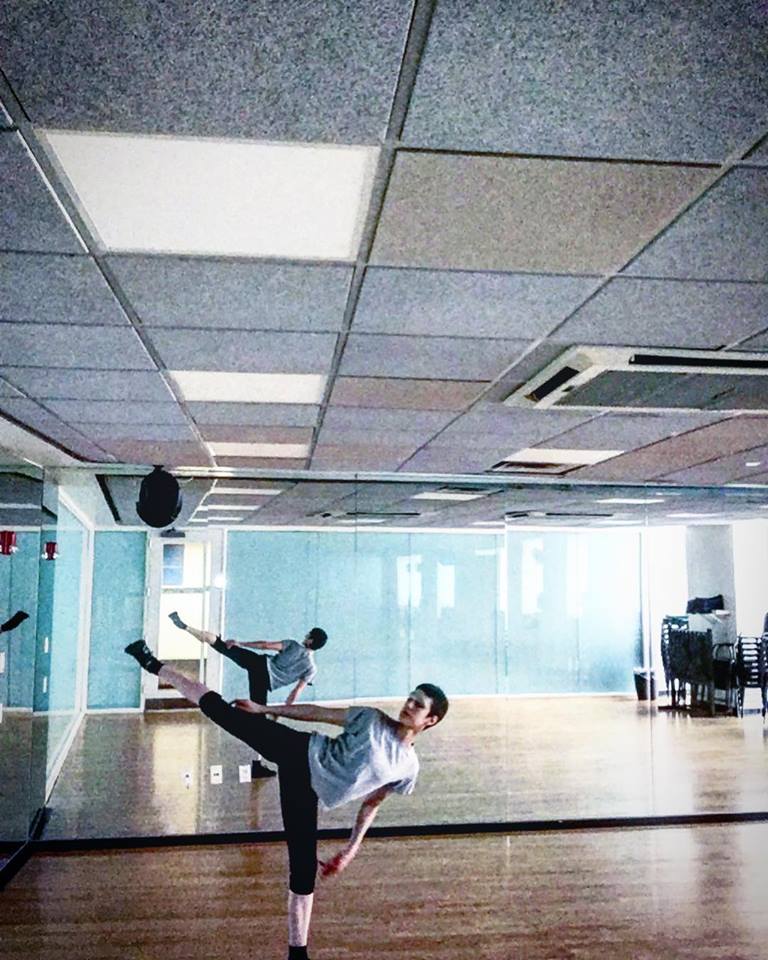
What
subject scope covers your current training role?
I specialize in corrective exercise, and that
serves as the foundation for everything else. When a client comes to me for
non-corrective work, such as weight loss or overall fitness, I still use the
principles behind a comfortably moving body, plus my background in dance and
martial arts, to make sure they get the biggest return on their workout.
How
does someone find the type of athletic pursuit that’s right for them? Is it about personal interest, a balance of
training ranges that work together, or a match to particular goals?
All of the above! I find people work best when
they have a concrete, specified interest that they want to enhance. For
example, one of my dearest dudes came to me for overall longevity, so we
started off with a lot of stability and small-muscle strength work, which led
to larger strength movements, and then pure brute strength with core
maintenance. As we navigated progressions for exercises around his pre-existing
injuries— meniscus and rotator mishaps— he told me about his admiration for
ballet dancers, so I worked that into his routine by giving him techniques that
could both strengthen his weak points and help him realize how to embody the
physicality of a dancer, in his own way. He’s progressed exponentially since we
made that connection, and now we choreograph his workouts so that every
exercise feeds into that goal and passion.
It’s not so much balance as it’s a matter of
interweaving. Find the points that lead to each other, and build on them in a
positive manner.
In
particular in reference to readers who may have been involved in the past, what
has changed in sports training, related to sports physiology knowledge,
training approaches, cross-training philosophy, diet and other factors, mental
approach, etc.?
Oh gosh. Everything.
When I started, “vegan” and “keto” were
unicorn words on Google, and YouTube was only just starting to be the go-to
fitness platform. Zuzka Light, a guru I followed in 2009, was filming sketchy
dumbbell videos in a basement with her boyfriend. Now she’s a certified
wellness coach with her own brand, and a book out in Barnes & Noble— sans
boyfriend, go figure. It’s incredible to see that evolution with her and other
wellness professionals, and pretty tickly to know that I’m participating in it
on a smaller level.
The fitness industry continues to grow at such
a rapid pace, so the knowledge keeps getting rewritten, which can be dizzying.
You have to be on top of it at all times, while still applying the truths
gathered in your own experience. Not every solution works for every body, which
is why the industry has exploded; more and more people are looking for that
custom solution, and with the external motivation from social media and
Instagram, they’re more likely to want to put in the self-work it takes to get
their body to the place they want it to be.
My job, in all of that, is to help the
individual along by being an interpreter between the person and their body. Not
everyone trains like that, but as I said, gone are the days of plug-and-chug
exercise routines and diet plans. I’m not a big fan of diet plans, either,
because they don’t account for the variability of the person’s emotional state
and environment, ie: both the world we live in outside, and the world of the
microbiome that lives inside us. Both of these are responsible for each of our
biological responses to food, and that allowance is hard to program into a
standard diet or workout regime. I guess the biggest change is that popular
science is now giving us more freedom to listen to our gut, literally.
Could
you say a little about your background with “motion training,” what that scope
refers to. What related practices did
you train in, and how those helped with other sports pursuits?
“Motion training” falls under the “movement
training” buzzword, which is a brand of fitness that stems from teaching the
client how to perform primal movements that are also found in dance,
gymnastics, capoeira, martial arts, etc, in order to achieve greater
neurological connection with their bodies. Ido Portal made this very popular
amongst certain MMA enthusiasts, from his work with Conor McGregor, and you
can see it in the way that fighter moves like jaguar and a crocodile when he’s
in the ring— fluid, responsive, never stepping twice the same way.
That’s why movement training results in
all-around better performance for even the average Joe, as each individual
movement serves as a blueprint for what the body will later be able to perform
subconsciously. While you’re training, you won’t know why you’re being told to
bridge up your hips to one side, for example, but then it’ll come up during an
act of daily living when you have to reach over your head for something at an
awkward angle, or in an emergency like nearly being nailed by a delivery biker,
that requires drastically shifting your center of gravity in order to move out
of harm’s path.
I don’t use Ido Portal’s method, but I am
certified in Animal Flow, which was created by Mike Fitch of Global Bodyweight
Training. If you watch the video, it’ll make my above explanation make more
sense: This Is Animal Flow
What is
it like living in NYC?
Breathtakingly wonderful. Every day I wake up
and I’m grateful I’m here— and that I’m lucky enough to live on the Upper West
Side, two blocks from a Trader Joe’s!
Your
look changed (hairstyle, most obviously).
Is there anything more to share about that?
Funny you mention it like that, because even
though it looks like I’m changing my game from the ultra-feminine Snooty Tea
alter ego, it’s actually been an experience of coming back to my roots.
 |
from the Snooty Tea Person days |
That’s where the cosplay comes in. As a
cosplayer, in our groups I was usually the one doing “bishounen,” or “pretty
boys,” which meant that I spent my adolescence walking around in a very
androgynous second skin— and it was fun! Now I channel it into my personal
style, with a little taekwondo thrown in there for kicks.
Oh gosh, I didn’t mean that pun! I swear.
Dangit. Old habits die hard.
 |
more than just pulling it off, but the fitness guru image works too |


