Showing posts with label tea blog. Show all posts

Monday, August 7, 2017

The end of a tea blog

No, not this blog.  Let me explain.

I love old tea blogs, looking back on perspectives on tea from way back when, maybe even ten years ago.  What Western tea culture must have been like!  The pu'er bubble burst around then, and people kept discovering new and unique versions of teas, like aged oolongs, or obscure forms of hei cha, and new producer countries kept turning up.  They still do; as far as I know I've "broke" the news of two new tea origins, of production in Spain and North Korea (teas I actually did try, in the second case).


A different type of transition relates to a changing of the guard in tea blogging; old blogs go inactive, new ones start up.  This at least partly relates to a natural process of changing personal interests.  I think back to how I loved wine at one point, then tisanes, and craft beer, after English and German beer before that.  I once owned a small espresso machine, and later went back to plain drip brewed coffee, and then switched to tea.  I was into liquors once too, but that related more to getting drunk, kind of a different thing.


This tea blogger's closing remarks in Another Tea Blog sums up all that related to their own transition:


Ok, I fought it and fought it, but the blog is officially dead. It saddens me, as tea has given me much pleasure, as has this blog. Unfortunately for now my interests and hobbies have moved on to other things.

Even without updates, many people still find their way to this blog. It is my hope that it will still be a source of information to some. I have disabled the comment moderation. If you wish to leave a comment, feel free, but I will most likely not respond.

Hopefully this is temporary. Hopefully tea will once again be the source of pleasure that it was to me. And in the mean time, hopefully it will continue to be a source of pleasure for you.


And that is the theme of this post, examining the life cycle of tea blogging, largely through the perspective and words of people that had written a blog but stopped.  With a bit of my rambling added it runs a little long but I found their input fascinating, well worth the read.

If you read through that blog, or any other, the posts tell the same type of story about initial enthusiasm, ramping up knowledge and experience, and writing and tasting skills, about building connections with others who share the interest, then eventually interest tapering off, at least in writing.  That's more or less the type of cycle I summarized in a comment on a seven year old resurrected thread on Steepster about starting a tea lounge.  Based on a little looking around none of those people commenting there probably actually started a tea lounge, and none seemed to maintain an active online interest in tea, or at least the trail goes cold there.


It's similar to this article on the 12 phases of every coffee snob's life; it ends with going quiet:


Phase 12: You develop an ability to keep your opinions to yourself

The clouds part. It becomes clear that not every coffee needs three adjectives attached to it. Mr. Coffee doesn't seem like such a bad dude anymore, he's just trying to feed his kids. There's actually a strange pleasure in drinking plain diner coffee, although you'll still draw the line at coffees from bank lobbies and hotel continental breakfasts. 


I could swear that there was a similar commentary in A Tea Addict's Journal, authored by "Marshal N," about stages of tea experience, more related to a form change than an eventual end.  A 2012 post there on tea blogging in general, about what is out there and changes, will suffice as a background reference.  There isn't much there that sums up general patterns but it is interesting comparing that post to his perspective on blogging from 2007 in the Cha Dao blog.  An observation on one reason why people write a tea blog from that:


But in much of the English-speaking community, from which most tea bloggers are drawn, oftentimes the only person who drinks tea seriously whom the blogger knows is the blogger him/herself. What the blogs, and the exchanges that take place both on and off sites, serve are the same needs that a tea drinker in China wants from a visit to a teahouse or teashop -- an interaction with somebody else who is passionate about tea.


That is true of my blog.  Compared to the real life group interaction mentioned in that early post even more of my own tea-related contact remains online.  I talk about tea in different places, all online, like in this FB group I helped found and moderate.


Old blogs coming back to life


There are few cases of old blogs continuing for a long time, on the order of a decade.  Besides the Tea Addict's Journal the Half Dipper comes to mind.  Both are perhaps quieter than before but both are well worth checking out, with both authors now drawing on a wealth of experience.  There are a few recent examples of classic blogs going dormant for years and then returning to some degree of activity:  Matt Cha's blogBear's blog, and Tea Obsession.

They don't tend to become too philosophical about re-starting, to examine their motivations for not blogging, or blogging again, or delve into cultural shift examination.  They just go back to talking about tea, probably from a slightly different perspective.  There might be more insight to draw on related to those cases but I didn't turn up any, so I'll move on to a few descriptions of why people stop blogging, input about personal experiences.  This short tangent can stop at mentioning those special cases.


The end of two of my favorite tea blogs, and one from before my time


I asked one of my favorite former tea bloggers about her experiences, and why she thought people let the writing interest go, the author of the Snooty Tea Blog.  The video form of that blog is under Natasha Nesic; following the trend of most early bloggers her real name wasn't connected to her work at first, but later on it was.  I'd like to include what I liked about her blog but it's hard to pin down; watch a video if you're curious about that.  Her input:


I believe that recreational blogging takes a certain dedication and outside support to maintain motivation. The ones who can do it sustainably are in fields with a much larger audience--therefore greater support network, greater opportunity to make cash. Income speaks, at the end of the day. We want to be paid for doing what we love.

These days it's more of a thing that personal training clients find fascinating--"You're a tea sommelier? And you had a blog?" but then we go back to squats. Fitness is where my real passion is, though I still enjoy a good cup of Pu-Erh. 


her iconic blog profile photo (and of course she's actually in the videos)


So a few different points there; overall support network issues and balancing different demands comes into play, and interests can change over time.  It does seem like tea blogs tied to a tea business tend to last longer, and that in cases when a tea blogger not working in the industry moves into that it helps solidify the connection.

I looked around through old tea blogs to find other examples, really as much out of personal interest as research for this post.  Based on asking around the author of one very well developed and now inactive tea blog, Palatabilitea, passed on her own insights to her own experiences, edited down just a little:


As a teacher, I know that human brains are wired to enjoy novelty, and that I have to develop multiple strategies and approaches to keep my students' interest. But we also end up returning to a few favorites.  I am still very interested in tea and continue to drink it daily. I just no longer have the need to constantly explore it and find new teas and new ways of brewing. I've had hundreds of different teas, each brewed in many ways, and I've gotten to the point where I'd rather just keep a few of my favorites on hand and brew them in my favorite ways.

Why my particular blog dried up was not a reflection of me losing interest in tea or the online tea culture, but more of a reflection of a huge change in my life. The couple of years I wrote my blog was a unique period of time between graduating from my undergrad and moving on to my first graduate program. When I started the blog, the Great Recession was in full swing and the only job I could manage to get was a part time receptionist position.  I started writing the tea blog as a way to keep my writing chops sharp, while at the same time studying to pass the GRE.  I'd fallen into a core group of live chatters on Adagio's TeaChat, and a few of them had started blogs to archive our tasting notes. We realized that a lot of other people were reading our blogs, too, which really bothered some of the guys (I was the only girl), and they stopped writing for that reason. More of us stopped for the same reason I did: our lives changed.

In my case, I got into a demanding graduate program. I went from having tons of 'free time' to none at all, and blogging was actually fairly labor intensive. Between tasting multiple rounds, taking notes, photography and photo editing, and then finally composing and editing, I think I was putting 5 hours of work into each post, and I just did not have that time. 

...And when I did get a bit of free time and funds back, I found I preferred not constantly writing about and talking about tea. The constant discussion had begun to feel performative, and I had developed a critic's lens when it came to tea...and that was keeping me from enjoying the moment and the tea in my cup. Drinking tea was far more pleasurable and meditative when I wasn't evaluating it. And it was a major relief from my "day job" of literary criticism. So I stopped paying attention to the tea chatter that was going on online, and I've been quite happy with my decision. 


I can relate to all of that.  Tea blogging does take time, and to some extent the activity takes away from simply enjoying the experience, even if it does push you to explore some aspects more deeply.  There seems to be a divide between people that enjoy trying to define tea tasting through description, who experience the analysis and communication as enriching it, and for others who find it gets in the way.  That gets compared to photography, how for some that puts distance between them and what they see, and for others it somehow adds a meaningful extra dimension.


While I was writing this post one of my own favorite current tea bloggers posted her sign-off from tea blogging, Amanda from My Thoughts Are Like Butterflies.  That blog won't be updated with reviews from here on out but I highly recommend reading through the existing posts.  She influenced my own experience of writing about tea, I suppose to some extent related to reviewing style, but really more about adding a bit more of myself to my blog posts.  Her closing post tells the story:


Well, all, the time has come to hang up my blogger hat, this is the last update this blog will have. I have given this a lot of thought and realized it was time to move on to other things! Before I get into the meat of the blog, thank you...all of you...all the readers, fellow bloggers, tea companies, tea growers, all the ones that found my words useful and relevant, you guys are the reason I continued with this blog for as long as I did, the reason I went from posting quick tasting notes on Facebook to long-winded rambles. I will never have the right words to accurately express my appreciation and the glowing warm fuzzies I get in my heart.


There are myriad reasons why, so I will give a quick rundown. 

1. I have burned out and no longer feel I have anything worth saying about these teas, which doesn't do anyone justice, and I really do not want my burn out of writing to leach into the tea itself, I adore tea and will do anything to avoid jeopardizing my love of it!

2. It is a job that doesn't pay anything, and I no longer find this job fun, it went from being a hobby and passion to a job. I know from experience this is toxic as hell one's hobbies should never only be a job. 


a pure soul


3. Yes, my health is part of it, I am tired of beating myself up for missing blog days due to being too unwell. I started this blog in part to make myself feel constructive while also being disabled, and that really helped at first, now I no longer need it for the confidence boost and the stress of missing posts got old. 


4. I just want to drink tea, I am tired of having to stop my sessions to take notes and mess with taking pictures, it is so easy with Instagram to take (mediocre) photos and throw them on there while waiting for the cup to cool, the process of taking notes mid tasting and photos were just getting in the way of my enjoyment,I am tired of having to think about it, I just want to get lost in tea.Those are the main reasons I am ending the blog, I feel as though a weight has been lifted from me!


She goes on to sign off a bit more, and explain that disappointed readers can still catch more limited updates on Instagram.

Those last two citations overlap a bit, and pretty much sum it up:  it can shift from being a labor of love to just being work, and for most it's work that doesn't actually pay.  Except maybe in tea samples, or for some limited advertising revenue, but a lot of tea bloggers are doing it almost entirely just to share experiences.

I'm not thinking of throwing in the towel just yet but it wouldn't take much in the way of life circumstances changes for me to scale back the effort I put in.  I've used tea exploration, research and writing to support different ends, to explore a subject I love and also social networking avenues.  Blogging always was about two separate interests, for me, one related to experiencing tea and the other to all the rest, and I could imagine the latter dropping out.  For now it's still a labor of love, and along with the mundane reviews I have a few other interesting things in mind to tell you about.

Tuesday, November 3, 2015

Happy 2nd birthday to this blog


It's been two years for this blog!  That's easier for me to keep track of than my wedding anniversary because I started just before my daughter was born.  The idea back then was that I wouldn't have time for such things as writing later, and I'd been researching teas and drinking different ones then.  That was not long after a second trip to China, where I'd bought a lot of tea, almost randomly, and it was time to start sorting out what I was drinking.


These abstract theme posts don't seem as interesting as content closer to the subject so I'll say a bit about what I've learned in two years and be done with it.  I mean aside from what's already covered in these other posts; countless details about different teas, and an early start on identifying what tea tastes and feels like.  A chocolate blogger contributed in a recent post and gave a really clear and thorough explanation of palate development, preference changes, and subjectivity issues, all themes I keep coming back to.


Wuyi Yancha!  like drinking a rock that tastes good.


Lessons learned:


Common sense goes a long way.  The opposite of what you always hear, right, that there is a large set of ancient Chinese secrets one needs to learn to really make better tea.  There's something to those fine details, more about optimizing technique once one gets some basic brewing steps and preferences down.  Someone really could start there, and work backwards, learn the finer points first and then figure out what basics they extend from after, and oddly enough it seems to work that way sometimes.  As with most things it's as well to not throw ordinary reason completely out the window.


It's an experience.  Really what else would it be?  Judging by courses and degrees maybe it's an academic field of study instead, or about a credential level, and of course it relates to a vocation for many.  If one becomes a bit burned out on the sales pitches that turn up along with background information it's helpful to remember that all the tea wouldn't make the trip here without it being a business.  In this sense "here" means anywhere, unless you are a tea farmer, or live across the street from a plantation, and even then it really needs to be a viable business for someone to keep on growing and processing it.


Some people take tea way too seriously.  Kind of strange coming from someone that wastes the time on it I do, so I guess I just mean it related to people that take it all differently than I do.  This seems to contradict the next idea:


There are lots of approaches to tea, and no one of them is right.  Better to keep an open mind and try different things, to learn from people that see it differently.  It's ok to never drink tea blends or certain types, or to never brew Western style, but maybe better still to keep an open mind.  Someone might hate the idea of blending tea with anything, or even mixing the same types to balance attributes, and then later figure out that they really love masala chai (or Earl Grey; whatever it happens to be).


Some degree of contradiction in the experience of tea is fine.  Just like related to being married, just not that much inconsistency.  Rules and conventional wisdom play a role, and so does breaking those rules.  One tea mentor said to watch out for people that make absolute claims related to tea since preferences and other natural variations tend to make the fact of the matter more complicated than that.  It's not directly related to the same point but he also said to be wary of a shop selling too many kinds of tea, but that's not a hard and fast rule, just something to consider.


useful tool or tangent?  interesting to keep investigating either way.

One warning sign related to tea expertise is someone claiming to be an expert.  But of course they really could still be one.


I recently read a blog site where the author said the best way to learn tea knowledge is to read classic sources, of course only available in Chinese language, implying she was the go-to expert you really needed to listen to.  The last blog I read that in I didn't get around to reading again, and I recently noticed that vendor went out of business.  The most knowledgeable sources seem to down-play being an authority, realizing there is more to learn than any one person knows.


Of course there is something else going on with people being trained and working as a Tea Sommelier; the field is expanding to include roles for people recommending tea for a living, so it is necessary for some people to step forward and claim that level of knowledge.


You can't judge a tea type by one tea.  How many then?  One relatively ideal example of the type is fine, which you would need lots of experience to recognize as such.  Those ideas make a nice circle.  Even after one has pinned down the ideal, paradigmatic type--as much as there could be such a thing, but it typically doesn't work that way--something else could still crop up, variations and such.


it's about interesting places and people too

The experience of tea changes over time.  Kind of obvious, right?  Preferences are going to change, palate development, etc., but perhaps more interesting is that different aspects become more interesting, like the feel of the tea, or aftertaste (hui gan, which doesn't exactly mean aftertaste; here is an interesting article that compares such terms to wine, which may make more sense if one has been through a lot of tasting that too).


I'll say more about that as I follow the path further; I'm not so far along just yet myself.  In a way it's a shame for people that get hooked by trying a really good tea early on, and jump in tying many other exceptional types, because someone experiencing the whole range from tea bags to mid-grades and on could spend many years continually trying better teas.  Of course they would still go through trying them with a changing palate, comparing different qualities and picking up new dimensions, so a lot of the same would still apply.


It's not just about tea.  For me the experience of drinking tea and knowledge of tea are two separate but related things, but for this point I mean something else again.  It's also social.  This point gets a bit strange since my tea connections are almost all online, so just I have the outsider's vantage through messages.  Funny how the conversations and groups and the rest work out, mostly nice enough.  If you like you could join a Facebook group that I help moderate to talk about it online more yourself, but aside from the issue of most such groups being a little bit quiet there are lots of them to choose from.


Plenty for one list!  Thanks to those that read this blog, for taking some part in exploring with me, even if you never did get around to commenting on your own experiences.  I'm open to talking about tea, sort of my thing to do that, so feel free to say hi, and by all means feel free to help out by flagging it when I've said something that's clearly wrong.  It's a learning process.  And more than that about one nice cup of tea after another.

Tuesday, July 7, 2015

Double Dogs tea room visit (Shui Jin Gui reviewed)


As far as tea cafes go in Bangkok Double Dogs tea room gets mentioned most, aside from references to "high tea," the British version of a mid-afternoon meal that's more about different kinds of snacks.  I finally visited there, with the shop located in the center of the main street of the Bangkok Chinatown, Yaowarat road.
 

a little dark for taking pictures


I'd heard a mix of good and bad things about this place, that the tea was great, or also that it was normal tea and overpriced.  It seemed likely this was similar to the mixed reviews that three star hotels get here; based more on expectations than what the hotels are like.

 
The shop is in plain site on the main central road but still somehow hard to find.  Google Maps is close on where it is but not exactly right, so based on that you'd need to walk down the block a bit.  My first impression walking in was that the shop is dark, and small, just a few tables.  it looked like they had more private space in back, maybe a separate room, but the front wouldn't seat many.


I selected a Shui Jin Gui from the menu, without much to go on for description about the different teas listed.  First impression:  nice tea.  The first infusion the waitress poured for me was not brewed for long, hard to taste much, essentially just a long rinse. Later typical Wuyi Yancha flavors emerged, wood, leather, floral tones, cocoa and sweetness but seemingly related to aromatic sweetness in the smell of leather, not similar to the sweetness of fruit.
 
As can happen the complexity isn't well described by a list of flavors.  Perhaps a trace of slate or such mineral underlied the other primary flavors.  The tea was good, maybe only disappointing for being so familiar, due to drinking a lot of comparable teas recently.
 
 
I noted there was very little char flavor element to the tea, and later research indicated it was supposed to be roasted more lightly than other Wuyi Yancha, so that made sense.  Some references even said the tea should brew to a yellowish or greenish color instead of the more typical reddish brown, but it looked a lot like any other typical version of the other Wuyi Yancha types.
 
It brewed a number of small pots consistently, good for the tea type.  I probably would have had more luck picking up subtle changes over the infusions except for having a slight cold at the time.


After four or five infusions the tea body (feel) was thinning but a woody taste and floral sweetness remained.  The char might have picked up a little, having been diminished by shorter infusion times earlier on, showing up a little more as I lengthened timing to compensate.
 
Chinese cakes were nice, maybe not ideal pairing for tasting due to being a bit sweet, but a good snack with tea.  At cost of 260 baht ($9) the value was ok, given that this is a rare tea type and some of that relates to drinking tea in a cafe. 


Related to the issue of value it was the smallest tea-pot I've ever seen, so it maybe held 3 or 4 grams of dry tea, and the cup it brewed each time couldn't have been more than an ounce.  Of course I'm familiar with the gongfu-cha approach, and it was no problem spending 20 minutes brewing and drinking 6 ounces of tea, but with different expectations it could seem a little odd.  The staff didn't mention anything about brewing at all, but there was really only timing to get right or screw up.
 
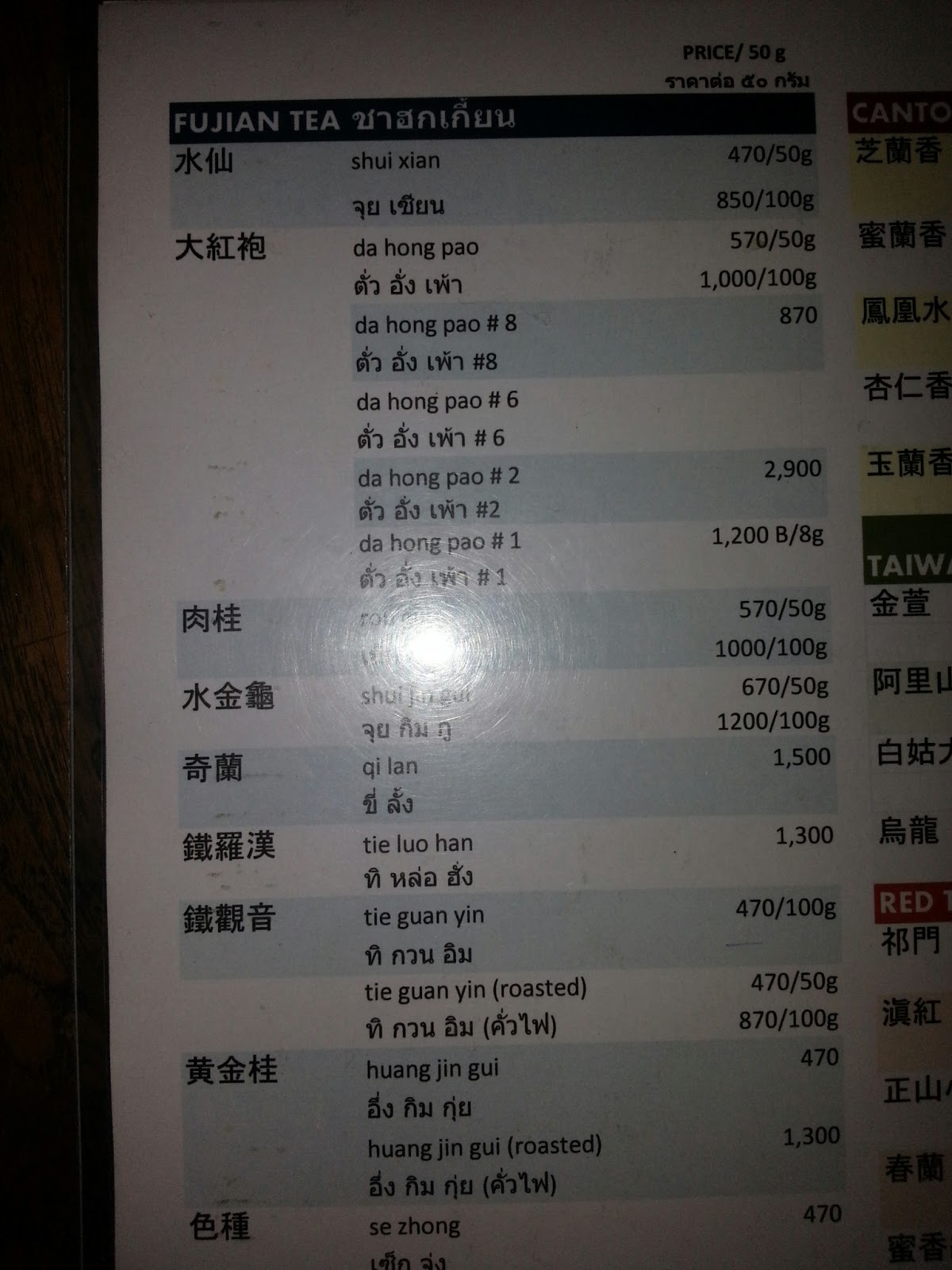
Before I left I checked the take-out tea list (pictured here; no way to take it in that dark room without a flash though).  There were a lot of interesting sounding teas on it, most between 500 and 1000 baht per 50 grams ($15 and $30), a price range for which decent teas are to be expected.  Since quality is such a factor in that range it's hard to judge value. 


It would be the high point for some to take a break in a nice quiet café in the middle of a noisy Chinatown, but for me it wasn't worth it to buy a tiny pot of tea (and 3 or 4 grams of leaves) for over 200 baht versus 670 baht for 50 grams take-away and a dozen times as much tea at home.
 
I suppose I'd probably buy and drink some teas that I'd tried given that range but didn't buy any then.  The staff there didn't seem up to talking about tea, even after I was taking pictures of menus and such.  To be fair here in Thailand that can relate to English language competency as much as not having "service mind."


Bangkok Chinatown

Research section:


Reading around a bit about the general tea type I found an interesting description of the same type of tea sold by the same shop, so perhaps the exact same tea, but not necessarily so:
 
This tea makes you feel like immersing down in the deep sea of mind, exploring the marks of dignity and pain that imprinted  upon your life’s journey. Its characteristics is akin to that of a man in the late 50 years old. Deep and judicious, a frisky and wise old uncle. He is a bit of a rowdy, but a this is the roughness that accentuate the trace of his scars in life. He exhibits a dried passion, dry but peppery.
 
Are we still talking about tea?  A bit over the top but I like it, even though I have no idea what that means.  Actually another part of the same post mentioned more typical flavor elements, including cocoa, orange peel, nutmeg, and charcoal.  If it was the same tea it seemed to me there was an interesting earthiness to it that different people might describe in different ways.

 
It's normal for vendor content to crowd other types of references (reference sites, blogs, forum discussions), but in this case it was almost all just sales content many pages into a Google search.
 
This site is an unfamiliar general reference, www.oolongteainfo.com/shui-jin-gui/:
 
Shui Jin Gui, also called Golden Turtle in English, is a member of Si Da Ming Cong (the four famous Wuyi Oolong tea bushes). The other three members of the family are: Tie Luo Han, Bai Ji Guan, and Da Hong Bao. Shui Jin Gui comes from the Wuyi Mountain in the Northern Fujian province of China.
 
Of course that's what other vendors say too, although in rare cases there are five names listed.  The tea legend behind this one is something about a turtle god turning into a tea plant (ok...), and their description:
 
The tea has flowery sweet aroma with a pleasantly sweet aftertaste. Compared with other oolong teas, its taste is more subtle as it process with a lighter fire finish.
 
Another vendor site (Seven Cups) says a bit more about the typical taste, or at least of their product:
 
The dry tea leaves have a wonderful charcoal aroma, but after you infuse you can find the lightly floral aroma with plum blossom sweetness.
 
It was interesting they mentioned an alternate version of the "turtle" name origin (not so unusual for there to be more than one):
 
A torrential storm washed a few of these cliff-dwelling bushes down onto another farmer’s land. The bushes carried water and clay down the slopes with the tea bush on top, resembling an algae covered longevity turtle swimming in the water, thus the name “Water Turtle” was given to these bushes.
 
Maybe that happened; it really doesn't matter if it did or didn't.  I also mentioned this vendor description because there is a Tea Chat forum discussion of their teas, related to an earlier version of the same tea, or at least the discussion is from 2012.
 
The input is quite interesting, and everyone sounds very well informed and authoritative, even without anyone saying much about what the tea tasted like.  It's as well since impressions and descriptions vary, and brewing approach differences changes things quite a bit, and results already shift over different infusions, and so on.  Just mentioning a general impression works.
 
Other descriptions are essentially the same, and of course pricing for any versions of this tea aren't on the value-oriented end of the spectrum.  It's probably the case that lower end or knock-off versions of Wuyi Yancha tea would be sold as Da Hong Pao instead since it's more familiar, but that's still no guarantee that teas sold as this type would be genuine, actually what they were sold as.


One more description (Verdant's) ventured to the detailed extreme:


The burnt caramel depth transformed in the aftertaste to a lingering dark elderberry and earthy hazelnut profile.... The mineral notes gave way to sweet cinnamon and the warmth of ginger without the spiciness. Towards the very end, the aftertaste transformed into an almost vegetal creamy green bean flavor with a lingering honeydew melon sweet orchid finish.


Sounds nice.
 

Tuesday, June 2, 2015

Tea brewing timer; standard tea brewing times reviewed


Today when I came to work there was a tea brewing timer sitting on my desk, but with no indication of who put it there.  It has a cool look to it, with three different sand timers for three different types, from Twinings.

Of course my first thought was "my kids are going to love playing with that."  Next I wondered who put it there.  Then after a lot more synapses firing I wondered how well it would work for timing tea infusions.


the gift!


If I timed tea brewing more often that thought might have came up earlier.  I experimented with a tea brewing app once, a little, but didn't use it much to time stopping an infusion process.  I got stuck at the part about the times it suggested as standard not matching other references for standard brewing times, and sort of kept on winging it, experimenting with changes a lot.


I had started drinking a lot of loose teas about six or seven years ago, oddly enough years before really going overboard with research and purchasing, so I was thousands of cups in by the time the idea of optimizing would have made much difference, and already decent at guessing out times.  I was over a decade into drinking tisanes before switching to tea made from tea at all (tisanes = herbal teas to most people), so I was lots more thousands of cups of brewing those along prior to then.  But tisanes do tend to be a bit forgiving, and of course tea from the tea plant does require a more careful touch to get better results, or optimization (for some).


I'd like to say I've internalized brewing to the degree that I vary every tea related to temperature, ratio of tea, and time by type, and to some extent that's actually true.  A lot of infusions are a test of varying these, and I don't vary them as much as in the past.  Of course I take vendor instructions into account or even actually use them as the case warrants.


example Tea Pal table from page

Google mentions that a "Tea Guy" blog post lists a number of different apps for this.  It doesn't take much clicking around to see the same issue coming up, along with the related concerns of brewing temperature and tea to water ratio.


Note that this table isn't shown as an indicative optimum for these teas; it's an example from a blog page details about the app.  Of course it's going to let you adjust these parameters for preference (surely?).  From this image it's a bit odd that two types of dragonwell (longjing) could have differing brewing parameters, but of course such a thing could happen.  The parameters don't look so far off at a glance but comparing them to other tables will show the odd part about "standards" differing.


But then after an hour of looking around for standard tables not much turns up.  There is a lot there in a Google image search, and the typical major tea producers are going to say something, but other reputable references are hard to find (bloggers, standard tea resources).  You see bloggers mentioning the standard parameters versus what a manufacturer says relatively often in posts but that could as easily be related to their typical, learned preferences, not some objective consensus.


testing the timer

Before I get into all that, a bit on what times the sand timers indicated.


white:  2:00 (just over)

black:  3:45

green / tisanes:  4:45


Odd, right?  The first thing that seemed odd is that white teas are often recommended for the longest brewing times rather than the shortest, sometimes for 4 or even 5 minutes instead of 2.


3 to 3 1/2 minutes might be an average recommended time for brewing in general (varying so much related to preference and other parameters there would be no standard), but it would seem odd to brew green tea for nearly five minutes.  Green tea is actually kind of a broad category anyway (oolong or black tea too, for that matter), so citing just one time wouldn't make sense.


It's probably about time to get back to some tables and see where any of this stands related to research.


Tea timing parameters references:


lots of brewing parameters tables!  but they don't match  :(


One last tangent before I do get to these:  the question ignores a general separation in brewing technique into two types.  Related to the same general question in a LinkedIn group discussion (in Tea Enthusiasts and Entrepeneurs), I commented this (really the question was about adjusting tea strength by changing different brewing parameters--close enough):


The question doesn't address the context that in general there are two different approaches to brewing loose tea.

One relatively Western version relates to standard brewing times (3 to 5 minutes, typically using a teapot, although the vessel doesn't matter as much as water to tea proportion and timing). A second technique typically referred to as gongfu cha (which translates roughly as tea technique) uses either a smaller pot, generally clay rather than ceramic, or a gaiwan with a much higher proportion of leaves to water and many shorter brewing times.

Different references vary for the second technique brewing time depending on the strength of the tea desired, but it's not uncommon to see very short brewing times used for some tea types resulting in a very diluted version of the tea (of course intentionally).

So to answer the question, one would select a general brewing technique then other aspects like desired tea strength, vessel, number of infusions, etc. based on preference, which would also relate to tea type. A black tea would generally produce less infusions than other types, perhaps only one depending on those factors, and in my experience then green, then oolong, then pu'er in order of increased tea output from tea type, but others might contest that since all the different factors tend to mix.


Good answer!  Always best to not actually answer the question.  From here on, and prior, I'll be citing references about Western brewing, and won't really get into gongfu technique.  Those infusion times are much shorter.  Sometimes 30 seconds is used as a base-time, adding length of time subsequently per preference and tea type, or even shorter times could be used.


Note the link goes to the group, not the discussion, since it's a private group (but you could join it, just explain to them that you have an unusual level of interest in tea).


That said a tea brewing times table isn't really valid, as the other discussion responses generally agreed, in addition to other factors relating (eg. "green" tea isn't all one thing; it really might make sense to brew different teas of the same type different ways, especially for tea types that varies a good bit).  All the same, back to seeing where standard tables do lead.


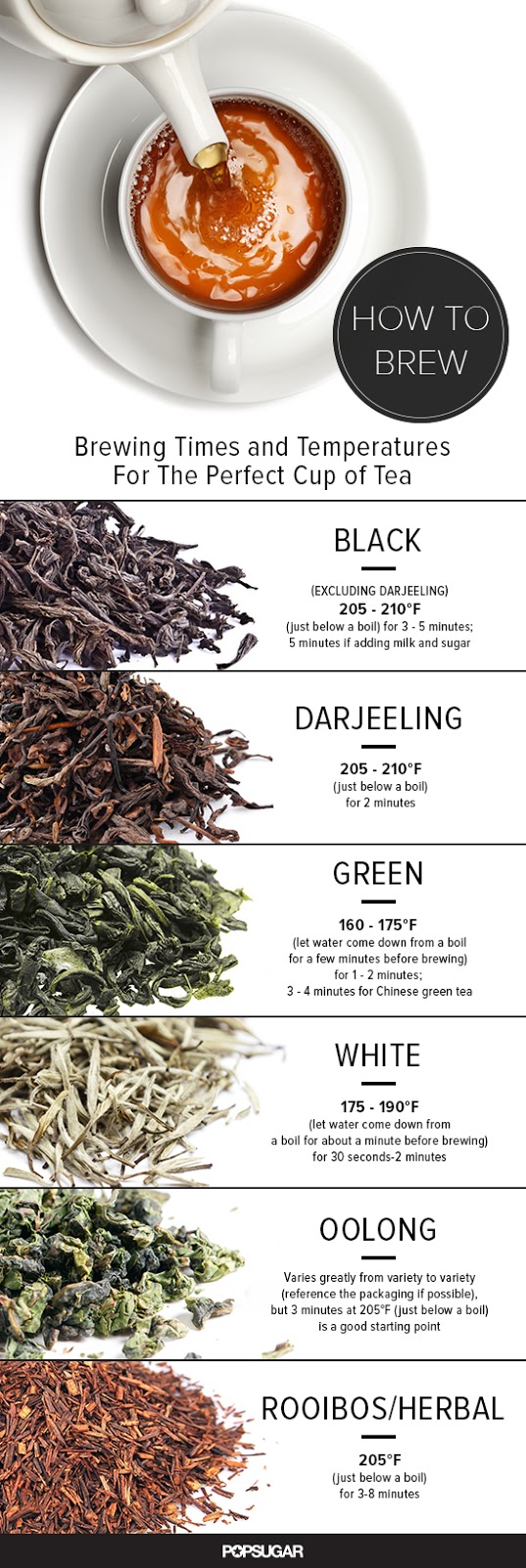
This table is a nice looking graphic, reasonable enough content, although taken from a blog not really focused only on tea (a food blog, "fine dining lovers").  Why even cite it then, right?  I guess for comparison, and it shows one more type of reference out there.


By now I'm getting familiar with the expression "for the perfect cup of tea."  I wrote a post about an article on it not long ago, and I've seen other references since.


The two references are actually not that far from each other.  Darjeeling is a bit off, with temperature and brewing time varying a lot for both, but then identifying Darjeeling as just one type of tea is already a mistake (even more than for the others, maybe, but I did just see a table about brewing different types of Japanese teas differently, possibly related to this blog site).  Darjeeling can be prepared as white, green, or black tea (or even oolong), and these categories seem to tend to mix a bit, to me.  Darjeelings from the different seasons (flushes) are different, and surely there are other variables.


Art of Tea table reference


Both tables agree on really short brewing time for white teas, expressed as a broader range than for most, and oddly I'm with them on that, it varies even more than for other tea types related to what you want out of your white tea.  Of course this doesn't speak to the longer times some white tea makers recommend.

One more quick tangent, related to a point about this in a recent post of this blog about a white tea::


Second infusion I brewed longer to see how that changed results,  since it's common to see that advised for white teas.  The character of a tea can change over infusions so really separating out the two effects would require making the tea again. 


I did this on purpose this time (really!) since sometimes it seems a light-brewed tea can actually help subtle elements stand out, or maybe that just seems so to me.  Brewing longer allows a white tea to reach a more conventional flavor strength but some subtlety might get lost, so in the end the best way is subjective, however you like.


If the point were only to show that there are different standards being recommended as starting points I'd already be there.  But why not go on to see what tea makers recommend, to look a little closer at some of these numbers.


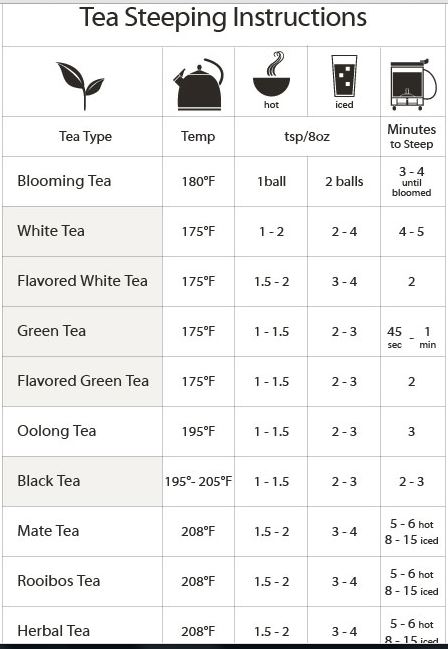
Teavana brewing table


On the right is Teavana's online page reference for brewing guidelines (and obviously they'll recommend adjusting for preference).  Some differences:


-white tea is back to the longer recommended time I'm typically seeing from vendors, with the temperature consistent across the different references


-green tea brewing time recommendation has dropped way down to a minute or less, without differentiation within the range of green teas


-everyone is ok with brewing oolong for 3 minutes


-black tea is back to a standard range, allowing for a shorter time of 2 minutes, with their temperature range dipping below the others.  Some people consistently recommend brewing black teas at boiling point but in general I do like results for a bit below for a lot of black tea types.


Getting back to the idea of timing support, a simple on-line timer allows you to set the time in a window, offering these guidelines (Steep It).


It's hard to imagine not using a phone-based application for something like this but I guess there must be some reason why it would come in handy, like if you lose your phone.  Some of these parameters are close to the others, some are way off, like green tea dropping to one minute (a bit short, that, for Western style), or white down to 30 seconds.  And I've seen chai references that say to boil the tea, then let it sit, then reboil, but I'm still working on my chai basics.


Had enough of the tables yet?  One last check on what Twinings suggests, since their sand timers did seem a bit off:


Note this page again references a "perfect cup of tea."  Probably better for them to not go there...


And they say for temperature just use boiling point water to brew all of them.  Noooo!!!!!


Aside from those horrors, and white tea again a bit low (1 minute), the times are ok.  (cold brewed iced tea in 5 minutes?  whatever).


It doesn't match my sand timer "settings" at all; not sure how that came about.


tea party!  never mind the toy coffee maker

Conclusion:


My kids will love playing with this timer.


Friday, May 8, 2015

A Longjing tea review, and a philosophy of tea


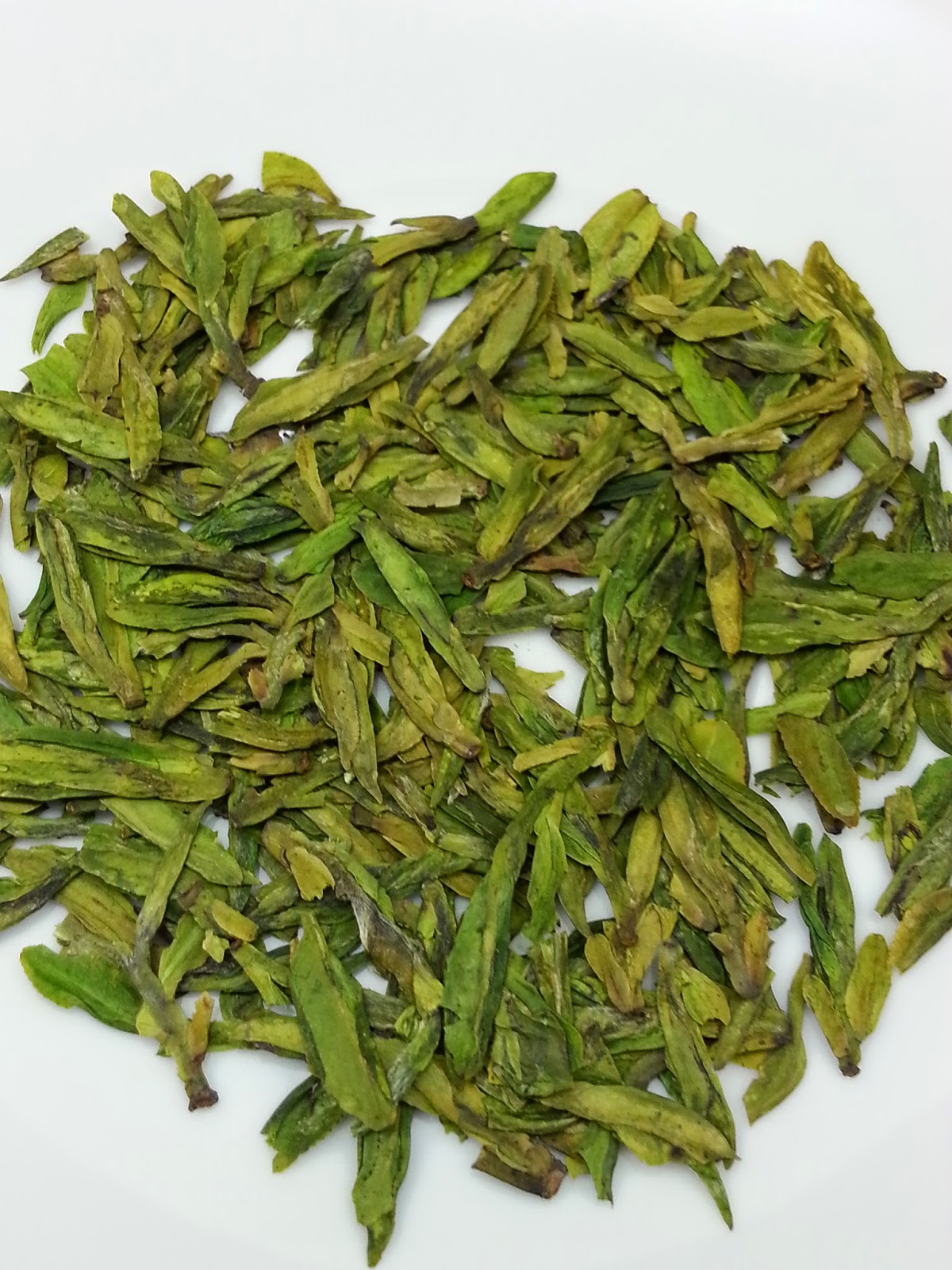
I just tried a second tea purchased from the Tea Village shop, Longjing or Dragonwell (their reference on it here).  As chance has it I’ve been discussing this type of tea separately as my favorite example of a green tea, so I wanted to write about it before some other interesting teas I just bought, and the queue of others stacking up at home.  As for post layout here I’ll ramble a little first, and then review a tea, and move on to some deep thoughts (sort of).  Somehow it seems a good time for talking about tea in general.


Longjing was one of the first "decent" teas I tried, based on the advice of a Chinese work associate.  Thais don't drink much tea, and I've not met any that are really into them.  He said that Chinese people prefer to drink fresh tea (later it turns out aging can be positive in different contexts, but still right for that tea), and he advised that Longjing spring teas had just been shipped to Bangkok, and even mentioned one place to get them in Chinatown.

Different blog references about Bangkok Chinatown shops tend to caution about tea being stored improperly or for a long time in some shops (the large jars you see in different places), and of course weather conditions here for tea storage are the opposite of optimal:  really hot and humid.  But somehow Longjing typically falls under a separate category and when you ask about that in a Chinatown shop they go and get sealed bags from a refrigerator.

At that time I tried different grades of the Longjing teas they were selling, and could tell some difference in them, but wasn’t so clear on what the difference meant or which I preferred, so I sort of just picked one.  I’ve not really progressed in terms of Longjing character or grade understanding or preferences, but then I’m not really angling to be that type of tea expert, a walking reference on tea types and flavor profiles.  I research what interests me, try lots of teas, talk to people about all that, and whatever sticks I retain.

I will repeat one fragment I recall about Longjing from research, although this really won’t pass as knowledge.  I watched a tea review video once where Jason Walker (a well-known tea reviewer) said the characteristic flavor element in Longjing should be toasted rice rather than nuts (see a different review of a similar tea here; or maybe it is the same one, I didn't actually watch it prior to writing this).

As much as anything this raised the issue of what “should be" related to tea, in this case related to a flavor element, the type of thing tied to grading, along with other details.  But what does this "should" mean?  It could mean people are describing it wrong, one common element generally found in most examples.  It could instead mean that better versions taste one way and others with a different characteristic element, sort of related but not the same.  I took it as some of both.

Location is also an issue, with different types of Longjing produced in different places, similar in preparation styles but essentially slightly different teas (but to be clear grade level and location really are separate).  It all gets a bit complicated, just sorting out this one tea.  You could read more about that here in one general reference, or there is always Wikipedia's take, or lots of vendors have lots to say.  Note that all these references links here are about Longjing, but the range of possible tea subjects is a bit broad, not just about tea types (processing, regions, tea gear, brewing--on and on).

There are different other references if someone wants to go overboard, a tea forum (there is more than one, actually), Steepster (review post site, with some reference and discussion content), and plenty of reference sites (I've been mentioning the Tea Guardian lately, but there are others), and so on.  If the concern is about buying tea, which would surely come up, a bit deeper look might make more sense than idle curiosity would drive.  Subjective preference could well be a completely different set of concerns, of course.  No one can help with that part, except to point in different directions based on input about what you like.

This review is just to say what this tea is like, and a little about what it is, and I suppose to start in on where further investigation might lead.


Review section:


The tea tastes fresh to me, very lively.  I'm not saying it necessarily was made a lot more recently than most teas I've ever had, but rather that it tastes like that (so maybe).

The typical descriptions one runs across for green teas are grassy or vegetal, and it’s along those lines, but with the distinctive flavor only Longjing seems to have.  Again someone might say the primary taste component is similar to toasted rice, or nuts, and that may well vary a lot by the actual tea (growing location, grade level, preparation style, handling, proper brewing process, brewing water type and vessel used, etc.).  So I’ll just stick to this tea.


I’m not sure how to describe it.  Great work reviewing tea, right?  To me it tastes like Longjing, as if in some strange way that might be a basic flavor, but of course that doesn’t work as a description.  The tea is sweet, light, and slightly vegetal, but not so much like grass or a vegetable.  The closest actual vegetable flavor might be very fresh sweet peas, nothing like the dark green mess that comes with overcooked peas, or frozen ones, or--the horror--canned peas, but a sweetness and freshness that sort of transcends and tastes like something else.


Pardon the tangent, but the days of people knowing what truly fresh vegetables taste like seems to have passed.  If you grow your own green peas, pick them when completely ripe, and prepare them just then it's far different than what a grocery store or market is going to give you.  Or at least that's how I remember it when I did that.


It almost works better to talk about the character of the tea without breaking it into a list of flavor components, even though that is the standard approach.  It has an unusual feel to it, a soft sort of astringency that gives it an unusual dryness, but in a subtle, pleasant way, nothing like the way stronger teas can really stretch such sensations (no need to name names).  There is depth to the way the lightness and sweetness mixes with that feel, and a light vegetal character, and another component that is hard to fully determine (below that toasted rice and the vegetable elements and sweetness, a very light and soft mineral, something...).

It seems the main distinctiveness relates to the tea essentially being fried, versus Japanese teas being steamed.  In cooking when you fry almost anything the flavor changes significantly, differently for different ingredients, and varied per how you’ve prepared them.  Roasted garlic is wonderful, very different than raw garlic, and not so far off in terms of preparation steps from the much less pleasant bitterness of overly cooked garlic.  If all the conditions are just right the final product is just right, and no one could prepare it based on a description of process steps, it takes more than that.

After discussing the Malliard reaction (what happens to toast) related to a recent post about Hojicha (Japanese roasted green tea) it almost seems one should dig much deeper to see what’s really going on with this Longjing, but I won’t.  The tea gains a wonderful distinctive nature from whatever combination of causes, all the while staying even more fresh for going through the processing.


A philosophy of tea


On the one hand I’ve loved all the different Longjing teas I’ve tried, and on the other the teas referred to as such can vary a lot, described by growing locations, types, and grades.  As with many types they are rumored to routinely be sold as knock-off versions.  The brewing process isn’t quite as forgiving as for lightly oxidized oolongs, which are sort of hard to screw up (optimizing them is still a different thing).  So trying one from a reputable vendor would likely be an indicative experience (probably a very positive one, per my experience), but even trying a few teas doesn’t really let you learn of the type in any detail.


dedicated to future tea gurus

It’s these types of contradictions I love about tea; it’s how you take it, and you sort of never do get to the bottom of it.  One could be fearful of what to buy, from who, the actual value, and brewing variances, and focus on gear, or get lost in research, and online discussions, and be better off drinking coffee in the end.  Or you could just go buy some loose teas and dump them in hot water, and keep improving every step of that process over time, what you buy and how you make it, marveling at the degree of achieved success each time and always building on it.


With this type of perspective in a way it’s almost best to know nothing; beginners mind, the Zen idea.  Once someone has actually tried loose tea (maybe decent loose tea; it’s not all so interesting) the journey is begun, but it could be all the more interesting for being much closer to the beginning than far down the learning curve.


I suppose that's not completely true since someone could keep brewing decent Longjing at boiling point water temperature and more or less ruining it (it would be bitter, which it shouldn't be), but I mean aside from such concerns.


It’s possible that some could instead turn to the dark side of tea, tea snobbery, criticizing others for not knowing what they know, and not being worthy of higher tea experiences, likely prompted by fear of being judged themselves.  But in general tea people are balanced, open, positive, nothing like that (even vendors; and without them the tea stays where it started out, essentially with Asians drinking most of it).


So one should walk the path of tea experience with an open mind and light heart.  One should drink decent tea, then better teas, to learn and find their own way.  It's always pleasant to find that most other people that are into tea have a similar perspective.  It can be daunting that vocabulary and the concepts being described by advanced tea drinkers can be a bit much, even for me after two years of obsessive study, but taken for what that's worth it's just an extension of the same type of exploratory approach it begins with.