Showing posts with label wet. Show all posts

Friday, April 22, 2022

Sheng pu'er storage, wet, dry, and optimum

first published in TChing here

I've been giving sheng pu'er storage conditions some thought lately, and recently ran across examples of teas altered by the two extremes.  One paradigm was in the form of two different 2005 and 2014 sheng pu'er versions stored dry, in Kunming, that were very well preserved, and the other related to two 2009 cakes that were far more fermented than either of those.  That 2014 version was from Laos, so I usually call the type "sheng" but not "pu'er," a naming convention theme I don't revisit every post.

I don't know where the second more fermented versions were stored, but since I live in one of the hottest and most consistently humid places in the world, in Bangkok, I can draw on plenty of experience about how wetter storage tends to go, and speculate about how artificially maintained conditions might be different than here (although I don't do much with that in this).  I've posted about an even more extreme example in trying a 2010 Nan Jian (Tulin) mini brick, after writing this draft, so I'll leave that out of this discussion.
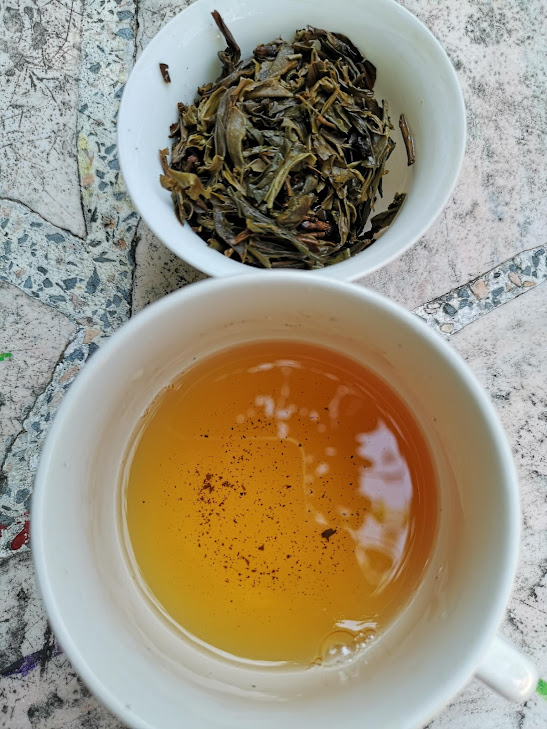

that 2005 Menghai sheng pu'er; a bit age transitioned


the Nan Jian / Tulin 2010 version, kind of at a similar level


Of course all of this is speculation, pulling together perspective based on partial inputs.  I've only mostly been drinking sheng pu'er for 4 or 5 years, so I don't have any examples of cakes that I've seen transition through even a decade of aging cycle myself, with 15 years cited as a more common fully aged starting point.  I did buy a few sheng and shu cakes around a decade ago but finished them.  Of course that range of experience is all relative to conditions, mapping fermentation level to time period, as more about those examples shows.  This could run long, like a short booklet on these themes, so I'll try to offset that by breaking thoughts up by short section, and really only offer input about humidity as a factor in relation to these cases, even though more than one input came into play, with temperature and air contact other main concerns, and starting point, the tea material, is just as critical as storage factors.  

A bit of an aside, I first wrote about pu'er storage conditions when researching that subject in 2016, and updated that adding a bit on what relative humidity is all about in 2017, with more on natural climate area ranges there.  As you read those posts they shift from only referencing external input to adding more about what I've experienced.  I wrote about sheng storage in a summary post comparing Kunming, Hong Kong, and Malaysia standard natural humidity levels back in 2019 (with local area tables in that post from the Weather Online site); I guess it is time to get back to updating comments on this subject.


Let's start with filling in what those examples covered, then a few definitions, then on to those thoughts about transition patterns.


Two "wet stored" 2009 sheng cakes (reviewed here):  it's a shame not knowing the storage conditions, but those two had to be stored right at the edge of as wet as possible to get to well transitioned in 13 years.  They still had a touch of younger character in limited senses, a bit of vegetal range left, but heavy fermentation related flavors stood out a lot more (mushroom, geosmin--essentially dirt, heavy earth, wood, and mineral flavors, warm dried fruit, dark wood and aged furniture).  Lots of teas I've reviewed here shared some of that scope, but it takes a different kind of input to get that much geosmin emerging.  For intense, bitter and astringent teas, like Xiaguan tuochas tend to be, you really need a lot of transition to move off that range some might see as unapproachable, so 15 years of relatively fast aging might be just the thing.  I suppose that's jumping ahead though, on to the patterns.


2009 versions, much more fermentation transitioned than the other two teas


1980 and 1993 versions color comparison (from here), relatively fully transitioned, brewed fast


Two well-preserved dry stored cakes:  a 2005 Menghai version and 2014 Laos tea.  There's a common discussion point that a trade-off for drier storage, beyond not transitioning (fermenting) is that a sour or wood-like aspect can develop, and I keep coming back to whether that happens or not in examples like these.  Both were really well-preserved, aged to a relative degree of half that if they'd spent the time here, or even less.  Some degree of bright, floral, aromatic, and fresh aspects remained in both, of course more so in the 2014 version, with that 2005 more in a "teen years" sort of middle ground for aspects present.  Starting point changes a lot, and I can't be sure how they were initially, but Laos teas are essentially never challenging to begin with (per trying at least a dozen sheng versions from there), and for Menghai versions that definitely can come up, intense character early.  


2014 Laos version, a little washed out by high lighting level, but also light


Is that really a regional character aspect theme though?  I'm not sure.  Laos teas have to be made from wild-grown, naturally occurring material because they're not farming teas in the same monoculture forms that are common in China there yet.  Surely someone is replanting and growing tea through more standard farming, but I mean in general.  Mountainous areas in Laos tend to be cool as SE Asia goes, not like the hotter lower flatlands in Laos.  It's unlikely that heavy pesticide and fertilizer use would come up as often as in standard monoculture farming; the trees have been living naturally for decades, or more likely centuries (a general 400 year age range comes up for the tea growing practices, often extended to saying that the actual plants are often 400 years old, which isn't right, they would vary in age, most much younger).  Then plant types would vary; although parts of Laos close to Yiwu that's no guarantee that plant types growing overlap so much.

To keep this moving back to that one storage input range let's consider what those wet and dry ranges really mean.


Dry storage:  


Based on reviewing average local climate conditions it doesn't seem that dry in Kunming, varying from low 50s (RH %) up to nearly 80, as a monthly average.  It's not necessarily the outdoor humidity level as a relative value that's a problem in temperate locations (the US, Europe), but that if it's cool out and heated indoors then that relative humidity level of heating air that can hold a lot less moisture is dry, relatively speaking.

For indoor storage it's commonly accepted that if the range falls below 50% the tea fermentation will become inactive (whether that's actually right or not, but that sounds like a reasonable conventional understanding to me).  In March and April, stored at natural local humidity levels, Kunming stored teas wouldn't be fermenting much, but that's still perhaps not bone dry.  Since it's an average it's harder to say, and it's not easy to factor in how indoor temperature moderation would work out, if real indoor conditions wouldn't tend to be drier.


Wet storage:  we can cite Malaysian values as an example here, and compare that to indoor controlled conditions:


Malaysian local climate shows humidity level in the mid 70s to low 80s, all the time, that's humid.  That's based on an average temperature window of 24 to 31 C (75 to 88 F, surely often hotter at mid-day).  That's a little more humid than here (Bangkok), where it's quite hot and humid, but weather varies a little more, with both are in a similar ballpark.  


I was going to use here as an example, about how it's cooler now because it's 10 AM, and the value will dry a bit as temperature increases, but it's 32 C (89 F) and 65% now, pretty hot and humid (when I wrote the first draft).  Maybe the point would've worked better at 6 AM, back when it was still in the 20s (closer to 80 F).  I'm first editing this on the Thursday shown and it really did get up to 37 C yesterday, which is hot, human body temperature, so the units conversion to 98 F comes easily.  I ran yesterday, in the afternoon, and was really feeling it.  Due to bad judgment I doubled my normal route length, from 4 km to 8, and I still felt the impact in the evening as a result of both.


People discussing controlling temperature for sheng storage tend to fix on specific humidity level they feel is high but still safe from mold, often using 70% RH for that, or sometimes less.  70% is kind of the edge, although other conditions factor in too, temperature, and degree of air contact.  I don't think you could hold stored sheng at the Malaysian local maximum, 84%, without experiencing problems.  If temperature shifts just a little it would take time for the salt pack to adjust and any condensation is a worst case for tea (sheng pu'er cakes; other teas don't need to be stored in contact with humidity, perhaps with shu pu'er and hei cha as possible exceptions).


Ideal / natural storage (two different things):  I'll have to mostly speculate a little about this but wave off the subject more than I address it.  One idea behind "natural storage" is that you aren't holding the humidity and temperature at one set value, and normal fluctuations in range allow the tea to experience a more normal, organic sort of environment.  If I'm remembering right Marshal N, of the Tea Addict's Journal blog, has speculated that some degree of change could be beneficial, having moisture move in and out of the tea, letting microfauna experience more normal circumstances.  I'm not sure, even if that attribution is completely accurate, since I've not been reading that blog as much for awhile.

"Ideal" would be a tricky concept, since people might naturally want different outcomes based on having different preferences.  Or something that gets less attention, it might depend on the tea character starting point, with more aggressively bitter and astringent teas really needing a lot of transition, and others that don't changing more positively when the shift is slower.  I won't get far with speculating about that second point here, except to say that I have liked some teas that weren't changed much over time, like those two I mentioned earlier.  

That 2010 Nan Jian / Tulin version is probably an even better example, the one I didn't go into here.  But then maybe I would've liked both just as much "younger" and stored wetter, and the 2005 Menghai version did seem to need more time to get to a likely more optimum aging level.  I'm trying it again with breakfast, and after, as I edit this; it will probably be better in 5 more years.

It would be nice if I had more exposure to what others see as optimum results, trials of 20 year old teas stored in different ways, starting from different characters, that turned out very well.  I'll only ever get so far with that; I don't have the tea budget to approach it in the most efficient ways.  This is a hurdle that many could find problematic in relation to feeling like they have a moderate degree of exposure to the subject, that trying 100 aged sheng versions wouldn't necessarily seem like a good background, because then someone might just want to try 100 much better versions.  Or too see the patterns play out for themselves for a few dozen cakes, a project that would take that 15 years or so.

On the one hand this is exactly what I love about sheng, beyond the direct experience of drinking the tea itself, that the experience of these transitions and inputs is never-ending.  In a recent video interview (where I was interviewed, odd) I answered that this is what keeps tea experience so new and interesting to me, even though I've been drinking a lot of teas over the past 8 or 9 years, that sheng versions can change every time you check in on them.

It was interesting talking to a well-known US tea enthusiast about these issues recently in a meetup, with "Mr. Mopar," but it's hard to drill down to discussing these levels of inputs and outputs.  As general patterns you can, but not in relation to getting a sense of how any one tea shifted, where it ended up (at one given time), and why.  Online group tasting is better for that, but it would still go one or two examples at a time.


All this reminds me of a tea enthusiast commenting about trying to break into sheng pu'er in a group post, trying out 15 or so versions from Yunnan Sourcing.   He referenced that as his "ante."  It seemed that if he chose 15 of the same type of versions, younger or medium aged factory teas, dry stored so not age transitioned, he wouldn't really experience much of the broader range of sheng pu'er.  Acclimation to bitterness takes time, and the main way people seem to adjust to that, beyond continuing to try bitter tea versions over time, is to approach sheng through shu experience.  Or it can work to try aged forms first, or milder, sweeter sheng versionss earlier on (with Yiwu origin teas often more like that).  He didn't like many of the teas.

I wouldn't have liked the 2005 Menghai version I'm trying now five years ago, and I guess I still have mixed feelings about it now, about bitterness and green wood vegetal range standing out a lot.  Without knowing the background context I might have expected this to represent relatively aged (fermentation transitioned) sheng, but it's definitely not that.  Dabbling in sheng over time might be a better approach, rather than letting one set of samples from one vendor determine your final take.  

A local friend recommended getting a cake and drinking all of it, just to adjust to the range, and to get brewing down.  Oddly that's good advice, but it also delayed my exploration of sheng quite a bit, because in not understanding types I bought something comparable to this Menghai tea when it was relatively new, based on a recommendation from another contact who probably had little exposure to sheng, with no communication about that context.  I could endure the bitterness and astringency by the end of that cake, brewing it fast, but it wasn't a helpful experience.

Needless to say very little of this is actionable guidance, just scattered discussion instead.  Maybe eventually I'll be able to write a post that goes that next step, on to practical advice and promising approach points.


Saturday, April 9, 2022

2009 Qiaomu Qi Zi and Xiangxi Kongque sheng pu'er comparison


Qiaomu Qi Zi left, Xianxi Kongque right, in all photos


Moychay sent some sample of aged sheng to try awhile back, which I've reviewed a couple of, but haven't got so far with.  That is a favorite and fascinating tea category; it was really about illness (covid), vacation, and catching up on other samples that slowed getting further.

I didn't check what these are prior to tasting, beyond what was clear from the labels, and them being from 2009.  It seemed like a likely theme might be these being heavily fermented, even for being 13 years old, since that came up in the earlier aged sheng samples.  I don't know where any were stored but it wasn't dry there.  That did come up again, but let's check the Moychay information first, prior to the review notes:


Qiaomu Qi Zi Bing Sheng Cha (2009), 360 g.


Sheng Puerh from Changning Mentong Yinshan Factory. The shoots from the tea trees of Yinshan Mountain (Baoshan County) of the 2009 harvest were used as raw materials.

360-grams teacake of medium density easily separates into twisted brown leaves, buds and thin cuttings...  

The aroma is vibrant, fruity-balsamic. The taste is rich and strong, silky, sweetish, slightly spicy, with juicy woody astringency, herbaceous bitterness, sourness of green apples and a refreshing aftertaste.


Cost stands out in that listing, $63 for 360 grams.  Unless I'm wrong they've shifted the site prices to reflect the current weaker Russian ruble exchange rate, so this may well have been around $100, or over that, at the beginning of the year.  Still, inexpensive as 13 year old sheng goes, depending on quality level.  That depends on source too, and what the tea is, experienced aspects in addition to reputation of the branded version.  I didn't add a conclusions section yet, when editing to add description to notes, so I'll add a take on quality level and match to personal preference there.  

It's interesting scanning through customer site comments there but I'll skip mentioning that part here, since there is plenty in the post already.  Customers really liked it, and to me it was ok in relation to my preference, just not great, but with value factored in maybe a bit better.


Xiangxi Kongque Sheng Pu (2009), 360 g.


“Xiangxi” (“Lovesickness“) is an aged sheng Puerh from Changning Mentong Yinshan Factory (Baoshan County), harvest 2009.

360-grams teacake of medium density easily separates into twisted brown leaves, buds and thin cuttings...

The bouquet of the ready-made tea is mature, woody-balsamic with notes of autumn leaves, oak moss, herbs and fruits. The aroma is deep and warm, fruity-balsamic. The taste is rich, silky, sweetish, slightly spicy, with woody astringency, sourness of green apples and a refreshing finish.


This lists for $57, even less, but again part of that being so low probably relates to an exchange rate anomaly.  Still, it would be fair to judge this as a presented as medium quality, value oriented, somewhat aged sheng pu'er.  A vendor like Yunnan Sourcing would list teas like this, but they wouldn't get the same amount of attention that their younger in-house versions would, so it would take some paging through listings to even find them.  Kunming storage is dry, the opposite of what these seemed to experience, so while these teas are relatively far along for fermentation level I'd expect most YS 13 year old sheng to be well-preserved, for better or worse.  This 2005 sheng version from Chawang Shop highlights that tendency and divide; it is much less fermented than these two teas, even though it's 4 years older.

I don't think we can accept as an assumption that either range is better, fairly well fermented (more wet stored), or fairly well preserved (on the dry side).  It varies by preference, and outcome might well depend as much on the starting point character of any given tea as a general preference for type.  Some people might think they want ideal storage, not wet or dry, but what that is would vary by preference, and skill in managing conditions might factor in as much as local geographical climate.

One last point, on review perspective:  I tend to only review what I like most, since that makes for the most interesting story to tell.  I'm a little more mixed on how these work out, per match to preference, but there is a story to be told about how moderate cost, mostly-aged sheng versions tend to be.

On with tasting results, and comments on how it all plays out in these cases.


Review:


Qiaomu Qi Zi:  heavy on mushroom initially.  That kind of aspect can fade fast but this is strong enough that it's going to be a few rounds before it drops out, if it does.  That's not my favorite range for sheng flavor.  To me it tastes like tree fungus smells, more than mushroom, but dried wild mushroom is close enough.  

It has other depth "behind" that letting it show potential, sweetness, warmth, complexity, aged furniture range, maybe even warm spice.  But that mushroom is going to need to ease up for me to be able to appreciate that.  It's cleaner than all this probably makes it sound, not really musty, or overly earthy, just quite fermented for being 13 years old, with one flavor aspect that I don't necessarily see as positive.


Xiangxi Kongque:  maybe a trace of mushroom, but none at all in comparison with that dominating the other.  Slightly earthy, heavy, even a touch musty other range is probably more like one would expect from how I'm describing the first tea.  I get a sense this will "clean up" fast though, that a lot of that will be present during the next round but that for this I'm tasting early round effects that will clear.  

One particular heavy earthy and mineral flavor stands out; both of these are so fermented for being this age.  Storage had to be on the wet side, I guess.  For them being so heavy in flavor there isn't really much musty or off range (a subject that I could say a lot more about in relation to local Bangkok storage experiences), so apparently that was carefully controlled, not pushing over into a set of conditions that could ruin the tea.  That's unless someone doesn't like tea like this, then it was actually ruined, just in a more limited sense, "not matching preference."  It's not "off," as I see it.  I think the next round will be about a lot of transition, at least for this version, and what I mean by all that will be clearer during a third infusion.

It's not that my friend Ralph (of the Daily Tealagraph page on Instagram) dislikes teas fermented heavily, but more that he describes having a somewhat negative symptom reaction from the effect.  These may or may not trigger that; I'm not sure of how that cause and effect works out.  For taste preference not favoring heavy flavors from high degree of fermentation input these wouldn't be good, and based on the opposite I think they might turn out to be quite favorable.  But character transitions across infusions will tell that story.


Qiaomu Qi Zi, second infusion:  I'm not brewing these quite as fast as I would tend to for younger versions, I guess related to trying to keep that transition pace moving through these early rounds.  It's going to make them come across as even heavier in tone and more intense, not that I would confuse these for being faded, subtle aged sheng versions if I brewed them lighter.

Heavy mushroom, again.  I think the balance is shifting, that all that other range I described as behind or supporting that has drawn even.  There's no way mushroom (or fungus) taste will drop out by the next round but the balance could be quite different.  It's cool the way that heavy earth flavor, even in the range of peat or geosmin (dirt), still seems clean in a sense.  Complex mouthfeel and aftertaste really starts to kick in for this.  It'll be interesting seeing how a more favorable balance works out next round.


Xiangxi Kongque:  I'm going to need some sort of palate cleansing food or drink to get through all this and retain any sense of taste; this is intense and heavy, again.  The last description still works, I could just make more of a start on whether the extra flavors gaining ground in terms of expression are really aged furniture, aromatic oils, or dried fruit, versus how much this tastes like dirt, cement blocks, or rocks.  It's still good though, in a sense, and again I think the third round is really where this review more or less starts, on the more positive evolved character for both.  So let's skip ahead.  It's time to moderate infusion time, back to less than 10 seconds, to stop pushing through extraction to drive transition and see how these are brewed more optimally.


Qiaomu Qi Zi, third infusion:  right on schedule, the mushroom input eases up, letting other aspect range express itself.  Still heavy flavors, of course, even for brewing this fast, not much over 5 seconds.  Going with a lower proportion to make dialing in timing easier would make sense; it wasn't any optimum that led me to use this "full gaiwan" approach, just daily brewing practice habit.  

These heavy flavors could be interpreted in lots of ways, as including aged furniture, heavy mineral base, towards spice range, as peat or geosmin, including dried fruit, etc.  I think they will clean up to become more distinct next round, all mixing with the last traces of that mushroom "burning off" this round.  Complexity is certainly good in this, and again the range is much cleaner than before, which wasn't murky or musty beyond so much dried mushroom standing out. Thick mouthfeel and aftertaste extension of the experience are nice; those will probably carry over as positive inputs across a lot of rounds.


Xiangxi Kongque:  this seems a little limited in comparison, covering a narrower range, with a bit less of the sweet complexity filling in (aromatic wood, spice / aromatic oil, dried fruit).  It's not a subtle tea, and intensity is fine, there is just less aspect range.  Heavier mineral and earth tone stands out across a limited scope, warm rock into cement range and then towards dark aromatic wood, or really maybe towards how tree roots tend to smell.  I don't see that as positive or negative, more just interesting.  With it having so much depth it could easily evolve to include more positive complexity, but the other is already there, if it can "clean up" just a little more.

Moving through rounds of teas this intense is going to affect my mental state a bit.  I don't tend to talk about that, never mind shifts in internal energy patterns, even though for some people that is the point, not sensory experience.  Doing combined tasting trades off being able to isolate the effect of any one tea, which to many people reviewing sheng would be unthinkable.  The upside is being able to place one sensory experience against another, and getting through samples and tea experience faster.  If I can only review tea once a week that's 50 or so reviews a year, which is a lot, but I tend to try to cover even more versions than that.  This process and the editing afterwards takes time, so doing two reviews per week is pushing it.


Qiaomu Qi Zi, fourth infusion:  mushroom returns; I've probably brewed this slightly stronger, letting heavier flavors stand out more.  The overall balance is interesting though, and pleasant.  There is a lot going on beyond that.  The richness of feel is nice, not really something I would call astringency, but even this form of body is related to that.  A cleaner caramel sort of range emerges, joining aged furniture and dried fruit tones, just very heavy dried fruit, starting from dried Chinese date but extending into warm spice range.  It's interesting how it covers so much scope but seems unified, integrated.

I'm wondering why this tastes this much like mushroom.  Is that a storage conditions related input, or does a different kind of intensity naturally transition to that, regardless of pace or form of change?  If I had experienced a lot more cases of teas changing from one thing to another, with a broad range of storage conditions background, then I would know better.  I should at least find out where these teas probably spent this past 13 years, if that's not in the product descriptions, which is generally not listed in Moychay sheng descriptions.


Xiangxi Kongque:  it's interesting the way that heavy flavor I described in different ways shifts to seem a lot like coffee in this round, even a medium level roast.  A bit of geosmin remains, that's a big part of the effect, but it has been joined by other flavor range, which I guess one may or may not describe as cleaner.  A touch of vaguely musty mushroom edge is present too; that would probably seem a lot stronger an input to me if it wasn't a much higher proportion input in the other (not as much this round; I mean in general).  

Both of these teas are definitely only suitable for people who like strong fermentation range input.  At a guess it may work to store these quite a bit drier for a few years and a lot of that heavier, potentially objectionable range could clear up.  In 2 or 3 it might be possible to see that change occurring, but it's possible that a relatively complete transition might not occur that fast.  If I try teas that have a pronounced musty edge from storage here, which I think often relates to a combination of hot and humid storage and getting essentially no air contact at all, I can experience the bulk of that clear up within half a year, but this seems to be a different and deeper level input, a main part of what these teas are now, and perhaps will always be.  The point was that the heaviest flavor range might still fade, while these pick up depth, but I don't know.  

If both could transition to become clearer, sweeter, smoother, and more complex after a few more years in relatively dry storage both could become more exceptional in relation to what I prefer most.  Or if one values heavy earthy flavors, even including geosmin and dried mushroom range, they could be seen as in a great place now.  It will be interesting to see how website page comments place them.  Usually input doesn't lead to that depth, and certainly doesn't relate to future potential, and half the people commenting say they like the teas just as they are, and the other half find them flawed and limited, regardless of how any teas are.  Surely a really good or bad tea could push towards drawing out one take or the other instead, but half and half comes up a lot.  Comments were like that, and here's an interesting example on the positive side:


It combines an old damp barn, a wet garden, some perfume, beetroot sweetness, dustiness, apple notes, but all these parts are very lapped and smoothed. The taste is balanced and pleasant.


Not the exact same aspect interpretation I arrived on, but this kind of works.  Connection or gap with preference is something else, if someone sees this as balanced or pleasant or not.


On a site like Yunnan Sourcing 90% of the consumer input is positive, which I think relates more to bias and expectation about what one should communicate than people being more positive and negative.  People barely offer any justification or detail to why they feel as they do there, where on the Moychay site at least one detail is always included explaining why they arrive at an opinion, again probably relating to standard communication form instead of them not having more to say on the YS site.  

This part is more my own speculation--not the rest wasn't--but I think that people offering Yunnan Sourcing product commentary see themselves as a good judge of tea for describing why they appreciate and like products, and the same is true of Russians criticizing Moychay teas, that they could also place themselves as experienced good judges of tea for noticing why versions are flawed or limited.  I don't think it's just optimism or pessimism driving that, instead that it's a local tea culture factor, but I can't really unpack it further.


Qiaomu Qi Zi, fifth infusion:  I'll keep this short, trying to get through one more round after to do something with my kids.  I like the balance in this, how all those previously described aspects are coming together in an even level, including warm tones, sweetness, earthy aspects across a broad range, with geosmin replacing mushroom now, heavy mineral, aged furniture / aromatic wood, and dried fruit.  There's a lot going on, and a general sense of richness really stands out.  It's not musty but for people preferring clean, sweet, lighter flavor range it would have to be too much.  Sheng can age to fade to include depth but not that heavy range; it's not just about fermentation transition level.


Xiangxi Kongque:  this seems to lack complexity in relation to the other tea, but I think taken without that side by side comparison it would fare better.  There's plenty going on, not in dis-similar terms of how I've described the other, just maybe less.  Somehow richness level doesn't match, but that's an emergent interpretation based on a lot of the rest, not just one thing.  Maybe the caramel / toffee range in the other helps it seem that way, and this lacks that.  Feel isn't as smooth and full, including a dry edge instead.  What I've described as a coffee taste is positive, I think, but the rest doesn't extend as far.


Qiamou Qi Zi sixth infusion:  still improving, but only marginally.  Spice range emerges as the rest cleans up.  The best of this tea I'll probably skip reviewing for not doing a dozen round description of it in notes.  Pounding through more than a dozen combined infusions and writing notes for over an hour and a half are too much for these review sessions.  I ate some steamed peanuts between rounds to give my palate a rest and settle my stomach but that wouldn't be enough to offset drinking 20 cups of these teas.


Xiangxi Kongque:  not changing that much.  It's in an interesting place, in between a lot of relative extremes, leaning towards a heavy, earthy, but still balanced experience.  It's funny that these could age transition this much in 13 years, but I expected that based on others in this set being like that.  Wherever they've spent that time it had to be quite warm and humid.  Like here in Bangkok, I guess.  Or I cave environment sort of storage could've pushed these to age faster through humidity input without the temperature as a factor, potentially explaining why some of that mushroom and geosmin developed to the degree it did, for them being in an active microfauna environment.


Later infusions:  nice for being cleaner, balanced, still plenty intense, and generally more positive than the first 3 or 4 were.  I would guess that these both represent good value-oriented examples of ways to access relatively fully fermentation transitioned teas, instead of drinking 20+ year old examples that tend to cost quite a bit more.  Those early rough edges are probably the cost of taking this alternative path, the mushroom and geosmin being a bit pronounced.

These will both probably express at least one more interesting aspect over the next few rounds, which I'll make no notes for (this is based on interpreting the seventh).  Longevity is an issue too, how they work out past a dozen infusions.


Conclusions:


It's interesting trying to place this experience in relation to preference, how good the teas seemed, related to how pleasant.  I can appreciate and enjoy but don't love sheng that is fermented to this degree, or in this way, if that makes sense.  It's ok, an interesting experience, just not a personal favorite.  It's not that the negative (or potentially negative) aspects seem problematic, or that it's too limited in some way, it just doesn't click as much as other range.

Someone else could easily tie this back to what they see as objective quality markers, and set up a divide in terms of expecting whatever other positive aspect range, maybe body feel related, which again you lose for comparison tasting, or tied to camphor or whatever else, about mouthfeel or aftertaste, and so on.  Maybe this form of heavy fermentation effect could be seen as a flaw.  To me it's just not a personal favorite range; that's it.  The teas are interesting and generally good but not that kind of preference match.  It will be interesting seeing how that relates to value concerns, going back and adding that in an intro section after the note taking / tasting phase.


[Later]:  for these being value-oriented teas I think they're fine.  I've bought teas as moderate quality, relatively aged sheng versions in the local Bangkok Chinatown and the trade-offs you encounter in character for those are similar, giving up a rough edge here or a little depth there.  It's nice owning a couple of older, inexpensive sheng cakes to see how they keep changing, and to have that to drink when you feel like it.  Others wouldn't have the same Chinatown shop access in a lot of places, so teas like these would fill that gap.

As to value the cost of these prior to what I think was an exchange rate general pricing drop matches what I tend to pay for those here, around $90.  

To be as transparent as possible I'm not tracking how much a lot of items cost on the Moychay site, but happened to look up what their pressed tisane bars cost in relation to making a social media post comment in the past week or so.  Listed price went down, considerably, from around $4.50 to just over $3, exactly what one would expect in relation to ruble devaluation, even after the Russian government propped that level back up to a somewhat recovered rate.  

Or then again checking on that exchange rate maybe all that is completely wrong:


They managed to prop it up almost back to where it had been; interesting.   This post isn't supposed to be about finance or current events, so I won't speculate further, but I'm still guessing that currency value fluctuations are shifting the Moychay prices, at least related to listings in dollar values.