Showing posts with label ideal. Show all posts

Friday, April 22, 2022

Sheng pu'er storage, wet, dry, and optimum

first published in TChing here

I've been giving sheng pu'er storage conditions some thought lately, and recently ran across examples of teas altered by the two extremes.  One paradigm was in the form of two different 2005 and 2014 sheng pu'er versions stored dry, in Kunming, that were very well preserved, and the other related to two 2009 cakes that were far more fermented than either of those.  That 2014 version was from Laos, so I usually call the type "sheng" but not "pu'er," a naming convention theme I don't revisit every post.

I don't know where the second more fermented versions were stored, but since I live in one of the hottest and most consistently humid places in the world, in Bangkok, I can draw on plenty of experience about how wetter storage tends to go, and speculate about how artificially maintained conditions might be different than here (although I don't do much with that in this).  I've posted about an even more extreme example in trying a 2010 Nan Jian (Tulin) mini brick, after writing this draft, so I'll leave that out of this discussion.
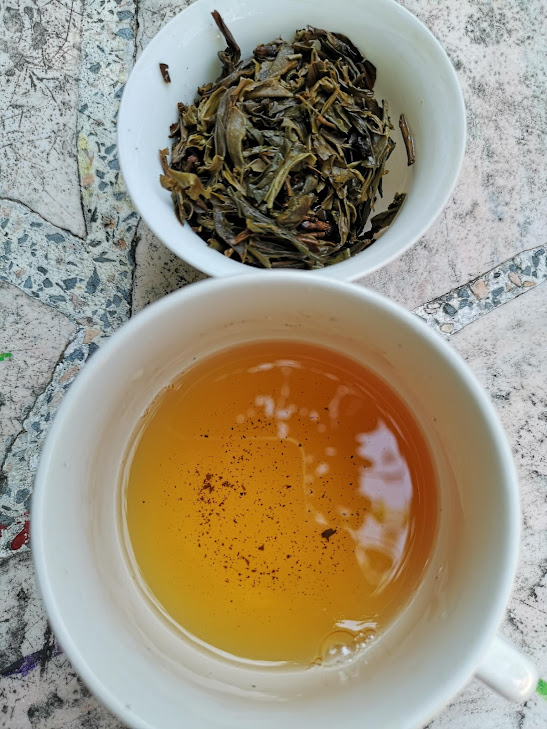

that 2005 Menghai sheng pu'er; a bit age transitioned


the Nan Jian / Tulin 2010 version, kind of at a similar level


Of course all of this is speculation, pulling together perspective based on partial inputs.  I've only mostly been drinking sheng pu'er for 4 or 5 years, so I don't have any examples of cakes that I've seen transition through even a decade of aging cycle myself, with 15 years cited as a more common fully aged starting point.  I did buy a few sheng and shu cakes around a decade ago but finished them.  Of course that range of experience is all relative to conditions, mapping fermentation level to time period, as more about those examples shows.  This could run long, like a short booklet on these themes, so I'll try to offset that by breaking thoughts up by short section, and really only offer input about humidity as a factor in relation to these cases, even though more than one input came into play, with temperature and air contact other main concerns, and starting point, the tea material, is just as critical as storage factors.  

A bit of an aside, I first wrote about pu'er storage conditions when researching that subject in 2016, and updated that adding a bit on what relative humidity is all about in 2017, with more on natural climate area ranges there.  As you read those posts they shift from only referencing external input to adding more about what I've experienced.  I wrote about sheng storage in a summary post comparing Kunming, Hong Kong, and Malaysia standard natural humidity levels back in 2019 (with local area tables in that post from the Weather Online site); I guess it is time to get back to updating comments on this subject.


Let's start with filling in what those examples covered, then a few definitions, then on to those thoughts about transition patterns.


Two "wet stored" 2009 sheng cakes (reviewed here):  it's a shame not knowing the storage conditions, but those two had to be stored right at the edge of as wet as possible to get to well transitioned in 13 years.  They still had a touch of younger character in limited senses, a bit of vegetal range left, but heavy fermentation related flavors stood out a lot more (mushroom, geosmin--essentially dirt, heavy earth, wood, and mineral flavors, warm dried fruit, dark wood and aged furniture).  Lots of teas I've reviewed here shared some of that scope, but it takes a different kind of input to get that much geosmin emerging.  For intense, bitter and astringent teas, like Xiaguan tuochas tend to be, you really need a lot of transition to move off that range some might see as unapproachable, so 15 years of relatively fast aging might be just the thing.  I suppose that's jumping ahead though, on to the patterns.


2009 versions, much more fermentation transitioned than the other two teas


1980 and 1993 versions color comparison (from here), relatively fully transitioned, brewed fast


Two well-preserved dry stored cakes:  a 2005 Menghai version and 2014 Laos tea.  There's a common discussion point that a trade-off for drier storage, beyond not transitioning (fermenting) is that a sour or wood-like aspect can develop, and I keep coming back to whether that happens or not in examples like these.  Both were really well-preserved, aged to a relative degree of half that if they'd spent the time here, or even less.  Some degree of bright, floral, aromatic, and fresh aspects remained in both, of course more so in the 2014 version, with that 2005 more in a "teen years" sort of middle ground for aspects present.  Starting point changes a lot, and I can't be sure how they were initially, but Laos teas are essentially never challenging to begin with (per trying at least a dozen sheng versions from there), and for Menghai versions that definitely can come up, intense character early.  


2014 Laos version, a little washed out by high lighting level, but also light


Is that really a regional character aspect theme though?  I'm not sure.  Laos teas have to be made from wild-grown, naturally occurring material because they're not farming teas in the same monoculture forms that are common in China there yet.  Surely someone is replanting and growing tea through more standard farming, but I mean in general.  Mountainous areas in Laos tend to be cool as SE Asia goes, not like the hotter lower flatlands in Laos.  It's unlikely that heavy pesticide and fertilizer use would come up as often as in standard monoculture farming; the trees have been living naturally for decades, or more likely centuries (a general 400 year age range comes up for the tea growing practices, often extended to saying that the actual plants are often 400 years old, which isn't right, they would vary in age, most much younger).  Then plant types would vary; although parts of Laos close to Yiwu that's no guarantee that plant types growing overlap so much.

To keep this moving back to that one storage input range let's consider what those wet and dry ranges really mean.


Dry storage:  


Based on reviewing average local climate conditions it doesn't seem that dry in Kunming, varying from low 50s (RH %) up to nearly 80, as a monthly average.  It's not necessarily the outdoor humidity level as a relative value that's a problem in temperate locations (the US, Europe), but that if it's cool out and heated indoors then that relative humidity level of heating air that can hold a lot less moisture is dry, relatively speaking.

For indoor storage it's commonly accepted that if the range falls below 50% the tea fermentation will become inactive (whether that's actually right or not, but that sounds like a reasonable conventional understanding to me).  In March and April, stored at natural local humidity levels, Kunming stored teas wouldn't be fermenting much, but that's still perhaps not bone dry.  Since it's an average it's harder to say, and it's not easy to factor in how indoor temperature moderation would work out, if real indoor conditions wouldn't tend to be drier.


Wet storage:  we can cite Malaysian values as an example here, and compare that to indoor controlled conditions:


Malaysian local climate shows humidity level in the mid 70s to low 80s, all the time, that's humid.  That's based on an average temperature window of 24 to 31 C (75 to 88 F, surely often hotter at mid-day).  That's a little more humid than here (Bangkok), where it's quite hot and humid, but weather varies a little more, with both are in a similar ballpark.  


I was going to use here as an example, about how it's cooler now because it's 10 AM, and the value will dry a bit as temperature increases, but it's 32 C (89 F) and 65% now, pretty hot and humid (when I wrote the first draft).  Maybe the point would've worked better at 6 AM, back when it was still in the 20s (closer to 80 F).  I'm first editing this on the Thursday shown and it really did get up to 37 C yesterday, which is hot, human body temperature, so the units conversion to 98 F comes easily.  I ran yesterday, in the afternoon, and was really feeling it.  Due to bad judgment I doubled my normal route length, from 4 km to 8, and I still felt the impact in the evening as a result of both.


People discussing controlling temperature for sheng storage tend to fix on specific humidity level they feel is high but still safe from mold, often using 70% RH for that, or sometimes less.  70% is kind of the edge, although other conditions factor in too, temperature, and degree of air contact.  I don't think you could hold stored sheng at the Malaysian local maximum, 84%, without experiencing problems.  If temperature shifts just a little it would take time for the salt pack to adjust and any condensation is a worst case for tea (sheng pu'er cakes; other teas don't need to be stored in contact with humidity, perhaps with shu pu'er and hei cha as possible exceptions).


Ideal / natural storage (two different things):  I'll have to mostly speculate a little about this but wave off the subject more than I address it.  One idea behind "natural storage" is that you aren't holding the humidity and temperature at one set value, and normal fluctuations in range allow the tea to experience a more normal, organic sort of environment.  If I'm remembering right Marshal N, of the Tea Addict's Journal blog, has speculated that some degree of change could be beneficial, having moisture move in and out of the tea, letting microfauna experience more normal circumstances.  I'm not sure, even if that attribution is completely accurate, since I've not been reading that blog as much for awhile.

"Ideal" would be a tricky concept, since people might naturally want different outcomes based on having different preferences.  Or something that gets less attention, it might depend on the tea character starting point, with more aggressively bitter and astringent teas really needing a lot of transition, and others that don't changing more positively when the shift is slower.  I won't get far with speculating about that second point here, except to say that I have liked some teas that weren't changed much over time, like those two I mentioned earlier.  

That 2010 Nan Jian / Tulin version is probably an even better example, the one I didn't go into here.  But then maybe I would've liked both just as much "younger" and stored wetter, and the 2005 Menghai version did seem to need more time to get to a likely more optimum aging level.  I'm trying it again with breakfast, and after, as I edit this; it will probably be better in 5 more years.

It would be nice if I had more exposure to what others see as optimum results, trials of 20 year old teas stored in different ways, starting from different characters, that turned out very well.  I'll only ever get so far with that; I don't have the tea budget to approach it in the most efficient ways.  This is a hurdle that many could find problematic in relation to feeling like they have a moderate degree of exposure to the subject, that trying 100 aged sheng versions wouldn't necessarily seem like a good background, because then someone might just want to try 100 much better versions.  Or too see the patterns play out for themselves for a few dozen cakes, a project that would take that 15 years or so.

On the one hand this is exactly what I love about sheng, beyond the direct experience of drinking the tea itself, that the experience of these transitions and inputs is never-ending.  In a recent video interview (where I was interviewed, odd) I answered that this is what keeps tea experience so new and interesting to me, even though I've been drinking a lot of teas over the past 8 or 9 years, that sheng versions can change every time you check in on them.

It was interesting talking to a well-known US tea enthusiast about these issues recently in a meetup, with "Mr. Mopar," but it's hard to drill down to discussing these levels of inputs and outputs.  As general patterns you can, but not in relation to getting a sense of how any one tea shifted, where it ended up (at one given time), and why.  Online group tasting is better for that, but it would still go one or two examples at a time.


All this reminds me of a tea enthusiast commenting about trying to break into sheng pu'er in a group post, trying out 15 or so versions from Yunnan Sourcing.   He referenced that as his "ante."  It seemed that if he chose 15 of the same type of versions, younger or medium aged factory teas, dry stored so not age transitioned, he wouldn't really experience much of the broader range of sheng pu'er.  Acclimation to bitterness takes time, and the main way people seem to adjust to that, beyond continuing to try bitter tea versions over time, is to approach sheng through shu experience.  Or it can work to try aged forms first, or milder, sweeter sheng versionss earlier on (with Yiwu origin teas often more like that).  He didn't like many of the teas.

I wouldn't have liked the 2005 Menghai version I'm trying now five years ago, and I guess I still have mixed feelings about it now, about bitterness and green wood vegetal range standing out a lot.  Without knowing the background context I might have expected this to represent relatively aged (fermentation transitioned) sheng, but it's definitely not that.  Dabbling in sheng over time might be a better approach, rather than letting one set of samples from one vendor determine your final take.  

A local friend recommended getting a cake and drinking all of it, just to adjust to the range, and to get brewing down.  Oddly that's good advice, but it also delayed my exploration of sheng quite a bit, because in not understanding types I bought something comparable to this Menghai tea when it was relatively new, based on a recommendation from another contact who probably had little exposure to sheng, with no communication about that context.  I could endure the bitterness and astringency by the end of that cake, brewing it fast, but it wasn't a helpful experience.

Needless to say very little of this is actionable guidance, just scattered discussion instead.  Maybe eventually I'll be able to write a post that goes that next step, on to practical advice and promising approach points.


Monday, November 27, 2017

Is there one best oolong brewing temperature?


This is about there being an objective best case versus subjective preference variation related to water temperature used to brew oolong.  That's not catchy, is it?  Let's try the popular media version:

Do you like your oolongs steeped in boiling point water, or use water that's a bit cooler instead?  Some people claim there is one right answer.


Of course personal preference relates to some degree to every choice and sub-theme related to tea.  Or does it?  Are tea bags generally inferior to mid-range quality loose tea?  I think so.  I guess you could still put those teas in a bag and they wouldn't turn out so differently, but that's complicating the real issue, the actual generality.

Would most people agree that green tea should be brewed using water at less than boiling point temperature?  Sure.  Even an issue like that one, selected to have one clear answer, might not be as objectively clear as it first seems. 

As a bit of background, different references say different things about what temperature to use for oolong.  Check out this version from the Reddit tea subforum page:


There it is then; brew oolongs at 85 C / 185 F, we're finished.  Or maybe not.  That guide may apply better to Western style brewing than Gongfu style, even though one doesn't typically encounter the idea that temperature choices would vary uniformly between the two approaches.  They can, though; along with using a higher proportion of tea to water using much shorter infusion times can serve some of the same purpose as moderating temperature, related to offsetting astringency or other aspect range that could be experienced as negative. 

Since this subject came up related to a tea group discussion let's start from there instead.

Brewing oolong at boiling point temperature


Someone asked about staff in Taiwanese tea shops universally brewing oolong using boiling point temperature water in the Gong Fu Cha FB tea group.  This triggered an interesting discussion of whether or not water at that temperature really is best for preparing oolongs or not.  There are lots of references and tables out there related to standard brewing parameter suggestions (I wrote about that awhile back) and those vary for oolongs.  To summarize, several different opinions emerged:


-brew oolongs using boiling point water temperature, obviously (about half the responses, or maybe just over that).


-only flawed oolongs will give better results at lower than boiling point temperatures, related to offsetting flaws; use boiling point temperature water for every high quality oolong type.


-only brew the lightest versions at lower temperatures (the least oxidized, in this context, although the styles discussed also tended to be less roasted too).


-brew oolongs at whatever temperature you prefer the outcome related to; subjective preference for specific aspects is the ultimate guide.


The argument for the "only use boiling point" option is that tea components extract differently at different temperatures, and for better quality teas--combining the first two answers, sort of--that's really the optimum.

I was arguing for the last, more or less, but probably as much related to defending people's option to prefer whatever parameter they want.  I do tend to brew most oolongs using boiling point water, although I also shift parameters quite a bit, to see what happens related to that.  Per my understanding it does just vary the aspect range a little if you use slightly lower temperature (90-95 C, 195-205 F).  When experimenting with different oolongs--they come in quite a range of types--some do seem better prepared at slightly cooler temperature. 

Of course it is hard to exclude quality level and flaws in specific teas as a factor related to that, and it's impossible for me to taste a tea using someone else's aspect preferences (their sense of taste, in the one sense).  I guess it's conceivable that I'm just not drinking good enough tea, or that my own flawed preferences are a problem.  That sounds like I'd be joking (and it can be hard for even me to tell when I am or not), but preferences do tend to shift over time, and I'm definitely not claiming to have arrived at a God's eye perspective on tea, just somewhere in between only getting started and having sorted some things out.


all different oolongs, but only part of the range


For Dan Cong it depends on the character of the version; some tend to be softer, and boiling point water is fine, and if that characteristic astringency is a bit more intense using slightly cooler water moderates that (versus using flash infusions; both will work, but the results aren't identical).  I'm not so sure that would be a case of a tea considered as flawed, since those teas vary by lots of factors, but of course teas come in a range of quality levels, and it does seem like less of an issue for better versions, so maybe it really is that simple.  I've tried versions sold more as commercial, mass produced Dan Cong that were different in quality and character, but they vary by plant type / aspect range in better versions too.  Ya Shi (duck shit) tends to be softer and more subtle than Mi Lan Xiang, for example (or also aroma based versus flavor intensive, per a different way of using some terms, but that also introduces a second set of concerns).

One comment by Thomas Smith attempted to explain an actual difference in using slightly cooler water, about changes that go along with variation:


[Brewing at boiling point] Definitely pushes more taste to the forefront, bringing it more in line with the intensity the aroma can provide. The cost seems to be a reduction in the ease of distinguishing taste characteristics, a skew of sourness over sweetness, a move to flavors closer to darker leafy greens and citrus in the lighter oxidized teas (as compared to romaine/endive crispness and a fruitiness closer to pomes and drupes), and a slight comparative dampening of aroma in secondary and tertiary infusions. Can provide more heft, though, which can be pleasant.


Interesting!  He added more to that, within the context of additional discussion:


Hotter water can relinquish more solutes more readily, but can also more rapidly force volatiles out of solution, leaving the aroma potentially less complex by the time it is consumed. Certainly not a huge issue for many wulongs, but a factor in some. And, as indicated earlier, oversaturation can diminish one’s ability to actually perceive the full complexity that can be achieved. The compounds that are soluble at appreciable levels with 100 degree water when steeped at typical short brewing times are also soluble at 85 degrees, given slightly more time. There is merit to experimentation.


A couple of those are subtle points that could easily be taken the wrong way, extended to mean something they seem not to intend, or to reach specific conclusions that really aren't being argued.   As I took it he's not really making a case for or against brewing at any temperature in those comments, instead talking around related factors.  Anyone interested in running through all the points made on either side--or the various sides--can take a look at the discussion, since individual comments and points would be in response to the others.


Related to green tea brewing in Vietnam


The grounding of any optimums in tea preference is problematic.  Even for that same point related to green tea, for which almost no one is ever going to advocate use of full boiling point temperature, it's my understanding that it is completely conventional to brew green tea at that temperature in the Vietnamese tea tradition.  The idea is that some people there love the astringency and bitterness that results from that practice (or so I take it).

Of course you can't generalize a whole country like that, and it's likely that not only are some people influenced by lots of factors (foreign traditions, personal experience, and whatever else), there are also regional variations in both teas and brewing conventions.  I just talked to Huyen about that (that friend who sent some Vietnamese tea samples), and she confirmed that there are really two schools of thought about green tea brewing temperature there.  What she actually did say:


green tea brewing at boiling point in Hanoi

With green tea: there are 2 ways brewing. First, if you want to focus about the flavor, you can use boiling water at 95-98 degree.  But if you want to focus about the taste, you can brew at 80-85 degrees.  The time to steep tea is 20-25 seconds.  That’s my way to brew tea.


Someone might justifiably claim that flavor and taste are synonyms, so opposing them doesn't work (or the same would apply slightly differently for the Chinese description opposing flavor and aroma, really, since taste is tongue-based but most of flavor is really aromatic component based, that is, aroma). 


I think what's going on in both cases are references to real, valid distinctions, just framed in these other cultural and language based contexts, which aren't translating well.  Once you try two versions of the same tea, one described as flavor-intensive and the other aroma-intensive (not related to Huyen's comment, still on the Chinese descriptions framing), then you know exactly what that means, and it makes sense.  My take is that there's probably more of a translation issue going on, that these are extended from use of Vietnamese terms.


If the distinctions in what we taste with our tongue versus what's picked up through aromatic compound sensation--and the related terminology--isn't familiar I'd recommend Barb Stuckey's video reference (the author of Taste What You're Missing; that would also work for further reading).


Related to it being one of two common conventions to use boiling point water for green tea in Vietnam (per this account), then could we claim that a broad part of the entire local tradition and those individual shared preferences are somehow wrong?  If the benchmark is inter-subjective agreement among Western tea enthusiasts then maybe we could; it might be that they're doing it wrong.

Or maybe not.  I ran across a reference source claiming that green tea should be brewed using boiling point water not so long ago (not expressed quite that simply, in a Tea Master's blog post on green tea).  This could be just be my impression but there seems to be a broad, general divide in tea preferences between people claiming that any tea should be brewed using boiling water, and very short infusions, with others holding more to the ranges expressed on charts and such.  It may be that the generality correlates quite a bit with regions or branches of tea traditions.


really nice Assam oolong (reviewed here); but as well to not complicate this


McDonald's hamburgers as an analogy for rejecting subjective preference


An influential and experienced member of the tea community provided an example of a broad inter-subjective agreement that we could define as wrong:  if a group of people were to choose the objectively best burger alternative between McDonald's versions and a high-quality fresh-ground version (Angus beef or the like), and some chose McDonald's versions as their favorite (which would actually happen), couldn't we say their preference is wrong?  Phrasing for that gets tricky, doesn't it?  It's hard to express "best" in such a way that it's clear that you don't mean "according to personal preference," since that is one thing that would tend to mean.

Why is McDonald's burger version clearly inferior?  Let's start with the beef itself:

Thankfully, McDonald’s and several other chains recently stopped using the “pink slime” in their beef. But the vast majority of fast food beef comes from CAFO (concentrated agricultural feeding operation) cows. Not only is this horrible for the animals and the environment, but eating meat from sick animals will only make you sick.  Eat a McDonald’s hamburger and you might be getting a mouth full of antibiotics, hormones, and dangerous bacteria.


Beyond all that (some of which you may not actually be able to taste) there are over 50 questionable chemicals and additives in a single burger (including the other ingredients), per that article, and it's not even possible to order those cooked to specific temperatures.  They're just not great.

As I interpret this we're not comparing McDonald's food to the local steakhouse burger version, per the tea brewing temperature analogy; it maps closer to the "best burger in Bangkok" debate that never completely stops in a local FB foodie group.  Maybe somehow one of those burgers really is best, but it seems more likely that most could agree some of the outlier opinions are based on an odd preference range, or perhaps limited exposure to the others.  Maybe it would be possible to come up with a short list, to identify some answers and preferences as more correct.  No one even jokes about McDonald's being best in that group; if they were having a bad day the admins might ban you.


I'm not really finished with mapping out all of this oolong brewing temperature issue, but as I see it there is no end to it.  It seems likely that as with exposure to a broad range of foods--corresponding to McDonald's foods lovers trying a range of fresh food alternatives--people would gravitate more towards consensus opinions.  I can't say if everyone would only use boiling point temperature water for oolongs, with enough brewing experience, and if using the highest quality tea versions.


A friend brought up a related point when talking about tea-houses in Taiwan a couple months ago; to him they tend to brew tea too strong, seemingly appreciating the feel and aftertaste aspects in the tea more than the flavor, and ruin the effect of the taste by over-brewing, per his preferences.  That was seconded by a relatively identical comment in that discussion.  That doesn't map directly onto the hot water versus slightly cooler debate for oolongs, but some of the same concerns could just be playing out a different way. 

Another friend added a thought that muddies the waters just a bit further:  a cigarette smoker would be more inclined to favor stronger flavors, perhaps even flavors in a certain range, and this could push them towards distinct preferences (eg. oolongs brewed at boiling point, versus liking some types of oolong brewed cooler).  It's sometimes mentioned that a lot of exposure to tea leads to preferences skewing in certain directions, not just related to being more right, to fine-tuning awareness, but also to natural progressions occurring.  I've discussed this in relation to de-emphasizing flavor as a main factor in the past, but I've seen it mentioned related to flavor range too.


another interesting non-standard oolong, from Toba Wangi in Indonesia 


Conclusion


To me there is an interesting tension between two competing ideas: 

1)  personal preference ("taste") is individual and varied, and differing opinions can be valid

2)  with enough exposure and progress along a natural preference curve there are consensus right answers related to patterns of agreement (objectivity in the sense of inter-subjective agreement). 


I'm not really arguing for or against either, I just don't see one simple answer as identifying the facts of the matter in most cases related to tea preference.  Sometimes it works better to say "beginners tend to like that aspect range, more experienced tea drinkers this other," but for any one outcome it's rarely that simple.

Since lots of people gave a lot of great input it's also worth reading that group discussion, in light of these sorts of concerns, of course also based on one's own experiences in brewing oolongs.