Monday, December 24, 2018

Meeting online tea friends, and about tea swaps


Originally published as:  http://www.tching.com/2018/12/meeting-online-tea-friends/


Editor's note:  Merry Christmas!  It's odd posting about something else today, but the timing of the TChing post worked out to match up.  I'll share lots of cool pictures of the little elves soon enough.


I’ve long since talked to lots of people online about tea.  That relates most to writing a blog about tea, and being an admin for an international themed FB tea group, and now for a second, and participation in forums or a sub-Reddit and such.

That has extended into real life more lately, with three people just visiting here in Bangkok.  I’ll use that example to lead into how value-oriented purchasing could enable tea swaps.  Linking the ideas is a stretch, but it should work.  To keep it simple I’ll place the initial themes by visitor, and tie together the threads at the end.

Tea from Nepal


Narendra Kumar Gurung, the Nepal tea vendor setting up a co-op style processing initiative, sent some teas.  A contact of his, Sunil Sainju, was visiting Bangkok for a conference so he brought them.  Right away this doesn’t seem to relate to how someone who isn’t blogging or talking to producers might use a similar approach, but I’ll get to that.  I just reviewed a golden needle style black from those; very nice tea.


Meeting an online friend from Laos


There are just a few online contacts who feel a lot like real-life friends, even though I’ve never actually met them.  Cindy of Wuyi Origin stands out; we’ve never actually met but I’d trust her with my kids.  Anna of Kinnari Tea, who I just met, is another favorite.  It’s a little awkward adding that extra level of input about someone after only talking by message, but it’s rare that they’re not at all what you expect.  Anna is great. 

I didn’t try any of the half-dozen Kinnari Teas (Laos versions) that she dropped off but I already know that they’re fantastic, unique and high quality.  I gave her some samples of this and that, including some from Narendra (nice how it goes in a circle, especially shared with people who would appreciate them most).

Somnuc Amnousinh, another visitor from Laos


I’ve been reviewing very unique teas from Laos and Vietnam recently, mostly local versions of sheng (pu’er-style teas).  In this case passing on teas in return completed a tea swap.  Due to space limitation I’ll only mention one unique personal detail about Somnuc:  he speaks Chinese, Vietnamese, French, English, and Laos, and is probably fluent in Thai (which overlaps with Lao).  Very cool.


How this ties back to tea swaps


These mostly aren’t tea trades for me; more often people give me samples for blog review.  But I give away tea to anyone I think will appreciate it, not much quantity, but enough to try part of what I’m trying.  I think a related “swap” theme could apply to more people.

These three related tea sources aren’t exactly what I had in mind (and Somnuc doesn’t even sell tea), but still let’s use the other two as an example.  Someone could reach out to Anna or Narendra to try to buy tea, and even though they’re both not really set up as end-point retail suppliers as agreeable people they’d probably help out with that.  Buying samples off a wholesale vendor seems a bit unrealistic but one might decide to buy a ¼ kilogram of a few different teas instead (for example).
That idea comes from a vendor selling their own produced teas in a large-block retail form, from the Halmari Assam producer’s offering a nice orthodox Assam black for $25 per 250 grams (with their “oolong” my own favorite).  That’s the smallest quantity they sell.  Or Assam Teehaus is another co-op style producer selling similar teas, but that drifts off this theme.


Meeting Maddhurjya Gogoi and Bulu Deka (of Assam Teehaus), at the Jip Eu shop (with Sasha and Kittichai)


A similar approach might relate to a shared group-buy theme.  It doesn’t make sense to buy low quantities of teas from the other side of the world; shipping would cost as much as the tea.  The higher the volume the more that proportion balances back out.  Or someone with a kilogram (or pound) of tea, who doesn’t plan to just drink through it, could use it for trades for other teas, or for gifts.

There’s lots more that I could say about making tea-contacts online, or trying out other novel forms of teas, and limitations and potential problems with swaps, but that covers the initial broad themes.  This post on more direct producer sourcing might spark some other ideas, but only on the supply side.

Thursday, December 20, 2018

Semi-oxidized Jing Mai sun-dried black tea


This tea is interesting for an aspect mentioned in it's description, as "Hong Cha: semi-fermented tea." People get riled up about translation as fermentation instead of oxidation but the point is clear, and use of both terms was standard at one time. It's not fully oxidized, or at least that's implied; that could mean different things.

At the end (checked after writing these notes) again this tea isn't currently available.  It's interesting in style though, so I'll go ahead and post the notes as a finished review. 

I've been reviewing a good bit more Moychay teas lately because of one running theme:  clearing through trying what I didn't get to, so that older tea sample sets don't carry over to next year.  I still have more teas from Moychay, and lots from around South East Asia, from Anna and Somnuc, and from Tea Side (a Thai vendor), and another Liquid Proust set (finally the actual "sheng olympiad" version), but I'd rather review what is interesting from prior to all that before moving on.

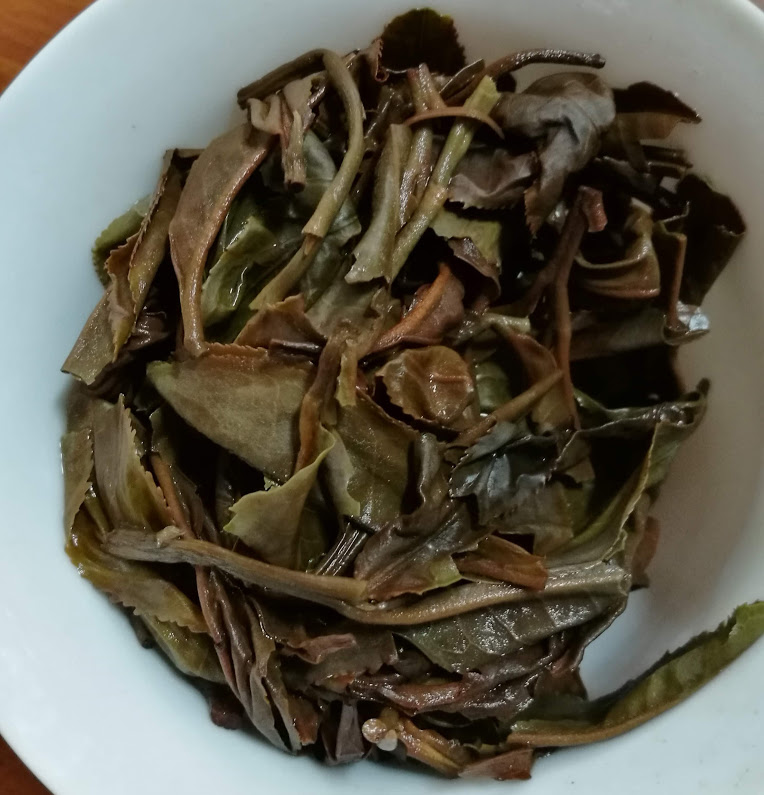
The dry leaves are really dark but lighter streaks and an unusual coloring imply to me that the brewed leaves won't be that common pale brown color, and that brewed character will vary too. We'll see.


It does brew a bit lighter in liquid color, not the reddish of a standard black tea. And the aspect range is unusual, lighter, with a different form of mineral aspect, and not malty at all.  I have tasted this profile before, more commonly in unconventional oolong versions. It's not bad, but hard to place. I'll break down flavor more in the second infusion.


This tea type seems so unconventional that there wouldn't be an established demand for it (less oxidized black tea). Tea Side in Thailand and Farmerleaf in Yunnan sell enough black teas they might reference oxidation level but the low end for black teas is usually higher than this. Oriental Beauty oolong is often more oxidized. All the same it's interesting; different.


It's well-made good quality tea, definitely not something unintentionally prepared this way. It works.


The character is closest to black tea, per my judgement, but the lighter mineral character, floral range, and light vegetal aspect isn't. So maybe it's really in the middle. That vegetal range is a bit non-distinct; it could be interpreted as woody, or it might not be wrong if someone saw that as tying to some sort of similar range, eg. some type of grain.  To me green wood is closest.  The floral tone is nice, very rich and pronounced (orchid, or something such, towards lavender, or maybe just that). That gives it a perfume-like character that extends into feel and overall effect. Some lighter wuyi yancha are like that too; that part is in oolong range. It's hard to place what makes this seem just as much like a black tea to me, given only a flavor aspect list.

It might be mostly expectation making it seem more black; the label description. Oolongs aren't just backed-off oxidation black teas, the processing is different.  The only other "lightly oxidized black tea" that comes to mind relates to the trouble people have in placing some versions of Darjeeling, in particular the first flush versions, which typically aren't fully oxidized.  One odd way to get around that is not to commit; just call a version "first flush Darjeeling" and lead into aspects description instead of categorization from there.


More of the same on the third round. A lighter tone, different mineral range (lighter), and brighter floral tones are kind of in between oolong and black tea, and I could relate to an argument that it just is oolong (although it seems to not be, to me). It's a cool effect, which only works at all because it's good tea (all relative, "good," but the quality is evident).


The next round is similar again. The balance probably is shifting, with warmth picking up just a little.  The flavor gains complexity; floral tone covers a lot of ground and some fruit may be layering in with that.  That part is towards juicyfruit gum.

There's probably a slight savory component lending to that complexity effect, a trace of sun-dried tomato. Even though umami (related to that) is familiar with sencha and gyokuro (Japanese teas) in this aspects set and presentation to me it matches a black tea theme.


Next round the tea is still transitioning, but in a subtle way. Mineral is heavy, still in an atypical form. It probably tastes like some kind of rock, since that's how mineral goes, and to stretch imagination a little further maybe like volcanic rock, like a black sand beach or volcano crater might smell.  There might even be a faint touch of sulfur in it, struck-match, but it's positive in this since that fits in well with a pronounced range of other minerals.  Sweetness and floral tone also add to that balance.

All in all an interesting tea.  It's far from finished after 4 or 5 infusions, where these notes leave off, but that gets the general character across.


Moychay's description


Given this tea is unusual checking on the vendor description seems in order; what is it?  The first thing their website listing says is that it's out of stock.  That's been coming up lately.  They may sell some teas they've only been able to obtain in limited quantity, in which case they might just come and go.  That's probably not more of a limitation than vendors only selling what they can carry a large stock of, since then the range would scale way back to include only those in greater availability.

Here's their description:


Qing Wei Shaiqing Hong Cha (semi-fermented red tea)

"Fresh Fragrance" was made in the spring of the Yunnan large-leaf tea trees of Mount Jingmai (Puer County). It was under the sun.  [surely a reference to sun-drying in processing]

In appearance: large flagella of greyish-brown leaves and silvery biege buds. The aroma is a restrained, with spicy, woody and fruity notes. The liquor is transparent, meadow honey color.
The fragrance is a bit tart.


Odd this being semi-fermented didn't draw more discussion.  Being a sun-dried black from Jing Mai does add more real description, but it's nothing like a typical version of those.  It seemed more floral than fruity or spicy to me but woody definitely works, and a secondary aspect had shifted from the pronounced floral towards fruit later on.

This tea is unusual and appealing for being a bit unique.  It's not a great match for my aspect preferences in black teas, or in general, but related to offering a chance to try something different it's much more appealing.

In looking around for this product description Moychay does really do carry a lot of black teas; it's not the only black tea that's a bit unique listed.  The tea description wouldn't necessarily help someone place it but they do have a comments section that adds a bit.  The impressions are originally written in Russian, and automatic translation could be a little clearer, but still they work.  It's always funny hearing mixed impressions of teas; something unusual like this some people will love and some won't like at all.  There are examples of people who just didn't like it (to be fair and balanced), but I'll cite a comment of someone who did, mainly to make the point of how automatic translation goes:


Guy - super! Really surprised and pleased! Yes, it has both sheng and white tea to taste. And in general, the taste is not usually pleasant. It is a pity that it did not work out to take 100 grams, took 50 samples for testing. And it keeps the straits well. And if you overdo it a bit, then not much thermonuclear taste. The finish is long, refreshing. In dry form, the leaf has a caramel flavor, and when brewing it is even stronger and more intense. In general, tea is interesting, tasty and not ordinary!


I guess that floral tone really is more common to sheng than black teas; that part works.  But the overall character definitely doesn't remind me of sheng, or white; it was kind of its own thing.  I guess the "thermonuclear" part relates to this working brewed strong; it would still be fine, but in general would seem optimum back in the standard range.  This probably matched that person's aspect preferences slightly better than my own but we're in agreement over the novelty, and the generally positive impression overall.

Wednesday, December 19, 2018

Local Phonsaly Laos black tea from Somnuc


not much for packaging description


I don't know much about this tea; it's from the Phongsaly area (North of Laos), and surely it's from a local Assamica plant type ("shan" plant types, I think that is).  Somnuc passed it on, that tea contact I've been mentioning and reviewing teas from.  A short review should cover it then, just describing how it is.

Review


It's an interesting tea.  I expected earthy, on the sweet side, rich, with earthy aspects near a tree bark and fruit so sweet it was like dried dark cherry.  Most of that was from the slightly rustic look and sweet and rich dry tea smell.  It was like that, so much so that it works as an initial description, but with even a little more earthiness than I expected.

The woodiness is complex.  "Tree bark" is still right, but not that smell you get from sniffing a tree, or breaking off a chunk of bark.  It's the smell of the back of the bark, that you only encounter when splitting firewood (or I guess logging, if the tree happened to split a bit, and I've done some of that too, but I'll try to keep this relatable).

It's "cleaner" than it sounds but still earthy in an unusual way.  I suppose another normal description might be that it tastes woody, but like sticks.  The sweetness is really nice; that gives it balance.  I'll stick with describing another aspect range as a warm, rich fruit, but a version that's hard to make out under the rest.  This should evolve a good bit infusion by infusion, so that one aspect interpretation might become more clear.


tasted with a jasmine black just reviewed separately; it never works out like that


In the second infusion that earthy /  woodiness comes across more as autumn forest floor or fallen leaf; not so far off, just a little different.  A faint version of cinnamon spice joins in.  I really like this tea.  I could imagine someone with different preferences being put off by this character, seeing it as strange, or not clean in effect, or just not matching preference, but it works for me.  Sweetness still ties to a fruit range I'm not really putting description to.  It's not that far from apple cider or roasted squash; I suppose it's possible that it's just complex, covering a range, and that's what makes it hard to pin down.

Even description as floral works, it's just a different part; there's a lot going on in this tea.  Experienced together with that clean version of autumn leaf it has a great balance.  Even though this tea is a little odd I think I'd be happy to buy a half a kilogram of it and see how it goes drinking it all the time.


On the next (third) infusion the tea is "cleaning up" (although not in the sense that it was musty, or off), moving off that autumn leaf range.  Cinnamon stands out more, and the wood tone that is present is more like split hardwood (let's go with cherry tree, a wood that actually does smell a bit fruity).  The fruit stands out more too, and complex related range that had been more "apple cider and roasted squash" is now closer to just cherry.  There's a very faint tartness that might relate to some forms of cherry but I'd typically not describe this tea as tart.  The cherry, cinnamon, and hardwood makes for a different, even nicer balanced aspect set.


There is no astringency to the tea but enough of a related aspect range to give it a full feel (as black teas go; oolongs and pu'er feel full in a different way).  Aftertaste is nice; those two supporting aspects make for a complex experience.  Per an alternative interpretation some of that cherry and wood is still tied back to apple cider, the way that sweetness joins an interesting earthiness in slightly fermented fresh apple juice.  A little sourness would match with that cider description, if present, but it seems to only include a trace of tartness instead.


The next (fourth) infusion might again be the best yet, although it's still pretty close to the last, so that describing the slight shift in proportion of the same aspects wouldn't be informative.  The way that cinnamon and cherry combines is great, with a much milder range of earthiness supporting an overall positive balance.  I did go on to stretch a few more infusions out of this after this break in taking notes but it seemed to only fade from this fourth infusion versus transitioning aspect balance further.  It kept producing really pleasant tasting infusions, they just kept getting thinner.

Conclusion


I love this type of tea character, and that it transitioned as much as it did, and this specific aspect set.  It probably wasn't all that far off some Yunnan black tea styles, which is understandable since it came from right across the border.  It's so close that a lot of the teas produced in that general area cross the border and end up being sold as Yiwu, or so I've heard.

It's yet another example of a local South East Asian tea being great in a novel way.  Anna of Kinnari Tea dropped off a number of versions in a visit I mentioned not so long ago; I'll be saying more about other related versions soon enough.  I'm not finished with this set from Somnuc too, so there will be more of novel and--if the pattern holds--very pleasant teas to go from those too.


this map again (Phongsaly); below that Luang Prabang is one of the cooler places I've visited in SE Asia