Showing posts with label Great Value. Show all posts

Wednesday, January 31, 2024

A controversy over adding lemon and salt to tea


Facebook tea groups are wrapping up a phase of discussion about the theme of adding lemon or salt to tea, a recommendation from a recent book on tea.

This relates to Steeped: The Chemistry of Tea, by Michelle Francl. Basically salt is supposed to offset astringency and lemon reduces tea scum or cloudiness caused by calcium compounds. Here are the claims, cited in an article reviewing that book content (which I guess could contain some error in summary, to be fair to the original author):


Francl’s pro tips for the perfect brew are:

Adding a pinch of salt – the sodium ion in salt blocks the chemical mechanism that makes tea taste bitter.

Steeping teabags quickly but with plenty of dunking and squeezing – to reduce the sour-tasting tannins created by caffeine dissolving slowly in water.

Decaffeinated tea can be made by steeping a teabag for 30 seconds, removing it and discarding the liquid, then adding fresh water and rebrewing for five minutes.

A small squeeze of lemon juice can remove the “scum” that sometimes appears on the surface of the drink, which is formed from chemical elements in the tea and water….


There are two sets of problems with these ideas: one is that they make no sense, presented in this form, and the other is that what they really probably refer to that could be accurate, after some editing and adjustment, is still problematic.

It’s possible that the first claim is that when you taste salt you also notice less bitterness. It could instead relate to a claim that sodium is going to offset extraction of compounds resulting in astringency, which is a mouthfeel effect that is often confused with bitterness.  Bitterness is a flavor, not a mouthfeel aspect, but people conflate the two. It doesn’t clearly say that; that’s only one possible interpretation of this summary. 

Caffeine really does taste bitter, as some other medications do, like aspirin, but surely salt isn’t going to offset caffeine extraction. Salt doesn’t seem likely to affect tannin extraction either, but I suppose I wouldn’t know if it did. In the following point, related to caffeine, tannins aren’t created by caffeine, and again it seems doubtful that caffeine could affect tannin extraction.  Again the feel effect of tannins is more often misinterpreted as bitterness, not sourness.

A short tangent can help place that first possible interpretation.  I add salt to masala chai (spiced black tea) to increase flavor depth, which happens even without noticeable salty flavor, as can occur with food.  Once out with family to a Mongolian grill place a niece and I added salt to our dishes that ended up way too spicy.  Salt doesn’t decrease the experience of spice, the heat, but it can help spicy food flavors balance better and make more sense.  This may be the claim here, that the salt isn’t blocking any compound extraction, or shifting feel effect, but that the overall flavor balance might seem more positive when shifted a little, potentially even without the tea tasting salty.  Maybe.

That decaffeination hack listed has been debunked over and over; this study’s caffeine extraction rate testing results work as good a summary review as any to show why:


30 seconds: 9% caffeine removal

1 minute: 18% caffeine removal


So no, removing 9% of the caffeine isn’t going to help much, and you're probably removing 9% of the flavor along with it. Beyond these errors some main points work, to a limited degree, which I’ll move on to critiquing.

One problem with these claims goes back to why a tea would be astringent or would have a scum on it in the first place. It’s talking about brewing low quality, ground material, tea-bag black tea, which is very astringent for a few different reasons.

The form of the leaf is a main input; whole leaf tea is less astringent, because compounds extract differently in ground material (tannins, to use the informal designation; let’s get back to what those really are shortly). The more you chop or grind the material the faster it brews, and the more overall flavor is extracted, just not necessarily the most positive flavor or feel related compounds.  This is why tea bags that contain 2 or 2 1/2 grams of tea leaf material are quite chopped or even ground up, to get more out of a little leaf content, which brews faster. So you can use better quality, more whole-leaf tea instead and skip the salt, but it’s more expensive, and you would need to use a bit more leaf.


a Ceylon (Sri Lankan tea) tea bag I cut open awhile back.


It doesn’t add much to what I’ve just expressed but lets consider what tannins even are, in relation to some of the flavor compounds being discussed, from this Tea Epicure source:


There are an estimated 30,000 polyphenolic compounds in tea.There are several known categories within polyphenols…

Within the flavonoid group are flavanols, flavonols, flavones, isoflavones, and anthocyanins. Flavanols (short for flavan-3-ols) are the most prevalent and thus the most studied. Flavanols are often referred to as tannins or catechins. 

The major flavanols in tea are: catechin (C), epicatechin (EC), epicatechin gallate (ECG), gallocatechin (GC), epigallocatechin (EGC), and epigallocatechin gallate (EGCG). EGCG is the most active of the catechins, and this flavanol is often the subject of studies regarding tea antioxidants.

Flavanols are converted to theaflavins and thearubigins during oxidation. They are the compounds responsible for the dark color and robust flavors that are present in oxidized teas…


The same kind of theme repeats with adding lemon. If you use water very high in calcium compounds, which is not so unusual for a lot of water sources, a light scum can form on the top of your tea, from polyphenols in the tea interacting with those calcium compounds. Lemon juice can clear that up. Or passing the water through a charcoal filter might help, removing some of the calcium compounds instead, before they combine with brewed tea and form a scum. 

“Tea enthusiasts” often use some special water version, bottled spring water from an ideal mineral profile source, or they’ll treat water to strip all the minerals, reverse osmosis filter it, and re-add an optimum mineral blend. All that might be going a bit far; in most cases using filtered tap water is fine for a decent outcome.  The extra level of concern seems to relate to optimizing outcome from a much better quality range of tea, the opposite extreme.


So in conclusion, no, salt and lemon have no place in tea. 


Or if you really want to use cheap tea bags to make tea, and brew it with relatively unsuitable high calcium content water, then sure, add those things. It’s your tea; it’s up to you.

If the goal is to experience above average quality tea that changes things, but that’s not everyone’s goal. Lipton or Great Value tea bags are really cheap, and easy to prepare, and if you add milk and sugar to that tea it can be ok. Or sugar and lemon, I guess; I don’t think it’s going to work to add both lemon and milk, since drinking curdled milk in tea won’t be pleasant. It’s just nothing like what tea enthusiasts drink.  

Most of the time, at least; I’ll drink Lipton sometimes at our office, because I’m only in there once a week after work from home was instituted.  Dilmah is better but they usually stock Lipton there.  There probably is no standard example of a tea enthusiast, so I couldn't possibly be one, but the generality of not using tea bag tea still holds up.


this meme breakdown makes for a long story


It’s too long a subject to treat as a short tangent here but pleasantness of the tea, flavor character and such, is only one part of range of concerns. Tea enthusiasts tend to take up the idea that more natural grown tea could be healthier, from forest or more natural growing condition sources, versus standard plantation teas, which are potentially grown with more pesticide input. Maybe it works out like that.  My guess is that Lipton is safe enough, but once you switch over to the lowest cost bulk sources from Chinese or Indian markets you are taking some real risk.

The same astringency that is a concern for “bitterness” input can also lead to stomach problems, for some. I wrote about this concern awhile back related to a co-worker needing to quit tea due to stomach impact.

The short version of that writing is that it will probably be necessary to drop out drinking matcha, black tea, green tea, and sheng pu’er entirely once these problems have already developed. Prior to experiencing damage to your stomach eating food before drinking any tea could protect you, at a guess most effectively if that food contains both complex carbohydrates and fat.  Eating just fruit doesn't seem to help, based on my experience. 

There are other types of tea that are milder than these, oolongs or white teas, and routinely alternating the types of tea that you drink could help.  Drinking more whole leaf tea would be better.  Once you already have a problem switching to shu pu’er could help, or going off tea entirely for a long period of time.

Let’s get back to the starting point and think all this through one more step: who is going to be interested enough in tea to buy and read a book about the subject, and then also prepare it from Lipton or Great Value tea bags?


Vietnamese black tea, the last black tea I bought a few months ago


whole leaf tea and CTC tea (from an early blog post, before phone camera quality had improved)


I would assume that this “better quality” tea is a familiar subject to anyone reading my blog posts or Quora answers, but in case it’s not this post covered more on that divide.


Wednesday, October 21, 2020

Tea group themes; Great Value black tea


It has always been interesting to me how some tea group participants, self-admitted tea enthusiasts, can prefer lower quality grocery store teas.  Most typically their preference would evolve beyond Lipton, on to Harney and Sons blends, for them to feel connected enough to the interest to go out and join a social media group.  Not always though.

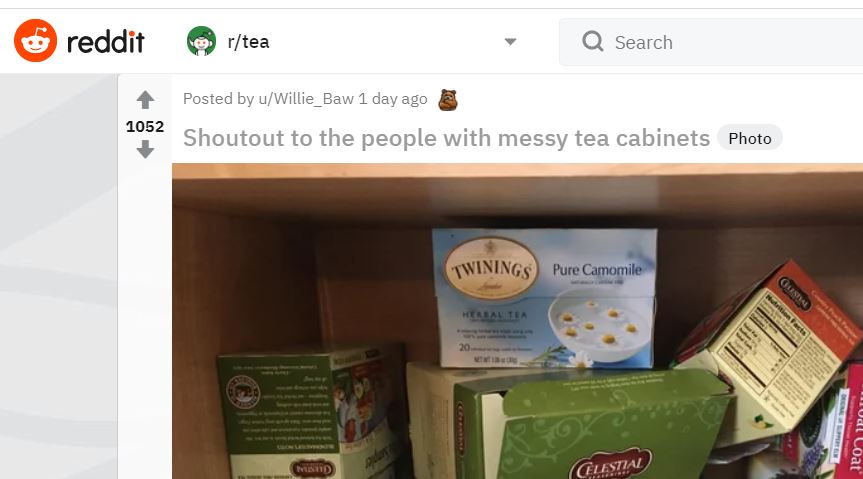
A recent Reddit post brought all this to mind:


The one other part that strikes me as odd is how that resonates with so many others.  This post could as easily have drawn 1000 upvotes by the time it drifted out of feed sorting.  I'll get back to critiquing the tea preference shown in the photo more after checking in on another post that just brought this up:


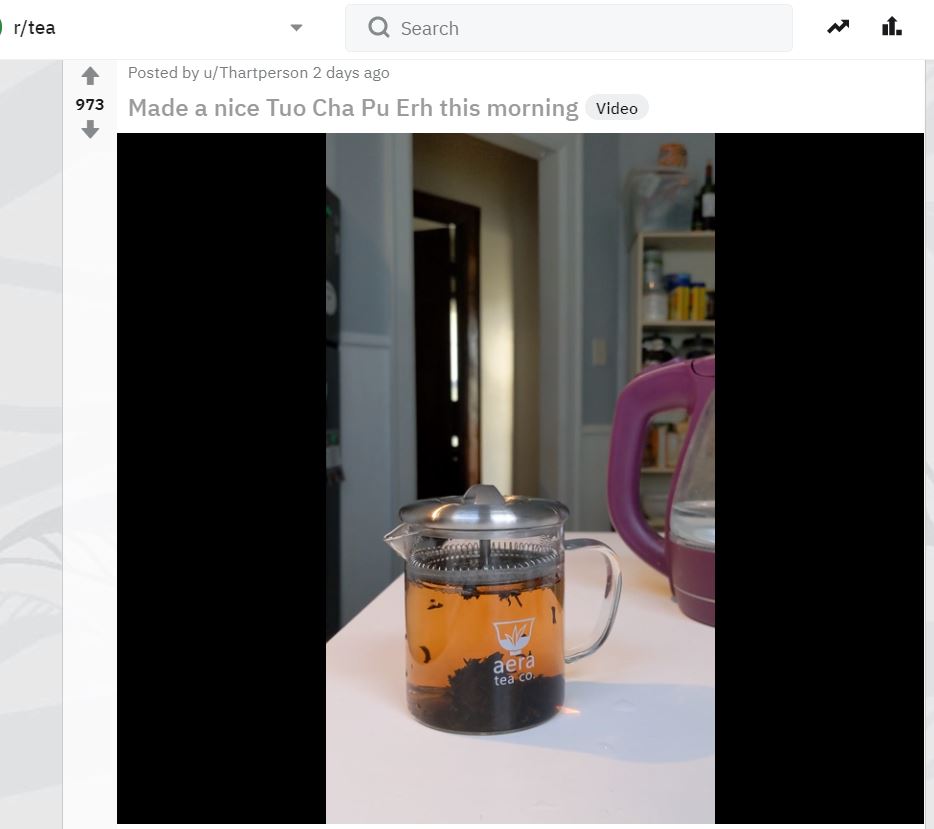
This was actually cool for showing a time-lapse brewing process.  But the tea itself was almost certainly awful, one of those tablets of highly ground and compressed shu pu'er.  All the versions I've yet to try, that were presented that way, tasted like drinking hot water out of an ashtray that had been wiped out but not completely cleaned.  Almost no one who drinks shu prefers it at that infusion strength, brewing to the similar color of lightly brewed black tea, versus turning out darker.  If that person had swirled the tea in that French press at a minute or so in results would've been much better.  Probably using better tea would be better too.

I reviewed a shu pu'er version recently that's a good example of a very low cost tea that's much, much better, a Moychay (Russian vendor) version selling for around $20 for a 357 gram cake.  More typically outlets like Yunnan Sourcing would sell good, standard versions for $30 or so (or less; this is a standard-source standard type version for $24).


I don't care that these people drink low quality tea, or that others feel positively about that, and no doubt share their preference.  The only thing that strikes me as odd is that they join and follow a social media group to express that.  It would be like drinking instant coffee and joining a Facebook group to express that shared interest.  Why do that?  Are there groups out there for people who drink instant coffee, boxed wine, or Coke?  I looked it up on Facebook:  no.  There is a Coke drinker's group in Argentina but the focus is on collecting limited edition cans and such.  Of course I could cite other tea groups with a focus on what I might see as "lower quality" teas, but that would come across as more negative than I would intend it.

To some extent I'm critical of these types of preferences because the people expressing them haven't put in any time or effort to improve their awareness, to explore better versions of teas and then change the form.  But maybe there's a gap in my reasoning.  They would need to add expense too, and maybe "leaving off" at that level of expense and type-preference is fine.  In some limited sense of course it's fine; it's their beverage.  If they want to drink instant coffee or Kool-Aid that's on them.  Or if they want to drink hot water out of a mostly clean ashtray, savoring that smoky aroma.

Maybe even the step before the social media participation seems strange to me:  self-identification as a tea lover, or tea enthusiast.  I can relate better to the people who feel that way who are onto high-tier grocery store tea and tisane blends, but not related to someone buying the cheapest black tea on the market.  Is it really that bad though?  I looked into that.


Great Value tea review:


Let's start with more critique of that first photo.  The "messy shelf" theme is fine.  Leaving two of the tea boxes partly open is less functional; the tea would air out a lot even with the boxes closed, and lose flavor, and that's a good way to make sure that happens as fast as possible.  The Celestial Seasonings preference I can actually kind of relate to; it's not the highest quality tisane blends one could buy, but their products are novel, and decent.  An inexpensive tea-bag version of green tea sounds awful to me.  And then there is Great Value black tea.

I've not tried it; maybe it's not bad.  If it's a lower-cost and slightly lower quality version of Lipton then it's probably quite bad.  Walmart lists a 100 bag box of that tea for $1.94; at least in terms of low cost it is a great value.  The same size (count and volume) Lipton product Walmart sells for $3.48, coming up on twice the cost.  I guess it depends on how good it is.  This review shares one opinion on that:


Rate Tea Great Value black tea review:

The small bags are well-packed with tea that has been ground practically to dust. Still, my low expectations were met or slightly exceeded. First, it tasted like tea and not some other substance or chemical. That's a fair start. The aroma was weak, the color and flavor each moderate in strength, but the taste rather bland in character. 

While not competitive in overall flavor with most branded black teas I've tried, it's actually a decent value for the price. I recommend it for those who are addicted to tea and have run out of everything else, and the aisles at WalMart have likewise exhausted all their supply of name-branded teas.


So it's not as good as Lipton, in their opinion, but if saving that $1.50 on a box of 100 makes a lot of difference then it's fine.  Opinions on teas are subjective, so I looked up a second review, to get a more complete take:


Tom's Tea Reviews, Great Value black tea

...As teas go, Great Value black tea equals the best I’ve tasted.  I like its clear, deep orange-red color with virtually no bitterness.

...Great Value black tea resembles the Red Rose Original Tea (reviewed here) in terms of taste, aroma, and appearance in the cup.  For most intents and purposes, this tea appears to be a less costly version of Red Rose.  Yet it does not shirk on flavor or overall tea quality.

...Particularly when I’ve not taken any tea in recent days, I can become “wired” when I again consume it, and can feel sick when riding in a car after drinking it.  It can make me feel quite nauseous when I’m gone without it for several weeks.

...It’s a perfect beverage and a great buy.  So I’d therefore rate it at 99 out of 100.


He loves it; a different take.  The tea potentially making him feel sick doesn't factor in; presumably all tea that he drinks makes him sick if he's been off tea for awhile.  Switching to a more whole-leaf version would probably drop out that stomach effect, and experienced astringency (mouth-feel related to some types of polyphenol content, what end up being called tannins, which really could be flavonol types, or else may be theaflavins and thearubigins).  His review for Lipton is almost identical, so for costing two thirds as much the Great Value brand really is a good deal, per his opinion.


That's probably saying enough about tea-bag teas.  At this point it may help to point out a favorite of my own, to provide a different benchmark.  I bought a couple of Dian Hong versions earlier in the year from a China-based vendor; one of those will do:


2019 Bao Shan Ye Sheng Hongcha (Dian Hong), my review, and vendor listing


The Chawang Shop vendor description:

Baoshan is one of largest wild tree (ye sheng cha) area in Yunnan. Growing wild and naturally in the forest. This material come from April harvest, processed as red tea in small batches.  The taste is rich, full, sweet, no astringency. Complex and rich aroma. 


Part of my review:

It includes sweetness, and some fruit in that peach range, but also a lot of warm mineral depth, which extends towards a mineral effect close enough to table salt.  The fruit comes across as dried fruit.  I guess potentially as dried peach, matching the dry leaf scent, but warmer, more like dried tamarind (or both; it's complex).


That tea cost $6 for 50 grams, on the outrageous side compared to just under $2 for 226 grams of the Great Value version.  For not being ground to dust one would typically use 3 grams or so to brew a couple of strong infusions (the process take longer, maybe using 3 and then 4 minute infusion times), versus one tea bag (2.26 grams) being mostly brewed out to make one large mug.  So kind of even for output?  Cost is more a factor; this Chawang Shop version costs 12 cents per gram, while Great Value costs under 1 cent per gram.  It's almost free; 1.94 cents per bag.

Then there is shipping cost to content with, if you buy a tea from China.  Let's check on a tea I'd expect to be roughly equivalent from a US source, which to be clear I've not tried:


High Mountain Red Ai Lao Mountain Black Tea (from Yunnan Sourcing)


Scott's take (the vendor):

High mountain tea grow at 2000 meters on Ai Lao Shan in Zhenyuan area of Simao.  Picked and processed only from the first flush of spring this black tea is lightly oxidized and processed similiar to Taiwanese black tea or Wu Yi Rock tea.   There is a still a greenish tinge left to the leaves!  The brewed tea is rich and thick with hints of dried Longan fruit with a protracted mouth feeling!

The tea is grown at almost 2000 meters making it one of the highest black teas we offer.  Mr. Guo was born and raised in central Taiwan and his father had a black tea factory there.  Mr Guo, traveled to Thailand and eventually decided on Yunnan.  He was always a big Pu-erh tea fan and decided to spend time learning about Ai Lao area pu-erh since it's one of the remotest and untouched places in all Yunnan.  He met many local pu-erh growers and worked with one in particular (Mr. Feng) to introduce a Taiwanese style processing which marries black tea and oolong in a sweet and fruity style!


It is helpful to hear other takes on teas, since all that can be subjective.  Oddly Stephen Colbert (the talk show host) passed on his thoughts on this version, in a Tea 4 Tuesday segment they do.  But he usually just confirms which parts of the vendor description he agrees with, eg. if it really seems fruity or not.

Reviews on the site all pretty much liked it, but that would be a biased set of opinions, since mostly only fans of the vendors tend to share reviews.  I'll cite one anyway:


This hongcha is one of the best I've tasted so far, and definitely the best bang for your buck. Strong and fruity aroma, super smooth, roasty and buttery taste with a looooong and delicious after taste reminiscent of nuts and pastry. Forgiving to brew, and probably my number 1 recommendation for people who are new to proper black teas. Everyone who is new to the world of tea and Yunnan Sourcing should order some of this stuff! 


Only two reviewers gave it 3 of 5 stars, with the rest 5, and only one made a negative comment (it's a little sour).  No doubt it's lightly oxidized black tea, as the vendor description claimed, which wouldn't be familiar to everyone.  It may or may not actually be sour; people unfamiliar with reviewing often mix up interpretations for the flavors that they really do experience.

With both these Yunnan black teas (Dian Hong) costing $6 for 50 grams, coupled with my own claim that 3 grams or so can brew two pleasant and intense cups, each cup would cost about 18 cents.  For a college kid that could be a significant expense, but for most others spending $6 on 30 or so beverage servings is on the low end for cost.  Walmart sells 12-packs of Coke for $5; that's lots more.  It would be better to never drink any Coke, related to the sugar content, and tea probably is healthy, but sorting out any health claims is essentially impossible.


On tea evangelism


I think this tea evangelist role I've taken up works out, but I'm not reaching very many people.  One by one people might see a post, or check out a review, and tea awareness and interest spreads.  Maybe Stephen Colbert is helping with that too.  Not so much in the Reddit r/tea group; people seem to be on whatever page they are already on there.  They might eventually try something different that they see in a grocery store, or maybe not even that.

One might wonder, why try to convince others to drink better tea?  On the positive side it could be to share an experience that I found to be positive.  That could pair with health interests, helping others make better choices related to that goal.  Not as positive, people tend to validate themselves based on being seen as knowing more, or making better choices, so maybe I'm only doing that.  

I could go on to make the claim that I'm more aware of my own motivations than most due to practicing an unusual degree of introspection, guided by formal meditation and study of Buddhism, but that just shifts ground to another unsupported claim.  I see it as trying to help others, but it really is whatever it is.


I tend to share tea in person too; anyone visiting Bangkok could look me up


Follow-up:  one day later that post did cross to well over 1000 upvotes; algorithms in social media platforms tend to show what is popular to more people, pushing results to either draw no feedback and response or else to receive a lot of it: