Showing posts with label sommelier. Show all posts

Wednesday, February 15, 2023

Tea culture appreciation versus appropriation


I just caught an earlier discussion between So Han Fan and Riu Liu on this subject, which was quite interesting.  It wasn't what I expected; much more developed and refined, and very insightful, just great really.  One would expect this kind of discussion to never move far off saying that white people new to tea aren't well-trained enough or "Chinese enough" to have a developed opinion worth listening to about Chinese cultural aspects, and that was part of it, but it kept going from there, uncovering layers of how all that really maps out.

I won't be able to summarize everything they said; it covered too much ground.  People should watch that instead of reading this, if it came down to choosing; just put it on 1.25 speed if nearly two hours seems like too much, and listen to it while you're doing something else.  

As far as further commentary here goes let's take it bit by bit, point by point, without ever trying to tackle the grand scope in one go.


white people new to tea aren't well enough informed or Chinese enough to have a developed opinion worth listening to:  this was never expressed or addressed directly, at least in clear detail related to fully unpacking this, but it definitely was a sub-theme that factored in early on.  Both speakers, So Han and Riu, touched on examples of how this really did manifest in real life problems they've experienced personally, and that worked, probably better than a regressive development of ideas, exploring layer after layer of context and assumptions.  

In some of those cases people really did cross over from appreciating Chinese culture (positively engaging with it), exploring it, into taking it on as their own, and using it for personal gain and profit, while promoting overly summarized and partly incorrect ideas.  Without clear examples the nuances of what really happened wouldn't have shown through, and how complex inputs come together.

To back up quite a bit, this already assumes that there is a traditional, unified, accepted, authority based, accurate version of traditional Chinese culture, or strands of that, sets of ideas and practices.  Does this work?  Yes and no, probably.  But then it would really take the nearly two hours to develop only this point.  It's something I've been considering a lot for many years, in the most recent form repeatedly discussing this with a friend who is exploring Chinese tea culture as a research anthropologist, in China, Taiwan, and the US, with only early research and summary academic publication related to China completed.  That anthropologist friend looks for "schools," training organizations, or "masters," and for looking for that kind of thing he is able to find it. So Han and Riu both explicitly covered how it doesn't occur in the form one might expect, as a Westerner, related to exactly that context, which I'll get back to.  

So where does this leave us, setting this aside, if we can't fully unpack this dimension?  It's a little awkward, because it's not clear how we can specify the contrast with a Chinese person who is a part of an original culture, who can speak for that perspective, without clarifying to what extent a unified historical culture even exists.  


Different levels and factors enter in, related to the second part about someone being a suitable representative, brought up by both speakers:  someone being racially Chinese, part of a Chinese culture (foreign or in China, which is different), speaking Chinese languages, exposed to a strand of the tradition ("study under a master" and such), with background engaging with tea producers, vending experience (both a pro and a con, as I see it), and so on.  

Indirectly So Han ends up justifying his position as "Chinese enough" based on family history, race related genetics, language proficiency, visits to China, and contact with producers.  That's Chinese enough, probably, but someone else could try to move the goalposts and demand exposure to some other background or training of some sort, or claim that the sourcing exposure was actually very limited.  Let's set that aside.


tea producers as a reference:  one of So Han's examples is clear and easy to consider, about producers identifying types of tea, with this serving as a more distinct and accurate identifier of type than Western oriented categories.  This gets a little odd; he was saying that a partially oxidized green tea was identified as a green tea by the producer, so it is that, even if Westerners see it as some sort of exception, or not in that category.  It's hard to say if that authority justification would work in every case, but there's something to it.  Then Riu started in on saying that organization of categories and use of concepts might be slightly different within different cultures, which they both developed further, and I'd like to add more on here.

A friend who produces oolong in China once almost apologetically offered that they don't really use the category of oolong (/ wulong) there, and just call tea versions by the name of what they are, per individual plant type input.  The same kind of divide has came up related to saying whether sheng pu'er is a version of hei cha.  A driver for it needing to either be that, or to not be, relates to the familiar initiative for Westerners to put every tea into one of a limited set of main categories (green, black (/ red), oolong, white, hei cha, yellow).  

Per seemingly good input from people familiar with local Chinese perspective sheng pu'er is just sheng pu'er, and hei cha is something else, and they don't need to force that complete division into main groups to work out.  Surely some people in China would want the groups to stick, and they would have their own opinion, but in general it may well just not be a typical Chinese project.  Other examples So Han and Riu covered reinforced that.


Buddhists and Taoists have lineages, but not tea cultures:  a great point by So Han.  I'm not sure this is right, since the "master" and "schools" themes come up in China and Taiwan too, but I agree with and love the point he's making, that tea culture is a living, diverse, locally oriented theme in China instead, not at all unified and codified as religions are.  This single point I keep returning to in discussion with that anthropologist friend, how it may not be valid for some people in China to try to fix, package, and essentially sell one version of Chinese tea culture, regardless of what credentials they can collect together or justify.  Riu mentioned her own experience studying under a "master" (I don't love that term, but it must apply in some cases).  I can't do justice to summarizing that, and would make it less accurate by trying to, so people should check it out there instead (around 53:30, with So Han introducing the set of ideas there first).

To be clear I'm not the right person to try and place those claims of people being masters, with lineages, tied to training classes and certifications, etc., in both China and Taiwan.  Even relatively unified or standard approaches to ceremonial Gong Fu Cha brewing I'm just not familiar with.  Oddly a main stepping stone in exploring tea was a ceremonial brewing demonstration, held at a Huawei product display site on a visit to Shenzhen a decade ago for an IT project, so it's not as if I've never seen any versions of it.


Was that an example of cultural exploitation on their part?  I don't see it that way, but an argument could be made for that, depending on what was presented there, and how it was framed.


how does all this relate to Buddhism scope?:  it's a bit of a tangent but I did study Buddhism for quite awhile, on my own and in academic scope, and was ordained as a Thai Buddhist monk at one point (only for a bit over two months, which is normal in their tradition), and have lived in a Thai Buddhist family for the last 15 years.  So how do these parallel themes overlap or differ; would it be ok for a Westerner to have the same kind of exposure that I've had, or a few years' worth instead of 30, and to position themselves as some sort of teacher, or cultural authority?  Of course not.  Even if a respected member of that tradition officially sanctioned it that would still seem sketchy, especially if it was for-profit.

To be clear it's fine to comment on Buddhist themes in online discussions, for anyone, even with very limited exposure.  There's no reason why someone couldn't answer Quora questions, comment on Buddhism group threads, write a blog, or post videos to Youtube.  It would be best if they clarified their level and type of exposure, but that's up to them.  Selling anything drawing on their own authority in relation to Buddhism, or promoting themselves as a teacher or representative, even without a commercial angle, would be a step too far.  Wearing robes and such would be context dependent, if that would make sense or not, but in general a little would go a long way in terms of adding on such trappings.  It would be as well to not do that, but of course anyone can if they want to.

It's not as if there is a fixed timing or exposure level after which changing a role would make sense, but anyone participating for a few years in such a tradition and then making it their own, taking on the role of teacher and passing on adjusted ideas, would seem to be acting in bad faith, or at least poor judgement.  Tea vendors just selling tea don't parallel this context concern at all, but a little goes a long way related to re-packaging Gong Fu ceremonial or aesthetic practices.  If that kind of thing is offered as something they've taken up as a derived and adjusted individual practice, versus a direct continuation of an older tradition, that changes things a little.  Training certificates make for a strange scope; I'll stop short of getting into that part.


why do Westerners need to apply the Chinese cultural context framework?:  this is more a tangent here than coverage or response to what they said, my thoughts on how this tends to go.  It seems like people don't need for their tea experience to follow a traditional Chinese form, right, they could just drink tea?  A couple of natural exceptions to that come to mind.

Plenty of Western tea enthusiasts love both the experience of drinking tea, the taste, getting brewing right, learning types, etc., and also the formal, ceremonial, and aesthetic forms and aspects.  I don't see anything wrong with that.  Collecting teaware is fine, or setting up a room in a Chinese decoration theme, adopting a formal way of brewing drawn from some external source, even going further and investigating Taoism, and so on.  Once someone starts wearing traditional Chinese clothing it all gets a little strange, because why, and what imagery is being borrowed?  Then it's hard to say where a natural dividing line should occur.  It's subjective.  


my friend Huyen's family appreciates traditional aesthetic range without making it strange


at least the goggles go a step beyond more original scope (credit Wikipedia Gong Fu cha page)


Still I have no problem with that, people adopting and adjusting foreign cultural traditions, but what if the person taking this up is a tea vendor?  Now we're on to that all being a marketing angle, which somehow seems worse.  

Two lines of concerns come up:  is that even ok for someone with limited exposure to these themes, and how would there ever be a line drawn as to when it's ok?  What if So Han was American born Chinese but he didn't speak the language, and hadn't visited China, and learned from text sources and discussions instead?  It's hard to say how that would be different.  Someone could visit China dozens of times and still not have relevant additional cultural input, even though that would tend to come up if they were interested.  Lots of people visit China once or twice and take up a mantle of being an expert, and I've been to China three times, and Hong Kong and Taiwan as many more, and I had limited exposure to tea themes.  Visiting producers changes things, but only a little.  Short visits are tourism, even if someone brings back some tea they bought from a producer.

It's hard to place how it would all be different if So Han was white, if his genetics were different.  Is it really more "his" for being Chinese?  In one sense yes, but in another maybe not.  If he grew up as a third generation Chinese American with almost no contact with that aspect of Chinese culture it would only be "his" in a very limited sense.  If someone else, who is white, somehow entered into close contact with a Chinese family or local culture over an extended time, along with a tea tradition, the genetics would seem to drop out as a most relevant factor.


A European tea vendor friend commented that he is in the no-win situation of cultural borrowing being expected of him, that if he hosts tastings with absolutely no reference to Gong Fu cha background it would be seen as problematic, as not fulfilling expectations.  Then no matter what he learns and incorporates of course it can't apply as a universal, valid, appropriate inclusion from Chinese culture, which is a very diverse thing on its own.  So what should he do?  Probably intention and framing is important, to address why he is including some components, what background he is drawing on, and what kinds of claims he isn't trying to make.  Then of course you can't add a disclaimer to every sentence; that kind of thing could only be an early framing point.


Finer points made in examples in the video:  I think this is worth touching on a little, especially since that Reddit discussion went there, without the clear benefit of someone having an informed perspective to review these points made.  Let's examine some:


American tea enthusiasts rejecting that shai hong is red (black) tea (a sun-dried variation of Dian Hong, Yunnan black tea):  that's crazy; what else would it be?


questioning if green tea can be partially oxidized:  this breaks down to how people use categories, and the Western project of making things fit in boxes doesn't map back to China (as So Han explained).  For the most part I think if a producer says a tea is green tea then it is, with that broad scope potentially varying more than one might expect.  That's a problem with awareness and perspective related to the negative judgment, but to a limited extent people are also just talking past each other.  There are many kinds of green tea made in China, in lots of regions, and it's quite reasonable that some of that scope is unfamiliar.  

This comes up a lot with sheng (pu'er-like tea) made in Southeast Asian countries either being oxidized a bit much (from a long wither, maybe?), heated too hot, so taking on some green tea characteristics, or seeming unfinished by not being heated enough, taking on an in-between-white character.  To me it's still sheng, but a stylistic variation, with aging potential likely impacted, more than there's a concern over any naming or type convention.  Call it whatever you want; that doesn't change what it is.


is yellow tea fermented or oxidized?:  I don't know, really, maybe both.  The person making the comment, interrupting a presentation with a correction, was clearly wrong on that level, so we could almost just stop there.  If a green tea stored wet and warm transitioned based on a chemical reaction involving enzymes and an input from oxygen then it oxidized; if bacteria or fungus was involved it fermented (as we commonly used the term; really food science uses two other terms for both these things), and it could be both.  

There was a time when an oxidation process was often translated as fermentation instead, and it could less than perfectly clear what role bacteria and fungus are playing in some processing.  But again it sort of doesn't matter, and communicating respectfully is more important than taking better and better guesses about such things.


claiming a lot of Chinese tea is at high risk of being contaminated:  I think So Han's explanation of why the context and framing of that perspective is absurd is worth considering.  Again that's the main point, the form and tone of exchanges, but this kind of claim or belief comes up over and over.  I've heard vendors based in China say the same thing (one Chinese and one European, that come to mind).  Was that because of awareness of real risks, due more to personal bias, or just marketing?  

Here in Thailand my wife buys into this bias a lot more than I do because of isolated cases, like people in China once putting melamine (plastic powder) in powdered milk, to increase protein test level results.  The way that played out in the example So Han shared was clearly way out of line, but it's not really only racism that fuels that concern, even though it is mostly that.  

On my first visit to China our local guide went on and on about how many foods are at risk of such problems, and he explained that a whole egg can be "faked," re-created from other ingredients.  I'm not so sure about that, but it's an interesting thought.  The tricky part about interpreting such comments is that it can become a joke to Chinese people to play up the absurdity of the more extreme rumors, so all that part could've definitely been a put-on.  Or urban rumors and myths enter in.  Then people drinking powdered plastic in powdered milk was real, and not necessarily only isolated instances, so the worst cases are definitely bad enough.


what about appropriation being an example of appreciation?:  this seemed to be covered from lots of different angles in the video, on different levels.  People taking up foreign culture based practices are fine, but communicating their own expertise and authority, and utilizing these for their own personal gain, is all typically a step too far.  Even if a good review and sorting process could extract a dozen or two individual aspects of the broad Chinese tea cultural landscape patching those together to serve as a functional "school" of sorts doesn't really work.

Setting aside vendors taking things a bit far atypical personal practices can seem a bit absurd, viewed in one way.  Lots of people wear natural fiber robes to drink tea out of beautiful hand-made teaware.  Per one take this is functionally ceremonial (it supports relaxation and meditation functions), and also aesthetically pleasing, or it could just seem odd to someone else, or related to a subculture that might be overly dependent on borrowing aspects from other cultures.
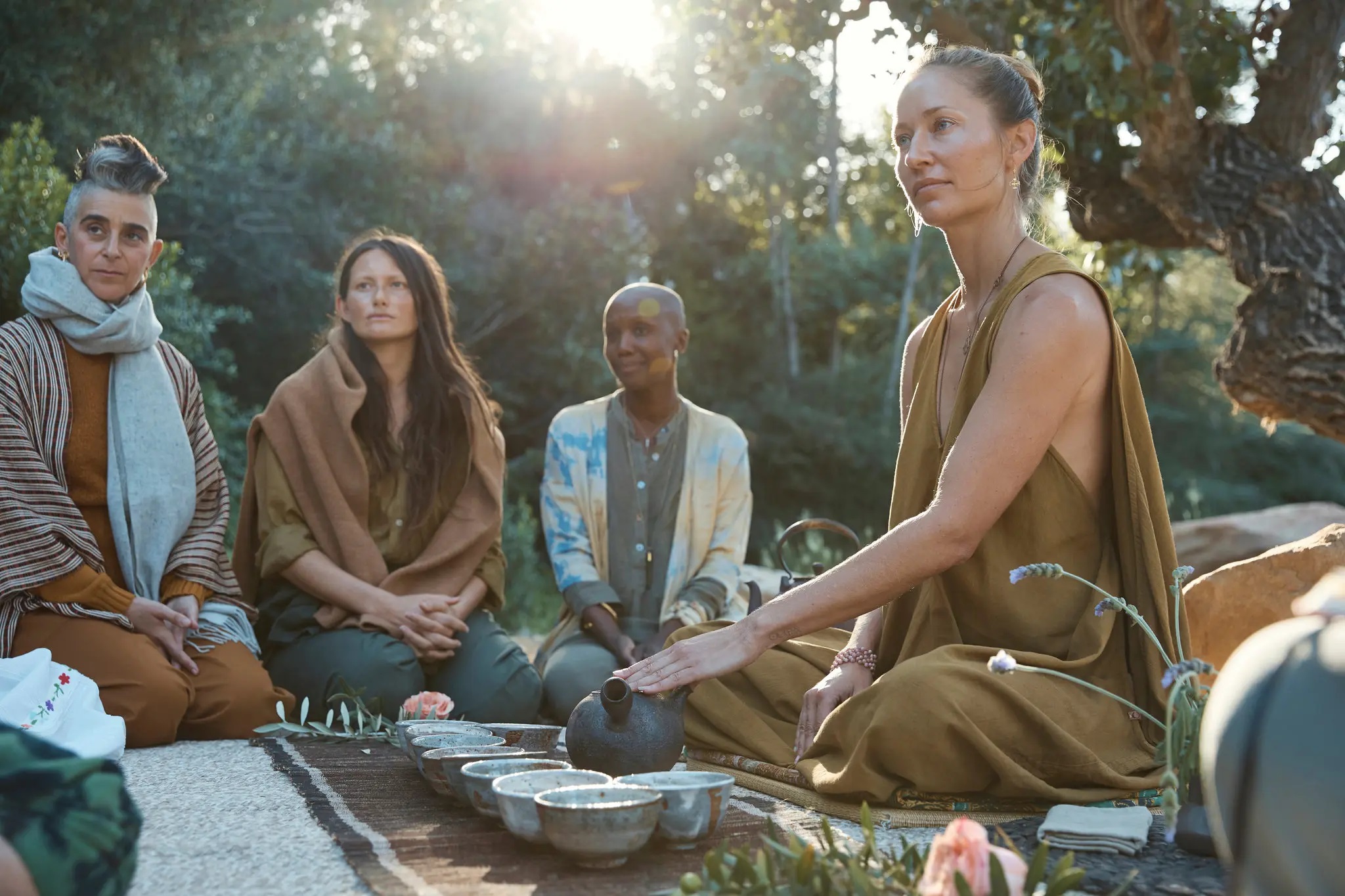

a NY Times article sums up a take on an LA subculture (photo credit and article)


a finer point about prior context of discrimination mattering:  So Han raised a good point about how all these ideas don't necessarily stand alone as a guide to what works and what doesn't related to borrowing from other cultures, because the context of how different cultures interact in the present matters.  If there was no racism against Asians, or negative stereotypes at play to work around, different forms of uptake could be regarded as more reasonable, because the broader context would be simpler, and less problematic.  On the negative side Chinese people can be regarded as potentially deceptive, an unfair stereotype since anyone can be like that, and I don't see that as necessarily being a broad cultural condition (even though my wife does tend to claim that "Indians are tricky," even after we've been mutual friends with several Indians, and I count even more as friends).  

This can be a little harder to place than it might seem at first.  Black people in the US experienced a fairly consistent and broad form of racism in the US in the 1950s and 60s, which unfortunately isn't completely resolved today, but discrimination against Asians in the US never took as consistent a form.  There are negative aspects to common Asian stereotypes, and the ongoing culture war surely has made racism worse instead of better, relating to plenty of examples of incidents, but it all varies a lot, and keeps changing.


what about Chinese people exploiting Chinese culture?:  tied to another less than fair or ideal stereotyping anyone with a certain nationality or "race's" genetics can also be granted freer reign to speak for broad traditions that they may or may not have a lot of exposure to, or the right type and degree of background.

In one of my first exposures to differing tea types a local Chinese-Thai woman was selling sheng pu'er.  Looking back what she communicated about tea was quite limited, over the course of a number of visits (her shop was close to where I worked), a bit odd given how that would've factored into selling it.  Per what she shared it seemed like either her father or uncle was into tea, and it wasn't clear that she had learned much about the subject from them.  About 10 years ago I bought a cake of modestly priced "young" or new factory sheng at that shop to drink, to explore and acclimate to the type.  That purchase was based on a recommendation of a fellow visitor there instead of that shop owner, who made no recommendations, related to limiting discussion of any background.  It was probably roughly as poor a choice as I could've made, quite harsh without significant aging input.  Still, it worked out; I acclimated to bitterness, some, and went on to explore oolongs more, returning to sheng exposure and preference some years later, only after her shop had closed.

That shop owner was also selling Chinese artwork, in some seemingly traditional form, having people produce high volumes of quickly made versions using related site space as a studio.  Looked at one way both ventures represented exploiting a connection to "her" culture, two different subject themes which she may or may not have been an expert in, or even as knowledgeable as an average tea enthusiast or fan of art.  Or maybe that's a completely unfair and inaccurate take.  Thais don't put much thought into topics like cultural appropriation, or even racism for that matter, so it wouldn't have been discussed as being an example of that back then.  

Maybe this doesn't connect as well to this point for a second reason, because the stereotype image of Chinese people is completely different here in Thailand.  In one sense it's not negative at all, and in another it could be seen as such.  All that is complicated, and maybe a bit off the point, but somehow it seems relevant to clarify that there isn't the same sort of otherness or negative connotation here that Chinese people would experience in the US in most places.  A lot of people have Chinese ancestry, and people with Chinese family background tend to be among the most wealthy members of society.


That last part may muddy the waters a bit in relation to a strand of other related themes matching up better.  I suppose it works to be mindful that simple conclusions don't work well related to unpacking and understanding complex issues and perspectives.  That's why So Han and Riu offering their thoughts and examples worked so well, because they touched on broader scope issues, then brought up examples of personal experiences relating to those points, and clarified how they saw it all fitting together based on the benefit of hindsight and further consideration.


Friday, May 28, 2021

Tea processing and demand shifts in China


photo credit Suzana, as usual


that one cup has an interesting story, here


This is really about input from another meetup, but since the points I found most interesting relate to tea processing and demand shifts in China the focus is on that.  Cindy Chen, the Wuyi Origin producer--also ran by her husband and family--talked about these issues mostly related to Wuyishan (Wuyi Yancha "rock oolong") and Chaozhou (Dan Cong) production, but really more related to Wuyi Yancha.  Earlier discussion on other themes was interesting too, and I'll add a little about infusing tea in oil and alcohol at the end, another main point.  To back up a bit related to this meetup context, we invited a number of people we've talked to in small previous group discussions to join together, which included one session with Cindy.  Eight people attended altogether; not bad.

Cindy started telling us about their business, about volumes produced, general background, how specialized orders work out, tied to general processing themes, and about changes in tea awareness and demand in China over the last decade.  Truly fascinating stuff!  Some of it was familiar but the part about a shift in demand and awareness was not.


we saw just a little tea sorting going on


She mentioned some production issues related to different teas, about how Wuyishan growing areas are laid out, and how micro-climate, especially in terms of sun exposure, changes final tea character a lot.  I wrote an interview post about those factors--Making Rock Oolong--based on her input awhile back, which overlaps, and shared some pictures of a harvest season since then.  

The short version is that not only do plant types and ages matter, and rainfall and other local climate issues, and local soil conditions, but sun exposure also does.  The same plants growing on a small valley floor and on ledges, or at the edge of that valley, would produce different character tea.  An example:  initial intensity varies, and the more forward oriented aroma notes, with those ranges more pronounced with greater sun exposure, with tea with more depth and subtlety resulting from partly shaded conditions.

Josh was trying to place this in relation to Japanese green teas, but we never really made a clear connection in discussion.  For those, per my understanding, partial shading prior to harvest greatly increases chlorophyll production, increasing flavor intensity across one range, and to some extent increasing bitterness.  But Wuyi Yancha oolongs are not bitter, at all, given how processing changes compounds that probably would come across that way if you chewed a fresh leaf.  It seems to contradict, to say that sun exposure increases oolong intensity, but restricting sun exposure increases Japanese green tea intensity, but it all must map out in a more complicated form than that.

Onto the awareness changes part.  It's my impression that Cindy was talking about awareness and demand shifts (increases) among a very limited subset of Chinese tea drinkers and consumers, her own customer base.  They are becoming more knowledgeable, and making more specific demands.  I think that the "average Chinese person" doesn't see tea so differently than they did 20 years ago, beyond more young people drinking coffee and bubble tea now.  

I'm basing that on visiting China three times (which is very limited input), and knowing three Chinese families, living here in Bangkok, as more in-depth feedback.  All three were close friends of my kids, and all three we joined for dinner parties, sports outings, attending local Thai holiday events, and to restaurants and the local zoo.  Those kinds of contact give you more time to talk about daily life.  All three drank tea but essentially knew nothing about the subject. They drank whatever local types were in a grocery store or local market, and couldn't describe those types in much detail.  The same was true of a Japanese friend, again the father of my daughter's best friend; he may or may not have been familiar with the concept of "sencha," and drank whatever he happened to buy at a grocery store.


two of those friends; they are missed, back in China now


looking like this isn't about cultural immersion, in the normal sense


Cindy's customers are at the other end of the scale; they know tea.  According to her it has went beyond just ordering much better versions for gifts and such, or liking those for daily consumption, some are onto special ordering very specific versions.  I'll get back to that gift idea, which ties to a broader transition theme.  In some very limited cases Cindy's family do produce "single bush / tree" tea versions, but that makes a lot less sense for Wuyishan oolongs, which tend to be from relatively small plants, that never grow to a size that supports that.  We've discussed how that works in relation to Dan Cong before but I'll stick to what was covered yesterday.  

Over time a limited set of her customers have learned how varying growing conditions inputs can change tea, and can specify which exact type they want.  Not just in relation to oxidation and roast level, but related to ordering specific versions from limited range growing areas, eg. from a certain growing field location.  On the broader scale a lot of customers are appreciating better tea too, without taking those kinds of next steps. They can seek out the types and higher quality levels from producers like Cindy, replacing earlier preference for well-known and mass-marketed volume production blended teas.  


my favorite picture of Cindy, showing one growing area


Cindy said that the status of giving main commercial brand teas as a gift has at least partly been replaced by giving better quality tea. That seems a positive step.  For those unfamiliar with truly high end Wuyishan oolongs, or Dan Cong, it won't work to describe what Cindy sells.  It's so good that I recommend that people exploring such oolongs don't start there, that they experience more moderate quality versions first, to identify the range, and experience some flaws, then move onto what the true potential is.  It doesn't work as well exploring in the other direction, and there's learning involved with drinking medium quality or even flawed teas.


All of this reminds me of some interesting input from a Chinese-Malaysian friend about tea service in a business context, more a formal entertainment theme than related to gifts.  It might seem like I'm jumping the track a bit, changing countries, shifting from personal preference and gift-giving to a third tea drinking context, but Cindy did actually bring up that tea can also play an important role in business interactions.  I'll cite part of what that friend said, a lawyer in Kuala Lumpur, William.  

The tl;dr version is that in business it's normal for higher executives to make an elaborate show of preparing tea for guests; it's expected.


In this message, I would like to share something about the various settings Chinese in mainland China drink teas.

Setting 1:

This setting is deemed to be the most elaborate form, favoured by the chairman, the chief executive officer 'CEO' of a corporation, for having a large room for workplace. The office is usually divided into two section, one part is for work, the other is designed into a room that resembles a teahouse. There is a desk, the height of and shaped like a dinner table, a seat is placed at one side, whilst two more seats are positioned on the opposite side of the desk. A thorough accessories, complete with a hot water kettle, tools and equipment for gongfu tea preparation is placed on the table.

The chairman or the CEO would be the host, serving tea via gongfu style, when meeting another colleague, discussing company matters or seeing a guest to talk over business partnership. It is through such reception with another entrepreneur or industrialist that business deals are entered into. Besides opting for a game of golf or to meet in a restaurant over a six course meals with tea or red wine, both outings are well-liked in Malaysia, as well, inviting another captain of industry for tea into this section of the office of a highest-ranking person in the company is also a very popular form of arrangement, allowing a formal dialogue be serenely engaged between both the host and his guest in the most private manner.

A man who holds directorship in his guest's company would also entertain his guest in similar environment if he himself is also the head or owner of his own company located elsewhere, away from his guest's home or workplace and has similar detailed set up for tea drinking, too, making conversation and even giving of advice and imparting his knowledge to his guest if his visitor is his junior or a newly appointed figurehead. The tea brewing could be put together, simply for the exchange of ideas or brainstorming for business planning and development between an 'uncle' and his 'nephew'.


not even close to the same theme, a corporate presentation I attended in China


This clearly ties into an elaborate gift-giving culture common in China.  There are three other cases (settings) that he described, extending to lower level managers hosting much less elaborate versions of the same process, onto tea house or cafe forms and expectations.  Suffice it to say that the elaborate nature of the forms and device use is only scaled down, but expectations about very particular types of experience remain in place, just in more casual forms.  The most informal form he describes is what goes by the name "grandpa style" brewing in Western enthusiast circles, coined by an influential tea blogger:

In China, the ongoing and trouble-free tea infused in a flask or teapot at home would be '龍井茶' or 'Loong Jeng Cha', also known as 'Dragon Well tea', a renowned roasted green tea from '杭州' or 'Hong Jau' or 'Hangzhou', using a huge wok for '殺青' or 'Saat Cheng', a process literally means 'to kill-green' those tea leaves with bare hands. It is observed that Loong Jeng tea has been a leading tea variety and a household name in China, prepared and served in many a Chinese home. I had personally witnessed Chinese strolling all over the streets in Guangzhou, China, carrying glass canisters of all shapes and sizes made for seasoning paste and sauce, being recycled into drink container, all filled with teas.


Of course we know that green tea type as "Longjing."

Rest assured that my friend is immersed in a form of sub-culture that's much more Chinese in origin than Malaysian, with plenty of direct contact within China.  He communicates that in every such message about those cultural issues.  We last discussed traditional Chinese medicine approaches to healing bone fractures, related to a US friend breaking her ankle recently.  He passed on a version of the Guan Yin origin legend in this post about reviewing two traditional Tie Guan Yin versions (which he gave me, along with a good bit of Liu Bao; he's both generous and informative).


Back to Cindy's input, I'm missing some ideas that connect these themes, about processing steps, and other broad demand shift details.  She mentioned that the main shift seemed to occur beginning about 10 years ago, when better tea uptake really took off, which has gradually increased ever since.  Kind of off subject, she said that the latest spike in demand seems to relate to white tea instead, with prices in Fuding-produced white teas shooting up about 30% this year.  For growing up so embedded in the tea industry and culture she would tend to hear about other areas and types, beyond producing both Wuyi Yancha and Dan Cong herself (her husband and his family is from Chaozhou).

This post is already running long, and heavy on tangents, but I wanted to share a description of Cindy I ran across awhile back, from Jeff Fuchs' Tea and Mountain Journals.  It will help fill in the part I can't do justice to, about how Cindy is, which I very much appreciate every time I interact with her:


Cindy is made of tea it seems. Rampant energy, talking of nothing else, she knows tea from the soil to the very skin of the leaf and through the various stages it is a subject that is part of her. Her entire family for generations has produced Rock teas (called ‘yen cha’ locally), named for the fact that the teas generally grow in small terraced plots amidst stone and shadows where the teas must struggle to find a root-hold in the soils...


She's like that, energetic, and a very pure and humble soul.  She shares this experience and information from a place of shared interest, not as a vendor promoting products, and not as an expert passing down wisdom from on high.  Jeff covers that context too:

On this morning Cindy uses a simple white ceramic gaiwan, or flared cup vessel, for ease of examining colour and rapid fire infusions. Rapid fire they are, but with Cindy every serving is something fresh and perfect, though she in all of her modesty claims that she is “only someone who knows tea a little”.


She was born into knowing and experiencing more than a little of tea.  Her young daughters could teach me about tea right now, a lot more than we could cover together in a lengthy span of time.  It's probably as well to move on to touch on a second sub-theme.


learning about roasting oolong as a toddler, with an unrelated boo-boo


Infusing tea with oil and alcohol


Josh--that Canadian tea somellier--and Suzana discussed this more than the rest of us, for Josh attempting repeated trials along this line, and Suzana experimenting with it just a little.  You can infuse tea in oil; who knew?  The tea cocktail theme, and infusing tea in alcohol, is familiar enough, even though I've never actually tried it out myself, since I really don't drink.  This is a nice summary interview article on the alcohol infusion / tea cocktail theme by Tony Gebely.

The main idea is that you can actually infuse tea leaves in oil, and get slightly different results than using water.  Of course that would relate well to cooking, but they seemed to be discussing it more as a way to just check how it works out.  Knocking back a small gongfu cup of tea infused cooking oil would seem a little strange though, and drinking a dozen probably wouldn't digest well, no matter what you ate with that.  They really did go into detail about which aspect notes came out the most related to using different oils, teas, and approaches, but I suppose I was tuning in and out of that for not planning to try it.  I'll just stick to using hot water.  

Josh mentions where he sees this approach going, which is a novel vision:

In my mind how I see my process working is that the taster will begin a session with an infused oil made from the tea leaf their session will be based on. They move it around to coat their mouth and swallow it. Then I make the tea, and using an atomizer to mist the alcohol essence onto or in the vicinity of the tea or taster I can combine the every soluable aspect of the tea in one sitting.


Infusing tea with alcohol seems more promising to me, if someone already drinks alcohol, I'm just not so sure about using it to scent the air.  It could add a lot of potential flavor range to cocktails, and I suppose the caffeine could be a positive input, like drinking Red Bull and vodka, which came up after my drinking days.  Earl Grey is described as suitable for that use, in Tony's article, and gin is described as a popular alcohol input.

Huyen mentioned trying tea infused alcohol in a separate message discussion after that meeting.  She was having some technical problems with sound coming through; not including it in the session may have related to that.  I don't have much to add about that but a picture she shared tells part of the story.  She claims that wine is used as in input in at least one of these, which would explain why the "gunpowder" version is amber, instead of the yellow-gold one would expect from a green tea infusion.  Then again the liquor used in these isn't specified, on the bottle labels.  Sugar and alcohol content are specified. 


photo credit Huyen; that tea infused alcohol she discussed


It's not as if we only talked about tea themes in China and the oil and alcohol infusion issue.  This session ran long, and Narendra provided thoughts and discussion related to other tangents, especially as they related to Nepal teas, which he produces.  An interesting sub-theme came up about how family production and sales seem common in China, with tea production based on a plantation / large-scale model in places like India instead, and in Thailand and Indonesia.  Tea just seems better integrated in Chinese culture, beyond forms like masala chai being prevalent in India.

Only Alexander Zhiryakov also joined, beyond my set of friends and the others I've mentioned, but he was balancing attention with some other demand. We never drifted onto Russian oriented tea issues, or Laos Tea, or the Tea ID testing program theme we talked about in that other session.


Alexander is really pulling off a pandemic look


I haven't mentioned that Ralph was married in the last week; congratulations to both of them!


I'm not sure where this meetup form will naturally evolve next, but this was a cool step, expanding range to include more participants and broader discussion scope.


Huyen wasn't in the other photos.  Teams mixes framing formats when people use phones.


Friday, April 30, 2021

Meetup with Joshua Linvers, a Canadian tea sommelier


photo credit Suzana, as usual


Another meetup!  At least the people we meet with are completely different, from different parts of the world, varied cultures, and with completely different takes on tea.  This time my friends--Suzana, Ralph, and Huyen--and I met with Josh Linvers, a Canadian tea vendor and sommelier (on Facebook, Instagram, and his own vending and blog reference site). 

An hour into this session we were still on random small-talk, covering a bit here and there on how we got into tea, on Japanese and Vietnamese versions, tea history, and broad preference trends, all over the map.  It didn't seem like this was going to lead to something unified to write here about.  Eventually the tea sommelier theme came up; that works better.  As an aside, his site name is "sommerier," which someone might wonder about relating to tea instead of wine, but dictionary.com seems to clear this up:


ORIGIN OF SOMMELIER

1920–25; <French, Middle French, dissimilated form of *sommerier, derivative of sommier one charged with arranging transportation, equivalent to somme burden (<Late Latin sagma horse load <Greek ságma covering, pack saddle) 


I wrote the basics about Joshua's thoughts on tea pairing with food last year, with a longer and more detailed summary on his own page about that.  It's not that complicated, or at least the basics aren't.  Tea can't necessarily stand up to strong flavors in foods the way wine can, so it needs to play a more complementary role.  Most typically you can't pair similar combinations, because it overpowers the tea expression of the same scope, so you need to settle on offsetting balance, aspects that enhance each other, which is where it gets more complicated.  A quote from a wine-making friend in that post describes that context well, from Dan Senkow, a really great guy, very insightful and funny in his own way:


In simple terms one may either use an element in the wine to compare or contrast. So, this may be done with flavors, textures, weights, or a mixture of the above. Example a heavy lobster bisque with a light crisp wine or a rich opulent creamy one. 


So the creamy wine--or tea, in this example--won't match with a creamy soup, because real cream in a lobster bisque is much heavier and stronger than it could ever be in a milk oolong (Jin Xuan), so that oolong could end up tasting like water.  Per Joshua's input and approach that milk oolong could pair really well with any food that works well with a creamy, buttery input, that isn't expressing a lot of that itself, which would tend to overpower the related range.

There is a Taiwanese oolong example on a menu graphic shown in that post I just cited but I'm not sure it works as an example of this tea aspect.  Maybe; that was a fushoushan oolong and pumpkin mille-feuille, pumpkin layered with cream and pastry sheets.  Me speculating about how that pairing works seems pointless.

I'd mentioned in that earlier post that all this wasn't something I am eager to take up, and I've not tried to pair any tea with food in the year since.  Except for that happening on its own having breakfast, but that's definitely not an example of that.  I just had some Anhua Qian Liang hei cha with a mango; I suppose the towards spice range earthiness and sweet citrusy fruit were fine together.  Maybe just not some sort of complementary, magical combination.

Joshua did list out some of what seemed to work really well for him, with my memory not tracking most of that well.  Gyokuro and scallops comes to mind, and savory pork, like pork belly, with a fruity sheng.  Lots of sheng isn't fruity but I'd imagine anyone reading this would get the reference; some is, and sweet, approachable, and flavor intense floral range can lean towards fruit in some versions.  I tried a Mannuo sheng that was pretty fruity recently, and a wild-origin Yongde sheng that was, in a slightly different sense.  He also mentioned that smoked Lapsang Souchong works really well with cinnamon buns, which does sound interesting.  If more of that was around here I'd check on that.

It was interesting getting more of his input on how universal this appeal seemed to be, if most customers "got it."  Back in that mention of Dan's input about wine pairing, he emphasized that what people like is the right yardstick, not what an expert tells them they should appreciate, or what is objectively best.  We see a lot of that play out in ordinary tea appreciation, people being on completely different pages.  Josh didn't extend all the way to root causes but it seemed like people self-selecting as foodies who open to exploring tea and wine pairing probably come into it with a broader than average appreciation of food range.  What clicks most would still be individual, but most could still relate to what kind of works in a general sense.


in-depth discussion but less than ideal screen capture results


It would be nice if I could collect some of the other fragments of discussion into novel facts or insight to pass on here.  We talked about purple tea a good bit, what that's about, and what we've tried (an Assamica plant type or set of types that evolved naturally to become purple).  I think I may have only ever tried one version, or at least that's the only one I remember trying.  It was ok but unremarkable, and trying one version of any tea tells you nothing at all.  

If you try a single tea version and it's the best quality, most exceptional, most type-typical version you can learn a lot from the experience, but you couldn't place it as being that by just trying one version.  You couldn't place that context even if someone you trust told you that was the case, that a version represented that.  But we can pick up good information from others in lots of cases, and if someone had said that about a few other versions in relation to types then they would probably be right.

I've really not did justice to that tea and food pairing theme.  It was especially interesting how Josh can shift how he sees a tea to tie that in, to get a sense of where to place it in relation to food.  But he specifically stated that 90% of all tea just isn't good enough for exceptional aspect character to support a great complementary pairing, and that it doesn't really work in all of the other 10% of cases.  In some cases a tea is just good, and can express one or more very exceptional aspects, flavors or otherwise, but may not pair well.  In the best case a combined food and tea experience can evoke a certain response, a surprise at how the sum is greater than the parts, maybe even triggering a vivid memory of a prior experience.  

I get flashes of that reminder of other experience in relation to aspects, more so than dominant flavor elements.  A tea aspect will remind me of walking in a certain type of outdoor environment, the forest scent there, or a food I've had in the past but haven't experienced in a long time.  One tea was a bit grapey in a way that reminded me of visiting my great grandfather, of a specific type of grapes that grew there, not so far off Welch's grape juice but different than any other kind I've ever tried. 

Of course the pairing idea isn't mostly about recreating a nostalgic experience, more about a marriage of inputs that work well together.  Since tea can't "stand up" to flavors the way a dry white wine can (let's say a Sauvingon Blanc, although I was really a red drinker myself), it has to be more subtle than that.

In Western tea circles less is more in relation to what you experience of food along with tea.  I don't want to go as far as saying that something could get missed related to that, because we have to miss most of all the range of possible experience when we choose to have any specific experiences.  Focus and deeper experience is all about narrowing down range.  All the same there is something there.  Joshua gave a good example that only highlights part of what I mean.

He said that fruit tends to not be overly sweet and intense in flavor in Canada, because the growing season is so short.  And because of mass production farming as an input, a part we really didn't get into. Strawberries can be pleasant there but almost never sweet, rich, and full in flavor as in the best examples.  It's a bit sad, when you think about it, that beautiful, expensive, large and colorful grocery store strawberries in Canada or here--tropical fruit is the way to go in Thailand--have almost no flavor compared to the wild strawberries I would pick by roadsides as a child in Pennsylvania.  Back on the initial topic, he said that if you drink a bit of matcha before having those strawberries, or any fruit, that shift in your palate makes the fruit taste much sweeter and more intense.  That's a novel thought, isn't it, that we could move off considering what flavors might negatively impact tea experience (or positively, as I've covered here), and move on to how a tea might radically shift the food experience instead. 


Josh is also into Japanese pottery, with more detail on this example and photo credit here


Changing topics a bit, it has been nice how friendly, interesting, and insightful these people joining these sessions have been.  It was great meeting people I already knew well in earlier rounds, and introducing them to my friends, but this adds depth, not knowing what's coming in the discussions.  Josh is really more in the middle; we've talked a good bit.

One more tangent and I'll let this go.  It was interesting the way that Josh seemed to approach tea through the lens of wine appreciation and food pairing.  In general Western tea enthusiasts track through a fairly consistent form of tea appreciation, where at first they embrace complex, intense, and approachable flavors, as in Tie Guan Yin light oolongs, then onto other range that takes more acclimation, like sheng pu'er, or maybe at least white tea or hei cha. Then it's often onto appreciating mouthfeel and aftertaste aspects more, the whole experience, and then maybe ending on "cha qi" appreciation, folding in how a tea makes you feel.  What he is describing isn't completely different but the focus is a little off that sequence.  He's definitely not learning most of the background he is applying through online tea group discussion and the same references familiar to most Western tea enthusiasts, so he's not necessarily tied to those forms.

Josh even talked about how focusing on tea experience, and maybe also how it interrelates with food, can support experiencing more sensory depth in everyday life.  It can make it easier to notice scents around you.  I was just talking to Ralph about how odd it was that when I first moved to Bangkok I was struck by how novel everything smelled, not just the stinky canals and fragrant flowering trees, and very aromatic Chinatown shops and mixed-input old markets, but all over.  Now I rarely smell anything at all; it's all so normal it blends into an unnoticed background.  It seemed like that was part of what Josh was getting at, that we can tap into that background more than we typically do, if we choose to.  Some focused range of sensory experience can help serve as a gateway to that.  Or who knows, maybe I got that part wrong.


I am planning to do a different form of discussion soon, having a guest join who is more suitable for explaining a complex set of ideas versus discussing personal exposure, and other conversation.  I'm not saying that I plan to turn this form into a podcast theme, but I do intend to do a more open meeting version.  I'll mention more about that in the usual places, in that one international theme tea group I moderate, or in a Quora Space I write about tea.


Saturday, June 13, 2020

Tea and food pairing


This is a subject that hasn't even been mentioned in this blog.  I eat food with tea all the time, most typically with breakfast every day, but they are never intentionally paired, in that one limited sense.

To some extent I must take that into account if I'm having a tea with lunch, but essentially the tea is whatever I feel like having, and maybe one that doesn't conflict with the food.  But not necessarily a version that complements or matches the food; I just don't think along those lines.

It's perhaps most common for tea enthusiasts to claim that they never eat any food at all with better versions of tea, not even a neutral form of cracker, or maybe only something like that.  Then again that depends on the tea preference too.  People into English Breakfast Blends probably would be more inclined to have snacks with them than Chinese sheng pu'er or oolong drinkers.


I was recently talking to a new online contact about this theme, Joshua Linvers.  He is a tea enthusiast who works related to food and tea pairing (and with wine), associated with the Q Haute Cuisine restaurant.  There's more on that direction and theme on his own website, with this article on pairing tea and food a good starting point.

I'll start with his input on some general pairing themes.


Joshua's comments on tea and food pairing


The aspects of young sheng that I enjoy are when they come off as particularly fruity once the bitterness fades. Fruity such as apricot, papaya, or perhaps dried mango. From that starting point I would have to consider what else is going on -- is it also related to tobacco, or walnut, or is it root-like and autumnal?

A Xi Gui Pu'Erh paired dish we made at the restaurant was Venison jerky with cured duck, pickled figs, walnut chutney, a whiskey gastrique, and crostinis. [That origin isn't familiar, but a Hojo post covers what it's about].  

With a young puerh from Lincang we made a course which was pork and shiitake mushroom broth with walnut gnocchi, dried apricots, and pancetta.


Ultimately I think the way I like to do pairings is try to adjust for 'shortcomings' or things about the tea or food that might be a bit alienating for some people.

For example, if someone doesn't like bitterness you can do a pairing with strong saltiness or strong sweetness to make it seem less intense. If a tea has a bitter apricot flavor and you make a bitter apricot pie, you're going to screw it all up and end up tasting nothing from either of them. If you choose a complimentary flavor to apricot --- say nuts for example. If you're eating a pecan pie, or a bowl of salty pecans, the tea wont taste as bitter, and the apricot flavor is really going to resonate because you're putting two complimentary flavors together.

If you would consider pairing fruit with meat, I think people have some standard opinions of what works -- pineapple and pork for example, cranberries and turkey, applesauce with beef bolognese, etc.

It stands to reason that if you're someone who likes the match of pineapple and pork that having a tea which reminds you of pineapple is a good start for a pork based pairing.


Interesting!  One part reminds me of a tangent that's so unrelated I probably shouldn't mention it, about my niece and I both screwing up a Mongolian grill meal by adding too much spice to it (where you choose ingredients and they cook it for you).  I told her there wasn't much of a way to remove the heat (although you can add a little sugar and cook it a bit, if you have that "do-over" form available), but adding salt could at least make the spice level make more sense.  She agreed, and we both ate our meals slightly better balanced, but still too spicy.


The mention of teas tasting like fruit is unusual, but it's a bit complicated why that is, how patterns in flavors work out.  Floral aspects or other range more dominant in some types, and mouthfeel (astringency) and aftertaste aspects often tend to be emphasized more than flavor.  I do like fruity teas the best in general myself, but lots of other range comes up as much or more.

The basic premise and theme seems to work, that at some level pairing would have to be about setting up complementary patterns.  More on wine will extend to why that doesn't necessarily typically relate mostly to flavor, although that is one range that could be emphasized in an approach to pairing.


I'll add a few of those pairing menus Joshua had mentioned here for reference.


There's a problem in reviewing specific pairings:  teas aren't as consistent as they might potentially be by general type.  There is often a singular "type-typical" style, but any given tea can be a great version and still not be exactly like that.

With a lot of general range a continuum of variation enters in, eg. oolongs can be roasted or oxidized to different levels, even when there is a narrow conventional-type window to shoot for.  Sheng pu'er varies a lot across a few different dimensions, and aging (storage) factors can change teas a lot, in addition to varying starting points.


My impression of food and wine pairing, in comparison


It's not something that I've covered here at length but I did work in the restaurant industry for awhile, as a server.  I did some informal training in wine background, and drank different wines for a few years, as I mentioned in this post about preference change patterns in comparison with tea.  But I was a better snowboarder than waiter.


I owned that mountain


Pairing flavors that would complement each other did come up, in the wine and food, and as much emphasis on getting the character, the feel and weight, balanced for specific dishes.  At some points discussion of a wine being acidic enough to complement a certain dish would be mentioned, but at a guess the ph of wine isn't varying all that much, and that was really about feel aspects (astringency, weight) and dryness versus sweetness matching.  Since that was just a guess I'll look up a Wine Spectator reference to see if that's mostly right or completely wrong:


PH is the measure of the degree of relative acidity versus the relative alkalinity of any liquid, on a scale of 0 to 14, with 7 being neutral. Winemakers use pH as a way to measure ripeness in relation to acidity. Low pH wines will taste tart and crisp, while higher pH wines are more susceptible to bacterial growth. Most wine pH's fall around 3 or 4; about 3.0 to 3.4 is desirable for white wines, while about 3.3 to 3.6 is best for reds...

While these numbers might mean something to chemists and wine geeks, it's important to remember that the way a bottled wine tastes is about the relationship of things like pH and TA to other factors like alcohol, tannin, extract and sweetness. There's no chemical formula to make great wine—not yet, anyway.


So maybe it does make a lot of difference.  Joshua would know more about that, but this really does have to focus mostly on tea, and only associate back to wine related to pairing themes, not character  or aspect inputs.

Customers usually kept it basic; they seemed to buy wines they were familiar with and liked, and must have expected them to work well enough with what they were ordering.  Some had no idea what they liked and then I would usually recommend really approachable wines.

It did seem to make sense to match a general type of wine with the food (color, and sub-type within that broad range, and character beyond that), especially related to an experienced lightness or heaviness of both.  I worked in a traditional Italian restaurant once and Chianti really did stand up well to a heavy, strong flavored, tomato-based food range (although of course there were cream sauces and pestos).  Most of those wine versions were probably a little rough.

White wines would be nice with lighter foods, and Cabernet or heavier reds with beef and other grilled meat; I never really made it past those kinds of basics.  Working in a wild game restaurant heavier flavored reds came up a lot.


I was usually only drinking wine with a snack, at most, with wine experience as the main theme.  I cooked a lot back then but I wasn't a foodie, in that one sense, and I'm still not.  As my wife says I have a "crocodile's tongue."  I can sort of tell how good the food is but I'm really happy to eat a grilled cheese sandwich with sauteed mushrooms for dinner, or even just fruit, or breakfast cereal.


Wine pairing input from a wine-maker friend


To me this still really isn't doing justice to comparison to wine and food pairing (not that it has to).  To fill in that gap I asked a friend who has long since worked as a wine maker, working for some well-known producers.  From that friend, Dan Senkow:


Not going into specifics on wine, that would be confusing to many. The first and most important rule is drink what you like. If the quote un quote best pairing for a dish is something one doesn’t like then it is not going to work. 

Second there is no such thing as an expert for all people. Everybody is the expert for what they like. No one is the arbitrator of taste. It is true some people may know more about the way a wine is produced from a technical standpoint. However, they do not know more about how it makes the individual feel.

In simple terms one may either use an element in the wine to compare or contrast. So, this may be done with flavors, textures, weights, or a mixture of the above. Example a heavy lobster bisque with a light crisp wine or a rich opulent creamy one. 

Remember it is the marriage of food and wine, they both have to make each other better or they shall split apart. The wine and the food must have a place to fit in. If the dish is a complete package all on its own, the wine has to fight for a spot to fit in. We know how that works in relationships.Together greater than the parts they must be.


Dan's sense of humor stood out more than the bottomless wine knowledge; some part of everything was funny


Lots of that seemed really insightful to me, especially the the examples about the two broad strategies for pairing, and how it helps for gaps to exist in the food profile to complement.  The last part about relationships can be a touchy subject, being married to a Thai.

I can't evaluate which strategies Joshua's restaurant was using, since I just don't have that background or degree of imagination.  But it all works well together as a starting point for thinking the subject through.


Maybe all this could've hung together a little better but the different threads did seem interesting, some of which overlapped between the two scopes.  I can cite a bit more from Joshua's blog post on tea and food pairing that might help with that, with linking it all together:


Tea in a pairing behaves differently than wine, if for no other reason than sheer amount of ‘sensations’ wine can be bountiful in, be that acidity, tannin, and alcohol or the flavor sensations of sweet, sour, bitter, pungent, umami, and spicy (although spicy not so much)...

With pairing tea, you are often forced to take a different approach because you can’t go head to head with a lot of foods and expect the tea to come out on top or even equal. It plays the gentler, more passive role in the marriage...

With tea you need to take another approach — you either use the tea to cleanse the tongue afterwards and highlight nuances in the food that you’ve observed and hope that the pairing might bring in focus; or you use the tea as a set-up to put the food in a better light...


He adds a lot more context there, and a number of pairing examples.  That post includes a tasting exercise, how to use a few basic food inputs tested against a tea to work out how the coupling can be positive, or take different forms.


To be clear on context all of this still just isn't for me.  Eventually I might try it, but I could live without ever going there.  For as broad and complex as tea experience is for me it works to only take up a limited range as it connects with the last theme I was on, evolving scope organically.  If I ever take up more of a food interest beyond eating the three meals a day that might make more sense.

Thursday, June 11, 2020

A Buddhist take on the designation of tea master / artist


An online friend posted an interesting question recently:  What does it mean to be a Tea Artist?

This was first published in TChing, here and here.

My own response is the general theme of this post.

This mentions but never really does explain the claim to represent Buddhism, and if you read that related response detail carefully I'm not saying that at all.  The claim is that my interpretation of use of personal labels and roles has been influenced by Buddhist ideas and practices.  It doesn't relate to having been an ordained monk, to completing two degrees related to Buddhism, or to living in a Buddhist family in a Buddhist country, even though those have been some of my own personal contact points with Buddhism.  Since it's not essential to the rest it's as well to not really develop that part further.


with a cat I think of as my first daughter; a kitten in this picture but now 12


Some framing discussed with that friend addresses issues that underlie fixed role or status designations, related to tea:


I really do think the people who embrace ritual tea interest or competitive tasting aren't getting anything wrong.  It's just a different way to take it all.  Once you take up titles or labels that changes things a little, but even then that could be fine, getting ranked, certified, or acknowledged.

That relates to a Tea Masters Cup group that people join and compete in, an educational interest group that--per my understanding--hosts competitions related to ceremonial form practices and tasting identification.  The last would seem to represent overlap with wine sommelier scope, more or less.


I never really do unpack use of "artist" as a designation versus the more common "tea master" in what I added to that discussion.  Along with those "tea expert" and "tea enthusiast" form a sort of continuum.  My own input relates to underlying context, so not directly about that theme anyway, how those varying terms map out.

Tea production is something else; this response is mostly about the consumption side.


My response to the initial question, what does it mean to be a tea artist?


As someone influenced by Buddhism I tend to use labels and extra concepts sparingly. They can help clarify meaning but they can also limit it. If a few people are tea artists then everyone else has a shallower expression or experience of tea compared to them.  To me the opposite is more true instead, that any of us brewing and drinking tea are sharing common experience. If you put yourself above others for any reason you typically do an injustice to them, and also to yourself. Extreme humility is a very functional position, and an especially valid personal choice.


If you drop the label you only need to keep in mind what is positive that potentially gets lost, and then choose to retain that if it's worth keeping. Unique experience of tea or expression through tea experience can be positive, but linking that to achievement or personal status I would typically see as negative.  Maybe within a competitive interest group that's different.


I might add a little about the one part, what could come along with the label or designation that might be positive. People use tea expert--or artist, master, enthusiast; whatever it is--to describe a range of competencies. Some people are into ceremonial forms, others into experiencing and being able to differentiate types and quality levels of tea. Just being able to brew tea effectively gets a lot of focus, and I suppose to some limited extent the most positive outcomes also require that, careful progress through a learning curve.


this organization relates to tea practice competition (maybe not related to ITMA / Tea Masters training)


To me it's useful to stay open to appreciating teas across a range of quality levels (a theme that only overlaps a little).  Emphasis on only exploring and appreciating the highest, most unique, most rare and sought after forms of some teas could work out even better when coupled with broader interest.  To be clear, as an ordinary tea drinker, with some background and experience, I sometimes drink good versions of teas but nothing too rare, unusual, or costly.  Working from a limited budget makes that choice for me.

I can be more specific about what I mean by type diversity. I think Earl Grey and masala chai are valid, interesting, and pleasant forms of tea, even though I focus more on plain, single-input, higher quality teas. But then I'm a generalist myself, related to tea preference, and of course it's just as valid and reasonable to focus on one type (eg. aged sheng pu'er, or Dan Cong oolong), and to explore higher quality level scope as a main range of interest.


To summarize, it seems that "tea artist" would of necessity mean a broad range of things to different people. Again, tea production is a completely different theme that I've not included in this answer, but of course it could be included.  Making great tea would require even more knowledge and skill than brewing it.

I don't reject this or other role or status designations as valid, or potentially quite useful, I just don't include use of such terms in how I approach tea.


a Vietnamese friend embraces the aesthetic side of tea, and formal brewing, but all that only overlaps