 |
traffic jammed up, with a nice overhead walkway system here, a common theme in Bangkok |
 |
some traffic management designs work really well, like this large roundabout |
This is an interesting subject, that came up in a recent Quora question.
Of course it's experiential, and you need to sort out how to practice driving safely, and then do that, but some of the differences can be described in writing. It's harder to drive in Bangkok than in the US, of course. Motorcycles are everywhere, it's all one big traffic jam, and laws, conventions, and intersection designs seem pretty random, for quite awhile when you start. Then later it all seems more normal.
A main part here will be that answer Quora answer content, about if traffic really is bad in Bangkok, and how the context is different, but it might be interesting to start with a tip first, and work back to why that different driving practice makes sense:
You can't really turn your head to check a blind spot, as my wife needed to practice over and over when preparing for a Hawaii driver's license exam. Eventually you would kill a motorcycle driver if you continually turned away from forward vision for that long. Glances at mirrors have to serve that function for you; you have to see those cars entering the zones you can't see. Then this might seem to add risk, related to blind spot awareness, and the necessity of changing lanes on an expected pace comes into play. Ideally while using turn signals, but other drivers are reacting to other cars' movements, not to that. And motorcycles use the space between two cars, centered in their own lanes, as an extra small lane, so erratic movement within your own lane isn't really ok either.
The Quora answer content covers more context, of why it works out like that:
Somehow it usually takes 45 minutes to get almost everywhere, unless you happen to be very close to where you are going, or on the opposite side of town, in which case it might take an hour. It’s odd how that works out. Part of that is from us living in the center of town, not along Sukhumvit, but in one of many older neighborhoods on the west side not really close to or extra far from anything.
Accidents aren’t the problem. Streets can be essentially closed for a few reasons, for construction, for VIP processions, or just because current flow of traffic overwhelms road capacity, probably the main reason. You avoid this by learning where bottlenecks occur, and not being there, doing whatever it takes to take another route, or avoiding rush hour. Google Maps has some idea of current conditions but it’s not 100% accurate.
 |
I love visiting Chinatown but I pretty much never try to drive along the main road there |
It’s hard to say how to drive in general. A lot of conventions are completely different than in other countries, but it’s all very informal, nothing that would appear in road laws of guidance material. You have to flow with traffic, working within the range of what other people expect that you might do. There is always a motorcycle within one meter of your car, so if you do anything unexpected it wouldn’t take long for you to crash into one of them. You have to remain aware of where everyone else is at all times, but at the same time you can’t maintain constant hyper-alertness, so it has to be a secondary running process, just normal for you.
It takes time, if you are coming from a completely different driving environment; it will feel natural after a couple of years. I remember the first time I ever drove in Bangkok, based on no warning or preparation at all, when my wife was sick one day. Switching sides of the road and car was scary enough, but if you leave a single car length of space between you and the car you follow a steady stream of traffic will pull into that space, possibly within one meter of your car. You have to learn to follow close, 2 to 3 meters from the car in front of you. On the highways all the rules change, but you still need to follow closer than is legal in the US. Highway driving is much easier, to me, but at first others’ range of driving practices seems random.
It’s a bigger problem than driving conventions that the road systems are hard to figure out. Intersections don’t really take on standard forms, and in some cases there are no stop signs or lights controlling traffic flow, you just kind of take turns, with everyone pushing for the right of way at all times. That describes driving in general, really. You can change lanes when there is any hint of an opening, but not related to using a signal and steering into an open spot. You just drift over and take the position when it’s open, having faith that the roughly one car length gap is yours to use. It would make sense to use a turn signal, but if you alert the car at the back end of that gap in advance that driver will cut you off, so you just hit the signal while you go, and then the ball is in their court to avoid the collision.
 |
overpasses skip over high traffic intersections, but traffic flow can be slow on those too |
 |
headed out of Siam towards Silom; those people are stuck |
Half of all drivers seem to not follow standard queue practices, and over time you learn to pick your spots when you do or don’t. It may not be possible to shift into a left or right turn lane fast enough, unless you really know the road, so you need to be able to drift in when a minor gap occurs, nudging in front of another car.
If you have to turn from the wrong lane then you do; you can’t “go around the block” in many places. It could add 15 minutes of driving time getting back to where you were, or much longer if you get lost attempting it. In many cases we won't drive to and from places using the same route, because lots of parts of road systems end up being one-way, or limiting intersection turning access, so there is no going around the block for those reasons; there's very little chance that taking three consecutive lefts or rights would get you back to where you are.
If you can’t read Thai some of what is on signs is going to escape you, about when you can turn left on red, or when a far left lane doesn’t need to stop at a light, and so on. Never mind about all that; making mistakes is fine, up until you get in an accident. Just go with the flow, and learn to follow normal expectations. Turn lane signs above the roads and those painted on the lanes don’t always match, so there’s not always a clear right pattern to follow anyway.
Eventually you will get into a bad traffic jam and spend a half an hour more or less parked, probably within a few days of driving. Try not to drive through that route at the same time of day again, if you can. Threading through a less direct route might take time, but not like just parking for awhile. Until you learn your way around don’t pull the plug at the first slow-down and take side streets either; that’s only going to work when you have some idea of how to pull it off. Google Maps isn’t crystal clear on which roads are one way, or which intersections you can turn at, so don’t expect that app to keep bailing you out either. If it’s all you’ve got you have to go with it, but resets in route planning will happen if you use Maps.
Not driving is better; use the BTS, MRT, and ferry system. The highways are fine, when you want to get out of Bangkok, as long as you drop expectations about setting cruise control and relaxing and eating while you drive. Focus in, and it all works well. Unless you drive out of the city during a holiday weekend, and then you are screwed, no matter what approach you take.
So far so good, and in a sense that's relatively complete, about differences, with only a bit of how-to. Can we go further though; is it possible to describe how to learn to bridge over from experience elsewhere, and do it quickly?
The extra momentary awareness part is one main key; I could add a bit about that. Learning to drive in the US is about a very unfamiliar process of ongoing tasks and reactions becoming familiar, and that general context is the same everywhere, it just takes on different forms. Later driving in the US you can let a knowledge of driving rules and conventions simplify the process for you, and limit what you need to pay close attention to. Not everyone is going to follow cars using the 3 second spacing rule but you can generally assume that cars will be at least a car length or two away. When people violate that, and tailgate, it's frustrating, but it's clear that's an exception case. In Bangkok, and to a lesser extent elsewhere in Thailand, you follow right behind another car, maybe not much over a car length even at lower range highway speeds. In the city it's at a few meters distance. A different kind of focus is required.
You can't remain on-edge the whole time, since that's not practical, but you have to build up a more dialed in momentary awareness, with an expectation of shorter reaction times. It all really works because everyone flows in such a way that others expect them to, not based on cutting their reaction times in half, but it's a bit of both related to adjustment. In the US you can see a traffic opening, turn on a signal, then quickly change lanes, but in Thailand you need to leave a little more allowance for potential reactions from others, and tend to drift at medium speed, giving others time to react. There could always be a motorcycle in your blind spot. And it all works in relation to watching other cars more closely, habitually checking mirrors, all the time, keeping a running tab on where other cars are. It has to all "run in the background;" if it was all conscious effort any driving would be exhausting. And it will be stressful for the first year or so of practice, but later after switching over habits and expectations it's fine.
If you hit a motorcycle, a Thai driver with you being a foreigner, you are likely to be at fault, regardless of who did what. Getting it all right is critical. I've only been in one very minor accident in 15 years; a large truck passed too close to us when I was turning at a light, with a signal on, waiting for the car ahead to move, and his oversized rubber bumper scuffed our car's paint as it struck us. In the US there would be no question about fault; he hit another vehicle, queued in the process of making a legal turn, with a signal on. Insurance reps came out and declared it a no-fault case; it seemed like if there had been real damage they may have entertained a different ruling, but weren't going to get an insurance company process involved over scuffed paint repair. In a sense I get it; if insurance judgments can be based partly on "from the gut" resistance to allocate responsibility it limits the general escalation of insurance payouts, and general cost. We had benefitted from one part of that system and outcome for years, so it was our karma to not unfairly benefit from an extra level of fairness at that time, beyond what the system usually supports.
For a long time I had avoided driving on rural highways at night; the scary road statistics here seemed to imply that this was where real danger lies. Then gradually I drove more and more at night on dark rural highways, and it was ok. I think the negative stats might relate to two causes that sort of potentially involve me, but which I can partly control: people might drive drunk more frequently, and drivers on motorcycles are more likely to experience fatality as a result of accidents. Not all motorcycles have functional headlights, even on dark country roads; that kind of condition might factor in too. You just need to be more careful, that little bit more alert. Eating while you drive is a bad idea; you can't just zone out as you definitely can on the US interstate system. It's best to not drive right beside large trucks, or really any other cars; you can offset risks from other drivers from keeping away from them, when that's possible.
It takes a few years but eventually it all becomes second nature, just normal. Then you experience an odd bit of related reverse culture shock going back to the US to drive, when everything is again just a little different. Cars are further away from you, in general, and slightly more predictable, so it's easier, in a sense. People aren't as forced to flow with traffic as in Thailand there, from necessity, so early on it's as well to watch out for people making erratic driving movements within what they regard as their own space. Use of turn signals is somewhat optional in both places, so that stays the same.
For American tourists I think most shouldn't drive while visiting Thailand. Even a great driver from back there would have a lot to adjust to. Outside of Bangkok or Chiang Mai it's probably ok, but in the cities it's just different, and hectic. You could always drive just a bit slower than the flow of traffic, and that would cue others in on you being a special case, but even that's going to be stressful.
There are other ways to get around, which is really too much to cover here, how buses, hiring a driver, tuk-tuks, songthaews, and jumbos are different kinds of options. Or there are motorcycle taxis, but I'd pass on that too. It's a good way to save a couple of dollars here and there, in comparison with using taxis, but then you'd be zigging and zagging through tiny gaps between cars, which isn't an experience I'd want to have.
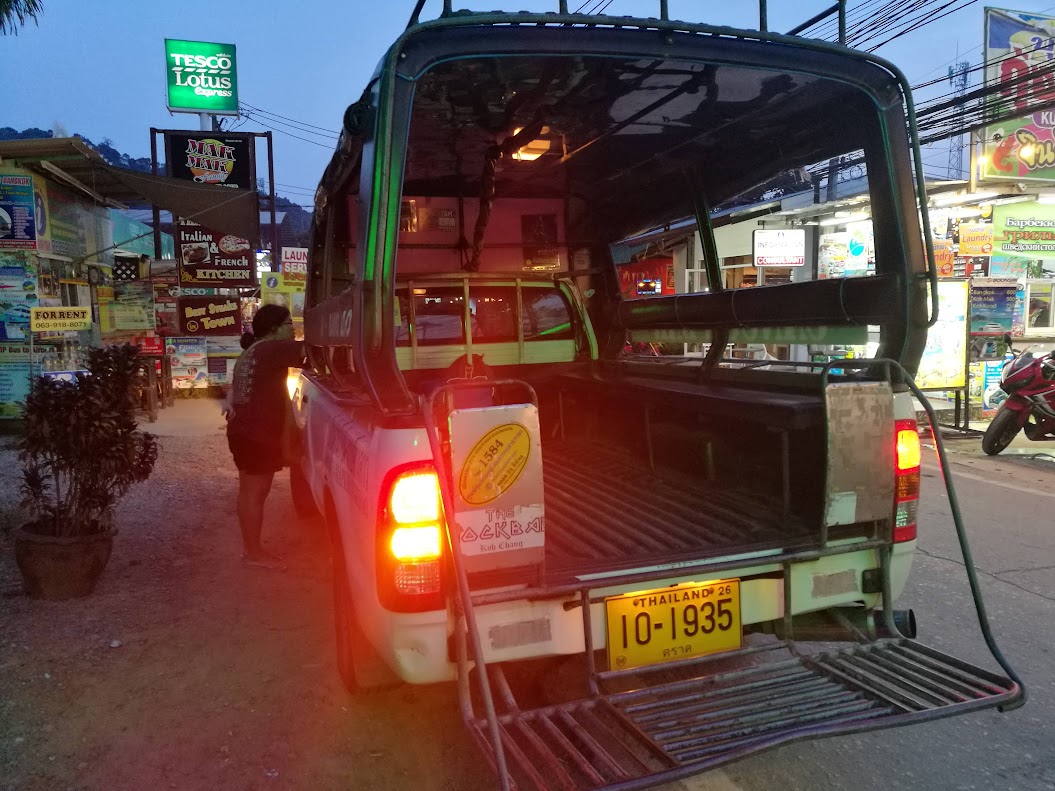 |
a songthaew, a truck converted into something like a small bus |
 |
the BTS runs one level above traffic (shown), and MRT / subway below it |
 |
I think of this as a jumbo, but of course there is probably a different Thai name |


